

Key Takeaways
- Japan's Companies Act provides an enforceable contractual framework that reduces commercial risk for foreign-owned entities operating under a Kabushiki Kaisha or Godo Kaisha structure.
- With 53+ bilateral tax treaties in force, registered entities in Japan can materially reduce withholding tax exposure on cross-border income flows.
- Incorporation through the Legal Affairs Bureau under the Ministry of Justice grants foreign businesses full ownership rights in most commercial sectors, without mandatory local shareholding requirements.
- Domestic registration generates measurable consumer trust advantages in sectors where vendor credibility directly influences purchasing decisions, a benefit that foreign branches or representative offices typically cannot replicate.
Forming a business in Japan, an independent sovereign nation in East Asia, is governed by the Legal Affairs Bureau under the Ministry of Justice, which oversees company registration and corporate filings nationwide. Foreign businesses most commonly establish a presence through a Kabushiki Kaisha. Japan operates a comprehensive territorial-leaning tax system with treaty obligations spanning over 70 bilateral agreements, shaping how foreign-sourced income is treated for registered entities.
Openness to foreign direct investment has increased steadily under successive policy frameworks, with the government actively removing restrictions across most sectors. Wholly foreign-owned entities are permitted in the majority of industries, and ownership structures do not require local shareholding in standard commercial activities.
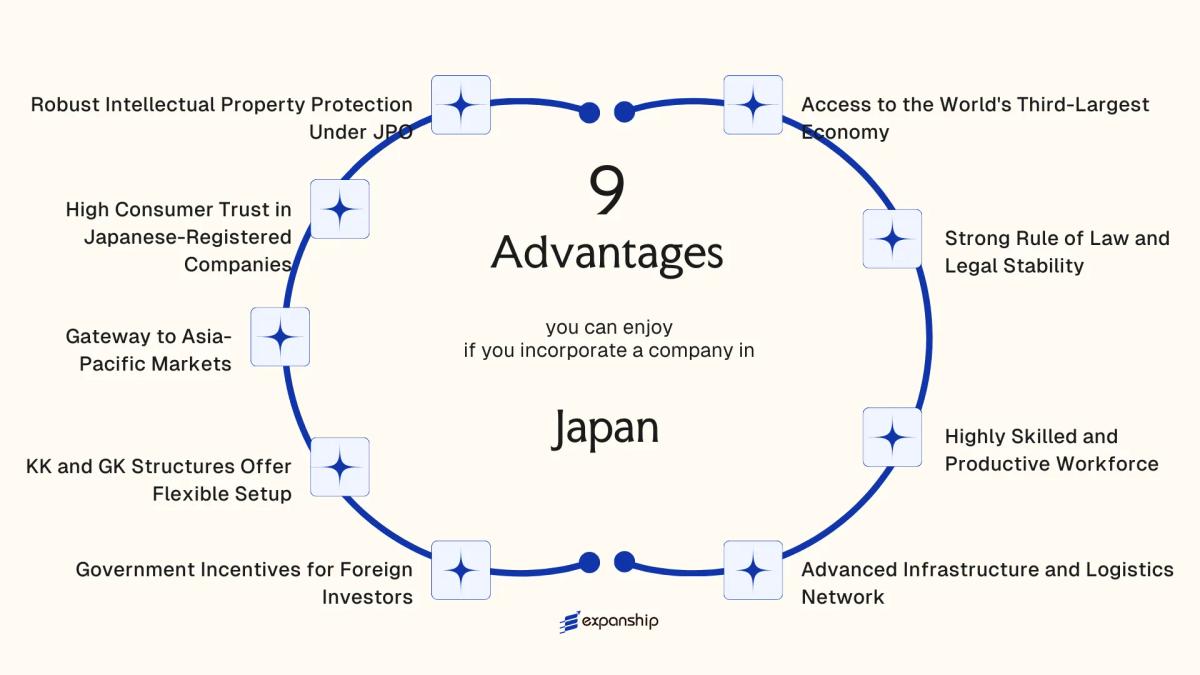
The benefits of incorporating in Japan extend across legal, operational, and market access dimensions. This article examines the primary advantages that make Japan company formation a considered choice for businesses seeking a structured, credible presence in one of Asia's most developed economies.
Access to the World's Third-Largest Economy
Japan's position as the world's third-largest economy by nominal GDP — exceeding $4 trillion USD — is not an abstract statistic. For a foreign business owner, it represents direct access to one of the most mature, high-spending consumer markets on the planet.
Scale That Translates to Commercial Opportunity
Japan's GDP business opportunity for foreign investors is grounded in domestic consumption patterns that differ from other large economies. Household spending accounts for a substantial share of GDP, and the country consistently ranks among the top destinations for foreign direct investment inflows under frameworks overseen by the Japan External Trade Organization (JETRO). Incorporating a local entity positions your firm to participate directly in procurement cycles, distribution networks, and B2B contracts that typically require a registered Japanese presence.
Market Access Through Formal Establishment
A registered company in Japan holds standing to enter supplier agreements, apply for government tenders, and open corporate banking relationships that are generally unavailable to foreign entities operating without local incorporation. Japan's third largest economy business advantages are most accessible to firms with a legal footprint inside the country. The Companies Act (Kaisha-hō) governs the formation of recognized business structures, which grants your entity the same foundational legal standing as a domestic firm.
A locally incorporated entity unlocks direct market participation that a foreign branch or representative office typically cannot access.
Strong Rule of Law and Legal Stability
Japan's legal system is grounded in codified civil law, drawing from the German legal tradition and adapted through decades of domestic legislative development. For foreign businesses, this means commercial disputes are resolved through predictable, well-established frameworks rather than discretionary judicial interpretation.
The Companies Act (Kaisha-hō, Act No. 86 of 2005) governs the formation, management, and dissolution of corporate entities, giving your business a clear statutory foundation from day one. Contractual obligations are consistently enforced through the court system, and contract law principles under the Civil Code (as revised in 2020) reflect modern commercial realities. Foreign firms are not subject to discriminatory legal treatment relative to domestic companies in most commercial contexts.
Arbitration is available under the Japan Commercial Arbitration Association (JCAA), providing an internationally recognised alternative to litigation for cross-border disputes.
The stability of Japan's regulatory environment translates into several concrete operational advantages:
- Licensing conditions and corporate compliance requirements change through formal legislative processes, not administrative discretion, giving your planning a durable legal basis
- Court judgments on commercial matters follow established precedent, reducing the outcome variance that complicates contract enforcement elsewhere
- Foreign judgments can be recognised under Article 118 of the Code of Civil Procedure if specific statutory conditions are met

Company Incorporation in Japan
Establish a legally compliant corporate entity in Japan with guidance on structure selection, registration, and post-incorporation requirements.
Highly Skilled and Productive Workforce
Japan skilled workforce benefits for foreign companies extend well beyond general technical competence. The country's labor market is shaped by a culture of precision and institutional accountability that directly affects output quality. Workforce participation in manufacturing, engineering, and technology sectors reflects decades of structured vocational training under frameworks supported by the Ministry of Health, Labour and Welfare (MHLW), which regulates labor standards and occupational skills certification nationwide.
| Indicator | Detail |
|---|---|
| Tertiary education attainment (25-64 age group) | Approximately 54% hold a university or college degree |
| R&D workforce | Among the highest researcher-to-population ratios in the OECD |
| Labor productivity sector strengths | Precision manufacturing, automotive, semiconductors, robotics |
| Skills certification body | Ministry of Health, Labour and Welfare (MHLW) |
For a foreign firm, this translates into reduced training overhead after hiring and a shorter ramp-up period before local staff operate at full capacity. Sectors such as automotive engineering, robotics, and pharmaceutical development draw heavily on a talent pool trained through both university programs and company-administered apprenticeship models.
The Act on Promotion of Women's Participation and Advancement in the Workplace (2015) has progressively expanded the available talent pool by increasing female workforce participation, which gives your entity access to a broader base of qualified candidates than was available a decade ago. Structured employment norms, including well-defined labor contracts governed by the Labour Contract Act, also give foreign businesses predictable employment relationships from the outset.
Advanced Infrastructure and Logistics Network
Japan's infrastructure advantages for businesses are grounded in one of the most developed transport and logistics systems among OECD member nations. The country operates five major international airports under the Ministry of Land, Infrastructure, Transport and Tourism (MLIT), including Narita and Haneda, both of which handle significant cargo volumes connecting your firm to North America, Europe, and Southeast Asia within hours.
Port infrastructure compounds this reach. The Port of Yokohama and Port of Kobe rank among the busiest container terminals in the Asia-Pacific region, giving registered companies direct access to transoceanic freight corridors without relying on third-country transshipment hubs.
Domestically, the Shinkansen rail network and an extensive expressway system reduce last-mile delivery times significantly. For firms operating across multiple Japanese prefectures, this means distribution costs remain predictable and transit times reliable.
Checklist for businesses using Japan's logistics network:
- Verify your entity is registered with the Legal Affairs Bureau before signing freight contracts
- Confirm whether your cargo qualifies under Japan Customs' AEO (Authorized Economic Operator) program for expedited clearance
- Review MLIT port usage regulations if your business involves import-heavy operations
- Special economic zones may offer preferential logistics terms; eligibility conditions apply
Japan's domestic parcel delivery (takuhaibin) network achieves next-day coverage across nearly all 47 prefectures, a density that most continental-scale economies cannot replicate.
Government Incentives for Foreign Investors
Japan government incentives for foreign investors operate through a coordinated framework involving national policy, preferential tax treatment, and direct institutional support. The structure is designed to reduce entry costs and lower the effective tax burden for qualifying foreign-owned entities.
JETRO and Direct Investment Support
The Japan External Trade Organization (JETRO) provides no-cost consulting, market-entry assistance, and temporary office space through its Invest Japan Business Support Centers. This reduces the upfront operational cost for a foreign firm establishing its first presence, particularly during the incorporation and licensing phases.
The national government also offers cash subsidies under the Foreign Direct Investment Attraction Subsidies program, which has targeted sectors including digital infrastructure, semiconductors, and green technology. Approved applicants have received grants covering a portion of capital expenditure, making asset-heavy investments materially more viable.
Tax Incentives and Special Economic Zones
Under the Act on Special Measures for Industrial Competitiveness, foreign-owned companies operating in designated National Strategic Special Zones may access reduced corporate tax rates and expedited regulatory procedures. These zones are geographically specific, and eligibility depends on the business category and the local zone authority's approval.
Accelerated depreciation on qualifying machinery and equipment is available under the Special Taxation Measures Law, allowing your business to recover capital costs faster than standard schedules permit. For R&D-intensive operations, a tax credit of up to 25% of qualifying research expenditure can apply against the firm's corporate tax liability.
Identify the Incentives Your Japan Entity Qualifies For
Expanship can assess which national subsidies, zone-based tax benefits, and JETRO programs apply to your business structure and sector.
KK and GK Structures Offer Flexible Setup
Two entity types available under the Companies Act (Kaisha-ho) account for the majority of foreign incorporations in Japan: the Kabushiki Kaisha (KK) and the Godo Kaisha (GK). Each carries distinct structural characteristics, and the choice between them produces real operational consequences for your business.
- A KK separates ownership from management by design. Shareholders hold equity while directors run operations, which allows foreign investors to bring in local management without surrendering ownership control. This structure also carries strong brand recognition among Japanese partners and institutions, which can affect how suppliers and clients engage with your firm.
- The GK operates under rules closer to a limited liability company. Members can manage the entity directly without appointing a separate board, reducing both administrative overhead and ongoing compliance costs. For a small foreign-owned operation or a holding entity, this translates to a materially lower annual maintenance burden.
- KK and GK structure advantages in Japan include the absence of a minimum capital requirement. Earlier legislation mandated JPY 10 million for a KK; the 2006 Companies Act removed this threshold entirely, allowing incorporation with as little as JPY 1.
- Neither structure requires a Japanese national among the directors or members, meaning a fully foreign-owned and foreign-directed entity is legally permissible from the outset.
Gateway to Asia-Pacific Markets
Japan's geographic position at the Pacific Rim places your business within close operational reach of China, South Korea, Southeast Asia, and Australia. For firms targeting multi-market APAC expansion, a Japan-registered entity provides a credible base that regional partners and regulators recognize.
Japan holds 21 Economic Partnership Agreements (EPAs), including the Comprehensive and Progressive Agreement for Trans-Pacific Partnership (CPTPP) and the Japan-EU EPA. A company incorporated here can access preferential tariff treatment across these agreements, reducing trade costs that a purely offshore structure would not qualify for.
The CPTPP alone covers 11 member economies representing roughly 13% of global GDP. Goods and services moving between your Japan entity and CPTPP partners benefit from staged tariff elimination schedules, giving you a structural cost advantage over competitors operating from non-member jurisdictions.
A business exporting manufactured components from Japan to Canada under CPTPP rules may face 0% tariff where the standard MFN rate previously applied at 6.5%, based on Schedule of Canada under Annex 2-D of the CPTPP text.
Regional headquarters functions, including procurement, distribution coordination, and treasury management, are legally operable through a Kabushiki Kaisha or Godo Kaisha without mandatory branch restrictions, making Japan incorporation advantages for Asia-Pacific expansion structurally accessible from the point of setup.
High Consumer Trust in Japanese-Registered Companies
Japan registered company consumer trust advantages are concrete and measurable. Japanese consumers consistently rank domestic registration as a marker of legitimacy, making local incorporation a practical prerequisite for market entry rather than an optional formality.
A company registered under the Companies Act (Kaisha-hō) and listed in the Commercial Register (Shōgyō Tōkibo) is publicly verifiable by any individual or business counterpart. This transparency is not incidental — Japanese B2B buyers and retail consumers routinely check registration status before committing to a commercial relationship, particularly with unfamiliar foreign-origin firms.
Registration also unlocks several trust signals that directly affect commercial outcomes:
- A local corporate address and registered entity name signal operational permanence.
- Compliance with the Financial Services Agency (FSA) or sector-specific regulators becomes demonstrable.
- Issuing domestic invoices under a local entity satisfies the requirements of Japan's Qualified Invoice System (Tekikaku Seikyūsho), which large retail and enterprise buyers require for consumption tax credit purposes.
Operating through a foreign entity without local incorporation often disqualifies your business from supplier lists maintained by major Japanese corporations.
Qualified Invoice System registration requires a separate application to the National Tax Agency (NTA) and is distinct from standard company incorporation.
Robust Intellectual Property Protection Under JPO
Japan intellectual property protection benefits are grounded in a well-developed legal framework that has been refined over more than a century. The Japan Patent Office (JPO) administers patents, trademarks, utility models, and industrial designs under a unified system, giving foreign businesses a single institutional point of contact for IP registration across multiple asset types.
Patent Protection With Broad Territorial Reach
Patent rights granted by the JPO cover the entire national territory and remain valid for 20 years from the filing date under the Patent Act (Act No. 121 of 1959). For a foreign firm developing proprietary technology, this means enforceable exclusivity in one of the world's largest consumer and industrial markets, backed by courts that consistently uphold registered rights.
Trademark Registration and Brand Security
JPO trademark registration advantages for businesses include a 10-year protection term, renewable indefinitely, which gives long-term brand security without re-examination. Japan is a member of the Madrid Protocol, so international registrations filed through WIPO can designate the country directly, reducing the administrative burden for firms already holding marks in other jurisdictions.
IP Enforcement Through the Court System
Intellectual property disputes in Japan are heard by the IP High Court, established in 2005 as a specialist appellate body. Decisions from this court are technically consistent and internationally recognized, which reduces litigation uncertainty for foreign rights holders compared to jurisdictions where IP cases are distributed across general courts without specialist oversight.
- Patents, utility models, trademarks, and designs are each registered under separate JPO procedures
- Japan Patent Office IP benefits for foreign companies include access to the Patent Prosecution Highway (PPH), which accelerates examination using prior approvals from partner offices
- Rights holders can seek injunctive relief and damages simultaneously under the Patent Act and Trademark Act
Why Japan Stands Out Among Global Business Destinations
Compliance Services for Companies in Japan
Stay aligned with Japanese regulatory requirements — from annual filings and tax obligations to statutory reporting under the Companies Act.
Foreign investors evaluating incorporation in the Asia-Pacific region typically weigh Japan against Singapore, Hong Kong, and South Korea. These are the jurisdictions that share a similar target investor profile — internationally oriented companies seeking a regulated, credible presence in a major economic zone. What the comparison reveals is that why Japan stands out as a business destination is less about a single headline advantage and more about the density of structural benefits that hold across multiple categories simultaneously.
Few jurisdictions combine a GDP of this scale with a domestic consumer market of 125 million people, a bilateral tax treaty network exceeding 80 agreements, and patent protections administered by a statutory body as established as the Japan Patent Office. Singapore offers lower corporate tax rates; Hong Kong maintains simpler filing requirements. Where this country holds a consistent position is in areas that matter most to firms building long-term commercial credibility: legal predictability under the Companies Act 2006 equivalent framework, depth of workforce skills, and the weight that a Japanese registration carries with both institutional and retail counterparties.
| Parameter | Japan | Singapore | Hong Kong | South Korea |
|---|---|---|---|---|
| Standard Corporate Tax Rate | 23.2% | 17% | 16.5% | 24% |
| Bilateral Tax Treaties | 80+ | 90+ | 50+ | 90+ |
| Domestic Market Size | ~125 million | ~6 million | ~7.5 million | ~52 million |
| Intellectual Property Framework | JPO — established 1885 | IPOS | HKIPD | KIPO |
| Foreign Director Permitted | Yes (GK structure) | Yes | Yes | Restricted |
| Legal System Stability | Civil law, high predictability | Common law, high predictability | Common law, some uncertainty post-2020 | Civil law, high predictability |
Conclusion
Japan's regulatory clarity, deep consumer markets, and treaty-backed intellectual property protections collectively form the core case for establishing a company there. The benefits of incorporating in Japan are most pronounced for businesses where market credibility and legal predictability directly affect commercial outcomes.
Among the strongest arguments examined in this blog: the enforceability of contracts under Japan's Companies Act provides a stable legal foundation that reduces commercial risk over time, and the country's 53+ bilateral tax treaties meaningfully lower withholding tax exposure for foreign investors operating across borders. Consumer trust in domestically registered entities also produces measurable commercial advantages, particularly in sectors where vendor credibility influences purchasing decisions.
Determining whether Japan company formation aligns with your objectives depends on your industry, the scale of your intended operations, and your cross-border structure. A firm targeting regional distribution across Asia-Pacific will find a different calculus than one focused solely on domestic sales or licensing arrangements. The advantages of registering a company in Japan carry different weight depending on those variables.
Structuring an entity correctly from the outset, whether as a Kabushiki Kaisha or Godo Kaisha, has long-term implications for governance, liability, and tax treatment. Getting that foundation right is the starting point for realising the full scope of what this jurisdiction offers.
Start Your Japan Company Formation With Expanship
Japan company formation with Expanship covers the full incorporation cycle for foreign investors establishing a Kabushiki Kaisha or Godo Kaisha. From preparing articles of incorporation to meeting the requirements set by the Legal Affairs Bureau under the Companies Act, Expanship manages the procedural and compliance obligations that foreign principals cannot easily handle remotely. Every service is tied to the specific entity structures and regulatory processes covered throughout this blog.
Expanship's scope for your Japan entity includes:
- Preparation and notarization of incorporation documents, including articles of incorporation for KK structures requiring notarial authentication
- Registered office and resident representative services to satisfy statutory address requirements
- Filing and liaison with the Legal Affairs Bureau for company registration
- Post-incorporation compliance management, including annual reporting and statutory maintenance
- Banking introduction assistance to support corporate account opening with local financial institutions
- Document legalization and apostille coordination for foreign-sourced materials
Each service corresponds to a concrete obligation under Japanese corporate law, not a generic package applied uniformly across jurisdictions.
Reach out to Expanship Japan to discuss your incorporation requirements.
Frequently Asked Questions (FAQ)
Registration with the Legal Affairs Bureau generally takes between one and three weeks from the date of notarized article submission, assuming all documents are in order. A KK requires prior notarization of its articles of incorporation by a Japanese notary, which adds several days to the timeline. A GK skips this notarization step, making it marginally faster to register.
The effective corporate tax rate for companies in Japan, combining national and local taxes, typically falls between 23% and 34%, depending on company size and prefecture. Smaller entities with paid-in capital under JPY 100 million qualify for a reduced national corporate tax rate on income up to JPY 8 million. The National Tax Agency administers these rates, and applicable surtaxes vary by municipality.
The Invest Japan initiative, administered through JETRO, targets foreign direct investment broadly but prioritizes sectors including advanced manufacturing, healthcare, and digital technology. Not all businesses qualify for direct grants; eligibility depends on investment size, job creation projections, and sector classification. Regional incentives through local prefectural governments operate separately and may have distinct qualifying criteria.
The Japan Patent Office (JPO) is among the higher-volume patent offices globally and has reduced examination backlogs through accelerated examination programs available to qualifying applicants. Patents granted by the JPO are enforceable through the Japanese court system, which has established IP High Court procedures specifically for patent disputes. Cross-border enforcement, however, depends on treaty arrangements and does not automatically extend JPO protections outside Japan.
Under the Companies Act (Kaisha-ho), a KK that fails to file required financial statements or hold annual general meetings risks penalties and, in cases of prolonged non-compliance, potential dissolution proceedings initiated by the Legal Affairs Bureau. Directors can face personal liability for compliance failures, particularly where creditors are affected. The company's registered status may also be flagged, which can impair banking relationships and contract enforceability.
Foreign-invested companies can enforce contracts and pursue disputes through Japan's civil court system, which operates under the Civil Code and Civil Procedure Code with no structural bias against foreign parties. Japan is also a signatory to the New York Convention on the Recognition and Enforcement of Foreign Arbitral Awards, meaning arbitral awards obtained abroad are generally enforceable domestically. This makes contractual dispute resolution predictable for businesses operating across multiple jurisdictions.
Legal Disclaimer
The information provided in this article is for general informational purposes only and does not constitute legal, tax, or professional advice. While we strive to ensure the accuracy and timeliness of the content, laws and regulations are subject to change, and the application of laws can vary widely based on specific facts and circumstances.
Readers should not act upon this information without seeking professional counsel tailored to their individual situation. Expanship and its authors disclaim any liability for actions taken or not taken based on the content of this article.
For specific advice regarding your business setup, compliance requirements, or any legal matters, please consult with qualified legal and tax professionals in the relevant jurisdiction.