

Key Takeaways
- All S.r.l. and S.p.A. formations in Italy must be executed via a notarial deed before a public notary and registered with the Registro delle Imprese, administered by the competent Camera di Commercio, before the entity acquires legal status.
- Under the Codice Civile, the chosen legal form determines the applicable minimum share capital threshold, making the selection of entity type a capital-planning decision as well as a structural one.
- Beneficial ownership disclosure is a continuing compliance obligation in Italy, requiring UBO information to be filed and maintained with the Registro delle Imprese beyond the initial incorporation date.
- Foreign founders and non-resident directors must account for residency considerations and Italian tax identification requirements when preparing documentation for the registration process.
Incorporating a business in Italy is governed primarily by the Codice Civile (Civil Code) and supervised through the Registro delle Imprese, the national commercial register administered by the local Chambers of Commerce (Camere di Commercio). Foreign investors and domestic founders alike must satisfy a defined set of formation requirements before an entity can be registered and legally operational.
This article addresses the structural, documentary, and compliance requirements that apply across the incorporation process, as regulated under Italian law.
Failure to meet these requirements results in rejection of the registration application by the competent Chamber of Commerce, preventing the entity from acquiring legal status or conducting business. Specific requirements vary depending on the legal form chosen, the sector in which the business will operate, and the nationality or residency status of the founders.
The requirements outlined here are most relevant to non-resident entrepreneurs, foreign companies establishing a subsidiary, and investors unfamiliar with Italian company law who are preparing to enter the registration process for the first time.
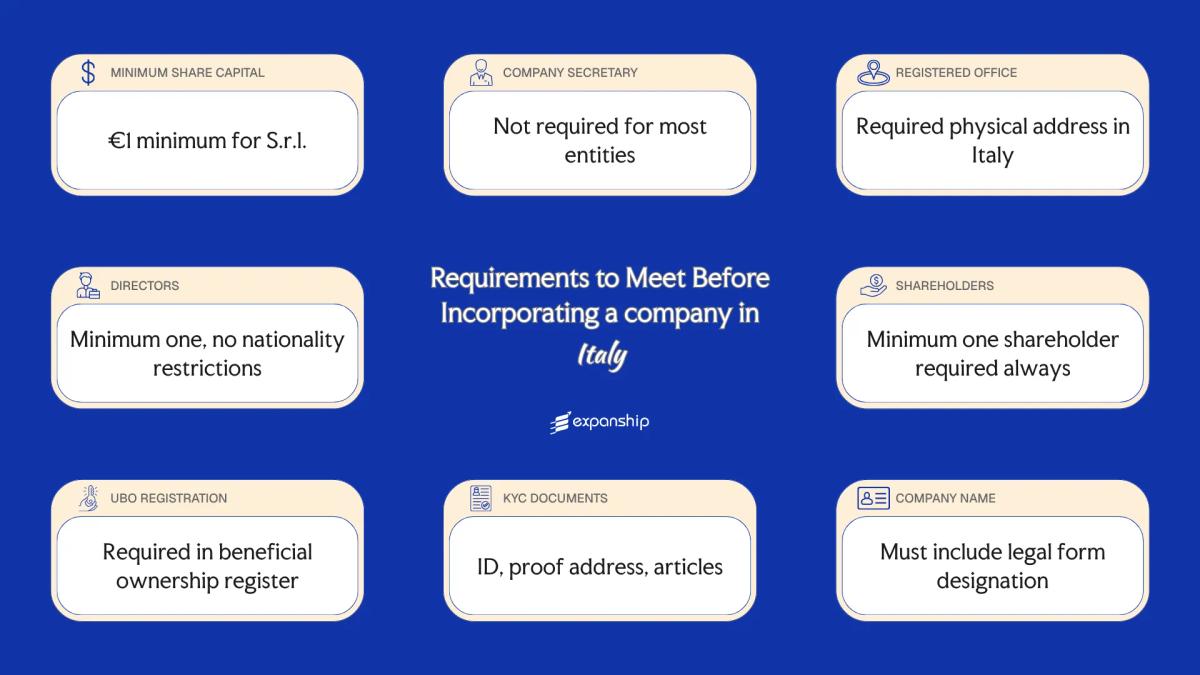
Minimum Share Capital Requirements in Italy

Italy minimum share capital requirements differ significantly depending on the legal form chosen at incorporation. Both the Società a Responsabilità Limitata (SRL) and the Società per Azioni (SpA) operate under a par value share system, with capital thresholds and deposit obligations governed by the Codice Civile.
Capital must be deposited into a dedicated bank account before the notarial deed of incorporation is executed, and the Registro delle Imprese verifies compliance at the point of registration. Share capital is a statutory obligation that persists beyond incorporation; the entity must maintain the minimum threshold throughout its operational life.
| Parameter | Detail |
|---|---|
| Minimum Authorized Share Capital | EUR 1 for SRL Semplificata; EUR 10,000 for standard SRL; EUR 50,000 for SpA |
| Maximum Authorized Share Capital | No statutory requirement |
| Minimum Paid-Up Capital | 25% of subscribed capital at incorporation for SRL; 25% for SpA |
| Paid-Up Requirement at Incorporation | Full payment required for SRL Semplificata; 25% deposit required for standard SRL and SpA |
| Accepted Currency | Euro (EUR) |
| Accepted Forms of Contribution | Cash; in-kind contributions subject to independent expert valuation under Article 2343 of the Codice Civile |
| Timeframe to Deposit Capital | Prior to execution of the notarial deed of incorporation |
The bank deposit confirming paid-up capital must exist before the notary executes the deed. Funds cannot be deposited after signing and applied retroactively.
Company Secretary Requirements in Italy
Under Italian corporate law, there is no mandatory requirement for a company secretary in the traditional sense. The Società a Responsabilità Limitata (S.r.l.) and Società per Azioni (S.p.A.) structures do not impose a statutory obligation to appoint a dedicated corporate secretary as a distinct officer role.
Certain administrative functions associated with company secretary obligations Italy firms must address are typically handled by the board of directors or a designated notary. For an S.p.A., the board meeting minutes must be recorded and certified, a duty often assigned to an appointed secretary of the board rather than a formally titled corporate officer.
Where a board secretary is appointed, general eligibility criteria apply:
- No statutory residency requirement exists for a board secretary under the Codice Civile.
- The role may be filled by an individual or, in practice, a professional such as a commercial lawyer or accountant.
- No formal licensing or professional qualification is mandated by law for this position.
- The appointed person must have legal capacity under Italian civil law.

Incorporate a Company in Italy
Set up your Italian legal entity with guidance on structure selection, notarial requirements, and Commercial Register registration.
Registered Office Requirements in Italy
Registered office requirements Italy mandate that every company maintain a sede legale, a registered legal address situated within Italian territory where official correspondence, legal notices, and regulatory communications are directed. Failure to maintain a compliant address can result in the Agenzia delle Entrate or the Registro delle Imprese issuing administrative sanctions, and courts may declare corporate acts invalid if official notifications cannot be served.
- A physical address is required; a P.O. box alone does not satisfy the sede legale obligation.
- Virtual office addresses are generally accepted provided the location is a real, identifiable premises where the company can receive official correspondence.
- The address must be located within Italy; foreign addresses do not qualify.
- Proof of entitlement to use the address, such as a lease agreement or property ownership document, is required at incorporation.
- The registered address is publicly listed in the Registro delle Imprese and is accessible to third parties.
- Any change of registered address must be formally notified to the competent Camera di Commercio and registered in the Registro delle Imprese to take legal effect.
Director Requirements in Italy

Meeting the director requirements in Italy means assuming statutory duties under the Codice Civile, including the obligation to act in the corporate interest, maintain accurate accounting records, and file required disclosures with the Camera di Commercio. Directors of an S.r.l. or S.p.A. face personal liability for acts carried out in breach of their fiduciary duties or in violation of the articles of association.
| Parameter | Detail |
|---|---|
| Minimum Number of Directors | One director is required for both S.r.l. and S.p.A. structures. |
| Maximum Number of Directors | No statutory maximum; the number is determined by the articles of association. |
| Local/Resident Director Required | No statutory requirement for a resident or locally domiciled director. |
| Nationality Restrictions | No nationality restrictions apply under Italian corporate law. |
| Minimum Age Requirement | Directors must have reached the age of majority, which is 18 years. |
| Corporate Directors Permitted | Corporate directors are not permitted; only natural persons may serve as directors. |
| Director Must Be a Shareholder | No requirement for a director to hold shares in the company. |
| Publicly Listed on Registry | Directors are registered in the Registro delle Imprese, which is publicly accessible. |
| Disqualification Conditions | Persons subject to bankruptcy restrictions, criminal convictions involving economic offences, or disqualification orders under Italian law are ineligible. |
Unlike many EU jurisdictions, Italy does not require at least one director to be resident within the country or even within the European Union, meaning a company can be validly governed entirely by non-resident foreign nationals.
Shareholder Requirements in Italy

A Società a Responsabilità Limitata (SRL) can be formed with a single shareholder, making a sole-member structure fully permissible under Italian law. No statutory maximum applies to the number of shareholders an SRL may have.
Nationality and Residency Restrictions
Shareholder requirements in Italy impose no nationality or residency conditions on individuals or entities holding shares in an SRL. Foreign ownership of up to 100% is permitted, subject to standard anti-money laundering checks under Legislative Decree 231/2007.
Corporate Shareholders
Legal entities may hold shares in an SRL without restriction. No conditions on the jurisdiction of incorporation of the corporate shareholder are imposed at the company level, though UBO disclosure obligations still apply.
Shareholder Liability
Liability is limited to each socio's subscribed capital contribution. Personal assets remain protected except where a court pierces the corporate veil due to fraud or abuse of the legal form.
Register of Shareholders
SRL companies are not required to maintain a traditional libro soci following the 2009 reform; shareholder data is instead recorded through notarised deed filings with the Registro delle Imprese, which is publicly accessible.
Shareholder Structure Guidance for Your Italian Entity
Get tailored advice on structuring shareholding arrangements that meet Italian incorporation requirements under the Registro delle Imprese framework.
UBO / Beneficial Ownership Registration Requirements in Italy
Under Italy's beneficial ownership registration requirements, a beneficial owner (titolare effettivo) is defined as any natural person who ultimately owns or controls more than 25% of a company's shares or voting rights, as established under Legislative Decree No. 231/2007, implementing the EU's Fourth and Fifth Anti-Money Laundering Directives.
- Identify all natural persons holding, directly or indirectly, more than 25% ownership or control of the entity.
- Compile the required personal data for each UBO, including full name, date of birth, nationality, and nature of the ownership or control exercised.
- Submit the beneficial ownership declaration to the Italian Business Register (Registro delle Imprese) through the local Chamber of Commerce (Camera di Commercio).
- File within 30 days of incorporation or within 30 days of any subsequent change to the ownership structure.
| Parameter | Detail |
|---|---|
| Ownership Threshold for UBO Status | More than 25% of shares or voting rights |
| Filing Authority | Registro delle Imprese, via the local Camera di Commercio |
| Disclosure Deadline at Incorporation | Within 30 days of incorporation |
| Publicly Accessible Register | Yes, accessible to competent authorities and obliged entities; general public access is subject to conditions under national implementing rules |
| Penalties for Non-Disclosure | Administrative sanctions apply under Legislative Decree No. 231/2007; fines vary based on the severity and duration of the breach |
| Ongoing Update Obligation | Yes, updates required within 30 days of any change |
KYC / Document Requirements in Italy

KYC document requirements Italy incorporation are governed by Legislative Decree No. 231/2007, the primary anti-money laundering instrument transposing EU AML directives into national law and administered by the Unità di Informazione Finanziaria (UIF). Notaries and intermediaries conducting incorporation procedures are obligated to perform customer due diligence before the deed of incorporation is executed.
Individual / Personal Documents
- Valid government-issued photo ID (passport or national identity card) for each director, shareholder, and UBO
- Proof of residential address dated within three months, such as a utility bill or bank statement
- Tax identification number (codice fiscale) for each individual involved
- Completed self-declaration form confirming beneficial ownership status where applicable
Corporate Documents
- Certificate of incorporation or equivalent constitutional document for the corporate shareholder or director
- Articles of association or statutes of the corporate entity
- Register of directors and, where available, register of shareholders
- Proof of registered address of the corporate entity
Source of Funds Documentation
- Recent bank statements covering a minimum of three months demonstrating available capital
- Audited financial accounts where the shareholder is a corporate entity
- Written declaration of the origin of funds if capital is sourced from a private individual
Notarisation and Apostille Requirements
- Foreign public documents must carry an apostille under the 1961 Hague Convention
- All non-Italian documents must be accompanied by a certified Italian translation
- Notarisation by a local notary (notaio) is required for the deed of incorporation itself
The most common cause of incorporation delay is the submission of foreign identity documents without a certified Italian translation or the required apostille.
Company Name Requirements in Italy
Italy company name requirements are assessed at the point of incorporation through the Chamber of Commerce (Camera di Commercio), which maintains the Business Register (Registro delle Imprese). Proposed names are checked for availability and distinctiveness against existing registrations.
Your chosen denominazione sociale must be in Italian or use Latin characters, and it must include the legal form suffix — for example, "S.r.l." for a limited liability company or "S.p.A." for a joint-stock company. No statutory minimum or maximum character length applies, but the name must be sufficiently distinct from existing entries.
Certain words are prohibited or require prior authorisation. Terms referencing government bodies, financial institutions, or regulated professions fall into this category, as do words that could mislead the public about the firm's activities or legal status.
Name reservation is available through the Registro delle Imprese before formal incorporation. The reservation period is limited, and the application is submitted to the relevant provincial Chamber of Commerce office.
Compliance Services for Companies in Italy
Expanship assists Italian-registered entities with ongoing compliance obligations, including Business Register filings, statutory reporting, and regulatory updates.
Conclusion
Italy company incorporation requirements span several regulatory dimensions, from minimum capital thresholds under the Codice Civile to UBO registration with the Registro delle Imprese. Among the more structurally significant obligations is the notarial deed requirement for S.r.l. and S.p.A. formation, along with director residency considerations that affect operational setup. Beneficial ownership disclosure adds a further compliance layer that persists well beyond the initial registration. Once these obligations are understood, the practical focus shifts to assembling the correct documentation, engaging qualified local professionals, and establishing a timeline aligned with Camera di Commercio processing schedules.
Expanship's Corporate Services for Italy Expansion
Incorporating in Italy involves specific obligations across share capital thresholds, UBO registration with the Camera di Commercio, and ongoing compliance filings that vary by entity type. Expanship's Italy company formation services are structured around these local requirements, reducing the administrative load that comes with managing filings across the Registro delle Imprese, the Agenzia delle Entrate, and notarial processes.
Beyond initial registration, your business will need continued support across several operational areas. Expanship's service scope for Italy covers:
- Preparing and filing all company registration documents, including notarial deed coordination
- Providing a registered office address and acting as your local registered agent
- Liaising directly with Italian regulatory bodies and handling government submissions on your behalf
- Managing post-incorporation obligations to keep your entity in good standing
- Facilitating introductions to Italian banking institutions
- Handling tax registration with the Agenzia delle Entrate and coordinating with local authorities
To discuss your Italy expansion, contact Expanship Italy.
Frequently Asked Questions (FAQ)
A foreign national can serve as sole director of an Italian company, but they must hold a valid Italian tax identification code (codice fiscale) and, if residing outside the EU, a valid visa or permit that allows them to conduct business activities in Italy. There is no statutory requirement under the Civil Code for directors to be Italian residents, but the absence of a codice fiscale will block registration with the Registro delle Imprese.
Failure to register or update beneficial ownership information in the Registro dei Titolari Effettivi, established under Italian Legislative Decree 231/2007 as amended, can result in administrative fines imposed on the company and its directors. The obligation applies regardless of company size, and the information must be kept current whenever ownership or control structures change. Deliberate non-disclosure can also trigger scrutiny from the Unità di Informazione Finanziaria (UIF), Italy's financial intelligence unit.
A notary (notaio) is required for the incorporation of both an SRL and an SPA, as the deed of incorporation must take the form of a public deed (atto pubblico) under Article 2463 of the Italian Civil Code. The notary authenticates the articles of association, verifies the identity of the founding shareholders, and submits the registration application to the Registro delle Imprese. Simplified SRLs (SRL semplificata) established by individuals under 35 years of age follow a standard notarial deed but benefit from reduced notarial fees.
A virtual office address is legally permissible as the registered office (sede legale) of an Italian company, provided it is a fixed, identifiable address within Italian territory at which official correspondence and legal notices can be received. The address is publicly recorded in the Registro delle Imprese and must remain current at all times. Using a registered address service does not fulfil obligations around actual business presence for VAT purposes, which is governed separately under Italian VAT law and EU Directive 2006/112/EC.
Yes. A single-member SRL (SRL unipersonale) must have its entire share capital fully paid up at the time of incorporation, rather than the partial payment permitted for multi-shareholder entities. This requirement is set out under Article 2464 of the Italian Civil Code and is designed to protect creditors in the absence of joint liability. The sole shareholder's identity must also be published in the Registro delle Imprese.
Foreign corporate shareholders are generally required to provide certified copies of their constitutional documents, a certificate of good standing or equivalent from their home jurisdiction, and proof of the identity of the natural persons authorised to act on their behalf. Italian notaries and the Registro delle Imprese apply due diligence requirements derived from Legislative Decree 231/2007, meaning that complex ownership chains may require additional documentation tracing back to the ultimate beneficial owner. Documents issued in a foreign language must be accompanied by a certified Italian translation.
Legal Disclaimer
The information provided in this article is for general informational purposes only and does not constitute legal, tax, or professional advice. While we strive to ensure the accuracy and timeliness of the content, laws and regulations are subject to change, and the application of laws can vary widely based on specific facts and circumstances.
Readers should not act upon this information without seeking professional counsel tailored to their individual situation. Expanship and its authors disclaim any liability for actions taken or not taken based on the content of this article.
For specific advice regarding your business setup, compliance requirements, or any legal matters, please consult with qualified legal and tax professionals in the relevant jurisdiction.