

Key Takeaways
- Italy's corporate tax framework imposes a dual burden on businesses, combining the standard IRES corporate income tax with the regional IRAP levy, which applies even when a company reports no net profit.
- Under the Codice Civile, forming a Società per Azioni requires a minimum share capital of €50,000, creating a meaningful upfront capital commitment that many early-stage or foreign entrant businesses must absorb before generating revenue.
- Mandatory notarial involvement in company formation adds procedural cost and delay that is structurally embedded in Italian law rather than discretionary, meaning it cannot be bypassed even for straightforward incorporations.
- Italy's civil court system processes commercial disputes on timelines that materially exceed EU averages, exposing businesses to prolonged uncertainty when contractual or shareholder conflicts require judicial resolution.
Italy operates under a heavily regulated corporate framework, shaped by the Codice Civile and supplemented by extensive secondary legislation governing business formation, taxation, and ongoing compliance. Understanding the disadvantages of incorporating in Italy requires examining several distinct categories — spanning registration processes, tax obligations, labor requirements, and judicial efficiency. These disadvantages do not apply uniformly; a sole-activity SRL will face a materially different compliance burden than a publicly structured S.p.A. or a foreign-owned branch entity.
The primary Italian Civil Code provisions governing company formation and operation underpin most of the structural constraints discussed in this article. Foreign investors entering through equity participation, joint ventures, or wholly owned subsidiaries are most likely to encounter these constraints directly. The cons of forming a company in Italy become particularly pronounced for businesses unaccustomed to civil law systems or notarial-dependent incorporation procedures.
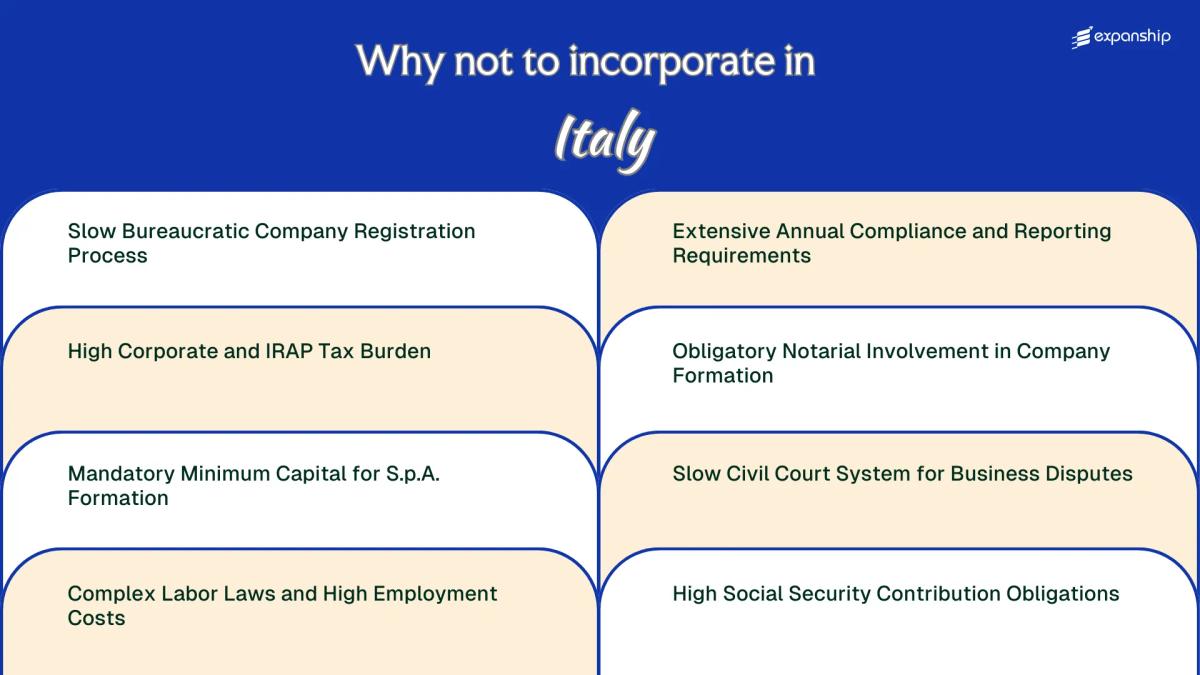
Slow Bureaucratic Company Registration Process
Italy company registration bureaucracy problems affect foreign businesses from the first day of setup. Registration timelines that run weeks longer than other EU member states translate directly into delayed market entry and increased pre-revenue costs.
Registration Through the Registro delle Imprese
New companies must register through the Registro delle Imprese, the official business registry administered by the local Chambers of Commerce (Camere di Commercio). Processing times vary significantly by province, and in major commercial centers like Milan or Rome, backlogs routinely extend the process beyond what official timelines suggest, leaving your entity unable to operate legally or open a business bank account until registration is complete.
Coordination Across Multiple Bodies
Beyond the registry itself, the slow business registration process in Italy requires parallel filings with the Agenzia delle Entrate for a tax identification number and VAT registration. Each body operates independently with no unified submission system, so a delay in one filing cascades across the entire setup sequence, stalling your ability to invoice clients or hire staff.
Until full registration with both the Registro delle Imprese and the Agenzia delle Entrate is confirmed, your entity has no legal standing to conduct commercial activity, sign enforceable contracts, or access the Italian banking system.
High Corporate and IRAP Tax Burden
Italy's corporate tax burden drawbacks are most visible when you stack the two primary business taxes side by side. Resident companies pay IRES (Imposta sul Reddito delle Società) at a flat 24% on net profits, which already exceeds the EU average of roughly 21%.
What compounds the problem is IRAP, the Regional Tax on Productive Activities. IRAP tax disadvantages in Italy stem from its structural design: it applies to a company's net production value, not its profit, meaning you pay even in a loss-making year.
The standard IRAP rate sits at 3.9%, though regional authorities can adjust it upward. This regional variability creates unpredictable tax exposure that is difficult to model accurately during pre-incorporation planning.
Combined, these obligations produce an effective tax cost that foreign-owned firms find disproportionately heavy. The practical burden this creates includes:
- IRAP is calculated before deducting most labor costs, so headcount growth directly increases your regional tax base
- A foreign parent company receiving dividends from an Italian subsidiary may face withholding tax on distributions, reducing repatriated profit
- The dual-filing requirement for both IRES and IRAP means separate declarations, increasing your accountancy and compliance costs annually
Certain entities, including some partnerships and sole traders, fall outside the IRAP regime entirely, but most corporate structures used by foreign investors do not qualify for that exclusion.

Company Incorporation in Italy
Set up your Italian company with accurate tax planning built into the structure from day one.
Mandatory Minimum Capital for S.p.A. Formation
Italy S.p.A. minimum capital requirements set the threshold at €50,000 for forming a Società per Azioni, which must be fully subscribed at incorporation. At least 25% of cash contributions must be deposited with a bank or covered by a surety bond before the notarial deed is executed.
| Requirement | Threshold / Condition | Practical Burden |
|---|---|---|
| Minimum share capital | €50,000 fully subscribed | Blocks entry for undercapitalized foreign firms |
| Cash deposit at formation | 25% of cash contributions | Immediate liquidity tied up before operations begin |
| Surety bond alternative | Must cover unpaid portion | Additional cost if cash is unavailable upfront |
| Bearer share prohibition | Not permitted under current law | Limits certain ownership structuring options |
For foreign investors accustomed to jurisdictions where formation capital is nominal or absent, locking up €50,000 before the business generates any revenue represents a real cash flow constraint. The requirement exists under the Italian Civil Code's provisions governing S.p.A. entities, and there is no phased payment option for the subscribed minimum.
The S.r.l. structure reduces this threshold significantly, but that entity carries its own governance restrictions that may not suit firms requiring a publicly tradeable share structure or institutional investment compatibility. The capital obligation is a structural barrier, not a procedural one, meaning it cannot be resolved through preparation alone.
Complex Labor Laws and High Employment Costs
Italy labor law challenges for businesses stem largely from a legal framework built to protect employees, not to ease employer obligations. Dismissing a permanent employee is rarely straightforward, and the procedural and financial exposure involved can be significant for a foreign-owned entity.
The Statuto dei Lavoratori (Law 300/1970) governs the relationship between employers and workers, restricting dismissal grounds and establishing mandatory reinstatement rights in firms with more than 15 employees. For any foreign business scaling past that threshold, the exposure to unfair dismissal claims grows considerably.
Termination costs compound the hiring risk. Severance pay under the Trattamento di Fine Rapporto (TFR) accrues annually at roughly 6.91% of gross salary and must be paid upon termination regardless of the reason for separation.
Collective bargaining agreements (CCNLs) are sector-specific and legally binding. Your firm must apply the correct CCNL for each employee category, which directly dictates minimum pay scales, working hours, and leave entitlements.
- TFR severance accrual is mandatory for all employees from the first day of employment
- CCNLs impose sector-specific minimum wages that override any lower contractual terms
- Probationary periods are capped under most CCNLs, limiting early-stage flexibility
- Firms with more than 15 employees face stricter dismissal justification requirements under Law 300/1970
- Unjustified dismissal can result in reinstatement orders or substantial indemnity awards
Even if your company has no Italian employees yet, signing certain commercial contracts can trigger employer-equivalent obligations under Italian labor law in specific agency and contracting structures.
Extensive Annual Compliance and Reporting Requirements
Italy annual compliance requirements drawbacks extend well beyond filing paperwork. The obligations imposed on resident companies create recurring administrative costs that foreign business owners frequently underestimate before entry.
The Scope of Mandatory Reporting Obligations
Società a responsabilità limitata (S.r.l.) and S.p.A. entities must file annual financial statements with the Registro delle Imprese, submit periodic VAT declarations to the Agenzia delle Entrate, and maintain statutory books that satisfy the Codice Civile. Each obligation runs on its own calendar, meaning your company faces multiple independent deadlines throughout the year rather than a single consolidated filing cycle. This fragmentation alone drives up the cost of local accountants and tax advisors, whose continuous involvement is effectively non-negotiable.
Practical Burden on Foreign-Owned Entities
Italy's corporate reporting framework requires certified financial statements prepared under Italian GAAP (OIC standards) or IFRS, depending on entity size, which means a foreign parent cannot simply repurpose home-country accounts. Errors or late submissions carry administrative penalties enforced by the Agenzia delle Entrate and can trigger audit exposure, adding financial risk on top of the baseline compliance cost. Smaller foreign-owned firms gain no meaningful reduction in this burden; simplified accounting thresholds exist but do not eliminate the core filing requirements.
Support for Managing Compliance Obligations in Italy
Get guidance on annual reporting requirements, filing deadlines, and regulatory obligations for your Italian entity.
Obligatory Notarial Involvement in Company Formation
Forming a company in Italy carries an obligatory notarial involvement that represents a direct financial and logistical burden — the Italy notary requirement in company formation applies to both S.r.l. and S.p.A. structures, requiring a licensed notaio to authenticate the atto costitutivo and statuto before registration with the Registro delle Imprese. This adds a mandatory professional fee layer that most EU jurisdictions do not impose for equivalent entity types.
- Notarial fees for drafting and authenticating the mandatory constitutional deed are set according to tariff schedules and can run from several hundred to several thousand euros depending on share capital and complexity, increasing your setup cost before the business generates any revenue.
- The notaio must be physically present or formally engaged within Italy, which means foreign founders cannot complete this step remotely without appointing a local representative through a notarized power of attorney.
- Any subsequent amendment to the articles of association — including changes to share capital or corporate purpose — requires a further notarial act, generating recurring costs throughout the company's lifecycle.
Slow Civil Court System for Business Disputes
Italy civil court system business risks are a concrete operational concern for any foreign entity operating there. Proceedings before the Tribunale delle Imprese, the specialized commercial court section established under Legislative Decree No. 168/2003, routinely extend for several years before reaching a final judgment.
Backlogs within the civil judiciary mean that contract disputes, shareholder conflicts, and debt recovery actions can remain unresolved far longer than in most comparable EU economies. Your business capital may remain effectively frozen during that period, with no practical recourse to accelerate proceedings.
Italy consistently ranks among the slowest EU jurisdictions for resolving commercial disputes. According to the European Commission's EU Justice Scoreboard, Italian civil courts require among the longest timeframes in the bloc to dispose of first-instance commercial cases.
This delay compounds enforcement risk: even a favorable ruling may arrive too late to prevent financial damage. Arbitration clauses offer a partial alternative, but they require advance contractual agreement and are not universally applicable.
Hypothetical scenario: A foreign-owned S.r.l. files a €180,000 contract dispute before the Tribunale delle Imprese in Milan. If the first-instance judgment takes three to four years, the firm must carry that receivable as an unrecovered asset on its balance sheet throughout, absorbing both liquidity constraints and auditor scrutiny.
High Social Security Contribution Obligations
Italy social security contribution drawbacks are among the most financially consequential factors for any foreign business hiring local staff. Employer contributions to INPS (Istituto Nazionale della Previdenza Sociale) typically range from 28% to 32% of an employee's gross salary, depending on the sector and contract type.
These rates sit well above the EU average employer contribution rate, which generally falls between 20% and 24%. For a foreign firm scaling a local team, this gap translates directly into a payroll cost structure that can undermine otherwise viable hiring plans.
The burden does not rest solely on contributions to INPS. Employers are also required to fund TFR (Trattamento di Fine Rapporto), a mandatory severance accrual calculated at approximately 6.91% of annual gross salary, effectively adding another layer to total employment cost.
Self-employed workers and freelancers engaged through certain contract structures may also trigger contribution obligations, meaning the high payroll costs in Italy are not automatically avoided by using non-employee arrangements.
For companies in specific sectors such as construction or agriculture, contribution rates can exceed standard thresholds, making the actual employer burden sector-dependent rather than uniform.
Any foreign business employing staff in Italy, including through secondment arrangements, is subject to INPS contribution obligations from the first day of employment, with no minimum headcount threshold that exempts small or newly established entities.
Navigating These Disadvantages Successfully
Overcoming Italy incorporation disadvantages requires structural preparation rather than reactive problem-solving. Matching the right entity type to your operational needs, engaging a notaio early, and building compliance calendars around statutory deadlines are all decisions that shape outcomes from the outset.
- Select an S.r.l. over an S.p.A. where capital flexibility matters, avoiding the €50,000 minimum share capital threshold that applies to the latter.
- Register with the Registro delle Imprese through the Agenzia delle Entere to obtain your tax identification and VAT number before commencing operations.
- Budget for IRAP alongside IRES from the outset, since the regional production tax applies independently of profit and cannot be offset the same way.
- Structure employment contracts under the applicable CCNL (national collective labour agreement) for your sector to ensure statutory compliance from the first hire.
- Appoint a statutory auditor (sindaco) proactively if your firm is likely to meet the thresholds that make the Collegio Sindacale mandatory.
- Establish a litigation reserve and consider arbitration clauses in commercial contracts, given the extended timelines of Italian civil court proceedings.
These steps address the most structurally significant friction points, but they operate within a regulatory framework that the Ministero delle Imprese continues to update. Compliance obligations in Italy remain active and periodic, not one-time tasks resolved at incorporation.
Italy's Overall Business Potential
Despite the Italy business environment challenges and potential drawbacks outlined across this blog, the country remains a credible destination for foreign incorporation. Access to the EU single market, a significant consumer base of roughly 60 million people, and established industrial clusters in sectors like manufacturing, fashion, and agri-food give the jurisdiction real structural weight.
| Pros | Cons |
|---|---|
| Full access to the EU single market and free movement of goods and capital | IRAP is levied on a tax base that does not account for operating losses, creating a burden independent of profitability |
| Italy's GDP ranks among the largest in the eurozone, offering a substantial domestic market | Civil court proceedings can extend for years, making commercial dispute resolution slow and unpredictable |
| The S.r.l. structure allows incorporation with as little as €1 in share capital | S.p.A. formation requires a minimum paid-up capital of €50,000, restricting that structure for smaller investors |
| A dense network of bilateral tax treaties reduces withholding tax exposure for cross-border operations | Mandatory notarial involvement in company formation adds procedural cost and time that most EU peers do not require |
| Strong regional industrial clusters provide supply chain depth in key sectors | Social security contribution rates for employers regularly exceed 30% of gross payroll |
Foreign investment limitations and prospects must be assessed against this full picture. The doing business in Italy drawbacks are structural, not incidental, and they affect timelines, cost bases, and operational flexibility in measurable ways.
Corporate Compliance Services in Italy
Stay current with Italy's annual reporting obligations, statutory filings, and regulatory requirements for companies registered under Italian law.
Conclusion
Italy's overall position as a business destination is shaped significantly by the Italy incorporation drawbacks summary covered throughout this blog. The notarial requirements under Civil Code provisions, the dual burden of IRES and IRAP, and rigid labor protections under the Statuto dei Lavoratori collectively create a demanding operating environment. These are structural features of the Italian system, not temporary conditions. Specialist guidance from professionals familiar with the Registro delle Imprese and INPS obligations can materially reduce the risk of delays and compliance failures during formation and ongoing operations.
Expanship's Italy Expansion Support
From notarial deed requirements at formation to INPS contribution filings and IRAP declarations, Italy's incorporation framework places real operational weight on incoming businesses. Italy company formation support services like those Expanship provides exist precisely to help your business manage these obligations without misreading procedural requirements or missing regulatory deadlines.
Expanship works with businesses at every stage of establishing and maintaining an entity in Italy. Here is what that support covers:
- Preparing and filing all incorporation documents, including coordination with the notaio where required.
- Providing a registered agent and local office address to satisfy Italian residency requirements.
- Handling filings with the Camera di Commercio and liaising with the Agenzia delle Entrate on your behalf.
- Managing ongoing compliance obligations after your entity is active.
- Facilitating introductions to local banking institutions.
- Registering your firm for tax purposes and coordinating with relevant local authorities.
Reach out to Expanship Italy to discuss how we can support your incorporation process.
Frequently Asked Questions (FAQ)
IRAP (Imposta Regionale sulle Attività Produttive) applies broadly to companies conducting business activity in Italy, including both S.r.l. and S.p.A. structures. The standard rate sits at 3.9%, though regional authorities can adjust this rate within legislatively defined bands, meaning your effective liability varies depending on where your registered office or production activity is located. Sole professionals without an autonomous organization have successfully argued exemption, but for structured entities, IRAP is essentially unavoidable.
Failure to file annual financial statements with the Chamber of Commerce (Camera di Commercio) or maintain statutory books can result in administrative fines and, in serious cases, director liability under the Italian Civil Code. The company risks losing its active legal status, which can trigger complications with banking relationships and public procurement eligibility. Persistent non-compliance may also draw scrutiny from the Agenzia delle Entrate, Italy's tax authority.
Notarial fees for incorporating an S.r.l. or S.p.A. in Italy typically range from EUR 1,500 to EUR 3,500 or more, depending on the complexity of the articles of association and the notary's tariff. These fees are set within a framework established by Italian professional regulations, so significant discounting is uncommon. Combined with registration taxes and Chamber of Commerce duties, total formation costs are meaningfully higher than in jurisdictions that allow digital self-registration.
Italy requires a minimum fully paid-up share capital of EUR 50,000 to incorporate a Società per Azioni (S.p.A.), which places it at the higher end of EU member state requirements. By contrast, an S.r.l. can be formed with as little as EUR 1 under the simplified S.r.l. structure, though this brings its own operational restrictions. For businesses that need the S.p.A. structure to access capital markets or meet counterparty requirements, the EUR 50,000 threshold is a genuine upfront financial commitment.
Misclassification of workers under Italian labor law, governed primarily by the Codice Civile and sector-specific national collective bargaining agreements (CCNL), exposes the company to back payment of social security contributions, unpaid leave entitlements, and severance obligations. The National Labor Inspectorate (Ispettorato Nazionale del Lavoro) has broad audit powers and regularly investigates misclassification in sectors with high freelance usage. Financial exposure can be substantial given that employer social security contributions in Italy run between 28% and 35% of gross salary.
Structuring alone does not exempt a business from Italian social security obligations if it employs staff based in Italy. Contributions to INPS (Istituto Nazionale della Previdenza Sociale) are triggered by the employment relationship and the employee's habitual place of work, not the nationality or structure of the employing entity. Even seconded foreign employees may fall under Italian social security rules absent a bilateral totalization agreement between Italy and the employee's home country.
Commercial disputes in Italy resolved through ordinary civil court proceedings can take three to seven years at first instance, with appeals extending the timeline further. Italy's Tribunale delle Imprese handles specialized commercial matters, but even these courts face significant backlogs. International businesses frequently address this by including arbitration clauses governed by rules such as those of the Camera Arbitrale Nazionale e Internazionale di Milano, though this requires advance contractual planning.
Legal Disclaimer
The information provided in this article is for general informational purposes only and does not constitute legal, tax, or professional advice. While we strive to ensure the accuracy and timeliness of the content, laws and regulations are subject to change, and the application of laws can vary widely based on specific facts and circumstances.
Readers should not act upon this information without seeking professional counsel tailored to their individual situation. Expanship and its authors disclaim any liability for actions taken or not taken based on the content of this article.
For specific advice regarding your business setup, compliance requirements, or any legal matters, please consult with qualified legal and tax professionals in the relevant jurisdiction.