

Key Takeaways
- Italy's IRES corporate tax framework, combined with the Patent Box regime under Article 6 of Legislative Decree No. 23/2015, allows IP-intensive businesses to structure a measurably lower effective tax rate than a standard corporate rate alone would produce.
- Registering through the Registro delle Imprese grants an Italian entity full EU Single Market access, giving non-EU investors a treaty-backed commercial presence across all member states through a single regulated structure.
- The S.r.l. formation model provides SMEs and founder-led businesses with capital flexibility and a defined legal structure under the Italian Civil Code, without imposing nationality requirements on shareholders.
- Foreign companies with genuine operational ties to manufacturing, IP development, or southern European distribution benefit most from Italian incorporation, where compliance obligations with the Agenzia delle Entrate follow a predictable, codified framework.
Incorporating a business in Italy — a G7 member state and founding member of the European Union — positions your company within one of the continent's largest economies. The country operates under a treaty-based tax framework, maintaining an extensive network of double taxation agreements that affects how cross-border income is treated. Foreign ownership of Italian companies is generally permitted without restriction, and the regulatory environment does not impose nationality requirements on shareholders in most standard structures.
Company registration falls under the jurisdiction of the Registro delle Imprese, the official business register administered through the local Chambers of Commerce. Foreign businesses establishing a local presence most commonly do so through an S.r.l.
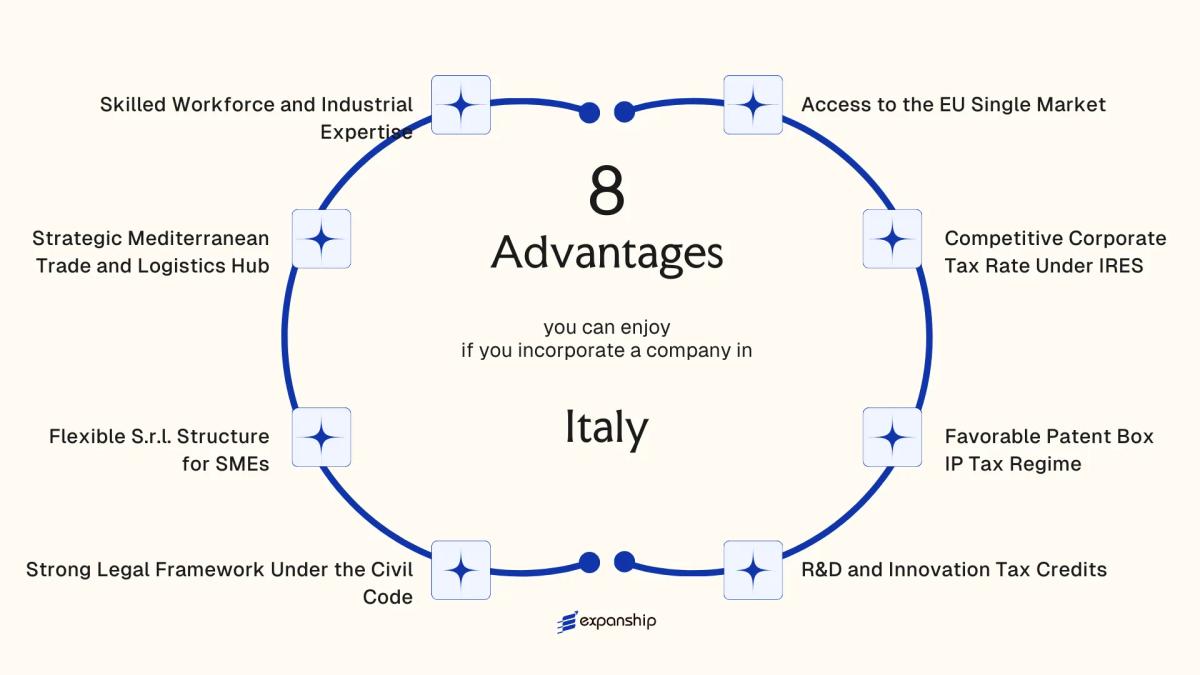
The benefits of incorporating in Italy span tax policy, market access, and structural flexibility. This article examines the specific advantages your business can access through Italian company formation, drawing on the legal and regulatory conditions that apply to entities registered under Italian law.
Access to the EU Single Market
Incorporating in Italy grants your business automatic access to the EU single market, covering over 440 million consumers and governed by the Treaty on the Functioning of the European Union (TFEU). This access is structural, not preferential — it follows from EU membership itself.
Freedom to Operate Across Member States
An Italian-registered entity, whether an S.r.l. or S.p.A., can provide services, employ staff, and establish branches across all 27 EU member states without requiring separate incorporation in each. This is grounded in Articles 49 and 56 of the TFEU, covering freedom of establishment and freedom to provide services respectively.
Eurozone Membership and Its Commercial Effect
Italy's membership in the eurozone eliminates currency conversion costs and exchange rate exposure when trading within the single currency area. For a foreign-owned firm billing clients in Germany, France, or Spain, all transactions settle in euros — removing a layer of financial friction that non-eurozone EU jurisdictions cannot eliminate.
A single Italian entity can contract, invoice, and operate commercially across the EU without triggering separate registration obligations in each member state.
Competitive Corporate Tax Rate Under IRES
Italy's standard corporate income tax rate sits at 24%, applied under IRES (Imposta sul Reddito delle Società), the national corporate income tax governed by Presidential Decree No. 917/1986, known as the Testo Unico delle Imposte sui Redditi (TUIR). For foreign investors structuring a subsidiary or resident entity, this rate provides a predictable and defined tax burden against which earnings can be planned.
The EU average corporate tax rate hovers around 21–22%, but several major economies within the bloc apply higher effective rates once regional surcharges are included. Germany's combined federal and trade tax burden, for example, routinely exceeds 30%. At 24% flat, your Italian entity avoids that layered rate structure.
A regional production tax, IRAP (Imposta Regionale sulle Attività Produttive), applies separately at a standard rate of 3.9%, though the base and rate vary by sector and region. This is a known, calculable cost rather than an unpredictable variable.
Several structural features of IRES make tax planning more manageable for foreign-owned companies:
- Dividends received from subsidiaries may qualify for a 95% exclusion under the participation exemption rules in TUIR
- Capital gains on qualifying shareholdings can receive the same 95% exemption treatment
- Italy maintains an extensive network of double taxation treaties, reducing withholding tax exposure on cross-border income flows

Company Incorporation in Italy
Set up a legally compliant Italian company with full support on IRES registration, tax identification, and entity structuring.
Favorable Patent Box IP Tax Regime
Italy's Patent Box IP tax regime benefits businesses that hold qualifying intellectual property by allowing a partial exemption on income derived from that IP. Introduced originally in 2015 and restructured significantly by Law No. 23/2023 (the so-called "Patent Box 2.0"), the current regime provides a 110% super-deduction on eligible IP-related costs rather than a reduced rate on IP income as previously structured. This shift means qualifying expenses are deducted at more than their actual value, directly reducing taxable income.
| Parameter | Detail |
|---|---|
| Applicable Tax | IRES (corporate income tax) and IRAP |
| Benefit Mechanism | 110% super-deduction on eligible IP costs |
| Qualifying IP Assets | Patents, know-how, designs, software under copyright |
| Governing Legislation | Law No. 23/2023; prior Decree No. 3/2015 |
| Administering Authority | Agenzia delle Entrate |
For a foreign-owned entity conducting R&D activity in Italy, the practical effect is a meaningful reduction in net taxable income tied directly to IP development expenditure. Software protected by copyright, industrial patents, and legally recognized designs all qualify, giving technology firms and manufacturers a broad range of eligible assets. Your business must conduct direct development, enhancement, or protection activities on the IP to access the deduction. This activity requirement connects the fiscal benefit to genuine operational presence, which also strengthens the substance of your Italian structure under international tax standards.
R&D and Innovation Tax Credits
Italy R&D tax credits for businesses operate under a regime introduced by Law 160/2019 and subsequently amended through the National Recovery and Resilience Plan (PNRR). The mechanism offers a tax credit rather than a deduction, meaning it directly reduces your tax liability rather than simply lowering the taxable base — a structurally more valuable position for capital-intensive research operations.
The credit rates vary by activity category. Fundamental research and experimental development attract a higher rate than technological innovation or design activities. Eligible costs include personnel directly engaged in qualifying activities, external contracts with universities or certified research bodies, and depreciation on instruments used exclusively for R&D purposes.
For foreign-owned Italian entities, the regime applies at the company level without requiring the parent to conduct any qualifying activity. Your Italian subsidiary can claim credits independently, provided it maintains documentation establishing the qualifying nature of expenditures — as required under the guidelines issued by the Ministry of Enterprise.
Keep these points in mind when accessing this benefit:
- Credits apply only to incremental or qualifying costs defined under Law 160/2019
- Prior technical assessment (perizia tecnica) may be required for larger claims
- Activities must be conducted within the EU or EEA to qualify under certain categories
- Credits are usable in three annual instalments via the F24 tax payment form
- Misclassification of activities between categories carries recapture risk during audits
Design and aesthetic innovation activities qualify for a dedicated credit rate under the Italian regime — a category most jurisdictions exclude from R&D incentive programs entirely.
Strong Legal Framework Under the Civil Code
The Italy Civil Code legal framework for companies, codified in the Codice Civile of 1942 and substantially reformed in 2003, provides a structured and predictable legal environment that foreign business owners can rely on when establishing and operating a corporate entity. Predictability matters in cross-border investment decisions, and the Civil Code delivers this through codified rules governing corporate governance, shareholder rights, director liability, and capital requirements.
Codified Protections for Shareholders and Directors
Articles 2380 to 2396 of the Codice Civile define director duties and liability standards with specificity, meaning disputes over fiduciary conduct are resolved against a clear statutory baseline rather than evolving case law. For foreign investors unfamiliar with Italian courts, this reduces interpretive risk considerably.
Shareholder protections are similarly grounded in statute. Minority shareholders in a Società per Azioni (S.p.A.) hold statutory rights to challenge resolutions, inspect accounting records, and appoint auditors under specific ownership thresholds, reducing exposure to governance disputes that can otherwise stall operations.
Institutional Stability and Enforcement Infrastructure
Corporate registrations and filings are administered through the Registro delle Imprese, managed by local Chambers of Commerce under the supervision of the Ministry of Enterprises and Made in Italy. This institutional structure ensures that your company's legal standing is formally recorded and publicly verifiable.
Italy's judiciary includes specialized commercial courts (Tribunale delle Imprese) with jurisdiction over corporate and intellectual property disputes. Their subject-matter focus produces more consistent outcomes in business litigation than generalist courts would.
Plan Your Corporate Structure in Italy
Speak with our team to understand how the Codice Civile's provisions apply to your specific entity type and ownership structure.
Flexible S.r.l. Structure for SMEs
The Italy S.r.l. structure advantages for SMEs are codified primarily in Articles 2462 to 2483 of the Codice Civile, which govern the Società a responsabilità limitata as a distinct legal form designed with smaller enterprises in mind.
- Liability is capped at each member's contribution to the share capital, meaning your personal assets remain separate from the company's obligations — a structural protection that holds regardless of company size.
- The minimum share capital for a standard S.r.l. is €10,000, but a simplified variant (S.r.l. semplificata) can be formed with as little as €1, making entry accessible for early-stage foreign founders without requiring significant capital commitment upfront.
- Quota transfers between members are governed by the company's own statuto, giving founders direct control over ownership changes without requiring public share issuance or stock exchange compliance.
- Unlike a S.p.A., the S.r.l. does not require a board of statutory auditors unless it exceeds specific thresholds under Article 2477 — reducing ongoing governance costs for smaller operations.
- Management can be assigned to one or more amministratori under terms defined in the statuto, allowing your business to configure oversight structures that reflect its actual operational needs rather than a fixed statutory template.
Strategic Mediterranean Trade and Logistics Hub
Italy's geographic position at the center of the Mediterranean places your business within direct shipping range of North Africa, the Middle East, and the western Balkans, giving physical trade operations a routing advantage that landlocked European jurisdictions simply cannot replicate.
The port network reinforces this position. The Port of Genoa, managed under the Autorità di Sistema Portuale del Mar Ligure Occidentale, is among the busiest container terminals in the Mediterranean. Gioia Tauro in Calabria functions as a major transshipment hub connecting sub-Saharan African and Asian cargo routes to European distribution chains.
For firms operating in manufacturing, import/export, or logistics, basing a company near these corridors reduces both transit time and freight costs relative to routing cargo through northern European ports.
A 2023 report by Assoporti, the Italian port authority association, recorded over 487 million tonnes of goods handled across Italian ports that year, reflecting the scale of commercial throughput available to businesses registered and operating within the country.
Rail and road infrastructure connects these ports to the broader TEN-T (Trans-European Transport Network) corridors, meaning goods entering through Italian terminals can reach Central European markets without transshipment delays at additional border points.
Skilled Workforce and Industrial Expertise
Italy skilled workforce advantages for companies are grounded in a technically dense labor pool shaped by decades of concentrated industrial activity. The country's northern regions — particularly Lombardy, Piedmont, and Emilia-Romagna — house clusters of engineering, precision manufacturing, and automotive suppliers that have trained generations of specialist workers.
Emilia-Romagna alone hosts the "Motor Valley," home to firms such as Ferrari, Lamborghini, and Ducati, along with their extensive supplier networks. Hiring in proximity to these clusters gives your business access to technicians and engineers already experienced in high-tolerance production environments, reducing onboarding time and training costs.
Vocational training in the sector is structured through the Italian Istituti Tecnici Superiori (ITS Academy) system, which produces graduates with direct industry-specific competencies. This pipeline connects employers to qualified candidates without requiring firms to build training programs internally.
- Mechanical and automation engineering talent is concentrated in the Po Valley industrial corridor.
- Textile and fashion production expertise clusters in Tuscany and Veneto.
- Food technology and agri-industrial skills are accessible in Emilia-Romagna and Campania.
Access to sector-specific talent pools is geographically concentrated, so your registered business location within the country will directly affect the quality and availability of relevant skilled labor.
Italy vs. Other European Incorporation Destinations
Three jurisdictions form a natural comparison set for this analysis: Germany, France, and the Netherlands. All four countries are founding or early EU members, target similar inbound investors, and offer established corporate legal frameworks. The comparison is instructive not because one structure dominates, but because each jurisdiction presents different trade-offs across tax, entity flexibility, and market access that affect different business profiles in distinct ways.
Where Italy vs Europe incorporation destinations comparison becomes most relevant is at the intersection of tax incentives and entity governance. Germany's GmbH and France's SARL share structural similarities with the Italian S.r.l., but neither country's standard corporate tax rate matches the combined effect of Italy's 24% IRES rate and its Patent Box regime applied together. The Netherlands attracts IP-holding structures through its innovation box, yet its effective rate and substance requirements differ materially from Italy's Patent Box rules.
| Parameter | Italy | Germany | France | Netherlands |
|---|---|---|---|---|
| Standard Corporate Tax Rate | 24% IRES | 15% KSt + trade tax (~30% combined) | 25% | 25.8% |
| IP Tax Regime | Patent Box (reduced rate on qualifying IP income) | No dedicated patent box | Patent Box (10%) | Innovation Box (9%) |
| Minimum Share Capital (SME entity) | €1 (simplified S.r.l.) | €25,000 (GmbH) | €1 (SARL) | €0.01 (BV) |
| EU Single Market Access | Full | Full | Full | Full |
| R&D Tax Credit | Yes (up to 20% on eligible costs) | Yes | Yes (30% CIR) | Yes |
| Civil Law Legal System | Yes (Codice Civile) | Yes (BGB) | Yes (Code Civil) | Yes |
Compliance Services for Companies in Italy
Maintain your Italian company's statutory obligations, from annual filings with the Registro delle Imprese to ongoing tax compliance under IRES and IRAP requirements.
Conclusion
Italy's case for foreign incorporation rests on a combination of tax efficiency, legal structure, and market access that few European jurisdictions replicate in the same configuration. The IRES corporate tax rate, combined with the Patent Box regime under Article 6 of Legislative Decree No. 23/2015, creates a defensible tax position for IP-intensive businesses. Access to the EU Single Market through an Italian entity remains one of the most direct routes available to non-EU investors seeking a regulated, treaty-backed commercial presence in Europe.
Not every structure suits every business. An S.r.l. works well for SMEs and founder-led ventures requiring capital flexibility, but the right entity type, sector classification, and regional incentive profile will vary depending on your industry and ownership model.
The practical case for an Italian company formation is strongest when the business has genuine operational ties to the country, whether through manufacturing, IP development, or distribution into southern European markets. Formation requirements under the Registro delle Imprese and ongoing obligations with the Agenzia delle Entrate are defined and predictable, which supports long-term planning. Understanding how those requirements apply to your specific structure is the logical next step before committing to any incorporation decision.
Start Your Italian Company Formation With Expanship
Expanship assists foreign founders and investors with Italy company formation, covering the full incorporation lifecycle from entity selection through ongoing statutory compliance. The firm works directly with the Registro delle Imprese, the Chamber of Commerce-administered commercial register through which all Italian business entities must be formally registered, and coordinates with the Agenzia delle Entrate for tax identification and VAT registration. Whether your structure of choice is the Società a responsabilità limitata or a branch of a foreign entity, the underlying compliance obligations require precise local execution.
Expanship's service scope across the Italian market includes:
- Preparation and legalization of incorporation documents, including notarized deeds of incorporation required under the Italian Civil Code
- Registered office and agent provision to satisfy domicile requirements under Italian law
- Filing and liaison with the Registro delle Imprese and the relevant Camera di Commercio
- Post-incorporation compliance management, including annual returns and statutory bookkeeping obligations
- Tax registration and coordination with the Agenzia delle Entrate for codice fiscale and partita IVA assignment
- Banking introduction assistance to support the opening of a corporate account with an Italian credit institution
Reach out to Expanship Italy to discuss how your business can be structured and registered within the Italian legal framework.
Frequently Asked Questions (FAQ)
The standard Imposta sul Reddito delle Società rate is 24%, applied to a company's net taxable income. Certain qualifying entities, including cooperative societies, may be subject to a reduced rate under specific provisions of the Testo Unico delle Imposte sui Redditi (TUIR). The 24% rate does not include the regional production tax, IRAP, which is levied separately at a base rate of 3.9%, though this varies by region and sector.
Under the current Patent Box regime, companies can obtain a 110% super-deduction on qualifying IP-related costs, including research and development expenses directly linked to the development or maintenance of eligible intangible assets. Eligible assets include patents, industrial designs, and certain copyrighted software, but not trademarks, which were excluded following the 2021 reform under Legislative Decree No. 146/2021. The benefit is claimed through the annual tax return rather than through a separate ruling procedure, which was the requirement under the prior regime.
Yes, an Italian-incorporated subsidiary of a foreign parent qualifies for the R&D tax credit under Article 1, paragraphs 198 to 209, of Law No. 160/2019, provided the qualifying expenditure is incurred and recorded by the Italian entity. The credit applies to costs such as personnel engaged in R&D activities, external research contracts, and eligible materials. The Italian entity must maintain adequate documentation and comply with the certification requirements introduced following the 2021 "Decreto Sostegni-bis" to avoid clawback by the Agenzia delle Entrate.
The incorporation of an S.r.l. generally takes between one and three weeks from the point that all documentation is in order and the deed of incorporation is executed before a notaio. Registration with the Registro delle Imprese, maintained by the local Camera di Commercio, is required before the company can commence operations, and this step alone can take several business days depending on the local office's processing times. Delays typically arise from incomplete apostille documentation or late issuance of an Italian tax identification code for foreign shareholders.
The Italian Civil Code provides several default protections for minority quotaholders in an S.r.l., including the right to inspect company books and the right to challenge resolutions adopted in breach of the law or the articles of association before the Tribunale delle Imprese. The articles of association can modify or expand many of these default rights, giving founders flexibility to tailor governance arrangements at the time of incorporation. Disputes involving minority rights in larger or more complex structures are handled by specialized company law courts, which brings a degree of predictability to enforcement.
Italy offers geographic and logistical proximity to Southern European, North African, and Eastern Mediterranean markets that neither the Netherlands nor Ireland can match operationally. The Netherlands and Ireland are generally preferred for holding structures and IP ownership due to their extensive treaty networks and lower headline tax rates, whereas an Italian entity is more practical when the business requires a physical commercial or manufacturing presence within the country. The choice between jurisdictions depends primarily on whether the entity's purpose is operational, IP-holding, or intermediate, since Italy's IRES rate of 24% is comparable to the Netherlands but higher than Ireland's 12.5% standard rate for trading income.
Legal Disclaimer
The information provided in this article is for general informational purposes only and does not constitute legal, tax, or professional advice. While we strive to ensure the accuracy and timeliness of the content, laws and regulations are subject to change, and the application of laws can vary widely based on specific facts and circumstances.
Readers should not act upon this information without seeking professional counsel tailored to their individual situation. Expanship and its authors disclaim any liability for actions taken or not taken based on the content of this article.
For specific advice regarding your business setup, compliance requirements, or any legal matters, please consult with qualified legal and tax professionals in the relevant jurisdiction.