
Key Takeaways
- Iraqi company formation is regulated by the Companies Registrar under the Ministry of Trade, with the Limited Liability Company (Sharika That Mas'ouliya Mahdouda) being the most commonly registered structure for both foreign and domestic investors.
- All core business entities in Iraq, including Public and Private Joint Stock Companies, partnerships, and sole proprietorships, are governed by the Iraqi Companies Law No. 21 of 1997.
- Foreign entities entering Iraq can operate through a branch office or representative office without establishing a separate legal person, or pursue direct registration under foreign company recognition procedures.
- The National Investment Commission's ongoing amendments to Iraq's investment framework indicate a gradual shift toward greater regulatory clarity for foreign market entrants.
Introduction to Entity Types in Iraq
Located in the Middle East, Iraq shares borders with Iran, Turkey, Syria, Jordan, Saudi Arabia, and Kuwait. It is an independent sovereign republic governed under a federal parliamentary system, with company formation regulated by the Iraqi Companies Registrar, which operates under the Ministry of Trade.
Iraq applies a territorial-based corporate tax system, with rates and exemptions varying by entity type and sector.
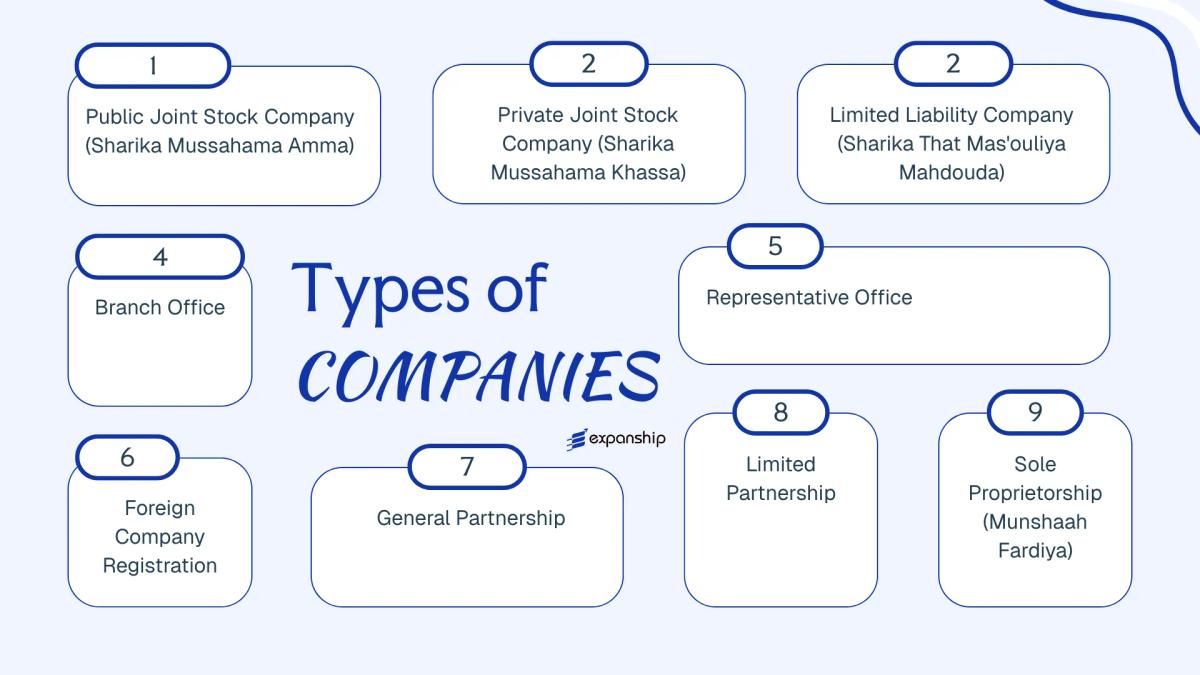
The types of business entities in Iraq available to both domestic and foreign investors include the Public Joint Stock Company, Private Joint Stock Company, Limited Liability Company, General Partnership, Limited Partnership, Sole Proprietorship, Branch Office, and Representative Office. Foreign entities may also register directly under procedures established for foreign company recognition. Each structure carries distinct requirements under the Iraqi Companies Law No. 21 of 1997, which remains the primary legislative instrument governing corporate formation and conduct.
This article examines each Iraqi legal entity structure in detail — covering formation requirements, ownership rules, liability, and practical considerations for your business.
An Overview of Business Structures in Iraq
Governed primarily by the Companies Law No. 21 of 1997 (as amended), the business structures available in Iraq fall into several distinct legal categories, each carrying different implications for ownership, liability, and permitted commercial activity. The Investment Law No. 13 of 2006 and sector-specific regulations also shape how certain entities operate, particularly those involving foreign capital. Each structure serves a defined commercial purpose, from full public ownership to single-person trading operations.
Business Structures at a Glance
| Entity Type | Legal Form | Liability | Taxed / Exempt | Local Trading | Minimum Members | Regulatory Authority | Governing Act |
|---|---|---|---|---|---|---|---|
| Public Joint Stock Company | Corporate | Limited to shares | Taxed | Yes | 25 shareholders | Companies Registrar, MoT | Companies Law No. 21/1997 |
| Private Joint Stock Company | Corporate | Limited to shares | Taxed | Yes | 3 shareholders | Companies Registrar, MoT | Companies Law No. 21/1997 |
| Limited Liability Company | Corporate | Limited to capital | Taxed | Yes | 2–25 partners | Companies Registrar, MoT | Companies Law No. 21/1997 |
| General Partnership | Non-corporate | Unlimited, joint | Taxed | Yes | Min. 2 partners | Companies Registrar, MoT | Companies Law No. 21/1997 |
| Limited Partnership | Non-corporate | Mixed liability | Taxed | Yes | Min. 2 partners | Companies Registrar, MoT | Companies Law No. 21/1997 |
| Branch Office (Foreign) | Non-separate entity | Parent liable | Taxed | Restricted | N/A | Companies Registrar, MoT | Companies Law No. 21/1997 |
| Representative Office | Non-separate entity | Parent liable | Generally exempt | No | N/A | Companies Registrar, MoT | Companies Law No. 21/1997 |
| Sole Proprietorship | Individual | Unlimited, personal | Taxed | Yes | 1 owner | Companies Registrar, MoT | Companies Law No. 21/1997 |
Each of these structures is examined in full in the sections below.
Public Joint Stock Company (Sharika Mussahama Amma)
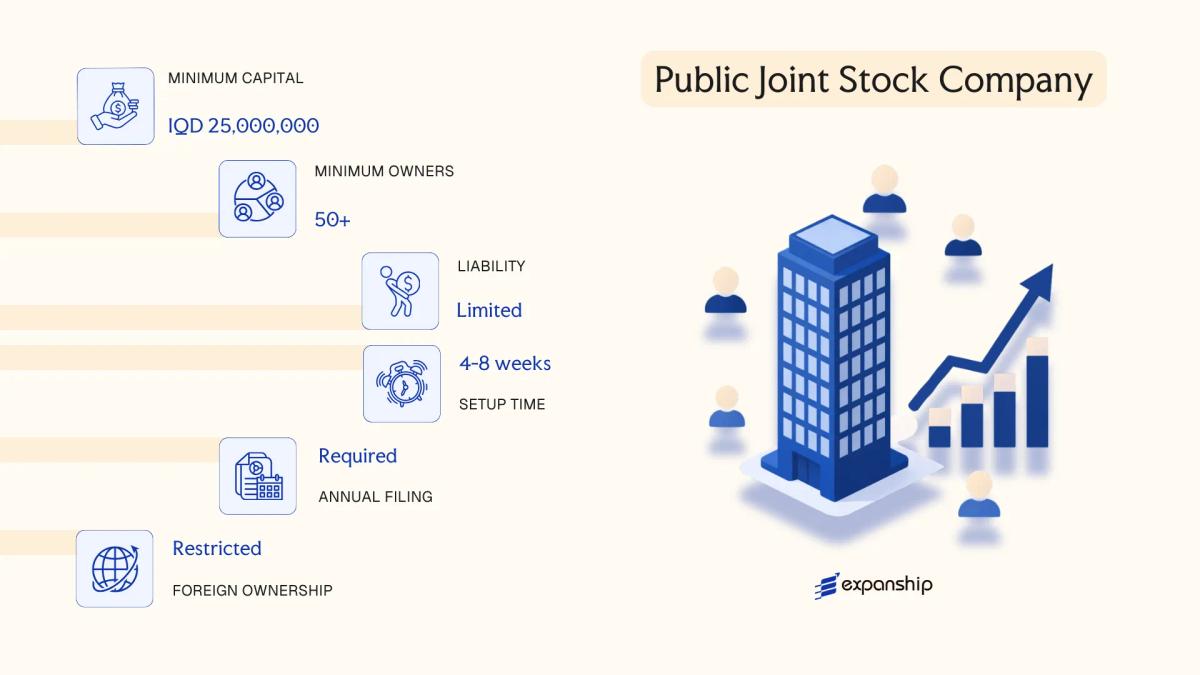
Iraq public joint stock company formation is governed primarily by the Companies Law No. 21 of 1997, as amended, which is administered by the Companies Registrar at the Ministry of Trade. This structure carries separate legal personality, meaning the entity itself holds rights and obligations distinct from its shareholders.
Shares in a Sharika Mussahama Amma are freely transferable and may be offered to the public, making this the appropriate vehicle for large-scale capital raising. The liability of each shareholder is limited to the nominal value of their subscribed shares.
Key Characteristics
| Requirement | Detail | Notes |
|---|---|---|
| Legal Form | Public Joint Stock Company (Sharika Mussahama Amma) | Separate legal personality; shareholders not personally liable beyond share value |
| Members | Shareholders; minimum 7 founders | No statutory maximum on shareholders; shares may be held by individuals or entities |
| Governing Body | Board of Directors (minimum 3, maximum 12 members) | At least one Iraqi national typically required on the board |
| Local Presence | Registered office in Iraq required | Physical address; registered agent not a standard statutory requirement |
| Share Capital | Minimum paid-up capital generally set at IQD 2,000,000 for private operations; public offering thresholds are higher | Capital denominated in Iraqi Dinar (IQD); shares must have a fixed nominal value |
| Privacy | Shareholder registry is filed with the Companies Registrar | Filings are not fully private; registry is accessible to authorities |
Focus Points
- Taxation: Subject to corporate income tax at 15% under the Income Tax Law No. 113 of 1982 (as amended); VAT is not yet broadly enacted in Iraq; withholding tax applies to certain payments to non-residents — see the Iraqi Tax Authority for current rates.
- Annual Compliance: Audited financial statements must be filed annually with the Companies Registrar and the Board of Supreme Audit.
- Securities Regulation: Public share offerings require approval from the Iraqi Securities Commission (ISC) and, where applicable, listing on the Iraq Stock Exchange (ISX).
- Foreign Ownership: Restrictions apply in certain sectors; full foreign ownership in a public joint stock structure may require prior approval from relevant sectoral authorities.
- Conversion: Can be converted to a private joint stock company or LLC subject to Companies Registrar approval and shareholder resolution meeting statutory thresholds.
Closing
This structure suits large enterprises, infrastructure projects, and businesses seeking to raise capital from the public or institutional investors. The primary advantage is unrestricted share transferability combined with access to public capital markets; the key limitation is the high administrative and regulatory burden, including mandatory audit, ISC oversight, and the minimum founder requirement.
Best suited for large Iraqi or foreign-backed enterprises planning public capital raises, institutional investment, or eventual listing on the Iraq Stock Exchange.

Company Incorporation in Iraq
Expanship assists with the full incorporation process for Iraqi business structures, including public and private joint stock companies.
Private Joint Stock Company (Sharika Mussahama Khassa)
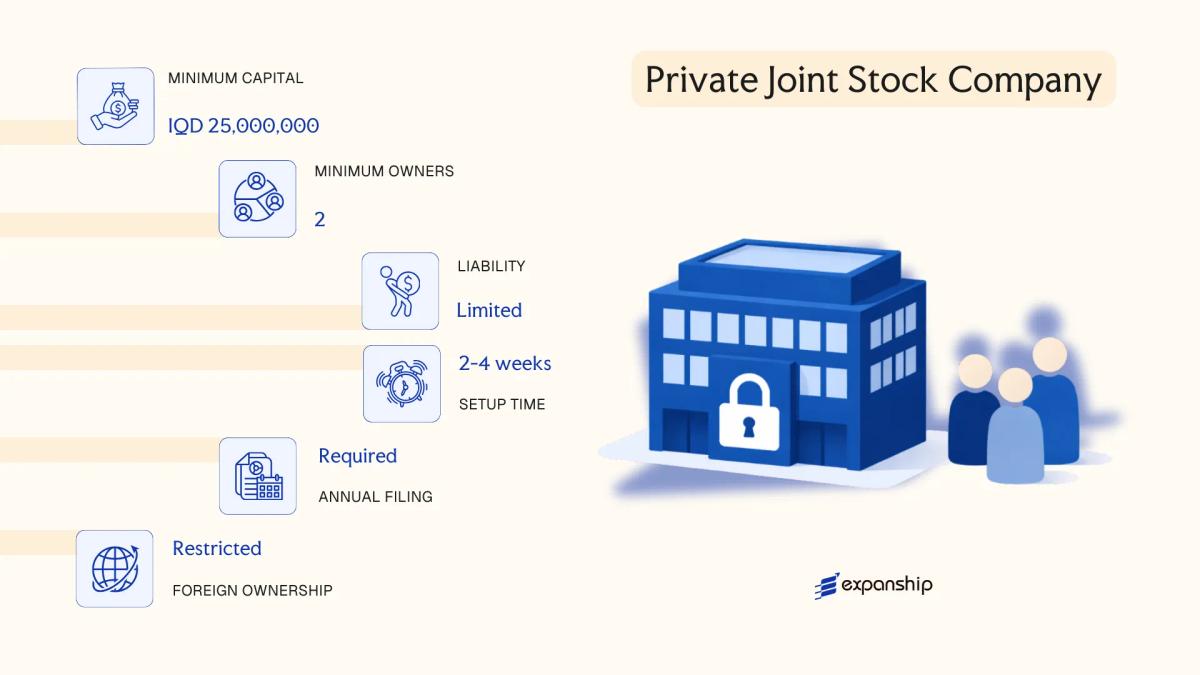
Governed by the Companies Law No. 21 of 1997 (as amended), an Iraq private joint stock company setup produces a distinct legal entity with its own rights, obligations, and capacity to own assets separate from its shareholders. Shares in this structure are restricted from public offering and cannot be listed on a stock exchange, making it a closed form of shareholding company.
Liability for each shareholder is confined to the value of their subscribed shares. This structure suits businesses seeking the corporate framework of a joint stock entity without the disclosure requirements attached to publicly listed firms.
Key Characteristics
| Requirement | Detail | Notes |
|---|---|---|
| Legal Form | Private Joint Stock Company (Sharika Mussahama Khassa) | Separate legal personality; shares not publicly tradeable |
| Members | Shareholders: minimum 3, maximum not fixed by statute for private form | Directors appointed to manage; board of directors required |
| Capital | Minimum paid-up capital required at registration (Iraqi Dinar denominated) | Minimum thresholds set by the Companies Registrar; full subscription required before incorporation |
| Local Presence | Registered office address in Iraq mandatory | Must maintain a physical or registered address within the jurisdiction |
| Share Transfer | Restricted; transfers subject to existing shareholder approval or articles of association | Shares cannot be offered to the general public |
| Privacy | Shareholder and director details filed with the Companies Registrar | Records are accessible to regulatory authorities |
Focus Points
- Taxation: Subject to corporate income tax under the Income Tax Law No. 113 of 1982 at the standard rate; VAT obligations and withholding tax on certain payments may apply depending on the nature of transactions.
- Annual Compliance: Required to file audited financial statements and annual returns with the Companies Registrar under the Ministry of Trade.
- Conversion: Can be converted to a public joint stock company subject to meeting minimum capital and shareholder thresholds prescribed by the Companies Registrar.
- Restrictions: Foreign ownership may be subject to sector-specific limitations; investment law concessions under the National Investment Law No. 13 of 2006 can modify standard restrictions.
- Treaty Access: Resident entities may access Iraq's applicable double tax treaties, subject to substance and residency conditions.
Closing Paragraph
A Sharika Mussahama Khassa suits medium to large private businesses, holding structures, and joint ventures where partners require the formality of a corporate structure with controlled share circulation. The primary limitation is the prohibition on public capital raising, which caps financing options to private sources and retained earnings.
Best suited for joint venture partners or investor groups seeking a formal corporate structure with restricted share transferability and no intention to list publicly.
Limited Liability Company (Sharika That Mas'ouliya Mahdouda)
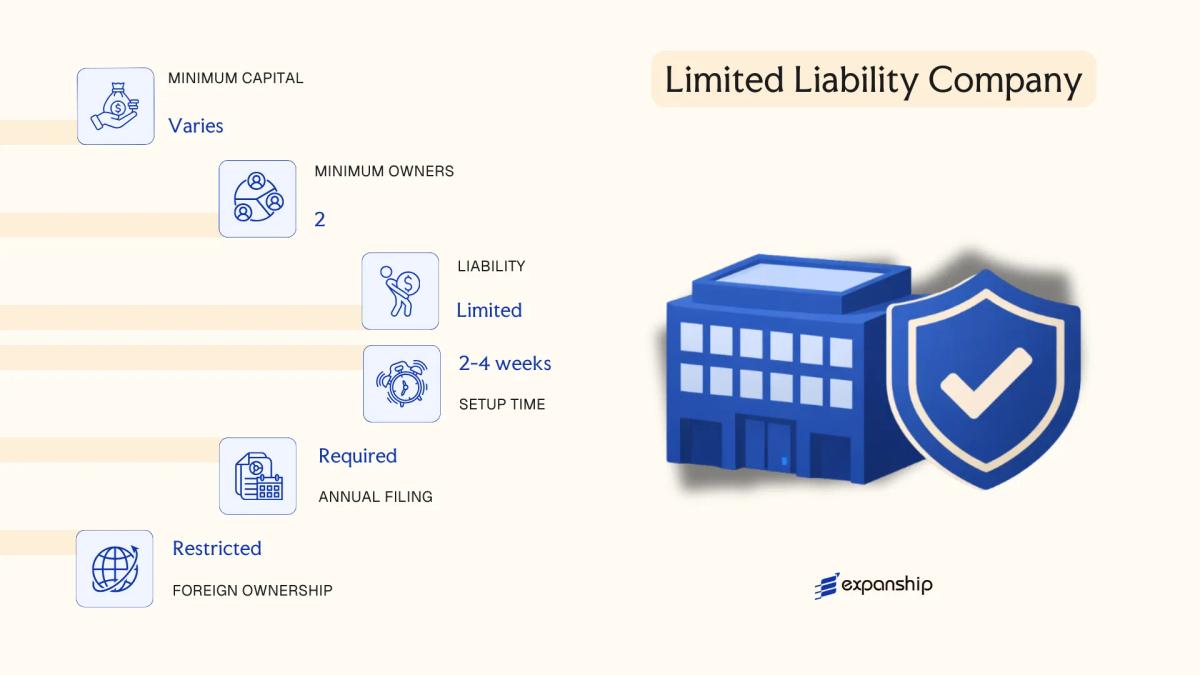
Governed by the Iraqi Companies Law No. 21 of 1997 (as amended), the Sharika That Mas'ouliya Mahdouda is the most widely used vehicle for Iraq limited liability company registration among foreign and domestic investors alike. Each member's liability is capped at the value of their subscribed shares in the company's capital.
As a separate legal entity, the LLC can own property, enter contracts, and incur obligations independently of its members. This hybrid structure sits between a partnership and a joint stock company, offering defined ownership without the public disclosure obligations attached to listed entities.
Key Characteristics
| Requirement | Detail | Notes |
|---|---|---|
| Legal Form | Limited Liability Company (Sharika That Mas'ouliya Mahdouda) | Registered with the Iraqi Companies Registrar under the Ministry of Trade |
| Members | Minimum 2, maximum 25 | Members hold transferable shares; share transfers require consent of other members |
| Management | One or more managers (Mudeer) | Need not be members; at least one manager must be appointed |
| Local Presence | Registered office address in Iraq required | A physical address within the jurisdiction is mandatory for registration |
| Capital | No statutory minimum for domestic LLCs; denominated in Iraqi Dinar (IQD) | Foreign-invested LLCs may face minimum capital requirements under investment licensing rules |
| Privacy | Member names filed with the Companies Registrar | Corporate records are not fully private; some details accessible to authorities |
Focus Points
- Taxation: Subject to corporate income tax at 15% under the Income Tax Law No. 113 of 1982 (as amended); oil-sector entities face higher rates; VAT framework is still developing, with no broadly applied VAT currently in force.
- Foreign Ownership: 100% foreign ownership is generally restricted; Iraqi partners are typically required unless the investment is licensed through the National Investment Commission under Law No. 13 of 2006.
- Annual Compliance: Annual financial statements must be filed with the Companies Registrar; audited accounts are required.
- Share Transfers: Member approval is required before any share transfer, limiting secondary market liquidity.
- Treaty Access: Iraq has a limited network of double taxation treaties; treaty benefits should be verified on a case-by-case basis.
Closing
The Iraqi LLC suits trading operations, service businesses, and joint ventures where partners want defined liability boundaries without the administrative burden of a public company structure. Its key advantage is operational flexibility in management; the principal limitation is the 25-member cap and restrictions on share transferability.
Best suited for foreign investors entering Iraq through a joint venture with a local partner, or domestic entrepreneurs seeking a structured vehicle for small-to-medium commercial operations.
Foreign Business Structures in Iraq [Branch Office, Representative Office, Foreign Company Registration]
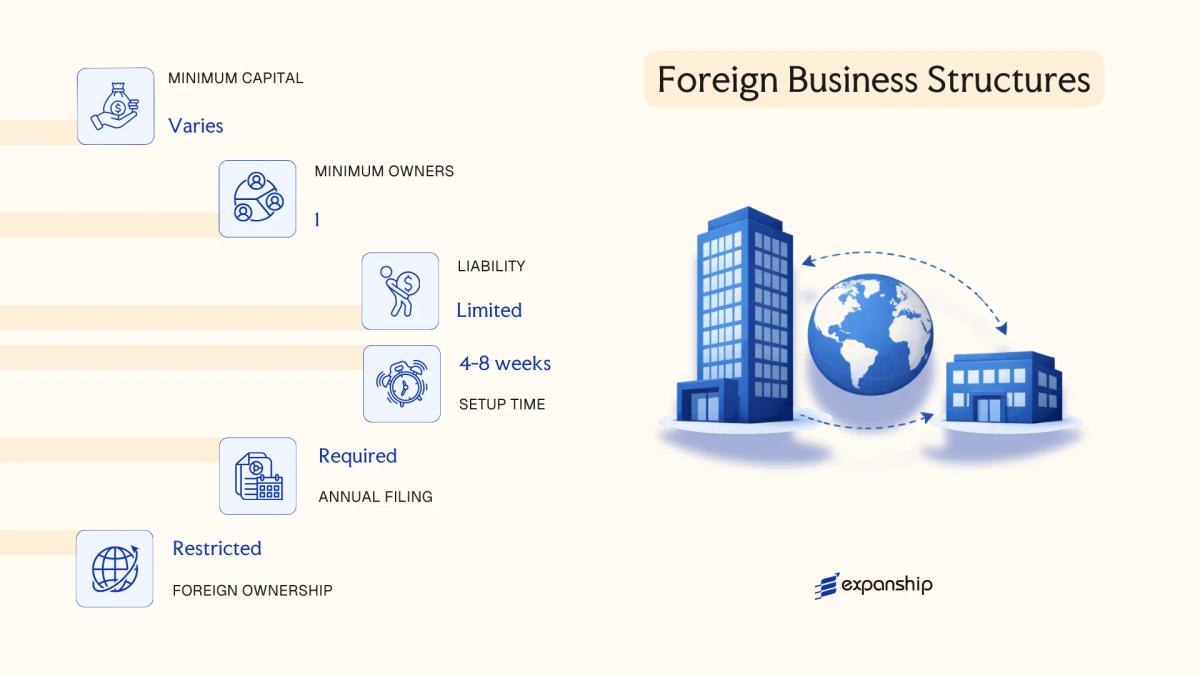
Foreign company registration in Iraq is governed primarily by the Companies Law No. 21 of 1997 (as amended), alongside sector-specific licensing requirements administered by the Companies Registration Department (CRD) under the Ministry of Trade. Depending on the structure chosen, a foreign entity may operate with or without separate legal personality in Iraq.
Three principal structures are available to foreign firms: a branch office, a representative office, and full foreign company registration. Each carries distinct legal standing, operational scope, and compliance obligations.
Key Characteristics
| Requirement | Branch Office | Representative Office | Foreign Company Registration |
|---|---|---|---|
| Legal Form | Extension of parent; no separate legal personality | Extension of parent; no separate legal personality | Locally incorporated entity with separate legal personality |
| Liability | Parent company bears full liability | Parent company bears full liability | Limited to registered capital |
| Permitted Activities | Commercial and operational activities per licence | Non-commercial activities only (market research, liaison) | Full commercial operations |
| Local Presence | Registered address in Iraq; local manager required | Registered address; local representative required | Registered office; local director generally required |
| Capital Requirement | No statutory minimum; sector-specific rules may apply | None | Subject to CRD requirements; varies by sector |
| Governing Body | CRD + relevant sector regulator | CRD + relevant sector regulator | CRD |
Focus Points
- Taxation: Corporate tax applies at 15% on Iraqi-sourced profits for branches; representative offices generally not subject to corporate tax unless generating income; withholding tax obligations may arise on payments to non-residents; VAT framework remains under development.
- Economic Substance: Branches conducting active operations must maintain a genuine physical presence and staff in-country.
- Annual Compliance: Annual renewal of registration, audited financial statements, and activity reports are required for branches and registered foreign companies.
- Treaty Access: Iraq has a limited network of double taxation agreements; treaty eligibility depends on the structure used and the parent's residence jurisdiction.
- Restrictions: Foreign ownership in certain sectors (oil services, construction, trading) may be subject to additional licensing or local partnership requirements under sector-specific regulations.
Sub-Types
Branch Office
A branch office is an extension of the foreign parent with no independent legal personality, permitted to engage in revenue-generating activities subject to CRD registration and sector-specific licensing. It is commonly used by foreign contractors and service firms operating under government or private sector contracts.
Representative Office
A representative office is restricted to non-commercial functions such as market research, promotional activities, and liaising on behalf of the parent. It cannot generate revenue or execute contracts directly in Iraq, making it suitable for firms assessing market entry before committing to a full operational structure.
Foreign Company Registration
Full registration as a foreign company through the CRD results in a locally incorporated entity with separate legal personality, capable of entering contracts, holding assets, and employing staff independently of the parent.
Closing
Foreign firms engaged in active contracting or trading typically opt for branch registration or full foreign company registration, as these permit direct commercial operations; the primary limitation is the administrative burden of ongoing CRD compliance and sector-specific licensing across multiple regulators. A representative office offers lower overhead but is legally prohibited from conducting revenue-generating activities.
Foreign companies testing the Iraqi market or supporting an existing contract without committing to a permanent commercial presence are best served by a representative office, while those executing contracts or generating local revenue should register a branch or locally incorporated entity.
Partnerships in Iraq [General Partnership, Limited Partnership]
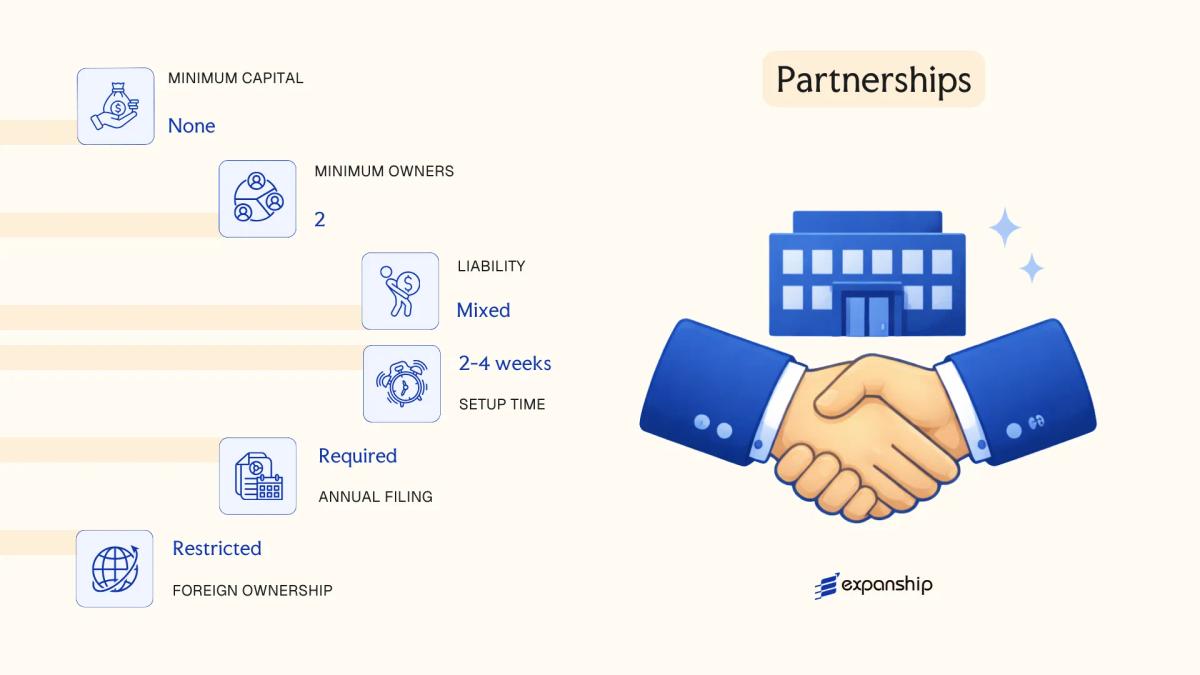
Partnership company formation in Iraq is governed by the Companies Law No. 21 of 1997 and its amendments. Both general and limited partnerships are recognised legal structures under this framework, though they occupy a narrower commercial role compared to capital-based entities such as the LLC.
Registered with the Companies Registration Department at the Ministry of Trade, partnerships in Iraq carry distinct liability profiles depending on their classification. Neither structure is commonly favoured by foreign investors, as personal liability exposure and structural constraints make them less suited to commercial-scale operations.
Key Characteristics
| Requirement | Detail | Notes |
|---|---|---|
| Legal Form | Partnership (Sharika) | Registered legal entity under Companies Law No. 21 of 1997 |
| Members | Partners (minimum 2, no statutory maximum) | General partners bear unlimited liability; limited partners are liable only to the extent of their capital contribution |
| Local Presence | Registered office in Iraq required | Physical address must be maintained within the country |
| Capital | Iraqi Dinar (IQD); no prescribed statutory minimum | Defined by the partnership agreement |
| Privacy | Partner details recorded in the commercial register | Public disclosure applies |
Focus Points
- Taxation: Partnerships are subject to corporate income tax at 15% on net profits under the Income Tax Law No. 113 of 1982; VAT and withholding tax obligations may apply depending on the nature of business activity.
- Annual Compliance: Partners must file annual financial statements and tax returns with the relevant authorities; failure to comply can result in penalties or deregistration.
- Foreign Participation: Foreign nationals face restrictions on partnership ownership; Iraq generally requires Iraqi partner involvement in locally registered entities.
- Conversion: Conversion to a different entity type, such as an LLC, is permitted under the Companies Law subject to regulatory approval and re-registration procedures.
- Treaty Access: Access to Iraq's double tax treaty network is limited and treaty coverage remains narrow, which can reduce the tax efficiency of this structure for cross-border operations.
Sub-Types
General Partnership (Sharika Tadamun)
All partners share unlimited joint liability for the debts and obligations of the business. This structure is typically used by small professional or trading firms where partners have equal standing and active involvement in management.
Limited Partnership (Sharika Tawsiya Basita)
At least one general partner bears unlimited liability, while one or more limited partners are liable only up to their capital contribution. Limited partners are restricted from participating in management; doing so risks reclassifying their liability as unlimited.
Closing
Partnerships suit small-scale, domestically focused operations where the partners have an established working relationship and prefer a straightforward contractual structure. The primary drawback is unlimited personal liability for general partners, which creates significant financial exposure in the event of business failure.
This structure is best suited for Iraqi nationals or small local firms operating in professional services or trading, where the partners are willing to accept personal liability and do not require external capital investment.
Sole Proprietorship (Munshaah Fardiya)
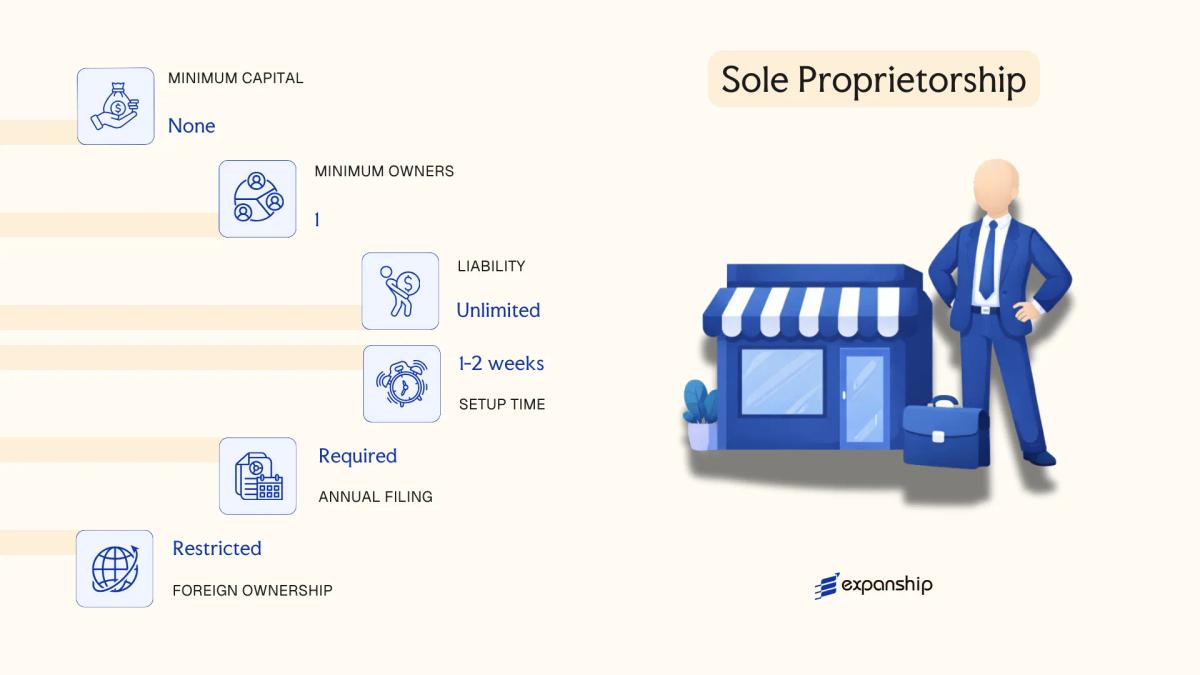
Sole proprietorship registration in Iraq is governed primarily by the Companies Law No. 21 of 1997, alongside relevant provisions under commercial registration regulations administered by the Ministry of Trade's Companies Registration Directorate. Unlike incorporated entities, the Munshaah Fardiya does not carry separate legal personality — the individual owner and the business are legally the same person.
Because no distinction exists between personal and business assets, the proprietor bears unlimited liability for all obligations incurred by the enterprise. This structure is typically used for small-scale commercial activities where the owner operates independently and does not require external shareholders or a board of directors.
Key Characteristics
| Requirement | Detail | Notes |
|---|---|---|
| Legal Form | Sole Proprietorship (Munshaah Fardiya) | No separate legal personality from the owner |
| Members | Single proprietor only | No shareholders or partners permitted |
| Local Presence | Registered business address required | Must be a physical address within Iraq |
| Capital | No statutory minimum | Owner funds the business directly |
| Liability | Unlimited personal liability | Personal assets exposed to business debts |
| Privacy | Name and trade registration publicly recorded | Limited confidentiality |
Focus Points
- Taxation: Subject to personal income tax under the Income Tax Law No. 113 of 1982; VAT obligations may apply depending on activity and turnover thresholds set by the General Commission for Taxes.
- Annual Compliance: Annual renewal of commercial registration with the Companies Registration Directorate is required to maintain active status.
- Treaty Access: As an unincorporated individual business, treaty benefits under Iraq's double tax agreements are generally not accessible.
- Conversion: Can be converted into a registered LLC or other corporate form, though this requires a fresh incorporation process rather than a structural amendment.
- Restrictions: Foreign nationals are generally prohibited from operating a sole proprietorship; this structure is reserved for Iraqi citizens.
Closing
The Munshaah Fardiya suits small domestic trading or service operations where simplicity of setup outweighs the need for liability protection or external investment. The primary drawback is unlimited personal liability, which exposes the owner's personal assets to any business-related claims or debts.
Best suited for Iraqi nationals running small, low-risk commercial or service-based operations who do not intend to bring in partners or outside capital.
How to Choose the Right Entity Type in Iraq
Selecting how to choose a company structure in Iraq requires more than weighing setup costs — the decision carries regulatory, tax, and operational consequences that are difficult to reverse once registration is complete.
Why Your Entity Choice Matters
Forming the wrong structure under the Companies Law No. 21 of 1997 can produce concrete, costly outcomes:
- Registering a foreign branch without obtaining the required licence from the Companies Registration Directorate exposes the firm to penalties and potential de-registration.
- Selecting an entity that lacks legal standing under Iraqi tax law means you cannot access any applicable double taxation arrangements, leaving withholding taxes unreduced.
- Incorporating a structure that carries mandatory audit requirements when your operation is a single-person consultancy adds recurring compliance costs that a sole proprietorship would not trigger.
- Choosing a general partnership when limited liability is operationally necessary leaves each partner personally exposed to the full debt obligations of the business.
Key Factors to Consider
- Business Activity: Active trading, passive asset holding, and regulated sectors such as banking each point to a distinct structure under Iraqi law.
- Ownership Structure: A sole operator has different registration pathways than a multi-party venture requiring defined shareholding and a board.
- Liability Exposure: Your tolerance for personal liability directly determines whether a limited liability company or a partnership is appropriate.
- Tax Position: Consider whether your business requires a taxable presence for treaty purposes or benefits from a lighter compliance profile.
- Foreign Ownership: The degree of foreign participation permitted varies by entity type, which affects how international shareholders can be structured.
- Exit and Continuity: Some structures allow conversion or redomiciliation; others require full liquidation, which affects long-term planning.
Compliance Services for Companies in Iraq
Maintain good standing with Iraqi regulatory authorities through structured compliance support covering annual filings, renewals, and ongoing reporting obligations.
Conclusion
Selecting the right structure is the first substantive decision in any Iraq company incorporation summary, and each entity type governs meaningfully different operational, liability, and ownership outcomes. The Limited Liability Company remains the most registered form for foreign and domestic investors under the Companies Law No. 21 of 1997, valued primarily for its flexible capital requirements and capped member liability. Public Joint Stock Companies suit large-scale capital mobilization; their private counterparts serve closely held ventures requiring share-based governance. Branch offices and representative offices extend a foreign firm's reach without creating a separate legal person. General and limited partnerships fit service-oriented or family businesses, while a sole proprietorship suits individual traders operating at smaller commercial scale.
Ongoing amendments to the investment framework, including activity under the National Investment Commission, signal a gradual move toward greater regulatory clarity for foreign entrants. Your choice of entity will shape tax exposure, governance obligations, and exit options throughout the life of the business.
How Expanship Can Assist You
Expanship provides corporate services for Iraq company formation across the full range of structures covered in this guide — from the Limited Liability Company registered under the Companies Law No. 21 of 1997 to branch offices and representative offices subject to approval by the Companies Registration Directorate at the Ministry of Trade.
From initial document preparation through to post-incorporation obligations, our team handles each stage directly:
- Document preparation, attestation, and legalization
- Registered agent and registered office provision in Iraq
- Filing and liaison with the Companies Registration Directorate
- Post-incorporation compliance management, including annual filings
- Banking introduction assistance for corporate account opening
Reach out to Expanship Iraq to discuss your specific requirements.
Iraq Company Formation
Incorporate your business in Iraq with direct support from registration through compliance.
Frequently Asked Questions (FAQ)
The Limited Liability Company (Sharika That Mas'ouliya Mahdouda) is the most frequently registered structure. Its relatively straightforward formation requirements and capped liability make it the default choice for small to mid-sized domestic and foreign-invested businesses.
A branch has no independent legal personality and its liabilities extend to the parent entity abroad, while an LLC is a separate legal person under Iraqi law. An LLC can trade locally without restriction, whereas a branch's permitted activities are generally tied to the scope defined in its registration with the Companies Registrar.
Privacy protections in Iraq are limited compared to offshore jurisdictions. Director and shareholder information for LLCs and joint stock companies is filed with the Companies Registrar and is not fully shielded from public access. Nominee arrangements are not a standard feature of Iraqi corporate practice.
No. A Sole Proprietorship (Munshaah Fardiya) is the only structure that a single individual can form alone. An LLC requires a minimum of two shareholders, and both General and Limited Partnerships require at least two partners by definition.
Foreigners may register an LLC, a Public or Private Joint Stock Company, or a Branch Office. Under Investment Law No. 13 of 2006, foreign investors operating through the National Investment Commission may access additional ownership and profit repatriation rights not available under general commercial registration.
Conversion between entity types is permitted under the Companies Law, most commonly from an LLC to a Joint Stock Company as a business scales. The process requires approval from the Companies Registrar and must satisfy the capital and shareholder requirements of the target structure.
No. A Sole Proprietorship does not constitute a separate legal person — the owner bears unlimited personal liability for all business obligations. General Partnerships also expose partners to joint and several liability. LLCs and Joint Stock Companies, by contrast, hold distinct legal personality under the Companies Law.
Legal Disclaimer
The information provided in this article is for general informational purposes only and does not constitute legal, tax, or professional advice. While we strive to ensure the accuracy and timeliness of the content, laws and regulations are subject to change, and the application of laws can vary widely based on specific facts and circumstances.
Readers should not act upon this information without seeking professional counsel tailored to their individual situation. Expanship and its authors disclaim any liability for actions taken or not taken based on the content of this article.
For specific advice regarding your business setup, compliance requirements, or any legal matters, please consult with qualified legal and tax professionals in the relevant jurisdiction.