
Key Takeaways
- Investment Law No. 13 of 2006 provides the statutory basis for foreign capital entry into Iraq, enabling full foreign ownership in most sectors without requiring a local equity partner.
- Tax exemptions administered by the National Investment Commission directly reduce operating costs during early years, making Iraq's fiscal environment more accessible than its regional profile might suggest.
- Companies registered in Iraq gain proximity to one of the world's largest proven oil reserves, generating sustained cross-sector procurement demand in energy, construction, and trade simultaneously.
- With a population exceeding 40 million and a territorial-based tax system, Iraq offers foreign businesses both a substantial domestic consumer base and a structured framework for limiting tax exposure on qualifying activities.
Sitting at the crossroads of the Middle East, Iraq is a sovereign Arab republic bordering six countries, including Turkey, Iran, and Saudi Arabia. For foreign businesses evaluating the benefits of incorporating in Iraq, understanding the regulatory entry point is foundational. Company registration falls under the oversight of the Companies Registrar, operating within the Ministry of Trade, and the primary vehicle through which foreign firms establish a formal presence is the Limited Liability Company.
Iraq operates a territorial-based tax system, with structured exemptions available to qualifying investors under national investment legislation. On the question of foreign participation, the country has taken a formally open posture through Investment Law No. 13 of 2006, which frames the legal basis for foreign capital entry across most sectors.
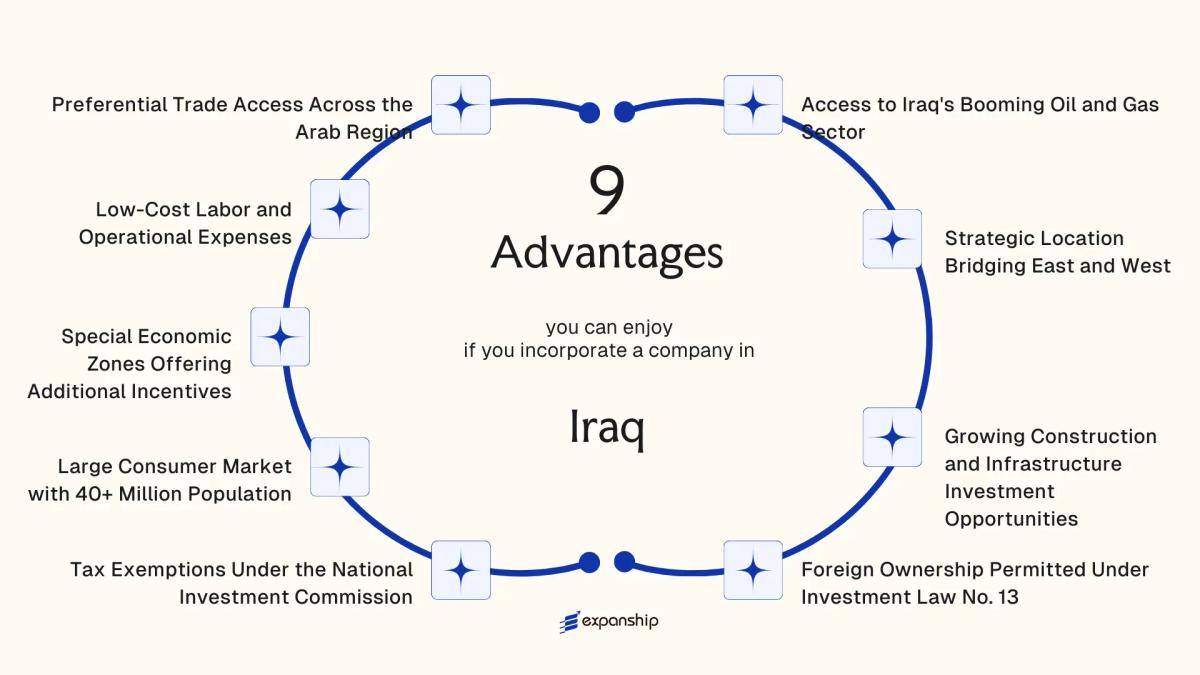
Foreign direct investment has grown materially in recent years, reflecting both resource-driven interest and broader economic reforms. This article examines the principal advantages your business can access by forming a company here.
Access to Iraq's Booming Oil and Gas Sector
Iraq oil and gas sector investment benefits are most accessible to foreign firms that establish a legal presence in-country, as most upstream and midstream contracts require a locally registered entity or a joint venture structure.
Contractual Access Through the Licensing Round System
Iraq's Ministry of Oil has conducted multiple licensing rounds since 2009, awarding long-term technical service contracts to international oil companies at fields including Rumaila, West Qurna, and Halfaya. These contracts are structured as Technical Service Contracts (TSCs), where the foreign operator recovers costs and receives a per-barrel remuneration fee rather than taking an equity share in reserves. Having a registered entity in-country is a practical prerequisite for bidding, since the Ministry of Oil requires local registration documentation as part of the qualification process.
Production Scale and Revenue Potential
Iraq holds the world's fifth-largest proven oil reserves, exceeding 145 billion barrels according to OPEC data. Production capacity targets set by the Iraqi government point toward significant upstream expansion, which creates contracted service demand for foreign businesses operating in drilling, engineering, logistics, and field maintenance.
A locally registered entity positions your firm to qualify directly for Ministry of Oil contracts rather than operating as a subcontractor through a third party.
Strategic Location Bridging East and West
Positioned at the intersection of the Arab world, Central Asia, and the Mediterranean trade corridor, Iraq's geographic placement has historically made it a transit and trade hub. For businesses today, that positioning translates into measurable logistical and commercial advantages.
Iraq shares borders with six countries: Turkey, Iran, Syria, Jordan, Saudi Arabia, and Kuwait. That configuration gives companies registered in the country direct overland access to major Gulf economies and onward connectivity toward European and Asian markets without requiring intermediary distribution infrastructure.
The Iraq strategic location advantages for business extend beyond simple proximity. Goods moved through Iraqi territory can reach Gulf Cooperation Council markets, Turkish ports connecting to Europe, and Iranian corridors linking to Central Asia, all within regional transit distances.
From a trade routing standpoint, a company based here can function as a distribution anchor across several distinct economic zones simultaneously. That positioning reduces relay costs that firms operating from single-corridor countries typically absorb.
Several factors make this geographic positioning operationally useful rather than theoretical:
- Overland routes connect directly to GCC consumer markets without maritime dependency
- Proximity to Iranian and Turkish industrial supply chains shortens component lead times
- Access to Jordanian and Syrian corridors opens pathways toward Levantine and North African markets
- Port access via Umm Qasr on the Persian Gulf provides sea freight options alongside land routes

Company Incorporation in Iraq
Set up your business entity in Iraq with guidance on legal structures, registration requirements, and compliance obligations.
Growing Construction and Infrastructure Investment Opportunities
Iraq infrastructure investment opportunities for companies are substantial, driven by reconstruction programs and federal budget allocations that have consistently prioritized physical development since 2003. The government's National Development Plan has directed billions of dollars toward housing, transport, water infrastructure, and electricity generation, creating sustained contract opportunities for foreign firms operating through locally registered entities.
Under Investment Law No. 13 of 2006, the National Investment Commission grants approved projects access to land-use rights and extended tax exemptions, which directly reduces the capital burden on foreign construction and engineering businesses during the early and most cost-intensive phases of a project.
| Sector | Primary Regulatory Body | Relevant Framework |
|---|---|---|
| Housing and Real Estate | National Investment Commission | Investment Law No. 13 (2006) |
| Electricity and Power | Ministry of Electricity | National Development Plan |
| Roads and Transport | Ministry of Construction | Federal Budget Allocations |
| Water and Sanitation | Ministry of Water Resources | National Development Plan |
Procurement in the construction sector is largely administered through provincial reconstruction councils and federal ministries, meaning a registered local entity positions your business to bid directly rather than through intermediary arrangements. Joint ventures with Iraqi firms are permitted, but foreign-owned companies can also qualify independently for government contracts under approved investment licenses. Given the scale of unmet infrastructure demand across multiple provinces, the pipeline of publicly funded projects remains active beyond any single budget cycle.
Foreign Ownership Permitted Under Investment Law No. 13
Under Investment Law No. 13 of 2006, foreign investors are permitted to hold up to 100 percent ownership in most sectors, which removes the mandatory local partner requirement that applies in many other markets across the Middle East. This structural feature directly affects how you control your business, retain profits, and make operational decisions without co-ownership obligations.
The law grants foreign-owned entities the same legal treatment as domestically owned companies. Protections include the right to transfer profits abroad, own assets, and enter contracts in your firm's name. These rights are administered through the National Investment Commission (NIC), the federal body responsible for issuing investment licenses under the law.
Securing an NIC license not only formalizes the 100 percent foreign ownership Iraq investment law framework for your entity but also activates associated protections against expropriation without compensation. For capital-intensive projects, this protection reduces exposure considerably.
Keep in mind:
- Investment licenses are issued by the NIC or provincial investment commissions, depending on the project location
- Certain sectors, including oil extraction and banking, retain separate regulatory requirements outside the general investment law framework
- The law applies to foreign natural persons and legal entities alike
- Land ownership by foreign investors remains restricted; leasehold arrangements are available as an alternative
Iraq's Investment Law No. 13 predates similar foreign ownership liberalization laws in several Gulf states, making it one of the earlier legislative frameworks in the region to formalize full foreign equity rights.
Tax Exemptions Under the National Investment Commission
Iraq National Investment Commission tax exemptions represent one of the most direct fiscal advantages available to foreign investors entering the market. Under Investment Law No. 13 of 2006, the National Investment Commission (NIC) grants approved projects an exemption from taxes and fees for a period of up to 10 years, with the duration tied to the nature and scale of the licensed investment.
What the Exemption Covers
The tax holiday applies to corporate income tax, which is otherwise levied at a flat rate of 15% under the Income Tax Law. For capital-intensive projects, particularly those in manufacturing, real estate development, or services, a decade-long exemption from that liability meaningfully reduces the cost of establishing operations and reaching profitability. Customs duties on imported machinery, equipment, and production inputs required for the licensed project are also exempt, reducing upfront capital expenditure.
Eligibility and Practical Application
Exemption eligibility is determined by the NIC at the federal level, with provincial investment commissions handling applications for projects outside the Kurdistan Region, which operates its own parallel framework under Regional Investment Law No. 4 of 2006. Projects must receive a formal investment license from the relevant commission before exemptions take effect, meaning the structure of your entity and the scope of declared activities directly influence what relief you qualify for. Investors operating in designated priority sectors, such as housing, industry, and agriculture, may receive preferential treatment during the licensing assessment.
Maximize Your Tax Exemption Eligibility in Iraq
Speak with our corporate services team to understand how NIC licensing decisions affect the tax relief available to your specific business structure and sector.
Large Consumer Market with 40+ Million Population
With a population exceeding 40 million, Iraq large consumer market business advantages are grounded in demographic scale and a predominantly young population. The median age sits below 22, meaning demand for consumer goods, retail, financial services, healthcare, and education is structurally expanding rather than stagnant.
- Domestic demand is not dependent on export conditions. A foreign firm selling into this market generates revenue tied to internal consumption, which insulates earnings from global commodity price volatility.
- Urban population growth in Baghdad, Basra, and Erbil is accelerating household spending across FMCG, electronics, and food services, creating addressable segments that did not exist at the same scale a decade ago.
- A low rate of formal banking penetration means financial services, fintech, and insurance products face limited incumbent competition, giving early-entry foreign firms a structural first-mover position.
- The National Investment Commission, established under Investment Law No. 13 of 2006, permits foreign entities to operate within this consumer base on terms comparable to domestic firms in approved sectors, removing a common barrier to market access.
- Per capita income growth tied to oil revenues has expanded the middle-income segment, directly increasing discretionary spending across retail and services categories.
Special Economic Zones Offering Additional Incentives
Iraq special economic zones business incentives extend beyond the general National Investment Commission framework, creating a distinct regulatory tier for companies operating within designated zones. The Al-Nakheela Free Zone and the Basra Special Economic Zone, among others, operate under the Free Zones Authority, which administers a separate set of benefits from those available to ordinarily licensed entities.
Within qualifying zones, businesses can access:
- Full exemption from customs duties on imported raw materials and production equipment
- Relief from corporate income tax for defined periods, which varies by zone and activity type
- Simplified licensing procedures under Free Zones Authority jurisdiction rather than standard ministry channels
For foreign investors, the separation from the standard regulatory process reduces administrative dependency on multiple government bodies. Your entity deals primarily with one authority, which cuts down coordination time across bureaucratic layers.
Qualifying as a zone-based company typically requires a defined commercial activity, physical presence within the zone boundary, and registration approval from the Free Zones Authority.
A foreign manufacturer operating within the Basra Special Economic Zone importing $2 million in equipment annually would face zero customs duty on those imports, compared to standard tariff rates applied outside zone boundaries — a direct reduction in capital expenditure from day one of operations.
Low-Cost Labor and Operational Expenses
Iraq low cost labor advantages for businesses are grounded in real wage differentials. Average monthly wages for semi-skilled and skilled workers remain well below those found in Gulf Cooperation Council member states, giving foreign firms a measurable reduction in recurring payroll costs from the first month of operations.
Labor relations and employment terms are governed by the Iraqi Labour Law No. 37 of 2015, which sets out minimum wage floors, working hours, and end-of-service entitlement structures. Because statutory minimums are modest relative to regional benchmarks, your firm can hire across technical, administrative, and operational roles without the salary compression that characterizes more saturated Gulf markets.
Office and commercial lease rates in cities outside Baghdad, including Erbil and Basra, offer further cost relief for businesses establishing physical presences. The Kurdistan Region in particular has developed a functional commercial real estate market where rental costs per square meter remain a fraction of comparable space in Amman or Dubai.
- Utility costs, including electricity in licensed industrial zones, are frequently subsidized for registered investors
- Local procurement of construction materials benefits from proximity to regional supply chains
- Workforce availability is supported by a young population, with a median age below 22
Wages and employment conditions may differ between federal Iraq and the Kurdistan Region of Iraq, as each operates under partially distinct administrative frameworks that affect employer obligations.
Preferential Trade Access Across the Arab Region
Iraq preferential trade access Arab region benefits flow directly from its membership in the Greater Arab Free Trade Area (GAFTA), which has been in force since 2005 and covers 18 Arab League member states. Under GAFTA, tariffs on qualifying goods traded between member countries are eliminated, giving companies incorporated in Iraq duty-free or reduced-duty entry into markets spanning North Africa, the Levant, and the Gulf.
For a foreign business structuring regional distribution through an Iraqi entity, this access is commercially significant. Goods produced or substantially processed within Iraq can move into GAFTA member markets without the tariff friction that applies to shipments originating from outside the bloc, reducing landed costs across the supply chain.
The practical scope of this benefit depends on rules-of-origin compliance. Products must meet the origin criteria defined under the GAFTA executive program to qualify for preferential treatment, which typically requires a minimum percentage of local value addition.
Beyond GAFTA, Iraq maintains bilateral trade agreements and economic cooperation arrangements with individual Arab states, including Jordan and Egypt, which can carry additional preferential terms for specific product categories or service sectors.
- GAFTA membership covers markets with a combined population exceeding 400 million people
- Duty elimination applies across a broad range of manufactured and agricultural goods
- Bilateral agreements may extend preferential terms beyond GAFTA's standard schedule
- Origin certification is administered through Iraqi chambers of commerce and relevant trade authorities
Why Iraq Stands Out Against Regional Competitors
Comparing Iraq vs regional competitors business advantages reveals a distinct profile. While Gulf states like the UAE and Saudi Arabia attract attention due to brand recognition and infrastructure maturity, they carry significantly higher operational costs, stricter foreign ownership rules outside designated zones, and saturated markets in many sectors. Jordan and Kuwait present smaller consumer bases and more limited resource-driven growth opportunities. The jurisdictions selected below reflect the realistic alternatives a foreign investor evaluating an Iraq entry would consider.
What the table below cannot fully convey is the structural weight of Iraq's position: access to one of the world's largest proven oil reserves, a population exceeding 40 million, and investment protections under Investment Law No. 13 of 2006 represent a combination that Gulf free zone setups do not replicate. The Iraq business environment advantages over regional markets are most apparent in sectors where land rights, long-term licensing, and resource proximity determine returns.
| Parameter | Iraq | UAE | Saudi Arabia | Jordan |
|---|---|---|---|---|
| Foreign Ownership (mainland) | Up to 100% under Investment Law No. 13 | Permitted since 2021 reforms, varies by activity | Up to 100% in select sectors under Vision 2030 | Up to 100% in most sectors |
| Corporate Tax Rate | 15% standard rate | 9% federal rate (from 2023) | 20% standard rate | 20% standard rate |
| Consumer Market Size | 40+ million | ~3.5 million nationals | ~36 million | ~10 million |
| National Investment Body | National Investment Commission (NIC) | Various free zone authorities | Ministry of Investment | Jordan Investment Commission |
| Oil & Gas Sector Access | Direct licensing via Ministry of Oil | Limited upstream access | Via Saudi Aramco concessions | Minimal upstream opportunity |
| Special Economic Zones | Multiple zones including Basra | 40+ free zones | NEOM, KAEC, and others | Aqaba SEZ |
Compliance Services for Companies in Iraq
Maintain your Iraqi entity's good standing with ongoing regulatory filings, licence renewals, and statutory obligations managed through Expanship.
Conclusion
The benefits of incorporating in Iraq converge on a single point: the country offers foreign businesses a rare combination of resource-driven demand, statutory investment protections, and structured fiscal relief that is difficult to replicate in comparable markets. Tax exemptions granted under the National Investment Commission, underpinned by Investment Law No. 13 of 2006, directly reduce the cost burden during your formative operating years. Access to one of the world's largest proven oil reserves creates sustained procurement and service demand that generates commercial opportunity across multiple sectors simultaneously.
Not every business model will extract equal value from these conditions. Firms operating in energy, construction, or trade stand to benefit most directly, while those in other sectors may find the investment framework applies more narrowly depending on the nature and location of their registered activity.
The legal and regulatory architecture is in place. Your next step is understanding how your specific business structure maps onto it.
Start Your Iraq Company Formation with Expanship Today
Expanship assists foreign investors with Iraq company formation, covering entity registration under the Companies Law No. 21 of 1997, licensing through the National Investment Commission, and ongoing compliance with the Ministry of Trade's Commercial Register. The services address each structural and regulatory step that this blog has outlined, from ownership structures permitted under Investment Law No. 13 of 2006 to tax exemptions and Special Economic Zone applications.
Expanship's scope in Iraq covers the following:
- Preparation and legalization of incorporation documents for submission to the Iraqi Companies Registrar
- Registered agent and registered office provision in Baghdad or other designated commercial centers
- Government filing and liaison with the National Investment Commission and Ministry of Trade
- Post-incorporation compliance management, including annual filings and license renewals
- Banking introduction assistance to support account opening with local and regional financial institutions
- Coordination with relevant free zone authorities for entities established within Special Economic Zones
To discuss your incorporation requirements, contact Expanship Iraq.
Frequently Asked Questions (FAQ)
The NIC does not publish a fixed statutory timeline for investment license approvals, and processing times vary depending on the sector, completeness of documentation, and project scale. In practice, obtaining an investment license and completing commercial registration with the Companies Registration Directorate can take several weeks to a few months. Delays are more common when submitted documents require supplementary review or when sector-specific clearances are needed from line ministries.
Companies licensed by the NIC under Investment Law No. 13 are eligible for exemptions from taxes and fees for a period that can extend up to ten years from the start of operations. The duration and scope of the exemption depend on the nature of the investment and the region in which the project is located. Projects situated in governorates outside the Kurdistan Region are subject to NIC approval, while the Kurdistan Regional Government administers its own parallel investment incentive framework.
Foreign firms entering the upstream oil and gas sector generally cannot operate under the standard NIC investment license framework, as petroleum activities fall under the jurisdiction of the Ministry of Oil and are governed by separate contractual arrangements such as Technical Service Contracts. A local partner is not universally mandated by statute, but contract structures negotiated with the State Oil Marketing Organisation or relevant authorities may include requirements for local participation. Downstream and service-related activities may follow different rules depending on the contracting entity.
Iraq is a member of the Arab League's Greater Arab Free Trade Area (GAFTA), which provides for tariff reductions or eliminations on qualifying goods traded among member states. A company registered in Iraq can, subject to meeting rules of origin requirements, benefit from preferential access to other GAFTA member markets. Iraq has also pursued bilateral trade arrangements, though the scope and current implementation status of individual agreements should be verified against active treaty schedules.
Wages in Iraq are generally lower than in Gulf Cooperation Council states, though exact figures vary by sector, skill level, and governorate. Foreign employers are subject to the Iraqi Labor Law No. 37 of 2015, which sets out minimum employment standards including working hours, termination procedures, and entitlements. Companies operating under an NIC investment license may also be subject to requirements relating to the proportion of Iraqi nationals employed relative to expatriate staff.
Companies established within designated Special Economic Zones (SEZs), such as the Al-Nakheel zone, may access incentives beyond those provided under the standard NIC framework, including customs duty exemptions on imported equipment and materials. The specific incentive package varies by zone and is governed by the terms set out under the relevant enabling legislation and zone authority. Investors should confirm the current operational status of individual SEZs and the applicable regulatory body, as development and activation levels differ across zones.
Legal Disclaimer
The information provided in this article is for general informational purposes only and does not constitute legal, tax, or professional advice. While we strive to ensure the accuracy and timeliness of the content, laws and regulations are subject to change, and the application of laws can vary widely based on specific facts and circumstances.
Readers should not act upon this information without seeking professional counsel tailored to their individual situation. Expanship and its authors disclaim any liability for actions taken or not taken based on the content of this article.
For specific advice regarding your business setup, compliance requirements, or any legal matters, please consult with qualified legal and tax professionals in the relevant jurisdiction.