
Key Takeaways
- Foreign investors must comply with both the Companies Law No. 21 of 1997 and Investment Law No. 13 of 2006, with the applicable requirements varying based on entity type, sector, and the extent of foreign ownership involved.
- Minimum share capital thresholds established under Iraqi law represent a binding prerequisite for registration, and failure to meet them results in outright rejection of the incorporation application by the Companies Registration Directorate.
- Beneficial ownership information must be disclosed in accordance with anti-money laundering regulations administered by the Commission of Integrity, forming a distinct compliance layer separate from the standard registration process.
- Director residency conditions linked to Iraqi law constitute a structural obligation that foreign investors must address during the entity formation stage, not after registration is complete.
Incorporating a business in Iraq is governed by the Companies Law No. 21 of 1997, as amended, which falls under the oversight of the Iraqi Companies Registrar, operating through the Ministry of Trade. Meeting the incorporation requirements in Iraq is a prerequisite to obtaining legal standing; failure to satisfy them results in outright rejection of your registration application or, if operating without registration, exposure to penalties under applicable commercial regulations.
This article covers the structural, documentary, and regulatory conditions that apply to entity formation, as established under Iraqi law.
Requirements can differ based on the legal entity type selected, the sector your business intends to operate in, and whether foreign ownership is involved. Iraq's Investment Law No. 13 of 2006 introduces additional conditions for foreign investors in certain sectors, so the requirements outlined here may not apply uniformly to every scenario.
This article is most directly relevant to foreign investors and business owners seeking to establish a formal commercial presence in Iraq for the first time.
Minimum Share Capital Requirements in Iraq
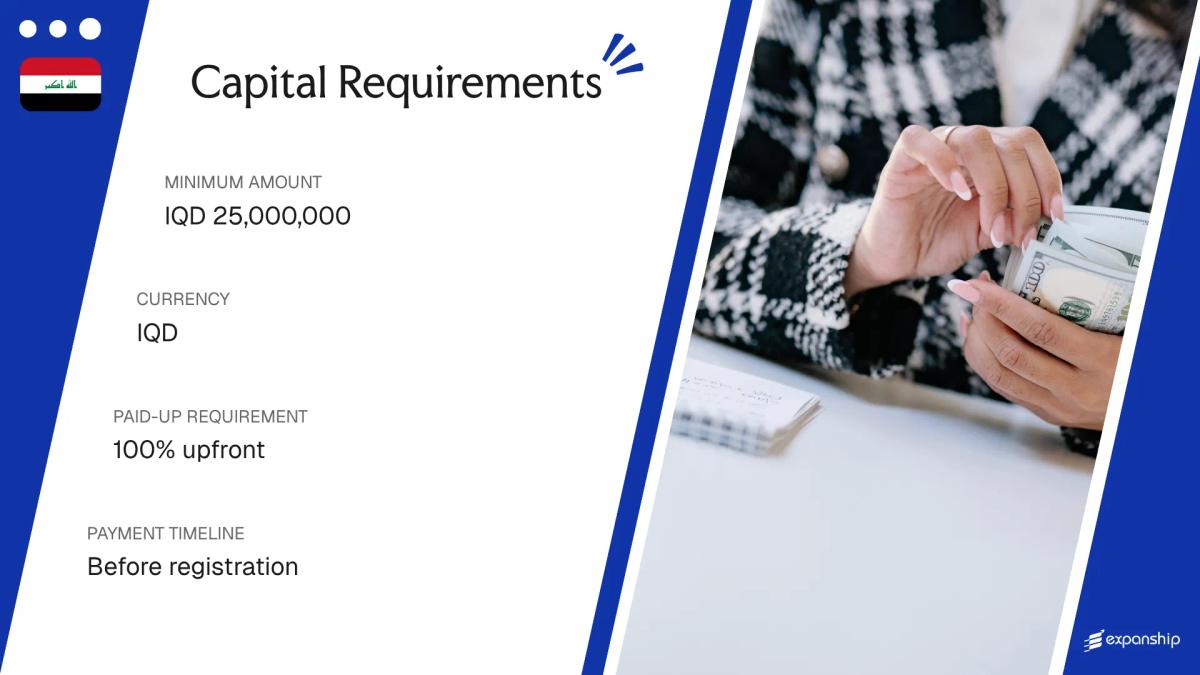
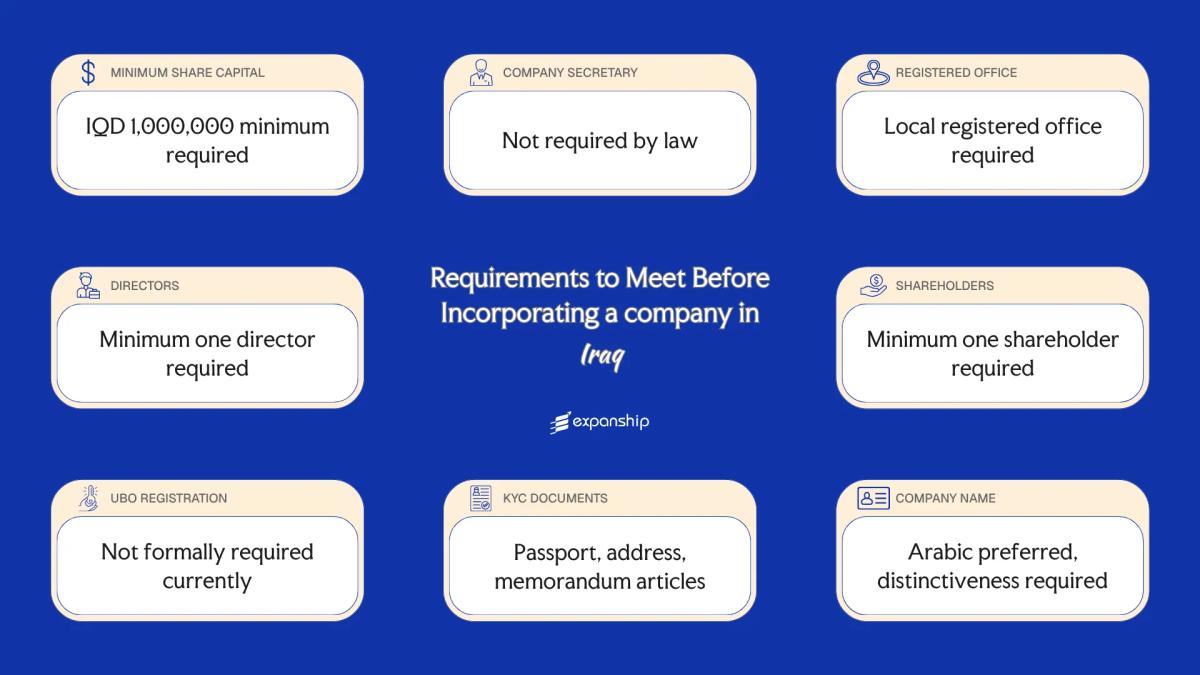
Iraq minimum share capital requirements are governed primarily by the Companies Law No. 21 of 1997, as amended, and enforced through the Companies Registration Department under the Ministry of Trade. Under this framework, share capital rules in Iraq operate on a par value system, meaning each share carries a nominal face value.
Capital deposit verification occurs at the point of incorporation through the Companies Registration Department, which requires evidence of paid-up capital before a company receives its certificate of incorporation. This obligation is tied to the incorporation process itself, not treated as an ongoing annual statutory requirement.
| Parameter | Detail |
|---|---|
| Minimum Authorized Share Capital | IQD 1,000,000 for a limited liability company (approx. USD 760) |
| Maximum Authorized Share Capital | No statutory maximum |
| Minimum Paid-Up Capital | No statutory minimum paid-up threshold distinct from authorized capital |
| Paid-Up Requirement at Incorporation | Full authorized capital must be subscribed; partial payment may be accepted subject to company articles |
| Accepted Currency | Iraqi Dinar (IQD) |
| Accepted Forms of Contribution | Cash contributions; in-kind contributions permitted subject to valuation |
| Timeframe to Deposit Capital | Prior to or at the time of incorporation registration |
Capital must be deposited and evidenced before the Companies Registration Department issues the incorporation certificate. Subscribing to shares without completing the deposit formality will stall the registration process.
Registered Agent Requirements in Iraq
Under Iraqi company law, registered agent requirements in Iraq are tied to the broader concept of appointing an authorized legal representative who can act on behalf of a foreign or domestic entity before the Companies Registration Department at the Ministry of Trade. This representative serves as the formal point of contact for regulatory correspondence and compliance obligations.
The legal representative is responsible for receiving official notices, submitting required filings, and maintaining communication with the relevant Iraqi authorities. Failure to maintain a properly appointed representative can result in administrative complications with the registrar.
Qualification criteria for who may serve in this role include:
- The representative must be an individual, not a corporate entity.
- Iraqi residency is generally required for the appointed legal representative.
- The individual must hold valid legal capacity under Iraqi civil law.
- Foreign company agents operating in Iraq are typically required to hold a valid residency and work authorization.
- There is no general licensing requirement specific to this role, beyond legal capacity and residency.

Incorporate a Company in Iraq
Set up your business entity in Iraq with guidance on legal structure, registration requirements, and compliance obligations.
Registered Office Requirements in Iraq
Registered office requirements in Iraq mandate that every registered company maintain a physical address within the country, as stipulated under the Companies Law No. 21 of 1997 and overseen by the Companies Registrar at the Ministry of Trade. Failure to maintain a compliant legal address can result in administrative penalties, suspension of the company's registration, or strike-off proceedings initiated by the Registrar.
- A physical street address inside Iraq is required; a P.O. Box alone does not satisfy the legal address obligation.
- Virtual offices are generally not recognized as compliant registered office addresses under Iraqi company law.
- The address must be locally based within Iraq; foreign addresses cannot fulfill this requirement.
- Supporting documentation, such as a lease agreement or proof of property ownership, is typically required to verify the address.
- The registered address is recorded in the Companies Register and is accessible to the public.
- Any change to the registered office address must be formally notified to the Companies Registrar at the Ministry of Trade.
Director Requirements in Iraq
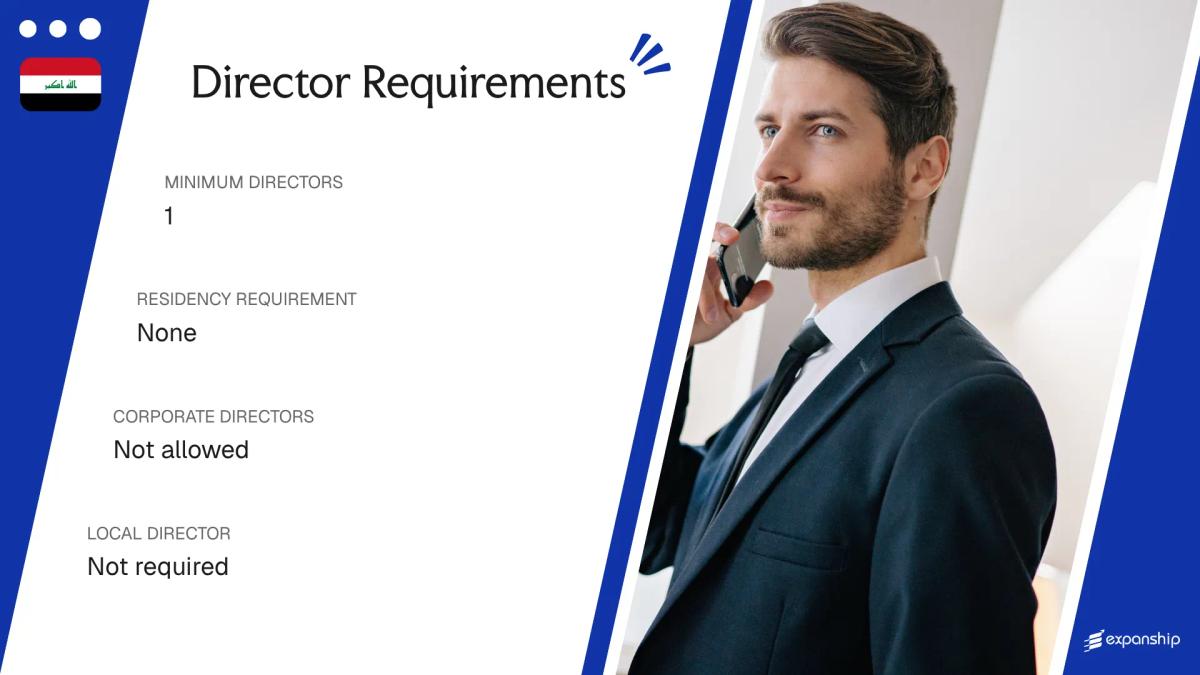
Under Iraqi company law, director requirements in Iraq are governed primarily by the Companies Law No. 21 of 1997 and its amendments, which establish the statutory duties and liabilities a director assumes upon appointment, including fiduciary obligations toward the company, personal liability for resolutions passed in violation of the law, and accountability to the General Assembly for management conduct.
| Parameter | Detail |
|---|---|
| Minimum Number of Directors | At least one director (manager) is required for a Limited Liability Company (LLC). |
| Maximum Number of Directors | No statutory maximum is prescribed under Companies Law No. 21 of 1997. |
| Local/Resident Director Required | No statutory requirement mandating a locally resident director exists, though practical licensing considerations may apply. |
| Nationality Restrictions | Foreign nationals may serve as directors, subject to applicable foreign investment regulations under Investment Law No. 13 of 2006. |
| Minimum Age Requirement | Directors must be of legal majority age, which is 18 years under Iraqi civil law. |
| Corporate Directors Permitted | Corporate entities are generally not permitted to serve as directors; a natural person is required. |
| Director Must Be a Shareholder | No statutory requirement obligates a director to hold shares in the company. |
| Publicly Listed on Registry | Director information is filed with the Companies Registration Directorate at the Ministry of Trade. |
| Disqualification Conditions | Individuals convicted of bankruptcy, fraud, or financial crimes are disqualified from serving as directors under Companies Law No. 21 of 1997. |
Despite allowing foreign nationals to hold directorships, certain regulated sectors in Iraq effectively require a local partner to assume the director role through licensing conditions rather than the Companies Law itself.
Shareholder Requirements in Iraq
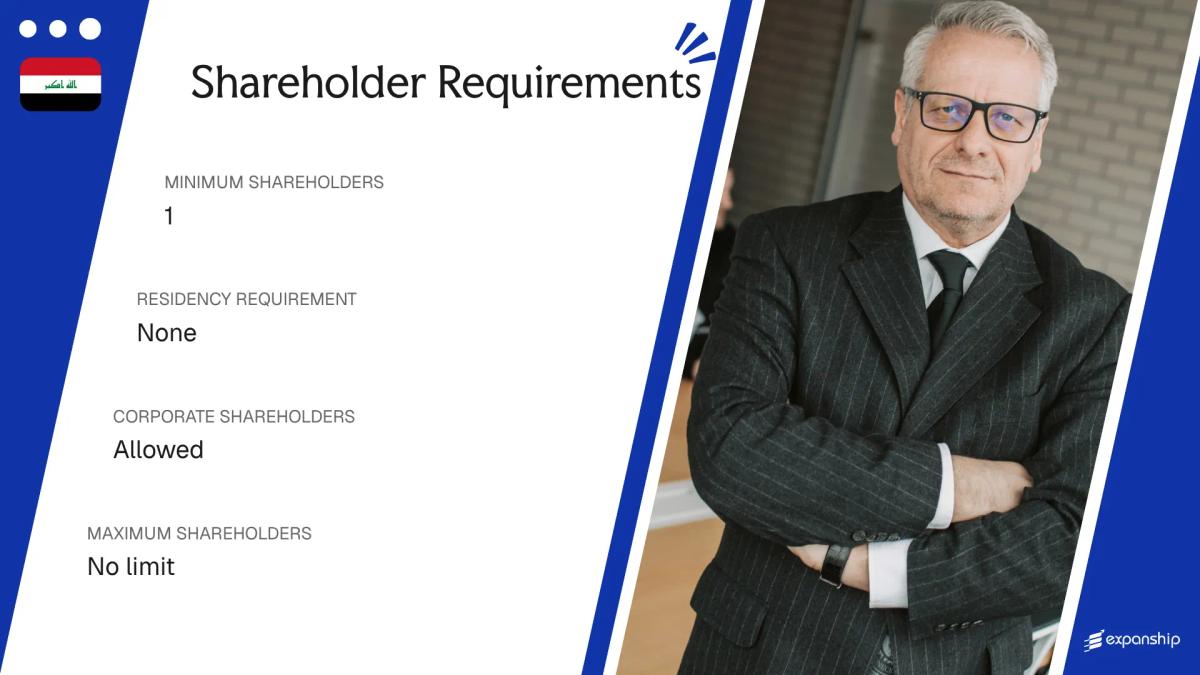
Under the Iraqi Companies Law No. 21 of 1997, a private limited liability company (LLC) requires a minimum of two shareholders and permits up to 25. A sole shareholder structure is not recognized for the standard LLC form under this framework.
Nationality and Residency Restrictions
Foreign nationals may hold shares in an Iraqi LLC, though certain sectors restrict or cap foreign ownership under applicable investment and sector-specific regulations. The National Investment Commission (NIC) oversees foreign participation under Investment Law No. 13 of 2006.
Corporate Shareholders
Corporate entities are generally permitted to act as shareholders in an Iraqi company. The specific conditions depend on the entity type and applicable sector regulations.
Shareholder Liability
Shareholder liability is limited to the value of each shareholder's capital contribution. In cases of fraud or improper conduct, courts may look beyond this limitation.
Register of Shareholders
A register of shareholders must be maintained and filed with the Companies Registration Department at the Ministry of Trade. Updates are required when ownership changes occur.
Structuring Your Shareholder Setup for Iraq Incorporation
Get guidance on ownership structures, foreign shareholding conditions, and documentation required when registering a company in Iraq.
UBO / Beneficial Ownership Disclosure Requirements in Iraq
Iraq beneficial ownership disclosure requirements are governed primarily by the Anti-Money Laundering and Countering the Financing of Terrorism Law No. 39 of 2015, administered by the Anti-Money Laundering and Countering the Financing of Terrorism Office (AMLCTFO). A beneficial owner is generally understood as any natural person who ultimately owns or controls 25% or more of a legal entity.
- Identify all natural persons holding 25% or above in the entity and document the ownership chain.
- Submit beneficial ownership information to the Companies Registration Department at the Ministry of Trade at the time of incorporation.
- Report any subsequent changes in UBO status to the same authority within a reasonable period of the change occurring.
| Parameter | Detail |
|---|---|
| Ownership Threshold for UBO Status | 25% or more |
| Filing Authority | Companies Registration Department, Ministry of Trade |
| Disclosure Deadline at Incorporation | At time of registration |
| Publicly Accessible Register | No statutory public register |
| Penalties for Non-Disclosure | Penalties apply under Law No. 39 of 2015; specific fines are determined by the AMLCTFO |
| Ongoing Update Obligation | Updates required upon material changes in ownership |
KYC / Document Requirements in Iraq
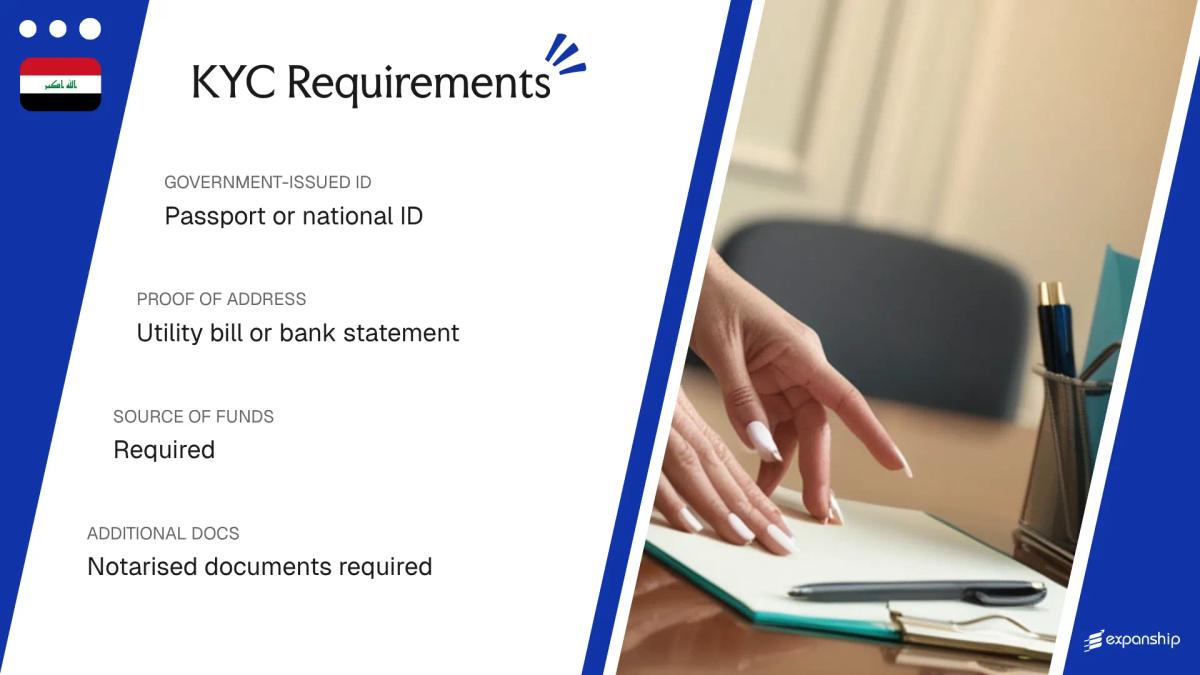
KYC document requirements Iraq company registration are governed by the Anti-Money Laundering and Countering the Financing of Terrorism Law No. 39 of 2015, enforced through the AMLCU at the Central Bank of Iraq.
Individual / Personal Documents
- Valid passport or national identity card for each individual director, shareholder, or beneficial owner
- Recent proof of residential address dated within three months, such as a utility bill or bank statement
- Completed know-your-customer declaration form as required by the registering authority
- Personal tax identification number where the individual holds one in their country of residence
Corporate Documents
- Certificate of incorporation of the corporate shareholder or director entity
- Memorandum and articles of association or equivalent constitutional document
- Current register of directors confirming the entity's authorised signatories
- Proof of the corporate entity's registered office address
Source of Funds Documentation
- Bank statements from the preceding three to six months evidencing available capital
- Audited financial statements where the shareholder is an established operating entity
- Written declaration of the source of funds if bank records are insufficient
Notarisation and Apostille Requirements
- Foreign documents generally require notarisation by a competent authority in the country of origin
- Official Arabic translation is required for all documents not already in Arabic
- Iraq is not a signatory to the Hague Apostille Convention; legalisation through the Iraqi embassy is the standard route
Untranslated foreign documents are among the most frequent causes of registration delay at the Iraqi Companies Registration Office.
Company Name Requirements in Iraq
Proposed company names in Iraq are assessed for uniqueness and public order compliance during the registration process. Any name that duplicates an existing registered entity or is considered contrary to public morals will be rejected.
Names must be written in Arabic, and a legal suffix indicating the entity type is required. No confirmed minimum or maximum character limits are publicly codified, but the suffix must accurately reflect the company's legal structure.
Certain words implying government affiliation, international bodies, or regulated industries require prior approval from the relevant ministry before the name can be accepted. Words considered offensive or misleading are outright prohibited.
Name reservation is available through the Companies Registrar at the Ministry of Trade. Reservations are generally granted for a limited period, after which the name lapses if incorporation is not completed.
Compliance Services for Companies in Iraq
Keep your Iraqi entity in good standing with timely filings, annual renewals, and ongoing regulatory support handled by local specialists.
Conclusion
Meeting Iraq company incorporation requirements involves understanding a defined set of obligations governed primarily by the Companies Law No. 21 of 1997 and overseen by the Companies Registration Directorate. Minimum share capital thresholds and residency-linked director conditions are among the more consequential factors for foreign investors. UBO disclosure obligations, shaped by anti-money laundering regulations administered through the Commission of Integrity, add another layer of formal compliance. Once these requirements are understood, the practical work of structuring and registering a business entity in Iraq can proceed with greater clarity.
Expanship's Corporate Formation Services in Iraq
Expanship's Iraq corporate formation services are structured around the specific requirements that govern entity setup under Iraqi law, including capital deposit procedures, the mandatory role of local partners or directors, and coordination with the Companies Registration Department. Working through these requirements independently adds considerable time to your setup timeline. Expanship reduces that operational burden by managing the procedural steps alongside you.
Our company incorporation services in Iraq cover the full registration lifecycle, from initial document preparation to post-formation obligations.
- We prepare and file all registration documents with the relevant Iraqi authorities on your behalf.
- Registered agent and office provision is arranged to satisfy local presence requirements.
- Our team liaises directly with government bodies throughout the filing process.
- Post-incorporation compliance, including annual obligations, is tracked and managed on your behalf.
- Banking introduction assistance is available to help your business establish a local account.
- Tax registration and liaison with the Iraqi General Commission of Taxes is handled as part of our service scope.
To discuss your requirements, contact Expanship Iraq.
Frequently Asked Questions (FAQ)
Yes, Iraqi law generally requires that the manager or at least one director of an LLC be an Iraqi national or a resident with the appropriate authorization. Foreign-owned entities operating under investment licenses granted by the National Investment Commission (NIC) may have different arrangements, but this exception is tied specifically to NIC-licensed structures and does not apply broadly.
Foreign nationals can hold shares in an Iraqi LLC, but 100% foreign ownership is only permitted under specific conditions authorized by the NIC under the Investment Law No. 13 of 2006. Outside of that framework, Iraqi law typically requires local participation in the ownership structure.
Non-compliance with beneficial ownership disclosure requirements can result in administrative penalties, suspension of business activity, or deregistration by the CRD. Iraq has been strengthening its anti-money laundering framework in alignment with FATF recommendations, and enforcement has become more active in recent years.
Iraqi company law requires that the registered office be a genuine physical address within Iraq where official correspondence and regulatory inspections can be conducted. A virtual office arrangement does not satisfy this requirement, and the CRD expects verifiable premises at the point of registration.
Registration through the NIC under Investment Law No. 13 of 2006 grants your business access to tax exemptions, land lease rights, and broader foreign ownership permissions that standard CRD registration does not provide. The two processes run through different regulatory channels, and the NIC route involves additional review steps and approval timelines that typically exceed those of a standard LLC incorporation.
Legal Disclaimer
The information provided in this article is for general informational purposes only and does not constitute legal, tax, or professional advice. While we strive to ensure the accuracy and timeliness of the content, laws and regulations are subject to change, and the application of laws can vary widely based on specific facts and circumstances.
Readers should not act upon this information without seeking professional counsel tailored to their individual situation. Expanship and its authors disclaim any liability for actions taken or not taken based on the content of this article.
For specific advice regarding your business setup, compliance requirements, or any legal matters, please consult with qualified legal and tax professionals in the relevant jurisdiction.