
Key Takeaways
- Foreign investors seeking majority control face structural barriers under Companies Law No. 21 of 1997, which imposes ownership restrictions that limit operational autonomy and require reliance on local partners or sponsors for legal standing.
- Registration through the Ministry of Trade's Companies Registration Directorate involves multi-stage procedural requirements across several government bodies, creating delays that can extend the incorporation timeline well beyond what is typical in comparable emerging markets.
- Iraq's underdeveloped banking infrastructure restricts access to standard financial services, making routine functions such as capital transfers, trade finance, and account maintenance operationally burdensome for foreign-owned entities.
- Inconsistent enforcement of intellectual property rights means registered trademarks, patents, and proprietary assets receive limited practical protection, exposing foreign businesses to commercial risk that legal registration alone cannot adequately address.
Iraq's regulatory environment for foreign businesses sits within an evolving legal framework, shaped by post-conflict reconstruction pressures and ongoing legislative reform. Companies Law No. 21 of 1997 and its subsequent amendments govern corporate formation, but enforcement and interpretation remain inconsistent across government bodies.
The disadvantages of incorporating in Iraq span multiple dimensions, from ownership restrictions and registration hurdles to financial infrastructure and security conditions.
These disadvantages do not affect every entrant equally. A multinational entering the oil and gas sector under a technical service contract faces a materially different set of constraints than a small foreign-owned trading firm registering under the Ministry of Trade.
This article is most relevant to foreign investors and business owners seeking direct equity participation or operational control through a locally registered entity in Iraq.
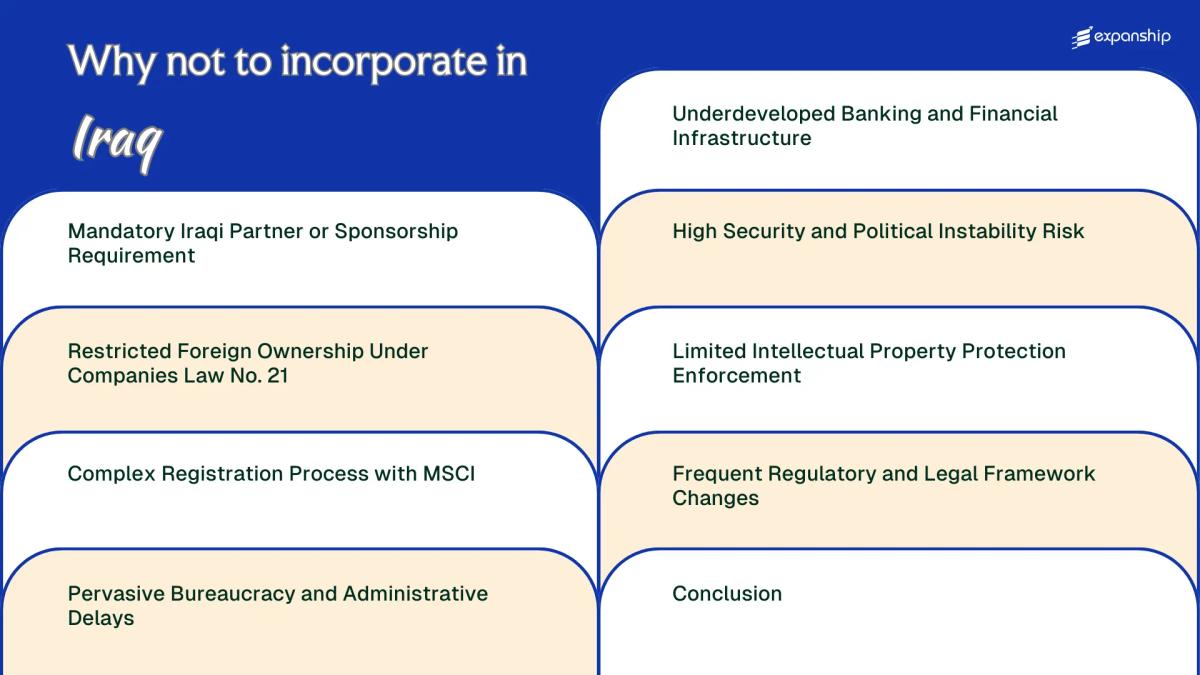
Mandatory Iraqi Partner or Sponsorship Requirement
Foreign companies operating in Iraq face the Iraq mandatory local partner requirement as a structural barrier from the moment they begin setup. This obligation directly limits your control over the business before operations even begin.
Structural Dependence on a Local Party
Under the Investment Law No. 13 of 2006 and related regulations, many foreign firms must engage an Iraqi national or locally registered entity as a partner or agent to conduct business activities. Your Iraqi partner holds legal standing that you do not, which means commercial decisions, contract execution, and regulatory dealings can depend on that party's cooperation.
This arrangement creates an unequal power dynamic that persists for the life of the business. If the relationship deteriorates, replacing a local partner involves legal proceedings under Iraqi Companies Law, which can be prolonged and unpredictable.
Profit and Control Implications
Profit-sharing with a mandatory local partner reduces your net return from operations. The local partner's share is not a fee you negotiate away; it is a structural cost tied to your legal ability to operate.
Exceptions exist in certain sectors covered by approved investment licenses granted by the National Investment Commission, but these are sector-specific and not universally available.
A foreign business owner can lose operational control entirely if the local partner withdraws cooperation, as Iraqi law may not provide a fast or enforceable remedy for foreign-held interests.
Restricted Foreign Ownership Under Companies Law No. 21
Iraq foreign ownership restrictions under Companies Law No. 21 of 1997 represent one of the most significant structural barriers facing foreign investors. The default position under this law limits foreign equity participation in most sectors, making full foreign ownership legally unavailable outside specific investment frameworks.
Under the general commercial company structure, foreign nationals are typically prohibited from holding a majority stake. This forces your business into a minority ownership position, which directly limits decision-making authority over operations, profit distribution, and strategic direction.
The practical consequences for a foreign business owner include:
- Profits cannot be freely allocated without approval or consent from the Iraqi majority shareholder, restricting your financial control
- Minority ownership exposes your investment to disputes with local partners who hold structural legal leverage over the entity
- Exit from the company is complicated when your stake is capped, since finding a buyer for a minority share in a restricted market is inherently more difficult
- Due diligence costs increase because verifying a local partner's legal standing and financial credibility becomes an operational prerequisite
Exceptions exist under the National Investment Law No. 13 of 2006, administered by the National Investment Commission, which permits 100% foreign ownership in approved sectors. However, qualifying for that framework requires a separate licensing process and does not cover all commercial activities.

Company Incorporation in Iraq
Understand the ownership structures available to foreign investors under Iraqi law before committing to a corporate setup.
Complex Registration Process with MSCI
The Iraq MSCI registration process challenges begin before your business even opens its doors. The Ministry of Trade's Companies Registration Directorate, operating under the Companies Law No. 21 of 1997, requires foreign entities to complete a multi-stage approval sequence that involves notarization, translation, ministerial review, and publication in the Official Gazette. Each stage is handled by a separate authority, and delays at any single point stall the entire sequence.
| Registration Stage | Responsible Body | Estimated Processing Time |
|---|---|---|
| Document notarization and legalization | Notary Public / Foreign Ministry | 2 to 4 weeks |
| Arabic translation (certified) | Approved translators only | 1 to 2 weeks |
| Company file review and approval | Companies Registration Directorate (MSCI) | 4 to 8 weeks |
| Official Gazette publication | Ministry of Justice | 2 to 4 weeks |
| Tax and chamber registration | Tax Authority / Chamber of Commerce | 2 to 3 weeks |
Certified Arabic translations are mandatory for all incorporation documents, and only state-approved translators are accepted. This requirement alone adds both cost and time before submission is even possible.
Publication in the Official Gazette is a legal prerequisite for the company to acquire legal personality. Until that step is complete, your firm cannot open bank accounts or execute contracts, leaving operations in suspension for weeks.
Pervasive Bureaucracy and Administrative Delays
Iraq bureaucracy risks for foreign businesses are among the most operationally disruptive factors any foreign investor will encounter. Multiple government ministries must sign off on a single registration file, and coordination between them is inconsistent and slow.
The General Commission for Taxes and the Ministry of Trade each maintain separate approval tracks that do not run in parallel. A process that takes days in comparable regional markets can stretch into months in Baghdad.
Administrative delays incorporating in Iraq stem partly from paper-heavy procedures that persist even where digital alternatives exist elsewhere. Your firm's documents may stall at a single desk for weeks without any formal notification.
- Government approval from multiple ministries is required before your entity can legally operate
- No statutory maximum processing time is imposed on most inter-ministerial approvals
- Document authentication requirements add sequential delays outside your control
- Foreign-language documents must be officially translated and notarized locally before submission
Foreign investors operating in the Kurdistan Region may encounter a separate administrative layer through regional authorities, adding further procedural complexity rather than reducing it.
Iraq ranks among the lowest globally for ease of starting a business, but the bureaucratic delay is often worse for foreign firms than for domestic ones due to additional authentication and approval steps that local entities are not subject to.
Underdeveloped Banking and Financial Infrastructure
Iraq banking infrastructure limitations for companies are among the most operationally disruptive factors foreign investors encounter. The financial system remains fragmented, state-dominated, and poorly integrated with global banking networks.
Structural Weaknesses in the Banking Sector
State-owned banks, including Rafidain Bank and Rasheed Bank, control a significant portion of deposits but operate with outdated systems and limited correspondent banking relationships, making routine international transfers slow and unreliable. For a foreign-owned entity, this means delayed capital injections, difficulties paying overseas suppliers, and restricted access to trade finance instruments that would be standard in most comparable emerging markets.
Consequences for Day-to-Day Business Operations
Private banks operating under the oversight of the Central Bank of Iraq are more commercially oriented, yet many still lack access to SWIFT-connected infrastructure at the level required for high-volume cross-border transactions. Dollar liquidity constraints, which intensified following Central Bank of Iraq currency auction reforms, directly affect your firm's ability to convert dinars and repatriate profits without significant delays or losses on exchange.
Addressing Financial Infrastructure Challenges When Incorporating in Iraq
Understand how banking limitations and financial system constraints affect your business operations in Iraq, and get guidance on structuring your setup accordingly.
High Security and Political Instability Risk
Iraq political instability risk for investors is not an abstract concern — armed conflict, militia activity, and inter-factional political disputes have directly disrupted business operations, supply chains, and physical assets across multiple governorates. Your firm's exposure to these conditions is structural, not incidental.
- The presence of non-state armed groups operating outside federal government control in certain regions means physical assets, personnel, and logistics routes face threats that no contractual or insurance arrangement can fully offset.
- Recurring political deadlocks within the Council of Representatives have historically delayed the formation of governments for extended periods, stalling regulatory decisions and public procurement contracts that foreign firms depend on.
- Protests, civil unrest, and periodic curfews have forced temporary business closures with no formal compensation mechanism under current Iraqi law.
- Security risks doing business in Iraq extend to kidnapping and extortion threats targeting foreign nationals, which substantially increase operational insurance and personnel protection costs.
- The Kurdistan Region, governed separately under the Kurdistan Regional Government, operates under different security conditions, meaning risk profiles vary significantly by location.
Limited Intellectual Property Protection Enforcement
Iraq intellectual property protection problems stem from a combination of outdated legislation and severely limited institutional capacity to enforce existing rights. The primary governing statute, the Trade Secrets and Unfair Competition Law and the Copyright Law No. 3 of 1971, predate modern digital commerce by decades, leaving significant gaps in coverage for software, domain names, and digital content.
Patent and trademark registration is administered through the Central Organization for Standardization and Quality Control (COSQC), but enforcement of registered rights through the courts is unreliable. Judicial proceedings involving IP disputes are slow, and courts lack specialist IP chambers, which means rulings are inconsistent and difficult to predict.
Counterfeiting and unauthorized reproduction of branded goods remain widespread in practice. Your registered IP rights may exist on paper, yet extracting a remedy against an infringer requires litigation that can span years without a guaranteed outcome.
A foreign software firm operating in the Iraqi market with a locally registered copyright could spend upwards of three to four years pursuing an infringement case through general civil courts, with no dedicated IP tribunal to expedite proceedings, and no guarantee of damages recovery that offsets the legal costs incurred.
Frequent Regulatory and Legal Framework Changes
Iraq regulatory instability business risks are among the least quantifiable costs a foreign firm will encounter. Laws governing foreign investment, licensing, and sector access have shifted multiple times since the Investment Law No. 13 of 2006 was enacted, with amendments and ministerial instructions frequently altering the conditions under which foreign entities operate.
The National Investment Commission (NIC) issues directives that can modify approved investment terms after a project has already commenced. Your business may be operating under assumptions that are no longer legally current without any formal transition period.
Sector-specific regulations, particularly in oil, telecommunications, and construction, are subject to revision through executive orders that bypass standard legislative cycles. This creates a compliance gap that is difficult to manage remotely or without continuous in-country legal counsel.
Foreign companies also face inconsistent application of existing rules across different governorates. Regulatory interpretations that hold in Baghdad may not apply in Basra or Erbil, and no centralized mechanism reliably harmonizes enforcement.
- Regulatory changes can retroactively affect existing licenses
- Ministerial instructions carry legal weight without parliamentary approval
- No formal advance notice period is guaranteed before rule changes take effect
Approvals granted by the NIC under the Investment Law do not provide contractual immunity against subsequent regulatory amendments, meaning your licensed activity can be legally restricted or repriced after operations have begun.
Conclusion
The cons of incorporating in Iraq accumulate into a structural burden that few other emerging markets place on foreign investors simultaneously. Ownership restrictions under Companies Law No. 21 of 1997, mandatory local partnership requirements, and the administrative weight of the MSCI registration process each reduce your operational independence before the business even begins.
Security conditions, underdeveloped correspondent banking access, and inconsistent IP enforcement then impose ongoing costs that are difficult to budget for reliably. Regulatory instability compounds this further, since framework changes can alter your compliance obligations without predictable timelines.
An Iraq company formation drawbacks summary ultimately points to one conclusion: the risks are structural, not incidental. They stem from legislation, institutional capacity, and the political environment rather than from factors a well-prepared entry strategy can fully neutralise.
Strategies to Overcome These Challenges
Overcoming Iraq business incorporation challenges requires structural preparation before entry, not reactive adjustment after problems emerge.
- Register your entity type through the MSCI portal to satisfy the formal incorporation requirements under Companies Law No. 21 of 1997.
- Structure ownership arrangements in advance to comply with mandatory Iraqi partner or local sponsorship requirements applicable to foreign firms.
- Open corporate accounts with state-owned banks such as Rafidain or Rasheed Bank, which maintain broader correspondent banking access than most private institutions.
- File trademark and IP registrations with the Central Organisation for Standardisation and Quality Control before commencing commercial operations.
- Monitor regulatory updates through the Board of Supreme Audit and relevant ministry publications to track legal framework changes affecting your sector.
- Obtain political risk insurance through multilateral providers to address instability exposure that falls outside standard commercial risk policies.
These steps address the most structurally significant barriers but do not eliminate the underlying regulatory complexity that defines this jurisdiction's corporate environment. Foreign businesses should treat compliance as an ongoing operational function, not a one-time entry requirement.
Iraq's Overall Investment Potential
Iraq investment risks and potential are real on both sides of the ledger. The country holds the fifth-largest proven oil reserves in the world, a young and growing population, and a government that has made public commitments to diversifying the economy beyond hydrocarbons. Against that stands a documented set of structural barriers that any foreign business owner must weigh with clear eyes before committing capital.
| Pros | Cons |
|---|---|
| Access to one of the world's largest oil and gas markets creates substantial commercial opportunity | Foreign ownership is capped under Companies Law No. 21 of 1997, limiting control over your entity |
| A large, underserved consumer base offers genuine demand across sectors outside energy | Mandatory local partner or sponsorship requirements reduce operational independence |
| Government-stated policy supports foreign direct investment and economic diversification | The MSCI registration process involves multiple agencies and extended processing timelines |
| Reconstruction demand continues to generate infrastructure and services contracts | Pervasive administrative delays increase cost and time-to-market for foreign firms |
| Geographic position connects Iraq to Gulf, Levant, and Iranian markets | Intellectual property protections exist in statute but are inconsistently enforced in practice |
Security conditions and political instability remain material variables, not background noise.
Compliance Services for Companies in Iraq
Maintain regulatory standing and meet ongoing legal obligations for your Iraqi entity, from annual filings to statutory reporting requirements.
Conclusion
Iraq incorporation drawbacks conclusion: the structural barriers documented across this analysis reflect a foreign investment environment that carries measurable operational costs. Ownership restrictions under Companies Law No. 21 of 1997, combined with the mandatory local partner requirement, limit the degree of control your firm retains over its own entity. Security and political instability compound these concerns, introducing variables that no corporate structure can fully absorb. For businesses willing to accept that profile, targeted professional guidance on registration procedures and compliance obligations under Iraqi law remains a practical necessity.
Expanship's Iraq Expansion Support
Incorporating in Iraq places specific operational demands on foreign investors, from securing approvals through the Ministry of Trade and Industry's Companies Registration Directorate to satisfying the foreign ownership thresholds imposed under Companies Law No. 21 of 1997. Expanship works alongside your business to manage the procedural weight these requirements generate, reducing the administrative burden that compounds at each stage of the registration and compliance cycle.
Beyond the initial formation process, Expanship supports a wider range of corporate needs throughout your Iraq engagement.
- Expanship prepares and files all company registration documents with the relevant Iraqi authorities.
- A registered agent and official business address in Iraq are provided for your entity.
- Expanship liaises directly with government bodies, including the MSCI, on your behalf.
- Post-incorporation obligations are tracked and managed on an ongoing basis.
- Banking introduction support is available to help your firm establish local accounts.
- Tax registration and coordination with local fiscal authorities is handled for your business.
Reach out through Expanship Iraq to discuss your specific requirements.
Frequently Asked Questions (FAQ)
The requirement applies broadly to most foreign entities seeking to operate commercially in Iraq, though the specific ownership thresholds and exceptions depend on the sector and the investment framework being used. Under Companies Law No. 21 of 1997, wholly foreign-owned structures face significant restrictions, and most foreign investors must work with an Iraqi national partner or sponsor to proceed. Investment Law No. 13 of 2006 offers some exceptions in designated zones, but those carve-outs are limited in scope.
There is no fixed figure, but delays at the Ministry of Trade and Industry's Companies Registration Directorate regularly extend timelines by several months beyond what is officially stated, and each extension carries indirect costs including legal fees, staff time, and deferred revenue. Some foreign businesses report registration processes stretching well beyond a year when document authentication, sectoral approvals, and ministry sign-offs compound. These costs are real but difficult to budget for in advance because the timeline is not reliably predictable.
Enforcement of intellectual property rights in Iraq is weak in practice, even where statutory protections exist on paper. Courts lack the specialization and speed to resolve IP disputes efficiently, and counterfeiting or unauthorized use of trademarks and proprietary processes is difficult to stop through local legal channels alone. Foreign firms with valuable IP are generally advised to hold those assets in a separate offshore holding structure rather than within the Iraqi operating entity.
Iraq's banking sector presents greater practical limitations than most comparable Middle Eastern jurisdictions. Correspondent banking relationships are restricted due to international compliance concerns, dollar liquidity constraints are common, and cross-border fund transfers can face delays or rejections that would not occur in the UAE, Jordan, or even neighboring Kuwait. Foreign firms regularly find that basic treasury operations require workarounds that add cost and administrative overhead.
Regulatory changes in Iraq can alter licensing conditions, ownership rules, or tax obligations with limited transition periods, and there is no guaranteed grandfathering of previously approved structures. The legal framework has seen repeated amendments, and foreign investors have found that approvals granted under one ministry interpretation were later reversed or reinterpreted. Your company may need to restructure or seek fresh approvals at your own expense if the rules governing your sector shift after incorporation.
Companies Law No. 21 of 1997 operates as the baseline corporate statute and imposes restrictions that limit or complicate full foreign ownership in standard commercial entities. Investment Law No. 13 of 2006, administered through the National Investment Commission, provides a parallel path with more permissive ownership rights, but only for qualifying investment projects meeting defined capital thresholds and sectoral criteria. The two frameworks coexist without full harmonization, which means your structure and rights differ materially depending on which legal pathway your registration falls under.
Legal Disclaimer
The information provided in this article is for general informational purposes only and does not constitute legal, tax, or professional advice. While we strive to ensure the accuracy and timeliness of the content, laws and regulations are subject to change, and the application of laws can vary widely based on specific facts and circumstances.
Readers should not act upon this information without seeking professional counsel tailored to their individual situation. Expanship and its authors disclaim any liability for actions taken or not taken based on the content of this article.
For specific advice regarding your business setup, compliance requirements, or any legal matters, please consult with qualified legal and tax professionals in the relevant jurisdiction.