

Key Takeaways
- At least one director of an Indian company must have been physically present in India for a minimum of 182 days during the preceding calendar year, as required under the Companies Act 2013.
- Beneficial ownership disclosure must be filed with the Registrar of Companies via Form BEN-2, making transparent reporting of ultimate ownership a mandatory structural obligation rather than a voluntary disclosure.
- Foreign investors incorporating in India must obtain a Digital Signature Certificate to submit filings through the MCA21 portal, as the Registrar of Companies does not accept unsigned electronic submissions.
- Entity type determines which provisions of the Companies Act 2013 apply, meaning private limited companies, public limited companies, and one person companies are each subject to distinct requirements across capital, directorship, and shareholder structure.
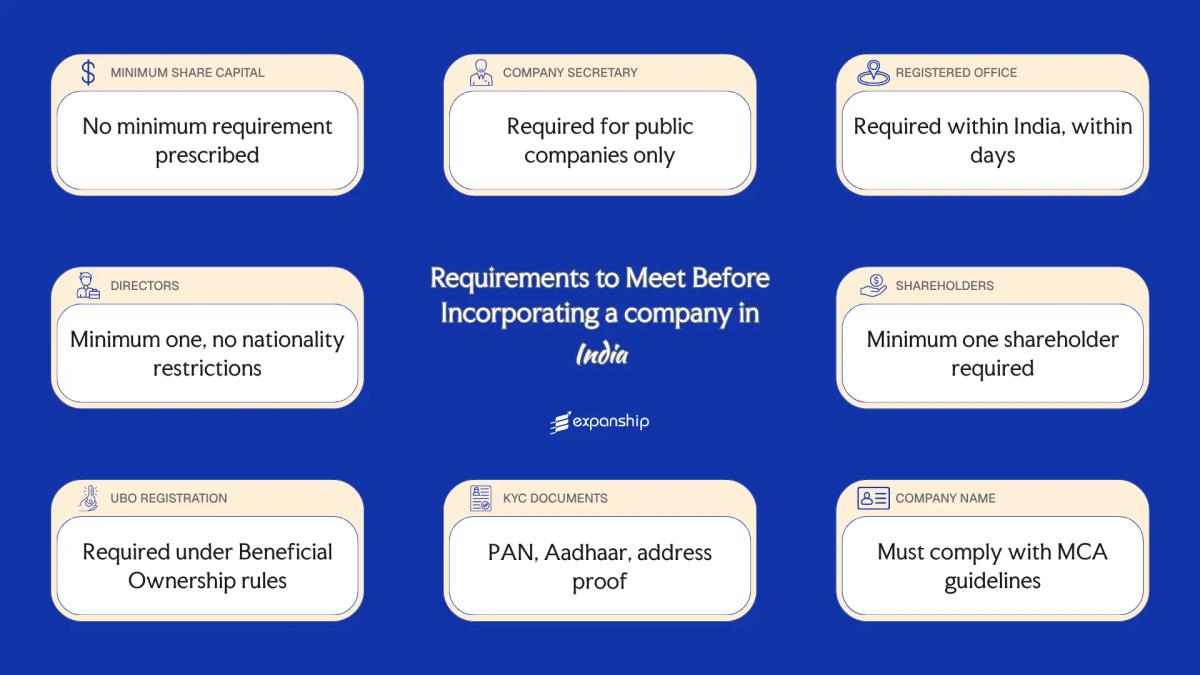
Incorporation requirements in India are governed by the Companies Act 2013, administered by the Ministry of Corporate Affairs (MCA) through the Registrar of Companies (RoC). The Act establishes the legal foundation for how companies are formed, structured, and maintained within the country.
This article covers the structural, documentary, and compliance-related requirements applicable to entity formation under Indian law. Requirements span areas including capital thresholds, directorship, registered office obligations, and beneficial ownership disclosure.
Failure to meet these requirements results in rejection of the incorporation application, and operating without valid registration exposes a business to penalties under the Companies Act 2013.
Specific requirements vary by entity type — private limited companies, public limited companies, and one person companies are each subject to different provisions. Your industry sector and foreign ownership structure may also affect applicable compliance obligations.
Foreign investors, non-resident entrepreneurs, and multinational firms establishing an Indian subsidiary will find this article most directly relevant to their situation.
Minimum Share Capital Requirements in India
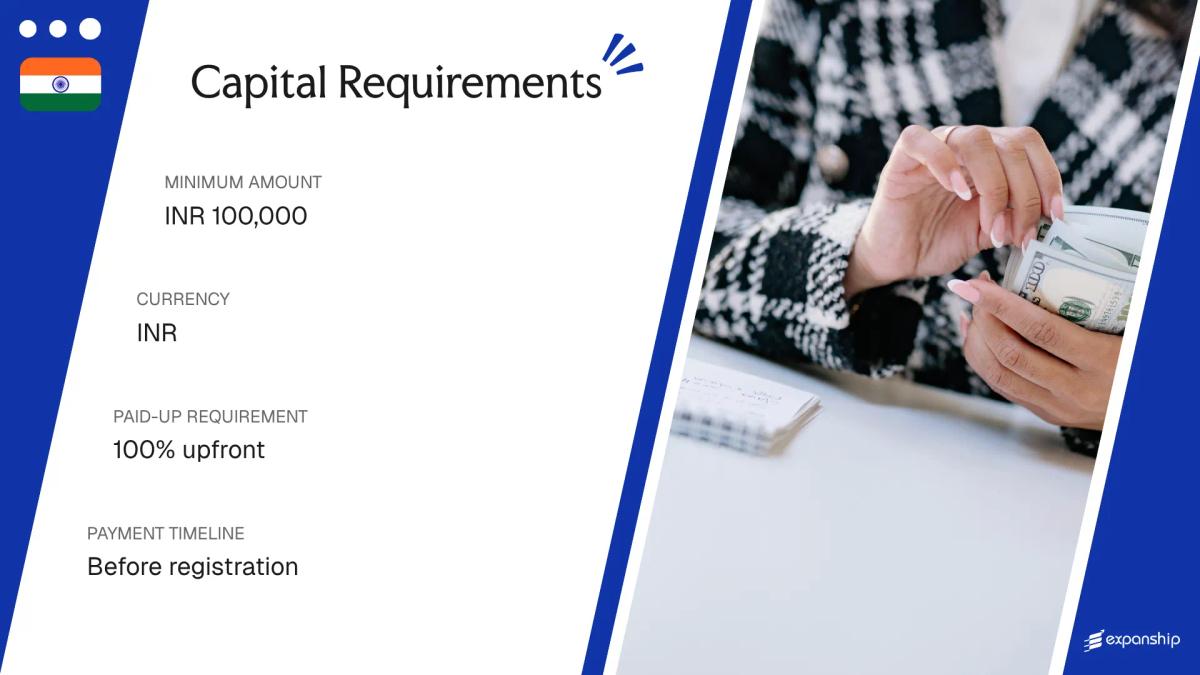
Under the Companies Act, 2013, minimum share capital requirements in India were formally abolished by the Companies (Amendment) Act, 2015. Private limited companies and public limited companies are no longer required to maintain a minimum paid-up capital at incorporation or on an ongoing basis. The Registrar of Companies (RoC), operating under the Ministry of Corporate Affairs, enforces capital-related compliance at the point of registration.
India operates on a par value share system, meaning each share must carry a stated face value. Authorised capital, which defines the ceiling on shares a company may issue, must still be declared in the Memorandum of Association and attracts stamp duty and RoC filing fees calculated on its amount.
| Parameter | Detail |
|---|---|
| Minimum Authorized Share Capital | No statutory minimum |
| Maximum Authorized Share Capital | No statutory cap |
| Minimum Paid-Up Capital | No statutory requirement |
| Paid-Up Requirement at Incorporation | No statutory requirement |
| Accepted Currency | Indian Rupee (INR) |
| Accepted Forms of Contribution | Cash or kind (movable/immovable property, intangibles) |
| Timeframe to Deposit Capital | No prescribed statutory deadline |
Abolishing the minimum paid-up capital requirement does not eliminate the need to declare authorised capital. Stamp duty and RoC fees are calculated on the authorised capital amount stated in your Memorandum of Association, so the figure you choose at incorporation has direct cost implications.
Company Secretary Requirements in India
Under the Companies Act, 2013, company secretary requirements in India apply to public companies with a paid-up share capital of Rs. 5 crore or more, as well as to certain other prescribed categories of companies. A company secretary in this context is a whole-time Key Managerial Personnel (KMP), distinct from a practicing company secretary engaged for certification purposes.
The Institute of Company Secretaries of India (ICSI) governs the profession, and CS compliance obligations in India are tied directly to ICSI membership. Only individuals holding a valid ICSI membership may serve in this capacity.
Qualification criteria for a company secretary in India:
- Must be an associate or fellow member of the Institute of Company Secretaries of India (ICSI).
- Must be an individual; a firm or corporate body cannot hold this position.
- Must not have been disqualified under any provision of the Companies Act, 2013.
- Responsible for ensuring board meeting procedures, filing of statutory returns, and maintaining statutory registers.
- For listed entities, additional obligations under SEBI regulations may apply.

Incorporate a Company in India
Set up your legal entity in India with end-to-end support on registration, compliance structuring, and document preparation.
Registered Office Requirements in India
Under the Companies Act, 2013, every company incorporated in India must maintain a registered office capable of receiving and acknowledging official correspondence from the Registrar of Companies and other statutory authorities. Failure to comply with registered office requirements in India can result in penalties under Section 12 of the Act, including fines on the company and its officers for each day the default continues.
- A physical address is required; a mere postal box does not satisfy the registered office obligation under Section 12 of the Companies Act, 2013.
- Virtual offices are permitted provided the address is a functional premises where official documents can be received and acknowledged.
- The address must be located within India, in the state where the company is registered with the relevant Registrar of Companies.
- Proof of ownership or a valid lease agreement, along with a no-objection certificate from the property owner, must be submitted to the MCA.
- The registered office address is publicly recorded on the MCA21 portal and forms part of the company's official public record.
- Any change of registered office must be notified to the Registrar of Companies by filing Form INC-22 within 30 days of the change.
Director Requirements in India
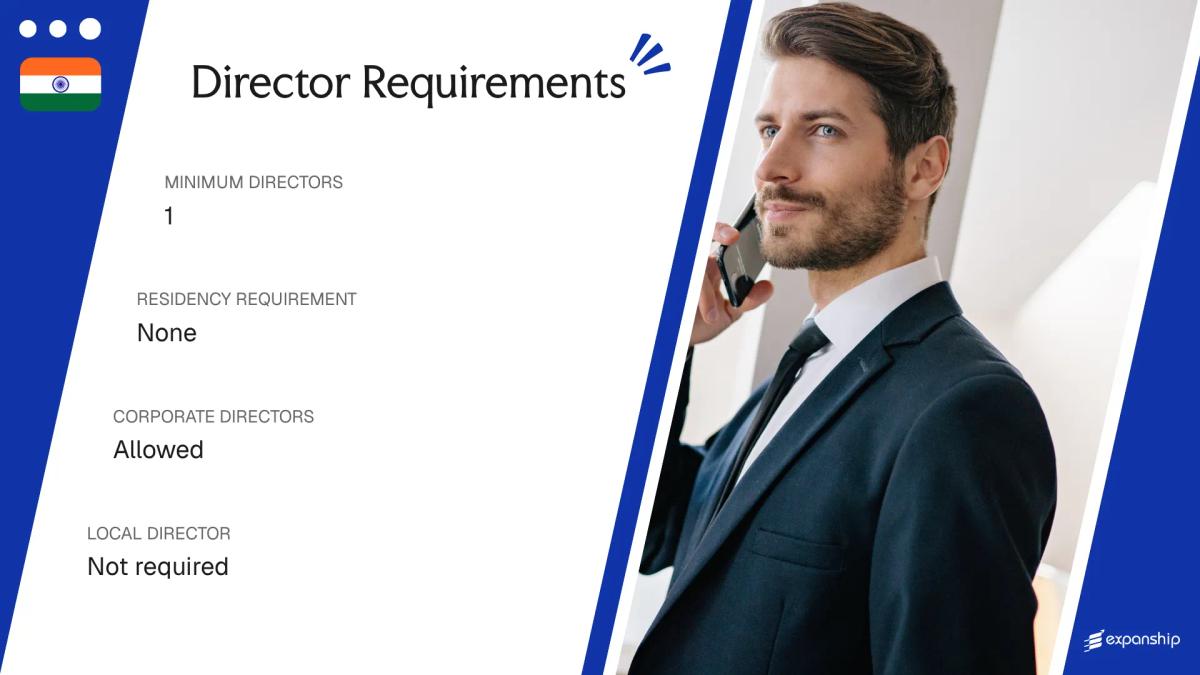
Meeting the director requirements India incorporation rules impose starts with understanding that every appointed director assumes statutory duties under the Companies Act, 2013, including fiduciary obligations to act in good faith, avoid conflicts of interest, and exercise reasonable care and diligence. Non-compliance can result in personal liability, disqualification, or prosecution under Sections 166 and 167 of the Act.
| Parameter | Detail |
|---|---|
| Minimum Number of Directors | A private limited company requires at least 2 directors; a public limited company requires at least 3. |
| Maximum Number of Directors | A company may have up to 15 directors without shareholder approval; beyond 15 requires a special resolution. |
| Local/Resident Director Required | At least one director must have stayed in India for a minimum of 182 days in the previous calendar year, per Section 149(3). |
| Nationality Restrictions | No nationality restrictions apply; foreign nationals may serve as directors. |
| Minimum Age Requirement | Directors must be at least 18 years of age. |
| Corporate Directors Permitted | Corporate directors are not permitted; only natural persons may be appointed. |
| Director Must Be a Shareholder | No statutory requirement for a director to hold shares in the company. |
| Publicly Listed on Registry | Director Identification Numbers (DIN) and basic particulars are filed with the Ministry of Corporate Affairs and are accessible via public records. |
| Disqualification Conditions | Disqualification arises under Section 164 of the Companies Act, 2013, on grounds including conviction for certain offences, failure to file financial statements for three consecutive years, or insolvency. |
A foreign national serving as a director is still required to obtain a Director Identification Number (DIN) from the Ministry of Corporate Affairs, going through the same application process as an Indian resident.
Shareholder Requirements in India
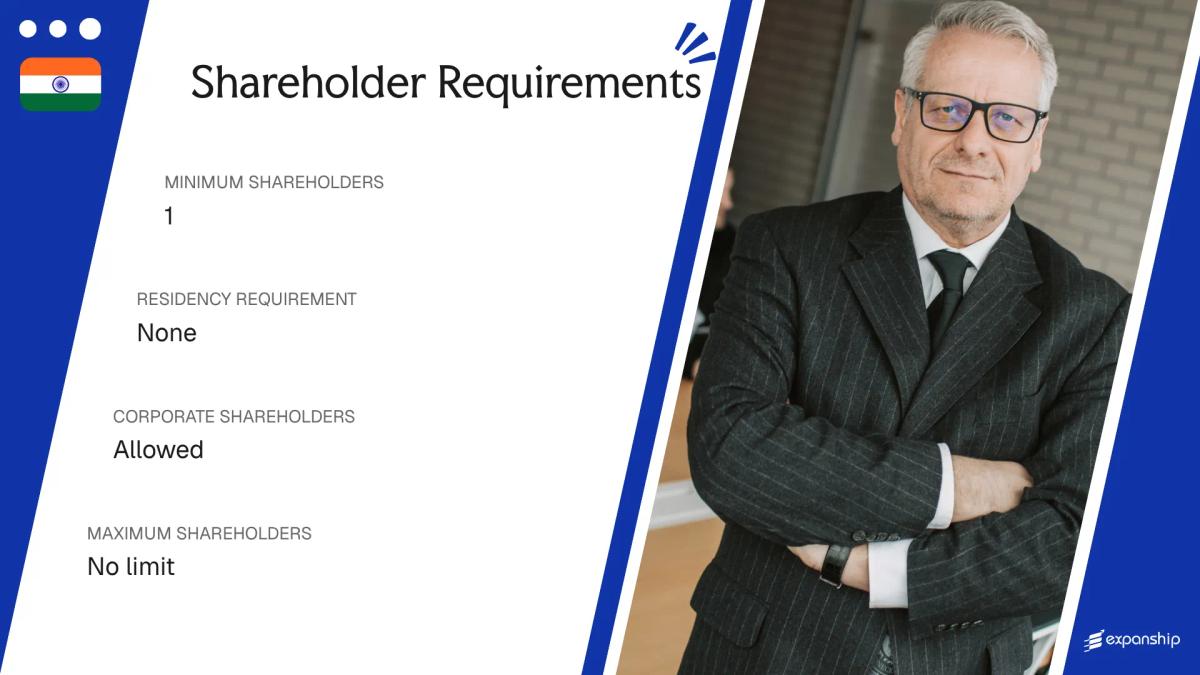
Under the Companies Act, 2013, a private limited company requires a minimum of two shareholders and permits a maximum of 200. A one-person company (OPC) structure exists for sole shareholder arrangements, though it carries its own statutory restrictions distinct from the private limited form.
Nationality and Residency Restrictions
Shareholders are not required to be Indian residents or nationals. Foreign ownership is generally permitted, though certain sectors are subject to caps or approval requirements under the Foreign Exchange Management Act (FEMA) and the FDI policy administered by the Department for Promotion of Industry and Internal Trade (DPIIT).
Corporate Shareholders
Corporate entities, including foreign companies, may hold shares in an Indian private limited company. Applicable FDI entry routes and sectoral conditions still govern the transaction regardless of the shareholder's legal form.
Shareholder Liability
Shareholder liability is limited to the unpaid amount on their shares. Piercing of the corporate veil remains possible in cases of fraud or misrepresentation, as recognized under judicial interpretation of the Companies Act, 2013.
Register of Shareholders
Every company must maintain a Register of Members under Section 88 of the Companies Act, 2013. This register is not publicly available on the MCA21 portal, but any changes in shareholding must be updated and remain available for inspection by members and debenture holders at the registered office.
Guidance on Shareholder Compliance for Your Indian Entity
Get clarity on shareholder structuring obligations, foreign ownership rules, and registration requirements when incorporating a private limited company in India.
UBO / Beneficial Ownership Disclosure Requirements in India
Under the Companies Act, 2013, read with the Significant Beneficial Owners (SBO) Rules, 2018, a significant beneficial owner is any individual holding at least 10% of shares, voting rights, or dividend entitlements in an Indian company, whether directly or through indirect or derivative means.
- The company identifies all individuals who qualify as SBOs based on the 10% threshold and notifies them using Form BEN-4.
- Each identified SBO files a declaration in Form BEN-1 with the company.
- The company then files Form BEN-2 with the Registrar of Companies within 30 days of receiving the BEN-1 declaration.
- The company maintains a register of SBOs in Form BEN-3, available for inspection at the registered office.
| Parameter | Detail |
|---|---|
| Ownership Threshold for UBO Status | 10% of shares, voting rights, or dividend rights |
| Filing Authority | Registrar of Companies (MCA21 portal) |
| Disclosure Deadline at Incorporation | Within 90 days of incorporation or upon crossing the threshold |
| Publicly Accessible Register | No; BEN-3 register is held at the registered office |
| Penalties for Non-Disclosure | Fines on the company and SBO; potential prosecution under Section 90 of the Companies Act, 2013 |
| Ongoing Update Obligation | Yes; changes must be declared and filed within 30 days |
KYC / Document Requirements in India
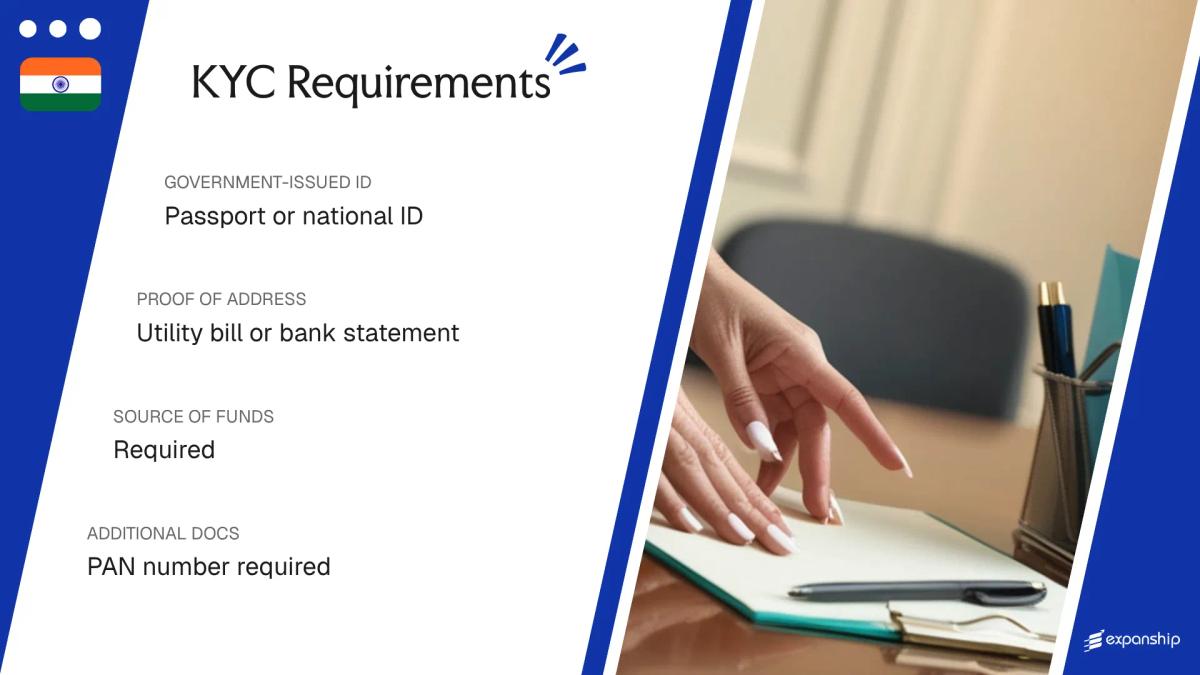
KYC requirements India company registration are governed primarily by the Prevention of Money Laundering Act, 2002 (PMLA), with MCA filings reinforcing identity verification obligations through forms such as DIR-3 KYC and the SPICe+ incorporation form; the Financial Intelligence Unit oversees AML compliance at the national level.
Individual / Personal Documents
- Passport (mandatory for foreign nationals); PAN card or Aadhaar for Indian residents
- Recent utility bill or bank statement as proof of residential address, dated within two months
- Passport-sized photographs are required for each director and individual shareholder
- A specimen signature on plain paper or as part of the DIR-3 KYC form submission
Corporate Documents
- Certificate of Incorporation of the foreign or domestic corporate entity
- Memorandum and Articles of Association or equivalent constitutional documents
- Register of Directors or equivalent document confirming current officeholders
- Proof of registered office address for the corporate shareholder or director
Source of Funds Documentation
- Recent bank statements covering at least three to six months of account activity
- Audited financial statements for corporate subscribers introducing share capital
- A written declaration of the source of funds may be required by the filing professional
Notarisation and Apostille Requirements
- Documents originating outside India must be notarised and apostilled under the Hague Convention
- India is a signatory to the Hague Apostille Convention; apostille is accepted in lieu of full legalisation
- Official translations into English are required where source documents are in another language
Mismatched name spellings across identity documents and MCA filings are the most frequent cause of SPICe+ form rejection.
Company Name Requirements in India
Company name requirements India govern how proposed names are assessed before incorporation. All names pass through the Ministry of Corporate Affairs portal, where automated checks screen for similarity with existing registered entities, trademarks, and prohibited terms. A name that is deceptively similar to a registered business or a well-known brand will be rejected.
Names must be in English or a recognised Indian language and must end with the appropriate legal suffix reflecting the entity type. Private limited companies carry "Private Limited" and public companies carry "Limited" at the end.
Certain words require prior approval from specific government bodies before the MCA will accept them. Words implying a connection to the government, national emblems, or regulated sectors such as banking or insurance fall into this category.
Name reservation is handled through the RUN (Reserve Unique Name) service on the MCA21 portal. A successfully reserved name remains valid for 20 days, within which incorporation must be initiated.
Compliance Services for Companies in India
Maintain your statutory obligations in India with structured compliance support covering annual filings, regulatory reporting, and ongoing corporate maintenance.
Conclusion
India company incorporation requirements are defined primarily by the Companies Act 2013, administered by the Ministry of Corporate Affairs through the Registrar of Companies. The framework sets out conditions across director appointments, registered office compliance, shareholder structure, and disclosure obligations that collectively govern how a foreign investor establishes a legal presence.
Among the more consequential obligations are the mandatory beneficial ownership disclosures under Form BEN-2 and the Digital Signature Certificate requirements that underpin the MCA21 portal filings. Director residency rules also carry practical weight, given the requirement for at least one director to have spent 182 days in India during the preceding calendar year.
Once these requirements are understood, the practical work of structuring the entity, appointing compliant officers, and filing with the Registrar of Companies begins.
Expanship's Corporate Services for India Expansion
Expanship's corporate services India company formation support is designed around the specific requirements set by the Ministry of Corporate Affairs, from preparing DSC and DIN applications to structuring your entity for MCA21 portal filings. Managing director eligibility rules, UBO declarations under the Companies Act 2013, and registered office documentation all carry precise compliance obligations that take time to coordinate correctly. Expanship's role is to reduce that operational burden, not to make the process something it isn't.
Beyond registration, the scope of support covers the full incorporation lifecycle:
- We prepare and file all company registration documents, including the SPICe+ form and supporting identity materials.
- A registered office address and agent service is provided where required.
- We liaise directly with the MCA, RoC, and other relevant government bodies on your behalf.
- Post-incorporation compliance management is handled to keep your entity in good standing.
- Banking introduction assistance is available to help your business establish a local account.
- Tax registration with the Income Tax Department and GST authorities is coordinated on your behalf.
Reach out through Expanship India to discuss your incorporation requirements.
Frequently Asked Questions (FAQ)
No statutory minimum paid-up capital applies to a private limited company under the Companies Act, 2013 following the 2015 amendment that removed the earlier INR 100,000 threshold. Your company can be incorporated with a nominal share capital, though the authorised capital you declare at incorporation will determine the stamp duty payable to the relevant state government.
Non-disclosure of significant beneficial ownership under Section 90 of the Companies Act, 2013 can result in the company and its officers being liable to a fine, and in continued default, a further daily penalty applies until compliance is restored. The Ministry of Corporate Affairs can also restrict the rights attached to the undisclosed shares.
Yes, every proposed director must obtain a Class 3 Digital Signature Certificate before submitting incorporation forms on the MCA21 portal. The DSC is used to authenticate the SPICe+ form and related declarations, so the process cannot advance without one issued in each director's name.
A residential address is legally permissible as a registered office for an Indian private limited company under the Companies Act, 2013. The address must be capable of receiving official correspondence from the Registrar of Companies and other regulatory authorities, and proof of that address, such as a utility bill and a no-objection letter from the property owner, must be submitted at the time of incorporation.
A name approved by the Registrar of Companies through the RUN (Reserve Unique Name) service is valid for 20 days from the date of approval. If the SPICe+ incorporation application is not filed within that window, the name reservation lapses and the process must be restarted.
Legal Disclaimer
The information provided in this article is for general informational purposes only and does not constitute legal, tax, or professional advice. While we strive to ensure the accuracy and timeliness of the content, laws and regulations are subject to change, and the application of laws can vary widely based on specific facts and circumstances.
Readers should not act upon this information without seeking professional counsel tailored to their individual situation. Expanship and its authors disclaim any liability for actions taken or not taken based on the content of this article.
For specific advice regarding your business setup, compliance requirements, or any legal matters, please consult with qualified legal and tax professionals in the relevant jurisdiction.