

Key Takeaways
- Foreign investors can hold 100% equity in most sectors without a local partner under India's automatic FDI route, eliminating the ownership dilution that applies in many comparable emerging markets.
- Domestic companies incorporated under the Companies Act, 2013 and electing the concessional regime under Section 115BAA of the Income Tax Act pay a base corporate tax rate of 22%, materially below the standard rate that applied before the 2019 reform.
- DPIIT-recognised startups can access a three-year income tax exemption under the Startup India scheme, reducing the effective tax burden during the critical early revenue phase.
- India's combination of an English-speaking technical workforce, a maturing venture capital ecosystem, and enforceable intellectual property rights under the Trade Marks Act and Patents Act produces an operating environment that few emerging markets can replicate in aggregate.
Incorporating a business in India — the world's most populous democracy and a sovereign republic — draws interest from foreign entrepreneurs seeking access to a large domestic market and a cost-effective operating base. The benefits of incorporating in India extend across tax, talent, capital access, and sectoral policy, making the jurisdiction a subject of serious evaluation for outbound investment strategies.
Company registration is administered by the Ministry of Corporate Affairs, which operates under the Companies Act, 2013. Foreign businesses typically establish a presence through a Private Limited Company. India follows a residence-based tax system with an extensive network of double taxation avoidance agreements, positioning it as a treaty-reliant jurisdiction rather than a zero-tax one.
Foreign direct investment is broadly permitted, with the government having progressively liberalized ownership rules across most sectors through its automatic and government approval routes. Your firm can hold full equity in many industries without requiring a local partner. This article covers the principal advantages of registering a company in India under the current regulatory and policy framework.
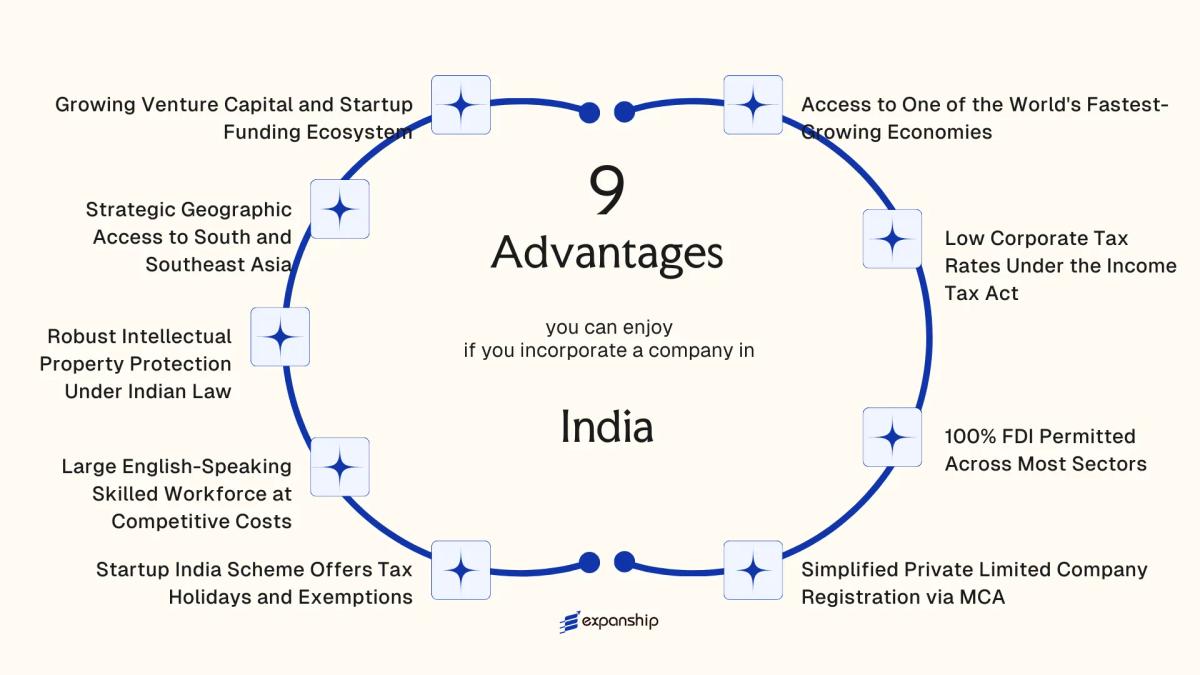
Access to One of the World's Fastest-Growing Economies
India fastest growing economy status is grounded in consistent GDP expansion — the IMF projected India's economy to grow at approximately 6.5% in 2024, making it one of the highest growth rates among major economies globally. For a foreign business owner, this trajectory means entering a market where consumer demand, infrastructure investment, and private sector activity are expanding simultaneously.
Scale and Consumer Market Depth
India's population exceeds 1.4 billion people, with a rising middle class driving domestic consumption across sectors from retail and financial services to manufacturing and technology. Tapping into this demand base is structurally difficult to replicate in comparable emerging markets.
Economic Policy Frameworks Supporting Foreign Participation
The government's Production Linked Incentive (PLI) scheme, active across 14 sectors, directly ties output growth to financial incentives for qualifying companies. Business opportunities in the Indian market have been further structured through bilateral investment treaties and trade agreements that provide your firm with a degree of legal predictability when operating across borders.
Incorporating locally positions your entity to qualify for sector-specific government incentive schemes that are unavailable to foreign-registered firms operating without a domestic presence.
Low Corporate Tax Rates Under the Income Tax Act
India corporate tax rate advantages stem directly from amendments introduced under the Taxation Laws (Amendment) Act, 2019, which inserted Section 115BAB into the Income Tax Act, 1961.
New manufacturing companies incorporated after 1 October 2019 and commencing production before 31 March 2025 qualify for a 15% base corporate tax rate under Section 115BAB. Including surcharge and cess, the effective rate comes to approximately 17%. For context, the standard corporate rate in Germany sits around 30%, and the U.S. federal rate is 21% before state-level additions. The gap is material for capital-intensive manufacturing operations.
Domestic companies not engaged in manufacturing can elect Section 115BAA, which caps the base rate at 22%, bringing the effective rate to roughly 25.17%. Opting into either regime requires forgoing certain deductions and incentives, so the net benefit depends on your firm's cost structure.
From a foreign investor's perspective, the Income Tax Act benefits for companies in India are reinforced by treaty access. India maintains Double Taxation Avoidance Agreements with over 90 countries, which can reduce withholding taxes on dividends and royalties repatriated to your home jurisdiction.
Why this tax structure works in practice:
- The 15% rate applies from year one, not after a qualifying period
- No minimum paid-up capital threshold conditions the rate eligibility
- The regime is codified in statute, not dependent on discretionary government approval
- Treaty benefits layer on top of domestic rates, compounding the fiscal advantage

Incorporate a Company in India
Set up your Indian private limited company with full compliance support under the Companies Act, 2013 and MCA registration requirements.
100% FDI Permitted Across Most Sectors
Under the Consolidated FDI Policy issued by the Department for Promotion of Industry and Internal Trade (DPIIT), foreign nationals and overseas entities can hold up to 100% equity in a wide range of Indian sectors without prior government approval. This automatic route mechanism means your business can establish a presence and receive foreign capital without navigating a case-by-case government clearance process, which directly reduces setup timelines and administrative overhead. The 100% FDI benefits in India apply across sectors including manufacturing, IT services, education, and logistics.
| Sector | Permitted FDI Limit | Route |
|---|---|---|
| IT & Software Services | 100% | Automatic |
| Manufacturing (most categories) | 100% | Automatic |
| Single Brand Retail Trading | 100% | Automatic (up to 49%), Government above |
| Defence | 74% | Automatic; beyond requires Government approval |
| Insurance | 74% | Automatic |
Sectors routed through the automatic channel are governed by the Foreign Exchange Management Act (FEMA) and its associated regulations administered by the Reserve Bank of India. Because RBI approval is not required for automatic route investments, the capital infusion process follows a structured post-facto reporting obligation rather than a pre-clearance requirement. This distinction is operationally significant: foreign capital can enter the entity before regulatory interaction concludes.
Certain sectors, including multi-brand retail and gambling, remain restricted or prohibited under the current policy, so confirming your firm's sectoral classification before structuring the investment is a prerequisite, not a formality.
Simplified Private Limited Company Registration via MCA
Registering a Private Limited Company (Pvt Ltd) in India is handled entirely through the Ministry of Corporate Affairs portal, using the SPICe+ (Simplified Proforma for Incorporating a Company Electronically Plus) form. This single integrated form covers name reservation, incorporation, PAN and TAN allotment, EPFO and ESIC registration, and GST enrollment in one submission. For a foreign investor, this consolidation means fewer agencies, fewer filings, and a predictable timeline rather than sequential approvals spread across multiple departments.
The process is paperless and centrally administered. Once the ROC (Registrar of Companies) approves the application, a Certificate of Incorporation is issued digitally under the Companies Act, 2013. Paid-up capital requirements for a Pvt Ltd are minimal, with no statutory minimum, which removes a common barrier that exists in several other Asian markets.
Keep these points in mind:
- A minimum of two directors is required; at least one must be an Indian resident under Section 149(3) of the Companies Act, 2013
- A registered office address in India is mandatory at the time of incorporation
- Foreign nationals must submit notarized and apostilled identity documents
- DIN (Director Identification Number) for foreign directors is obtained through the SPICe+ form itself
India's SPICe+ form also automatically enrolls the new entity with the Employees' Provident Fund Organisation, meaning your compliance clock starts from day one without a separate application.
Startup India Scheme Offers Tax Holidays and Exemptions
The Startup India scheme, administered through the Department for Promotion of Industry and Internal Trade (DPIIT), provides recognized startups with a set of tax benefits that directly reduce the cost of operating during the critical early years. For a foreign entrepreneur establishing a presence here, these Startup India scheme tax holiday benefits can materially alter the financial calculus of incorporation.
Three-Year Income Tax Holiday Under Section 80-IAC
Under Section 80-IAC of the Income Tax Act, 1961, DPIIT-recognized startups can claim a 100% tax deduction on profits for any three consecutive years out of their first ten years of incorporation. This effectively eliminates corporate income tax liability during those elected years, preserving capital that would otherwise leave the business.
Eligibility requires that the entity be incorporated as a Private Limited Company or a Limited Liability Partnership, with annual turnover not exceeding INR 100 crore in any financial year. Your business must also demonstrate that it is working toward innovation, development, or improvement of products, processes, or services.
Exemption on Angel Tax Under Section 56(2)(viib)
DPIIT-recognized firms are exempt from the angel tax provision under Section 56(2)(viib) of the Income Tax Act, which previously taxed capital raised above fair market value as income. Without this exemption, early-stage funding rounds could trigger unexpected tax liabilities, deterring seed and angel investors from participating.
This protection applies specifically to investment received by recognized startups, making the entity more fundable at a stage when external capital is most needed for growth.
Maximize Your Startup India Tax Benefits
Speak with Expanship's India incorporation specialists to assess your DPIIT recognition eligibility and structure your entity to qualify for available tax exemptions under the Startup India scheme.
Large English-Speaking Skilled Workforce at Competitive Costs
India's skilled English-speaking workforce advantage is among the most structurally significant factors for foreign firms evaluating the country as an incorporation base. With over 125 million English speakers, the country produces approximately 1.5 million engineering graduates and 800,000 IT professionals annually, giving your business access to a deep technical talent pool without the recruitment constraints common in smaller markets.
- English proficiency eliminates the communication overhead that typically affects operations in non-anglophone emerging markets, reducing training costs and shortening onboarding cycles for client-facing and technical roles.
- Average software developer salaries in India range from USD 8,000 to USD 20,000 per year, compared to USD 90,000 to USD 130,000 in the United States, making it cost-effective to build full in-country teams rather than relying on contract arrangements.
- The National Skill Development Corporation (NSDC), established under the Ministry of Skill Development and Entrepreneurship, funds structured vocational and technical training across sectors, which continuously replenishes the mid-level talent supply your operations can draw from.
- Tier-2 cities such as Pune, Hyderabad, and Chennai now host established IT and professional services clusters, meaning competitive labor costs India businesses benefit from are not confined to high-cost metros like Mumbai or Bengaluru.
Robust Intellectual Property Protection Under Indian Law
India intellectual property protection benefits are grounded in a set of dedicated statutes: the Patents Act, 1970 (amended in 2005), the Trade Marks Act, 1999, the Copyright Act, 1957, and the Designs Act, 2000. Each statute creates a distinct legal right, giving foreign businesses a clear, enforceable framework for protecting different categories of IP in a single market of over 1.4 billion people.
The Office of the Controller General of Patents, Designs and Trade Marks (CGPDTM) administers registration across all these categories. For a foreign entity, having a registered trademark or patent grants the right to initiate civil and criminal proceedings in Indian courts — a meaningful deterrent against infringement at scale.
India is also a signatory to the Paris Convention, the Patent Cooperation Treaty (PCT), and the WIPO Copyright Treaty. This means IP rights secured in your home jurisdiction can be extended to India through established international filing routes, reducing duplication of legal effort.
A foreign software firm that registers its copyright under the Copyright Act, 1957 automatically receives a 60-year protection term for software works, aligning with international standards and allowing long-term commercialization without repeated re-registration costs.
Strategic Geographic Access to South and Southeast Asia
India's strategic location advantage for businesses stems from its position at the intersection of South Asia, Southeast Asia, and the Middle East. Sitting along major Indian Ocean shipping lanes, the country connects your firm to over 1.9 billion consumers across SAARC nations alone.
For companies targeting regional expansion, an India-incorporated entity offers operational proximity to markets like Bangladesh, Sri Lanka, Nepal, and Myanmar, without requiring separate regional holding structures in each jurisdiction. Southeast Asian markets, including Singapore, Thailand, and Vietnam, are reachable within a four-to-five hour flight from major commercial hubs like Mumbai, Chennai, or Kolkata.
India's gateway to South Asia for companies is further reinforced through trade agreements. The country maintains bilateral and regional trade arrangements under frameworks including the ASEAN-India Free Trade Agreement and the SAARC Preferential Trading Arrangement, which can reduce tariff exposure on goods moving across member states.
- Chennai and Kolkata ports serve as eastern gateway nodes for Southeast Asian freight corridors.
- Mumbai's Jawaharlal Nehru Port Trust (JNPT) handles a significant share of India's container traffic, supporting import-export operations at scale.
Trade agreement benefits under AIFTA and SAPTA apply to goods meeting specified rules of origin criteria, so your product classification and manufacturing process must be reviewed before assuming preferential tariff access.
Growing Venture Capital and Startup Funding Ecosystem
The India venture capital ecosystem benefits for startups extend well beyond capital access. Incorporated entities gain credibility with institutional investors, which directly affects their ability to close funding rounds at competitive valuations.
SEBI, the Securities and Exchange Board of India, regulates Alternative Investment Funds (AIFs) under the AIF Regulations 2012. Category I and Category II AIFs specifically channel capital into early-stage and growth-stage companies, meaning your incorporated entity can receive structured fund inflows from registered domestic pools without navigating grey regulatory territory.
The Startup India initiative, administered by DPIIT, gives recognized startups access to a registered network of over 50 SEBI-registered VCs and angel funds through the Fund of Funds for Startups (FFS), seeded with INR 10,000 crore through SIDBI. For a foreign founder, this translates to a government-backed funding pipeline that is unavailable to unregistered or offshore-only entities.
Sectoral depth also matters here. Active VC investment is concentrated in fintech, SaaS, healthtech, and deeptech, with Mumbai, Bengaluru, and Delhi-NCR housing the largest concentration of fund managers. A locally incorporated Private Limited Company can issue CCPS (Compulsorily Convertible Preference Shares), the instrument most Indian VCs require by default, whereas a foreign structure typically cannot issue this instrument under FEMA regulations.
Key structural advantages for incorporated entities include:
- Eligibility to receive funding under the FFS routed through SIDBI
- Ability to issue CCPS and CCDS, the standard instruments in Indian term sheets
- Access to DPIIT recognition, which unlocks investor tax exemptions under Section 56(2)(viib)
India vs. Other Emerging Market Incorporation Destinations
Comparing India's incorporation profile against other emerging markets requires selecting competitors that target a similar investor profile. Brazil, Vietnam, and South Africa are the most relevant reference points: each attracts foreign capital through FDI liberalisation, has a large domestic consumer base, and is frequently evaluated alongside India by investors considering emerging market entry. The comparison below focuses on parameters where India's regulatory framework holds a neutral or favourable position relative to these three jurisdictions.
One distinguishing factor that shapes the India vs emerging markets incorporation advantages discussion is the combination of English as an official business and judicial language, a codified company law framework under the Companies Act, 2013, and a single online registration portal through the Ministry of Corporate Affairs. Vietnam conducts most regulatory processes in Vietnamese, Brazil's legal system operates in Portuguese, and South Africa, while English-speaking, has a smaller consumer market. These structural differences carry direct implications for post-incorporation compliance, dispute resolution, and day-to-day operational management by a foreign-based director or shareholder.
| Parameter | India | Brazil | Vietnam | South Africa |
|---|---|---|---|---|
| Primary company law | Companies Act, 2013 | Lei das S.A. / Civil Code | Law on Enterprises 2020 | Companies Act, 2008 |
| Official business language | English | Portuguese | Vietnamese | English |
| Standard incorporation timeline | 7-10 working days | 30-90 days | 7-15 working days | 5-10 working days |
| Minimum paid-up capital (private company) | None | None (Ltda) | None | None |
| Foreign director residency requirement | One resident director required | At least one resident director (Ltda) | At least one resident representative | None required |
| Online incorporation portal | MCA21 (National) | State-level JUCEB/JUCESP | National Business Registration Portal | CIPC online portal |
| Tax treaty network | 90+ treaties | 34 treaties | 80+ treaties | 79+ treaties |
| FDI automatic route availability | Yes, most sectors | Restricted in several sectors | Yes, but sector-specific licensing | Yes, most sectors |
Compliance Services for Companies in India
Manage your annual filings, director obligations, and statutory reporting requirements under the Companies Act, 2013.
Conclusion
The benefits of incorporating in India rest on a combination of structural tax advantages, market scale, and a legal framework that has been systematically updated to accommodate foreign ownership. Among the most substantive factors: the reduced corporate tax rate of 22% under Section 115BAA of the Income Tax Act, the three-year income tax exemption available to DPIIT-recognised startups, and the broad application of 100% FDI under the automatic route across most sectors. Together, these features lower the cost and administrative complexity of establishing a compliant, commercially active presence.
Whether a Private Limited Company under the Companies Act, 2013 suits your structure depends on your industry classification, revenue model, and intended ownership arrangement. A firm operating in a restricted FDI sector, for instance, will face approval requirements that differ materially from one entering under the automatic route. The applicable benefit set is not uniform across all business types.
For foreign founders and investors who qualify fully for the available provisions, the combination of a fast-growing domestic consumer base, capital access through a maturing startup funding ecosystem, and enforceable IP protections under the Trade Marks Act and Patents Act creates a foundation that is difficult to replicate in comparable emerging markets. The next step is matching your specific entity structure and sector to the correct registration pathway and compliance obligations under MCA and applicable regulatory bodies.
Start Your India Company Formation with Expanship
India company formation with Expanship covers the full arc of what a foreign investor needs to establish a Private Limited Company under the Companies Act, 2013. From coordinating with the Ministry of Corporate Affairs during the SPICe+ incorporation process to managing post-registration filings with the Registrar of Companies, Expanship handles the administrative and compliance work that would otherwise require multiple local specialists. The services are structured around the specific requirements of foreign-owned entities, including mandatory Director Identification Number registration and the Reserve Bank of India's foreign investment reporting obligations.
Expanship's India engagement covers the following areas:
- Document preparation, notarization, and apostille coordination for foreign director appointments
- Registered office address provision to satisfy MCA incorporation requirements
- Government filing and liaison with the Registrar of Companies across all relevant jurisdictions
- Post-incorporation compliance management, including annual ROC filings and board resolution maintenance
- RBI FIRMS portal reporting support for foreign direct investment transactions
- Banking introduction assistance to support corporate account opening with scheduled commercial banks
Reach out to Expanship India to discuss your company registration requirements.
Frequently Asked Questions (FAQ)
Company incorporation via the Ministry of Corporate Affairs (MCA) portal typically takes between 10 and 20 working days, depending on document completeness and any queries raised by the Registrar of Companies. The process uses the SPICe+ (Simplified Proforma for Incorporating Company Electronically Plus) form, which consolidates multiple registrations including PAN, TAN, and GST. Delays most commonly arise from discrepancies in director KYC documents or name approval rejections.
Under the Income Tax Act, 1961, a newly incorporated domestic company that does not claim specified exemptions or incentives is subject to a base corporate tax rate of 22% under Section 115BAA, plus applicable surcharge and cess, bringing the effective rate to approximately 25.17%. New manufacturing companies incorporated after October 1, 2019, may qualify for a reduced rate of 15% under Section 115BAB. The applicable rate depends on which regime the company opts into at the time of filing.
The Startup India scheme, administered by DPIIT, applies only to entities that meet specific eligibility criteria, not all newly registered firms. Your business must be incorporated as a Private Limited Company, Registered Partnership, or LLP, be less than 10 years old from the date of incorporation, and have an annual turnover not exceeding INR 100 crore in any previous financial year. Recognition under the scheme unlocks benefits including a three-year income tax exemption under Section 80-IAC, subject to approval by the Inter-Ministerial Board.
Yes. Under Section 149 of the Companies Act, 2013, every Private Limited Company must have at least two directors, and at least one of them must have stayed in India for a minimum of 182 days during the previous calendar year. A foreign national can serve as a director provided they obtain a Director Identification Number (DIN) and comply with KYC requirements. This residency condition applies to one director only; the remaining directors can be non-resident foreign nationals.
Trademark registration is governed by the Trade Marks Act, 1999, patent protection falls under the Patents Act, 1970, and copyright is covered by the Copyright Act, 1957, all administered through the Office of the Controller General of Patents, Designs and Trade Marks (CGPDTM). A company incorporated in India can file for IP protection domestically and also access international frameworks through India's membership in WIPO treaties. Enforcement is available through both civil courts and the Intellectual Property Appellate Board, providing multiple avenues for rights protection.
India's effective corporate tax rate of approximately 25.17% for domestic companies sits broadly in line with Brazil but is higher than Singapore's headline rate of 17% and certain Southeast Asian jurisdictions with preferential regimes. However, for new manufacturing entities, India's 15% rate under Section 115BAB is directly competitive with rates offered in Vietnam and Indonesia for qualifying investments. The comparison also shifts when accounting for India's large domestic consumer base, bilateral tax treaty network spanning over 90 countries, and the absence of withholding tax under specific treaty provisions.
Legal Disclaimer
The information provided in this article is for general informational purposes only and does not constitute legal, tax, or professional advice. While we strive to ensure the accuracy and timeliness of the content, laws and regulations are subject to change, and the application of laws can vary widely based on specific facts and circumstances.
Readers should not act upon this information without seeking professional counsel tailored to their individual situation. Expanship and its authors disclaim any liability for actions taken or not taken based on the content of this article.
For specific advice regarding your business setup, compliance requirements, or any legal matters, please consult with qualified legal and tax professionals in the relevant jurisdiction.