

Key Takeaways
- Foreign investors entering restricted sectors face a fragmented approval process under India's FDI policy, which imposes equity caps and government-approval requirements that materially limit ownership flexibility before a single rupee of capital is deployed.
- Under the Companies Act 2013, every incorporated entity must appoint at least one director who has been resident in India for a minimum of 182 days in the preceding calendar year, creating an immediate structural dependency for fully foreign-owned operations.
- India's multi-layered fiscal environment — combining GST rates across multiple slabs, corporate income tax obligations, and transfer pricing compliance for cross-border entities — adds recurring administrative cost that goes beyond the standard compliance burden seen in comparable emerging market jurisdictions.
- Repatriation of dividends and proceeds from Indian subsidiaries is subject to Reserve Bank of India oversight and Foreign Exchange Management Act regulations, meaning that extracting returns from an Indian structure carries procedural friction that does not dissolve once the business is profitable.
India operates under one of the more heavily regulated corporate frameworks among emerging economies, governed primarily by the Companies Act 2013. The drawbacks of company formation in India span procedural, financial, and sector-specific dimensions — each examined in detail through the sections that follow.
The disadvantages of incorporating in India do not apply uniformly. A wholly foreign-owned technology firm faces a materially different set of constraints than a domestic manufacturing entity or a foreign company entering a restricted sector.
This article is most relevant to foreign investors and multinational entities evaluating India as a jurisdiction for subsidiary formation, branch registration, or joint venture structuring.
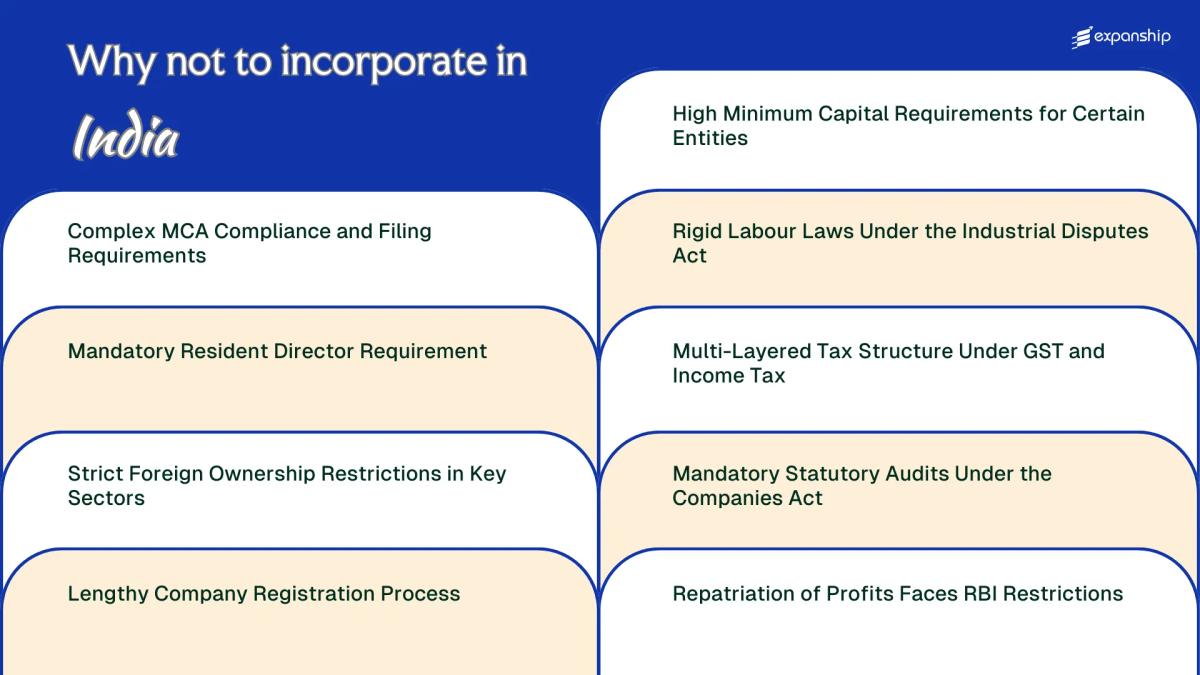
Complex MCA Compliance and Filing Requirements
MCA compliance challenges India extend well beyond routine paperwork. Foreign-owned companies registered under the Companies Act, 2013 face a dense web of mandatory filings administered by the Ministry of Corporate Affairs through the MCA21 portal.
Volume and Frequency of Mandatory Filings
Every private limited company must submit multiple annual returns and financial statements to the Registrar of Companies, including Form MGT-7 and Form AOC-4, within strict post-financial-year deadlines. Missing these deadlines triggers per-day late fees under Section 403 of the Companies Act, which accumulate quickly and can render a dormant or lightly active foreign subsidiary disproportionately expensive to maintain.
Directors of defaulting companies can also face personal disqualification under Section 164(2), a consequence that foreign nationals serving as nominee directors may not anticipate.
Ongoing Event-Based Filing Obligations
Beyond annual returns, any change in directors, registered office, or share capital requires separate event-based filings within prescribed timelines. For a foreign parent company that restructures frequently, each corporate change at the subsidiary level generates an independent compliance obligation that demands local legal coordination.
ROC annual filing problems India-based entities face are compounded by periodic MCA21 portal outages and form revision cycles, which can delay submissions even when a company is fully prepared.
A company that accumulates filing defaults under the Companies Act, 2013 risks being struck off the register by the ROC under Section 248, effectively invalidating the foreign investment made into that entity.
Mandatory Resident Director Requirement
The resident director requirement India restrictions impose under Section 149(3) of the Companies Act 2013 are straightforward in rule but operationally inconvenient in practice. Every company incorporated in the country must have at least one director who has stayed in India for a minimum of 182 days during the preceding calendar year. For a foreign-owned entity with no existing local network, sourcing and retaining a qualifying individual adds both cost and dependency to the corporate structure.
This is not a passive compliance checkbox. The appointed resident director carries legal accountability under Indian company law, meaning your firm's regulatory standing is partially contingent on an individual you may have limited control over.
The practical burdens this creates include:
- Recruiting a qualified resident director through third-party nominee services generates recurring annual fees that have no equivalent in many other Asian incorporation destinations
- If the appointed director resigns or loses qualifying residency status mid-year, the company falls out of compliance until a replacement is confirmed with the Registrar of Companies
- Any director disqualification under Section 164 of the Companies Act 2013 can restrict the entire company's ability to file returns or make regulatory applications
- Vetting a resident director for trustworthiness adds due diligence costs that foreign founders must absorb before operations begin
Private companies must still meet this threshold regardless of their size or turnover.

Company Incorporation in India
Set up your Indian company with compliant directorship arrangements and full MCA registration support.
Strict Foreign Ownership Restrictions in Key Sectors
Foreign ownership restrictions across India's key sectors represent one of the more significant structural barriers under the FEMA (Foreign Exchange Management Act) sectoral cap framework. The government enforces these limits through the Consolidated FDI Policy, administered by the Department for Promotion of Industry and Internal Trade (DPIIT), and any breach can trigger regulatory penalties or forced divestment.
Certain sectors are outright closed to foreign capital. Retail trading in tobacco products, lottery businesses, gambling, and chit funds are among the prohibited FDI sectors, meaning your business model may be entirely non-viable before incorporation even begins.
| Sector | FDI Cap | Entry Route |
|---|---|---|
| Print Media (publishing of newspapers) | 26% | Government approval |
| Private Security Agencies | 49% | Government approval |
| Insurance Companies | 74% | Automatic (beyond 49%, government) |
| Defence Manufacturing | 74% (100% in some cases) | Automatic up to 74% |
| Public Sector Bank Privatisation | 26% aggregate foreign cap | Government approval |
Even in permitted sectors, caps frequently require majority control to remain with an Indian partner. This forces foreign investors into joint ventures where strategic decisions, profit allocation, and exit rights depend on domestic counterparties rather than the investor's own business judgment. Sectors operating under the government approval route add further friction, requiring FIPB-successor clearances that extend timelines considerably. Foreign firms in capital-intensive industries find that minority ownership positions limit their ability to consolidate financials under home-country accounting standards.
Lengthy Company Registration Process
The lengthy company registration process in India adds measurable time and cost to your market entry. Incorporating a private limited company requires sequential approvals across multiple digital systems, including the Ministry of Corporate Affairs' MCA21 portal, and delays at any single stage cascade into the overall timeline.
Obtaining a Digital Signature Certificate, Director Identification Number, and name reservation through the SPICe+ form must each be completed before the next step can begin. A single name rejection by the Registrar of Companies resets the name approval stage entirely, which is a common cause of slow business incorporation timelines.
Post-incorporation, the firm must separately register for PAN, TAN, GST, and professional tax in applicable states. Each registration involves a distinct authority with its own processing window.
- Name approval under the SPICe+ form is subject to rejection if it resembles an existing registered entity or trademark
- DIN and DSC must be obtained before the SPICe+ filing can proceed
- GST registration is mandatory if turnover exceeds the applicable threshold and must be obtained from a separate portal after incorporation
- State-level registrations such as professional tax vary by location and have no unified processing timeline
- MCA registration delays can arise from document discrepancies, requiring resubmission and extending the overall window
Despite the government's Startup India initiative, a company formed under the Companies Act 2013 and a recognised startup must separately apply to DPIIT for startup recognition, meaning incorporation alone does not confer any startup-related tax benefits.
High Minimum Capital Requirements for Certain Entities
Certain entity types face statutory minimum capital thresholds that have no equivalent in many comparable markets, making minimum capital requirements India companies must meet a front-loaded financial commitment before operations begin.
Who Faces the Highest Thresholds
Non-Banking Financial Companies registered with the Reserve Bank of India are subject to a minimum net owned fund requirement of INR 10 crore (approximately USD 1.2 million), a figure that excludes working capital and operational setup costs entirely. For a foreign promoter sizing up entry options, that capital must be locked into the entity before the firm can legally commence NBFC activities, which delays any return on deployment.
Practical Consequences for Foreign Investors
The paid-up capital restrictions India imposes on NBFCs and certain category-specific licences mean that capital cannot be redirected until regulatory thresholds are satisfied and RBI approval is secured. A private limited company incorporated for general trade carries no prescribed minimum paid-up capital under the Companies Act, 2013, but the NBFC minimum capital challenges India presents can disqualify undercapitalised foreign entrants from accessing credit intermediation entirely.
Guidance on Managing Capital Requirements Before Entering India
Understand the capital thresholds applicable to your intended entity type and sector before committing funds to incorporation.
Rigid Labour Laws Under the Industrial Disputes Act
Labour law restrictions India businesses encounter under the Industrial Disputes Act, 1947 add significant operational friction, particularly for firms employing 100 or more workers.
- Establishments with 100 or more workers must obtain government permission before laying off, retrenching, or closing operations under Chapter VB of the Industrial Disputes Act, and approval is routinely withheld, leaving your business locked into payroll obligations it cannot exit.
- Even below the 100-worker threshold, retrenchment requires one month's prior notice or wages in lieu, plus retrenchment compensation calculated at 15 days' average pay per completed year of service, creating measurable exit costs on every employment contract.
- Misclassifying a dispute or failing to comply with mandatory conciliation procedures under the Act can expose your firm to adjudication before a Labour Court or Industrial Tribunal, a process that can extend for years.
- Contract labour arrangements are subject to the Contract Labour (Regulation and Abolition) Act, 1970, which allows the government to prohibit contract work in specific processes, removing a common workaround for workforce flexibility.
Multi-Layered Tax Structure Under GST and Income Tax
The tax structure challenges India companies face stem from two overlapping systems operating simultaneously: the Goods and Services Tax framework and the Income Tax Act, 1961. Your business must comply with both, and each carries its own filing schedules, registration thresholds, and penalty structures.
Under GST, firms are required to file multiple returns monthly and annually, including GSTR-1, GSTR-3B, and GSTR-9, depending on turnover. The GST compliance burden India businesses carry is compounded by the tiered rate structure — 0%, 5%, 12%, 18%, and 28% — which requires precise product and service classification that can expose foreign-owned entities to misclassification penalties.
Corporate income tax for domestic companies currently sits at 22% (plus surcharge and cess), bringing the effective rate closer to 25.17%. For foreign companies, the base rate is 40%, before surcharges apply.
- Input tax credit claims under GST are subject to vendor compliance, meaning your credit can be disallowed if a supplier defaults on their own filings.
- Transfer pricing regulations under the Income Tax Act apply to cross-border transactions between related entities, adding a separate documentation and audit obligation.
A foreign-owned company with INR 5 crore in annual revenue operating across two GST-registered states would manage separate state-wise GST registrations, monthly GSTR-3B filings, reconciliation with GSTR-2B for input credits, and an annual audit return — generating an estimated 200+ compliance actions per year before accounting for income tax obligations.
Mandatory Statutory Audits Under the Companies Act
Every company incorporated under the Companies Act, 2013 must appoint a qualified Chartered Accountant as its statutory auditor, regardless of revenue, size, or operational activity. This obligation applies from the first financial year, meaning even a newly formed entity with zero transactions carries a recurring audit cost.
The statutory audit is not a one-time exercise. Audited financial statements are required for annual filings with the Ministry of Corporate Affairs, and any delay or non-compliance triggers penalties under Section 147 of the Act.
For foreign business owners unfamiliar with Indian accounting standards (Ind AS or AS, depending on company classification), the process introduces an additional layer of dependency on local professionals. The statutory audit requirements India-based businesses face leave no threshold exemption for small or dormant private companies, which contrasts with several other jurisdictions where audit obligations are waived below certain turnover or asset thresholds.
Auditor appointments must also follow strict rotation norms under Section 139, requiring individual auditors to rotate every five years. This creates administrative continuity risk and repeated onboarding costs that compound over time.
Audit exemptions that apply in your home jurisdiction do not carry over — every Indian private limited company, including dormant ones, is legally required to appoint a statutory auditor under the Companies Act, 2013 before filing its first annual return.
Repatriation of Profits Faces RBI Restrictions
Profit repatriation restrictions in India are governed by the Foreign Exchange Management Act (FEMA), 1999, and administered by the Reserve Bank of India (RBI). While dividends can technically be remitted freely to foreign shareholders, the surrounding compliance framework creates friction that delays and increases the cost of moving funds abroad.
Before remitting dividends, your company must satisfy all applicable tax withholding obligations under the Income Tax Act, 1961, including a base withholding tax of 20% on dividends paid to non-residents, unless reduced by a relevant Double Taxation Avoidance Agreement (DTAA). Each remittance also requires a Chartered Accountant's certificate in Form 15CB, followed by a Form 15CA filing with the income tax portal. This certification requirement adds professional fees and processing time to every outward transfer.
For foreign investors accessing retained earnings or repatriating branch profits, RBI reporting requirements under FEMA regulations add another compliance layer. Any delay in meeting these filings can result in penalties under FEMA, effectively holding funds in the jurisdiction until documentation is complete.
Strategies to Overcome These Incorporation Challenges
Overcoming India incorporation challenges requires structural preparation before the entity is registered, not after problems surface.
- Appoint a resident Indian director at the time of incorporation to satisfy the Companies Act 2013 requirement under Section 149(3) before the MCA rejects your application.
- Review the Foreign Direct Investment Policy's sector-specific caps and entry routes on the DPIIT FDI portal prior to selecting your business activity and entity type.
- Register for GST and obtain your PAN and TAN simultaneously with MCA registration to avoid sequential delays in becoming operationally compliant.
- Structure equity and profit distribution agreements in advance to account for RBI repatriation procedures under the Foreign Exchange Management Act.
- Engage a statutory auditor before the first financial year closes, as the Companies Act 2013 mandates audit appointment at incorporation.
These steps address procedural and regulatory requirements that are fixed by statute, not subject to discretion. The Ministry of Corporate Affairs, RBI, and DPIIT each govern distinct compliance layers, and your entity must satisfy all three independently.
India's Overall Appeal for Foreign Investors
Despite the India foreign investment risks and appeal debate, the country remains a credible destination for foreign incorporation when the business model aligns with its regulatory structure. Its large consumer base, established legal framework under the Companies Act, 2013, and growing digital infrastructure give it weight as a serious market.
| Pros | Cons |
|---|---|
| Large domestic market with a population exceeding 1.4 billion consumers | FDI is prohibited or capped in sectors such as multi-brand retail and defence manufacturing |
| English-language legal system and well-codified corporate law under the Companies Act, 2013 | MCA compliance requires multiple periodic filings, with penalties for missed deadlines |
| Developed capital markets and access to a broad skilled workforce | At least one resident director must be appointed before incorporation can proceed |
| GST has unified indirect taxation into a single national framework | Profit repatriation requires RBI approval and adherence to FEMA regulations |
| Double Taxation Avoidance Agreements with over 90 countries reduce cross-border tax exposure | Company registration timelines can extend due to multi-agency approvals |
Corporate Compliance Services for Companies in India
Stay on top of MCA filings, annual returns, statutory audits, and RBI reporting requirements for your India-registered entity.
Conclusion
The cons of company incorporation in India are real and operational, not merely procedural. RBI restrictions on profit repatriation, the sector-specific foreign ownership caps enforced through FEMA, and the layered compliance obligations under the Companies Act 2013 each impose ongoing costs on foreign-owned entities. Structural decisions made at incorporation often determine your exposure to these constraints for years. Working with advisors who understand MCA filing cycles, FIPB-adjacent approval routes, and RBI remittance frameworks reduces the risk of non-compliance materially.
Expanship's India Incorporation Support Services
Registering a company in India involves a specific set of obligations that go well beyond the initial MCA filing. From satisfying the resident director requirement under the Companies Act 2013 to managing RBI-governed profit repatriation and sectoral FDI caps, the compliance burden compounds quickly. Expanship's India company incorporation support services are designed to reduce the operational weight of meeting these requirements, giving your business a structured path through each regulatory stage rather than leaving you to interpret them independently.
Expanship works across the full incorporation and post-registration cycle. Our services for India include:
- Preparing and filing company registration documents with the Ministry of Corporate Affairs
- Providing a registered agent and local office address for official correspondence
- Handling government filings and liaising directly with relevant regulatory bodies
- Managing ongoing post-incorporation compliance obligations under the Companies Act
- Facilitating introductions to local banking institutions for account opening
- Registering your entity for GST and coordinating with local tax authorities
To discuss your India setup, contact Expanship India.
Frequently Asked Questions (FAQ)
There is no fixed percentage cap on profit repatriation itself, but the process is governed by the Foreign Exchange Management Act (FEMA) and requires compliance with RBI regulations before funds can be transferred abroad. Dividends can only be distributed from after-tax profits, and any royalty or service fee payments to a foreign parent are subject to transfer pricing scrutiny by the Income Tax Department. Delays arise frequently when documentation does not satisfy the authorised dealer bank's requirements under FEMA.
Under the Companies Act, 2013, late filing attracts additional fees that escalate the longer the default continues, and persistent non-compliance can result in the company being struck off the Register of Companies by the Registrar. Directors of a defaulting company can also be disqualified under Section 164(2) from holding directorships in any Indian company for five years. The financial and professional consequences extend well beyond a simple fine.
Restrictions apply sector by sector, not uniformly. India's Foreign Direct Investment policy, administered through the Department for Promotion of Industry and Internal Trade (DPIIT), divides sectors into automatic route and government approval route categories, with certain industries such as defence, multi-brand retail, and print media carrying sub-limits or outright prohibitions. A foreign investor in an unrestricted sector can hold 100% equity without prior approval, while the same investor entering a restricted sector must apply to the Foreign Investment Facilitation Portal and wait for inter-ministerial clearance.
India operates a tiered GST structure with rates at 0%, 5%, 12%, 18%, and 28%, and correctly classifying your goods or services across these slabs requires ongoing legal review because misclassification triggers demand notices and penalties from the GST Council's enforcement arm. Beyond classification, businesses must file monthly or quarterly returns through the GSTN portal in addition to annual reconciliation statements, meaning a small firm can face over two dozen GST filings per year. That volume compounds when the business also carries Input Tax Credit claims that require matching with supplier filings.
For a Private Limited Company, India technically removed the statutory minimum paid-up capital requirement, so that specific barrier no longer applies at incorporation. However, certain regulated sectors, including banking, insurance, and non-banking financial companies (NBFCs), still impose substantial minimum net-owned fund or capital requirements set by the Reserve Bank of India or the relevant sectoral regulator. Choosing a standard Private Limited Company to sidestep capital thresholds is possible in unregulated sectors, but not in any activity requiring a sectoral licence.
Every company registered in India, regardless of size or turnover, is required under Section 139 of the Companies Act, 2013 to appoint a qualified Chartered Accountant as statutory auditor and have its accounts audited annually. Failure to comply exposes the company and its officers to prosecution under Section 147, which carries fines and potential imprisonment for directors. The audited financial statements are also a prerequisite for filing the annual return with the MCA, so non-compliance creates a cascading default across multiple regulatory obligations.
India's Industrial Disputes Act, 1947, requires companies employing 100 or more workers to obtain government permission before carrying out retrenchments or closures, a requirement that most comparable emerging markets do not impose at that threshold. In practice, approvals are rarely granted swiftly, and businesses have historically found the process expensive and time-consuming. The four new Labour Codes passed by Parliament consolidate existing legislation but have not yet been fully operationalised across all states, leaving businesses in a period of regulatory uncertainty.
Legal Disclaimer
The information provided in this article is for general informational purposes only and does not constitute legal, tax, or professional advice. While we strive to ensure the accuracy and timeliness of the content, laws and regulations are subject to change, and the application of laws can vary widely based on specific facts and circumstances.
Readers should not act upon this information without seeking professional counsel tailored to their individual situation. Expanship and its authors disclaim any liability for actions taken or not taken based on the content of this article.
For specific advice regarding your business setup, compliance requirements, or any legal matters, please consult with qualified legal and tax professionals in the relevant jurisdiction.