

Key Takeaways
- Every company incorporated in Israel must maintain a physical registered office address within the country, as required under the Companies Law, 5759-1999, administered by the Companies Registrar under the Ministry of Justice.
- Foreign investors are subject to beneficial ownership disclosure obligations introduced through the 2016 amendment to the Companies Law, requiring disclosure of ultimate beneficial owners as a condition of lawful registration.
- The entity type selected, the industry of operation, and the residency status of applicants each determine which specific structural and documentary requirements apply at the point of formation.
- Appointing compliant directors and securing a registered address are immediate post-structuring obligations that must be satisfied before the entity can obtain legal standing in Israel.
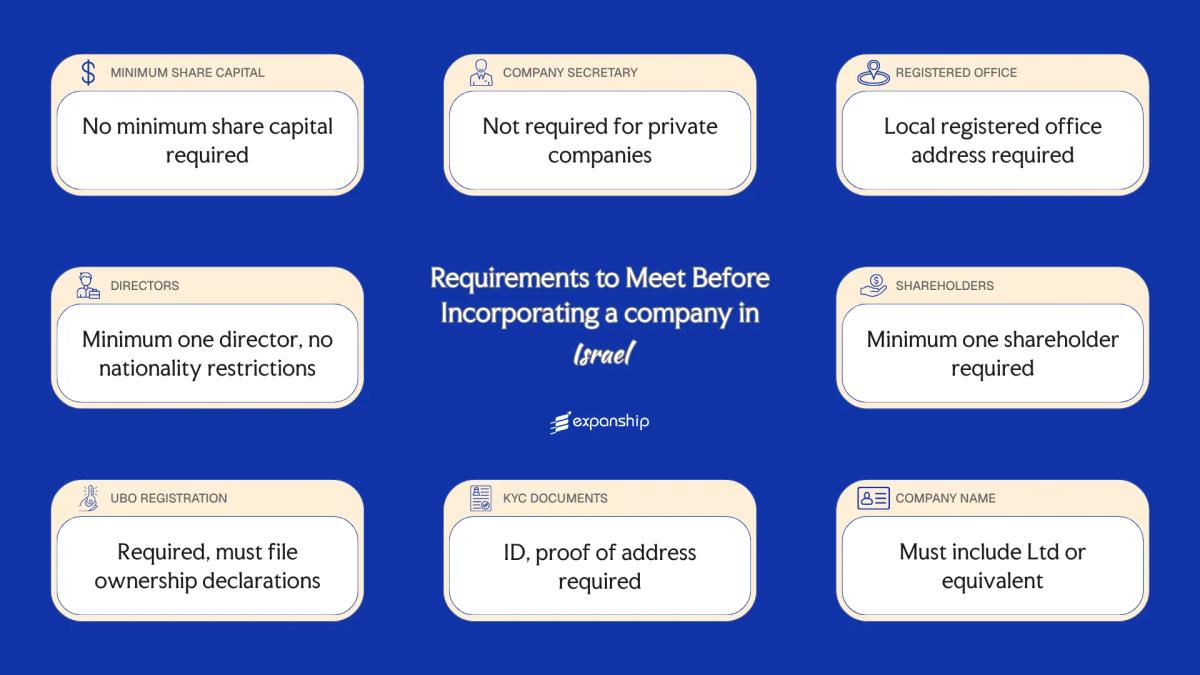
Entity formation in Israel is governed by the Companies Law, 5759-1999, with the Companies Registrar operating under the Ministry of Justice serving as the primary authority overseeing registration. Meeting the incorporation requirements in Israel is a prerequisite to obtaining legal standing; non-compliance results in rejection of the application or inability to operate as a registered entity.
The requirements covered in this article span structural, documentary, and governance obligations that apply at the point of formation. Specific conditions vary depending on the entity type selected, the industry your business operates in, and whether the applicant is a foreign national or a locally resident investor.
This article is most relevant to foreign entrepreneurs, multinational firms, and individual investors seeking to establish a legal presence through Israel company registration requirements before commencing operations.
Minimum Share Capital Requirements in Israel
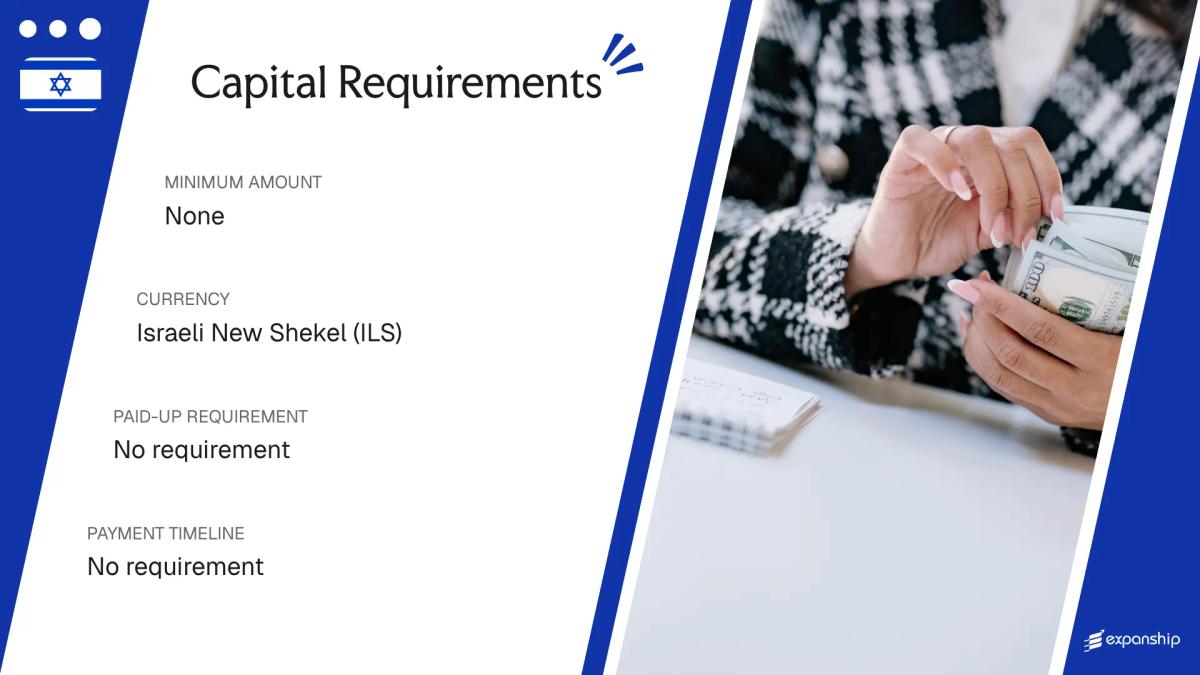
Under the Israeli Companies Law, 5759-1999, there is no statutory minimum share capital requirement for private companies (chevrot ba'am meugerot). Your business can be incorporated with a nominal share capital, giving founders flexibility in structuring equity from the outset.
Share capital is registered with the Israel Companies Registrar (Rasham HaChevrot) as part of the incorporation filing. The registrar does not require proof of capital deposit at the time of registration, and there is no ongoing statutory obligation to maintain a minimum capital threshold post-incorporation.
| Parameter | Detail |
|---|---|
| Minimum Authorized Share Capital | No statutory requirement |
| Maximum Authorized Share Capital | No statutory requirement |
| Minimum Paid-Up Capital | No statutory requirement |
| Paid-Up Requirement at Incorporation | No statutory requirement |
| Accepted Currency | Israeli New Shekel (ILS) or foreign currency |
| Accepted Forms of Contribution | Cash or non-cash assets |
| Timeframe to Deposit Capital | No statutory deadline |
No minimum share capital does not mean authorized capital can be omitted from the articles of association. The memorandum and articles filed with Rasham HaChevrot must still specify the authorized share structure, including the number of shares and their par or no-par value designation.
Company Secretary Requirements in Israel
Under the Companies Law 5759-1999, appointing a company secretary is not a statutory requirement for private companies in Israel. Public companies, however, are required to appoint a company secretary, who holds formal responsibilities under that law.
The secretary's duties include maintaining the company's registers, ensuring that board resolutions are recorded accurately, and submitting required filings to the Israeli Companies Registrar (Rasham HaChavarot).
Qualification criteria for serving as a company secretary in Israel:
- No mandatory licensing requirement exists for private company secretaries under Israeli law.
- Public company secretaries must meet fitness and propriety standards set by the Companies Law.
- A secretary may be an individual or a corporate entity, subject to the appointing company's articles.
- Residency in Israel is not a statutory requirement for this role.
- A person who has been declared legally incompetent or bankrupt is disqualified from serving.

Incorporate a Company in Israel
Set up your business entity in Israel with guidance on legal structure, registration, and ongoing compliance obligations.
Registered Office Requirements in Israel
Israel registered office requirements are governed by the Companies Law, 5759-1999, which mandates that every company registered with the Israel Registrar of Companies maintain a local address at all times. Failure to maintain a compliant address can result in regulatory action by the Registrar, including fines or striking the entity off the register.
- A physical street address in Israel is required; a P.O. Box alone does not satisfy the requirement.
- Virtual office addresses are generally accepted provided they correspond to a physical location within the country.
- The address must be locally based; a foreign address does not meet the statutory requirement under the Companies Law.
- Ownership or a lease agreement is not explicitly mandated by statute, but the address must be one where official correspondence can be received and the company can be contacted.
- The registered address is publicly listed in the Companies Register maintained by the Registrar of Companies under the Ministry of Justice.
- Any change to the registered address must be formally reported to the Registrar of Companies by filing the appropriate notice, and the update takes effect upon registration.
Director Requirements in Israel
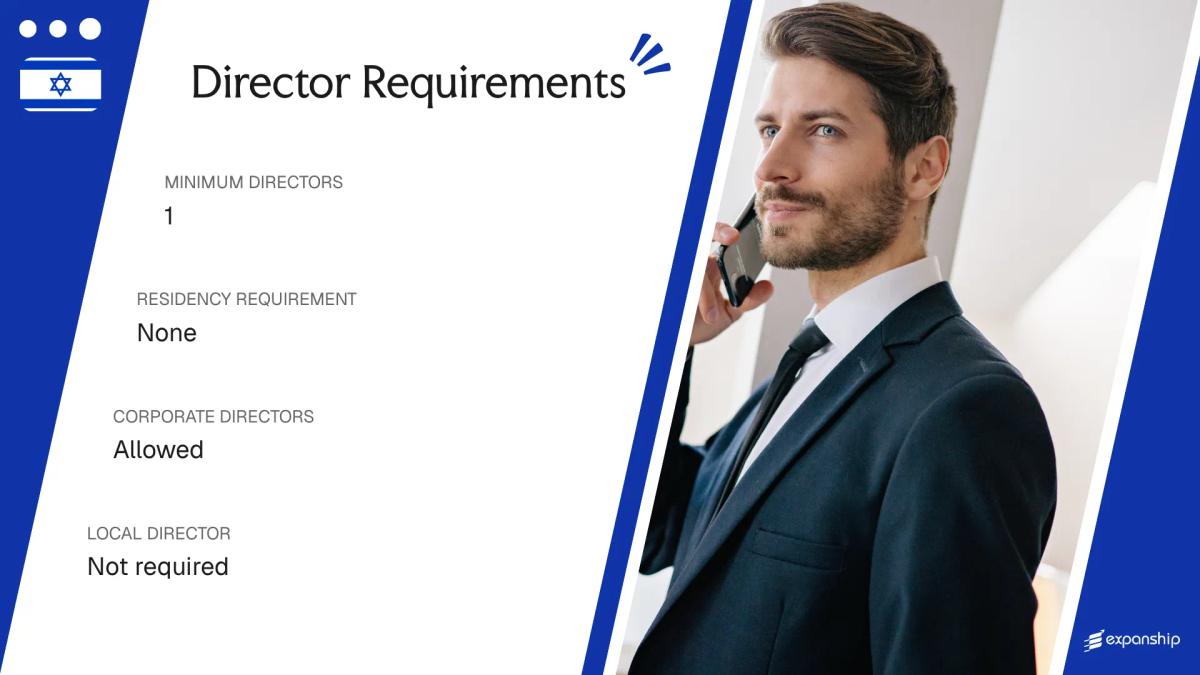
Under Israel director requirements, directors of a private company (Chevra Privately Held) assume statutory duties governed by the Companies Law, 5759-1999, including fiduciary obligations to act in the company's best interest and exercise reasonable care and skill. Personal liability can attach where a director breaches these duties or acts in contravention of the law.
| Parameter | Detail |
|---|---|
| Minimum Number of Directors | A private company must have at least one director. |
| Maximum Number of Directors | No statutory maximum is prescribed for private companies. |
| Local/Resident Director Required | No Israeli director residency rules mandate a locally resident director for private companies. |
| Nationality Restrictions | No nationality restrictions apply under the Companies Law. |
| Minimum Age Requirement | Directors must be at least 18 years of age. |
| Corporate Directors Permitted | Corporate directors are not permitted; only natural persons may serve. |
| Director Must Be a Shareholder | No requirement exists for a director to hold shares in the company. |
| Publicly Listed on Registry | Director details are filed with and held by the Israel Corporations Authority. |
| Disqualification Conditions | A person declared bankrupt or convicted of certain offences involving moral turpitude may be disqualified from serving as a director. |
Unlike many comparable jurisdictions, Israel does not require even a single resident or locally based director for a privately held company, meaning the entire board can be composed of non-residents living outside the country.
Shareholder Requirements in Israel
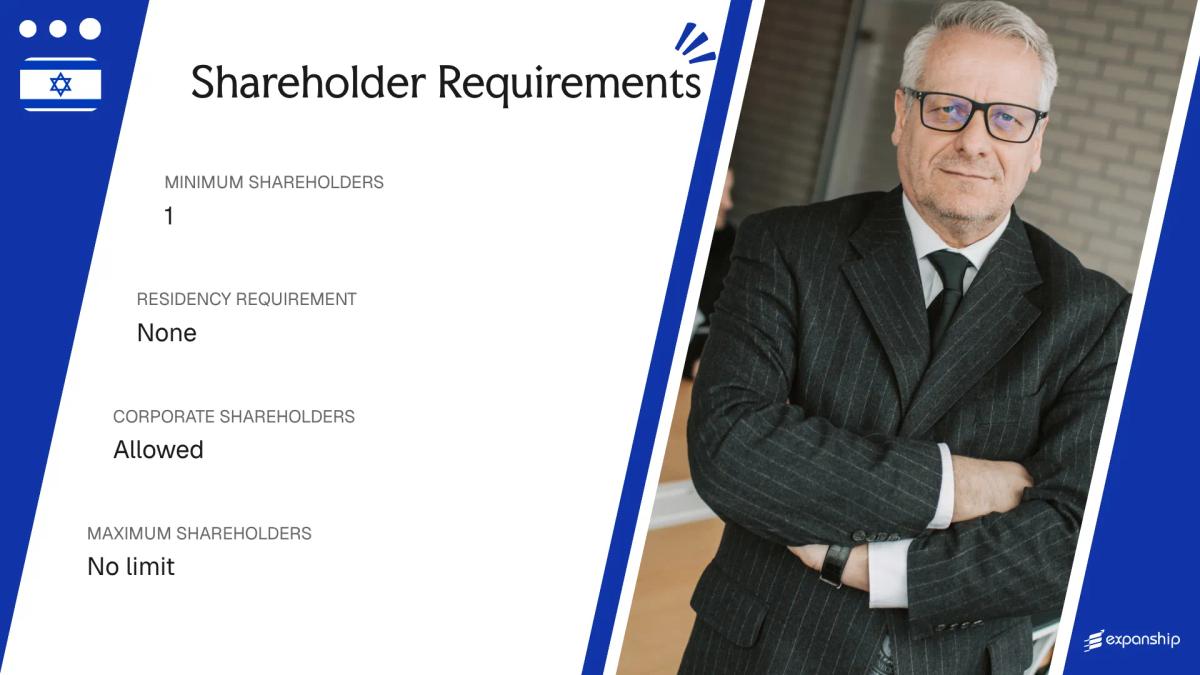
Under the Israeli Companies Law, 5759-1999, a private company requires a minimum of one shareholder and may have no more than fifty shareholders, excluding employees who hold shares. A single-shareholder structure is fully permitted, making sole-owner incorporation a straightforward option.
Nationality and Residency Restrictions
Israel shareholder requirements impose no nationality or residency conditions on shareholders of a private company. Foreign individuals and entities may hold shares without restriction on ownership percentage.
Corporate Shareholders
Corporate entities are permitted to act as shareholders in an Israeli private company. No special conditions are attached solely by virtue of the shareholder being a corporate body rather than a natural person.
Shareholder Liability
Shareholders of a private limited company hold liability that is confined to the unpaid amount on their shares. Piercing of the corporate veil remains possible under Israeli Companies Law where fraud or improper conduct is established.
Register of Shareholders
Every Israeli private company must maintain an internal register of shareholders under the Companies Law. The register is not publicly accessible, though Israeli company shareholder rules require it to be updated whenever ownership changes and made available for inspection by shareholders and certain authorised parties.
Guidance on Shareholder Structure for Your Israeli Company
Get tailored advice on meeting shareholder criteria when setting up a private company in Israel, from minimum counts to foreign ownership considerations.
UBO / Beneficial Ownership Disclosure Requirements in Israel
Under Israel's Companies Law, 5759-1999, and the Prohibition on Money Laundering Law, 5760-2000, a beneficial owner is generally defined as any individual holding 25% or more of shares, voting rights, or the right to appoint directors, or who otherwise exercises ultimate control over a company.
- Identify all individuals meeting the UBO threshold before or at the time of incorporation.
- Report UBO details to the Israel Registrar of Companies (Rasham HaChavarot) upon incorporation.
- Submit a declaration of beneficial ownership as part of the company's registration filings.
- Notify the Registrar of any changes to UBO information within a prescribed period following the change.
| Parameter | Detail |
|---|---|
| Ownership Threshold for UBO Status | 25% of shares, voting rights, or appointment rights |
| Filing Authority | Israel Registrar of Companies (Rasham HaChavarot) |
| Disclosure Deadline at Incorporation | At the time of incorporation registration |
| Publicly Accessible Register | No statutory requirement for full public access |
| Penalties for Non-Disclosure | Fines under the Companies Law, 5759-1999 |
| Ongoing Update Obligation | Yes; changes must be reported to the Registrar |
KYC / Document Requirements in Israel
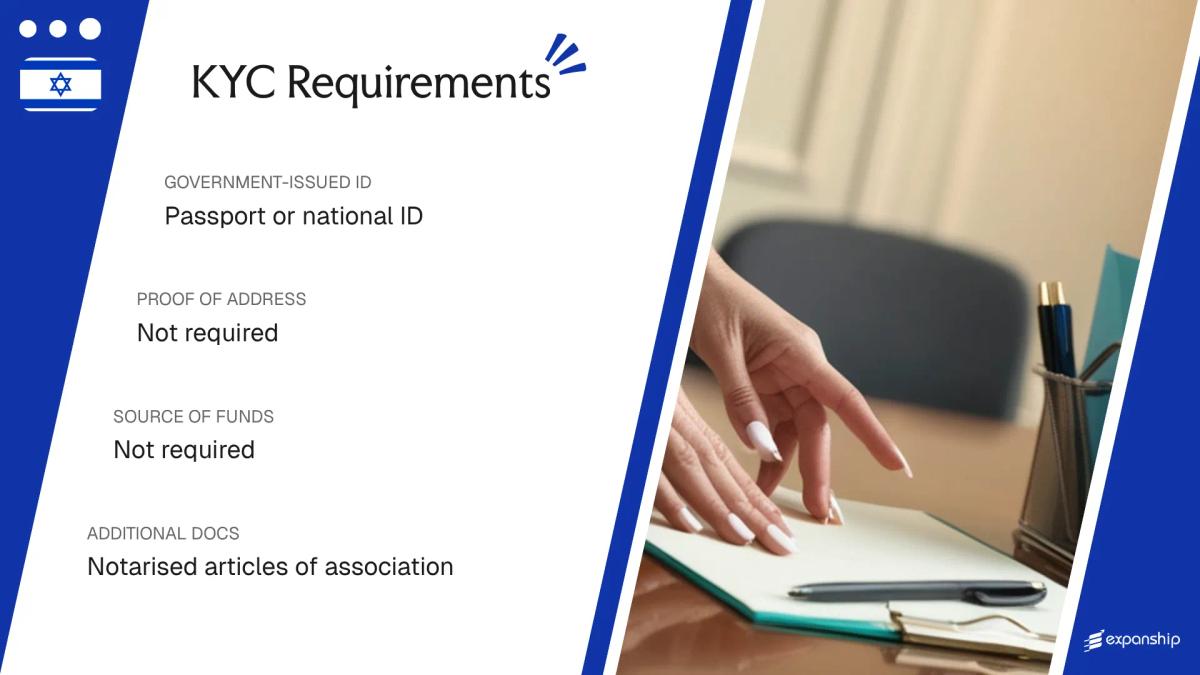
Israel company KYC requirements are governed by the Prohibition on Money Laundering Law, 5760-2000, administered by the Israel Money Laundering Authority. All parties involved in an incorporation must be identified and verified before the entity is registered with the Companies Registrar.
Individual / Personal Documents
- Valid government-issued passport or national ID card for each director, shareholder, and beneficial owner
- Proof of residential address dated within three months, such as a utility bill or official bank statement
- Completed and signed KYC declaration form as required by the registered agent or filing service
- A recent passport-sized photograph may be requested depending on the agent's internal compliance policy
Corporate Documents
- Certificate of Incorporation for any corporate shareholder or director
- Constitutional documents, such as articles of association or equivalent, confirming the entity's structure
- Current register of directors and, where applicable, register of shareholders
- Proof of the corporate entity's registered address in its home jurisdiction
Source of Funds Documentation
- Recent bank statements covering a minimum of three to six months
- Audited financial statements or management accounts for corporate shareholders
- A written explanation of the origin of funds if capital contributions are above standard thresholds
Notarisation and Apostille Requirements
- Foreign documents must generally be apostilled under the Hague Convention if the issuing country is a signatory
- Certified translations into Hebrew are required for documents not issued in Hebrew or English
- Notarisation by a local notary in the document's country of origin is typically required before apostille is applied
Submission of documents without a valid apostille from a Hague Convention signatory country is the most common cause of registration delay at the Israel Companies Registrar.
Company Name Requirements in Israel
Proposed company names are assessed by the Israeli Companies Registrar (Rasham HaChvarot) before incorporation can proceed. Israel company name requirements prohibit names that are identical or deceptively similar to those already registered.
Names must be submitted in Hebrew; a parallel foreign-language version may also be registered. The entity must include a legal suffix indicating its type, such as "Beinyan Mugbal" (B.M.) for a private limited company.
Certain words require prior approval from relevant government ministries before the Registrar will accept them. Words implying a connection to the state, royalty, or regulated professions fall into this category and are either restricted or outright prohibited.
Name reservation is available through the Registrar prior to formal incorporation. A reserved name is typically held for a limited period, during which no other entity may register it, allowing time to complete the incorporation process.
Compliance Services for Companies in Israel
Manage your ongoing statutory obligations in Israel, from annual filings to beneficial ownership reporting, through a single point of contact.
Conclusion
Israel company incorporation requirements are governed primarily by the Companies Law, 5759-1999, administered by the Companies Registrar within the Ministry of Justice. Among the requirements covered, beneficial ownership disclosure under the 2016 amendment and the mandatory local registered office address carry particular weight for foreign investors. Once these obligations are understood, the practical work of structuring the entity, appointing compliant directors, and engaging a registered address provider becomes the immediate next step.
Expanship's Corporate Services for Israel Expansion
Registering a company with the Israeli Registrar of Companies involves layered obligations, from UBO disclosure under the 2016 beneficial ownership regulations to meeting director residency conditions and maintaining a local registered office. Expanship's Israel company formation services are built around these specific requirements, reducing the administrative load without removing your responsibility to maintain ongoing compliance.
Our team supports your expansion across every stage of the process.
- We prepare and submit all incorporation documents to the Registrar of Companies on your behalf.
- A registered office address and resident agent are provided to satisfy Israeli statutory requirements.
- We handle government filings and liaise directly with the Israel Tax Authority and other relevant bodies.
- Post-incorporation obligations, including annual reporting and regulatory updates, are managed on a continuing basis.
- Banking introductions are facilitated to help you establish operational accounts in-country.
- Tax registration with the Israel Tax Authority and coordination with local authorities is handled as part of your setup.
To discuss your requirements, contact Expanship Israel.
Frequently Asked Questions (FAQ)
Yes, Israeli law does not require directors to be Israeli residents or citizens. The Companies Law, 5759-1999 permits full foreign directorship, though in practice, the Israel Tax Authority may use the location of board decisions as one factor when assessing where a company is effectively managed and controlled, which can affect corporate tax residency.
Any individual holding 25% or more of shares, voting rights, or the right to appoint directors in an Israeli company is considered a beneficial owner and must be disclosed to the Israel Corporations Authority. This requirement applies regardless of whether the holder is an Israeli resident or a foreign national, and the information is maintained in the company's register.
A company that operates without a valid registered office address in Israel breaches the Companies Law, 5759-1999, and the Israel Corporations Authority can issue fines and, in persistent cases, move to strike the entity from the companies register. The registered address must be a physical Israeli address capable of receiving official correspondence.
The documentation requirements are broadly the same, but foreign shareholders typically face additional verification steps. The Israel Corporations Authority requires certified and apostilled identity documents from foreign nationals, and some corporate service providers may also request bank reference letters or proof of source of funds to satisfy anti-money laundering obligations under the Prohibition on Money Laundering Law, 5760-2000.
An Israeli company must register a Hebrew name as its primary name with the Israel Corporations Authority, but it may also register an official English or Arabic version alongside it. The Hebrew name cannot be identical or misleadingly similar to an existing registered company, and certain terms require regulatory pre-approval before the Corporations Authority will accept the registration.
Legal Disclaimer
The information provided in this article is for general informational purposes only and does not constitute legal, tax, or professional advice. While we strive to ensure the accuracy and timeliness of the content, laws and regulations are subject to change, and the application of laws can vary widely based on specific facts and circumstances.
Readers should not act upon this information without seeking professional counsel tailored to their individual situation. Expanship and its authors disclaim any liability for actions taken or not taken based on the content of this article.
For specific advice regarding your business setup, compliance requirements, or any legal matters, please consult with qualified legal and tax professionals in the relevant jurisdiction.