
Key Takeaways
- Israel's corporate tax rate combined with the dividend withholding tax creates a multi-layer tax burden that compounds the cost of extracting profits from an Israeli entity.
- Under the Companies Law (5759-1999), private companies are required to maintain a registered office within Israel and file audited financial statements, adding mandatory recurring compliance costs that do not apply in lower-regulation jurisdictions.
- Foreign investors must navigate the Israel Companies Registrar's procedural requirements and anti-money laundering obligations, which together extend the timeline and administrative complexity of establishing and maintaining a compliant Israeli company.
- Geopolitical instability in the region, combined with the legal obligation on Israeli employees to perform military reserve duty, introduces operational disruptions that are structurally difficult for foreign-owned businesses to plan around.
Israel operates under a heavily regulated corporate environment, with company formation and ongoing compliance governed primarily by the Companies Law (5759-1999). The disadvantages of incorporating in Israel span taxation, administrative procedure, labor, and geopolitical exposure.
Not all of these drawbacks carry equal weight for every business. A technology firm with foreign investors faces a different set of friction points than a retail entity or a professional services firm operating domestically.
This article is most relevant to foreign entrepreneurs, non-resident investors, and multinational entities considering establishing a subsidiary or wholly-owned company under Israeli jurisdiction for the first time.
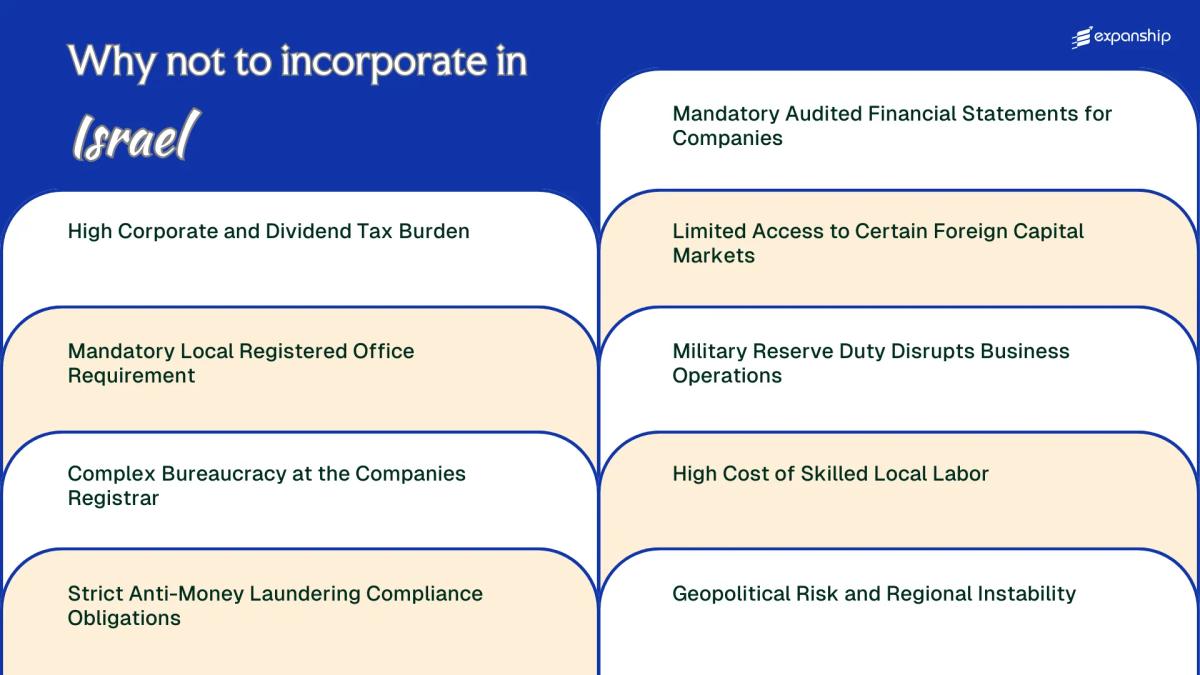
High Corporate and Dividend Tax Burden
The Israel corporate tax burden drawbacks are significant for foreign business owners. A standard corporate income tax rate of 23% applies to resident companies, and distributing profits compounds that cost further.
Combined Tax Rate on Distributed Profits
Dividends paid to individual shareholders are subject to a 25% withholding tax, rising to 30% for shareholders holding 10% or more in the distributing company under the Income Tax Ordinance. When combined with the 23% corporate rate, the effective tax on distributed profits can exceed 47%, which is materially higher than the OECD average and erodes the after-tax return foreign investors actually receive.
Impact on Foreign Shareholder Returns
For a foreign parent company receiving dividends, the applicable treaty rate may reduce withholding, but treaty benefits require formal qualification and do not eliminate the underlying corporate-level tax. The Israel Tax Authority administers these rules strictly, and misclassification of shareholder status or ownership thresholds triggers reclassification and retroactive withholding adjustments.
The combined corporate and dividend tax rate can exceed 47% on distributed profits, meaning a foreign investor extracts less than half of gross earnings after full Israeli taxation.
Mandatory Local Registered Office Requirement
Every company registered under the Israeli Companies Law, 5759-1999 must maintain a registered office address within Israel. This Israel registered office requirement restrictions foreign founders quickly encounter: you cannot use an overseas address, a P.O. box, or a virtual mailbox that lacks a verifiable physical presence.
For a non-resident director or sole foreign shareholder, this creates an immediate operational dependency on a local service provider before your company can function.
The practical burdens this imposes on a foreign business owner include:
- Sourcing a compliant local address through a third-party provider adds recurring annual fees that have no equivalent in jurisdictions permitting foreign registered addresses
- All official correspondence from the Companies Registrar is directed to this address, meaning delayed retrieval can cause missed compliance deadlines
- If your local address provider ceases operations, you must notify the Registrar of a change promptly or risk the registered address being recorded as invalid
- Contracts with registered agent services in Israel typically require local notarisation of authorisation documents, generating additional legal costs
The requirement applies regardless of company size or revenue. There is no exemption for dormant companies or holding structures.

Company Incorporation in Israel
Register your Israeli company with a compliant local registered office address through Expanship's incorporation service.
Complex Bureaucracy at the Companies Registrar
Israel Companies Registrar bureaucracy challenges are a practical obstacle that foreign founders encounter from the moment of incorporation. The registrar, known as Rasham HaChavarot, operates under the Companies Law, 5759-1999, and imposes a procedural workload that can slow entity formation and ongoing compliance significantly.
Filing documents with Rasham HaChavarot requires Hebrew-language submissions in most cases. For a foreign director or shareholder who does not read Hebrew, every filing requires certified translation, adding cost and time to what would otherwise be routine administrative tasks.
| Requirement | Trigger | Burden for Foreign Entity |
|---|---|---|
| Director change notification | Any board appointment or resignation | Must be filed within 14 days; late filing incurs statutory fines |
| Registered address update | Change of office address | Requires formal submission; cannot be updated informally |
| Annual report (Doch Shanti) | Each calendar year | Must be filed online via the registrar's portal; errors trigger rejection cycles |
| Document language | All formal filings | Hebrew required; foreign-language documents need certified translation |
Deadlines under the Companies Law are enforced with financial penalties. Missing the 14-day window for reporting director changes or share transfers, for example, generates automatic fines that accumulate until the filing is corrected.
The registrar's digital portal, while functional, does not offer full English-language support. Foreign business owners without a local corporate secretary or Israeli legal counsel face repeated rejection of filings that contain formatting or procedural errors.
Strict Anti-Money Laundering Compliance Obligations
Israel AML compliance obligations risks are among the more operationally demanding aspects of running a registered entity in the country. The primary framework is the Prohibition on Money Laundering Law, 5760-2000, enforced by the Israel Money Laundering and Terror Financing Prohibition Authority (IMPA). For foreign-owned companies, meeting these requirements involves sustained legal expenditure that does not diminish after incorporation.
Regulated entities must conduct customer due diligence, maintain transaction records for a minimum of seven years, and file suspicious transaction reports with IMPA. Each obligation carries a compliance cost that falls disproportionately on smaller foreign firms without dedicated local legal infrastructure.
Israel's FATF compliance burden stems partly from its active FATF membership and its domestic implementation of financial intelligence standards. This means regulators periodically update their expectations, and your compliance program must evolve accordingly at your expense.
The anti-money laundering restrictions also extend to beneficial ownership disclosure under the Companies Law, 5759-1999. Failing to maintain accurate beneficial ownership records exposes the company to administrative sanctions.
- AML obligations apply to banks, financial service providers, and certain corporate entities under the Prohibition on Money Laundering Law.
- Records must be retained for a minimum of seven years from the date of the transaction.
- Suspicious transaction reports must be filed with IMPA within prescribed timeframes.
- Beneficial ownership information must remain current and accurate under the Companies Law.
- Non-compliance carries criminal liability for both the company and its officers.
Israel's AML framework explicitly covers virtual asset service providers, meaning crypto-related businesses face the same mandatory reporting obligations as traditional financial institutions.
Mandatory Audited Financial Statements for Companies
Under the Companies Law, 5759-1999, every Israeli private company is required to have its annual financial statements audited by a licensed Certified Public Accountant (CPA) registered with the Institute of Certified Public Accountants in Israel. This Israel mandatory audit requirement applies regardless of company size or revenue, meaning even a dormant or early-stage entity carries the same statutory obligation as an established operating business.
Scope of the Statutory Obligation
There is no small-company exemption that removes the audit requirement entirely, which contrasts with frameworks in several EU member states where micro-entities qualify for audit relief below defined thresholds. For a foreign owner operating a subsidiary here, this means committing to annual CPA fees even during pre-revenue phases.
Cost and Administrative Consequence
The Israel company reporting obligations extend beyond the audit itself, requiring financial statements prepared under Israeli GAAP or IFRS as adopted locally, which may necessitate conversion from your home-country accounting standards. This adds a layer of professional fees and coordination time that directly increases your annual compliance cost.
The audited statements must also be submitted to the Companies Registrar, creating a firm annual deadline that your local CPA must meet, regardless of operational activity.
Addressing Israel's Corporate Compliance Obligations
Get structured guidance on managing statutory audit requirements and financial reporting obligations for your Israeli entity.
Limited Access to Certain Foreign Capital Markets
Israeli companies face real Israel foreign capital markets access limitations that foreign-incorporated competitors do not. Listing on major U.S. exchanges like the NYSE or Nasdaq is technically available to Israeli firms, but the dual reporting obligations under both the Israeli Securities Authority and the U.S. Securities and Exchange Commission create a compliance burden that raises costs and extends timelines significantly.
- Israeli companies seeking a U.S. listing must comply with both the Israeli Securities Law, 5728-1968 and U.S. federal securities regulations, creating parallel disclosure obligations that few small or mid-sized firms can absorb.
- Access to European capital markets is further restricted because Israeli entities are not incorporated within the EU regulatory perimeter, excluding them from certain prospectus passporting privileges under EU frameworks.
- The Tel Aviv Stock Exchange (TASE) has lower liquidity and a smaller institutional investor base than major global exchanges, limiting the capital volumes your business can realistically raise domestically.
- Foreign institutional investors governed by country-risk mandates may exclude Israeli-incorporated entities from their eligible investment universe entirely.
Military Reserve Duty Disrupts Business Operations
Among the Israel military reserve duty business risks, miluim (מילואים) stands out as one of the most operationally disruptive factors for any company employing local staff. Under the Defense Service Law (Consolidated Version), 5746-1986, Israeli citizens and permanent residents can be called up for reserve duty for periods that vary in length, often without extended advance notice.
A small or mid-sized firm is particularly exposed. If a key engineer, account manager, or team lead is called up during a product launch or client deadline, you have limited legal recourse to delay or refuse that service.
Employers are legally prohibited from terminating or penalizing reservists. This protection, while grounded in the Defense Service Law, means workforce gaps must be absorbed operationally rather than resolved through standard HR channels.
The IDF reserve service business challenges intensify during periods of heightened military activity, when call-up orders are issued at scale across entire age brackets simultaneously.
A startup with a development team of six, where two engineers are called up concurrently for 30 days, loses roughly 33% of its technical capacity with no contractual mechanism to recover timeline delays from clients.
High Cost of Skilled Local Labor
Israel high labor cost disadvantages are particularly acute in the technology and life sciences sectors, where most foreign firms establish operations. Salaries for software engineers, data scientists, and biotech specialists consistently rank among the highest globally, with senior developers commonly commanding annual packages exceeding $150,000 USD.
Beyond base salaries, Israeli labor law mandates substantial employer contributions. Under the National Insurance Law (Bituach Leumi), employers pay national insurance and health insurance levies on employee wages, adding a meaningful percentage to every payroll line. Pension contributions are also compulsory under the Expansion Order for Comprehensive Pension, requiring employer contributions of at least 6.5% of salary.
Severance obligations under the Severance Pay Law (1963) add further exposure. An employee dismissed after one year of service is entitled to one month's salary per year worked, which can represent a significant contingent liability as your headcount grows.
- Mandatory recreation pay (dmei havra'a) accrues annually for each employee.
- Annual leave entitlements are set by law and increase with seniority.
- Prior notice periods are legally prescribed and cannot be contracted below statutory minimums.
Foreign-owned entities incorporated in Israel are subject to the full scope of Israeli labor law from the first local hire, regardless of where the parent company is headquartered or what employment terms apply in the home jurisdiction.
Geopolitical Risk and Regional Instability
Israel geopolitical risk is a structural consideration for any foreign business owner, not an occasional disruption. The country shares borders with Lebanon and Syria, maintains an unresolved conflict with Gaza, and operates in a region where escalation can occur with limited warning.
Armed conflict directly affects supply chains, logistics routes, and the continuity of operations. During periods of active hostilities, air freight through Ben Gurion Airport has been disrupted, and shipping insurers have applied war-risk surcharges to cargo transiting Israeli ports.
Foreign parent companies may also face elevated risk ratings from institutional insurers and export credit agencies, raising the cost of trade finance for any entity incorporated locally. Some multinational compliance frameworks require board-level sign-off before entering conflict-adjacent jurisdictions, adding internal friction to the incorporation decision itself.
Rocket and drone attacks, even when intercepted by the Iron Dome system, trigger emergency protocols under Israeli civil defense law, halting commercial activity across entire regions for unpredictable durations.
Overcoming the Key Incorporation Challenges
Overcoming the key incorporation challenges in Israel requires structural planning before the entity is registered, not after operational problems emerge. The disadvantages covered in this blog are interconnected, and addressing them in isolation tends to be less effective than building them into your setup from the outset.
- Register your company through the Israel Registrar of Companies using a qualified local registered office address to satisfy the mandatory presence requirement from day one.
- Appoint a licensed Israeli auditor prior to your first financial year-end to meet the statutory audit obligation under the Companies Law, 5759-1999.
- Establish AML compliance procedures aligned with the Prohibition on Money Laundering Law, 5760-2000 before conducting any financial activity through the entity.
- Structure your shareholder arrangements with awareness of the 25% dividend withholding rate to avoid unexpected post-profit tax exposure.
- Factor reserve duty absences into employment contracts for any Israeli staff to reduce operational disruption risk.
These steps operate within a regulatory environment overseen by multiple bodies, including the Israel Tax Authority and the Israel Securities Authority. The framework is demanding, and meeting baseline requirements across tax, audit, and AML simultaneously places a real administrative burden on newly incorporated foreign-owned entities.
Israel's Overall Business Appeal
Despite the disadvantages covered throughout this blog, the Israel business environment risks and appeal exist on opposite ends of a spectrum that many foreign founders still find worth weighing. The country operates a functioning legal framework under the Companies Law 5759-1999, maintains an independent judiciary, and hosts a developed financial sector. For the right business profile, those structural foundations carry real weight.
| Pros | Cons |
|---|---|
| The Companies Law provides a clear statutory framework for corporate governance and shareholder rights. | Corporate tax at 23% combined with a 25–30% dividend withholding tax creates a high cumulative burden on distributed profits. |
| Israel's independent judiciary offers reliable enforcement of commercial contracts. | Mandatory audited financial statements under the Companies Law add recurring compliance costs regardless of company size. |
| A well-educated, technically skilled local workforce supports knowledge-intensive operations. | Skilled local labor commands some of the highest salary costs in the region, compressing margins for early-stage businesses. |
| The local capital market and venture ecosystem provide access to growth funding for qualifying firms. | Military reserve duty obligations under the Security Service Law can cause unpredictable staffing gaps. |
| Proximity to European and Middle Eastern markets offers geographic positioning advantages. | Geopolitical risk and regional instability introduce operational and reputational exposure that most other OECD jurisdictions do not carry. |
Compliance Services for Companies in Israel
Stay current with Israel's Companies Registrar requirements, AML obligations, and annual reporting duties under the Companies Law 5759-1999.
Conclusion
The Israel company formation disadvantages summary is straightforward: this is a technically advanced, OECD-member economy with functioning institutions, but your business will face structural friction that cannot be dismissed. A combined corporate and dividend tax burden reaching approximately 46.5%, mandatory audited financials under the Companies Law 5759-1999, and persistent geopolitical risk each impose real, recurring costs. Compliance obligations under the Prohibition on Money Laundering Law 5760-2000 add further administrative weight. For the right entity structure, these obstacles are manageable with proper legal and accounting support in place from the outset.
Expanship's Israel Expansion Services
Expanship's Israel company formation services are designed to reduce the operational burden that comes with incorporating in Israel, where obligations span the Companies Registrar, the Israel Tax Authority, mandatory audits, and AML compliance under the Prohibition on Money Laundering Law. Managing these requirements from outside the country, or without local expertise, adds significant friction to an otherwise viable market entry.
Beyond registration, Expanship supports your business across the full incorporation lifecycle.
- We prepare and file all company registration documents with the Companies Registrar on your behalf.
- A registered agent and local office address are provided to satisfy Israel's mandatory presence requirements.
- We handle government filings and liaise directly with relevant regulatory authorities.
- Post-incorporation compliance obligations are managed on an ongoing basis.
- Banking introduction assistance is available to help your entity establish local financial relationships.
- We coordinate tax registration and engage with the Israel Tax Authority on your behalf.
To discuss your requirements, contact Expanship Israel.
Frequently Asked Questions (FAQ)
It applies broadly to Israeli citizens and permanent residents of eligible age, regardless of their professional role or seniority. Under the Security Service Law, reservists can be called up for extended periods, particularly during escalations, which means a small business could lose multiple staff members simultaneously with limited advance notice. The obligation is not limited to junior employees — founders, directors, and senior managers are equally subject to call-up.
Audit fees for a private company (chevra pratit) registered under the Israeli Companies Law 5759-1999 vary based on turnover and complexity, but foreign-owned entities with cross-border transactions routinely incur costs starting from several thousand US dollars annually. Larger operations with intercompany arrangements or transfer pricing considerations face significantly higher fees. This cost applies regardless of whether the company generated profit during the year.
Israel's standard corporate tax rate of 23% is higher than jurisdictions such as Cyprus (12.5%) or the UAE (9% for qualifying businesses), making direct cost comparisons unfavorable for tax-sensitive structures. Dividend withholding tax adds a further layer, typically 25% for individual shareholders or 30% for substantial shareholders, under the Israeli Income Tax Ordinance. The combined effective rate on distributed profits can therefore exceed 40% before any foreign tax obligations are considered.
Non-compliance with the Prohibition on Money Laundering Law 5760-2000 and the regulations issued by the Israel Money Laundering and Terror Financing Prohibition Authority (IMPA) can result in substantial financial penalties and, in serious cases, criminal liability for directors and officers. Regulators have increased enforcement activity, particularly for firms in financial services, real estate, and those with cross-border ownership structures. The compliance burden falls on the company from the point of registration, not only once commercial activity begins.
No. The Israeli Companies Registrar requires every company incorporated in Israel to maintain a registered office address within Israel. This address must be operational and capable of receiving official correspondence and regulatory notices. Using a foreign address, even for a wholly foreign-owned entity, does not satisfy this statutory requirement under the Companies Law.
Processing times at the Registrar (Rasham HaChavarot) are longer than in jurisdictions such as the UK or Estonia, where digital incorporation can be completed within hours. Document requirements, including notarized and apostilled foreign director and shareholder documents, add both time and cost that are not typical in many Western European incorporations. For foreign applicants without a local representative, the process can take several weeks and requires careful coordination to avoid rejections on technical grounds.
Yes, the requirement applies to all companies incorporated under the Israeli Companies Law 5759-1999, including those that have not yet commenced trading or are temporarily inactive. There is no statutory exemption for dormant private companies comparable to the dormant company exemption available in the UK or certain EU jurisdictions. This means your entity will incur audit and accounting costs from the first financial year, regardless of revenue or operational activity.
Legal Disclaimer
The information provided in this article is for general informational purposes only and does not constitute legal, tax, or professional advice. While we strive to ensure the accuracy and timeliness of the content, laws and regulations are subject to change, and the application of laws can vary widely based on specific facts and circumstances.
Readers should not act upon this information without seeking professional counsel tailored to their individual situation. Expanship and its authors disclaim any liability for actions taken or not taken based on the content of this article.
For specific advice regarding your business setup, compliance requirements, or any legal matters, please consult with qualified legal and tax professionals in the relevant jurisdiction.