
Key Takeaways
- Non-resident investors in Israeli companies benefit from a capital gains tax exemption under the Income Tax Ordinance, removing a tax layer that would otherwise erode returns on equity exits.
- Qualifying businesses can access both direct grant funding through the Israel Innovation Authority and reduced corporate tax rates under the Law for Encouragement of Capital Investments, two mechanisms that operate independently and can apply concurrently.
- Israel's network of over 50 bilateral double tax treaties limits withholding tax exposure on dividends, royalties, and interest flows between Israeli entities and foreign counterparties.
- Companies engaged in R&D or technology exports are positioned to extract meaningfully more value from Israel's incentive frameworks than those operating in domestic trade or distribution, making industry classification a material factor in any incorporation decision.
Situated in the Middle East along the eastern Mediterranean coast, Israel is an independent sovereign state and a member of the OECD. Company registration falls under the purview of the Companies Registrar, operating within the Ministry of Justice. Foreign businesses most commonly establish a presence through a Private Company Limited by Shares. The country operates a territorial-leaning tax system supported by a network of bilateral tax treaties, making it a treaty-based jurisdiction with targeted domestic incentives.
Foreign ownership of Israeli companies is broadly permitted, with no general restrictions on non-resident shareholders holding equity in a locally registered entity. This openness extends to foreign direct investment across most sectors, subject to standard national security screening in designated industries.
The benefits of incorporating in Israel draw from a combination of statutory frameworks, government-backed funding mechanisms, and the country's position as a globally recognized center for technology and innovation. This article examines the concrete advantages your business can gain through Israel company formation.
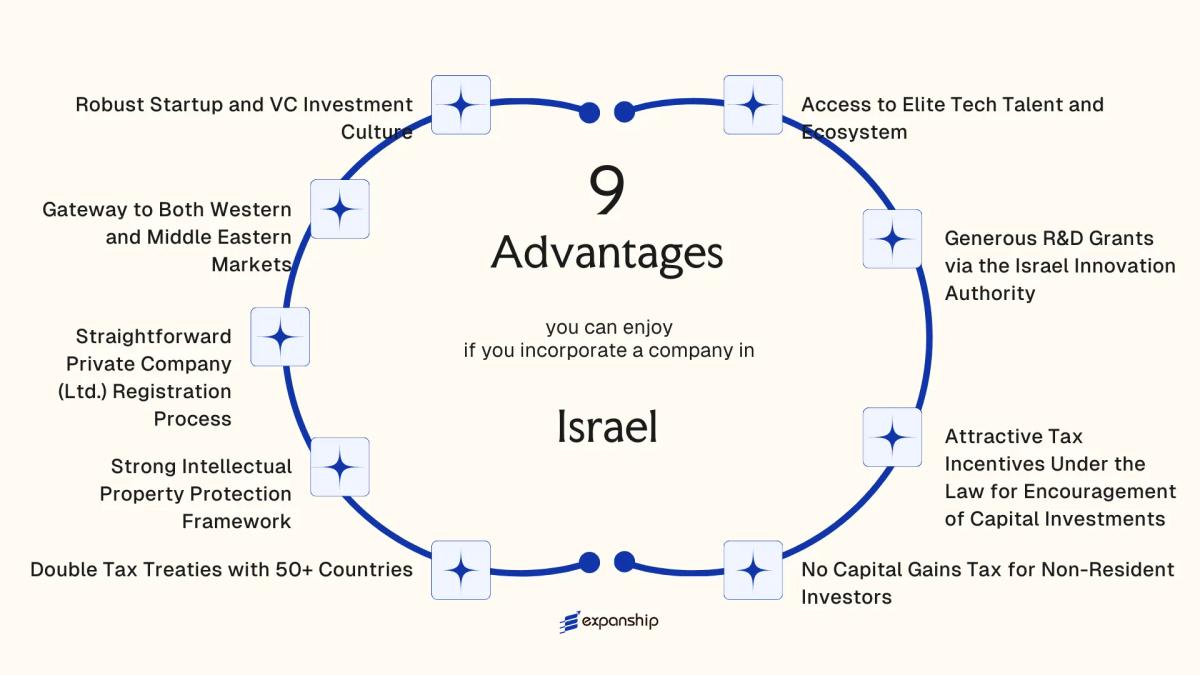
Access to Elite Tech Talent and Ecosystem
Israel tech talent advantages for businesses are, in large part, a product of mandatory military service. The Israel Defense Forces' technology units, particularly Unit 8200, produce engineers and cybersecurity specialists with applied experience that few academic programs replicate.
A Workforce Shaped by Structured Technical Training
Graduates of elite IDF units regularly transition into the private sector, bringing specialized skills in areas like signal intelligence, machine learning, and systems architecture. For a foreign business establishing a local entity, this means access to a talent pool pre-screened through one of the most demanding technical training programs in any country.
Density of Specialized Knowledge in a Compact Market
Tel Aviv ranks among the highest globally for startup density per capita, with the Tel Aviv-Yafo municipality functioning as a concentrated hub for deep-tech, cybersecurity, and life sciences firms. That concentration means your company can form partnerships, hire specialists, and engage with research institutions, including Technion and the Weizmann Institute, within a relatively tight geographic radius.
Incorporating locally positions your entity to hire directly from a technically trained workforce without relying on international recruitment pipelines.
Generous R&D Grants via the Israel Innovation Authority
The Israel Innovation Authority (IIA) administers one of the more direct government R&D funding programs available to technology companies. Under the R&D Law (Law for the Encouragement of Research, Development and Technological Innovation in Industry, 1984), approved companies can receive non-dilutive grants covering 20% to 50% of eligible R&D expenditures, depending on company size and program track. For a foreign business that has established an Israeli subsidiary, this means recovering a meaningful share of development costs without surrendering equity or taking on debt.
The IIA grants for foreign companies in Israel are accessible to locally incorporated entities, not just Israeli-founded startups. A foreign parent that sets up an Israeli subsidiary can apply through various IIA programs, including the Technological Incubators Program and the Innovation Lab track, provided the R&D activity is conducted within the country.
What makes the structure particularly favorable:
- Grants are non-dilutive, so your ownership stake remains unchanged
- Repayment is tied to future royalties on sales, only triggered if the product generates revenue
- Multiple funding tracks exist for different stages, from early-stage proof-of-concept through scale-up
- The IIA evaluates applications on technical merit, not company origin
Repayment obligations and IP transfer restrictions do apply, particularly if the company later seeks to move IIA-funded intellectual property outside of Israel.

Incorporate a Company in Israel
Set up an Israeli subsidiary or limited company and access IIA funding programs, government R&D incentives, and the local tech ecosystem.
Attractive Tax Incentives Under the Law for Encouragement of Capital Investments
Under the Law for Encouragement of Capital Investments, Israel has constructed a tiered corporate tax framework that directly reduces the tax burden on qualifying industrial and technology companies. The primary mechanism is the Preferred Enterprise status, which applies to firms engaged in industrial activities or certain technology-based operations. A Preferred Enterprise located in Development Area A pays a reduced corporate tax rate of 7.5%, while those elsewhere in the country are taxed at 16% — compared to the standard Israeli corporate rate of 23%.
| Enterprise Classification | Location | Corporate Tax Rate |
|---|---|---|
| Preferred Enterprise | Development Area A | 7.5% |
| Preferred Enterprise | Other regions | 16% |
| Special Preferred Technology Enterprise | Development Area A | 7.5% |
| Special Preferred Technology Enterprise | Other regions | 12% |
| Standard Corporate Rate | N/A | 23% |
Technology companies meeting higher revenue and R&D expenditure thresholds may qualify as a Special Preferred Technology Enterprise, which carries a 12% rate outside designated zones. Dividends distributed from preferred income to foreign shareholders are subject to a withholding tax of 20%, though applicable tax treaties can reduce this further.
For a foreign-owned entity generating income from technology, manufacturing, or IP-based operations, this structure means tax exposure that falls significantly below rates common in Western Europe. Eligibility is determined by the Israel Tax Authority in coordination with the Investment Center, and companies must meet defined criteria around industrial output and R&D activity levels.
No Capital Gains Tax for Non-Resident Investors
Israel no capital gains tax for non-resident investors is not a blanket exemption — it is a structured benefit codified under the Israeli Income Tax Ordinance. Non-resident individuals and foreign companies that hold shares in an Israeli firm are generally exempt from capital gains tax on the sale of those shares, provided the gains do not originate from a permanent establishment in the country.
This matters because it directly affects exit economics. When a foreign investor sells equity in a local startup or private company, the full gain transfers without Israeli withholding tax eroding the return — a structurally different outcome than in many OECD jurisdictions where capital gains are taxed at the shareholder level regardless of residency.
Eligibility depends on the investor's classification under Israeli tax law and the absence of a permanent establishment or local business activity that could reclassify the gain as business income.
Keep these points in mind:
- The exemption applies to non-residents as defined under the Income Tax Ordinance, not merely foreign passport holders
- Gains attributable to a permanent establishment in Israel fall outside the exemption
- The asset being sold must be a capital asset, not inventory or trading stock
- Treaty residency status can interact with domestic exemption rules
Foreign investors in Israeli venture-backed companies can exit fully exempt from local capital gains tax even if the company's primary assets are Israeli-developed intellectual property.
Double Tax Treaties with 50+ Countries
Israel double tax treaties benefits for businesses extend well beyond simple rate reductions. With treaties currently in force with over 50 countries, including the United States, the United Kingdom, Germany, France, and China, a company resident in Israel can access reduced withholding tax rates on dividends, interest, and royalties paid across borders. Without treaty protection, these payments are subject to standard withholding rates that can significantly erode cross-border returns.
Reduced Withholding on Dividends and Royalties
Treaty rates on dividends paid to foreign parent companies often fall between 5% and 15% depending on shareholding thresholds and the specific treaty in question. For royalty payments, which are particularly relevant to technology and IP-heavy businesses, treaties frequently reduce the withholding rate to 5% or lower, compared to the domestic statutory rate of 25%. This reduction directly affects after-tax cash flow when repatriating profits or licensing intellectual property internationally.
Eliminating Double Taxation on Business Profits
Each treaty defines permanent establishment rules, which determine when a foreign entity's activities in Israel (or vice versa) create a taxable presence. Clear treaty definitions reduce exposure to dual taxation claims by two separate authorities on the same income stream. The treaties follow OECD model convention principles, which means the allocation of taxing rights is structured around internationally recognized standards rather than unilateral domestic rules. For businesses structured with Israeli subsidiaries or holding entities, this predictability materially reduces tax risk when structuring cross-border transactions.
Structure Your Israel Entity to Access Treaty Benefits
Speak with Expanship's team about how to position your company to qualify for Israel's treaty network and reduce cross-border tax exposure from day one.
Strong Intellectual Property Protection Framework
Israel intellectual property protection advantages are well-grounded in statute. The Patents Law (1967), the Copyright Law (2007), and the Commercial Torts Law (1999) collectively form a codified framework that gives foreign businesses enforceable rights over their innovations from the moment a local entity holds them.
- As a signatory to the Patent Cooperation Treaty (PCT), a patent filed through an Israeli subsidiary can form the basis for international protection across 150+ member states, reducing the administrative burden of multi-jurisdiction filings.
- Israel's membership in the Paris Convention means your priority date established in one member country is recognized locally, giving foreign companies a clear path to securing patent rights without losing their original filing date.
- Trade secrets receive statutory protection under the Commercial Torts Law, which means proprietary processes and confidential business information held by your Israeli entity carry legal standing in civil proceedings without requiring formal registration.
- The Israeli Patent Office, operating under the Ministry of Justice, examines substantive patentability, which provides foreign tech firms with a credible, government-backed validation of their IP assets.
- IP ownership can be structured within the Israeli company rather than held offshore, which has direct implications for qualifying under the Preferred Technological Enterprise regime and accessing associated tax benefits tied to IP-derived income.
Straightforward Private Company (Ltd.) Registration Process
Registering a private limited company in Israel involves a single regulatory authority: the Companies Registrar, operating under the Israeli Companies Law, 5759-1999. Foreign nationals face no ownership restrictions, meaning a non-resident can hold 100% of shares without a local partner requirement. This directness reduces the structural complexity that foreign founders typically encounter in other jurisdictions.
The registration requires submitting incorporation documents, a company name approval, and a fee to the Companies Registrar. Once approved, the entity receives a company number and can begin operating. Processing times are generally short, often completed within a few business days for standard applications.
For a foreign business owner, these mechanics carry a specific advantage: there is no minimum share capital requirement under the Companies Law. You can incorporate with a nominal amount, avoiding the capital lock-up obligations present in many European jurisdictions.
A hypothetical scenario: A foreign founder incorporates an Israeli Ltd. with NIS 1 in share capital and two shareholders, both non-residents. Total government registration fees remain under NIS 2,800 (approximately USD 750), with no paid-up capital requirement prior to commencing business operations.
Israel private limited company registration benefits from this low-barrier entry structure, which keeps setup costs predictable and formation timelines short for internationally operating businesses.
Gateway to Both Western and Middle Eastern Markets
Israel's geographic and diplomatic positioning makes it a functional bridge between two distinct economic zones. As an Israel gateway to Middle East and Western markets, a company incorporated here can serve clients across Europe, the United States, and select Arab states under a single operational base.
The Abraham Accords, signed in 2020, normalized relations between Israel and the UAE, Bahrain, Morocco, and Sudan. For your business, this opens direct trade and banking channels with Gulf economies that were previously inaccessible, including the UAE's $500+ billion GDP market.
On the Western side, the US-Israel Free Trade Agreement, in force since 1985, eliminates tariffs on most goods. The EU-Israel Association Agreement provides preferential trade access to the European single market, meaning products manufactured or processed in Israel can enter EU member states at reduced or zero duty rates.
- Access to Gulf markets through post-Abraham Accords normalization
- Tariff-free goods trade with the United States under a bilateral FTA
- Preferential EU market entry under the Association Agreement
Preferential trade benefits under these agreements may depend on meeting specific rules-of-origin requirements; confirm your product or service qualifies before structuring operations around these access points.
Robust Startup and VC Investment Culture
Israel's startup and VC investment culture advantages are structural, not incidental. The country produces more Nasdaq-listed companies per capita than any other nation outside the United States, and that concentration of publicly traded tech firms signals a mature exit pathway that few comparable markets offer foreign founders.
Venture capital deployment in Israel runs at exceptionally high levels relative to GDP. In recent years, the country has consistently ranked among the top globally for VC investment as a share of economic output, which means early-stage and growth-stage companies are competing for funding in an active, well-capitalized market rather than a thin one.
Several features make this ecosystem particularly useful for foreign-incorporated entities or foreign founders operating local subsidiaries:
- The Israel Innovation Authority co-invests alongside private VC funds through structured programs, reducing the risk profile for private capital entering early-stage deals.
- A dense concentration of corporate R&D centers from firms like Google, Intel, and Microsoft creates acquisition interest, giving investors credible secondary exit options beyond IPO.
- The Tel Aviv Stock Exchange operates a dual-listing framework with Nasdaq, allowing companies to list on both markets simultaneously without duplicating disclosure obligations.
For a foreign founder, the practical implication is access to a funding environment where institutional investors, corporate acquirers, and public markets are all active participants. That multi-channel exit structure reduces dependency on any single liquidity event, which materially affects how VC funds price their initial investment risk when evaluating your entity.
Why Israel Stands Out Among Global Business Destinations
Few jurisdictions combine a technology-driven economy, structured government incentives, and preferential tax treatment for foreign investors within a single legal framework. That combination is why Israel stands out as a business destination when measured against comparable high-tech and investment-friendly jurisdictions in the region. The comparisons below focus on Cyprus, the UAE, and Singapore — three jurisdictions that attract a similar profile of foreign incorporators and that prospective investors in Israeli entities would realistically evaluate in parallel.
What the comparison reveals is not simply a tax rate differential. The Israel Innovation Authority grant mechanism, the zero capital gains tax for qualifying non-residents, and the treaty network with more than 50 countries collectively form a structure that few jurisdictions replicate at the same depth. Cyprus offers strong EU access and low corporate tax, but lacks a state-backed R&D grant programme of equivalent scale. The UAE provides zero corporate tax in free zones but has no comparable bilateral treaty network or innovation funding infrastructure. Singapore matches on treaties and IP incentives, but its geographic position provides no proximity advantage to European or Middle Eastern markets.
| Parameter | Israel | Cyprus | UAE (Mainland) | Singapore |
|---|---|---|---|---|
| Standard Corporate Tax Rate | 23% | 12.5% | 9% | 17% |
| Capital Gains Tax for Non-Residents | 0% (qualifying investors) | 0% | 0% | 0% |
| State-Backed R&D Grant Programme | Yes (Israel Innovation Authority) | No | No | Limited (EDB schemes) |
| Double Tax Treaties | 50+ | 60+ | 140+ | 90+ |
| IP Regime | Domestic protection + TRIPS compliance | IP Box (2.5% effective rate) | Free zone IP holding | IP Development Incentive (5–10%) |
| Access to EU Single Market | Association Agreement | Full EU Member | No | No |
| Access to Middle Eastern Markets | Direct + Abraham Accords | Limited | Regional hub | Limited |
| Proximity to European Financial Centres | Yes (direct flight, 3–5 hrs) | Yes (EU-based) | Moderate | No |
Compliance Services for Companies in Israel
Maintain good standing with Israeli regulatory requirements, including annual filings with the Companies Registrar, tax reporting to the Israel Tax Authority, and ongoing corporate governance obligations.
Conclusion
The benefits of incorporating in Israel are most compelling for businesses where technology development, intellectual capital, and international investor access intersect. The exemption from capital gains tax for non-resident investors, grounded in the Income Tax Ordinance, and the grant funding available through the Israel Innovation Authority create a structural environment that few jurisdictions replicate at this scale.
Tax efficiency under the Law for Encouragement of Capital Investments can meaningfully reduce the effective corporate rate for qualifying businesses, and the network of over 50 double tax treaties limits exposure to withholding taxes on cross-border income. These are not incidental features; they reflect deliberate policy choices that have shaped how foreign capital engages with the local economy.
That said, the degree to which your business benefits from these frameworks depends on its industry classification, ownership structure, and operational footprint. A firm focused purely on domestic distribution will access a different set of advantages than one engaged in R&D or technology exports. Understanding which provisions apply to your specific entity type is the necessary first step before any Israel company formation decision is finalised.
Start Your Israel Company Formation With Expanship
Incorporating a private company (Ltd.) under the Israeli Companies Law, 5759-1999 through the Companies Registrar at the Ministry of Justice involves a defined set of legal steps and compliance obligations. Expanship Israel business incorporation services are structured around this specific process, covering entity formation, ongoing statutory requirements, and coordination with the relevant regulatory authorities.
From document preparation through post-incorporation compliance, Expanship manages each stage of the process on your behalf:
- Preparation and legalization of incorporation documents, including Articles of Association
- Registered agent and registered office provision in Israel
- Filing and liaison with the Companies Registrar and relevant government bodies
- Post-incorporation compliance management, including annual reporting obligations
- Corporate secretarial support for ongoing governance requirements
- Banking introduction assistance to support your operational setup
Reach out to Expanship Israel to discuss your incorporation requirements.
Frequently Asked Questions (FAQ)
Registration typically takes between one and five business days when documents are submitted online through the Israel Companies Registrar's portal, provided all required materials are in order. The process requires submitting the Articles of Association, a declaration by each director and shareholder, and payment of the registration fee. Delays generally arise from incomplete documentation or apostille requirements on foreign-executed documents.
Under the Law for Encouragement of Capital Investments, a company qualifying as a Preferred Enterprise is taxed at a reduced corporate rate of 16% in most areas of the country, and 7.5% in designated development zones. These rates apply to qualifying income derived from approved activities. The standard corporate tax rate in Israel is 23%, so the differential is material for companies that meet the eligibility criteria set by the Israeli Tax Authority.
Non-resident investors are generally exempt from Israeli capital gains tax on the sale of shares in an Israeli company, provided the gains do not derive from real estate or a permanent establishment in the country. This exemption is grounded in the Income Tax Ordinance and is further reinforced by the terms of many of Israel's 50+ bilateral tax treaties. The specific conditions of each treaty, as well as the source of the gain, determine whether the exemption applies in full.
The Israel Innovation Authority administers several grant programs for R&D-intensive companies, including the Standard R&D Fund track, which reimburses up to 50% of approved research and development expenditures. Foreign-owned companies incorporated in Israel are eligible to apply, provided the R&D activity is conducted within the country. Acceptance is not automatic; applications are reviewed on the basis of technological innovation, commercial viability, and the applicant's capacity to execute the proposed program.
Yes. Intellectual property developed using Israel Innovation Authority grants is subject to transfer restrictions under the Encouragement of Research, Development and Technological Innovation in Industry Law, 5744-1984. Transferring such IP outside of the country, or manufacturing products based on it abroad, requires prior IIA approval and may trigger a repayment obligation or royalty arrangement. Companies should structure their IP ownership and licensing arrangements with these conditions in mind before accepting grant funding.
Israeli law does not mandate that a company's directors be Israeli residents or citizens. However, at least one director must be appointed, and the company must maintain a registered address in the country for correspondence with the Companies Registrar and tax authorities. For practical purposes, many foreign-owned companies appoint a local director or company secretary to manage statutory filings and liaise with the Israel Tax Authority and National Insurance Institute on ongoing compliance matters.
Israel has concluded double tax treaties with more than 50 countries, and these agreements frequently reduce the standard withholding tax rate on dividends, which can otherwise reach 25% or 30% depending on the shareholder's classification. The applicable treaty rate varies by country; for example, treaties with several OECD members reduce withholding to between 5% and 15% on dividends paid to corporate shareholders meeting a minimum ownership threshold. The Israel Tax Authority administers treaty relief, and foreign shareholders typically need to submit residency certification to claim the reduced rate.
Legal Disclaimer
The information provided in this article is for general informational purposes only and does not constitute legal, tax, or professional advice. While we strive to ensure the accuracy and timeliness of the content, laws and regulations are subject to change, and the application of laws can vary widely based on specific facts and circumstances.
Readers should not act upon this information without seeking professional counsel tailored to their individual situation. Expanship and its authors disclaim any liability for actions taken or not taken based on the content of this article.
For specific advice regarding your business setup, compliance requirements, or any legal matters, please consult with qualified legal and tax professionals in the relevant jurisdiction.