

Key Takeaways
- Under the Companies Act 2014, at least one director of an Irish private company limited by shares must be ordinarily resident in a European Economic Area member state, a requirement that directly affects the structural planning of any non-EEA-owned entity.
- Foreign investors incorporating in Ireland must register beneficial ownership information with the Register of Beneficial Owners, a statutory obligation administered through the Companies Registration Office that applies regardless of shareholder residency.
- Every Irish company must maintain a registered office address within the state from the date of incorporation, as this serves as the official address for correspondence from the Companies Registration Office and other statutory bodies.
- Compliance obligations in Ireland are enforced by both the Companies Registration Office and the Office of the Director of Corporate Enforcement, meaning post-registration failures to meet ongoing requirements can result in formal enforcement action.
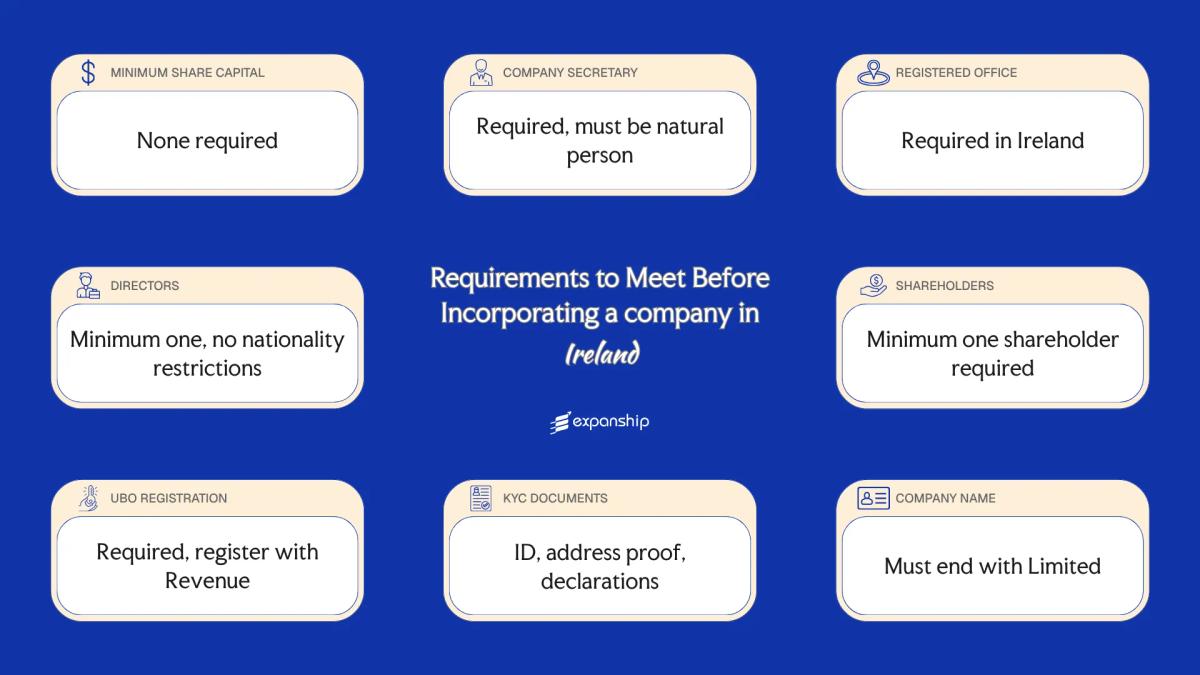
Ireland company incorporation requirements are governed by the Companies Act 2014, administered through the Companies Registration Office (CRO), which serves as the statutory body responsible for registering and regulating business entities in the state. The Act consolidated and reformed Irish company law, establishing the private company limited by shares (LTD) as the most widely used entity structure for foreign investors.
This article covers the structural, legal, and documentary requirements you must satisfy before and after registration with the CRO. Failure to meet these requirements can result in the rejection of your application or, post-registration, enforcement action by the CRO or the Office of the Director of Corporate Enforcement (ODCE).
Specific requirements vary depending on the entity type selected, the sector in which your business operates, and your residency status as a director or shareholder. The full text of the governing legislation is available via the Companies Act 2014.
This article is most relevant to non-EEA investors and foreign-owned businesses seeking to establish a legal presence in the jurisdiction for the first time.
Minimum Share Capital Requirements in Ireland
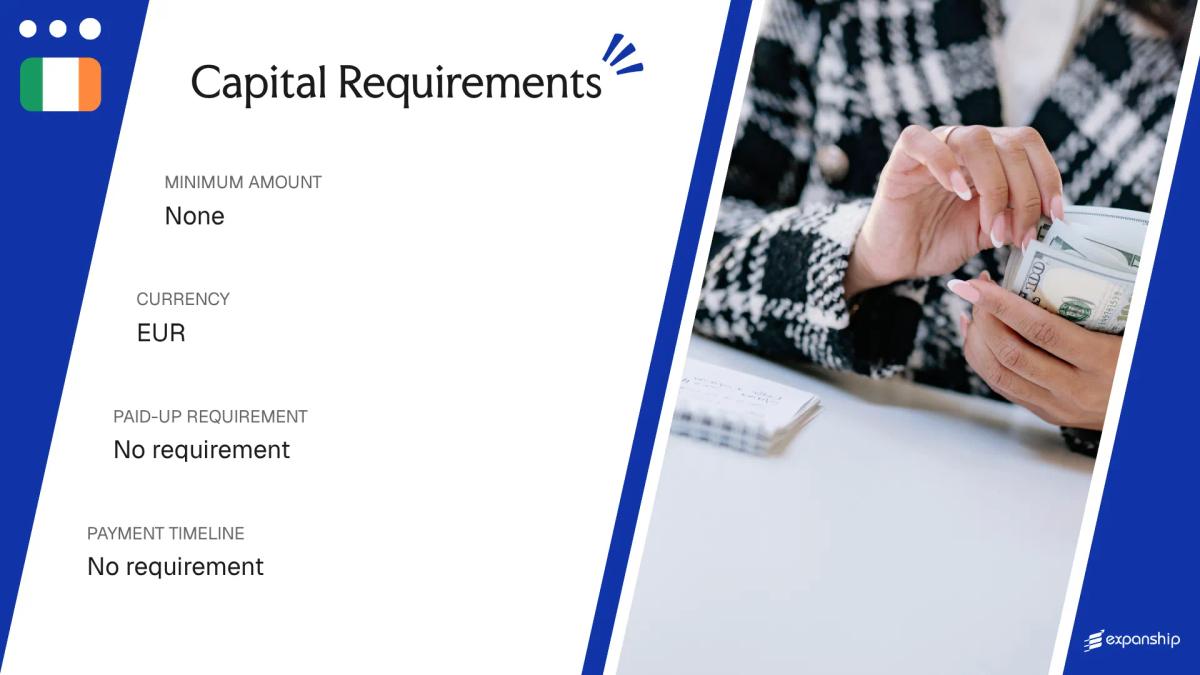
Under the Companies Act 2014, Ireland share capital requirements for a private company limited by shares (LTD) impose no statutory minimum authorized or paid-up capital. Your company must still establish an authorized share capital structure in its constitution, even though no floor amount is prescribed by law.
Shares in Irish companies are issued on a par value basis, meaning each share carries a nominal value stated in the constitution. The Companies Registration Office (CRO) processes incorporation filings but does not verify capital adequacy or require evidence of capital deposit at the time of registration.
| Parameter | Detail |
|---|---|
| Minimum Authorized Share Capital | No statutory requirement |
| Maximum Authorized Share Capital | No statutory requirement |
| Minimum Paid-Up Capital | No statutory requirement |
| Paid-Up Requirement at Incorporation | No statutory requirement |
| Accepted Currency | Euro (EUR); foreign currencies permissible |
| Accepted Forms of Contribution | Cash and non-cash contributions (assets, property) |
| Timeframe to Deposit Capital | No statutory deadline prescribed |
No minimum capital requirement does not mean share capital structure is optional. Every Irish LTD must define its share capital and par value in its constitution filed with the CRO at incorporation.
Company Secretary Requirements in Ireland
Under the Companies Act 2014, every Irish company must appoint a company secretary at the time of incorporation. This is a statutory requirement, not an optional administrative role, and the position carries defined legal obligations under Irish company secretary requirements.
The secretary is responsible for maintaining statutory registers, filing annual returns with the Companies Registration Office, and ensuring the company meets its compliance deadlines. Failure to file on time can result in the loss of audit exemption.
Qualification criteria for who may serve as company secretary:
- Must be a natural person or a corporate body; the role can be held by an individual or a separate legal entity
- A sole director cannot also serve as company secretary in a private company limited by shares
- No formal licensing requirement exists, but the director(s) must be satisfied the appointee has the skills to fulfil the duties
- A non-resident individual or foreign corporate body may serve, subject to no residency restriction under the Companies Act 2014
- Where a corporate secretary is appointed, that entity must be a properly constituted legal body

Incorporate a Company in Ireland
Set up your Irish company with full statutory compliance, including company secretary appointment and Companies Registration Office filings.
Registered Office Requirements in Ireland
Every company incorporated under the Companies Act 2014 must maintain Ireland registered office requirements by designating a physical address within the state where statutory correspondence and legal notices can be served. Failure to maintain a compliant registered address rules Ireland sets out can result in enforcement action by the Companies Registration Office (CRO), including strike-off proceedings.
- A physical address is required; P.O. boxes are not acceptable as a registered office.
- Virtual office addresses are permitted, provided they represent a genuine physical location within the state.
- The address must be situated within the Republic of Ireland; a Northern Ireland or UK address does not satisfy this requirement.
- No ownership or lease agreement is mandated by statute, but the occupier's consent to use the address is expected.
- The registered office address is publicly available on the CRO register and accessible through the Companies Online Registration Environment (CORE).
- Any change to the registered office must be notified to the CRO by filing Form B2, which takes effect upon registration.
Director Requirements in Ireland
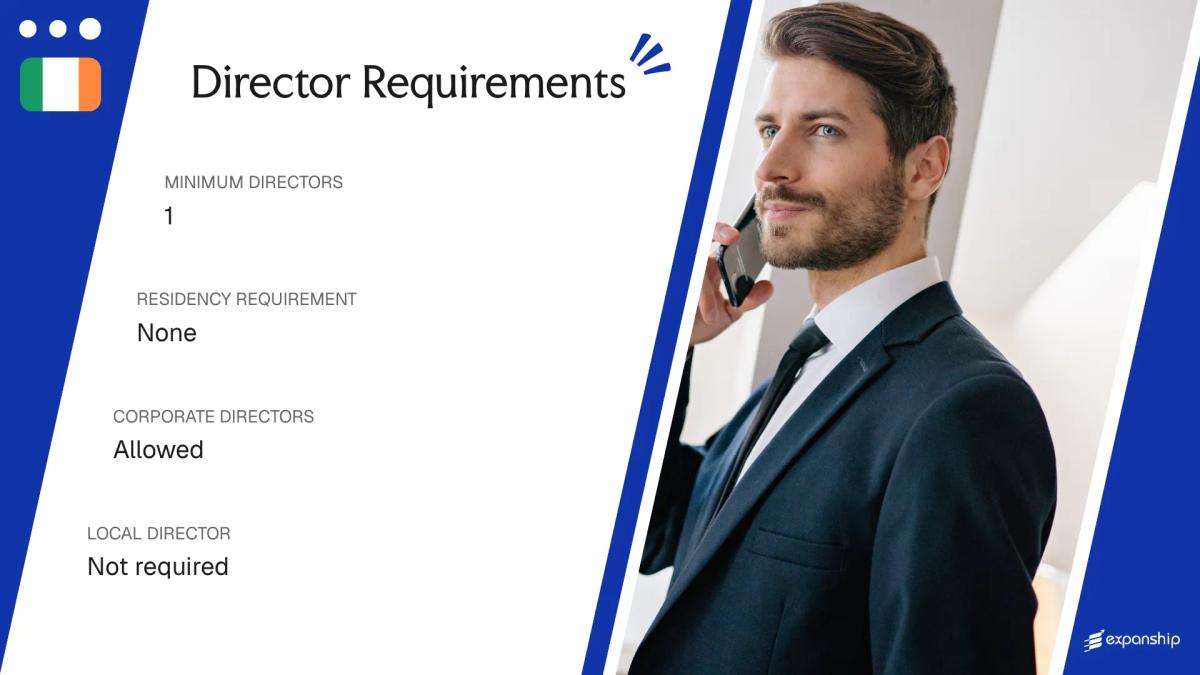
Under the Companies Act 2014, directors of an Irish private limited company assume statutory duties from the date of appointment, including fiduciary duties to act in good faith, duties of care and skill, and obligations to maintain proper books of account. Failure to meet these obligations can result in personal liability, restrictions, or disqualification under the company director rules governing Irish entities.
| Parameter | Detail |
|---|---|
| Minimum Number of Directors | A private limited company (LTD) must have at least one director; all other company types require a minimum of two. |
| Maximum Number of Directors | No statutory maximum applies for most company types. |
| Local/Resident Director Required | At least one director must be resident in an EEA member state; alternatively, a non-EEA resident director bond of €25,000 must be in place. |
| Nationality Restrictions | No nationality restrictions are imposed under the Companies Act 2014. |
| Minimum Age Requirement | Directors must be at least 18 years of age. |
| Corporate Directors Permitted | Corporate directors are not permitted in an Irish private limited company (LTD). |
| Director Must Be a Shareholder | No statutory requirement for a director to hold shares. |
| Publicly Listed on Registry | Directors are publicly listed on the Companies Registration Office (CRO) register. |
| Disqualification Conditions | A director may be disqualified by court order under Part 14 of the Companies Act 2014 for fraud, persistent filing failures, or unfitness to act. |
A single individual can serve simultaneously as the sole director and sole shareholder of an Irish LTD, making it one of the few EU jurisdictions where a fully single-person company structure is explicitly permitted by statute.
Shareholder Requirements in Ireland
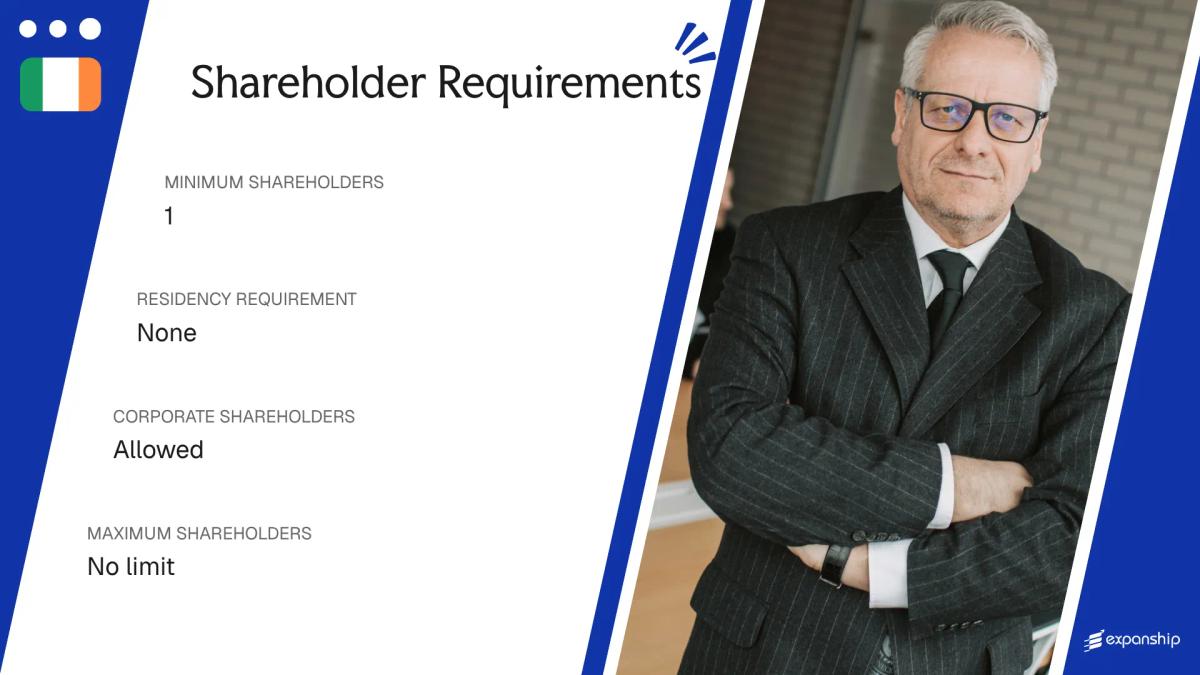
Under the Companies Act 2014, a private limited company (LTD) in Ireland requires a minimum of one shareholder and may have up to 149. A single-member company structure is fully recognised, allowing sole founders to incorporate without a second party.
Nationality and Residency Restrictions
Ireland shareholder requirements impose no nationality or residency conditions on shareholders. Foreign individuals and entities may hold 100% of the shares in an Irish private limited company without restriction.
Corporate Shareholders
Corporate entities are permitted to act as shareholders in an Irish LTD. No special conditions are attached beyond standard KYC and beneficial ownership disclosure obligations.
Shareholder Liability
Liability is limited to the amount unpaid on a shareholder's shares. In cases of fraudulent trading under the Companies Act 2014, courts may impose personal liability beyond that contribution.
Register of Shareholders
Every Irish company must maintain a Register of Members at its registered office. This register is not publicly filed with the Companies Registration Office, though it must be available for inspection and kept current following any ownership changes.
Guidance on Shareholder Structuring for Your Irish Company
Speak with our team about how shareholder rules under Irish company law apply to your specific ownership structure.
UBO / Beneficial Ownership Registration Requirements in Ireland
Ireland beneficial ownership registration is governed by the European Union (Anti-Money Laundering: Beneficial Ownership of Corporate Entities) Regulations 2019, which define a beneficial owner as any individual holding more than 25% of the shares or voting rights, or who otherwise exercises control over an entity.
- Identify all individuals who meet the beneficial ownership threshold prior to incorporation or within the required filing period.
- Record beneficial ownership details in the company's internal beneficial ownership register.
- Submit the required information to the Central Register of Beneficial Ownership of Companies and Industrial and Provident Societies (RBO), operated by the Companies Registration Office.
- File within five months of incorporation for newly formed entities.
- Update the RBO within 14 days of any change to the registered beneficial ownership information.
| Parameter | Detail |
|---|---|
| Ownership Threshold for UBO Status | More than 25% of shares, voting rights, or control |
| Filing Authority | Central Register of Beneficial Ownership (RBO), Companies Registration Office |
| Disclosure Deadline at Incorporation | Within five months of incorporation |
| Publicly Accessible Register | Yes, limited public access |
| Penalties for Non-Disclosure | Category 3 offence under Irish company law; fines apply |
| Ongoing Update Obligation | Within 14 days of any change |
KYC / Document Requirements in Ireland
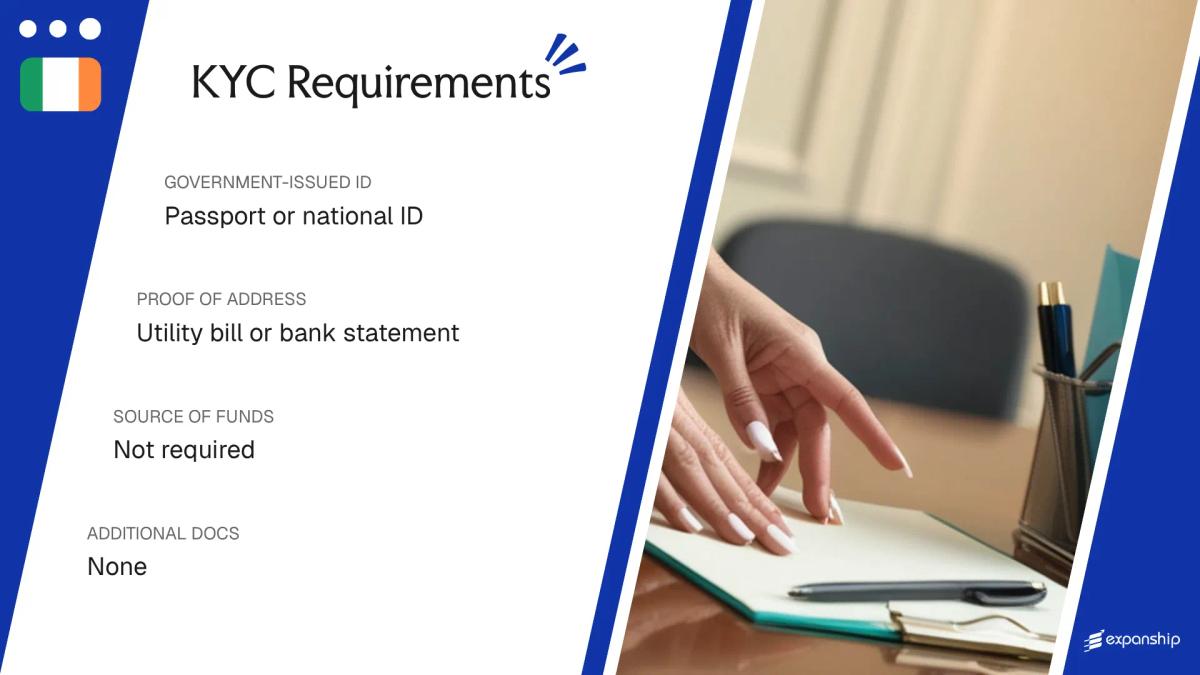
Ireland company KYC requirements are governed by the Criminal Justice (Money Laundering and Terrorist Financing) Act 2010, as amended, which obliges company formation agents and regulated persons to conduct customer due diligence before incorporation. The Financial Intelligence Unit sits within An Garda Síochána and receives suspicious transaction reports under this framework.
Individual / Personal Documents
- Valid government-issued photo ID (passport or national identity card) for each director, shareholder, and beneficial owner
- Proof of residential address dated within three months, such as a utility bill or bank statement
- Where a person acts in a representative capacity, a signed authorisation letter may be required
- Full name, date of birth, and nationality details consistent across all submitted documents
Corporate Documents
- Certificate of incorporation for any corporate shareholder or director
- Constitutional documents, such as articles of association or equivalent, evidencing the entity's structure
- Current register of directors from the corporate entity's home jurisdiction
- Proof of the corporate entity's registered office address
Source of Funds Documentation
- Recent bank statements (typically the last three to six months) showing the origin of capital
- Audited financial accounts where the introducing entity is an established business
- A written source of funds declaration may be requested where bank records are insufficient
Notarisation and Apostille Requirements
- Documents issued outside Ireland may require notarisation by a local notary public
- Apostille certification under the Hague Convention is generally required for documents from non-EU jurisdictions
- Official certified translations into English are required for any document not originally in English
The most common reason for incorporation delay is submission of proof-of-address documents that exceed the three-month validity window accepted by the Companies Registration Office and regulated formation agents.
Company Name Requirements in Ireland
Ireland company name requirements are assessed by the Companies Registration Office (CRO) at the point of incorporation. A proposed name must not be identical or too similar to one already on the register, and the CRO retains discretion to reject names it considers misleading or undesirable.
All company names must be in the Latin alphabet, though Irish language names are permitted. A private limited company must end in "Limited" or "Teoranta," the Irish equivalent.
Certain words require prior consent from a relevant authority before the CRO will accept them. Words implying state connections, financial services, or professional designations fall into this category.
Name reservation is available through the CRO. A reserved name is held for 28 days, during which your application must be submitted to retain it.
Compliance Services for Companies in Ireland
Maintain your Irish company's statutory obligations with support across annual returns, beneficial ownership filings, and ongoing CRO compliance.
Conclusion
Ireland company registration requirements span several distinct obligations governed primarily by the Companies Act 2014 and administered through the Companies Registration Office. Among the most consequential are the EEA-resident director rule, which requires at least one director to be ordinarily resident within the European Economic Area, and the beneficial ownership disclosure obligations under the Register of Beneficial Owners. Once these requirements are understood, a foreign investor is positioned to move from structural planning into the practical steps of entity formation and ongoing compliance management.
Expanship's Ireland Company Formation Services
Expanship's Ireland company formation services are structured around the specific requirements that Companies Registration Office filings, EEA-director rules, and beneficial ownership registration place on incoming businesses. From coordinating your company secretary appointment to ensuring your registered office meets the Companies Act 2014 criteria, the support is designed to reduce the administrative load these obligations create.
Expanship handles the full incorporation process and beyond, covering everything from initial setup through ongoing compliance:
- Preparing and filing all incorporation documents with the Companies Registration Office on your behalf.
- Providing a compliant registered office address and acting as your registered agent in Ireland.
- Managing all government filings and liaising directly with the relevant regulatory authorities.
- Handling post-incorporation compliance, including annual return obligations and statutory filings.
- Facilitating introductions to local banking institutions suited to your business structure.
- Registering your entity for the appropriate taxes and coordinating with the Revenue Commissioners.
To discuss your requirements, contact Expanship Ireland.
Frequently Asked Questions (FAQ)
Companies wholly owned by entities listed on a regulated market that are subject to adequate disclosure obligations may qualify for an exemption from filing beneficial ownership details on the Central Register of Beneficial Ownership (RBO). The exemption is not automatic; your company must still assess whether the listed parent meets the criteria set out under the European Union (Anti-Money Laundering: Beneficial Ownership of Corporate Entities) Regulations 2019. If there is any doubt, filing is the safer course, as failure to register carries criminal liability for the company and its officers.
Failure to comply with the RBO registration obligation is a criminal offence under the 2019 Regulations and can result in a fine of up to €500,000 on conviction on indictment. The obligation rests on the company itself, and directors can be held personally liable where non-compliance is attributable to their neglect or consent. The RBO also has the power to impose administrative sanctions independently of a criminal prosecution.
Yes, a corporate body can serve as company secretary of an Irish private limited company, provided it has the skills and resources to fulfil the role. The Companies Act 2014 does not prescribe formal qualifications for the secretary of a private company, but the directors are responsible for ensuring the appointee is capable of carrying out the statutory duties. If a sole director is appointed, that same individual cannot also act as company secretary.
Ireland imposes no minimum authorised or paid-up share capital for a private company limited by shares. A company can be incorporated with a single share of €1 nominal value, and there is no requirement to deposit capital into a bank account before the Companies Registration Office (CRO) processes the application. This contrasts with several EU jurisdictions that require a minimum paid-up amount as a condition of registration.
The CRO will refuse a name that is identical or too similar to an existing registered name, that contains a restricted word requiring ministerial consent, or that is considered offensive or contrary to public policy. If your application is rejected on name grounds, you must resubmit with an alternative name, which resets the processing timeline. Checking the CRO's online name search tool before submission reduces this risk, but approval is ultimately at the CRO's discretion.
The KYC timeline depends on how quickly all directors, shareholders, and beneficial owners provide certified identity documents and proof of address that meet the requirements of the firm handling the incorporation. Delays most commonly arise when documents are not certified correctly, when source-of-funds information is incomplete for high-risk structures, or when a beneficial owner is a corporate entity that requires its own chain of ownership documentation. Straightforward structures with EEA-resident individuals and standard documentation can typically be cleared within a few business days.
Legal Disclaimer
The information provided in this article is for general informational purposes only and does not constitute legal, tax, or professional advice. While we strive to ensure the accuracy and timeliness of the content, laws and regulations are subject to change, and the application of laws can vary widely based on specific facts and circumstances.
Readers should not act upon this information without seeking professional counsel tailored to their individual situation. Expanship and its authors disclaim any liability for actions taken or not taken based on the content of this article.
For specific advice regarding your business setup, compliance requirements, or any legal matters, please consult with qualified legal and tax professionals in the relevant jurisdiction.