
Key Takeaways
- Ireland's statutory 12.5% corporate tax rate on trading income, administered by Revenue and anchored in long-standing fiscal policy, provides a predictable and durable tax base rather than a time-limited incentive scheme.
- Companies incorporated under the Companies Act 2014 can access a participation exemption on qualifying dividends and gains, making Ireland a structurally efficient location for both operating entities and multinational holding arrangements.
- Membership of the EU Single Market combined with an English-speaking common law environment reduces the legal and operational friction that foreign businesses typically encounter when entering continental European jurisdictions.
- Ireland's R&D tax credit regime and Knowledge Development Box create measurable cost advantages for technology and IP-intensive businesses that generate qualifying income from protected intellectual property.
Registered as an independent sovereign state and a member of the European Union, Ireland operates a low-tax, treaty-based corporate tax regime that has attracted substantial foreign direct investment over several decades. The Companies Registration Office (CRO) is the statutory body responsible for company incorporation and ongoing compliance filings. Foreign businesses establishing a presence here most commonly do so through a private company limited by shares.
There are no restrictions on foreign ownership of Irish-registered entities, and non-resident directors and shareholders may hold interests without requiring local participation. This open posture toward international capital is reflected in the volume of multinational firms that have established operational and holding structures within the jurisdiction.
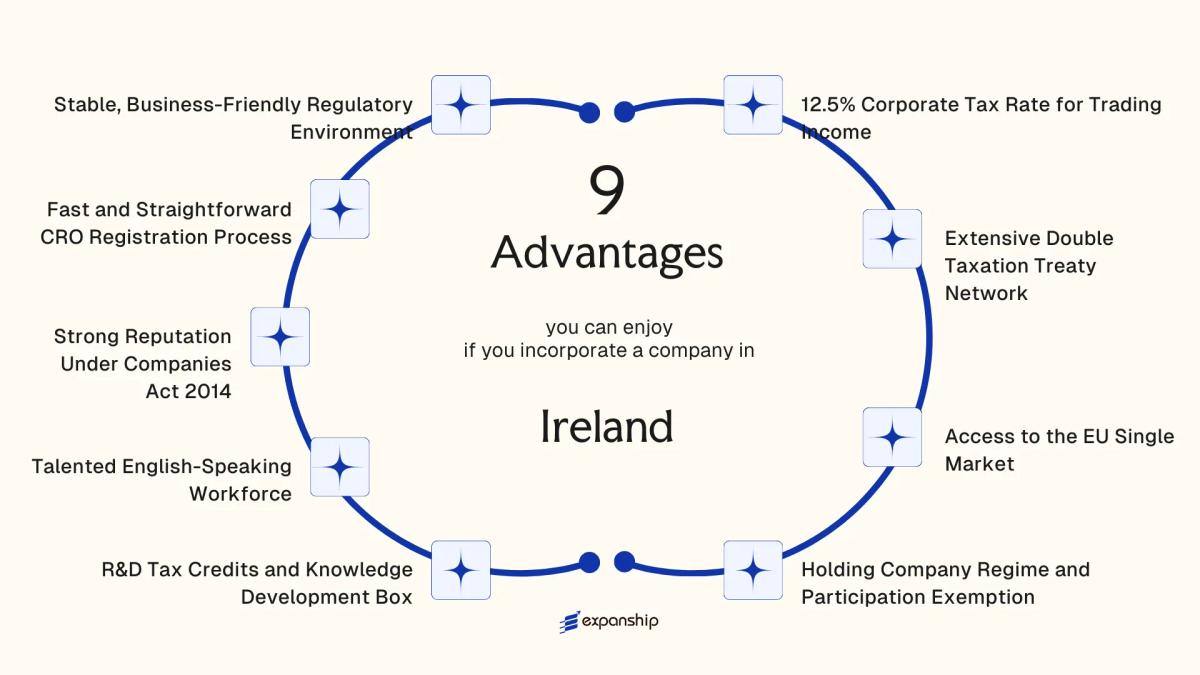
The benefits of incorporating in Ireland span taxation, market access, workforce quality, and regulatory clarity. This article examines each of those advantages in detail, drawing on the specific provisions of the Companies Act 2014 and the tax measures administered by Revenue, the Irish tax authority.
12.5% Corporate Tax Rate for Trading Income
Ireland's 12.5% corporate tax rate for trading income is one of the most cited figures in international tax planning, and it carries genuine weight. Under the Taxes Consolidation Act 1997, this rate applies to profits derived from active trading operations conducted through an Irish-resident entity.
What Qualifies as Trading Income
The 12.5% rate applies specifically to trading profits, meaning your business must conduct substantive commercial activity through the Irish entity. Passive income, such as rent or certain investment returns, falls under a separate 25% rate, so the structure of your operations determines which rate applies.
Why the Rate Matters in Practice
Compared to the EU average corporate tax rate of approximately 21%, the differential is substantial enough to affect post-tax profit margins meaningfully for mid-to-large trading operations. For a foreign business routing European sales or services through an Irish subsidiary, that gap compounds year over year.
Qualifying as a trading company also requires that genuine management and control functions are exercised within the jurisdiction, which reinforces the need for real operational substance rather than a nominal registration.
Active trading income earned through an Irish company is taxed at 12.5%, giving your business a structurally lower tax base compared to most EU member states.
Extensive Double Taxation Treaty Network
Ireland has signed over 76 double taxation treaties, one of the largest networks among EU member states. For a foreign business operating through an Irish-resident company, this means income flows — dividends, interest, royalties, and capital gains — are less likely to be taxed twice across borders. That directly reduces the effective tax cost of cross-border transactions.
The practical scope of this network is significant. Treaties cover major economies including the United States, United Kingdom, Germany, China, Japan, and Canada. Where a treaty is in force, withholding tax rates on outbound payments are typically reduced well below domestic statutory rates in the counterpart jurisdiction, which can otherwise erode returns considerably.
For businesses structured around an Irish holding or trading entity, the treaty network provides measurable certainty. Treaty provisions are enforceable under domestic law once the relevant agreement has been incorporated through statutory instrument.
Several features of this network make it particularly useful for internationally active firms:
- Reduced withholding tax rates on dividends paid to Irish-resident parent companies from treaty partners
- Protection against permanent establishment claims in jurisdictions where your firm has limited operational presence
- Dispute resolution mechanisms through mutual agreement procedures, offering a defined path when tax authorities disagree
Access is generally conditional on tax residency, which requires central management and control to be exercised within the state.

Incorporate a Company in Ireland
Set up an Irish-resident company and access one of the EU's most extensive double taxation treaty networks through Expanship.
Access to the EU Single Market
Membership in the European Union gives an Irish-registered company direct access to the EU single market, a trading area covering over 440 million consumers and 27 member states. For a foreign business owner, this is a structural advantage: a company incorporated in Ireland operates under EU law without customs formalities, tariff barriers, or separate market authorisation requirements when trading across member states.
The legal foundation is the Treaty on the Functioning of the European Union (TFEU), which guarantees the free movement of goods, services, capital, and persons. A firm established in Ireland can passport financial services under EU directives, trade physical goods across the bloc without intra-EU tariffs, and bid for public procurement contracts in other member states on equal footing with local entities.
| Market Dimension | Applicable EU Framework | Practical Scope |
|---|---|---|
| Goods | TFEU Articles 28-37 | Tariff-free circulation across all 27 member states |
| Financial Services | MiFID II, CRD IV, Solvency II | Cross-border passporting rights within the EU |
| Professional Services | Services Directive 2006/123/EC | Freedom to supply services across member states |
| Capital | TFEU Articles 63-66 | Free movement of payments and investment flows |
English is the primary business language here, which reduces operational friction when communicating with EU regulatory bodies such as the European Central Bank or the European Banking Authority. For non-EU founders, incorporating in Ireland for EU access removes the need to establish separate entities in multiple member states to serve European clients.
Holding Company Regime and Participation Exemption
Ireland holding company participation exemption benefits sit within a framework specifically designed to make the country a viable base for managing international investments. Under Irish tax law, dividends received from qualifying subsidiaries can be exempt from corporation tax, provided certain conditions under the Taxes Consolidation Act 1997 are met.
To qualify, the paying subsidiary generally must be resident in an EU member state or a country with which Ireland holds a tax treaty. The receiving Irish company must hold at least 5% of the ordinary share capital. That relatively low ownership threshold means smaller holding structures remain eligible, which is not always the case in comparable European regimes.
Capital gains on the disposal of qualifying subsidiaries are also exempt under the participation exemption rules. For groups managing asset-heavy subsidiaries or planning staged divestments, this removes a material tax friction point at the point of exit.
The Revenue guidance provides the authoritative framework for residence and exemption conditions.
Keep the following in mind:
- Subsidiary must be resident in an EU or treaty country
- Minimum 5% shareholding in the paying company is required
- Gains on disposal of qualifying shares can also qualify for exemption
- Anti-avoidance provisions under the Taxes Consolidation Act 1997 apply
Ireland's participation exemption applies to gains on share disposals as well as dividends, meaning a single holding structure can shelter both income and exit proceeds under the same legislative framework.
R&D Tax Credits and Knowledge Development Box
Ireland R&D tax credits and the Knowledge Development Box together form one of the more structurally generous IP and innovation regimes in the EU. For a foreign business owner, this means that qualifying research activity and commercialised intellectual property are taxed at rates significantly below the standard 12.5% trading rate.
The R&D Tax Credit Mechanism
Under the Taxes Consolidation Act 1997, as amended, companies can claim a 30% tax credit on qualifying R&D expenditure against their corporation tax liability. For businesses spending under €50,000 on qualifying R&D, the credit applies at a higher rate. Critically, the credit is refundable in certain circumstances, meaning a loss-making entity conducting genuine qualifying research can still receive a cash payment from Revenue, the Irish tax authority.
The Knowledge Development Box
The KDB offers a 6.25% effective tax rate on income derived from qualifying assets, including patents and certain copyrighted software. This rate is exactly half the standard 12.5% trading rate, and the KDB is explicitly designed to comply with the OECD's modified nexus approach, which links the tax benefit to where the R&D activity that generated the IP was actually performed. Your entity must therefore conduct substantial R&D activity within the jurisdiction to qualify, which prevents the regime from functioning as a pure holding structure for externally developed IP.
Maximise Your Irish Tax Position From Day One
Speak with Expanship about structuring your Irish entity to qualify for R&D credits and Knowledge Development Box benefits from the outset.
Talented English-Speaking Workforce
English is the primary language of business in Ireland, and for foreign companies, that removes a friction point that exists in most other EU member states. Ireland English-speaking skilled workforce benefits extend beyond simple communication; they affect how quickly you can hire, onboard, and delegate without translation overhead or interpretation gaps in legal and financial documentation.
- Approximately 56% of Irish adults aged 25 to 34 hold a tertiary qualification, one of the highest rates in the EU according to Eurostat data.
- The National Framework of Qualifications (NFQ) governs credential standards across Irish institutions, giving employers a consistent benchmark when assessing candidates.
- Major technology, pharmaceutical, and financial services firms have built substantial operations in Dublin, creating a concentrated pool of professionals with sector-specific experience in regulated industries.
- Irish third-level institutions, including University College Dublin and Trinity College Dublin, produce graduates in engineering, computer science, finance, and law annually, feeding directly into the commercial workforce.
- Because employment contracts, regulatory filings, and corporate governance documents are all produced in English, your legal team at home can review them without requiring certified translation.
For a foreign business owner hiring across borders, operating in a jurisdiction where the working language matches your corporate language reduces administrative cost and legal exposure in day-to-day operations.
Strong Reputation Under Companies Act 2014
Enacted in 2014, the Companies Act 2014 consolidated and modernised Irish company law into a single statute, replacing over 40 prior legislative instruments. For foreign business owners, Ireland Companies Act 2014 business reputation benefits begin at the structural level: the Act introduced the Company Limited by Shares (LTD) as a simplified corporate vehicle with a single-document constitution, no requirement for an objects clause, and full legal capacity to act. Counterparties, banks, and institutional investors recognise this structure as transparent and well-governed.
Compliance with the Act signals operational credibility to external parties. Auditors, legal counsel, and financial institutions across the EU treat CRO-registered entities as subject to a clear, enforceable framework, which reduces due diligence friction when your firm seeks credit, partnerships, or contracts.
The Office of the Director of Corporate Enforcement (ODCE) oversees compliance, and its active role means the register is not treated as a dormant administrative formality. A firm listed on the CRO carries a verifiable public record, which supports Ireland CRO regulatory credibility benefits when entering regulated sectors or cross-border transactions.
Under Section 16 of the Companies Act 2014, a private company limited by shares has "full and unlimited capacity to carry on and undertake any business or activity, do any act, or enter into any transaction." This removes the ultra vires risk that historically exposed companies incorporated under narrower objects clauses, reducing legal uncertainty for counterparties dealing with your entity.
Fast and Straightforward CRO Registration Process
One of the practical Ireland CRO company registration benefits is the speed at which a private limited company (LTD) can be incorporated. The Companies Registration Office typically processes standard applications within five working days, with a same-day registration option available for an additional fee.
Registration is conducted through the CRO's online portal, CORE (Companies Online Registration Environment). For a private LTD, you need a constitution, at least one director, one shareholder, and a registered address in the state. The director requirement under the Companies Act 2014 includes an EEA-resident director rule, though a non-EEA director can satisfy this by obtaining a Section 137 bond.
The implications are concrete for a foreign business owner:
- No minimum share capital is required for a private LTD
- A company secretary must be appointed, but this role can be outsourced
- The entire process can be completed remotely, without physical presence
Setup time directly affects when your entity can open bank accounts, sign contracts, and begin trading. A five-day incorporation window compresses that operational delay considerably compared to jurisdictions where registry processing runs several weeks.
If none of your directors are EEA-resident, you must arrange a Section 137 bond before the CRO will complete registration, which adds cost and lead time to the process.
Stable, Business-Friendly Regulatory Environment
Ireland's business-friendly regulatory environment benefits foreign companies through a legal framework that has remained consistent and predictable over several decades. That consistency reduces the compliance uncertainty that often affects entities operating across multiple jurisdictions.
The Companies Act 2014 consolidated and modernised Irish company law into a single, codified statute. For foreign directors and shareholders, this means obligations, filing deadlines, and governance requirements are clearly defined in one legislative instrument rather than scattered across amended legislation. The Central Bank of Ireland, the Competition and Consumer Protection Commission, and the Companies Registration Office each operate within defined mandates, which limits regulatory overlap.
Oversight structures here are aligned with EU standards under directives including the EU Shareholder Rights Directive and the EU Anti-Money Laundering framework. Because these rules derive from European-level legislation, a business already operating elsewhere in the EU will find the compliance requirements broadly familiar. That reduces the cost of legal and accounting adaptation when entering the Irish market.
Common law underpins the commercial legal system, which carries direct relevance for businesses from the UK, the United States, Canada, and other common law jurisdictions. Contract enforcement, dispute resolution mechanisms, and corporate governance concepts translate more directly than they would in a civil law country.
Conditions that support regulatory predictability include:
- Annual filing obligations managed through the CRO with defined statutory deadlines
- Director duties codified under Parts 5 and 6 of the Companies Act 2014
- A written constitution requirement that sets out a company's internal governance framework from incorporation
Why Ireland Beats Other EU Incorporation Destinations
Comparing Ireland against its most direct EU competitors reveals a consistent pattern: the same benefits appear elsewhere, but rarely in the same combination or at the same terms. The Netherlands and Luxembourg are the jurisdictions a foreign investor realistically weighs when evaluating Ireland vs other EU incorporation destinations advantages. Both offer participation exemptions and treaty networks, yet neither pairs those features with a 12.5% trading rate applied to active income under domestic law rather than a special regime.
Luxembourg's standard corporate rate sits above 24% when municipal business tax is included, and the Netherlands introduced a 25.8% headline rate in 2022 for profits above €200,000. Neither replicates the flat, unconditional trading rate that applies to Irish-resident companies under the Taxes Consolidation Act 1997. English as the sole official business language also removes a practical friction that neither competitor can match for common-law-trained investors and advisors.
| Parameter | Ireland | Netherlands | Luxembourg |
|---|---|---|---|
| Standard corporate tax rate | 12.5% (trading income) | 25.8% (above €200k) | ~24.94% (incl. municipal tax) |
| Official business language | English | Dutch | French / Luxembourgish / German |
| Participation exemption on dividends | Yes | Yes | Yes |
| Knowledge development box | Yes (6.25%) | Yes (Innovation Box, 9%) | Yes (IP regime, 8.5%) |
| Common law legal system | Yes | No | No |
| EU single market access | Yes | Yes | Yes |
| Double tax treaties (approx.) | 76 | 100+ | 80+ |
Compliance Services for Companies in Ireland
Stay on top of annual return filings, CRO obligations, and ongoing statutory requirements for your Irish company.
Conclusion
Ireland's position as a location for foreign business registration rests on a combination of factors that, taken together, are difficult to replicate elsewhere in the EU. The 12.5% corporate tax rate on trading income, underpinned by statute and reinforced by an extensive double taxation treaty network, provides a durable tax structure rather than a temporary incentive. Paired with the participation exemption available under the holding company regime, the framework supports both operating entities and group structures with meaningful tax efficiency.
The R&D tax credit and the Knowledge Development Box add a further dimension that is particularly relevant for technology and IP-intensive businesses. Access to the EU Single Market through a common law jurisdiction with an English-speaking workforce removes several of the operational frictions that affect foreign firms entering continental Europe through less familiar legal systems.
None of these advantages operate uniformly across every business model. The suitability of an Irish company structure depends on factors including your trading activities, where your substance is located, and how your group is organised. A holding entity optimised for passive income will engage with the regime differently than an active trading company seeking to qualify for the 12.5% rate. Establishing the right structure at incorporation, with reference to the Companies Act 2014 and applicable Revenue guidance, determines how effectively these advantages translate into practice for your specific circumstances.
Start Your Irish Company Formation With Expanship
Expanship assists foreign investors with Ireland company formation, covering the full registration process under the Companies Act 2014 and filing obligations with the Companies Registration Office (CRO). From selecting the appropriate entity type, whether a private company limited by shares (LTD) or a designated activity company (DAC), to meeting the resident director requirement and preparing constitutional documents, the firm coordinates each stage with the relevant Irish authorities.
Services provided include:
- Preparation and legalization of incorporation documents for CRO submission
- Registered office and resident director provision to satisfy statutory requirements
- Government filing and direct liaison with the CRO throughout registration
- Post-incorporation compliance management, including annual return filing with the CRO and Companies Act obligations
- Banking introduction assistance to support corporate account setup with Irish financial institutions
Expanship Ireland is available to assist foreign businesses with incorporating and maintaining compliance through Irish company incorporation services built around the regulatory framework described throughout this guide.
Frequently Asked Questions (FAQ)
The 12.5% rate applies specifically to trading income, meaning income derived from active business operations carried out in Ireland. Passive income — such as rental income or certain investment returns — is taxed at 25% under Schedule D of the Taxes Consolidation Act 1997. A company must demonstrate that genuine trading activity is conducted in the jurisdiction for the lower rate to apply.
Standard registration with the Companies Registration Office (CRO) typically takes between three and five business days when documents are submitted electronically through CORE (Companies Online Registration Environment). Expedited processing is available for an additional fee and can reduce turnaround to one business day. Timelines assume all submitted documents are in order and compliant with the Companies Act 2014.
Under the Knowledge Development Box regime, qualifying assets include computer programs, inventions protected by a qualifying patent, and certain other certified intangible assets where the income arises from research and development activity conducted within the state. The regime applies a 6.25% effective tax rate on qualifying profits. Assets must meet the nexus fraction requirements set out in the Taxes Consolidation Act 1997, which links the tax benefit to the proportion of R&D expenditure incurred directly by the company.
The participation exemption on dividends received from foreign subsidiaries is available subject to specific conditions under the Taxes Consolidation Act 1997. The paying company must be resident in a country with which Ireland has a double taxation agreement or in an EU member state, and the Irish holding company must hold at least 5% of the ordinary share capital. Capital gains on the disposal of qualifying subsidiary shares may also be exempt under the same framework, provided the subsidiary is a trading company or the holding is part of a trading group.
Ireland has an active network of over 76 double taxation agreements, covering most major trading and investment partner countries. Treaty benefits are not automatic: Irish tax law and OECD standards require that the company claiming treaty residence be genuinely managed and controlled from Ireland. Placing a brass-plate entity in the jurisdiction without real operational substance risks treaty entitlements being challenged by both Irish Revenue and the counterpart tax authority.
After incorporation, a private limited company registered under the Companies Act 2014 must file an Annual Return with the CRO each year, accompanied by financial statements that comply with Irish GAAP or IFRS as applicable. The company must also maintain a register of beneficial owners and file that information with the Central Register of Beneficial Ownership of Companies and Industrial and Provident Societies (RBO). Corporation tax returns are filed with the Revenue Commissioners, with deadlines tied to the company's financial year-end.
Legal Disclaimer
The information provided in this article is for general informational purposes only and does not constitute legal, tax, or professional advice. While we strive to ensure the accuracy and timeliness of the content, laws and regulations are subject to change, and the application of laws can vary widely based on specific facts and circumstances.
Readers should not act upon this information without seeking professional counsel tailored to their individual situation. Expanship and its authors disclaim any liability for actions taken or not taken based on the content of this article.
For specific advice regarding your business setup, compliance requirements, or any legal matters, please consult with qualified legal and tax professionals in the relevant jurisdiction.