

Key Takeaways
- Under the Companies Act 2014, every Irish private limited company must appoint at least one EEA-resident director, creating a structural obstacle for non-EEA founders who lack an established European presence.
- Passive income — including royalties, rental income, and investment returns — is taxed at 25% in Ireland rather than the headline 12.5% trading rate, making Ireland a less efficient holding jurisdiction than it may initially appear.
- Ongoing compliance with both the Companies Registration Office and the Revenue Commissioners imposes parallel annual filing obligations, meaning a company must satisfy two distinct regulatory bodies to remain in good standing.
- Mandatory appointment of a qualified company secretary, combined with audit requirements for companies exceeding statutory size thresholds, adds recurring professional services costs that can be disproportionately burdensome for smaller foreign-owned entities.
Ireland operates under a heavily regulated corporate framework, governed primarily by the Companies Act 2014. The obligations this framework imposes span tax compliance, directorship requirements, statutory filings, and professional appointments — and the disadvantages of incorporating in Ireland cut across each of these areas.
Not every drawback applies equally to all business types. A non-trading holding structure faces a different set of constraints than an active trading subsidiary, and a sole foreign director encounters different friction than a firm with an established European presence.
This article is most relevant to non-EEA investors, foreign founders, and overseas businesses considering an Irish private limited company who have not yet had direct exposure to the requirements of the Companies Registration Office or the Revenue Commissioners.
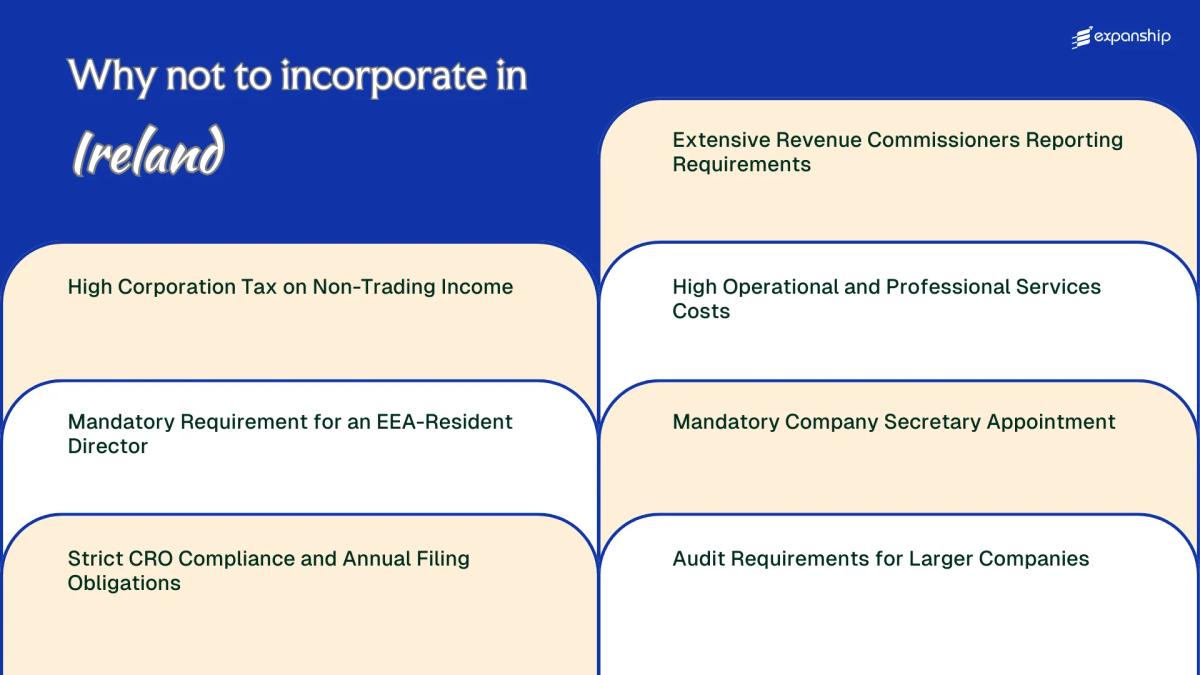
High Corporation Tax on Non-Trading Income
Ireland's high corporation tax on non-trading income creates a significant structural cost burden that many foreign investors underestimate before incorporating.
The 25% Rate and What It Captures
Passive income, including dividends from non-trading subsidiaries, rental income, and interest not arising from a trade, is taxed at 25% under Schedule D Case III, IV, and V of the Taxes Consolidation Act 1997. For a holding company or a business with meaningful investment income, this rate effectively doubles the tax exposure compared to the 12.5% rate applied to active trading profits.
Foreign investors who structure Irish entities to hold assets or receive passive returns face a materially higher effective tax rate than they may have anticipated.
Structural Limitations for Holding Structures
Revenue Commissioners apply the non-trading rate broadly, and the classification between trading and non-trading income can require formal analysis. If your entity's income mix shifts over time, a larger proportion of profits may fall into the 25% bracket without any change in the underlying rate itself.
This distinction creates real uncertainty for businesses whose revenue model evolves after incorporation.
Foreign investors using an Irish entity primarily to hold investments or receive passive income may face an effective tax rate that is double the headline rate most associated with Ireland.
Mandatory Requirement for an EEA-Resident Director
The Ireland EEA resident director requirement, established under Section 137 of the Companies Act 2014, mandates that at least one director of an Irish private limited company must be ordinarily resident in a European Economic Area member state. For founders based outside the EEA, this single structural rule can block incorporation entirely unless a workaround is arranged.
The most common alternative is a Section 137 bond, a two-year insurance bond currently valued at €25,000. Obtaining this bond adds direct cost and administrative effort before the company can even operate.
Relying on a bond rather than a qualifying resident director creates several practical burdens:
- Sourcing a reputable bond provider requires time and due diligence that delays incorporation
- The bond must be renewed if the company still lacks a qualifying EEA-resident director after two years, adding recurring cost
- Some banks and financial institutions view a bonded structure with greater scrutiny during account opening, slowing the process further
- If the bond lapses without replacement, the company falls into non-compliance with the Companies Registration Office
Non-EEA founders who appoint a professional nominee director to satisfy the residency rule face ongoing dependency on a third party for formal company decisions. That dependency carries its own cost, typically an annual retainer, and introduces a layer of governance complexity that does not exist in jurisdictions with no residency restriction.

Company Incorporation in Ireland
Understand the structural requirements for setting up an Irish limited company, including director residency obligations under the Companies Act 2014.
Strict CRO Compliance and Annual Filing Obligations
Ireland CRO annual filing obligations impose a recurring administrative burden that many foreign business owners underestimate before incorporation. Every company registered under the Companies Act 2014 must file an Annual Return with the Companies Registration Office, regardless of whether it traded during the year.
The Annual Return must be filed on time, and any late submission triggers automatic late filing fees plus the loss of audit exemption for the following two years. That audit exemption loss has direct cost consequences, since it forces firms that would otherwise qualify to engage statutory auditors.
| Requirement | Detail | Consequence of Non-Compliance |
|---|---|---|
| Annual Return deadline | Within 56 days of the ARD | Automatic late filing fees from day one |
| Late filing fee | €100 immediately, then €3 per day | Uncapped daily accrual until filed |
| Audit exemption loss | Triggered by any late Annual Return | Mandatory audit for the next two financial years |
| Strike-off risk | Persistent non-filing | Involuntary dissolution by the CRO |
The daily accrual of €3 with no statutory cap means a delayed filing can accumulate hundreds of euros before the error is corrected. For a foreign director unfamiliar with the Irish filing calendar, this is a realistic and recurring exposure.
Beyond the Annual Return, the CRO also requires financial statements to be attached in a prescribed format, which demands local accounting expertise. Outsourcing that work adds to the professional services cost that foreign-owned entities already carry.
Extensive Revenue Commissioners Reporting Requirements
Revenue Commissioners reporting requirements Ireland imposes on incorporated entities go well beyond a simple annual return. Corporate tax obligations are administered by Revenue, which requires companies to file a Form CT1 corporation tax return annually, along with supporting financial statements, computations, and declarations. Filing deadlines are tied to a company's accounting period end date, and missing them triggers automatic surcharges on the tax liability.
Preliminary tax payments are due before the accounting year ends. This means your business must estimate and pay tax before it knows the final liability, creating a cash-flow burden that catches many foreign-owned entities off guard.
The iXBRL requirement adds another layer. Financial statements submitted with the CT1 must be tagged in iXBRL format, which demands specialist software and technical knowledge that most foreign business owners do not have in-house.
- Corporation tax returns must be filed via ROS (Revenue Online Service) in CT1 format
- iXBRL-tagged financial statements are mandatory for most companies filing with Revenue
- Preliminary tax must be paid before the accounting period closes
- Surcharges apply automatically for late filing, independent of whether tax is owed
- Directors may be required to file personal Form 11 returns if they receive any Irish-sourced income
Ireland requires preliminary corporation tax to be paid before a company's financial year even ends, meaning you are taxed on profits you have not yet fully accounted for.
High Operational and Professional Services Costs
Maintaining an Irish company carries costs that go beyond the standard registration fees, and Ireland company operational costs drawbacks often catch foreign founders off guard once the entity is active.
Cost Structure for Statutory and Advisory Services
Fees charged by Irish solicitors, chartered accountants, and company secretarial firms sit at the higher end of the EU range, reflecting both professional indemnity requirements and the regulatory complexity imposed by the Companies Act 2014. For a foreign business owner without local knowledge, outsourcing these functions is not optional — it is a practical necessity.
The Compounding Effect on Smaller Entities
Annual compliance alone, covering Revenue Commissioners filings, CRO annual returns, and statutory accounts preparation, can generate recurring professional fees that erode the margins of a smaller trading entity. These costs apply regardless of revenue, meaning an early-stage company bears the same structural overhead as a well-established one.
A micro-entity qualifying under Section 280A of the Companies Act 2014 faces reduced reporting obligations, but the baseline cost of retained professional services remains fixed.
Managing the Cost of Irish Company Compliance
Speak with our team about structuring your Irish entity to minimise unnecessary professional service expenditure while staying fully compliant.
Mandatory Company Secretary Appointment
The Ireland mandatory company secretary requirement under the Companies Act 2014 obliges every private limited company to appoint a named individual or corporate entity to this role. This is not an administrative formality — the secretary carries statutory duties that create a distinct, ongoing compliance cost.
- Under section 129 of the Companies Act 2014, the company secretary must be a person with the skills and resources necessary to discharge the role, which in practice means most foreign founders must engage a professional firm rather than appointing a nominee without genuine capacity.
- The secretary is personally responsible for filing obligations with the Companies Registration Office, meaning any lapse in filings can expose both the officer and the company to penalties.
- Retaining a qualified corporate secretary in Ireland adds a recurring professional services cost that many offshore structures do not require.
Audit Requirements for Larger Companies
One of the more material Ireland company audit requirements drawbacks is the cost and complexity triggered once your company crosses statutory size thresholds. Under the Companies Act 2014, a company loses its audit exemption if it exceeds two of three criteria: a balance sheet total above €6 million, turnover above €12 million, or more than 50 employees. Once breached, a full statutory audit by a registered statutory auditor becomes mandatory.
Statutory audits in Ireland are not a formality. Fees for mid-size companies routinely run from €5,000 to €15,000 or more annually, depending on the complexity of the entity's financial affairs.
For foreign-owned subsidiaries or holding structures, the burden compounds. Consolidated group accounts may require audit at multiple levels, and the Irish subsidiary must independently satisfy the obligations under Irish large company audit obligations rules regardless of what the parent jurisdiction requires.
The exemption is also conditional on compliance history. A company that has previously failed to file annual returns on time with the Companies Registration Office automatically loses its audit exemption for the following year, creating a punitive knock-on cost.
A foreign-owned Irish subsidiary with €14 million in turnover and 30 employees exceeds the turnover threshold alone. Even if it qualifies on two of three criteria for exemption, a prior late CRO filing in year one would force a mandatory audit in year two, adding an estimated €8,000 to €12,000 in professional fees not budgeted for at incorporation.
Overcoming These Challenges in Ireland
Overcoming These Challenges in Ireland
Overcoming Ireland incorporation challenges requires structural preparation before the company is registered, not after problems surface. Most of the difficulties covered in this blog stem from fixed statutory obligations under the Companies Act 2014 and Revenue Commissioners rules, which means the mitigation approach is largely about anticipating requirements in advance.
- Appoint a qualified EEA-resident director at the point of incorporation to satisfy the Companies Act 2014 Section 137 requirement, or arrange a Section 137 bond in advance.
- Engage a qualified individual to fulfil the company secretary obligation under the Companies Act 2014 before the CRO registration is submitted.
- Register for all applicable Revenue taxes promptly through ROS to avoid penalties on late filing of returns.
- Assess whether your entity will breach the audit thresholds under the Companies Act 2014 and structure accordingly before the first financial year closes.
- Separate trading income from passive income streams in your financial planning to account for the differential tax treatment applied by Revenue.
These steps operate within a single, integrated regulatory framework administered jointly by the CRO and the Revenue Commissioners. Compliance across both bodies is mandatory and concurrent, not sequential.
Ireland's Value Despite These Drawbacks
The compliance obligations, director residency rules, and cost pressures covered in this blog are genuine structural features of Irish incorporation, not edge cases. For businesses whose activities align with what Ireland actually offers, those drawbacks sit alongside equally concrete advantages.
| Advantage | Disadvantage |
|---|---|
| The 12.5% corporation tax rate applies to trading income, one of the lowest headline rates among EU member states. | Non-trading income, including passive investment returns, is taxed at 25%, which substantially narrows the benefit for holding structures. |
| EU membership gives Irish-registered companies full access to the EU single market and EU treaty benefits. | At least one director must be EEA-resident, creating an ongoing structural requirement that adds cost if met through a nominee arrangement. |
| Ireland's extensive double tax treaty network, covering over 70 countries, reduces withholding tax exposure on cross-border payments. | Annual CRO filings and Revenue Commissioners reporting obligations require consistent professional input to maintain compliance. |
| English is the sole official language for statutory documents, reducing administrative friction for non-EU founders. | Professional services fees, including legal, accounting, and secretarial costs, run higher than in many competing EU jurisdictions. |
A mandatory company secretary appointment and audit thresholds for larger firms add further layers of overhead that some business models will absorb more easily than others.
Compliance Services for Irish Companies
Maintaining a company in Ireland involves ongoing CRO filings, Revenue Commissioners reporting, and company secretary obligations. This service covers the recurring compliance requirements that keep your Irish entity in good standing.
Conclusion
Any Ireland company incorporation cons summary must account for a structural reality: the formation costs, compliance obligations, and residency requirements covered in this blog are fixed features of the framework, not edge cases. The EEA-resident director requirement under the Companies Act 2014 adds a layer of administrative dependency that affects foreign-owned entities from day one. Ongoing obligations to the Companies Registration Office and Revenue Commissioners compound the operational burden over time. Qualified professional guidance does not eliminate these constraints, but it does determine how efficiently your business meets them.
Expanship's Irish Incorporation Support Services
Expanship's Ireland company formation support services are built around the specific compliance demands that CRO filings, Revenue Commissioners registrations, and resident director requirements place on incoming businesses. The operational weight of maintaining annual returns, satisfying audit thresholds, and managing company secretary obligations is real, and Expanship's role is to reduce that burden, not to suggest these obligations can be avoided.
Beyond incorporation, the firm supports your business across the full setup and maintenance cycle.
- Expanship prepares and files your company registration documents directly with the CRO.
- A registered office and resident agent are provided to satisfy Irish statutory address requirements.
- Filings with the CRO and Revenue Commissioners are handled on your behalf.
- Post-incorporation compliance, including annual returns and confirmation statements, is managed on an ongoing basis.
- Banking introduction assistance is available for newly incorporated Irish entities.
- Tax registration and liaison with Revenue Commissioners is coordinated from the outset.
To discuss your requirements, contact Expanship Ireland.
Frequently Asked Questions (FAQ)
It applies to private limited companies incorporated under the Companies Act 2014, which covers the most common structure used by foreign founders. If no director is ordinarily resident in an EEA member state, the company must take out a Section 137 bond, currently set at €25,000, to satisfy the Companies Registration Office.
Late filing with the Companies Registration Office results in the immediate loss of audit exemption for the following two financial years, in addition to daily late fees. For a small company that would otherwise qualify for exemption, losing that status significantly increases professional costs and creates an administrative burden that can persist well beyond the original missed deadline.
Annual compliance costs typically include a company secretary, registered office address, accountancy fees, and tax filing support from a local advisor. Between these services, a foreign-owned Irish entity realistically incurs several thousand euros per year in recurring professional fees before any transactional or advisory work is factored in.
Ireland's Revenue Commissioners require detailed filings across corporation tax, VAT, employer PAYE, and relevant contracts tax where applicable, with strict deadlines for each. Compared to some smaller EU jurisdictions with simplified small-company regimes, the cumulative volume of Irish compliance filings can be disproportionate for a newly incorporated entity that is still building revenue.
A company cannot have the sole director also acting as company secretary under the Companies Act 2014, so a separate appointment is always required. While the secretary does not need to be Ireland-resident, the role carries legal responsibilities for statutory filings, meaning appointing an unqualified or non-specialist individual creates genuine compliance exposure if deadlines or procedural obligations are missed.
Under the Companies Act 2014, a company loses its audit exemption if it exceeds two of three thresholds: turnover above €12 million, a balance sheet total above €6 million, or more than 50 employees. These limits are assessed on a per-financial-year basis, and a company that breaches them must appoint a registered statutory auditor, adding both cost and reporting complexity.
Revenue applies surcharges for late corporation tax returns, starting at 5% of the tax liability for returns filed within two months of the deadline and rising to 10% for later submissions. Interest also accrues on unpaid tax at a daily rate, meaning delays compound quickly, and a pattern of late filing can attract closer scrutiny from Revenue during an audit or compliance intervention.
Legal Disclaimer
The information provided in this article is for general informational purposes only and does not constitute legal, tax, or professional advice. While we strive to ensure the accuracy and timeliness of the content, laws and regulations are subject to change, and the application of laws can vary widely based on specific facts and circumstances.
Readers should not act upon this information without seeking professional counsel tailored to their individual situation. Expanship and its authors disclaim any liability for actions taken or not taken based on the content of this article.
For specific advice regarding your business setup, compliance requirements, or any legal matters, please consult with qualified legal and tax professionals in the relevant jurisdiction.