

Key Takeaways
- Foreign investors establishing a PT PMA must comply with foreign ownership restrictions under Indonesia's Positive Investment List, which determines whether a sector is open, restricted, or closed to foreign capital.
- Under Law No. 40 of 2007 on Limited Liability Companies, a PT or PT PMA must meet minimum paid-up capital thresholds as a condition of registration through the AHU Online system administered by the Ministry of Law and Human Rights.
- Beneficial ownership disclosure is a mandatory obligation for Indonesian entities, with UBO information required to be submitted to the Investment Coordinating Board (BKPM) in accordance with applicable BKPM regulations.
- Obtaining a Business Identification Number (NIB) through the Online Single Submission (OSS) system is a prerequisite for lawful business operation, and failure to satisfy structural or documentary requirements will prevent its issuance.
Incorporation requirements in Indonesia are governed primarily by Law No. 40 of 2007 on Limited Liability Companies (Company Law), with entity registration administered through the Ministry of Law and Human Rights via the Online Legal Administration System, known as AHU Online. Foreign investment structures are additionally subject to oversight by the Investment Coordinating Board, or BKPM, under the framework established by Law No. 25 of 2007 on Investment.
This article covers the structural, documentary, and regulatory requirements applicable to forming a PT (Perseroan Terbatas) or PT PMA, the standard vehicles for domestic and foreign-owned companies respectively.
Failure to satisfy these requirements will result in rejection of the registration application or inability to obtain the business identification number (NIB) necessary for lawful operation.
Specific requirements vary depending on the business sector, ownership structure, and whether foreign capital is involved, as certain industries are subject to restrictions under the Positive Investment List. This article is most relevant to foreign investors and business owners planning to establish or acquire a legal entity in Indonesia.
Minimum Share Capital Requirements in Indonesia

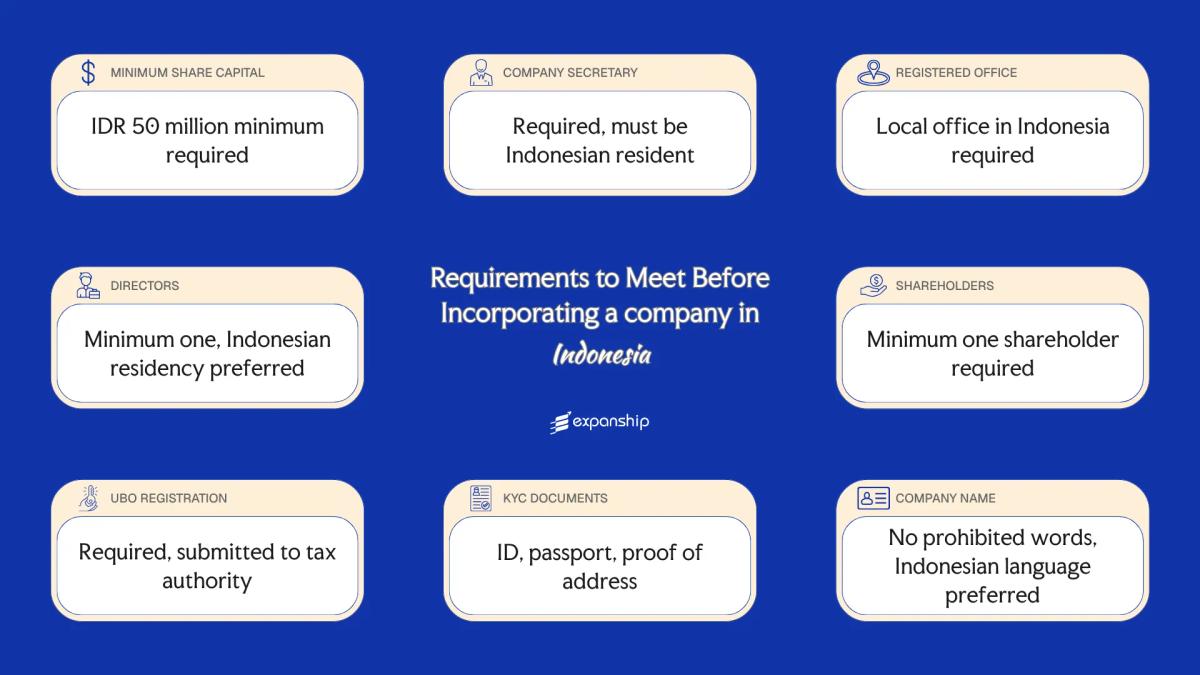
Under the Investment Coordinating Board (BKPM) framework and the Company Law (Law No. 40 of 2007), minimum share capital requirements in Indonesia apply to all limited liability companies, known as Perseroan Terbatas (PT). Capital structure follows a par value system, where each share carries a nominal face value that must be stated in the articles of association.
The Directorate General of General Legal Administration (AHU) under the Ministry of Law and Human Rights oversees company registration and verifies that the authorized and paid-up capital structure meets statutory thresholds at incorporation. Meeting the capital requirement is an incorporation condition, not a recurring annual obligation, though the paid-up capital must remain in place as part of the company's legal standing.
| Parameter | Detail |
|---|---|
| Minimum Authorized Share Capital | IDR 50,000,000 for domestic PT; higher thresholds apply for foreign-owned PT (PT PMA) under BKPM regulations |
| Maximum Authorized Share Capital | No statutory maximum |
| Minimum Paid-Up Capital | 25% of authorized capital must be paid up; minimum IDR 12,500,000 for domestic PT |
| Paid-Up Requirement at Incorporation | Must be paid up and evidenced at the time of deed of establishment before a notary |
| Accepted Currency | Indonesian Rupiah (IDR) |
| Accepted Forms of Contribution | Cash or in-kind assets; in-kind contributions require independent valuation |
| Timeframe to Deposit Capital | At or before the signing of the notarial deed of establishment |
The 25% paid-up minimum is calculated against your chosen authorized capital, not a fixed sum. Selecting a higher authorized capital figure directly increases the minimum paid-up amount your business must demonstrate at the notarial deed stage.
Company Secretary Requirements in Indonesia
Under Indonesia's Company Law (Law No. 40 of 2007 on Limited Liability Companies), publicly listed companies are required to appoint a Corporate Secretary. For non-listed PT (Perseroan Terbatas) entities, the role is not a statutory requirement under the same framework, though the Indonesia Financial Services Authority (OJK) mandates it for companies listed on the Indonesia Stock Exchange.
A Corporate Secretary serves as the primary liaison between your company and OJK, ensuring timely disclosure of material information to the public and coordinating board communications. The role also covers maintaining corporate records and monitoring compliance with applicable capital market regulations.
Qualification criteria for who may serve as Corporate Secretary:
- Must be a domiciled Indonesian resident with sufficient knowledge of capital market regulations
- Individual or designated internal officer appointed by the board of directors
- Required to hold competency in corporate governance and securities law as stipulated by OJK
- No specific professional licensing is mandated, but relevant regulatory knowledge is expected

Incorporate a Company in Indonesia
Set up your PT or foreign-owned entity in Indonesia with guided support across registration, structuring, and regulatory requirements.
Registered Office Requirements in Indonesia
Registered office requirements in Indonesia are governed by the Company Law (Law No. 40 of 2007 on Limited Liability Companies), which mandates that every PT (Perseroan Terbatas) maintain a domicile address that corresponds to its stated location in the company's Articles of Association. Failure to maintain a compliant PT domicile address can result in administrative sanctions from the Ministry of Law and Human Rights, including the potential revocation of legal entity status.
- A physical address is required; P.O. boxes do not qualify as a registered office.
- Virtual offices are permitted in certain municipalities, though acceptance varies by regional authority and business activity type.
- The address must be located within Indonesia and must match the municipality declared in the Articles of Association.
- A lease agreement or proof of address entitlement is required to support the domicile declaration during incorporation.
- The registered address is publicly listed in the Ministry of Law and Human Rights company registry (SABH system).
- Any change of domicile requires a formal amendment to the Articles of Association and must be approved by the Ministry of Law and Human Rights before it takes effect.
Director Requirements in Indonesia

Under the Company Law (Law No. 40 of 2007 on Limited Liability Companies), director requirements for an Indonesia company mandate that every PT (Perseroan Terbatas) appoint at least one director to the board of directors (Direksi). Directors bear direct statutory liability for the firm's operations and can be held personally accountable for losses resulting from fault or negligence in carrying out their duties.
| Parameter | Detail |
|---|---|
| Minimum Number of Directors | At least one director is required; PT that conducts public offerings or has assets above a statutory threshold must appoint a minimum of two directors. |
| Maximum Number of Directors | No statutory maximum is prescribed under Law No. 40 of 2007. |
| Local/Resident Director Required | No mandatory local resident director requirement exists under current company law, though work permit and immigration rules affect foreign director appointments in practice. |
| Nationality Restrictions | Foreign nationals may serve as directors but must hold a valid work permit (KITAS) and an expatriate placement permit (RPTKA) issued through the Ministry of Manpower. |
| Minimum Age Requirement | Directors must be at least 18 years of age and legally competent under Indonesian civil law. |
| Corporate Directors Permitted | Corporate directors are not permitted; only natural persons may hold a directorship in a PT. |
| Director Must Be a Shareholder | No statutory requirement for a director to hold shares in the entity. |
| Publicly Listed on Registry | Directors are recorded in the company's deed of establishment and registered with the Ministry of Law and Human Rights (Kemenkumham) through the SABH system. |
| Disqualification Conditions | A person is disqualified if they have been convicted of a criminal offence causing financial loss to the state, sentenced to imprisonment of five years or more, or declared legally incompetent by a court. |
Despite having no statutory requirement for a local resident director, foreign directors must individually obtain both an expatriate utilisation plan (RPTKA) and a limited stay permit (KITAS) — making each foreign board appointment a separate immigration process rather than a single company-level filing.
Shareholder Requirements in Indonesia

A Perseroan Terbatas (PT) requires a minimum of two shareholders at the time of incorporation, as established under Law No. 40 of 2007 on Limited Liability Companies. No statutory maximum applies, and a sole shareholder structure is not permitted for a standard PT.
Nationality and Residency Restrictions
Foreign ownership rules in Indonesia depend on the business sector, which is governed by the Positive Investment List under Presidential Regulation No. 10 of 2021. Certain sectors are fully open to foreign capital, while others impose ownership caps or are reserved exclusively for domestic shareholders.
Corporate Shareholders
Corporate entities may act as shareholders in a PT. No restriction limits this to Indonesian-incorporated firms, though foreign corporate shareholders must comply with applicable foreign ownership thresholds for the relevant sector.
Shareholder Liability
Shareholder liability is limited to the nominal value of shares held. Under Law No. 40 of 2007, this protection can be lifted if a shareholder abuses the corporate structure for personal gain or engages in bad-faith conduct.
Register of Shareholders
A PT must maintain an internal shareholder register, which records ownership details and any transfers. This register is not publicly accessible but must be kept current and made available during official inspections or legal proceedings.
Setting Up Your Shareholding Structure in Indonesia
Get guidance on structuring your ownership in line with Indonesia's investment regulations and corporate law requirements.
UBO / Beneficial Ownership Disclosure Requirements in Indonesia
Beneficial ownership disclosure Indonesia is governed by Presidential Regulation No. 13 of 2018, which defines a beneficial owner as any individual who ultimately owns or controls a corporation, either directly or indirectly, and meets at least one of the prescribed criteria under the regulation.
- Identify all individuals who hold 25% or more of shares, voting rights, or profits in the entity.
- Determine whether any individual exercises effective control over the company's management or policies, regardless of formal ownership percentage.
- Report beneficial owner data to the administering ministry or relevant institution at the time of business licensing or registration.
- Submit the UBO declaration through the Online Single Submission (OSS) system operated by the Investment Coordinating Board (BKPM).
- Update the beneficial owner information within a prescribed period whenever a change in ownership or control occurs.
| Parameter | Detail |
|---|---|
| Ownership Threshold for UBO Status | 25% of shares, voting rights, or profits; or effective control regardless of percentage |
| Filing Authority | Ministry of Law and Human Rights / Investment Coordinating Board (BKPM) via OSS |
| Disclosure Deadline at Incorporation | At the time of business licensing or entity registration |
| Publicly Accessible Register | Not publicly accessible; held by competent authorities |
| Penalties for Non-Disclosure | Administrative sanctions; specific penalties determined by the relevant supervising institution |
| Ongoing Update Obligation | Yes; updates required upon any change in beneficial ownership or control |
KYC / Document Requirements in Indonesia
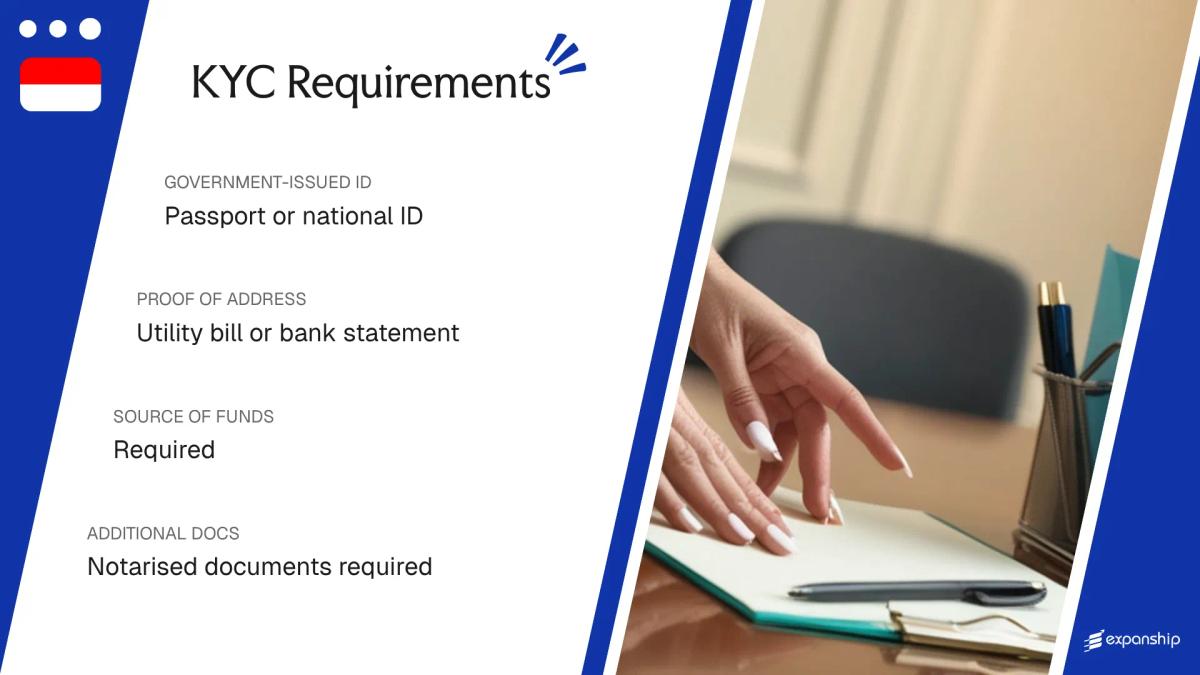
KYC document requirements Indonesia are governed primarily by Law No. 8 of 2010 on the Prevention and Eradication of Money Laundering, enforced through the PPATK, Indonesia's Financial Intelligence Unit. Collecting and verifying these documents is a prerequisite at the incorporation stage before a PT PMA or PT can be registered through the OSS (Online Single Submission) system.
Individual / Personal Documents
- Valid passport (for foreign nationals) or national identity card (KTP) for Indonesian nationals
- Taxpayer Identification Number (NPWP), required for all directors and shareholders
- Recent proof of residential address, such as a utility bill or bank statement dated within three months
- Passport-sized photograph may be required depending on the notary's internal procedures
Corporate Documents
- Certificate of incorporation or equivalent constitutional document of the shareholder entity
- Articles of association or equivalent charter document
- Register of directors and shareholders of the corporate entity
- Proof of registered office address of the corporate shareholder
Source of Funds Documentation
- Personal or corporate bank statements covering the preceding three to six months
- Audited financial statements where the shareholder is a corporate entity
- A signed source of funds declaration may be requested by the appointed notary
Notarisation and Apostille Requirements
- Foreign-issued documents must generally be apostilled under the Hague Apostille Convention, which Indonesia joined in 2022
- All foreign-language documents require certified translation into Bahasa Indonesia by a sworn translator (penerjemah tersumpah)
- Notarisation by a local Indonesian notary (Notaris) is required for the company's deed of establishment
Submission of foreign corporate documents without a certified Bahasa Indonesia translation is among the most common causes of registration rejection through the OSS system.
Company Name Requirements in Indonesia
Company name requirements in Indonesia are assessed during the incorporation process through an electronic registration system administered by the Ministry of Law and Human Rights. Names are evaluated against an existing database to confirm uniqueness before registration proceeds.
Your chosen name must be written in Indonesian (Bahasa Indonesia). The legal suffix "PT" (Perseroan Terbatas) must appear as a prefix to the entity name, and names must consist of at least three syllables.
Certain words are restricted or prohibited outright. Terms associated with government bodies, state institutions, or names that could mislead the public about the nature of the business require special ministerial approval or are rejected at the point of assessment.
Name reservation is available through the online AHU (Administrasi Hukum Umum) system. Once reserved, the name is held for a limited period, during which the incorporation process must be completed, or the reservation lapses and the name becomes available again.
Compliance Services for Companies in Indonesia
Maintain your Indonesian entity in good standing with ongoing compliance support, from annual reporting obligations to regulatory filings with the Ministry of Law and Human Rights.
Conclusion
Indonesia company incorporation requirements are defined by the Company Law (Law No. 40 of 2007) and administered through the Online Single Submission (OSS) system under the authority of the Investment Coordinating Board (BKPM). Foreign investors establishing a PT PMA must meet a defined set of structural and compliance obligations before commencing operations.
Among the requirements covered, foreign ownership restrictions under the Negative Investment List and minimum paid-up capital thresholds carry the most direct impact on how a business is structured. Shareholder composition and UBO disclosure obligations under BKPM regulations also shape the entity's governance from the outset.
Once these requirements are understood, the practical work of preparing documentation, coordinating with local authorities, and registering through the OSS system begins.
Expanship's Corporate Services for Indonesia Expansion
Incorporating a PT PMA in Indonesia involves navigating BKPM licensing, foreign ownership restrictions under the OSS-RBA system, and multi-agency compliance obligations that place real administrative demands on your team. Expanship's Indonesia company formation services are structured to reduce that operational load, handling the procedural steps while you focus on building your business.
Our scope covers the full incorporation and post-registration cycle:
- Preparing and filing incorporation documents, including deed of establishment and NIB applications through the OSS system
- Providing a registered agent and compliant local office address to satisfy domicile requirements
- Liaising with BKPM, the Ministry of Law and Human Rights, and other relevant authorities on your behalf
- Managing ongoing compliance obligations after your entity is incorporated
- Facilitating introductions to local banking partners to support account opening
- Handling tax registration with the Directorate General of Taxes and local government liaison
To discuss your requirements, contact Expanship Indonesia.
Frequently Asked Questions (FAQ)
The beneficial ownership obligation applies to all legal entities incorporated in Indonesia, including PT PMAs across all sectors, under Presidential Regulation No. 13 of 2018. Any individual who ultimately owns or controls 25% or more of shares, voting rights, or profits must be reported to the relevant ministry or institution. Failure to disclose accurate beneficial ownership information can result in administrative sanctions against the entity.
A foreign national can serve as a director of a PT PMA, but the company must have at least one locally domiciled director who holds a valid Indonesian work permit (KITAS) if they are foreign. Indonesian law under the Company Law (Law No. 40 of 2007) requires a PT to have at minimum one director, and where a foreign director is appointed, immigration and manpower compliance obligations apply in parallel.
The Ministry of Investment (BKPM) and the relevant regional government require that a PT PMA's registered address correspond to a verifiable commercial or office location, not a residential address. If the registered address does not meet zoning requirements, the company's business license (NIB) issuance through the OSS system can be delayed or refused. Using a virtual office is permitted in certain zones, but the address must still comply with local spatial planning regulations.
Both PT PMAs and domestic PTs are subject to the same naming rules administered through the Ministry of Law and Human Rights (Kemenkumham), which prohibit names that are identical or similar to existing registered entities. A name must consist of at least three words for a PT, cannot reference government institutions, and must not contain offensive or misleading terms. Foreign-language names are allowed only if accompanied by an Indonesian equivalent in the deed of establishment.
Foreign individual shareholders must provide a valid passport, proof of residential address, and in some cases a reference letter from their home country bank, depending on the notary's due diligence requirements. For foreign corporate shareholders, the notary and BKPM require certified copies of the company's constitutional documents, certificate of incorporation, and a resolution authorizing the investment, all of which must be apostilled or legalized by the Indonesian consulate in the relevant jurisdiction. Translations into Bahasa Indonesia by a sworn translator are required for all non-Indonesian language documents.
Yes. Companies that fail to report or update beneficial ownership information under Presidential Regulation No. 13 of 2018 are subject to administrative sanctions, which can include written warnings and suspension of business licensing services. Persistent non-compliance can escalate to restrictions on the entity's ability to access government services. The regulation places the reporting obligation on the management of the legal entity, meaning directors bear direct responsibility for ensuring timely and accurate submission.
Legal Disclaimer
The information provided in this article is for general informational purposes only and does not constitute legal, tax, or professional advice. While we strive to ensure the accuracy and timeliness of the content, laws and regulations are subject to change, and the application of laws can vary widely based on specific facts and circumstances.
Readers should not act upon this information without seeking professional counsel tailored to their individual situation. Expanship and its authors disclaim any liability for actions taken or not taken based on the content of this article.
For specific advice regarding your business setup, compliance requirements, or any legal matters, please consult with qualified legal and tax professionals in the relevant jurisdiction.