

Key Takeaways
- Foreign investors can access Indonesia's full corporate ownership potential through the PT PMA structure, with eligible sectors defined by Government Regulation No. 10 of 2021 replacing the former Negative Investment List.
- A standard corporate income tax rate of 22% under the Pajak Penghasilan (PPh) regime applies to foreign-owned entities, providing a predictable tax baseline for financial modeling and long-term planning.
- Companies establishing operations in Indonesia's Special Economic Zones face a materially distinct incentive structure — including tax holidays and reduced rates — that can significantly alter the cost calculus compared to standard incorporation in Jakarta.
- Indonesia's OSS (Online Single Submission) licensing system consolidates business registration and sectoral permits into a single platform, reducing the administrative friction that has historically complicated market entry in the region.
Situated in Southeast Asia, Indonesia is an independent sovereign nation and the largest archipelagic state in the world, spanning over 17,000 islands across the equator. The benefits of incorporating in Indonesia draw increasing attention from foreign investors seeking a foothold in one of the region's most significant economies. Company registration falls under the authority of the Ministry of Law and Human Rights, which oversees the legal establishment of business entities through the Administrasi Hukum Umum (AHU) online system. Foreign businesses typically enter the market through a PT PMA structure.
From a tax standpoint, Indonesia operates a territorial-leaning system with a standard corporate income tax applied under Pajak Penghasilan (PPh) regulations. The country maintains a generally open posture toward foreign direct investment, with the Investment Coordinating Board (BKPM), now operating under the Indonesia Investment Authority framework, overseeing FDI policy and sector eligibility. Ownership conditions vary by sector and are governed by the Positive Investment List under Government Regulation No. 10 of 2021.
This article examines the concrete advantages your business can access by forming a company here.
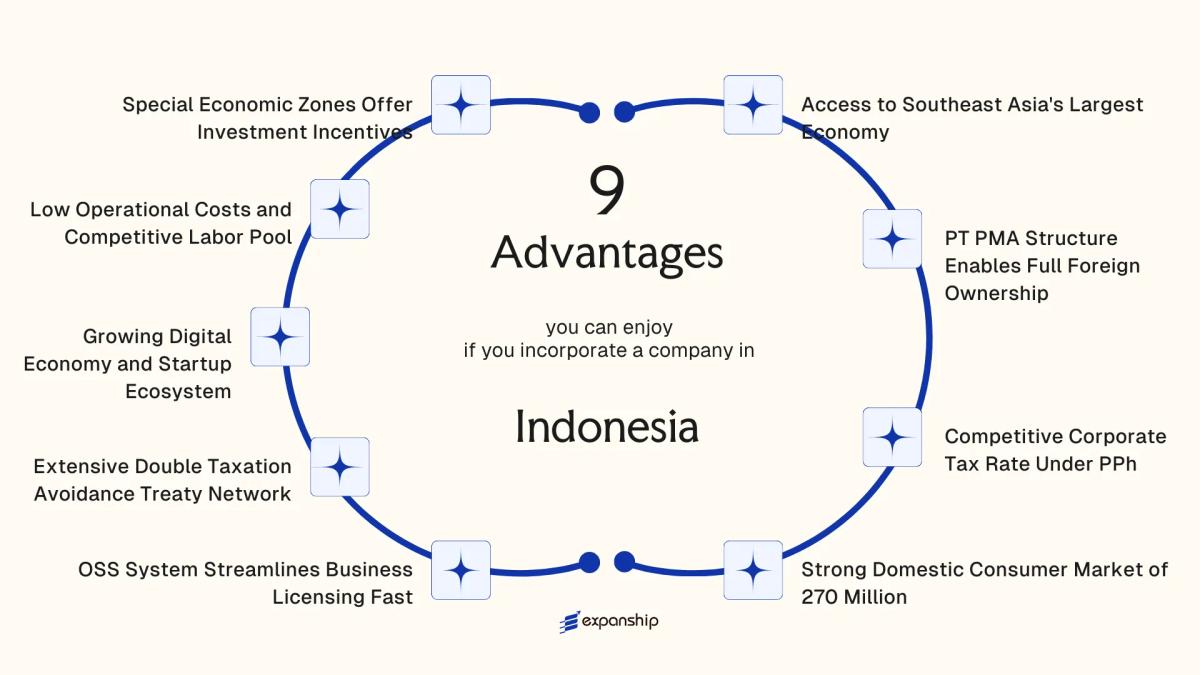
Access to Southeast Asia's Largest Economy
Indonesia's position as the Indonesia largest economy Southeast Asia advantage is grounded in measurable economic weight: the country contributes roughly 35% of the total ASEAN GDP, giving any foreign entity incorporated here direct commercial proximity to the region's dominant output base.
Economic Scale as a Structural Entry Point
GDP exceeding USD 1.3 trillion positions this market well above any of its ASEAN neighbors in absolute size. For a foreign firm, incorporation here means your legal presence sits inside the single largest national economy in the bloc, rather than using a smaller jurisdiction as a bridge.
ASEAN's free trade frameworks, including the ASEAN Trade in Goods Agreement (ATIGA), extend outward from each member state. A business registered in Indonesia can access preferential tariff schedules across ASEAN member markets, which reduces the cost basis of regional distribution from day one.
GDP Growth and Investor Relevance
Indonesia GDP growth opportunities for investors are supported by the country's consistent pre-pandemic expansion averaging around 5% annually. That rate reflects sustained domestic demand rather than export dependency alone, which reduces exposure to global trade volatility for firms serving local end markets.
Growth at that scale, across a multi-island archipelago of over 17,000 islands, also means underserved provincial markets remain commercially reachable through a single incorporated entity.
One incorporated entity in Indonesia gives your business legal access to the largest GDP base in Southeast Asia without requiring separate registrations across multiple ASEAN jurisdictions.
PT PMA Structure Enables Full Foreign Ownership
A PT PMA (Perseroan Terbatas Penanaman Modal Asing) is the principal vehicle through which foreign nationals establish a locally incorporated company. One of the primary PT PMA foreign ownership benefits in Indonesia is the ability to hold up to 100% equity in the entity, depending on the sector, without requiring a local partner.
The scope of permitted foreign ownership is governed by the Negative Investment List, now largely superseded by the business licensing reforms embedded in the Omnibus Law (Law No. 11 of 2020) and its implementing regulations. Under the revised framework, many sectors previously restricted to majority-Indonesian ownership have been opened further to foreign capital.
This structure matters because it gives your business direct control over profit repatriation, strategic direction, and operational decisions, without dilution through a nominee arrangement.
Sectors that remain fully accessible to foreign investors through a PT PMA include:
- Trading, manufacturing, and most service sectors carry no mandatory local shareholding requirement
- The minimum authorized capital threshold of IDR 10 billion is fixed and transparent, removing uncertainty from the planning process
- Foreign directors and commissioners are permitted, allowing your existing leadership to hold formal governance roles within the entity
BKPM (now integrated into the OSS system under BKPM/BPKM) serves as the regulatory authority overseeing investment licensing for PT PMA entities.

Incorporate a PT PMA in Indonesia
Establish a fully foreign-owned company in Indonesia with Expanship's end-to-end incorporation service, covering entity registration, licensing, and compliance setup.
Competitive Corporate Tax Rate Under PPh
Under Indonesia's Income Tax Law (Undang-Undang Pajak Penghasilan), corporate entities are subject to a standard rate of 22% on taxable net income. This rate, governed by PPh Badan (Pajak Penghasilan Badan), applies to most resident companies, including PT PMA structures established by foreign investors. For context, the OECD average corporate tax rate sits above 23%, which positions the Indonesia corporate tax rate PPh advantages as a tangible cost consideration when structuring regional operations.
| Entity Type | Standard Rate | Reduced Rate Condition |
|---|---|---|
| Standard PT / PT PMA | 22% | 50% reduction for listed SMEs with gross revenue under IDR 50 billion |
| Publicly Listed Companies | 22% | 3% reduction if minimum 40% of shares are publicly traded |
| Micro/Small Enterprises | 0.5% Final Tax | Gross annual turnover not exceeding IDR 4.8 billion |
Smaller firms benefit further from a 50% rate reduction applied to the taxable income portion attributable to gross revenue not exceeding IDR 4.8 billion, under Article 31E of the Income Tax Law. Your business structure and revenue scale directly affect which rate applies, so classification at the point of incorporation carries real financial consequences.
Annual tax obligations are filed through SPT Tahunan, with monthly installment payments required under Article 25. Compliance with this installment system helps your firm avoid underpayment penalties and maintains good standing with the Direktorat Jenderal Pajak (DGT), Indonesia's tax authority.
Strong Domestic Consumer Market of 270 Million
Indonesia's domestic consumer market business advantage is not just a matter of scale. With a population exceeding 270 million, the country represents the fourth-largest consumer base in the world. A foreign-owned entity structured as a PT PMA gains direct access to this base, with spending power increasingly concentrated in an expanding middle class projected to surpass 140 million people by 2030 according to national development forecasts.
Consumer demand is distributed across more than 17,000 islands, with urban centers like Jakarta, Surabaya, and Medan driving volume while secondary cities represent underpenetrated segments. This geographic spread means your business is not dependent on a single metropolitan market. Badan Pusat Statistik (BPS), the national statistics agency, tracks consumption data that confirms household expenditure has grown consistently across food, retail, and services sectors.
Key considerations when positioning for this market:
- PT PMA must comply with the Negative Investment List (revised under BKPM regulations) to confirm your sector is open to foreign equity
- Consumer-facing businesses may require specific sectoral licenses beyond the standard OSS-issued NIB
- Local content or partnership requirements apply in certain retail and distribution categories
- BPS consumption reports provide sector-level demand data useful for market entry planning
Indonesia's domestic consumption contributes over 50% of its GDP, meaning the market is driven primarily by internal demand rather than export cycles — insulating it from certain external trade disruptions.
OSS System Streamlines Business Licensing Fast
Indonesia's Online Single Submission (OSS) system, managed by the Investment Coordinating Board (BKPM), consolidates business licensing into a single digital portal. For foreign investors, the Indonesia OSS system business licensing benefits are concrete: fewer agencies to engage, one centralized interface, and a single business identification number (NIB) that serves as the primary license for most commercial activities.
A Single Registration Number Replaces Multiple Permits
Before OSS, obtaining operational clearance required coordinating across multiple ministries and local government offices, often taking months. Under the current framework, a registered entity receives a NIB through the OSS portal, which simultaneously functions as a company registration number, importer identification number, and customs access registration. That consolidation eliminates duplicative filings that previously created delays in commencing operations.
Reduced Administrative Burden for PT PMA Entities
Foreign-owned companies incorporated as PT PMA entities benefit particularly from risk-based licensing introduced under Government Regulation No. 5 of 2021. Businesses classified as low or medium-low risk receive automatic licensing upon completing OSS registration, without requiring a separate post-submission review. For medium-high and high-risk activities, OSS still centralizes the process even where additional technical verification applies, reducing the number of separate agency interactions your firm must manage.
Get Guidance on Incorporating and Licensing in Indonesia
Understand how the OSS system applies to your PT PMA structure and what licensing category applies to your business activity.
Extensive Double Taxation Avoidance Treaty Network
Indonesia's double taxation treaty network benefits foreign businesses by reducing or eliminating withholding tax on dividends, interest, and royalties paid between Indonesia and treaty partner countries. Governed under agreements locally referred to as Perjanjian Penghindaran Pajak Berganda (P3B), these treaties take precedence over domestic tax provisions under Indonesian tax law.
- As of 2024, Indonesia has concluded tax treaties with over 70 countries, including major investment sources such as the Netherlands, Singapore, Japan, the United Kingdom, and Germany. This breadth means your business can structure cross-border payments without being taxed twice on the same income stream.
- Under many P3B agreements, withholding tax on dividends paid to foreign parent companies is reduced to rates as low as 5% to 10%, compared to the standard domestic rate of 20% under Article 26 of the Income Tax Law (UU PPh). That reduction directly improves after-tax return on investment.
- Treaty benefits are not automatic. Your entity must obtain a Certificate of Domicile (SKD) from the relevant tax authority to claim reduced rates, and the beneficial owner of the income must meet the treaty's eligibility criteria. This requirement is administered by the Directorate General of Taxes (DJP).
Growing Digital Economy and Startup Ecosystem
Indonesia's digital economy advantages for startups and foreign investors are grounded in measurable scale. The country's digital economy was valued at approximately USD 77 billion in 2022 and is projected to reach USD 130 billion by 2025, according to the Google-Temasek-Bain e-Conomy SEA report. For a foreign tech business entering the region, that trajectory represents a real revenue addressable market, not a speculative one.
Regulatorily, the Financial Services Authority (OJK) governs fintech operations under OJK Regulation No. 77/POJK.01/2016 on peer-to-peer lending and has since expanded its framework to cover digital banking and payment systems. This structured oversight gives investor-backed startups a defined compliance path rather than operating in regulatory ambiguity.
The startup ecosystem is also institutionally supported. The National Research and Innovation Agency (BRIN) and the state-affiliated Merah Putih Fund back early-stage domestic and foreign-partnered ventures. This public capital infrastructure can reduce the cost of early market entry for foreign firms that qualify for co-investment arrangements.
"Indonesia's internet economy reached $77B GMV in 2022, the largest in Southeast Asia, and is on track to hit $130B by 2025." — Google, Temasek, Bain & Company, e-Conomy SEA 2022 Report
Low Operational Costs and Competitive Labor Pool
Indonesia's low operational costs and labor advantages translate directly into lower overhead for foreign-owned entities, particularly in manufacturing, services, and technology sectors.
Under the Manpower Act (Law No. 13 of 2003, now partially revised by the Job Creation Law/Omnibus Law No. 11 of 2020), wage structures are set at the provincial level through Governor decrees. This means your firm can plan payroll with regulatory predictability rather than negotiating in an unstructured environment.
Minimum wages vary by province:
- Jakarta's 2024 provincial minimum wage (UMP) sits at approximately IDR 5.07 million per month (roughly USD 320)
- Regions such as Central Java and East Java carry lower UMP figures, offering cost advantages for labor-intensive operations
- Skilled technical and professional roles remain competitively priced relative to Singapore or Australia
A working-age population exceeding 140 million people, combined with rising tertiary enrollment rates, means your business can source mid-level technical talent without the premium costs common in more developed ASEAN economies. Office leasing and utility costs outside Jakarta also remain a fraction of comparable cities like Singapore or Kuala Lumpur.
Provincial minimum wages are updated annually and vary significantly by region, so your actual labor cost baseline depends on where in Indonesia your operations are registered and physically located.
Special Economic Zones Offer Investment Incentives
Indonesia Special Economic Zone investment incentives are governed under Law No. 39 of 2009 on Special Economic Zones, which established the legal framework for KEK (Kawasan Ekonomi Khusus) zones across the archipelago. Businesses operating within a designated KEK can access a structured package of fiscal and non-fiscal benefits that are not available to companies incorporated outside these zones.
Tax Relief Within KEK Zones
Corporate income tax reductions are among the most significant fiscal advantages. Qualifying firms may receive an income tax holiday or reduction under Government Regulation No. 96 of 2015, with the scope and duration tied to investment value and sector. For capital-intensive projects, this can materially reduce the effective tax burden over the early years of operation.
Customs and VAT Exemptions
Goods brought into a KEK for production purposes are exempt from import duties, VAT, and luxury goods sales tax. This exemption applies for the duration that goods remain within the zone and are used in qualifying activities. For manufacturers or assemblers sourcing inputs internationally, this removes a cost layer that applies to businesses operating outside the zone.
Simplified Licensing for Zone Operators
Within KEK areas, business licensing is processed through a dedicated one-stop service managed by the KEK Administrator, separate from the general OSS (Online Single Submission) system. This zone-specific administration reduces the number of agencies involved in approvals.
Eligible sectors across KEK zones include:
- Tourism and hospitality
- Manufacturing and export processing
- Energy and industrial estates
- Digital technology and creative industries
- Logistics and distribution
Why Indonesia Stands Out Among ASEAN Business Destinations
Among ASEAN markets evaluated by foreign investors, the most frequent comparators for Indonesia are Vietnam, Thailand, and the Philippines. Each targets a similar profile of international investor, and each offers a large domestic market, manufacturing capacity, and trade connectivity. The comparison is useful not because these jurisdictions are equivalent, but because the structural differences reveal where Indonesia's regulatory and fiscal architecture produces distinct advantages.
Foreign ownership rules, tax incentives tied to specific zones, and the treaty network each sit differently across these four economies. Indonesia's Negative Investment List reforms under the Job Creation Law (Cipta Kerja, 2020) opened previously restricted sectors, while the OSS (Online Single Submission) system created a unified licensing framework that does not have a direct equivalent in every neighbouring market.
| Parameter | Indonesia | Vietnam | Thailand | Philippines |
|---|---|---|---|---|
| Standard Corporate Tax Rate | 22% | 20% | 20% | 25% (20% for SMEs) |
| Foreign Ownership Vehicle | PT PMA | FIE (Foreign Invested Enterprise) | BOI-promoted company or branch | 100% permitted in select sectors |
| SEZ / Investment Zone Incentives | Yes, under BKPM/KEK framework | Yes, Export Processing Zones | Yes, BOI zones | Yes, PEZA zones |
| Double Taxation Treaties (approx.) | 70+ | 80+ | 60+ | 43+ |
| Unified Online Licensing System | Yes, OSS-RBA | Partial | Partial | Partial |
| Population / Consumer Base | ~277 million | ~98 million | ~72 million | ~115 million |
Compliance Services for Companies in Indonesia
Ongoing compliance for Indonesian PT PMA entities, covering annual reporting obligations, tax filings, and regulatory submissions to BKPM and OSS.
Conclusion
Foreign ownership through the PT PMA structure, combined with a 22% corporate tax rate under the Pajak Penghasilan regime and access to a domestic consumer base of over 270 million people, positions this jurisdiction as one of the more structurally sound options in the ASEAN region for foreign direct investment. The benefits of incorporating in Indonesia are grounded in legal frameworks and regulatory architecture that have been progressively reformed to reduce barriers for international capital.
That said, the value of these advantages depends on your specific industry classification under the Daftar Negatif Investasi, your intended business model, and the extent to which your firm can use applicable tax treaty protections. A manufacturing entity entering through a Special Economic Zone faces a materially different cost and compliance structure than a digital services company operating from Jakarta.
Setting up a business here is a decision that warrants analysis against your operational requirements, not a generic checklist. The foundations are in place — the legal entity types, the OSS licensing system, the treaty network, the investment incentives — and understanding how each element applies to your particular circumstances determines whether the advantages translate into measurable outcomes for your firm.
Start Your Indonesian Company Formation With Expanship Today
Incorporating a PT PMA through Expanship means the work covered across this blog, from BKPM coordination and OSS licensing to SEZ incentive applications and tax treaty filings under PPh, is handled with direct attention to Indonesian regulatory requirements. Expanship works with the Indonesia Investment Coordinating Board (BKPM) and the Online Single Submission (OSS) system on your behalf, so your entity reaches operational status without gaps in compliance.
The service scope includes:
- Preparation, notarization, and legalization of PT PMA incorporation documents
- Registered office address and local registered agent provision
- Government filing and liaison with BKPM, the Ministry of Law and Human Rights, and OSS authorities
- Post-incorporation compliance management covering annual reporting and NIB maintenance
- Director and shareholder register upkeep in accordance with Company Law No. 40 of 2007
- Banking introduction assistance to support corporate account opening
Expanship Indonesia is available to discuss your PT PMA formation requirements.
Frequently Asked Questions (FAQ)
The standard corporate income tax rate under Pajak Penghasilan (PPh) is 22%, which applies to most PT PMA entities. Publicly listed companies that meet certain free-float requirements may qualify for a reduced rate of 19%. This rate is set under the Income Tax Law and has remained at 22% following adjustments made during the COVID-19 fiscal period, when a temporary reduction to 20% was proposed but not permanently enacted.
Processing times through the Online Single Submission (OSS) system vary by business sector and risk classification. Low-risk businesses can receive a Business Identification Number (NIB) within a single session after completing the online registration, while medium- and high-risk activities require additional verification steps that extend the timeline. The OSS system is administered by the Ministry of Investment and serves as the single entry point for all business licensing in Indonesia.
Companies operating within designated Special Economic Zones (KEK) can access tax holiday facilities, import duty exemptions, and value-added tax relief under Government Regulation No. 40 of 2021. The specific incentives vary by KEK and depend on the sector of activity and minimum investment threshold committed by the applicant. Applications for KEK incentives are processed through the relevant KEK Administrator and coordinated with the Ministry of Investment.
Indonesia has concluded tax treaties with over 70 countries, covering major trade and investment partners including the United States, the United Kingdom, Singapore, Japan, the Netherlands, and Australia. These agreements reduce or eliminate withholding tax on dividends, interest, and royalties paid between treaty jurisdictions. The applicable treaty must be claimed through the correct procedural filings with the Directorate General of Taxes to receive the reduced rates.
A PT PMA generally requires a minimum authorized capital of IDR 10 billion, with at least 25% paid up at the time of establishment. This threshold applies to foreign-owned companies and is set under the Investment Law and related BKPM regulations. Certain sectors may impose higher minimum investment commitments, and the requirement does not apply uniformly to micro and small enterprises, which operate under separate regulatory classifications.
A PT PMA does not require an Indonesian national as a shareholder, provided the business sector permits full or majority foreign ownership under the applicable investment negative list. However, at least one director and one commissioner must be appointed, and while these positions can be held by foreign nationals, the director responsible for day-to-day operations must hold a valid work permit (KITAS) if residing in Indonesia. The commissioner role can also be held by a foreign national under the same residency and permit conditions.
Indonesia and Singapore serve different strategic purposes for foreign investors in Southeast Asia. Singapore functions primarily as a regional holding and financial hub with a territorial tax system and no capital gains tax, while an Indonesian PT PMA provides direct access to a domestic consumer market exceeding 270 million people, which Singapore-based entities cannot access without a separate local presence. If your core business activity targets Indonesian consumers or requires local operational infrastructure, an Indonesian entity is structurally necessary rather than optional.
Legal Disclaimer
The information provided in this article is for general informational purposes only and does not constitute legal, tax, or professional advice. While we strive to ensure the accuracy and timeliness of the content, laws and regulations are subject to change, and the application of laws can vary widely based on specific facts and circumstances.
Readers should not act upon this information without seeking professional counsel tailored to their individual situation. Expanship and its authors disclaim any liability for actions taken or not taken based on the content of this article.
For specific advice regarding your business setup, compliance requirements, or any legal matters, please consult with qualified legal and tax professionals in the relevant jurisdiction.