

Key Takeaways
- Under Law No. 25 of 2007 on Investment and the Negative Investment List, foreign investors in a PT PMA face sector-specific ownership caps that can limit majority control or exclude foreign participation entirely in certain business activities.
- The BKPM licensing and OSS approval process introduces multi-stage regulatory clearances that extend the timeline and administrative burden before a foreign entity can legally commence operations in Indonesia.
- Foreign-owned companies are subject to mandatory minimum capital thresholds alongside localization requirements that obligate the appointment of Indonesian nationals to director and commissioner roles, regardless of operational preference.
- Multi-layered tax compliance obligations — spanning corporate income tax, VAT, and withholding tax reporting requirements administered across different regulatory instruments — create a compounding compliance burden that demands dedicated legal and accounting resources.
Indonesia operates under a heavily regulated foreign investment framework, shaped primarily by Law No. 25 of 2007 on Investment and its subsequent implementing regulations. The disadvantages of incorporating in Indonesia span structural, operational, and regulatory categories, each with distinct implications for foreign-owned entities. These challenges are governed and administered through bodies including the Badan Koordinasi Penanaman Modal (BKPM), now operating under the OSS system.
The severity of these cons varies considerably depending on your business sector, chosen legal structure, and the scale of intended operations. A trading firm faces a different compliance burden than a manufacturing entity or a service provider operating in a restricted sector.
This article is most relevant to foreign investors and multinational firms seeking to establish a PT PMA (Perseroan Terbatas Penanaman Modal Asing) — the primary vehicle for foreign direct investment under Indonesian law.
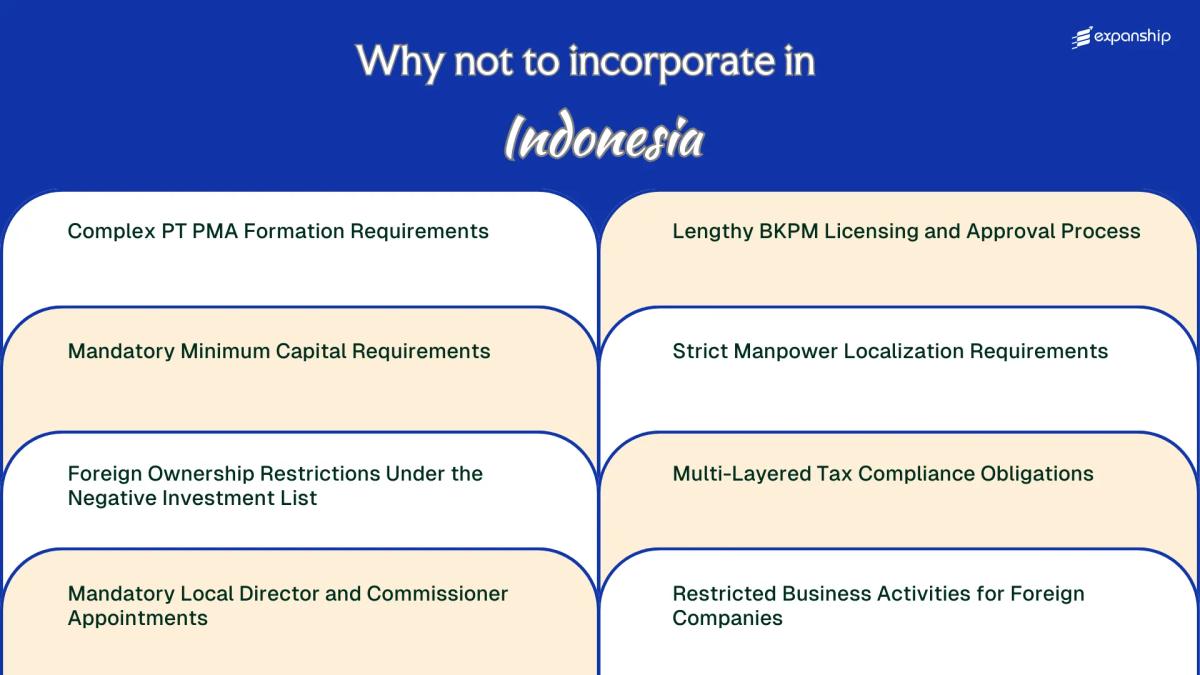
Complex PT PMA Formation Requirements
Establishing a PT PMA (Perseroan Terbatas Penanaman Modal Asing) is the standard vehicle for foreign direct investment in Indonesia, but PT PMA formation challenges begin well before the entity is operational.
A Multi-Stage Process With Multiple Gatekeepers
Foreign investors must obtain approval from the Online Single Submission (OSS) system administered by the Investment Coordinating Board, known as BKPM (Badan Koordinasi Penanaman Modal). The process involves submitting articles of association, shareholder declarations, and business activity classifications that must align precisely with the Indonesian Standard Business Classification (KBLI) codes, and any mismatch triggers delays or outright rejection.
Your chosen KBLI code determines which licenses apply, which ownership caps are imposed, and which additional sectoral approvals are required from separate ministries.
Documentation Standards That Create Structural Friction
Foreign shareholders must submit notarized and apostilled corporate documents, translated into Bahasa Indonesia by a sworn translator. Each document layer adds cost and time before a single regulatory decision is issued.
A KBLI code misclassification at the point of OSS registration can invalidate downstream licenses, forcing the entire application process to restart.
Mandatory Minimum Capital Requirements
Foreign companies establishing a PT PMA face a statutory minimum authorized capital of IDR 10 billion (approximately USD 625,000), as required under the Indonesia minimum capital requirements foreign company framework set by the Investment Coordinating Board (BKPM) and the Company Law (Law No. 40 of 2007). At least 25% of that figure must be issued, and 25% of the issued capital must be paid up at the time of incorporation. That paid-up threshold is roughly USD 39,000 before your business has earned a single rupiah.
This capital structure creates immediate friction for smaller foreign enterprises or early-stage ventures that lack the liquidity to commit these sums upfront.
The PT PMA capital investment restrictions generate several concrete burdens:
- Your working capital is partially locked into a statutory structure rather than deployed into operations, reducing early financial flexibility
- Meeting the authorized capital threshold may require foreign owners to over-capitalize relative to their actual business scope in the market
- Banks and notaries may require documentary proof of capital commitment before incorporation proceeds, adding administrative delay
- Businesses operating across multiple sectors may face sector-specific capital thresholds that exceed the general IDR 10 billion floor
Certain sectors, including hospitality and manufacturing, carry higher sector-specific minimums set by relevant line ministries, compounding the base requirement further.

Company Incorporation in Indonesia
Set up your PT PMA in Indonesia with full compliance across capital, licensing, and BKPM requirements.
Foreign Ownership Restrictions Under the Negative Investment List
Indonesia's Negative Investment List restrictions, formally structured under Presidential Regulation No. 10 of 2021 and its amendments, define which sectors are closed, partially open, or conditionally accessible to foreign capital. For a PT PMA (foreign-owned limited liability company), the practical result is that entire industries sit beyond reach, while others permit foreign participation only up to a defined equity ceiling.
| Sector | Maximum Foreign Ownership | Implication for Foreign Investor |
|---|---|---|
| Retail trade (certain categories) | 0% | Fully closed to foreign equity |
| Broadcasting services | 0% | No foreign participation permitted |
| Construction (non-specialist) | 67% | Minority or equal local stake required |
| Pharmaceutical distribution | 51% | Majority local ownership compulsory |
| Tourism and hospitality (certain sub-sectors) | 51% | Operational control limited |
Sectors classified as conditionally open require your business to partner with a local Indonesian shareholder. That dependency creates structural risk: your firm's governance, profit distribution, and exit options become subject to a party whose interests may not align with yours.
The DNI list foreign business restrictions apply unevenly across sectors, meaning due diligence costs are high before a single license is filed. Businesses operating across multiple verticals must evaluate each activity code separately, as a holding structure does not override individual sector caps.
Certain strategic sectors reserved for cooperatives or small-medium enterprises are closed outright to any corporate foreign entity, regardless of capital size.
Mandatory Local Director and Commissioner Appointments
Meeting Indonesia local director requirements as a foreign company is not merely procedural. Under the Company Law (Law No. 40 of 2007) and its implementing regulations, a PT PMA must appoint at least one director domiciled in Indonesia, along with a Board of Commissioners that includes at least one local commissioner.
This structure imposes a genuine governance constraint. If your existing management team is entirely foreign, you must either relocate a qualified individual or appoint someone locally, which introduces dependency on a person whose interests may not align with your business objectives.
The PT PMA commissioner appointment restrictions further complicate matters because the Board of Commissioners holds supervisory authority under Indonesian corporate law. A local commissioner is not a passive figurehead; they carry legal responsibilities and can affect board-level decisions.
Finding qualified, trustworthy local individuals willing to accept director or commissioner liability is not straightforward. Professional nominee arrangements exist but create their own legal and fiduciary exposure.
- At least one director must be domiciled in Indonesia at the time of company registration
- The Board of Commissioners must include at least one Indonesian-resident commissioner
- Both directors and commissioners carry statutory liabilities under Law No. 40 of 2007
- Appointing nominees does not transfer legal responsibility away from the company itself
- Any change in director or commissioner requires re-notification to the Ministry of Law
A foreign national serving as a director of a PT PMA is still required to hold a valid working permit (KITAS) and an Expatriate Utilization Plan (RPTKA) approval, even if they are a shareholder of the company.
Lengthy BKPM Licensing and Approval Process
The Indonesia BKPM licensing process challenges begin before your business earns its first rupiah. Even after completing PT PMA formation, foreign-owned entities must obtain sector-specific approvals through the Online Single Submission (OSS) system administered by the Investment Coordinating Board, known as BKPM.
Structural Delays Built Into the Approval System
OSS was introduced to consolidate licensing, but many permits still require post-OSS fulfillment commitments, meaning your business activity cannot legally commence until additional technical verifications are completed by sector-specific ministries. This creates sequential approval chains that can extend timelines well beyond initial estimates, particularly in regulated sectors such as healthcare, education, and financial services.
Practical Consequences for Foreign Investors
BKPM permit restrictions on foreign investors include compliance checks tied to minimum investment commitments and business activity codes under the KBLI classification system, where any mismatch between your registered KBLI code and actual operations can trigger re-licensing procedures. Each correction cycle consumes time and administrative resources, and for foreign firms operating on fixed deployment budgets, unplanned delays translate directly into increased setup costs and deferred revenue.
Support for Managing Indonesia's Investment Approval Process
Get structured guidance on BKPM licensing requirements, OSS submissions, and sector-specific approvals for your PT PMA.
Strict Manpower Localization Requirements
Indonesia manpower localization restrictions place binding obligations on PT PMA entities that directly limit how foreign companies staff their operations. Under Law No. 13 of 2003 on Manpower and its implementing regulations, hiring foreign nationals requires obtaining an IMTA (Izin Mempekerjakan Tenaga Asing) work permit for each individual, a process that adds cost and administrative lead time before any foreign employee can legally begin work.
- Each IMTA application requires a corresponding Rencana Penggunaan Tenaga Kerja Asing (RPTKA) approval from the Ministry of Manpower, creating a dual-layer authorization burden before a single foreign hire is confirmed.
- Foreign nationals are prohibited from holding certain positions designated as reserved for Indonesian nationals, forcing structural adjustments to your planned organizational hierarchy.
- Employers must pay a mandatory Dana Kompensasi Penggunaan Tenaga Kerja Asing (DKP-TKA) levy of USD 100 per foreign worker per month, adding a recurring cost that scales directly with headcount.
- Local hiring requirements under the same framework obligate companies to pair foreign workers with Indonesian counterparts for knowledge transfer purposes, effectively doubling staffing costs in designated roles.
Multi-Layered Tax Compliance Obligations
Indonesia tax compliance burdens foreign companies well beyond the standard corporate income tax filing. A PT PMA is subject to corporate income tax at a flat rate of 22%, monthly VAT reporting obligations, withholding tax obligations across multiple transaction categories, and annual tax return filings with the Directorate General of Taxes (DGT).
Withholding tax alone creates significant administrative friction. Payments to foreign affiliates, service providers, and lenders each trigger separate withholding obligations under different articles of the Income Tax Law (PPh), requiring correct classification to avoid penalties.
Transfer pricing adds another layer of exposure. Transactions between your PT PMA and its foreign parent must be documented under arm's length principles, and the DGT has broad authority to audit and reassess intercompany pricing.
- Monthly VAT returns are due regardless of whether taxable transactions occurred
- Payroll taxes require monthly calculation and remittance per employee
- Failure to file on time triggers administrative penalties under Law No. 28 of 2007 on General Tax Provisions
A foreign-owned PT PMA making quarterly royalty payments to its parent company must withhold PPh Article 26 at 20% (unless reduced by tax treaty), file monthly withholding slips, and maintain contemporaneous transfer pricing documentation, generating recurring compliance costs even before a single annual return is filed.
Restricted Business Activities for Foreign Companies
Certain sectors are entirely off-limits to foreign capital under Indonesia's Negative Investment List, formally governed by Presidential Regulation No. 10 of 2021 and its subsequent amendments. Your PT PMA cannot operate in these closed sectors regardless of ownership structure or capital commitment, which eliminates entire market categories from your addressable scope.
Sectors closed to foreign investors include:
- Small-scale fisheries and certain maritime activities
- Forest management in specific protected zones
- Specific broadcasting and media production activities
- Certain gambling and gaming-adjacent entertainment categories
- Traditional herbal medicine (jamu) retail at micro-business scale
Beyond fully closed sectors, many KBLI business activity codes carry foreign ownership caps rather than outright prohibitions. A foreign firm intending to enter retail trade, logistics, or health services may find its PT PMA limited to a minority stake, making operational control legally constrained from the outset.
The BKPM (now BKPM under OSS-RBA) enforces these classifications at the licensing stage. Your approved KBLI code directly determines what activities your entity may conduct, and operating outside that code constitutes a compliance violation.
Even if your target sector appears open under the current Negative Investment List, a mismatch between your registered KBLI code and your actual business activities can trigger license revocation by BKPM during routine compliance review.
Overcoming Indonesia's Incorporation Challenges
Overcoming Indonesia's Incorporation Challenges
Structurally addressing the difficulties of PT PMA formation begins with understanding which regulatory requirements are fixed by law and which can be planned around through deliberate entity structuring. Overcoming Indonesia incorporation challenges is less about finding shortcuts and more about sequencing compliance steps correctly from the outset.
- Verify your intended business activity against the current Positive Investment List before committing to a PT PMA structure, since BKPM classifications directly determine foreign ownership thresholds.
- Confirm paid-up capital funding meets the IDR 10 billion minimum and is documented in a manner acceptable to the Ministry of Law and Human Rights.
- Appoint at least one Indonesian national as a commissioner to satisfy directorship composition requirements under Law No. 40 of 2007.
- Register with the OSS system early to initiate business licensing before engaging sector-specific agencies.
- Prepare a manpower ratio compliance plan aligned with the Manpower Law before hiring expatriates.
Each of these steps operates within a regulatory framework that is subject to revision through Government Regulations and Presidential Decrees. Structural compliance does not eliminate ongoing obligations; it establishes the baseline from which your business must continue operating.
Indonesia's Investment Potential in Perspective
Despite the Indonesia foreign investment risks perspective that this blog has outlined, the country remains a credible destination for foreign capital. A population exceeding 270 million, a growing middle class, and membership in ASEAN's largest economy give the market genuine commercial weight that many businesses find difficult to ignore.
| Pros | Cons |
|---|---|
| Large domestic consumer market with sustained GDP growth | Minimum paid-up capital of IDR 10 billion required for most PT PMA structures |
| Strategic ASEAN location connecting major regional trade routes | The Negative Investment List (DNI) restricts or closes numerous sectors to full foreign ownership |
| Growing digital economy and infrastructure investment | BKPM licensing and approval timelines can extend the formation process considerably |
| Bilateral investment treaties provide some investor protections | Manpower regulations impose strict local hiring ratios and constrain expatriate placements |
| Diverse natural resources across key industry sectors | Multi-layered tax obligations at national and regional levels increase compliance overhead |
Ultimately, your assessment of the business environment should weigh these structural constraints against the scale of market access on offer. The formation barriers are real, measurable, and affect your cost base from day one.
Compliance Services for Companies in Indonesia
Maintain your PT PMA's standing with Indonesian regulatory requirements, including BKPM reporting, tax filings, manpower obligations, and annual corporate compliance.
Conclusion
The Indonesia company incorporation drawbacks summary presented across this blog reflects a foreign investment environment shaped by prescriptive regulation rather than administrative convenience. Among the most consequential constraints are the foreign ownership ceilings enforced through the Positive Investment List under BKPM's oversight, the mandatory appointment of local commissioners, and the substantial paid-up capital thresholds tied to PT PMA formation. Structural barriers of this nature require careful pre-entry planning. Specialist guidance on entity structuring, licensing sequencing, and ongoing compliance obligations can determine whether your business meets Indonesia's regulatory requirements from the outset.
Expanship's Indonesia Expansion Support
Incorporating a foreign company in Indonesia involves obligations that extend well beyond registration — from BKPM licensing and OSS system filings to meeting the Negative Investment List restrictions and ongoing manpower localization requirements. Expanship's Indonesia business expansion support is structured around reducing the operational burden these specific regulatory layers place on your business, so your team focuses on growth rather than administrative compliance.
Our services cover the full incorporation and post-establishment cycle. We work across the following areas:
- We prepare and coordinate all PT PMA registration documents for submission through the relevant Indonesian authorities.
- Your entity receives a registered local office address and appointed agent from day one.
- We handle government filings and liaise directly with BKPM, OSS, and other regulatory bodies on your behalf.
- Ongoing compliance obligations, including annual reporting and licensing renewals, are managed on your behalf.
- We facilitate introductions to local banking institutions familiar with foreign-owned entities.
- Tax registration with the Directorate General of Taxes and coordination with local authorities is handled as part of your setup.
Reach out to Expanship Indonesia to discuss how we can support your market entry.
Frequently Asked Questions (FAQ)
The Negative Investment List (Daftar Negatif Investasi), now restructured under Presidential Regulation No. 10 of 2021, applies to all foreign investors by default, though bilateral investment treaties can modify ownership ceilings in specific sectors for investors from treaty partner countries. Without a qualifying treaty, foreign ownership in restricted sectors is capped regardless of the investor's nationality or the size of their proposed investment.
Failure to comply with the manpower localization ratio requirements under Law No. 13 of 2003 and its implementing regulations can result in the revocation of the expatriate work permit (IMTA) for the foreign employee in question, and repeated violations can trigger sanctions against the company's operating license. The ratio obligations require employers to actively train and transfer skills to Indonesian counterparts, and non-compliance is treated as a substantive breach rather than a minor administrative error.
Government-side fees vary by business sector and the number of licenses required, but the BKPM registration, NIB (Nomor Induk Berusaha) issuance, and sector-specific approvals can collectively run into tens of millions of rupiah before professional service fees are added. Certain high-risk business classifications require additional environmental, operational, and sectoral permits that each carry their own fee schedules, meaning the total outlay depends heavily on the specific activity codes (KBLI codes) your business selects at registration.
No structural workaround eliminates this requirement. Indonesian Company Law (Law No. 40 of 2007) mandates that every PT, including a PT PMA, have at least one commissioner on its board, and while that commissioner does not have to be an Indonesian citizen, BKPM's practice and many sectoral regulations effectively pressure foreign investors toward appointing at least one local commissioner to satisfy supervisory requirements. Attempting to circumvent this through nominee arrangements carries its own legal and operational risks under Indonesian law.
Processing times for a PT PMA regularly extend beyond the statutory targets, with full operational readiness, including sectoral licenses beyond the basic NIB, often taking three to six months or longer in practice. By contrast, Singapore's foreign company registration can be completed in one to two business days, and Malaysia's Labuan structure has similarly compressed timelines. The gap is attributable to Indonesia's multi-agency coordination requirements, particularly where sector-specific ministries must independently validate the BKPM-issued approvals.
A PT PMA is treated as a resident taxpayer and is subject to Indonesia's 22% corporate income tax rate, monthly VAT filings, withholding tax obligations on dividends remitted to the foreign parent, and transfer pricing documentation requirements under the Director General of Tax regulations. Dividend withholding is typically set at 20% unless reduced by a relevant tax treaty, and the transfer pricing rules require annual documentation benchmarking intercompany transactions against arm's-length standards, adding a recurring compliance cost that many smaller foreign investors underestimate.
The ownership structure can be revised post-incorporation, but doing so requires a formal amendment to the company's articles of association, re-filing with the Ministry of Law and Human Rights, and updated disclosure to the Investment Ministry. If the revision involves a sector that has changed its foreign ownership ceiling following the original incorporation, the company must comply with the current regulation rather than the rules in force at the time of its establishment, which can force structural changes that the original investors did not anticipate.
Legal Disclaimer
The information provided in this article is for general informational purposes only and does not constitute legal, tax, or professional advice. While we strive to ensure the accuracy and timeliness of the content, laws and regulations are subject to change, and the application of laws can vary widely based on specific facts and circumstances.
Readers should not act upon this information without seeking professional counsel tailored to their individual situation. Expanship and its authors disclaim any liability for actions taken or not taken based on the content of this article.
For specific advice regarding your business setup, compliance requirements, or any legal matters, please consult with qualified legal and tax professionals in the relevant jurisdiction.