

Key Takeaways
- Under Act V of 2013 on the Civil Code, all companies must be registered through the Court of Registration before they have legal standing to operate in Hungary.
- Beneficial ownership information must be disclosed to the registry court from the point of formation, not at a later compliance stage.
- The registered office requirement obliges the entity to maintain a genuine Hungarian address that is formally linked to its official company records.
- Incorporation requirements in Hungary vary by entity type, industry sector, and whether foreign ownership is involved, meaning applicants must assess which specific obligations apply to their structure before submitting a registration application.
Company formation in Hungary is governed by Act V of 2013 on the Civil Code, which consolidates the legal framework for business entities. The registration process is administered by the Court of Registration operating under the Hungarian court system, with filings processed through the Company Registration Court.
This article covers the structural and documentary incorporation requirements in Hungary that apply at the point of formation.
Failure to satisfy these requirements results in the rejection of your registration application by the Company Registration Court, leaving the entity without legal standing to operate.
Requirements differ depending on the entity type you choose, your industry sector, and whether foreign ownership is involved, so not every requirement outlined here will apply equally to all applicants.
The primary legislation governing these obligations is available in the Civil Code on Hungary's National Legal Database.
This article is most relevant to foreign investors and non-resident business owners assessing the Hungary company formation requirements before initiating the registration process.
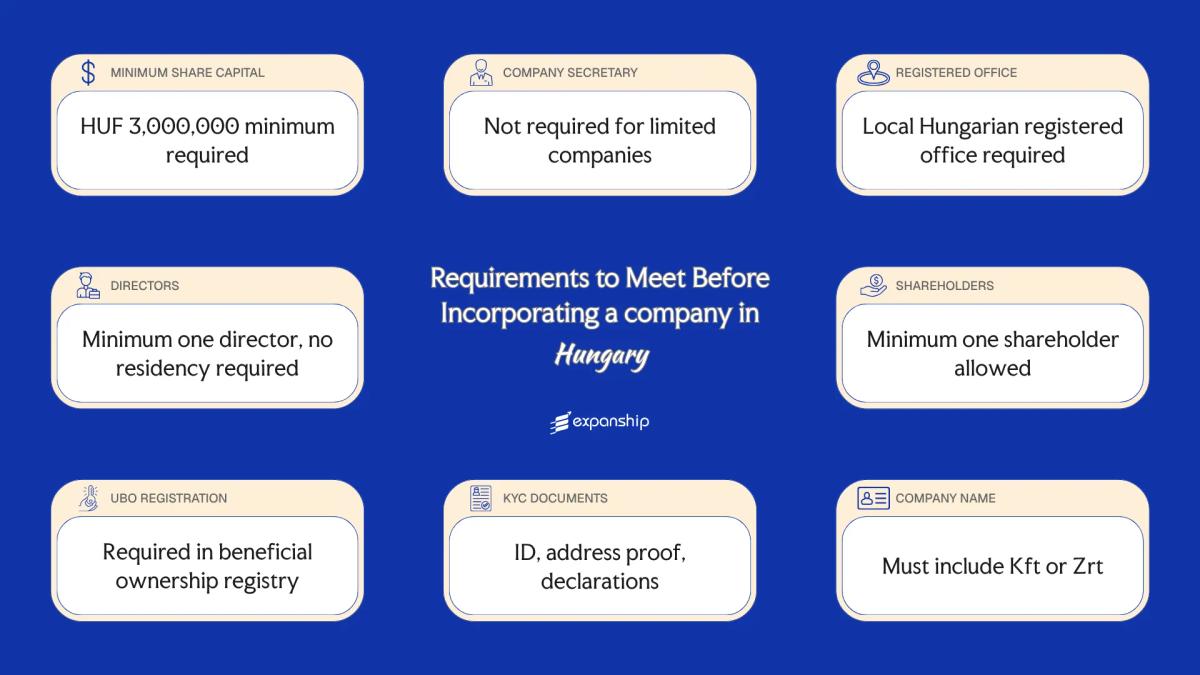
Minimum Share Capital Requirements in Hungary

Hungary minimum share capital requirements differ by entity type and are governed by the Civil Code (Act V of 2013), which sets out the statutory capital thresholds for each corporate form. The Companies Registration Court (Cégbíróság), operating within the Hungarian court system, verifies compliance at the point of incorporation.
For a Korlátolt Felelősségű Társaság (Kft), the minimum share capital is HUF 3,000,000. The Zrt (Zártkörűen Működő Részvénytársaság) carries a significantly higher threshold of HUF 5,000,000, reflecting its more structured share capital framework under Hungarian corporate law.
| Parameter | Detail |
|---|---|
| Minimum Authorized Share Capital | HUF 3,000,000 for Kft; HUF 5,000,000 for Zrt |
| Maximum Authorized Share Capital | No statutory requirement |
| Minimum Paid-Up Capital | HUF 3,000,000 for Kft; HUF 5,000,000 for Zrt |
| Paid-Up Requirement at Incorporation | At least 50% of cash contributions must be paid up at registration for a Kft; remainder within one year |
| Accepted Currency | Hungarian Forint (HUF) |
| Accepted Forms of Contribution | Cash and in-kind contributions (non-cash assets subject to valuation) |
| Timeframe to Deposit Capital | Cash contributions partially required before registration; balance within one year of incorporation |
For a Kft, in-kind contributions must be fully transferred to the company before the registration application is submitted to the Cégbíróság. Partial payment rules apply only to cash contributions.
Company Secretary Requirements in Hungary
Hungarian corporate law does not impose a company secretary requirement in the same form recognised under UK or Commonwealth-based systems. Under the Civil Code and the rules governing the Korlátolt Felelősségű Társaság (Kft) and Részvénytársaság (Rt), the company secretary requirements Hungary differs from those frameworks: the supervisory and administrative functions are instead distributed across the executive officer (ügyvezető) and, where applicable, a supervisory board.
A person or entity fulfilling a comparable secretarial or compliance role can be appointed to assist with Hungary corporate secretary obligations, including maintaining statutory records, coordinating filings with the Court of Registration (Cégbíróság), and supporting shareholder meeting documentation.
Qualification criteria for who may serve in this capacity:
- No statutory licensing requirement exists for a corporate secretary role under Hungarian company law.
- Both natural persons and legal entities may be engaged to perform secretarial functions.
- Non-residents and foreign nationals are not excluded from serving in an administrative capacity.
- The executive officer (ügyvezető) retains ultimate legal accountability for compliance filings regardless of any secretarial arrangement.
- Any legal representation before the Cégbíróság must be handled by a licensed Hungarian attorney (ügyvéd).

Incorporate a Company in Hungary
Set up your Hungarian legal entity with full support on registration, documentation, and compliance requirements under Hungarian law.
Registered Office Requirements in Hungary
Registered office requirements in Hungary apply from the moment of incorporation, as every Korlátolt Felelősségű Társaság (Kft.) or Részvénytársaság (Rt.) must have a valid Hungarian address registered with the Court of Registration (Cégbíróság), where official correspondence and regulatory notices are served. Operating with a non-compliant or fictitious address can result in the Cégbíróság initiating supervisory proceedings, which may lead to compulsory dissolution under the Ctv. (Act V of 2006 on Companies).
- A physical street address in Hungary is required; a P.O. box does not satisfy the requirement.
- Virtual office arrangements are permitted through licensed székhelyszolgáltatás providers registered with the Hungarian Bar Association or a regional chamber.
- The address must be located within Hungary; a foreign address cannot serve as the registered office.
- Your business must hold either ownership title or a valid lease or service agreement for the premises used as the registered seat.
- The registered office address is publicly listed in the Cégnyilvántartás (Company Register), accessible through the Igazságügyi Minisztérium's online portal.
- Any change of registered address requires a formal amendment filing with the Cégbíróság, subject to a statutory registration fee.
Director Requirements in Hungary

Under Hungarian law, director requirements in Hungary are governed by Act V of 2013 on the Civil Code (Polgári Törvénykönyv), which defines the statutory duties and personal liabilities that an ügyvezető assumes upon appointment to a Korlátolt Felelősségű Társaság (Kft.) or other business entity. Directors are held to a standard of care toward the company and its members, and can face personal liability for damages resulting from a breach of their management obligations.
| Parameter | Detail |
|---|---|
| Minimum Number of Directors | One director is required. |
| Maximum Number of Directors | No statutory maximum is set for a Kft. |
| Local/Resident Director Required | There is no statutory requirement for a director to be a Hungarian resident. |
| Nationality Restrictions | No nationality restrictions apply, though non-EEA nationals may require a work or residence permit to act in an executive capacity. |
| Minimum Age Requirement | Directors must have full legal capacity, which is attained at 18 years of age. |
| Corporate Directors Permitted | Corporate directors are not permitted; the ügyvezető must be a natural person. |
| Director Must Be a Shareholder | No statutory requirement exists for a director to hold shares in the company. |
| Publicly Listed on Registry | Directors are registered in the Company Registry (Cégbíróság) and their details are publicly accessible. |
| Disqualification Conditions | A person previously disqualified by court order, or banned from the relevant business activity under Hungarian law, cannot serve as director. |
Despite Hungary's EU membership, there is no requirement for a director to reside in Hungary or even within the EU, making a fully non-resident, non-EEA board entirely permissible under the Civil Code.
Shareholder Requirements in Hungary
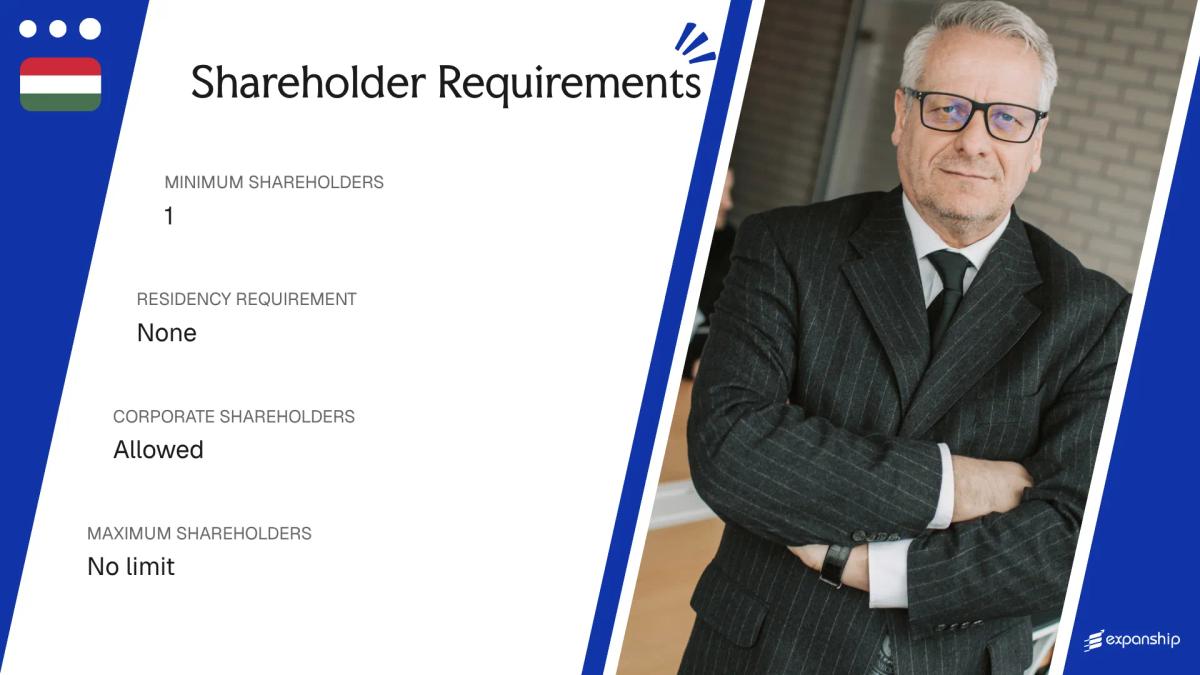
A Korlátolt Felelősségű Társaság (Kft) requires at least one shareholder, meaning a sole-member structure is fully permitted under the Hungarian Civil Code. There is no statutory upper limit on the number of shareholders a Kft may have.
Nationality and Residency Restrictions
Shareholder requirements in Hungary impose no nationality or residency conditions on individuals or entities holding ownership in a Kft. Foreign nationals and non-resident persons may hold 100% of the share capital without restriction.
Corporate Shareholders
Legal entities, including foreign corporations, may act as shareholders in a Kft. No special licensing or prior approval is required solely on the basis of the shareholder being a corporate body.
Shareholder Liability
Under Hungary company ownership rules, each shareholder's liability is limited to their capital contribution as recorded in the articles of association. Exceptions exist where a court may pierce the corporate veil if a shareholder abused the limited liability structure.
Register of Shareholders
A Kft must maintain an internal register of shareholders, recording each member's name, address, and quota. This register is not publicly accessible through the Company Court Registry, though quota transfers must be filed with the registry to take legal effect.
Setting Up Shareholder Structures for Your Hungarian Entity
Get guidance on structuring ownership in a Hungarian Kft, ensuring your shareholder arrangements meet the requirements set out under Hungarian law.
UBO / Beneficial Ownership Registration Requirements in Hungary
UBO registration requirements Hungary are governed by Act LIII of 2017 on the Prevention of Money Laundering and Terrorist Financing (Pmt.), which defines a beneficial owner (tényleges tulajdonos) as any natural person who ultimately owns or controls 25% or more of the shares or voting rights in an entity.
- Identify all natural persons holding, directly or indirectly, more than 25% ownership or voting rights in the company.
- Record UBO data in the company's internal register, maintained under the Pmt.
- Submit UBO information to the Central Registry (Központi Nyilvántartó Rendszer) operated under the supervision of the Hungarian tax authority (NAV).
- Report any changes to registered UBO data within 5 business days of the change occurring.
| Parameter | Detail |
|---|---|
| Ownership Threshold for UBO Status | Above 25% of shares or voting rights |
| Filing Authority | Central Registry (Központi Nyilvántartó Rendszer) under NAV oversight |
| Disclosure Deadline at Incorporation | At the time of incorporation or upon commencing a business relationship |
| Publicly Accessible Register | No; accessible only to obliged entities and competent authorities |
| Penalties for Non-Disclosure | Administrative fines under Act LIII of 2017; amounts determined by supervisory authority |
| Ongoing Update Obligation | Yes; changes must be reported within 5 business days |
KYC / Document Requirements in Hungary

KYC document requirements Hungary are governed primarily by Act LXXXVI of 2017 on the Prevention and Combating of Money Laundering and Terrorist Financing, administered by the Hungarian Financial Intelligence Unit.
Individual / Personal Documents
- Valid government-issued photo ID (passport or national identity card) for each individual director, shareholder, and beneficial owner
- Proof of residential address issued within the last three months, such as a utility bill or bank statement
- Completed and signed KYC declaration form confirming personal details and role within the entity
- Tax identification number where the individual holds one in their country of residence
Corporate Documents
- Certificate of incorporation or equivalent constitutional document for any corporate shareholder or director
- Current register of directors and register of shareholders for the corporate entity
- Proof of registered address of the corporate entity, such as an official utility bill or lease agreement
Source of Funds Documentation
- Recent bank statements (typically covering the last three to six months) evidencing available capital
- Audited financial statements where the corporate entity is the source of contributed capital
- A written declaration explaining the origin of funds if bank documentation is insufficient
Notarisation and Apostille Requirements
- Foreign-issued identity documents and corporate records generally require notarisation and an Apostille under the Hague Convention
- Official translations into Hungarian must be prepared by a sworn translator recognised under Hungarian law
- Documents originating from non-Hague Convention countries may require consular legalisation instead
Incomplete or incorrectly apostilled foreign corporate documents are the most frequent cause of incorporation delays filed with the Court of Registration.
Company Name Requirements in Hungary
Company name requirements Hungary are assessed during the registration process, with proposed names checked against the national company register to confirm uniqueness. A name already in use or confusingly similar to an existing entry will be rejected.
Structurally, the company name must include the Hungarian-language equivalent of the chosen legal form, such as "Korlátolt Felelősségű Társaság" or its abbreviation "Kft." for a private limited company. The name must be written in Hungarian or use Latin-script characters.
Certain words are restricted and require regulatory pre-approval before use, including terms that imply state authority, national affiliation, or connection to regulated industries such as banking or insurance. Outright prohibited are names that are misleading, contrary to public order, or suggest a function the entity does not hold.
Name reservation is available through the Hungarian court of registration prior to formal incorporation. A reserved name is held for a defined period, during which no other entity may register under the same designation.
Compliance Services for Companies in Hungary
Maintain good standing with Hungarian regulatory requirements, from annual filings to corporate record-keeping obligations.
Conclusion
Hungary company incorporation requirements span several distinct legal obligations, from minimum share capital thresholds under the Civil Code to UBO registration with the registry court. Among the more structurally significant elements are the registered office requirement, which demands a genuine Hungarian address linked to the entity's official records, and the beneficial ownership disclosure rules that apply from the point of formation. Once these obligations are understood, the practical next step involves assembling compliant documentation and engaging with the relevant Hungarian authorities to move from registration to operational status.
Expanship's Corporate Services for Hungary Expansion
Expanship's Hungary company formation services cover the full incorporation cycle, from preparing your Kft. constitutional documents through to registration with the Court of Registration. The specific requirements across share capital, UBO disclosure, and registered office compliance in Hungary each carry their own procedural weight, and coordinating them simultaneously is where most operational delays occur. Expanship manages that coordination on your behalf.
Beyond initial registration, the firm's service scope extends across the full lifecycle of your Hungarian entity:
- Preparing incorporation documents and submitting your company registration to the relevant Court of Registration
- Providing a registered agent and a compliant registered office address in Hungary
- Handling government filings and liaising with Hungarian regulatory authorities on your behalf
- Managing ongoing post-incorporation compliance obligations as your business evolves
- Facilitating introductions to banking partners familiar with Hungarian entity structures
- Registering your entity for tax purposes and coordinating with the National Tax and Customs Administration (NAV)
To discuss your setup requirements, contact Expanship Hungary.
Frequently Asked Questions (FAQ)
The full HUF 3,000,000 minimum share capital for a Kft. does not need to be paid up in its entirety before registration. Under the Hungarian Civil Code (Act V of 2013), at least half of the total subscribed cash contributions must be paid up at the time of incorporation, with the remainder due within one year of registration. Non-cash contributions, such as property or equipment, must be fully transferred at the time of formation.
If the registered office address becomes invalid, your company is required to update it with the Company Court of Registration without delay, as the address is a matter of public record in the Hungarian Company Register. Operating with an outdated registered address can expose the entity to procedural complications, including difficulties receiving official correspondence from NAV or courts. The change must be filed through an attorney registered in Hungary.
Failure to register beneficial ownership information with the Hungarian Registry of Beneficial Owners, maintained under Act LIII of 2017 on the Prevention of Money Laundering and Terrorist Financing, can result in supervisory measures and financial penalties. The registry is administered by the National Bank of Hungary (MNB) for certain entities and by the NAV for others, depending on the type of business. Non-compliance is treated as a regulatory violation, not merely an administrative oversight.
A corporate entity can hold shares in a Hungarian Kft. without restriction. However, where a foreign legal entity is a shareholder, the ultimate beneficial owners behind that entity must still be identified and registered in the Hungarian Registry of Beneficial Owners, tracing ownership up to the natural person(s) who ultimately exercise control or hold a qualifying interest. The reporting obligation exists regardless of how many layers of corporate ownership sit above the Hungarian entity.
Name reservation does not function as a standalone pre-registration process in Hungary the way it does in some other jurisdictions. The name is checked for availability and formally approved as part of the company registration process conducted through the Hungarian electronic company registration system (e-Cégeljárás). Once registered, the name receives protection under Hungarian company law, preventing another entity from registering an identical or confusingly similar name within the same activity category.
A foreign individual acting as a shareholder in a Hungarian company must provide a valid passport or national identity document, proof of residential address, and a declaration confirming the source of funds or assets contributed to the entity. These documents are required by the incorporating attorney under Act LIII of 2017 as part of their customer due diligence obligations before they can countersign and submit the deed of foundation. Notarised and apostilled versions may be required depending on the issuing country.
Legal Disclaimer
The information provided in this article is for general informational purposes only and does not constitute legal, tax, or professional advice. While we strive to ensure the accuracy and timeliness of the content, laws and regulations are subject to change, and the application of laws can vary widely based on specific facts and circumstances.
Readers should not act upon this information without seeking professional counsel tailored to their individual situation. Expanship and its authors disclaim any liability for actions taken or not taken based on the content of this article.
For specific advice regarding your business setup, compliance requirements, or any legal matters, please consult with qualified legal and tax professionals in the relevant jurisdiction.