

Key Takeaways
- Hungary's 9% corporate tax rate appears competitive, but the additional local business tax levied by municipalities — reaching up to 2% of net revenue — creates a compounded compliance and cost burden that foreign investors frequently underestimate when modelling effective tax rates.
- Formation of a Korlátolt Felelősségű Társaság (Kft) requires a minimum share capital contribution that must be deposited before registration, imposing an upfront capital commitment that is not recoverable as operational working capital until formal incorporation is complete.
- Filing obligations administered by the Nemzeti Adó- és Vámhivatal (NAV) involve multi-stream reporting requirements — including VAT, corporate tax, and local business tax returns on separate schedules — that generate a disproportionate compliance load for small and mid-sized foreign-owned entities without established local accounting infrastructure.
- Under Hungary's Civil Code (Act V of 2013) and associated labour legislation, employment protections are structured in ways that materially limit an employer's ability to restructure headcount or modify employment terms without triggering statutory notice periods, severance obligations, or works council consultation requirements.
Hungary operates under a moderately regulated corporate framework, with obligations spread across national tax authority requirements, company registry procedures, and sector-specific licensing rules. The disadvantages of incorporating in Hungary span several categories, from tax compliance burdens to structural and operational constraints that foreign investors frequently underestimate.
Not all drawbacks apply equally. The significance of each depends on your business model, the legal entity you choose, and the industry you operate in.
This article is most relevant to foreign entrepreneurs and non-EU investors establishing a new entity or acquiring a Hungarian subsidiary without prior experience of Central European regulatory environments. Familiarity with the governing legislation — including the Civil Code — is a practical baseline before committing to formation.
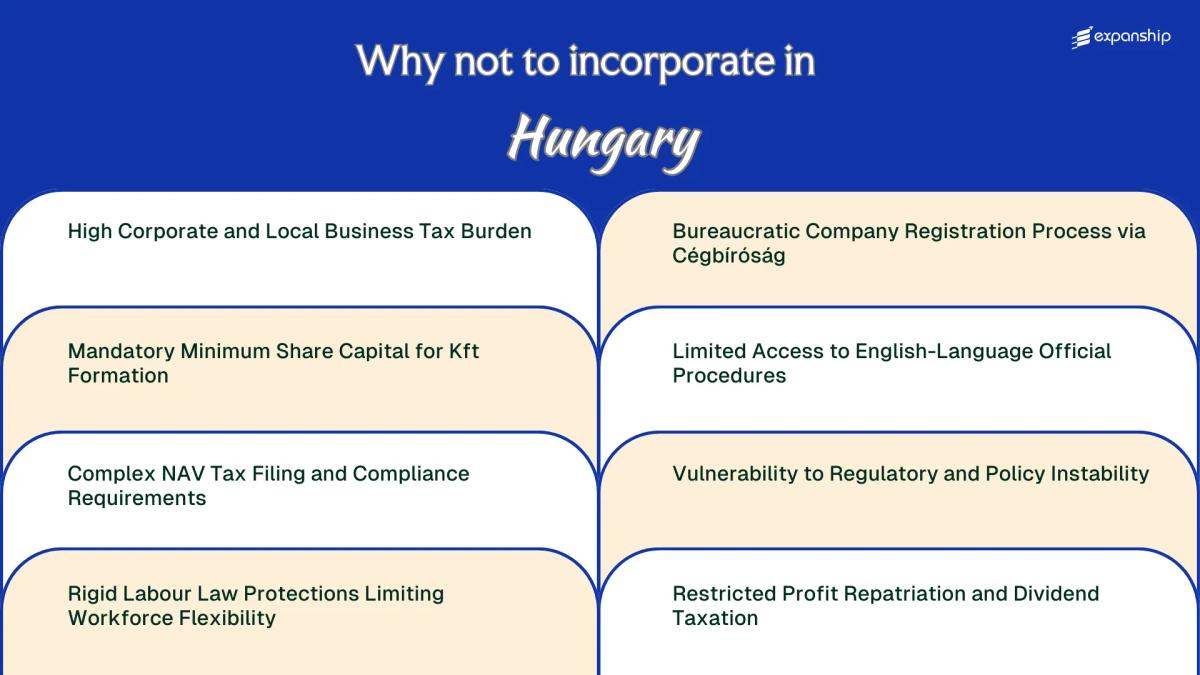
High Corporate and Local Business Tax Burden
Hungary corporate tax burden challenges are often underestimated by foreign investors who focus solely on the headline 9% corporate income tax rate under Act LXXXI of 1996.
The Local Business Tax Compounds Your Effective Rate
The iparűzési adó, administered at the municipal level under Act C of 1990, adds up to 2% on net revenues rather than profits. Because it applies to gross revenue minus limited deductions, a business with thin margins can face a disproportionately high effective tax burden relative to its actual earnings.
This tax is not a minor administrative formality. For foreign-owned entities operating in Budapest or other major commercial centres, the combined corporate and local business tax liability can meaningfully erode the competitiveness implied by Hungary's statutory rate alone.
Minimum Tax Obligations Restrict Loss-Year Flexibility
If a Kft or Zrt reports below a statutory minimum tax base, it becomes subject to a minimum tax threshold under the same Act LXXXI provisions. Your entity may owe tax even in unprofitable periods, which creates a direct cash-flow burden during early-stage operations or economic downturns.
Foreign business owners must calculate their effective tax exposure using both the corporate income tax and the iparűzési adó, as relying on the 9% headline rate alone will produce a materially inaccurate cost projection.
Mandatory Minimum Share Capital for Kft Formation
Hungary Kft minimum share capital requirements set a statutory floor of HUF 3,000,000 (approximately EUR 7,500–8,000 depending on exchange rates) under the Civil Code (Act V of 2013). This amount must be fully committed at the time of registration, not pledged over time.
For a foreign founder testing a new market, that capital is locked into the entity from day one, reducing early operational liquidity before the business has generated any revenue.
The requirement creates several practical friction points:
- Converting foreign currency into HUF exposes you to exchange rate losses before the company is even operational
- Capital deposited into a Hungarian bank account as part of Kft formation capital restrictions cannot be freely withdrawn until registration formalities are complete
- Incorporating multiple subsidiaries compounds the capital commitment, as each Kft requires its own statutory minimum
- Non-cash contributions require independent valuation, adding professional fees and delays to the formation timeline
Unlike some EU member states that have reduced or eliminated minimum capital thresholds for private limited structures, Hungary retains this hard floor with no tiered or phased alternative for small-scale foreign entrants.

Company Incorporation in Hungary
Set up your Hungarian Kft with full statutory compliance, including share capital structuring and registration through the Cégbíróság.
Complex NAV Tax Filing and Compliance Requirements
NAV tax filing compliance challenges in Hungary impose a reporting frequency and technical specificity that many foreign-owned firms find disproportionate relative to comparable EU markets. The National Tax and Customs Administration (NAV) requires companies to file VAT returns monthly if their annual VAT liability exceeds HUF 1 million, with online real-time invoice reporting (RTIR) mandatory for all domestic B2B invoices above HUF 100,000.
| Obligation | Frequency / Threshold | Burden for Foreign Operators |
|---|---|---|
| Real-Time Invoice Reporting (RTIR) | Every invoice above HUF 100,000 | Requires API integration with NAV's system; manual workarounds are non-compliant |
| VAT Return Filing | Monthly (if VAT liability exceeds HUF 1M/year) | Higher frequency than many EU jurisdictions; late filing triggers automatic penalties |
| Corporate Income Tax Return | Annual, with quarterly advance payments | Miscalculating advance payments results in surcharges |
| EKÁER (Road Goods Transport System) | Per qualifying domestic/cross-border transport | Separate registration and reporting layer outside standard tax filings |
RTIR integration requires your accounting software to communicate directly with NAV's XML-based data interface, meaning off-the-shelf international accounting tools often need custom development. That technical overhead represents a recurring cost, not a one-time setup expense.
EKÁER adds a separate compliance layer for businesses moving physical goods, with its own registration requirements distinct from standard tax returns. A single missed or late EKÁER notification can result in goods being held and fines applied.
Penalties under Act XCII of 2003 (the Tax Administration Act, now partially consolidated under Act CL of 2017) scale with the nature of the infringement, but NAV audits of foreign-owned entities have historically been more thorough when Hungarian-language accounting records are absent or incomplete.
Rigid Labour Law Protections Limiting Workforce Flexibility
Hungary labour law restrictions for employers are codified primarily in Act I of 2012, the Munka Törvénykönyve (Labour Code). This statute sets out mandatory notice periods, severance entitlements, and procedural requirements that significantly constrain how a foreign employer can manage headcount.
Terminating an employee requires written justification, and the grounds must be specific and verifiable. If a dismissal is successfully challenged before a labour court, the employer faces reinstatement orders or back-pay liability covering the entire dispute period.
Fixed-term contracts carry their own risks. Converting or terminating them early can trigger compensation obligations equal to the remaining contract term, which limits your ability to staff up for short-cycle projects without long-term financial exposure.
Overtime is subject to statutory caps under the Labour Code, and collective agreements can impose additional restrictions. Your payroll costs for extended working hours are therefore not fully within your control.
- Mandatory notice periods range from 30 days upward, scaling with length of service
- Written, substantiated justification is required for every individual dismissal
- Early termination of fixed-term contracts can trigger compensation up to 12 months' pay
- Labour court proceedings can result in reinstatement, not merely financial penalty
- Works councils must be consulted for collective redundancies above defined thresholds
Under the Munka Törvénykönyve, an employee on sick leave during a notice period may have that notice period suspended, effectively extending your termination timeline beyond what you initially calculated.
Bureaucratic Company Registration Process via Cégbíróság
The Hungary Cégbíróság registration process problems are structural, not incidental. Registration through the Court of Registration (Cégbíróság) requires notarized founding documents, and any procedural deficiency triggers a formal rejection rather than a correction request.
A Court-Administered Process With Little Room for Error
Under Act V of 2006 on Public Company Information, Company Registration and Winding-up Proceedings, the Cégbíróság operates as a judicial body, meaning procedural standards mirror litigation requirements. For a foreign founder unfamiliar with Hungarian civil law formality, the cost of errors compounds quickly through repeat notarization fees and re-filing delays.
Practical Consequences for Foreign Incorporators
Simplified registration (egyszerűsített cégeljárás) is available for standard-form entities, but deviations from template documents forfeit that expedited path entirely. Your business then enters a standard procedure where the court has up to 15 working days to act, during which your entity cannot legally operate.
Support for Overcoming Company Registration Challenges in Hungary
Expanship helps foreign businesses manage the formalities of Cégbíróság registration, including document preparation and procedural compliance.
Limited Access to English-Language Official Procedures
Official procedures in Hungary default to Magyar (Hungarian) with no statutory obligation on government bodies to provide English-language support, creating consistent friction for non-Hungarian speaker company formation. Foreign directors and shareholders must either hire qualified local translators or rely on bilingual legal counsel for every formal interaction.
- All submissions to the Cégbíróság (Company Court of Registration) must be filed in Hungarian, meaning translated and notarised documents are a recurring cost rather than a one-time onboarding expense.
- NAV (Nemzeti Adó- és Vámhivatal), the tax authority, conducts correspondence, audit notices, and compliance queries exclusively in Hungarian, so a non-Hungarian-speaking director cannot independently manage official tax communications.
- The limited English procedures Hungary business drawbacks extend to the electronic company registration portal (Onyik), where the interface and submission requirements operate solely in Hungarian.
- Statutory deadlines do not pause for translation delays, meaning a misunderstood filing notice can directly trigger penalties under Act CL of 2017 on taxation procedures.
Vulnerability to Regulatory and Policy Instability
Hungary regulatory instability risks for businesses are not theoretical. Since 2010, the government has introduced sector-specific surtaxes, modified corporate tax rules, and restructured entire regulatory frameworks with limited consultation periods, leaving foreign-owned entities with little time to adjust operations or financial projections.
The Hungarian legal environment is shaped heavily by government decrees and emergency ordinances, which can bypass standard parliamentary review. For foreign investors, this creates a structural unpredictability that makes medium-term financial planning genuinely difficult.
Sectors including banking, energy, telecommunications, and retail have each faced special levies introduced outside normal budget cycles. Your business may operate in a sector not currently targeted and still carry meaningful exposure if policy priorities shift.
Hungary's ranking on the World Bank Governance Indicators for regulatory quality has declined over successive measurement periods, reflecting a measurable deterioration in the predictability of rule-making.
According to the World Bank's Worldwide Governance Indicators (2022), Hungary scored in approximately the 60th percentile for Regulatory Quality, a figure that trails most Western EU peers and has trended downward over the prior decade.
Restricted Profit Repatriation and Dividend Taxation
Hungary dividend repatriation restrictions are not codified through capital controls, but the tax mechanics create a meaningful cost burden for foreign shareholders extracting profits.
Dividends paid by a Hungarian Kft or Zrt to non-resident individuals are subject to a 15% personal income tax under Act CXVII of 1995 (Personal Income Tax Act). Where a tax treaty applies, this rate may be reduced, but treaty eligibility requires documentary proof of residency that Hungarian tax authority NAV can challenge.
For corporate shareholders, dividends received from a Hungarian entity are generally exempt from corporate income tax under participation exemption rules. That exemption does not extend to all holding structures, and misclassified arrangements can result in unexpected withholding obligations.
Profit repatriation drawbacks in Hungary also arise from the timing of dividend distributions. Under the Civil Code, a Kft may only distribute profits confirmed in its approved annual accounts, meaning funds cannot be extracted until financial statements are formally adopted, creating a structural lag of several months for foreign investors.
Where a tax treaty between Hungary and your country of residence does not exist or does not cover dividend income, the full 15% domestic withholding rate applies with no automatic reduction available.
Strategies to Overcome These Disadvantages
Overcoming Hungary incorporation disadvantages requires structural decisions made before registration, not adjustments applied after the fact. The challenges documented in this blog span tax exposure, capital requirements, compliance obligations, and labour rigidity.
- Elect the Kft. structure with the minimum HUF 3,000,000 share capital, contributed in full before filing with the Cégbíróság, to satisfy the mandatory capital requirement upfront.
- Register for VAT and obtain a Hungarian tax number through the Nemzeti Adó- és Vámhivatal (NAV) at the time of incorporation to avoid compliance delays.
- Engage a local könyvelő (registered accountant) from incorporation, as NAV filing obligations under Hungarian accounting law require locally qualified representation.
- Structure employment contracts under Act I of 2012 (the Labour Code) with explicit fixed-term provisions where workforce flexibility is a priority.
- Plan dividend distributions accounting for the 15% personal income tax withheld at source under the Personal Income Tax Act.
Mitigation steps function within a regulatory environment shaped by the Companies Act (Act V of 2006) and the ongoing authority of NAV over tax compliance. Structural preparation reduces exposure but does not eliminate the underlying obligations each registered entity carries.
Hungary's Overall Appeal for Investors
Hungary's position in Central Europe, combined with a 9% corporate tax rate, makes it a credible destination for foreign incorporation despite the structural and administrative friction documented in this blog. The disadvantages are real and measurable, but they do not affect every business profile equally.
| Pros | Cons |
|---|---|
| The 9% corporate income tax rate is the lowest flat rate in the EU. | Local business tax (HIPA) adds up to 2% on top of the headline rate, increasing the effective burden. |
| Hungary offers access to the EU single market and its trade agreements. | NAV's complex filing requirements and frequent regulatory changes increase ongoing compliance costs. |
| Kft formation provides limited liability with a defined legal structure under the Civil Code. | The HUF 3,000,000 minimum share capital requirement locks up capital at the point of incorporation. |
| Double tax treaties with over 80 countries reduce withholding tax exposure on cross-border payments. | Dividend repatriation is subject to withholding tax and currency conversion risk given HUF volatility. |
| Budapest functions as a regional hub with developed banking and professional infrastructure. | Official procedures, including Cégbíróság filings, are conducted predominantly in Hungarian. |
Policy direction under the current government has shifted periodically, and the labour code's restrictions on workforce restructuring remain a structural constraint for operationally intensive businesses.
Compliance Services for Companies in Hungary
Stay current with NAV filing obligations, annual reporting requirements, and ongoing regulatory changes affecting your Hungarian entity.
Conclusion
Hungary's overall position as a business destination reflects a genuine tension between its competitive 9% corporate tax rate and the structural friction built into its regulatory environment. The Hungary company formation drawbacks summary covered in this blog points to NAV's demanding compliance requirements and the Cégbíróság registration process as two friction points that consistently affect operational timelines. Rigid Labour Code protections further limit how businesses can manage workforce costs. Structural preparation before entry reduces exposure to these factors considerably.
Expanship's Support for Your Hungary Expansion
Expanship Hungary company formation support is structured around the specific compliance obligations your business will face once registered. From preparing documentation for submission to the Cégbíróság to managing ongoing obligations under NAV's tax filing regime, Expanship reduces the operational weight of these requirements on your internal team without removing the underlying obligations they represent.
Beyond registration, Expanship's service scope covers the full post-incorporation period.
- Your company is registered and all formation documents are prepared for submission.
- A registered agent and local office address are provided to satisfy Hungarian residency requirements.
- Filings and correspondence with the Cégbíróság, NAV, and other authorities are handled on your behalf.
- Ongoing compliance obligations are monitored and managed after incorporation is complete.
- Introductions to local banking institutions are arranged to support account opening.
- Tax registration is completed and coordination with local authorities is managed throughout the process.
Reach out to Expanship Hungary to discuss how we can support your incorporation.
Frequently Asked Questions (FAQ)
Yes, the HUF 3,000,000 minimum share capital requirement for a Korlátolt Felelősségű Társaság applies equally to foreign and domestically owned entities with no exemption based on ownership structure. The capital must be contributed in accordance with the Hungarian Civil Code (Act V of 2013), and at least half must be paid in at registration. Failure to meet this threshold prevents the Cégbíróság from completing registration.
Missing a filing deadline with the Nemzeti Adó- és Vámhivatal (NAV) triggers automatic late penalties, and repeated non-compliance can escalate to tax audits or the suspension of the company's tax number. A suspended tax number effectively halts the entity's ability to issue valid invoices, which disrupts operations immediately. Hungary's real-time invoice reporting requirement (RTIR) means NAV has near-instant visibility into transactions, so discrepancies are identified faster than in jurisdictions with quarterly or annual reconciliation systems.
Foreign nationals face additional document authentication requirements that domestic founders do not, including apostilled identity documents and, in some cases, notarised translations into Hungarian. The Cégbíróság does not accept filings in any language other than Hungarian, so all constitutional documents must be prepared or translated by a qualified Hungarian lawyer. This makes using a local legal representative not just practical but effectively mandatory for foreign founders.
Hungary does not levy a domestic withholding tax on dividends paid to corporate shareholders, but individual foreign shareholders are subject to a 15% personal income tax on dividend distributions under Act CXVII of 1995. Tax treaty provisions may reduce this rate depending on the shareholder's country of residence, and some treaties bring it to zero, but the applicable treaty must be confirmed in advance and the correct administrative procedures followed to claim the reduced rate. Without proper documentation, the default 15% rate applies at source.
Hungary's Labour Code (Act I of 2012) requires mandatory notice periods, severance pay obligations, and, in collective redundancy situations, a 30-day consultation process with employee representatives before dismissals can proceed. For a foreign business accustomed to at-will employment regimes, this creates meaningful cost and timeline exposure when restructuring. Severance entitlements scale with length of service, so workforce reduction costs increase the longer employees have been with the firm.
Policy changes in Hungary have historically affected businesses with little transitional warning, most visibly through the introduction and repeated modification of sector-specific surtaxes in banking, retail, telecommunications, and energy. These levies were introduced outside of the standard annual budget cycle, giving affected businesses limited time to adjust financial projections. Foreign investors operating in sectors that have been targeted previously should treat policy volatility as a structural risk rather than an exceptional one.
The limitation extends well beyond registration. NAV's official online filing portal, communications, and audit correspondence are conducted in Hungarian, and the Cégbíróság's electronic filing system (eSzolgáltatás) operates exclusively in the language. For ongoing annual filings, VAT returns, and any regulatory correspondence, your business will require either a Hungarian-speaking in-house resource or a retained local accountant and legal adviser throughout the life of the entity.
Legal Disclaimer
The information provided in this article is for general informational purposes only and does not constitute legal, tax, or professional advice. While we strive to ensure the accuracy and timeliness of the content, laws and regulations are subject to change, and the application of laws can vary widely based on specific facts and circumstances.
Readers should not act upon this information without seeking professional counsel tailored to their individual situation. Expanship and its authors disclaim any liability for actions taken or not taken based on the content of this article.
For specific advice regarding your business setup, compliance requirements, or any legal matters, please consult with qualified legal and tax professionals in the relevant jurisdiction.