

Key Takeaways
- Hungary's 9% corporate tax rate under Act LXXXI of 1996 is the lowest flat rate in the EU, directly reducing the statutory tax burden on corporate profits compared to most competing European jurisdictions.
- Qualifying dividend income received by a Hungarian Kft benefits from a participation exemption, allowing foreign investors to structure holding arrangements in ways that eliminate double taxation at the entity level.
- Registration through the Court of Registration and ongoing compliance with the Hungarian Tax Authority (NAV) determine whether the jurisdiction's legislative advantages translate into actual financial outcomes for a given business.
- Hungary's combination of an extensive double tax treaty network, EU single market membership, and competitive labor costs makes the jurisdiction particularly well-suited for businesses that require both cross-border structuring flexibility and an operational Central European base.
Situated in Central Europe, Hungary is an EU member state with a low-tax corporate environment built around a territorial and treaty-based framework. Company registration falls under the authority of the Court of Registration, operating within the judicial system and responsible for maintaining the official company register. Foreign investors typically establish a Korlátolt Felelősségű Társaság, or Kft, as the primary vehicle for doing business in the country.
Ownership by non-residents is broadly permitted, and the government has maintained a generally open position toward foreign direct investment across most sectors. No general restrictions apply to full foreign ownership of a locally registered entity, though sector-specific rules exist in areas such as banking and defense.
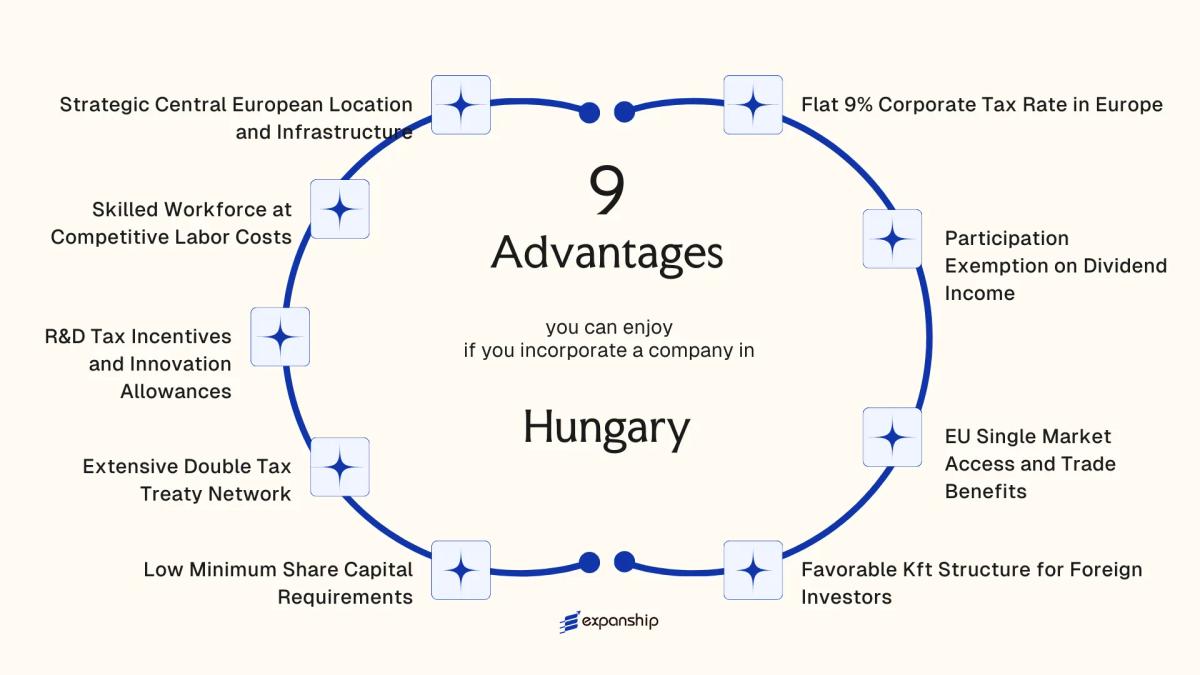
The benefits of incorporating in Hungary draw interest from businesses across Europe and beyond, reflecting the jurisdiction's position within the EU single market and its treaty infrastructure. This article examines the key advantages that the country's regulatory and tax framework offers to foreign companies considering setting up a local presence.
Flat 9% Corporate Tax Rate in Europe
Hungary's flat 9% corporate tax rate is the lowest statutory corporate income tax rate among all EU member states. Under the Corporate Tax Act (Act LXXXI of 1996), this rate applies uniformly to resident companies on their worldwide taxable income, with no graduated brackets or surtaxes layered on top.
How the Rate Compares Across Europe
The EU average corporate tax rate sits above 21%, meaning a profitable firm incorporated in Hungary retains significantly more post-tax earnings per euro of profit. For a foreign investor structuring European operations, that differential directly reduces the annual tax burden without requiring complex planning.
What Applies to Your Taxable Base
The 9% rate applies to adjusted pre-tax profit as calculated under Hungarian accounting rules, which follow the framework set by Act C of 2000 on Accounting. Certain deductions, including development reserves and loss carry-forwards, can reduce the taxable base further, making the effective rate potentially lower than the statutory figure.
A foreign-owned Hungarian entity operating at the EU average profit margin will face a corporate tax liability roughly less than half of what an equivalent business would owe in Germany, France, or Italy.
Participation Exemption on Dividend Income
Hungary participation exemption on dividend income provides a full 100% exemption on dividends received by a Hungarian resident company from qualifying participations. This applies to both domestic and foreign subsidiaries, meaning your holding structure keeps dividend flows free of corporate tax at the Hungarian level.
Under the Corporate Tax Act (Act LXXXI of 1996), the exemption is available without a minimum shareholding threshold for domestic dividends. For dividends from foreign entities, the receiving company must hold a qualifying participation, and payments from jurisdictions listed on Hungary's controlled foreign company (CFC) blacklist are excluded from the benefit.
For a Kft used as a holding vehicle, the practical outcome is that profits distributed upward from operating subsidiaries are not taxed again at the intermediary level. This prevents the erosion of returns that typically occurs in jurisdictions applying partial dividend credits or imputation systems.
What makes this treatment commercially significant:
- Dividend income flows through the structure without triggering a second layer of corporate tax
- The exemption covers dividends from EU and non-EU subsidiaries alike, broadening the range of usable holding structures
- No minimum holding period is required under the domestic corporate tax rules, giving your structure greater flexibility
- CFC exclusions are clearly defined, making compliance assessment straightforward

Incorporate Your Holding Company in Hungary
Set up a Hungarian Kft to take advantage of the participation exemption on dividend income and other corporate tax benefits.
EU Single Market Access and Trade Benefits
Membership in the European Union gives a Hungarian-registered entity direct access to the EU single market, a trading bloc covering over 440 million consumers and 27 member states. For a foreign business owner, that access is not theoretical — it means your company can sell goods and services across EU borders without customs duties, import quotas, or regulatory border checks between member states. That is a structural commercial advantage that non-EU-registered firms simply do not have.
Hungary EU single market access benefits extend specifically to the free movement of capital, goods, services, and people under the Treaty on the Functioning of the European Union (TFEU). A firm incorporated in Hungary as a Korlátolt Felelősségű Társaság or Zártkörűen Működő Részvénytársaság holds full EU legal standing, meaning it can bid on EU public procurement contracts, passporting rights apply in regulated sectors, and intra-EU transactions are governed by harmonized VAT rules under Council Directive 2006/112/EC.
| Entitlement | Governing Framework | Practical Effect |
|---|---|---|
| Tariff-free goods movement | TFEU Articles 28-37 | No customs duties on intra-EU trade |
| Services freedom | TFEU Article 56 | Cross-border service provision without local re-registration |
| EU procurement access | Directive 2014/24/EU | Eligibility to bid on public contracts across all member states |
| Harmonized VAT regime | Council Directive 2006/112/EC | Standardized intra-community transaction rules |
EU membership also means your business benefits from trade agreements negotiated collectively by the European Commission on behalf of all member states. Hungary alone has no bilateral free trade agreements, but as an EU member, your entity gains preferential access to markets covered by agreements with Japan, Canada (CETA), South Korea, and others — without requiring separate registration in a larger EU jurisdiction.
Favorable Kft Structure for Foreign Investors
The Hungary Kft structure benefits for foreign investors stem from a foundational legal design that accommodates full foreign ownership without restriction. Under the Civil Code (Act V of 2013), a Korlátolt Felelősségű Társaság can be established and wholly owned by non-resident individuals or foreign corporate entities. No local partner, nominee director, or resident shareholder is required.
Liability is capped at each member's subscribed capital contribution. This structural separation between personal assets and business obligations gives foreign investors a defined risk boundary that a branch or representative office would not provide.
A single member can form and operate the entity, meaning a foreign holding company can establish a wholly owned subsidiary without assembling a local shareholder group. Management can be exercised by a non-resident manager, though a registered address in the country remains obligatory and must be maintained through a registered seat service provider if the firm has no physical premises.
Keep these points in mind:
- Full foreign ownership is permitted with no equity restrictions
- A minimum of one member is sufficient to incorporate
- The managing director need not be a Hungarian resident
- A registered seat address within the country is a statutory requirement
- Corporate resolutions and founding documents must be executed before a Hungarian notary
A single-member Kft is legally permitted to have the same individual serve as both the sole member and the sole managing director simultaneously.
Low Minimum Share Capital Requirements
Hungary's low minimum share capital requirements make the Korlátolt Felelősségű Társaság (Kft) one of the more accessible corporate structures for foreign investors entering Central Europe. Under the Civil Code (Act V of 2013), a Kft requires a minimum registered capital of just HUF 3,000,000 — roughly EUR 7,500 to 8,000 depending on the exchange rate — which can be contributed in cash, in kind, or a combination of both.
Capital Accessibility at Formation
That threshold is not only low in absolute terms; it is also significantly below the requirements for comparable limited liability structures in several EU member states, where minimums can reach EUR 25,000 or higher. For foreign founders, this means less capital is locked into statutory requirements at the point of incorporation, leaving more working capital available for operational expenses from day one.
Founders are not required to deposit the full amount before registration. A portion may be deferred, subject to conditions set out in the company's articles of association and the Civil Code, provided the total is paid within a defined period after registration.
Structural Flexibility for Investors
A single shareholder — whether an individual or a corporate entity — can form a Kft, and no local resident shareholder is required. This means a foreign company or individual can hold 100% of the equity without needing a domestic co-owner, removing a structural constraint that exists in other jurisdictions.
Plan Your Entry into the Hungarian Market
Speak with our corporate services team about structuring your Hungarian entity to make the most of the Kft's capital and ownership framework.
Extensive Double Tax Treaty Network
Hungary's double tax treaty network advantages are among the most practical structural benefits available to foreign-owned entities operating across borders. With over 80 bilateral tax treaties in force, the network covers major trading partners across Europe, Asia, North America, and the Middle East.
- Reduced withholding tax rates on dividends, interest, and royalties paid between treaty countries lower the overall tax cost of cross-border income flows, which directly affects after-tax returns for foreign shareholders.
- Treaties eliminate the risk of the same income being taxed twice in two separate jurisdictions, giving your business greater certainty when repatriating profits or receiving payments from foreign counterparties.
- Many of Hungary's treaties include provisions aligned with the OECD Model Tax Convention, meaning the rules governing permanent establishment and beneficial ownership follow internationally recognized standards rather than unpredictable local interpretations.
- For holding structures, treaty protection on dividend distributions means that a Hungarian entity receiving income from a foreign subsidiary, and then distributing it onward, can do so within a defined and predictable tax framework.
- Treaty benefits are generally available to entities that qualify as tax residents under Hungarian domestic law, which is determined by place of incorporation or place of effective management, making residency status straightforward to establish for a locally registered firm.
R&D Tax Incentives and Innovation Allowances
Hungary R&D tax incentives for businesses are grounded in the Corporate Tax Act (Act LXXXI of 1996), which allows companies to deduct qualifying research and development costs at three times their actual value from the pre-tax profit base. That triple deduction directly reduces taxable income, not just the tax owed, making the effective relief significant when applied against the 9% corporate tax rate.
Small and medium-sized enterprises can also claim an additional tax credit equal to 10% of direct R&D expenditures, subject to conditions set by the National Research, Development and Innovation Office (NRDI Office). Foreign-owned subsidiaries registered as Hungarian entities are eligible, provided the R&D activity is carried out domestically.
The innovation contribution, governed by Act LXVII of 2003, applies primarily to larger domestic companies. SMEs are exempt, which reduces the compliance burden for foreign investors structuring through a smaller entity.
A company spending HUF 50 million on qualifying R&D in a tax year could reduce its taxable base by HUF 150 million. At the 9% corporate tax rate, this translates to a tax saving of HUF 13.5 million, compared to a saving of HUF 4.5 million without the multiplier.
Skilled Workforce at Competitive Labor Costs
Hungary skilled workforce competitive labor costs represent a concrete operational advantage, not just a headline figure. Average gross wages in Hungary remain significantly below Western European levels, translating directly into lower payroll expenditure for foreign-owned entities operating locally.
Employer social contribution tax (szociális hozzájárulási adó) currently stands at 13% of gross wages. That rate is among the lower employer-side burdens within the EU, where equivalent contributions in countries like France or Austria can exceed 30%.
The workforce itself carries strong technical depth. Hungarian universities, particularly in engineering, IT, and life sciences, consistently produce graduates that feed into sectors where precision and specialization matter.
- English and German proficiency are common in professional and technical roles, reducing communication friction for multinational management structures.
- The country's vocational training system (szakképzés) produces skilled tradespeople across manufacturing, logistics, and technical services.
- Budapest's concentration of shared service centers operated by multinationals reflects an established track record of absorbing complex back-office and knowledge-work functions.
Labor contracts and termination procedures are governed by the Labour Code (Munka Törvénykönyve), Act I of 2012, which provides a defined legal framework that your HR and legal teams can work within predictably.
Collective agreements (kollektív szerződés) in certain industries may impose wage floors or conditions above the statutory minimum, so sector-specific review is necessary before finalizing your payroll model.
Strategic Central European Location and Infrastructure
Hungary's geographic position at the crossroads of Western and Eastern Europe gives your business direct overland access to over 500 million EU consumers without requiring a secondary distribution hub. Budapest sits within a two-hour flight of 14 European capitals, which reduces travel time and operational overhead for firms managing multi-country teams.
The country's road and rail networks connect to the Trans-European Transport Network (TEN-T) corridors, specifically Core Network Corridor sections that run through Budapest. This means freight moving between Western Europe and the Balkans, Ukraine, or Turkey passes through Hungarian logistics infrastructure by default, not by detour.
Three international airports serve cargo and passenger traffic, with Budapest Ferenc Liszt International handling the majority of commercial volume. For companies in manufacturing, automotive supply chains, or distribution, proximity to established free trade zones — including those operating under customs warehouse procedures recognized under EU Regulation 952/2013 (the Union Customs Code) — reduces the cost of holding imported inventory before final clearance.
- Budapest ranks among the top Central European cities for European regional headquarters placement, according to industry site-selection surveys.
- The M0 ring road around Budapest connects all major radial motorways, reducing urban transit bottlenecks for logistics operators.
- Rail freight connections link directly to German, Austrian, Romanian, and Serbian networks under bilateral and EU-wide rail liberalization frameworks.
For foreign firms entering Central and Eastern European markets, having a single legal entity in one location capable of physically reaching multiple markets within 24-hour overland transport windows reduces the structural complexity of regional operations.
How Hungary Stacks Up Against Other European Jurisdictions
At 9% corporate income tax, Hungary holds the lowest statutory rate among EU member states — a fact that immediately positions it differently from neighbouring jurisdictions when foreign investors compare incorporation options. The three competitors chosen here, the Czech Republic, Austria, and Poland, share geographic proximity and target a broadly similar profile of foreign-owned entities, making them the most realistic alternatives a reader evaluating this market would also weigh.
What the table below cannot capture is timing. Austria imposes a 25% corporate tax rate with a minimum annual tax obligation for GmbHs, and Poland applies a standard 19% rate (with a reduced 9% for smaller firms). For a mid-sized foreign entity that does not qualify for Poland's reduced rate, the structural tax differential across a multi-year holding period is material. The Czech Republic, at 21%, also requires registration with the Czech Trade Licensing Office before formal incorporation can proceed, adding procedural steps absent from the Hungarian company registry process.
| Parameter | Hungary | Czech Republic | Austria | Poland |
|---|---|---|---|---|
| Corporate Tax Rate | 9% | 21% | 23% (from 2024) | 19% (9% for small firms) |
| Minimum Share Capital (Private LLC) | HUF 3,000,000 (~EUR 7,500) | CZK 1 (~EUR 0.04) | EUR 10,000 | PLN 5,000 (~EUR 1,150) |
| EU Member | Yes | Yes | Yes | Yes |
| Participation Exemption on Dividends | Yes | Yes (conditions apply) | Yes (conditions apply) | Limited |
| Standard VAT Rate | 27% | 21% | 20% | 23% |
| Active Tax Treaty Network | 80+ treaties | 90+ treaties | 90+ treaties | 90+ treaties |
Compliance Services for Companies in Hungary
Maintain good standing with Hungarian regulatory requirements, including annual filings, corporate changes, and ongoing statutory obligations.
Conclusion
Hungary's position as a low-tax EU member state with an extensive treaty network and a straightforward corporate structure makes it a substantively different proposition from most comparable European jurisdictions. The 9% corporate tax rate under the Corporate Tax Act (Act LXXXI of 1996) and the participation exemption on qualifying dividend income together reduce the effective tax burden in ways that directly affect after-tax returns for foreign investors.
Not every business will extract equal value from these features. A holding company or an R&D-intensive firm will benefit differently from the framework than a trading entity or a service business. The advantages of setting up a company in Hungary are most pronounced when your structure aligns with the specific provisions the legislation was designed to accommodate.
The Hungary company formation advantages covered across this blog point toward a jurisdiction that rewards deliberate structuring. Executing that structure correctly, from the registration of a Korlátolt Felelősségű Társaság with the Company Registry Court to meeting ongoing compliance obligations under Hungarian tax authority (NAV) requirements, determines whether the legal benefits translate into real operational and financial outcomes. The extent to which your business captures those outcomes depends on the quality of the formation and compliance process from the outset.
Start Your Hungarian Company with Expanship Today
Forming a Korlátolt Felelősségű Társaság (Kft) through Expanship means your business is handled by specialists who understand the full scope of Hungarian corporate requirements, from initial registration with the Budapest Metropolitan Court of Registration to ongoing obligations under the Hungarian Accounting Act. The benefits covered throughout this blog, including the 9% corporate tax rate, participation exemption rules, and R&D allowances, are only realised when the underlying structure is correctly established and maintained.
Expanship's Hungary company formation services cover each stage of the process, from document preparation to post-incorporation compliance:
- Preparation and notarisation of constitutional documents, including the deed of foundation required for Kft registration
- Registered office address and resident agent services to satisfy Hungarian domiciliation requirements
- Filing with the Company Court and liaison with the National Tax and Customs Administration (NAV) for tax number registration
- Post-incorporation compliance management, including annual filing obligations under the Companies Act (Act V of 2006)
- Corporate bank account introduction assistance with local and international financial institutions
For questions about incorporating in Hungary or to discuss your specific requirements, contact Expanship Hungary.
Frequently Asked Questions (FAQ)
The corporate income tax rate is a flat 9% on taxable profits, established under Act LXXXI of 1996 on Corporate Tax and Dividend Tax. No tiered or graduated rate applies based on profit size, which means the same rate applies regardless of whether your company earns HUF 10 million or HUF 1 billion. This rate is applied uniformly to resident companies and permanent establishments of foreign entities.
Dividends received by a Hungarian Kft from a qualifying subsidiary are generally exempt from corporate income tax under the participation exemption provisions of Act LXXXI of 1996. The exemption does not apply to dividends received from entities resident in jurisdictions classified as controlled foreign companies under Hungarian rules. This makes the Kft a functionally viable vehicle for holding subsidiary interests across multiple countries.
Capital gains from the disposal of a qualifying shareholding may be exempt under the participation exemption, provided specific conditions are met, including a minimum ownership threshold and holding period. The exact conditions are set out in Act LXXXI of 1996 on Corporate Tax and Dividend Tax. Where the exemption does not apply, the gain is treated as ordinary taxable income and subject to the standard 9% rate.
Hungary has concluded over 80 double taxation agreements, and the applicable treaty can reduce or eliminate withholding tax on dividends paid to foreign parent companies. Under domestic law, Hungary generally applies a 0% withholding tax on dividends paid to foreign corporate shareholders, which makes treaty access relevant primarily for interest and royalty payments rather than dividends. You should verify the specific treaty terms for the recipient jurisdiction, as rates for interest and royalties vary across agreements.
Qualifying research and development expenditures can be deducted from the corporate tax base at a rate exceeding the actual cost incurred, effectively reducing taxable profit below accounting profit. Hungary also offers an innovation contribution regime, though small and medium-sized enterprises may be exempt from this contribution depending on their classification under Act LXXXIV of 2007. Businesses conducting R&D activity through a Kft should assess eligibility against the definitions set by the National Research, Development and Innovation Office (NRDI Office).
A Kft is registered by the competent regional court acting as a company registry court (cégbíróság), and simplified incorporation can be completed within one business day when using a standard articles of association template. If a bespoke articles of association is used, registration typically takes up to fifteen working days. The company's registration number and entry into the Company Register (Cégjegyzék) are prerequisites before the entity can open a bank account or commence taxable activity.
The minimum subscribed capital of HUF 3,000,000 for a Kft does not need to be fully paid in cash before registration; at least half may be contributed in non-cash assets, and the remainder can be deferred up to one year after registration under the Civil Code. However, the managing director bears personal liability if the capital requirements are not met within the prescribed period. The full amount must be reflected in the company's financial statements and maintained as the registered capital throughout the entity's operation.
Legal Disclaimer
The information provided in this article is for general informational purposes only and does not constitute legal, tax, or professional advice. While we strive to ensure the accuracy and timeliness of the content, laws and regulations are subject to change, and the application of laws can vary widely based on specific facts and circumstances.
Readers should not act upon this information without seeking professional counsel tailored to their individual situation. Expanship and its authors disclaim any liability for actions taken or not taken based on the content of this article.
For specific advice regarding your business setup, compliance requirements, or any legal matters, please consult with qualified legal and tax professionals in the relevant jurisdiction.