
Key Takeaways
- All companies seeking legal standing to operate in Haiti must complete registration through the Centre de Facilitation des Investissements (CFI) before entering contracts or opening a corporate bank account.
- Entity formation in Haiti is governed by the Commercial Code, which establishes the structural and documentary baseline that determines whether a registration application is accepted or rejected.
- Minimum share capital thresholds vary by entity type and carry particular compliance weight for foreign investors determining how to structure their market entry.
- Certain sectors require additional licensing beyond the standard incorporation process, meaning that meeting the baseline formation requirements does not automatically confer the right to operate in regulated industries.
Entity formation in Haiti is governed by the Commercial Code, with oversight from the Centre de Facilitation des Investissements (CFI) and the Office National d'Assurance Vieillesse (ONA) playing roles in the broader registration process. Meeting the incorporation requirements in Haiti is a prerequisite before a business can legally operate, enter contracts, or open a corporate bank account in the country.
This article covers the structural, documentary, and regulatory requirements applicable to company registration in Haiti, spanning capital, governance, and compliance obligations. Failure to satisfy these requirements results in rejection of the registration application or denial of legal standing to conduct business.
Requirements differ depending on the entity type selected and the sector in which the business intends to operate. Certain industries are subject to additional licensing conditions beyond the standard Haiti business formation requirements.
Foreign entrepreneurs, non-resident investors, and multinational firms establishing a local presence are the primary audience for this article.
Minimum Share Capital Requirements in Haiti
Haiti minimum share capital requirements are governed primarily by the Commercial Code of Haiti, which applies to the société anonyme (SA) as the principal corporate vehicle used by foreign and domestic investors. Share capital in an SA is structured on a par value basis, meaning each share carries a nominal face value that must be stated in the company's constitutive documents.
The Office du Registre du Commerce et des Sociétés (ORCS) oversees the registration process and reviews corporate documents at the point of incorporation. Capital deposit verification is typically handled through a Haitian commercial bank, with documentary evidence provided to ORCS as part of the filing.
| Parameter | Detail |
|---|---|
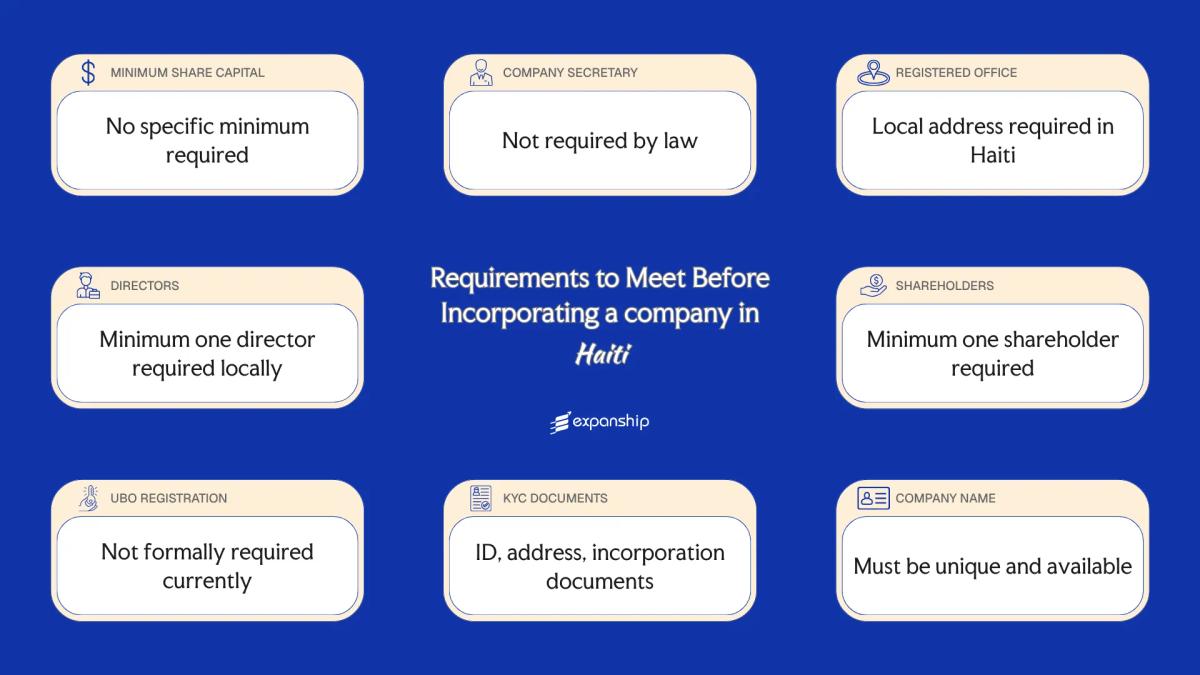
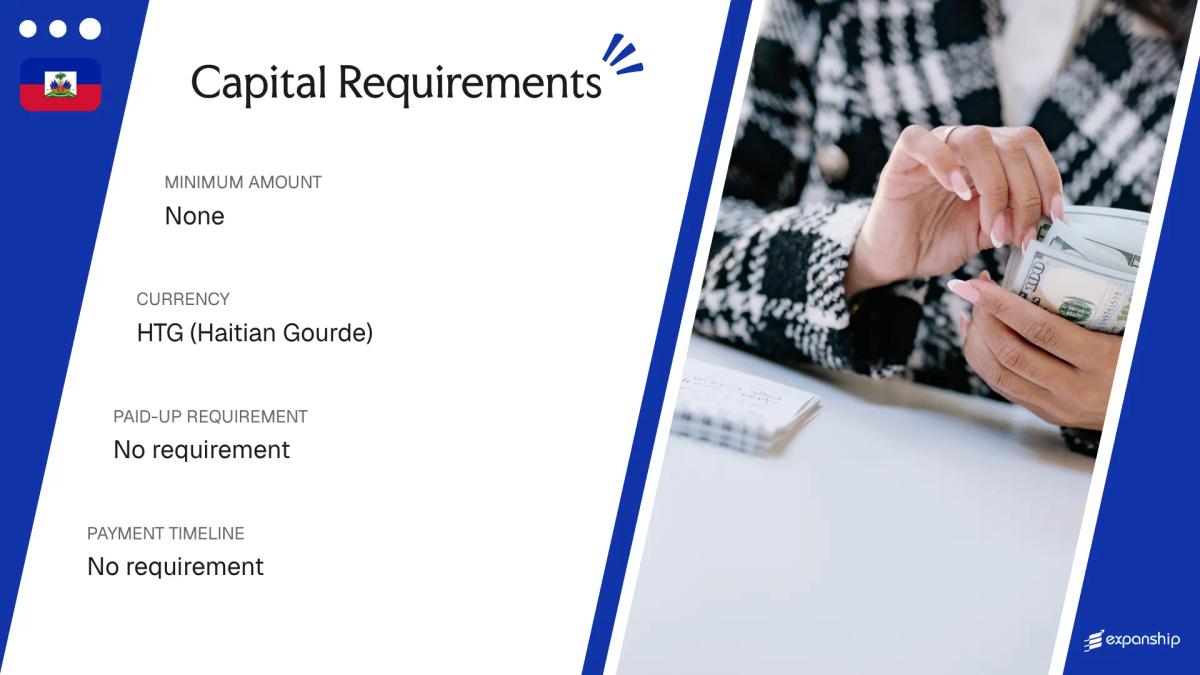
| Minimum Authorized Share Capital | No statutory minimum under general commercial law; the SA's articles must specify an authorized capital amount |
| Maximum Authorized Share Capital | No statutory maximum |
| Minimum Paid-Up Capital | No fixed statutory minimum; the articles of incorporation define the subscribed amount |
| Paid-Up Requirement at Incorporation | A portion of subscribed capital must be deposited at incorporation; the balance is callable per the articles |
| Accepted Currency | Haitian Gourde (HTG); USD is widely used in practice |
| Accepted Forms of Contribution | Cash contributions; in-kind contributions are permissible but subject to valuation |
| Timeframe to Deposit Capital | Initial portion deposited prior to or at the time of incorporation filing with ORCS |
The absence of a statutory minimum capital figure does not eliminate the obligation to define and document an authorized capital structure in your articles of incorporation. ORCS will not register an SA without this information clearly stated.
Company Secretary Requirements in Haiti
Under Haitian corporate law, company secretary requirements in Haiti are not structured in the same manner as common law jurisdictions. The Société Anonyme (SA) and other commercial entities governed by the Code de Commerce d'Haïti do not mandate a formally designated "company secretary" as a statutory officer.
Certain administrative and compliance functions, however, must still be fulfilled. A responsible party within the entity typically handles obligations such as maintaining corporate registers, ensuring timely filings with the Registre du Commerce et des Sociétés (RCS), and managing documentation related to shareholder meetings.
Below are the general qualification criteria for who may fulfill this administrative role within a Haitian-registered entity:
- No statutory licensing requirement exists for this role under current Haitian commercial regulation.
- The function may be performed by an individual or a designated officer already serving the company.
- No mandatory residency condition applies to the person carrying out secretarial duties.
- Corporate entities may assign these responsibilities internally to a director or authorized representative.
- Foreign nationals are not excluded from fulfilling this function on behalf of a local firm.

Incorporate a Company in Haiti
Set up your business entity in Haiti with full support on registration, documentation, and compliance filings through the Registre du Commerce et des Sociétés.
Registered Office Requirements in Haiti
Registered office requirements in Haiti mandate that every company maintain a physical address within the country's territory, serving as the official legal domicile through which state authorities and third parties can direct formal correspondence. Non-compliance with legal domicile requirements under the Haitian Commercial Code can expose the entity to administrative sanctions, including potential invalidation of corporate acts served to an incorrect address.
- A physical street address within Haiti is required; a P.O. box alone does not satisfy the legal domicile requirement.
- Virtual office arrangements are not formally recognised under Haitian commercial law as a compliant registered address.
- The address must be locally based; a foreign address cannot fulfil your firm's registered address obligations.
- Supporting documentation, such as a lease agreement or title deed, is generally required to evidence occupancy of the registered premises.
- The registered address is recorded in the Registre du Commerce et des Sociétés (RCS) and is publicly accessible.
- Any change to the registered address must be formally notified to the RCS, with updated documentation submitted to reflect the new location.
Director Requirements in Haiti
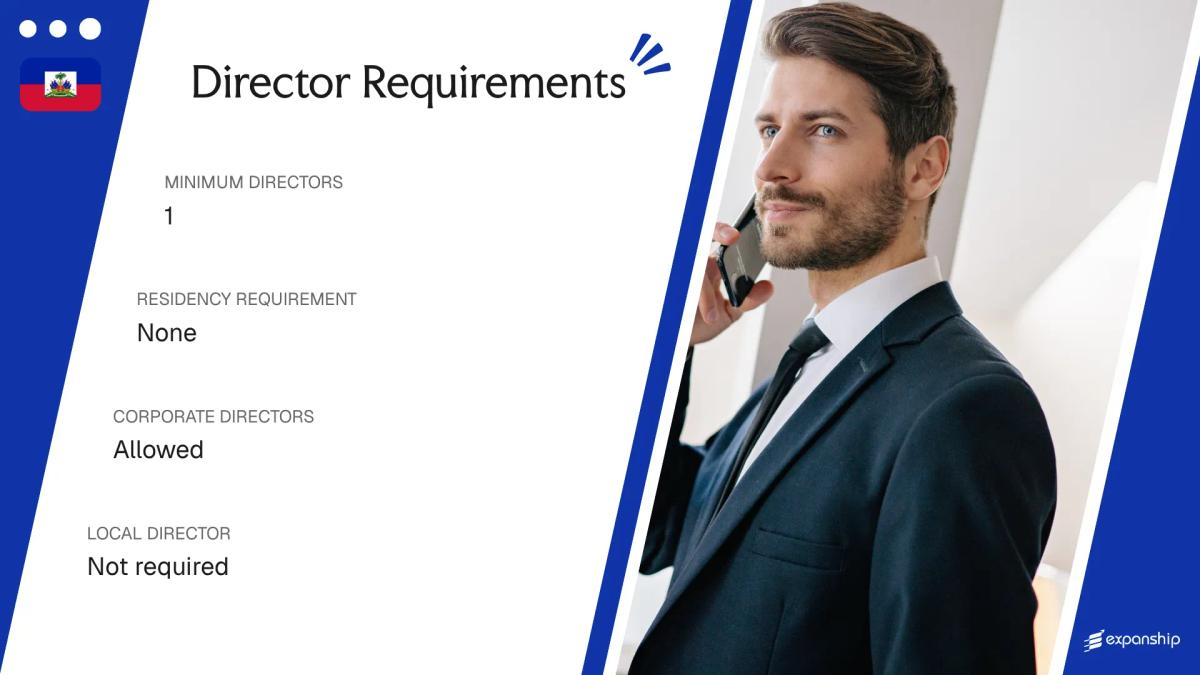
Under the Code Civil haïtien and the Loi sur les Sociétés Commerciales, director requirements Haiti company structures impose fiduciary duties on appointed directors, including obligations of loyalty, care, and prudent management on behalf of the entity. Directors assume personal liability for acts that contravene corporate statutes or result in harm to shareholders or third parties.
| Parameter | Detail |
|---|---|
| Minimum Number of Directors | One director is required for a société anonyme (S.A.). |
| Maximum Number of Directors | No statutory maximum is prescribed under Haitian commercial law. |
| Local/Resident Director Required | No statutory requirement mandates a locally resident director. |
| Nationality Restrictions | No nationality restrictions are imposed on directors under current legislation. |
| Minimum Age Requirement | Directors must have reached the age of majority, which is 18 years under the Code Civil haïtien. |
| Corporate Directors Permitted | No statutory provision expressly authorises corporate entities to serve as directors. |
| Director Must Be a Shareholder | No statutory requirement obliges a director to hold shares in the company. |
| Publicly Listed on Registry | Director information is filed with the Tribunal de Commerce but is not systematically published in a searchable public database. |
| Disqualification Conditions | Persons subject to judicial interdiction or convicted of certain criminal offences may be barred from serving as directors. |
Unlike many civil law jurisdictions, Haiti does not impose a statutory residency requirement for directors, meaning the entire board of a Haitian société anonyme can be composed of non-resident foreign nationals.
Shareholder Requirements in Haiti
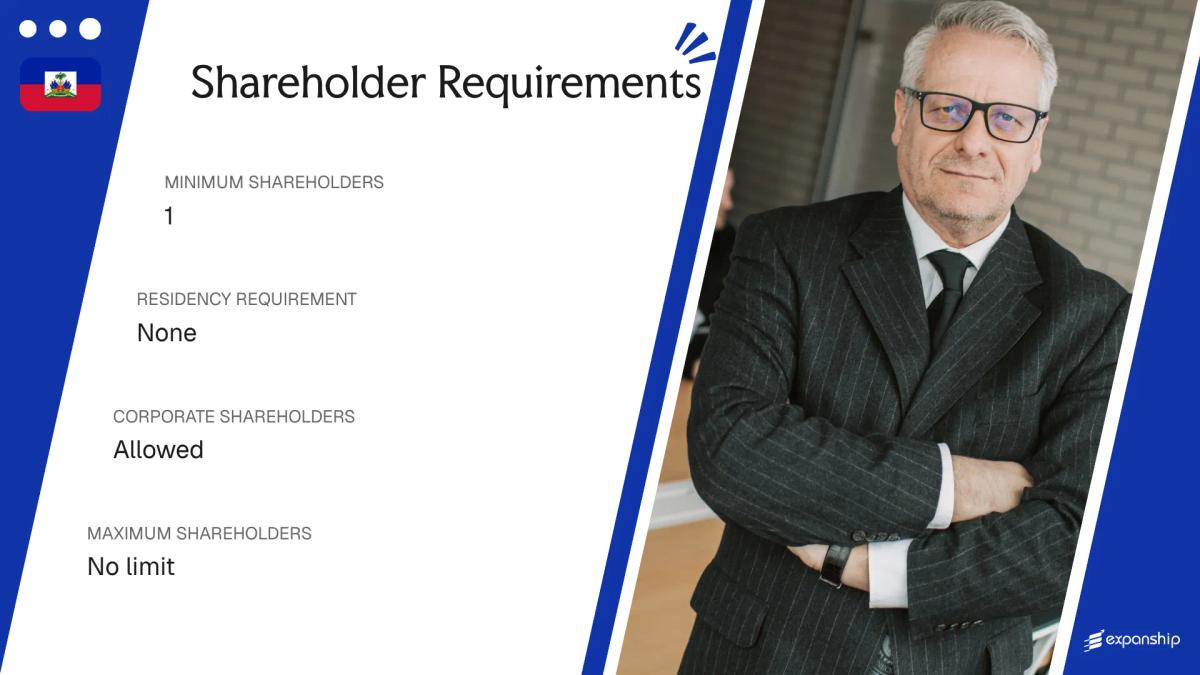
Under Haitian corporate law, a société anonyme (S.A.) requires a minimum of seven shareholders. No statutory maximum is prescribed, and sole shareholder structures are not permitted under this entity type.
Nationality and Residency Restrictions
Meeting the shareholder requirements Haiti company law sets does not obligate shareholders to be Haitian nationals or residents. Foreign ownership is generally permitted, though certain regulated sectors may impose restrictions on non-national ownership percentages.
Corporate Shareholders
Legal entities may hold shares in a Haitian S.A. Corporate shareholders are subject to the same registration and disclosure obligations as individual actionnaires under Haiti company ownership rules.
Shareholder Liability
Shareholder liability is limited to the amount contributed toward subscribed share capital. No general provision extends personal liability beyond that contribution under ordinary circumstances.
Register of Shareholders
A register of shareholders must be maintained at the firm's registered office. Filing or update obligations with the Tribunal de Commerce apply when ownership changes occur.
Shareholder Structuring Support for Your Haiti Incorporation
Get guidance on meeting shareholder obligations and structuring compliant ownership for your entity in Haiti.
UBO / Beneficial Ownership Disclosure Requirements in Haiti
Haiti does not currently maintain a formally enforced statutory framework specifically governing beneficial ownership disclosure Haiti in the context of company registration. No dedicated UBO register or mandatory filing obligation with a named regulatory authority has been established under Haitian commercial law as of the time of writing.
KYC / Document Requirements in Haiti
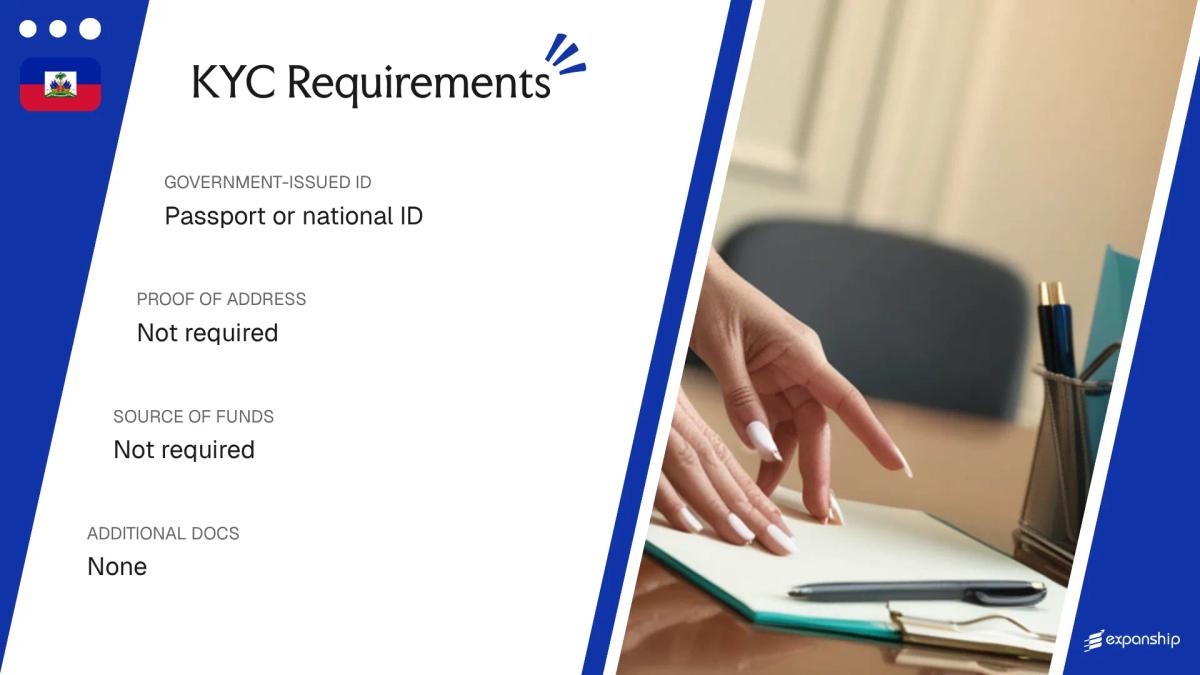
KYC requirements Haiti incorporation are governed under the country's AML framework, primarily enforced through the Unité Centrale de Renseignements Financiers (UCREF), which sets the due diligence standards applicable at the point of company registration.
Individual / Personal Documents
- Valid government-issued passport or national identity card
- Recent proof of residential address dated within three months (utility bill or bank statement)
- Completed KYC declaration form confirming beneficial ownership status
- Two recent passport-sized photographs may be required by the notary handling incorporation
Corporate Documents
- Certificate of incorporation of the corporate shareholder or director
- Certified copy of the constitutional documents (articles of association or equivalent)
- Current register of directors issued by the home jurisdiction
- Official proof of the corporate entity's registered address
Source of Funds Documentation
- Recent bank statements covering a minimum of three months
- Audited financial statements or accountant-certified accounts where available
- A signed declaration describing the origin of capital contributed to the entity
Notarisation and Apostille Requirements
- Foreign documents generally require apostille certification under the Hague Convention
- Non-French documents must be accompanied by a certified French translation
- Notarisation by a Haitian notary is required for constitutional documents filed locally
Incomplete or untranslated foreign-language documents are the most common cause of registration delays at the Registre du Commerce et des Sociétés.
Company Name Requirements in Haiti
Proposed company name requirements Haiti follow a review process conducted at the point of registration, where the name is assessed for uniqueness and general suitability before incorporation can proceed.
French is the operative language for legal entity names. A designated legal suffix reflecting the chosen business structure must appear in the name.
Certain categories of words are restricted. Names implying a connection to government bodies, international organizations, or regulated sectors such as banking or insurance require prior authorization from the relevant authority.
Name reservation is available in Haiti, though the duration and precise procedure are subject to the applicable administrative process at the time of filing.
Compliance Services for Companies in Haiti
Keep your Haitian entity in good standing with ongoing compliance support, from annual filings to regulatory reporting.
Conclusion
Haiti company incorporation requirements span several regulatory layers, from the OHADA-aligned corporate framework to the oversight functions carried out by the Office National d'Assurance (ONA) and the Direction Générale des Impôts. Among the requirements covered, the minimum share capital thresholds for specific entity types and the registered office obligation under Haitian civil and commercial law carry particular weight for foreign investors structuring their entry. Once these obligations are understood, the practical work of assembling compliant documentation, appointing qualifying officers, and registering with the Centre de Facilitation des Investissements begins.
Expanship's Corporate Services for Haiti Expansion
Incorporating in Haiti involves working within a framework shaped by OHADA-aligned commercial law, the oversight of the Centre de Facilitation des Investissements, and documentation requirements that can slow timelines for foreign businesses unfamiliar with local procedures. Expanship's Haiti corporate services expansion support is designed to reduce the administrative weight of those specific steps, from preparing statutory documents in French to coordinating with Haitian notaries and government registries.
Beyond initial registration, Expanship provides a structured range of services to support your business through each stage of establishment:
- We handle company registration and preparation of all required corporate documents.
- Our team provides registered agent and office services to meet local presence requirements.
- We manage government filings and liaise directly with Haitian regulatory authorities on your behalf.
- Post-incorporation compliance obligations are tracked and managed so your entity stays in good standing.
- Banking introduction support is available to help connect your business with suitable local institutions.
- We coordinate tax registration and engagement with the Direction Générale des Impôts and other relevant local bodies.
To discuss your requirements, contact Expanship Haiti.
Frequently Asked Questions (FAQ)
Foreign nationals can serve as directors of a Haitian company, but at least one director with local residency or ties to Haiti is strongly recommended in practice to satisfy administrative and operational requirements. The Tribunal de Commerce and other regulatory bodies may require a local point of contact for correspondence and compliance purposes. Relying entirely on foreign-based directors can create delays in post-incorporation filings and dealings with the Office National d'Assurance Vieillesse (ONA) and the Direction Générale des Impôts (DGI).
Non-compliance with beneficial ownership disclosure obligations exposes the company and its officers to administrative sanctions, potential fines, and in serious cases, suspension of business operations by the relevant authorities. Haiti has been strengthening its anti-money laundering framework under pressure from FATF-aligned standards, making UBO disclosure an area of increasing regulatory scrutiny. Directors and shareholders who knowingly omit or misrepresent ownership information face the most direct personal liability.
No. A Haitian company must maintain a physical registered office address on Haitian territory, and a foreign address does not satisfy this requirement under local law. The registered office serves as the official address for service of legal documents, government correspondence, and tax filings with the DGI, all of which must be processed within Haiti. Using a foreign address would render the registration application invalid before the Tribunal de Commerce.
Foreign shareholders are typically required to provide certified copies of valid government-issued identification, proof of address, and source-of-funds documentation as part of the KYC process. If the shareholder is a corporate entity rather than an individual, you will also need to supply the parent company's incorporation certificate, constitutional documents, and a certificate of good standing from its home jurisdiction. All foreign-language documents must be translated into French and, depending on the issuing country, may require apostille certification or notarisation before submission.
Company name approval in Haiti falls under the jurisdiction of the Tribunal de Commerce, which checks proposed names against existing registrations to confirm availability and compliance with naming rules. Names that imply government affiliation, use restricted terms, or are identical or confusingly similar to registered entities will be rejected. The timeline for name clearance can vary significantly depending on the volume of applications the tribunal is processing at the time of submission.
The formal requirement for a company secretary is not uniformly mandated across all Haitian business structures in the same way it is in common-law jurisdictions. An SA may have governance requirements that functionally necessitate a secretary-level role for corporate record-keeping and shareholder meeting administration, while a SARL operates with a simpler management structure. The specific obligations depend on the company's statutes and the applicable provisions of the Code de Commerce governing each entity type.
Legal Disclaimer
The information provided in this article is for general informational purposes only and does not constitute legal, tax, or professional advice. While we strive to ensure the accuracy and timeliness of the content, laws and regulations are subject to change, and the application of laws can vary widely based on specific facts and circumstances.
Readers should not act upon this information without seeking professional counsel tailored to their individual situation. Expanship and its authors disclaim any liability for actions taken or not taken based on the content of this article.
For specific advice regarding your business setup, compliance requirements, or any legal matters, please consult with qualified legal and tax professionals in the relevant jurisdiction.