
Key Takeaways
- Haiti's Investment Code provides statutory tax exemptions for priority sectors, allowing qualifying businesses to reduce their effective rate well below the standard 30% corporate income tax through a legal mechanism rather than discretionary relief.
- Foreign nationals face no ownership ceiling under Haitian commercial law, meaning a Société Anonyme can be wholly controlled by non-resident investors without structural workarounds.
- Manufacturers operating within SONAPI-administered free trade zones gain access to a distinct incentive layer that compounds the baseline advantages available to standard registered entities.
- Membership in CARICOM and eligibility under CAFTA-DR positions a Haiti-registered company to reach preferential export markets across the Caribbean and into North America from a single incorporated entity.
Situated on the western third of the island of Hispaniola in the Caribbean, Haiti is an independent sovereign nation and one of the founding members of the United Nations. Company registration falls under the authority of the Office of Notaries and the Centre de Facilitation des Investissements (CFI), which coordinates foreign direct investment procedures. The Société Anonyme remains the most common legal vehicle through which foreign businesses establish a presence in the country.
Haiti operates under a territorial tax posture, generally taxing income derived from domestic sources while applying reduced or no obligations to qualifying foreign-source revenue. Foreign nationals face no statutory prohibition on owning or controlling a locally registered entity, reflecting a formally open stance toward inbound investment.
The benefits of incorporating in Haiti span tax treatment, sector-specific incentives, and market access — this article examines each of those advantages in structured detail.
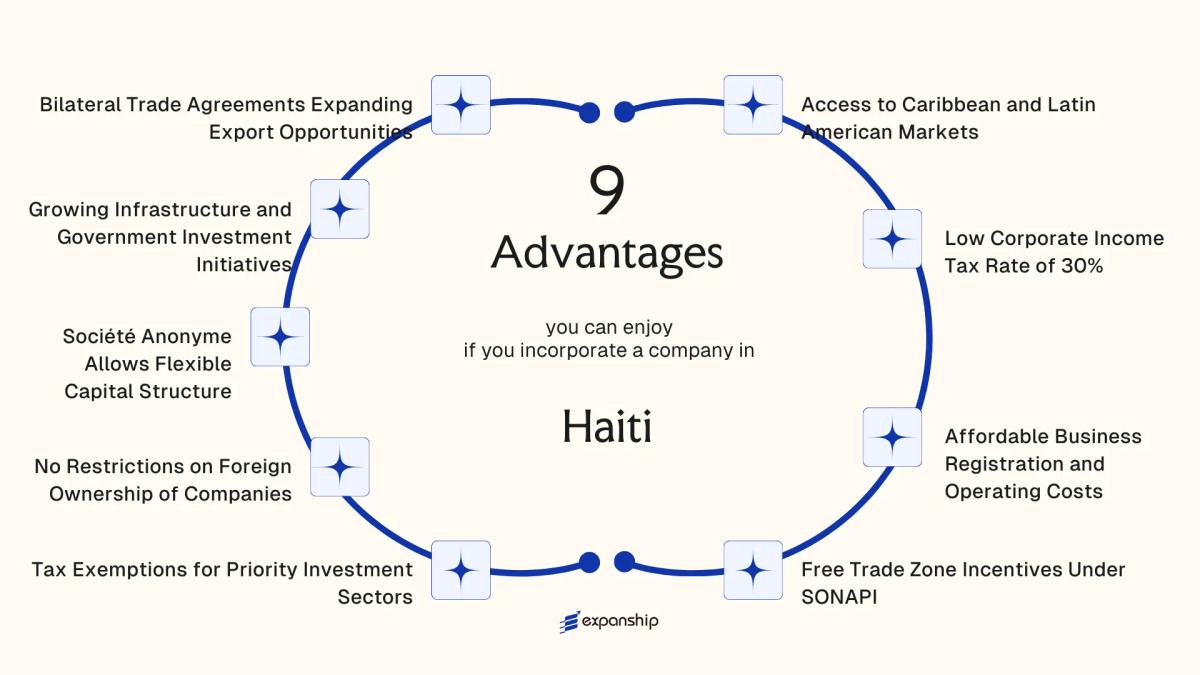
Access to Caribbean and Latin American Markets
Haiti's geographic position at the crossroads of the Caribbean Sea places your business within close shipping and trade proximity to both Latin American economies and North American entry points. Haiti access to Caribbean Latin American markets is a structural advantage rooted in location, not policy alone.
Regional Proximity as a Commercial Asset
Port-au-Prince sits within short maritime distance of major Caribbean trading partners, including the Dominican Republic, Jamaica, and Cuba. For firms distributing goods regionally, this reduces freight timelines and logistics costs compared to operating from a more distant base.
Trade Framework Connections
Haiti holds membership in CARICOM, the Caribbean Community, which provides a preferential trade framework across member states. Goods produced or processed within the country can qualify for reduced tariff treatment when exported to CARICOM partners, giving your entity a measurable cost advantage over non-member competitors entering the same markets.
CARICOM membership also creates pathways for service-sector firms seeking regional market recognition, particularly in professional and financial services.
CARICOM membership means goods your company exports to member states may qualify for preferential tariff rates unavailable to firms incorporated outside the bloc.
Low Corporate Income Tax Rate of 30%
Haiti's standard corporate income tax rate sits at 30%, applied to net taxable profits. While that figure may appear moderate rather than minimal, the Haiti corporate income tax rate benefits become more apparent when examined against the regional context and the specific conditions that apply to foreign-owned entities operating there.
For businesses structured under Haitian commercial law, taxable income is calculated on net profit after allowable deductions, which can meaningfully reduce the effective rate below the statutory ceiling. Your actual tax exposure depends significantly on how the entity's expenses, depreciation, and sector classification are accounted for under the General Tax Directorate's (DGI) framework.
Several structural features make the 30% rate more favourable in practice than it first appears:
- Allowable business deductions reduce the taxable base, not just the headline figure
- Foreign companies are taxed only on Haiti-sourced income, limiting exposure for firms with diversified international operations
- The rate applies uniformly, so there is no graduated surcharge on larger profit thresholds
- Compliance obligations under the DGI are defined by clear statutory categories, reducing ambiguity in filing
For foreign companies assessing their Haiti tax rate exposure, this source-based approach means offshore revenues fall entirely outside domestic tax jurisdiction.

Company Incorporation in Haiti
Register your business entity in Haiti with full compliance support across all DGI and commercial registry requirements.
Affordable Business Registration and Operating Costs
Registering a company in Haiti carries lower upfront and ongoing financial obligations than many comparable markets in the Caribbean region. Affordable business operating costs in Haiti begin at the formation stage, where government registration fees through the Office National d'Assurance Vieillesse (ONA) and the Centre de Facilitation des Investissements (CFI) remain relatively modest. This reduces the initial capital outlay your firm needs to commit before generating revenue.
| Cost Element | Governing Body / Process | Practical Implication |
|---|---|---|
| Company registration filing | CFI one-stop-shop process | Single-window submission reduces administrative time |
| Notarial deed fees | Licensed Haitian notary | Required for SA and SARL formation; fee scales with capital |
| ONA registration | Office National d'Assurance Vieillesse | Mandatory employer registration; standard flat-rate structure |
| Trade register inscription | Tribunal de Commerce | Formalises legal existence; fixed court fee applies |
The notarial deed requirement for a Société Anonyme or a Société à Responsabilité Limitée does carry a cost, but fees are calculated on declared capital, so a business with modest initial capitalisation keeps those charges contained. Annual maintenance obligations, including statutory filings with the Direction Générale des Impôts (DGI), do not involve the layered renewal fee structures present in several offshore-style jurisdictions. For a foreign investor establishing an operational presence rather than a shell structure, this translates to a more predictable annual cost base from the outset.
Free Trade Zone Incentives Under SONAPI
Haiti SONAPI free trade zone incentives represent one of the more structurally distinct advantages available to export-oriented manufacturers and assemblers. SONAPI, the Société Nationale des Parcs Industriels, administers industrial parks across the country, with the Caracol Industrial Park in the north being among the most developed. Firms operating within these designated zones gain access to a fiscal framework that differs significantly from the standard tax regime.
Businesses established under SONAPI's industrial park structure typically benefit from exemptions on customs duties for imported raw materials, machinery, and equipment used in production. This directly reduces capital expenditure for manufacturers who depend on imported inputs. Under Haiti's Investment Code and related free zone legislation, qualifying firms may also receive income tax holidays for a defined period, though exact durations depend on the sector and approval conditions set by the relevant authority.
The official framework governing industrial park eligibility is administered through the Ministry of Commerce and Industry in coordination with SONAPI.
Key conditions to keep in mind:
- Operations must be export-focused to qualify under the free zone regime
- SONAPI must formally approve your firm's classification within an industrial park
- Imported inputs must be used directly in production to attract duty exemptions
- Tax holiday durations are not uniform; they vary by approved activity and negotiated terms
SONAPI-managed zones have historically attracted significant U.S. textile investment under HOPE Act preferences, making Haiti one of the few Caribbean nations with a legislated duty-free apparel export channel directly into the U.S. market.
Tax Exemptions for Priority Investment Sectors
Haiti tax exemptions for priority investment sectors are codified under the Investment Code (Décret sur l'Investissement), which grants structured fiscal benefits to businesses operating in sectors the government has designated as priorities. These include agro-industry, tourism, manufacturing, and export-oriented production. For a foreign investor, this framework creates a direct reduction in tax liability during the early and mid-stages of operations, when capital recovery is most critical.
Sector-Specific Tax Holidays
Qualifying firms can receive full or partial exemptions from corporate income tax for periods that vary depending on the sector and the location of operations. Businesses established in less-developed regions may receive extended exemption periods compared to those in Port-au-Prince, which means geographic placement is a deliberate financial decision. These holidays defer your firm's tax obligations precisely when reinvestment capacity matters most.
Customs duty exemptions on imported equipment and raw materials are also available to eligible entities, reducing the upfront capital required to establish production facilities. Your business does not pay import duties on machinery that would otherwise represent a significant fixed cost at the start of operations.
Eligibility and Administrative Process
Incentive eligibility is determined through the Centre de Facilitation des Investissements (CFI), the body responsible for screening and approving investment applications. Approval requires submitting a formal investment project file demonstrating alignment with priority sector criteria. Meeting this threshold is what converts a standard incorporation into a tax-advantaged operating structure.
Identify Which Tax Exemptions Apply to Your Haiti Investment
Speak with our team to assess your sector eligibility under Haiti's Investment Code and determine the fiscal incentives available to your business.
No Restrictions on Foreign Ownership of Companies
Foreign investors face no legal restrictions on owning 100% of a Haitian company. Under the Investment Code (Décret du 28 mars 2002), national treatment principles apply, meaning foreign nationals hold the same ownership rights as Haitian citizens in most commercial sectors. This is the Haiti no foreign ownership restrictions benefit in its most direct form: your firm does not require a local partner, a nominee shareholder, or any minimum domestic equity stake to operate lawfully.
- Full ownership means you retain complete decision-making authority over the entity, including profit distribution, capital allocation, and strategic direction, without sharing control with a mandated local party.
- Because no minimum local equity is required, structuring costs associated with nominee arrangements or joint venture agreements are eliminated from the outset.
- Under the Investment Code, foreign investors are entitled to freely transfer profits, dividends, and capital abroad after fulfilling applicable tax obligations, which protects the financial value of full ownership.
- The absence of a forced partnership structure reduces governance risk, since disputes with mandatory local shareholders are a documented source of operational complications in jurisdictions that impose such requirements.
- Foreign ownership rights apply to the most commercially significant entity types, including the Société Anonyme and the Société à Responsabilité Limitée, giving you structural flexibility alongside ownership freedom.
Société Anonyme Allows Flexible Capital Structure
The Haiti Société Anonyme flexible capital structure is codified under the Commercial Code of Haiti, which governs how shares are issued, transferred, and valued. A Société Anonyme (SA) can divide its share capital into multiple classes, allowing your business to separate voting rights from economic interests. This separation gives founders and investors the ability to structure control and profit distribution independently.
Minimum share capital requirements for an SA are set at a defined threshold, and shares can be either nominative or bearer in form, depending on the company's articles of association. For foreign investors, this means entry terms can be negotiated with precision rather than constrained by a rigid single-class structure.
- Differential voting rights can be allocated across share classes
- Capital increases can be authorized through ordinary shareholder resolution
- Shares may be transferred without requiring unanimous consent among shareholders
Hypothetical scenario: A foreign investor holds 30% of equity in a Haitian SA but is allocated Class A shares carrying 60% of voting rights. A local partner holds the remaining 70% of equity with Class B shares carrying 40% of voting rights. This structure allows the foreign investor to retain operational control while limiting their financial exposure to less than a third of total invested capital.
Growing Infrastructure and Government Investment Initiatives
Haiti infrastructure investment opportunities for businesses are increasingly shaped by targeted public spending and multilateral financing programs. The Inter-American Development Bank (IDB) and the World Bank have both committed capital to road networks, port rehabilitation, and energy access projects, reducing the logistical friction that has historically affected supply chains for firms operating in the country.
The Port-au-Prince metropolitan area and the northern economic corridor around Cap-Haïtien are receiving directed infrastructure attention. For a foreign firm, proximity to improving port and road infrastructure directly affects distribution costs and supplier lead times, both of which factor into margin calculations at the operational stage.
Government investment initiatives under the general framework of Haiti's national development priorities have targeted the energy sector specifically. Unreliable electricity access has long constrained manufacturing and services operations; investments aimed at expanding grid capacity and off-grid solutions lower the cost burden on businesses that would otherwise absorb generator fuel costs as a recurring operational expense.
- Industrial park infrastructure, including at Caracol in the north, has received government and donor co-financing, providing foreign firms with access to pre-built facilities and shared utilities.
- These parks operate under coordinated regulatory arrangements that reduce setup timelines for incoming entities.
Infrastructure improvements are ongoing and uneven across regions, so your business location within the country will significantly affect which benefits apply in practice.
Bilateral Trade Agreements Expanding Export Opportunities
Haiti bilateral trade agreements export benefits position companies registered there to access preferential terms across multiple markets simultaneously, without the tariff burdens that apply to firms in non-signatory countries.
CARICOM Membership and Intra-Regional Trade
As a member of the Caribbean Community (CARICOM), Haiti is party to the Revised Treaty of Chaguaramas, which governs the CARICOM Single Market and Economy (CSME). Goods originating in Haiti can move to other CARICOM member states under preferential or zero-tariff conditions, depending on rules-of-origin criteria. For a manufacturer or distributor incorporated locally, this eliminates a significant cost layer when selling into markets like Trinidad and Tobago, Jamaica, or Barbados.
CBTPA and U.S. Market Access
Under the Caribbean Basin Trade Partnership Act (CBTPA), certain Haitian-origin products, particularly textiles and apparel assembled in qualifying facilities, enter the United States duty-free. This benefit is reinforced by the Haiti Economic Lift Program (HELP) Act and the Trade Act of 2010 (HOPE Act provisions), which expanded quota and duty-free access for apparel exports. A business incorporated in Haiti and operating through qualifying production structures can export garments to the U.S. without paying the standard tariff rates applicable to competitors in non-eligible countries.
EU GSP and ACP Framework
Through the African, Caribbean and Pacific Group of States (ACP) arrangement, Haitian exporters benefit from preferential access to European Union markets under the EU's Generalised Scheme of Preferences. Eligible product categories enter EU member state markets at reduced or zero duty rates.
- Textiles and apparel to the U.S. under HOPE/HELP Act provisions
- Agricultural and manufactured goods to CARICOM states under Revised Treaty of Chaguaramas terms
- Selected exports to EU markets under ACP-EU preferential frameworks
Why Haiti Stands Out Against Regional Competitors
Foreign investors evaluating Haiti's incorporation profile typically consider alternatives across the Caribbean basin, particularly the Dominican Republic, Jamaica, and Panama, given their geographic proximity and overlapping investor base. These jurisdictions compete for similar foreign capital and export-oriented business structures, making them the most relevant benchmarks. What the comparison reveals is that Haiti holds structurally distinct positions on several parameters, particularly around trade access, labour costs, and special economic zone frameworks, that are not always visible when reviewing individual benefits in isolation.
Haiti's SONAPI-administered free zone framework and CARICOM membership together create a trade access profile that neither Panama nor Jamaica replicates in the same combination. The Dominican Republic, while sharing the island of Hispaniola, operates under a separate customs territory and does not offer Haitian firms the same CARICOM preferential access. For businesses whose model depends on exporting to multiple markets under preferential terms, that structural difference carries direct cost implications at the customs and tariff level.
| Parameter | Haiti | Dominican Republic | Jamaica | Panama |
|---|---|---|---|---|
| Standard Corporate Tax Rate | 30% | 27% | 25% | 25% |
| CARICOM Membership | Yes | No | Yes | No |
| Free Trade Zone Framework | SONAPI (industrial parks) | CNZFE (export zones) | JAMPRO-linked zones | Panama Pacifico / Colón FTZ |
| Foreign Ownership Restrictions | None | None | None | None (most sectors) |
| HOPE/HELP Act Preferential US Access | Yes | No | No | No |
| Official Currency | Haitian Gourde (HTG) | Dominican Peso (DOP) | Jamaican Dollar (JMD) | USD (official) |
Compliance Services for Companies in Haiti
Maintain good standing with Haitian regulatory requirements, including annual filings, tax obligations, and corporate record-keeping under the applicable legal framework.
Conclusion
Haiti's position as a Caribbean economy with direct access to regional trade networks, a Société Anonyme structure that imposes no foreign ownership ceiling, and sector-specific tax exemptions under the Investment Code creates a case that is difficult to replicate elsewhere in the region at comparable cost. The benefits of incorporating in Haiti are most apparent when viewed against what a foreign investor actually needs: a legally recognised entity, a clear tax framework, and a pathway to preferential market access.
Free trade zone operations under SONAPI and priority sector exemptions represent the strongest financial arguments for eligible businesses. For firms that qualify, the effective tax burden can be substantially lower than the standard 30% corporate rate, and that reduction is grounded in statute rather than discretionary relief.
Your business objectives determine whether this jurisdiction fits. A manufacturing firm oriented toward CARICOM or CAFTA-DR export markets will find different utility here than a services company with no trade-dependent revenue. The regulatory framework, administered through bodies including the Direction Générale des Impôts, is transparent in its structure, and the legal entities available under Haitian commercial law offer sufficient flexibility for most foreign ownership arrangements. For investors whose model aligns with the incentive architecture in place, the next step is understanding the precise registration pathway and compliance obligations specific to their sector.
Start Your Haiti Company Formation With Expanship Today
Expanship handles Haiti company formation end-to-end, from preparing constitutional documents that meet the requirements of the Code de Commerce to liaising directly with the Registre de Commerce et des Sociétés (RCS) and the Direction Générale des Impôts (DGI). Whether your chosen structure is a Société Anonyme, a Société à Responsabilité Limitée, or a branch entity, each carries distinct compliance obligations that require accurate, jurisdiction-specific execution.
Our service scope covers each stage of the incorporation and post-registration process:
- Document preparation, notarization, and legalization in accordance with Haitian civil law requirements
- Registered agent and registered office provision within Haiti
- Government filing and direct liaison with the RCS and relevant ministry departments
- Post-incorporation compliance management, including annual reporting and tax registration maintenance with the DGI
- Banking introduction assistance to support corporate account opening with Haitian and regional financial institutions
Expanship also assists businesses seeking to register under SONAPI free zone frameworks or qualify for priority sector incentives, where additional documentation and ministerial approvals are required beyond standard registration procedures.
Reach out to Expanship Haiti to discuss your incorporation requirements.
Frequently Asked Questions (FAQ)
The standard corporate income tax rate in Haiti is 30%, applied to net taxable profits. Companies operating within designated free trade zones under SONAPI, or those registered in priority investment sectors, may qualify for partial or full exemptions from this rate for a defined period. The applicable rate and any exemptions depend on the entity's sector classification and compliance with the relevant investment code provisions.
SONAPI, the Société Nationale des Parcs Industriels, administers industrial parks and free zones where registered businesses can access tax holidays, customs duty exemptions on imported inputs, and reduced operational levies. Eligibility is tied to operating within a SONAPI-designated facility and meeting specific employment or production thresholds. The duration and scope of incentives vary by park and the nature of the business activity carried out.
Haiti holds preferential trade access to the United States market under the HOPE and HELP Acts, which provide duty-free treatment for qualifying textile and apparel exports. Separately, as a Caribbean Community (CARICOM) member, Haitian-registered firms can benefit from reduced tariff treatment when exporting to member states. The specific rules of origin requirements under each arrangement determine whether a given product qualifies.
A Société Anonyme (S.A.) is Haiti's principal corporate entity for larger commercial operations, characterized by share capital divided among shareholders whose liability is limited to their subscribed shares. Haitian law sets a minimum share capital threshold for the S.A., though the structure allows flexible distribution of shares and voting arrangements among multiple shareholders. The exact minimum capital figure is defined under the applicable commercial code provisions and should be verified against current regulatory guidance.
Registration timelines vary depending on entity type, document completeness, and the workload of the relevant authorities, including the Registre du Commerce. In practice, straightforward incorporations can take several weeks from submission of the required notarial deed and supporting documents to receipt of the official registration certificate. Delays are common when documentation requires apostille certification or translation, particularly for foreign-sourced corporate records.
Non-compliance with annual filing and renewal requirements at the Registre du Commerce can result in administrative penalties, suspension of the business registration, and potential loss of any tax incentive status granted under the investment code. Reinstating a lapsed registration typically requires settling outstanding fees and resubmitting updated documentation. Firms benefiting from SONAPI or sector-specific exemptions risk forfeiting those privileges if compliance conditions are not met on schedule.
Legal Disclaimer
The information provided in this article is for general informational purposes only and does not constitute legal, tax, or professional advice. While we strive to ensure the accuracy and timeliness of the content, laws and regulations are subject to change, and the application of laws can vary widely based on specific facts and circumstances.
Readers should not act upon this information without seeking professional counsel tailored to their individual situation. Expanship and its authors disclaim any liability for actions taken or not taken based on the content of this article.
For specific advice regarding your business setup, compliance requirements, or any legal matters, please consult with qualified legal and tax professionals in the relevant jurisdiction.