
Key Takeaways
- Haiti's Code de Commerce provides the nominal legal framework for business formation, but persistent gaps between statutory rules and institutional enforcement mean that compliance obligations offer little predictable protection in practice.
- Chronic political instability and the near-absence of reliable judicial mechanisms substantially increase the operational risk for foreign entities requiring enforceable contracts or dispute resolution within the country.
- Currency exposure is a compounding burden, as the Haitian gourde (HTG) has experienced sustained depreciation, creating material foreign exchange risk for businesses that hold local revenues or maintain HTG-denominated accounts.
- Multi-agency compliance — spanning BMPAD and other regulatory bodies — adds administrative friction and timeline uncertainty to business formation and ongoing operations, particularly for foreign investors without established local relationships.
Haiti operates under an evolving — and unevenly enforced — regulatory framework, where formal commercial rules exist on paper but institutional capacity to apply them consistently remains limited. The Code de Commerce governs the legal foundation for business formation, yet gaps between statutory requirements and actual practice are a defining feature of the operating environment.
The disadvantages of incorporating in Haiti span institutional, financial, infrastructural, and regulatory dimensions. How severely any one of these affects your business depends on the industry, the corporate structure you adopt, and whether your operations require physical presence in the country.
Foreign investors considering a manufacturing entity, a service firm with local staff, or a business requiring banking relationships will encounter different layers of difficulty. This article is most relevant to internationally based entrepreneurs and companies exploring direct investment or subsidiary formation in Haiti.
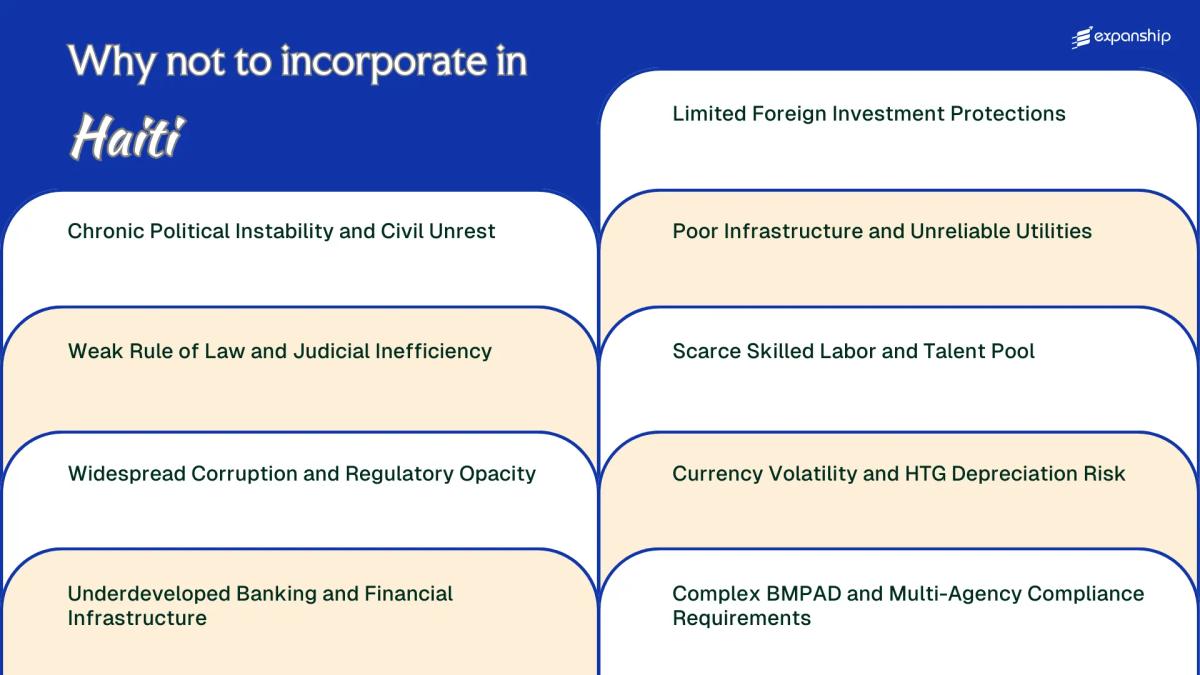
Chronic Political Instability and Civil Unrest
Haiti political instability business risks are among the most severe operational constraints any foreign investor will encounter in the Western Hemisphere. Since 2021, the country has functioned without an elected parliament, and gang-controlled territories now account for large portions of Port-au-Prince, directly severing supply chains and access to commercial districts.
Operational Disruption from Civil Unrest
Armed groups affiliated with the G9 federation and rival coalitions have periodically blockaded fuel depots and port access routes, halting imports and forcing business closures for weeks at a time. Your registered entity may be legally compliant under the Code du Travail and the relevant commercial statutes, yet still be unable to operate because physical access to premises cannot be guaranteed.
Structural Political Void and Its Effect on Regulatory Continuity
Ministerial positions, including those overseeing the Ministère du Commerce et de l'Industrie, have cycled through interim appointees with no legislative oversight. Regulatory decisions affecting your business can be reversed, delayed, or simply ignored without accountability.
Foreign business owners should treat operational continuity in Haiti as fundamentally uninsurable against political disruption, since standard commercial policies typically exclude losses attributable to civil unrest and state failure.
Weak Rule of Law and Judicial Inefficiency
Haiti weak rule of law challenges stem from a judiciary that has long operated without adequate funding, institutional independence, or consistent procedural standards. Courts face severe backlogs, and case resolution timelines frequently extend years beyond what would be commercially acceptable. For a foreign business, that delay is not a procedural inconvenience; it represents an inability to recover assets, enforce agreements, or exit a failed partnership on any predictable schedule.
Contract enforcement is formally governed by the Haitian Civil Code and Commercial Code, but practical enforcement depends heavily on which court hears your case and who presides. Judicial appointments have historically been subject to political influence, undermining impartiality.
This creates direct operational friction in several ways:
- Suppliers and local partners know that breach of contract carries limited consequences, which shifts negotiating leverage away from your firm.
- Obtaining a court order to freeze assets or compel performance can take months with no guaranteed outcome, leaving you exposed to capital loss.
- Foreign arbitration clauses in contracts may not be reliably enforced domestically, forcing you into a local court process anyway.
- Engaging qualified local legal counsel for routine disputes adds recurring costs that comparable markets do not generate.

Company Incorporation in Haiti
Understand the full compliance requirements before registering a business entity in Haiti.
Widespread Corruption and Regulatory Opacity
Haiti corruption risks for businesses are not theoretical. The country ranks among the most corrupt globally, consistently placed near the bottom of Transparency International's Corruption Perceptions Index, scoring 17 out of 100 in recent assessments. For your business, this means that interactions with public officials, licensing bodies, and customs authorities carry a tangible risk of solicitation.
Regulatory opacity compounds this. Multiple agencies, including the Centre de Facilitation des Investissements (CFI) and the Direction Générale des Impôts (DGI), operate with limited published procedures and inconsistent enforcement. Formal requirements exist on paper, but the gap between written rules and actual practice forces foreign-owned entities into informal negotiations that expose them to bribery liability under laws such as the U.S. Foreign Corrupt Practices Act or the UK Bribery Act.
| Indicator | Detail | Burden for Foreign Firms |
|---|---|---|
| TI Corruption Perceptions Index Score | 17/100 (2023) | One of the lowest scores in the Western Hemisphere |
| Regulatory process transparency | No centralized, publicly accessible procedure registry | Procedural requirements must be sourced informally |
| FCPA/UK Bribery Act exposure | Applies to foreign firms regardless of local norms | Legal liability attaches even if payment is "customary" |
| Business licensing delays | No statutory processing deadline enforced in practice | Unpredictable timelines increase operational costs |
Unofficial payments during company formation do not insulate your firm from home-country anti-corruption statutes. Compliance obligations follow your entity's nationality, not its location of incorporation.
Underdeveloped Banking and Financial Infrastructure
Haiti banking infrastructure limitations create immediate, concrete friction for any foreign entity attempting to operate commercially. The country has a small number of licensed commercial banks, with the Banque de la République d'Haïti (BRH) serving as the central bank and primary regulatory authority over the financial sector.
Opening a corporate bank account is slow and documentation-heavy. Foreign-owned entities frequently encounter extended delays, and some commercial banks apply discretionary criteria that are not publicly codified, leaving your firm without a clear legal basis to challenge a rejected application.
Correspondent banking relationships between Haitian banks and international financial institutions are limited. This restricts your ability to receive or send cross-border payments efficiently, which directly increases transaction costs and settlement times for any business with foreign suppliers or clients.
Formal credit facilities for businesses are scarce and expensive. Access to trade finance, letters of credit, or standard commercial lending is not reliably available through the local banking system, forcing foreign firms to rely entirely on external capital sources.
- Corporate account opening requires BRH-regulated bank compliance, with no guaranteed processing timeline.
- Cross-border wire transfers may be subject to delays and additional correspondent bank fees.
- Credit and trade finance products are not consistently available from local commercial banks.
- Foreign currency accounts are subject to BRH foreign exchange regulations, which restrict how USD holdings can be managed.
Haiti has one of the lowest formal banking penetration rates in the Western Hemisphere, with a large share of commercial transactions still conducted outside the regulated financial system, a structural reality that persists even in the formal corporate sector and is documented by the BRH.
Limited Foreign Investment Protections
Haiti foreign investment protection risks are among the most underexamined deterrents for foreign firms considering incorporation there. The legal framework governing foreign capital remains fragmented, offering limited recourse when disputes arise or assets are threatened.
Absence of a Bilateral Investment Treaty Network
Haiti has ratified very few bilateral investment treaties (BITs), leaving foreign investors without the treaty-based protections — such as fair and equitable treatment clauses or international arbitration access — that are standard in more treaty-active jurisdictions. Your firm cannot rely on BIT mechanisms to challenge expropriation or discriminatory treatment before neutral international tribunals.
Haiti FDI restrictions and limitations under domestic law are governed primarily by the Investment Code, but enforcement of its protections is inconsistent and subject to bureaucratic discretion.
Practical Consequences for Foreign Capital
Without enforceable treaty protections, your only avenue for dispute resolution is the domestic court system, which carries the same inefficiencies and susceptibility to external influence documented elsewhere in Haiti's legal environment. A lack of investor protections in Haiti means that asset seizure, contract nullification, or regulatory reversals carry no reliable legal remedy under international law.
Assessing Investment Protection Gaps Before Entering Haiti
Speak with our corporate advisory team about the structural risks facing foreign businesses in Haiti and how to approach entity formation with realistic legal expectations.
Poor Infrastructure and Unreliable Utilities
Haiti infrastructure problems for businesses extend well beyond inconvenience — unreliable power, degraded roads, and limited connectivity translate directly into higher operating costs and reduced productivity for any registered entity.
- Electricity access through Electricité d'Haïti (EDH) is so inconsistent that most businesses must purchase and fuel private generators, creating a recurring capital expense that foreign firms rarely factor into initial incorporation budgets.
- Frequent generator dependency drives diesel consumption costs that can consume a disproportionate share of operational budgets, particularly for manufacturing or data-dependent firms.
- Port-au-Prince's road network, damaged by the 2010 earthquake and inadequately rebuilt, slows supply chain movement and increases logistics costs for any firm relying on physical distribution.
- Internet connectivity remains among the least developed in the Caribbean, restricting your firm's ability to maintain real-time communication with overseas clients or headquarters.
- Water supply unreliability forces businesses to source private alternatives, adding a utility overhead that compounds the already elevated cost of running compliant Haiti company operations.
Scarce Skilled Labor and Talent Pool
Haiti skilled labor shortage challenges rank among the most immediate operational constraints for foreign firms establishing a local presence. The country's tertiary enrollment rate remains critically low, and years of brain drain have concentrated much of the trained professional class abroad, particularly in Canada, the United States, and France.
Finding locally qualified staff in fields such as accounting, engineering, IT, and legal compliance is genuinely difficult. Your business may be forced to rely on expatriate hires, which triggers work permit requirements under the Direction de l'Immigration et de l'Émigration and adds recurring administrative and compensation costs.
The public education system produces insufficient graduates with technical or managerial credentials to meet private sector demand. Workforce constraints incorporating in Haiti are therefore structural, not cyclical.
- Accounting and financial reporting professionals familiar with SYSCOHADA standards are scarce
- Bilingual (French/English) operational staff are concentrated in Port-au-Prince, limiting regional expansion
- High turnover results from competing offers and emigration pressure
A foreign firm hiring two expatriate managers in Port-au-Prince at international compensation rates could realistically incur an annual payroll premium exceeding $80,000 USD above comparable local talent costs in a peer Caribbean jurisdiction, before factoring in relocation, housing allowances, or permit fees.
Currency Volatility and HTG Depreciation Risk
Haiti HTG currency depreciation risks are among the most direct financial exposures a foreign business owner faces when operating through a locally incorporated entity. The Haitian gourde has lost substantial value against the US dollar over successive years, driven by low foreign exchange reserves, remittance dependency, and chronic monetary instability managed by the Banque de la République d'Haïti (BRH).
Foreign-currency revenues converted into HTG erode in real terms as depreciation accelerates. Your reported profits, when repatriated or benchmarked against USD-denominated costs, may reflect a net loss even when local sales figures appear stable.
Pricing contracts in HTG exposes your firm to mid-contract devaluation with no automatic adjustment mechanism. Dollarized contracts are more common in practice, but they create separate compliance considerations under BRH foreign exchange regulations.
Operational costs tied to imports, which most businesses in this market depend on, are effectively priced in USD. When gourde volatility widens the gap between local revenue and import costs, margins compress in ways that are difficult to hedge through local financial instruments.
Any business generating HTG revenues while carrying USD-denominated liabilities or import costs faces structural margin compression that no local hedging mechanism currently addresses under BRH's available instruments.
Complex BMPAD and Multi-Agency Compliance Requirements
Haiti BMPAD compliance challenges arise because the Bureau de Monétisation des Programmes d'Aide au Développement sits within a broader web of overlapping regulatory authorities that your business must satisfy simultaneously.
Registering a company requires engaging multiple agencies: the Centre de Facilitation des Investissements (CFI), the Direction Générale des Impôts (DGI), and the Ministère du Commerce et de l'Industrie, among others. Each body operates independently, with little coordination between them.
- Separate filings, fees, and timelines apply per agency
- Delays at one institution do not pause deadlines at another
- Documentation requirements frequently differ across offices
This fragmentation means your firm absorbs compounded administrative costs rather than a single consolidated compliance burden. For a foreign entity unfamiliar with local procedural norms, engaging local legal representation becomes a practical necessity, adding recurring overhead that incorporators in more consolidated regulatory environments do not face.
Overcoming Haiti's Business Environment Challenges
Overcoming Haiti business environment challenges requires structural preparation before incorporation, not reactive adjustments after problems surface. The disadvantages covered in this blog are systemic, and addressing them demands deliberate legal and operational choices from the outset.
- Register your entity through the Centre de Facilitation des Investissements (CFI) to access the official single-window process and reduce multi-agency bottlenecks.
- Establish a formal anti-corruption compliance policy aligned with Haiti's 2014 Anti-Corruption Law prior to commencing operations.
- Open corporate accounts with internationally affiliated banks operating in Haiti to reduce exposure to HTG depreciation and local banking instability.
- Secure independent power infrastructure, such as generator systems, at the business setup stage to offset utility unreliability.
- Register all foreign investment agreements with the Ministry of Commerce to establish a paper trail under applicable investment protection frameworks.
Mitigating Haiti incorporation risks does not eliminate underlying structural deficiencies in the judicial system, regulatory bodies, or financial infrastructure. These steps reduce exposure at the margins; they do not substitute for sustained legal monitoring under Haitian commercial law.
Haiti Still a Viable Business Destination
Haiti remains a credible incorporation destination for the right business profile, even after accounting for the disadvantages covered in this blog. The barriers are real and measurable, but they do not uniformly disqualify the country as a viable destination despite business risks.
| Pros | Cons |
|---|---|
| Preferential trade access under HOPE/HELP Acts provides duty-free entry to U.S. markets for qualifying manufacturers. | Chronic political instability and recurring civil unrest create unpredictable operating conditions. |
| Low labor costs relative to other Caribbean and Central American markets can reduce production expenses. | The HTG has experienced sustained depreciation, exposing foreign-held assets to currency loss over time. |
| Haiti's investment code offers tax incentives and exemptions across designated sectors. | Judicial inefficiency and weak rule of law limit practical enforceability of contracts. |
| Geographic proximity to North American markets supports export-oriented business models. | Multi-agency compliance requirements through BMPAD and other regulators add administrative burden. |
| A young, growing population represents a long-term consumer and labor base. | Underdeveloped banking infrastructure restricts access to financing and cross-border transactions. |
Corruption and regulatory opacity remain structural issues, not temporary conditions.
Corporate Compliance Services in Haiti
Stay current with Haiti's multi-agency regulatory requirements, including obligations under BMPAD and other applicable authorities.
Conclusion
Haiti's overall position as a corporate destination is defined by the structural disadvantages this blog has examined. The Haiti incorporation drawbacks summary is direct: judicial dysfunction under a court system that lacks enforcement capacity, HTG currency depreciation that erodes foreign capital, and multi-agency compliance demands through bodies like BMPAD and the Centre de Facilitation des Investissements create a high-friction operating environment. These factors compound one another. Structural support for foreign-registered entities remains thin. Understanding where those gaps fall most sharply is the starting point for any formation strategy.
Expanship's Haiti Business Formation Support
Expanship's Haiti business formation support is designed to reduce the operational weight that comes with incorporating in one of the Western Hemisphere's most demanding regulatory environments. From coordinating filings across BMPAD, the Centre de Facilitation des Investissements, and the Direction Générale des Impôts, to managing the documentation burdens tied to multi-agency compliance, Expanship works alongside your business to keep the process structured and progressing.
Our service scope covers the core requirements of establishing and maintaining a legal presence in Haiti:
- We prepare and register your company documentation in accordance with Haitian corporate law requirements.
- Registered agent and office services are provided to maintain your entity's legal standing in-country.
- Our team liaises directly with government bodies and regulatory agencies on your behalf.
- Post-incorporation compliance obligations are tracked and managed on an ongoing basis.
- We facilitate introductions to local banking institutions to support your account opening process.
- Tax registration and coordination with the DGI and relevant local authorities are handled as part of your setup.
To discuss your incorporation requirements, contact Expanship Haiti.
Frequently Asked Questions (FAQ)
Judicial inefficiency in Haiti affects entities of every size. Contract enforcement is unreliable across the board, and the civil court system suffers from chronic underfunding, procedural delays, and susceptibility to external pressure. A small trading company faces the same exposure as a large manufacturing firm when attempting to recover a debt or enforce a commercial agreement through Haitian courts.
The Haitian gourde (HTG) has lost substantial value against the US dollar over consecutive years, which directly erodes the local-currency revenues of any business selling into the domestic market. Repatriating profits becomes more costly as the exchange rate deteriorates, and dollar-denominated import expenses rise sharply against gourde-based income. Businesses without natural hedging mechanisms or USD-invoiced contracts absorb these losses directly on the bottom line.
The Bureau de Monétisation des Programmes d'Aide au Développement (BMPAD) sits within a multi-agency regulatory environment where overlapping mandates, inconsistent enforcement, and unclear procedural requirements create significant compliance exposure. Foreign firms operating in sectors touching BMPAD oversight may find that approval timelines are unpredictable and that requirements shift without formal notice. Non-compliance, even unintentional, can result in operational delays that have no clear administrative remedy.
Haiti presents a materially higher risk profile than most comparable Caribbean jurisdictions. Countries such as Jamaica or the Dominican Republic, which face their own governance challenges, maintain functioning legislatures, more stable currencies, and judicial systems with greater institutional continuity. Haiti's combination of gang-controlled infrastructure corridors, near-absent state services in some regions, and banking sector fragility places it in a distinct risk category even within the broader developing-market context.
Partially, but not entirely. While routing international transactions through offshore accounts reduces direct exposure to the fragility of Haitian commercial banks, any business with local employees, suppliers, or tax obligations must still interact with the domestic financial system. The Banque de la République d'Haïti (BRH) governs foreign exchange transactions, and compliance with local payroll, tax remittances, and vendor payments requires operating within a banking infrastructure that has limited correspondent banking relationships and inconsistent service reliability.
Haiti does not have a single consolidated business regulator, so compliance failures can trigger penalties across multiple bodies simultaneously, including the Direction Générale des Impôts (DGI) for tax matters and the relevant sectoral ministry for industry-specific licenses. Penalties can include fines, suspension of operating permits, and in some cases criminal liability for directors under Haitian commercial law. The absence of a clear appeals process means that resolving such issues often requires engaging local legal counsel and accepting extended timelines with uncertain outcomes.
Haiti lacks a bilateral investment treaty (BIT) network comparable to other jurisdictions in the region, leaving foreign investors without the treaty-based arbitration protections that would otherwise allow disputes with the state to be escalated to international forums such as ICSID. If your business is expropriated or subjected to discriminatory regulatory action, your recourse is largely limited to domestic courts, which, as noted throughout this blog, operate with significant inefficiency and limited independence. Exiting the market under distress conditions also involves liquidation procedures that can take years to complete within the Haitian legal framework.
Legal Disclaimer
The information provided in this article is for general informational purposes only and does not constitute legal, tax, or professional advice. While we strive to ensure the accuracy and timeliness of the content, laws and regulations are subject to change, and the application of laws can vary widely based on specific facts and circumstances.
Readers should not act upon this information without seeking professional counsel tailored to their individual situation. Expanship and its authors disclaim any liability for actions taken or not taken based on the content of this article.
For specific advice regarding your business setup, compliance requirements, or any legal matters, please consult with qualified legal and tax professionals in the relevant jurisdiction.