

Key Takeaways
- Companies incorporating in Guinea-Bissau must comply with the OHADA Uniform Act on Commercial Companies and Economic Interest Groups, which governs entity formation, governance structure, and shareholder obligations across all covered entity types.
- Foreign investors are required to establish a physical registered office in Guinea-Bissau, with registration administered through the Centre de Formalités des Entreprises (CFE) under the Ministry of Commerce.
- Share capital thresholds differ by entity type under Guinea-Bissau's commercial framework, meaning the chosen legal structure directly determines the minimum capital that must be subscribed at formation.
- Beneficial ownership disclosure obligations carry particular compliance weight for foreign-owned entities, requiring identification of ultimate beneficial owners as part of the registration and ongoing reporting process before the Tribunal Regional de Bissau.
Company incorporation requirements in Guinea-Bissau are governed by the country's commercial legislation, with entity registration administered through the Centre de Formalités des Entreprises (CFE) under the Ministry of Commerce. The applicable legal framework draws from the OHADA Uniform Act on Commercial Companies and Economic Interest Groups, which Guinea-Bissau adopted as a member state of the Organisation for the Harmonisation of Business Law in Africa. You can refer to the OHADA Uniform Act for the primary legislative text.
This article covers the structural and documentary requirements that apply to company registration requirements in Guinea-Bissau across entity formation, governance, and compliance categories.
Failure to satisfy these requirements results in rejection of the registration application or prevents the business from operating with legal standing.
Requirements may differ depending on the chosen entity type, the industry sector, and whether the investor holds foreign or domestic status. Confirming the applicable rules for your specific structure before initiating the process is advisable.
This article is most relevant to foreign entrepreneurs, offshore investors, and corporate groups evaluating Guinea-Bissau business incorporation rules for market entry or subsidiary establishment.
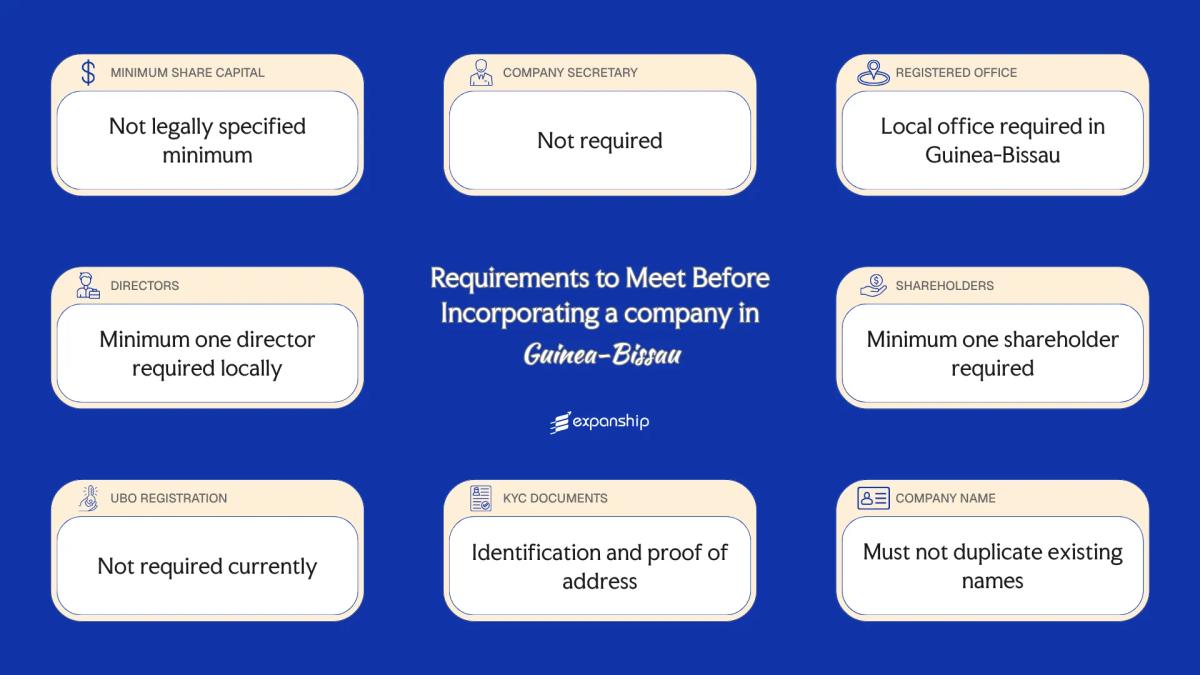
Minimum Share Capital Requirements in Guinea-Bissau
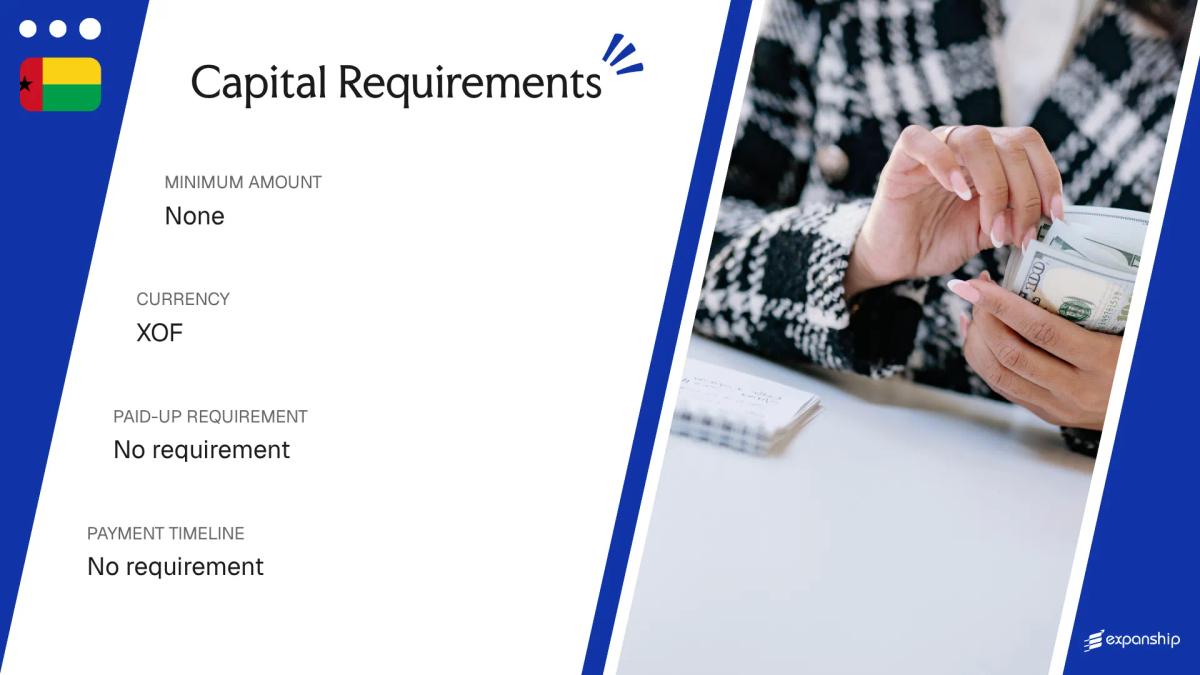
Guinea-Bissau share capital requirements are governed primarily by the country's commercial code, which draws from the OHADA Uniform Act on Commercial Companies, given the nation's historical alignment with OHADA-influenced frameworks through its membership in ECOWAS. Share capital in Guinea-Bissau operates on a par value system, meaning each share carries a nominal value stated in the company's constitutive documents.
The Conservatória do Registo Comercial, the commercial registry authority, oversees the verification of capital declarations at the point of incorporation. Capital requirements function as a one-time structural obligation at formation rather than a recurring statutory duty, though the authorized capital structure must remain reflected in registered documents.
| Parameter | Detail |
|---|---|
| Minimum Authorized Share Capital | No statutory minimum for SARL; SA requires a minimum as prescribed under applicable commercial law |
| Maximum Authorized Share Capital | No statutory maximum |
| Minimum Paid-Up Capital | No statutory minimum for SARL; partial paid-up thresholds apply for SA formations |
| Paid-Up Requirement at Incorporation | A portion of subscribed capital must be paid up at the time of incorporation for SA entities |
| Accepted Currency | West African CFA franc (XOF) |
| Accepted Forms of Contribution | Cash contributions and in-kind contributions; in-kind assets subject to valuation |
| Timeframe to Deposit Capital | At or before registration with the Conservatória do Registo Comercial |
Even where no minimum capital threshold applies, your company's constitutive documents must declare an authorized capital figure. Omitting this renders the registration filing incomplete.
Company Secretary Requirements in Guinea-Bissau
Under Guinea-Bissau company secretary requirements, the country's commercial framework does not formally mandate a company secretary as a distinct corporate officer in the same way common law jurisdictions do. Instead, the obligation centers on appointing a registered agent or legal representative who acts as the company's official point of contact with public authorities, including the Conservatória do Registo Comercial.
This representative handles statutory correspondence, ensures the entity remains in good standing with the registry, and supports document filing obligations under the OHADA Uniform Act on Commercial Companies, which Guinea-Bissau applies as a member state.
Qualification criteria for who may serve in this capacity:
- The representative must be a natural person or a legally recognized entity.
- No specific professional licensing is formally prescribed under the general OHADA framework.
- Residency within Guinea-Bissau is generally expected for practical and regulatory correspondence purposes.
- A corporate entity may serve, provided it is itself registered and in good standing locally.
- Foreign nationals may serve subject to compliance with local civil and commercial registration rules.

Incorporate Your Company in Guinea-Bissau
Set up your business entity in Guinea-Bissau with structured guidance through the Conservatória do Registo Comercial and OHADA compliance requirements.
Registered Office Requirements in Guinea-Bissau
Guinea-Bissau registered office requirements mandate that every registered company maintain a physical address within the country's territory, serving as the official domicile for legal correspondence and regulatory notices. Failure to maintain a compliant registered address can result in administrative sanctions under the country's commercial law framework, including potential deregistration by the relevant authorities.
- A physical address located within Guinea-Bissau is required; a P.O. box alone does not satisfy this requirement.
- Virtual offices are not formally recognised as a compliant registered office address under general commercial law principles.
- The address must be situated within Guinea-Bissau's national territory; a foreign address cannot serve as the legal domicile.
- Supporting documentation, such as a title deed or a lease agreement, is generally required to verify occupancy of the stated premises.
- The registered address is recorded in the Conservatória do Registo Comercial (Commercial Registry) and is publicly accessible.
- Any change to the registered address must be formally notified to the Commercial Registry, with updated documentation filed to reflect the new domicile.
Director Requirements in Guinea-Bissau
Upon appointment, directors of a Guinea-Bissau company assume fiduciary duties under the OHADA Uniform Act on Commercial Companies, including obligations of loyalty, prudence, and acting within the scope of authority granted by the statutes. Personal liability may attach for acts performed outside that authority or in breach of applicable law.
| Parameter | Detail |
|---|---|
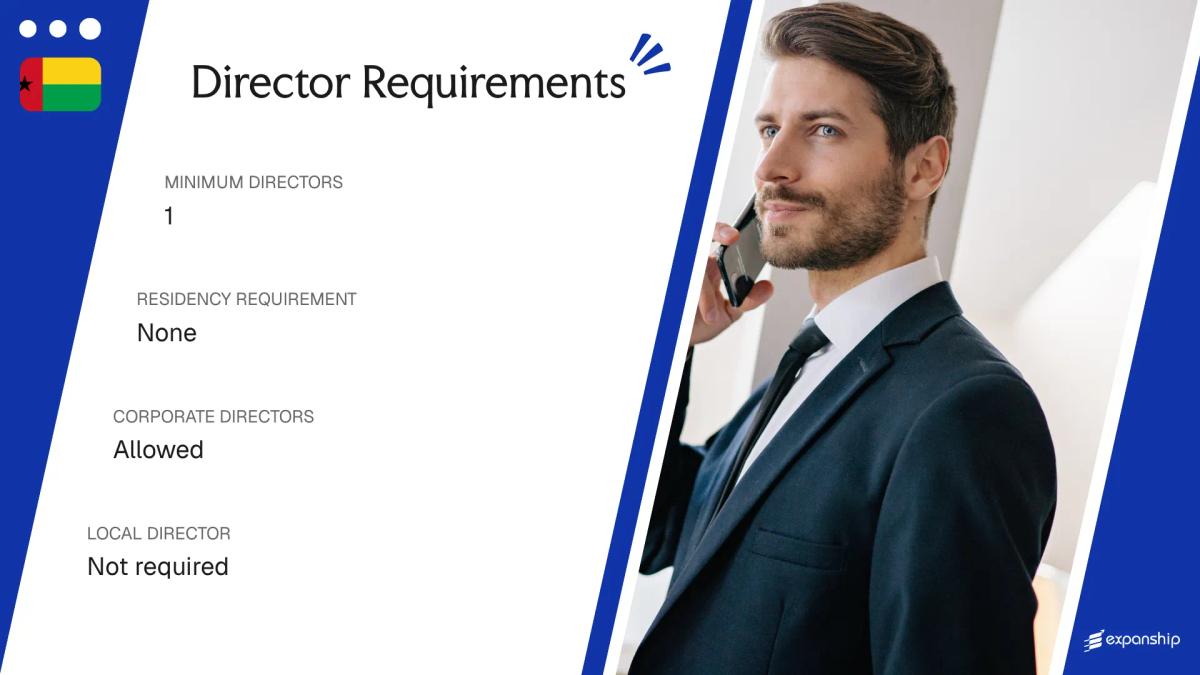
| Minimum Number of Directors | One director is required as a minimum. |
| Maximum Number of Directors | No statutory maximum is prescribed under applicable OHADA rules. |
| Local/Resident Director Required | No residency or local director requirement exists under current rules. |
| Nationality Restrictions | No nationality restrictions are imposed on directors. |
| Minimum Age Requirement | Directors must be at least 18 years of age. |
| Corporate Directors Permitted | Corporate directors are permitted under OHADA frameworks, subject to the statutes of the entity. |
| Director Must Be a Shareholder | Directors are not required to hold shares in the company. |
| Publicly Listed on Registry | Director information is recorded with the Registre du Commerce et du Crédit Mobilier (RCCM). |
| Disqualification Conditions | Persons subject to a judicial ban, prior conviction for financial crimes, or declared bankrupt may be disqualified from serving. |
Despite Guinea-Bissau's OHADA membership, the gérant of a single-member SARL can simultaneously hold the role of sole shareholder with no requirement for an independent director or supervisory body of any kind.
Shareholder Requirements in Guinea-Bissau
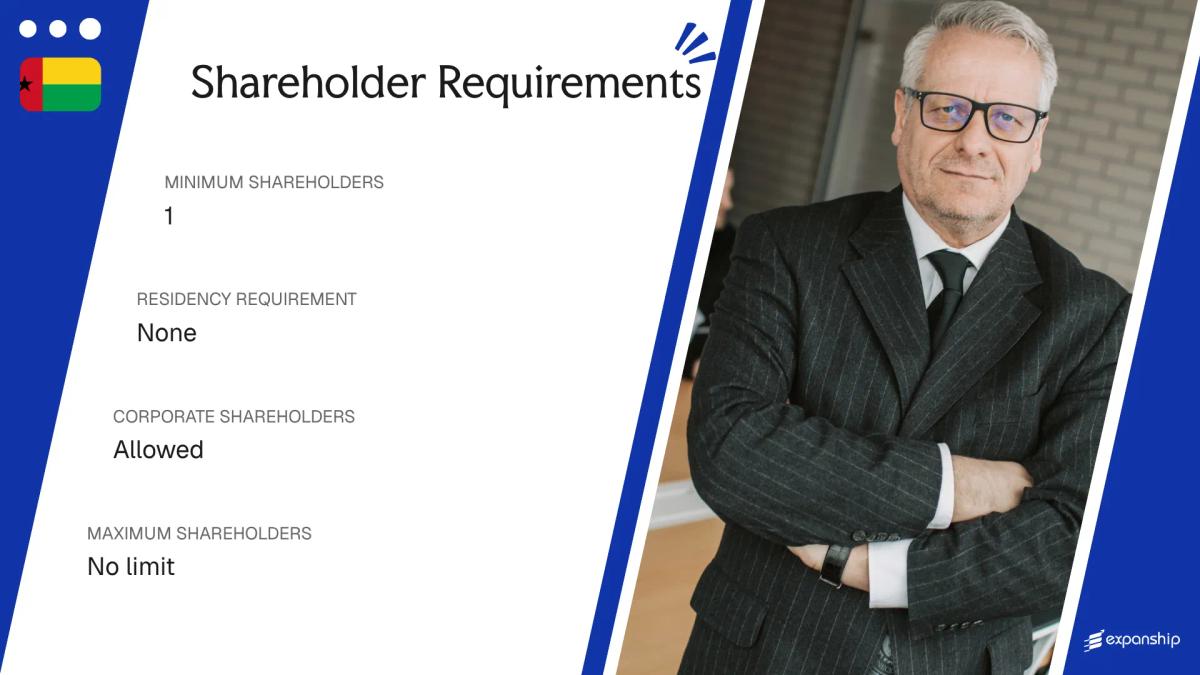
Under Guinea-Bissau's OHADA-aligned commercial framework, a Société à Responsabilité Limitée (SARL) requires a minimum of one associé, permitting a sole shareholder structure. No statutory maximum applies to the number of associés in a SARL, though practical thresholds may influence the choice of entity type.
Nationality and Residency Restrictions
Guinea-Bissau shareholder requirements impose no mandatory nationality or residency conditions on associés. Foreign nationals may hold shares without restriction, and no minimum local ownership percentage is required by general commercial law.
Corporate Shareholders
Legal entities may act as associés in a SARL. No additional conditions specific to corporate shareholders are imposed beyond standard incorporation documentation.
Shareholder Liability
Liability is limited to each associé's capital contribution. Extended personal liability does not arise under ordinary circumstances, though piercing of the corporate veil may apply in cases of fraud or abuse of the legal structure.
Register of Shareholders
A register of associés must be maintained at the company's registered office. Under OHADA Uniform Act rules, this record is not publicly accessible but must reflect any transfer of shares or change in ownership without undue delay.
Setting Up Your Ownership Structure in Guinea-Bissau
Get tailored guidance on associé requirements, share allocation, and compliance obligations before you incorporate your entity.
UBO / Beneficial Ownership Disclosure Requirements in Guinea-Bissau
Guinea-Bissau beneficial ownership requirements are not currently enforced through a dedicated statutory framework. No specific legislation establishing a formal UBO register or mandatory beneficial ownership disclosure process for companies incorporated in the jurisdiction has been identified.
KYC / Document Requirements in Guinea-Bissau
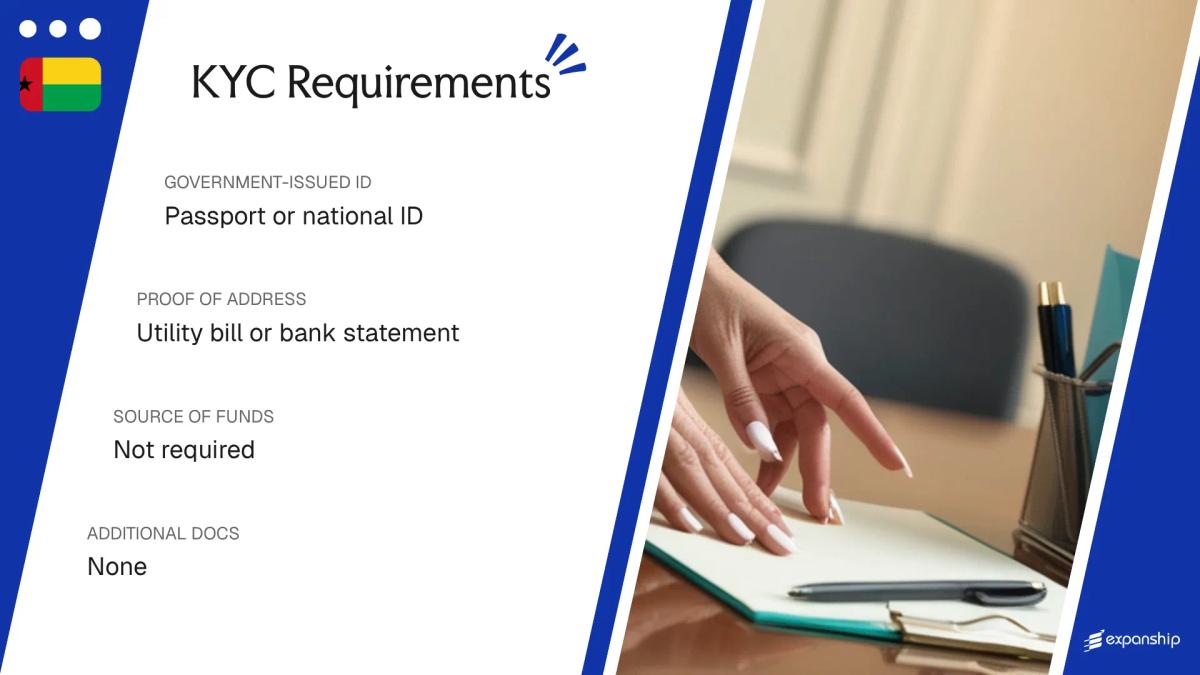
Guinea-Bissau KYC document requirements apply at the point of incorporation under the country's anti-money laundering framework, principally governed by Lei n.º 10/97 on combating money laundering, with oversight coordinated through the CENTIF, the national financial intelligence unit.
Individual / Personal Documents
- Valid government-issued photo identification (passport or national identity card) for each individual director, shareholder, or beneficial owner
- Proof of residential address issued within the past three months, such as a utility bill or bank statement
- Recent passport-sized photographs may be required by the registrar
- Signed declaration of the individual's role and capacity within the entity
Corporate Documents
- Certificate of incorporation of the corporate shareholder or director entity
- Constitutional documents, including articles of association or equivalent instrument
- Current register of directors from the corporate entity's home jurisdiction
- Proof of registered office address of the corporate entity
Source of Funds Documentation
- Bank statements covering a minimum of three months demonstrating the origin of capital
- Audited financial accounts of the corporate entity or individual where applicable
- Written declaration explaining the source of funds introduced into the company
Notarisation and Apostille Requirements
- Foreign-issued documents generally require notarisation by a qualified notary
- Documents originating outside ECOWAS member states typically require an apostille under the Hague Convention
- Official French translation is required for documents not already in French or Portuguese
Incomplete or un-apostilled foreign corporate documents are the most frequently cited reason for registration delays at the Conservatória do Registo Comercial.
Company Name Requirements in Guinea-Bissau
Guinea-Bissau company name requirements are assessed during the incorporation process, with proposed names reviewed for conflicts against existing registrations in the commercial registry. Approval is contingent on the name being distinguishable from those already on record.
Names must be rendered in Portuguese, the official administrative language. A legal suffix indicating the entity type is mandatory; for example, a private limited company uses "Limitada" or its abbreviation "Lda."
Certain words are restricted from use without prior authorisation from the relevant supervising authority. Terms implying state affiliation, financial regulation, or professional licensing fall into this category and generally require supporting documentation before the registry will accept them.
Name reservation is available prior to formal incorporation. Once granted, the reservation holds the chosen name for a defined period, though the standard duration follows general commercial registry practice in the jurisdiction.
Compliance Services for Companies in Guinea-Bissau
Expanship supports businesses with ongoing compliance obligations in Guinea-Bissau, including name reservation, registry filings, and regulatory correspondence.
Conclusion
Guinea-Bissau company incorporation compliance draws on a framework shaped by OHADA commercial law, national registration procedures, and oversight from bodies such as the Tribunal Regional de Bissau. Among the requirements covered, beneficial ownership disclosure and the physical registered office obligation carry particular practical weight for foreign investors structuring their entry. Share capital thresholds also vary by entity type, directly affecting how a business is initially structured.
Once these formation requirements are understood, the practical work of executing registration, satisfying KYC obligations, and maintaining ongoing compliance with local authorities begins.
Expanship Services for Your Guinea-Bissau Expansion
Handling Guinea-Bissau company formation services involves working within a civil law system that draws on Portuguese legal tradition, a BCEAO-regulated banking environment, and OHADA-influenced commercial frameworks. Expanship helps you manage the documentation sequencing, notarial requirements, and regulatory filings that this jurisdiction demands, reducing the coordination burden on your team without removing the inherent procedural steps.
Beyond registration, Expanship supports your business across the full setup and maintenance cycle:
- Your entity is registered with all required documents prepared to OHADA and local standards.
- A registered agent and physical office address are provided to satisfy Guinea-Bissau's presence requirements.
- Government filings are submitted and regulatory body liaison is handled on your behalf.
- Post-incorporation compliance obligations, including annual filings, are monitored and managed.
- Banking introductions are facilitated to connect your business with suitable local institutions.
- Tax registration and liaison with the Direcção Geral das Contribuições e Impostos are coordinated for you.
Reach out to Expanship Guinea-Bissau to discuss your incorporation requirements.
Frequently Asked Questions (FAQ)
Foreign nationals are permitted to hold director positions in Guinea-Bissau companies, including as the sole director. There is no statutory nationality or residency requirement that restricts directorship to Guinea-Bissau citizens, though any foreign director will need to provide notarised and apostilled identification documents as part of the registration process. Practically, having at least one locally based contact can help manage interactions with the Conservatória do Registo Comercial.
A Guinea-Bissau company must maintain a physical registered office address within the country at all times, and any change must be formally notified to and recorded by the Conservatória do Registo Comercial. Failure to update the registered address can result in official correspondence going undelivered, which may lead to missed regulatory obligations or compliance failures. The update process requires filing amended registration documents with the competent authority.
UBO disclosure obligations in Guinea-Bissau apply across company structures as part of the country's anti-money laundering framework aligned with WAEMU (West African Economic and Monetary Union) directives. Any individual holding a qualifying ownership or control threshold must be identified and recorded, regardless of whether the entity is an SARL or SA. There is no carve-out for smaller or domestically owned firms.
A non-resident shareholder must provide a certified copy of a valid government-issued passport, proof of residential address, and a bank reference or equivalent source of funds documentation. All foreign documents must be notarised and, where required, apostilled before submission to the Conservatória do Registo Comercial. If documents are not in Portuguese, certified translations are mandatory, as Portuguese is Guinea-Bissau's official administrative language.
Guinea-Bissau's company name rules require that names do not conflict with existing registered entities and conform to the conventions set out under the Commercial Code. While there is no absolute prohibition on foreign-language words, the name must be registrable with the Conservatória do Registo Comercial and must include the appropriate legal suffix identifying the company type, such as "Lda." for an SARL or "S.A." for a Sociedade Anónima. Names that are misleading, identical to existing registrations, or contrary to public order will be refused.
A single person can hold both roles in an SARL, making it possible to form and control the entity without involving additional parties at the ownership or management level. This structure is recognised under Guinea-Bissau's Commercial Code for limited liability companies. That individual must still meet all KYC and UBO disclosure requirements, and their dual role must be accurately reflected in the company's constitutional documents filed at incorporation.
Legal Disclaimer
The information provided in this article is for general informational purposes only and does not constitute legal, tax, or professional advice. While we strive to ensure the accuracy and timeliness of the content, laws and regulations are subject to change, and the application of laws can vary widely based on specific facts and circumstances.
Readers should not act upon this information without seeking professional counsel tailored to their individual situation. Expanship and its authors disclaim any liability for actions taken or not taken based on the content of this article.
For specific advice regarding your business setup, compliance requirements, or any legal matters, please consult with qualified legal and tax professionals in the relevant jurisdiction.