
Key Takeaways
- Guinea-Bissau's Code of Commerce provides the foundational legal basis for company formation, but the broader commercial legal framework remains insufficiently developed to support complex corporate structures or reliably protect investor rights.
- Persistent political instability and weak institutional governance create an unpredictable operating environment that materially increases the compliance and reputational risk burden for foreign-incorporated entities.
- Foreign investors face sector-specific ownership restrictions that limit the structural options available for market entry, joint ventures, and subsidiary formation in key industries.
- The combination of an underdeveloped banking infrastructure, shallow local capital markets, and a high-volume informal economy significantly constrains the financing options and transactional efficiency available to formally registered businesses.
Guinea-Bissau operates under an evolving and largely underdeveloped regulatory framework, placing it among the more challenging jurisdictions for formal business registration in West Africa. The disadvantages of incorporating in Guinea-Bissau span legal, financial, institutional, and operational domains, all of which are examined across this article.
The severity of these drawbacks is not uniform. Your exposure to specific risks will depend on the sector you enter, the legal structure you adopt, and the scale of operations you intend to run.
The primary commercial legislation governing business formation is the Code of Commerce, which outlines the legal basis for entity registration and corporate conduct. Foreign investors considering market entry, joint ventures, or subsidiary formation are the audience most likely to encounter the Guinea-Bissau company formation drawbacks documented here.
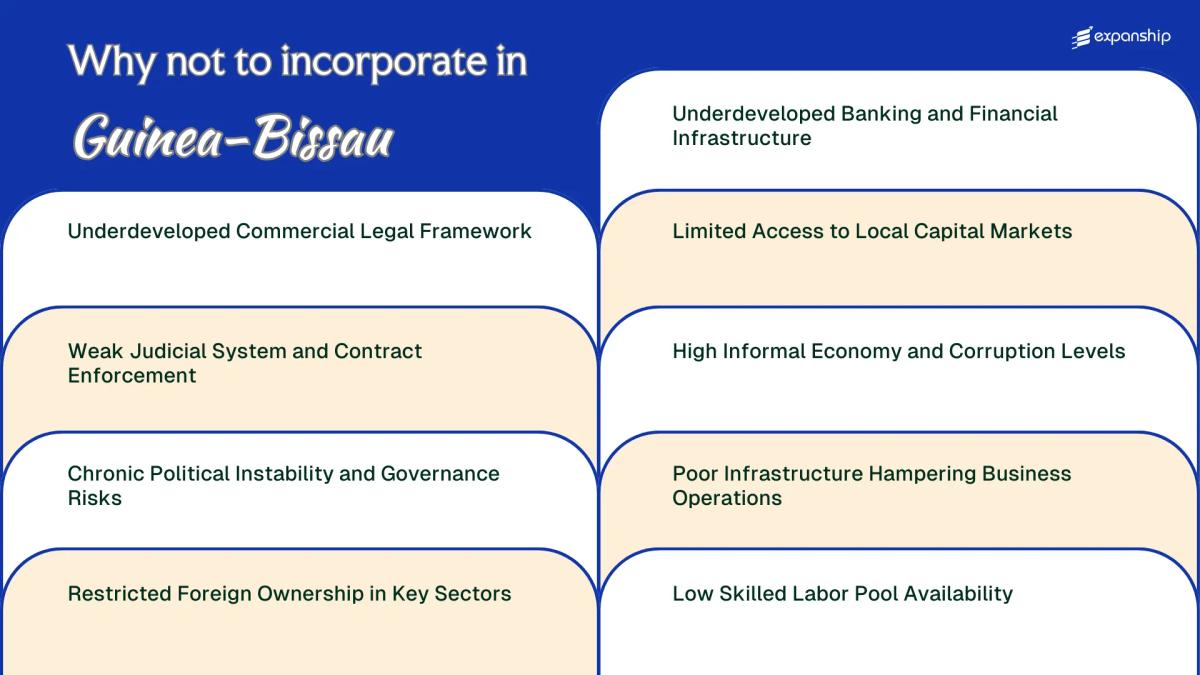
Underdeveloped Commercial Legal Framework
Guinea-Bissau commercial law limitations stem largely from a legal infrastructure that has remained largely unchanged since the post-independence codification period, leaving significant gaps in modern corporate governance standards.
Outdated and Incomplete Commercial Code
The country's commercial framework derives from Portuguese-era civil law traditions, with the Commercial Code failing to address contemporary needs such as electronic contracting, intellectual property enforcement, or foreign investor dispute mechanisms. Your business operates without the statutory protections that most OHADA member states now offer, as Guinea-Bissau has not ratified the OHADA treaty that standardizes commercial law across much of West and Central Africa.
Regulatory oversight of company formation falls nominally under the Ministry of Commerce, but the absence of a functioning, independent corporate registry creates registration ambiguities that can affect a firm's legal standing.
Absence of Modern Corporate Governance Standards
Shareholder rights, director liability, and minority investor protections are inadequately defined under the existing weak business legal framework. This means contractual arrangements that would be enforceable by statute elsewhere must instead rely on private agreement, increasing your legal exposure considerably.
Foreign business owners have no reliable statutory recourse for shareholder disputes or corporate governance breaches under current Guinea-Bissau corporate regulation, making equity-based structures particularly high-risk.
Weak Judicial System and Contract Enforcement
Guinea-Bissau contract enforcement challenges are structural, not incidental. The country's judiciary operates under severe resource constraints, with a limited number of trained commercial judges and no dedicated commercial court system to handle business disputes efficiently.
Enforcement of civil judgments is slow and unpredictable. Even when a court rules in your favor, the mechanisms to actually collect on that judgment are unreliable, meaning the legal victory may carry little practical value.
The country ranks poorly on the World Bank's Rule of Law index, reflecting systemic deficiencies that directly affect how contracts are interpreted and upheld. For foreign firms, this means standard contractual protections that would hold in most jurisdictions carry substantially less weight here.
Practical burdens this creates for your business:
- Recovering unpaid invoices through local courts can take years, effectively making trade credit a high-risk instrument
- Foreign arbitral awards are difficult to enforce domestically without a clear, consistently applied recognition framework
- Legal counsel with commercial expertise is scarce, increasing both cost and preparation time for dispute proceedings
- Contract disputes resolved locally rarely produce predictable outcomes, forcing firms to price uncertainty into every deal
Guinea-Bissau is a member of OHADA, the regional legal harmonization organization, which provides a supranational commercial law framework. However, local implementation and judicial familiarity with OHADA instruments remain inconsistent, limiting the practical benefit of that membership.

Company Incorporation in Guinea-Bissau
Understand the legal and structural requirements for registering a business entity in Guinea-Bissau before committing capital to the market.
Chronic Political Instability and Governance Risks
Guinea-Bissau political instability business risks are not theoretical. Since independence in 1974, the country has experienced more than nine coups or attempted coups, making it one of the most politically volatile states in West Africa. For a foreign investor, this frequency of government disruption translates directly into unpredictable regulatory environments, abrupt policy reversals, and the real possibility that licensing agreements or operational approvals become void when administrations change.
The Supreme Law Authority and the National People's Assembly have both been subject to unconstitutional suspension during past political crises. When legislative institutions are sidelined, the legal basis for business contracts, tax obligations, and corporate registrations becomes uncertain.
| Risk Factor | Practical Burden on Foreign Business |
|---|---|
| Average government lifespan (1974-present) | Under 2 years per administration, disrupting multi-year investment cycles |
| Coup/attempted coup frequency | 9+ incidents since 1974, each risking contract nullification |
| Regulatory continuity post-transition | No formal statutory mechanism guarantees prior approvals survive new governments |
| International credit rating | Unrated by major agencies, blocking access to structured trade finance |
Governance risks incorporating Guinea-Bissau extend to the institutional level. The state's fiscal administration has historically been influenced by military factions, which distorts how commercial regulations are enforced on the ground. Your business may face demands or operational interference that have no statutory basis but carry practical consequences. Formal complaints mechanisms offer limited recourse when the institutions handling them lack independence from political actors.
Restricted Foreign Ownership in Key Sectors
Guinea-Bissau foreign ownership restrictions apply most acutely in sectors tied to natural resources and national strategic interests. The country's investment framework, governed broadly by the Investment Code, reserves certain activities for the state or requires mandatory local participation, and the terms are not always defined with sufficient clarity to allow confident pre-entry planning.
Fisheries represent the clearest example. Access to fishing grounds and related commercial operations is subject to licensing and partnership conditions that favor national entities, meaning your firm cannot simply hold a majority stake and operate freely. Agriculture and land-use rights carry similar constraints, as land ownership by foreign nationals is constitutionally restricted, forcing investors into lease arrangements with uncertain long-term security.
These sectoral limits are not accompanied by transparent implementing regulations, so the practical scope of any restriction often depends on discretionary decisions by ministries rather than published thresholds. You can review the Investment Code framework through Guinea-Bissau's Ministry of Finance for the foundational legal basis, though secondary regulations may not be fully published online.
- Foreign equity caps apply in fisheries, agriculture, and resource-linked industries
- Land ownership by foreign entities is constitutionally prohibited; only leasehold rights are available
- Licensing approvals in restricted sectors run through ministerial discretion, not fixed criteria
- Joint venture requirements with local partners may apply without codified minimum shareholding thresholds
Guinea-Bissau's fisheries sector, one of the most commercially significant in West Africa, remains largely inaccessible to majority foreign-owned firms despite being the country's primary source of export revenue.
Underdeveloped Banking and Financial Infrastructure
Guinea-Bissau banking infrastructure drawbacks affect foreign companies from the moment they attempt to open a corporate account. The financial sector remains thin, with only a handful of commercial banks operating under the oversight of the Banque Centrale des États de l'Afrique de l'Ouest (BCEAO), the regional central bank shared across WAEMU member states.
Structural Gaps in the Banking Sector
Correspondent banking relationships are limited, which means international wire transfers can face delays and elevated transaction costs that erode operational efficiency. Most banks concentrate their physical presence in Bissau, leaving businesses operating in secondary regions with virtually no branch access.
Consequences for Day-to-Day Business Operations
The underdeveloped financial system creates practical friction around routine corporate functions: foreign currency exchange, trade financing, and payroll processing all become slower and less predictable than in peer markets. Digital banking infrastructure is minimal, meaning your firm cannot rely on the online treasury management tools that are standard in more developed financial environments.
Companies with cross-border supply chains are particularly exposed, as delayed settlements can disrupt supplier relationships and create cash flow gaps with no local short-term credit facilities to bridge them.
Managing Financial and Operational Challenges in Guinea-Bissau
Our team can help your business assess the structural limitations of Guinea-Bissau's financial environment and identify practical pathways for managing banking constraints during incorporation and ongoing operations.
Limited Access to Local Capital Markets
Guinea-Bissau capital market limitations are structural, not temporary. No domestic stock exchange exists, and the country's participation in the West African Economic and Monetary Union (WAEMU) regional exchange, the Bourse Régionale des Valeurs Mobilières (BRVM) based in Abidjan, remains inaccessible in practical terms for most locally incorporated entities given the compliance thresholds involved.
- Restricted business financing in Guinea-Bissau means your firm cannot raise equity capital through a local public offering, forcing reliance on retained earnings or external debt.
- The absence of a functioning domestic bond market means corporate debt instruments are not a viable financing option for businesses incorporated locally.
- BRVM listing requirements, including minimum capital thresholds and audited financial history standards, effectively exclude most Guinea-Bissau-registered companies from regional market access.
- Local commercial banks, operating under BCEAO monetary policy, offer limited credit products, meaning growth capital must typically be sourced from foreign investors or development finance institutions.
High Informal Economy and Corruption Levels
Guinea-Bissau corruption risks for businesses are not theoretical. Transparency International's Corruption Perceptions Index consistently ranks the country among the most corrupt globally, scoring 19 out of 100 in the 2023 index — placing it 162nd out of 180 countries.
For a foreign-owned entity, this creates direct operational exposure. Informal payments are frequently reported across licensing procedures, customs clearance, and public contract processes, meaning your documented costs rarely reflect your actual costs.
The informal economy accounts for a substantial portion of economic activity. Formal competitors operating under proper registration face structural cost disadvantages against unregistered operators who avoid tax and regulatory obligations entirely.
There is no dedicated anti-corruption agency with demonstrated enforcement authority. The General Inspectorate of State functions nominally, but prosecutions against business-related bribery remain rare.
Your firm also carries exposure under home-country legislation. Payments made to facilitate operations in Guinea-Bissau may trigger liability under laws such as the U.S. Foreign Corrupt Practices Act or the UK Bribery Act, regardless of local enforcement norms.
According to Transparency International's 2023 Corruption Perceptions Index, Guinea-Bissau scored 19/100, ranking 162nd out of 180 countries — lower than the Sub-Saharan Africa regional average of 33/100.
Poor Infrastructure Hampering Business Operations
Guinea-Bissau infrastructure problems extend across energy, transport, and logistics in ways that directly raise your operating costs and compress margins. The national grid, managed by EAGB (Electricidade e Águas da Guiné-Bissau), supplies power unreliably, forcing most businesses to run diesel generators as a primary or backup energy source.
Road coverage outside Bissau is sparse and frequently impassable during the rainy season. Goods movement between regions depends heavily on informal transport arrangements, which introduces unpredictability into supply chains that foreign firms typically cannot absorb without dedicated local intermediaries.
The port of Bissau is the country's main trade gateway, yet its handling capacity and logistics infrastructure are limited. This means import timelines are difficult to forecast, and delays translate directly into inventory costs and missed delivery commitments.
- Connectivity to regional markets through paved road networks is minimal
- Air freight options are constrained by limited commercial flight frequency at Osvaldo Vieira International Airport
- Cold chain and warehousing infrastructure are largely absent outside the capital
Conditions worsen during the rainy season from June to October, when road access to interior regions deteriorates significantly, effectively cutting off portions of the distribution network for months at a time.
If your business model depends on predictable logistics or uninterrupted power supply, you must budget for private infrastructure solutions from day one, as no regulatory framework currently obligates EAGB or other state entities to guarantee service continuity to commercial operators.
Low Skilled Labor Pool Availability
Guinea-Bissau's skilled labor shortage is among the most immediate operational constraints your business will encounter. Adult literacy sits at approximately 45%, one of the lowest rates in West Africa, which narrows the available pool of candidates for roles requiring technical, administrative, or financial competency.
The country's higher education infrastructure is limited. The Amílcar Cabral University in Bissau is the primary public institution, and its output across technical and professional disciplines is insufficient to meet private sector demand, particularly from foreign-owned firms with international compliance requirements.
Hiring challenges in Guinea-Bissau for foreign companies extend beyond credentials. High emigration rates among educated nationals further compress the available talent base, meaning roles that could be filled locally in comparable West African markets will likely require expatriate recruitment, carrying significantly higher costs and work permit obligations under local labor regulations.
Strategies to Overcome These Obstacles
Overcoming Guinea-Bissau business obstacles requires structural preparation before the entity is formed, not after problems emerge.
- Register your company through the Centro de Formalização de Empresas (CFE) to confirm sector-specific foreign ownership restrictions under the Investment Code before committing capital.
- Open accounts with a BCEAO-regulated bank operating in the country to reduce exposure to the fragmented local banking infrastructure documented in this blog.
- Draft all commercial contracts under OHADA Uniform Acts, which provide a more predictable enforcement framework than domestic civil procedure alone.
- Source skilled personnel regionally or internationally from the outset, given the documented constraints in local labor availability.
- Establish an internal compliance function that monitors ANIF reporting obligations to reduce exposure to the country's high corruption and informal economy risks.
Mitigating Guinea-Bissau incorporation risks does not eliminate the structural deficiencies documented across this blog. The OHADA treaty framework and BCEAO monetary oversight provide partial regulatory anchors, but gaps in domestic enforcement remain substantive.
Guinea-Bissau's Overall Business Viability
Guinea-Bissau's overall business viability assessment points to a jurisdiction that carries significant structural risk, yet remains a functional incorporation destination for businesses with specific regional trade, agricultural, or natural resource objectives. The disadvantages documented across this blog are not marginal frictions — they reflect systemic conditions that require deliberate risk planning.
| Pros | Cons |
|---|---|
| WAEMU membership provides access to a regional economic bloc and the CFA franc monetary framework | The commercial legal framework is underdeveloped, creating gaps in statutory protections for foreign investors |
| Cashew and natural resource sectors offer entry points into established export commodities | Political instability and repeated unconstitutional changes of government disrupt regulatory continuity |
| Low market saturation means reduced direct competition in formal sectors | The judiciary lacks the capacity and independence needed for reliable contract enforcement |
| Geographic position supports West African coastal trade access | Banking infrastructure is thin, limiting access to financing, payment processing, and foreign exchange services |
| Corruption is deeply embedded in public administration, increasing compliance costs and operational unpredictability |
Structural conditions in this market do not preclude incorporation, but they do define what a viable entry strategy must account for. Your business model needs to tolerate regulatory ambiguity, operate with limited local institutional support, and maintain offshore financial arrangements.
Compliance Services for Companies in Guinea-Bissau
Maintain your Guinea-Bissau entity in good standing with ongoing compliance support covering statutory filings, regulatory reporting, and annual obligations under local law.
Conclusion
Guinea-Bissau incorporation drawbacks summary reflects a jurisdiction where structural deficiencies outweigh short-term opportunity for most foreign firms. Persistent political instability, an underdeveloped commercial legal framework, and pervasive corruption collectively create an operating environment with material, ongoing risk. Contract enforcement remains unreliable, and banking infrastructure cannot adequately support cross-border transactions. These conditions do not disappear through entity selection alone. Addressing them requires local legal counsel, advance compliance planning, and structured risk mitigation before any registration proceeds.
Expanship's Guinea-Bissau Business Support Services
Dealing with the OHADA commercial framework, the Tribunal de Première Instance's limited capacity, and sector-specific foreign ownership restrictions creates a heavy administrative load for any incoming business. Expanship's Guinea-Bissau company formation support services are structured around precisely these conditions, helping your entity meet local regulatory requirements without adding unnecessary internal overhead to your operations.
From initial setup through ongoing obligations, our scope covers the practical work your business needs on the ground:
- Preparing and filing company registration documents with the relevant commercial registry authorities.
- Providing a registered agent and local office address to satisfy in-country presence requirements.
- Handling government submissions and liaising directly with regulatory bodies on your behalf.
- Managing post-incorporation compliance obligations as they arise under local law.
- Facilitating introductions to banking institutions familiar with foreign-owned entities.
- Registering your business for tax purposes and coordinating with local fiscal authorities.
Reach out to Expanship Guinea-Bissau to discuss your specific requirements.
Frequently Asked Questions (FAQ)
Guinea-Bissau is an OHADA member state, meaning the Uniform Acts governing commercial companies, accounting, and arbitration are technically in force. However, local institutional capacity to apply and enforce these rules consistently remains limited, so membership does not neutralize the risks created by weak domestic courts and an undertrained judiciary. The framework provides a legal foundation on paper, but gaps in enforcement mean your contractual protections are less reliable than in other OHADA jurisdictions.
Contract enforcement through domestic courts is not a reliable mechanism for foreign businesses in Guinea-Bissau. Judicial proceedings are slow, susceptible to political interference, and lack the technical specialization needed for complex commercial disputes. International arbitration under OHADA rules is a more defensible route, but enforcing an arbitral award domestically still depends on local judicial cooperation.
Corruption affects Guinea-Bissau at the operational level, not just at the policy level. Transparency International consistently ranks the country among the lower performers globally, and businesses routinely encounter informal payment expectations during licensing, customs clearance, and regulatory inspections. This creates unpredictable cost exposure that is difficult to budget for and impossible to formalize in corporate accounts.
Yes, foreign ownership restrictions apply in sectors including fisheries, natural resources, and land, which are constitutionally designated as state property or subject to government concession. Your firm cannot hold freehold land title in Guinea-Bissau regardless of its incorporation structure, and extractive sector entry requires negotiated agreements with the state that carry significant political and renegotiation risk. The specific conditions vary by sector and are not uniformly codified in a single investment law.
The banking sector in Guinea-Bissau is shallow, with very few licensed commercial banks operating in-country and limited access to trade finance, multi-currency accounts, or digital banking infrastructure. Your business will face practical difficulties with cross-border wire transfers, payroll management, and supplier payments, particularly if operations extend beyond Bissau. This is not a temporary gap but a systemic constraint tied to the country's low financial inclusion rate and the broader fragility of its economy.
By most objective measures, registering a company in Guinea-Bissau involves more procedural friction than in comparable ECOWAS members such as Senegal or Côte d'Ivoire. The Centre de Formalités des Entreprises is the designated one-stop registration body, but its operational efficiency is inconsistent, and processing timelines frequently exceed official estimates. Investors comparing the region should factor in not just registration cost but the time cost of repeated follow-up and the absence of reliable digital submission systems.
Legal Disclaimer
The information provided in this article is for general informational purposes only and does not constitute legal, tax, or professional advice. While we strive to ensure the accuracy and timeliness of the content, laws and regulations are subject to change, and the application of laws can vary widely based on specific facts and circumstances.
Readers should not act upon this information without seeking professional counsel tailored to their individual situation. Expanship and its authors disclaim any liability for actions taken or not taken based on the content of this article.
For specific advice regarding your business setup, compliance requirements, or any legal matters, please consult with qualified legal and tax professionals in the relevant jurisdiction.