

Key Takeaways
- Guinea-Bissau's ECOWAS membership gives locally registered entities tariff-free access to a regional market exceeding 400 million consumers, a direct commercial advantage for trading companies and exporters operating across West Africa.
- The Sociedade por Quotas structure keeps formation costs and ongoing administrative overhead measurably lower than comparable incorporation vehicles in many West African peer jurisdictions.
- Operating under the OHADA commercial law framework reduces structural legal uncertainty for foreign incorporators by providing a codified, regionally recognized set of business law principles rather than a jurisdiction-specific regime with limited external reference points.
- Investment facilitation through the Centro de Promoção do Investimento (CPI), combined with Guinea-Bissau's position as a primary global cashew exporter, creates direct alignment between entity location and commercial activity for businesses oriented toward agricultural trade.
Located on West Africa's Atlantic coast, Guinea-Bissau is an independent sovereign nation bordered by Senegal to the north and Guinea to the south and east. Company registration falls under the oversight of the Centro de Promoção do Investimento (CPI), the body responsible for facilitating and regulating foreign investment and business establishment in the country. Foreign businesses entering the market most commonly do so through a Sociedade por Quotas.
The country operates a low-tax regime, with rates that remain competitive relative to many regional counterparts. Foreign ownership is generally permitted, and the legal framework does not impose blanket restrictions on foreign nationals holding equity in locally registered entities.
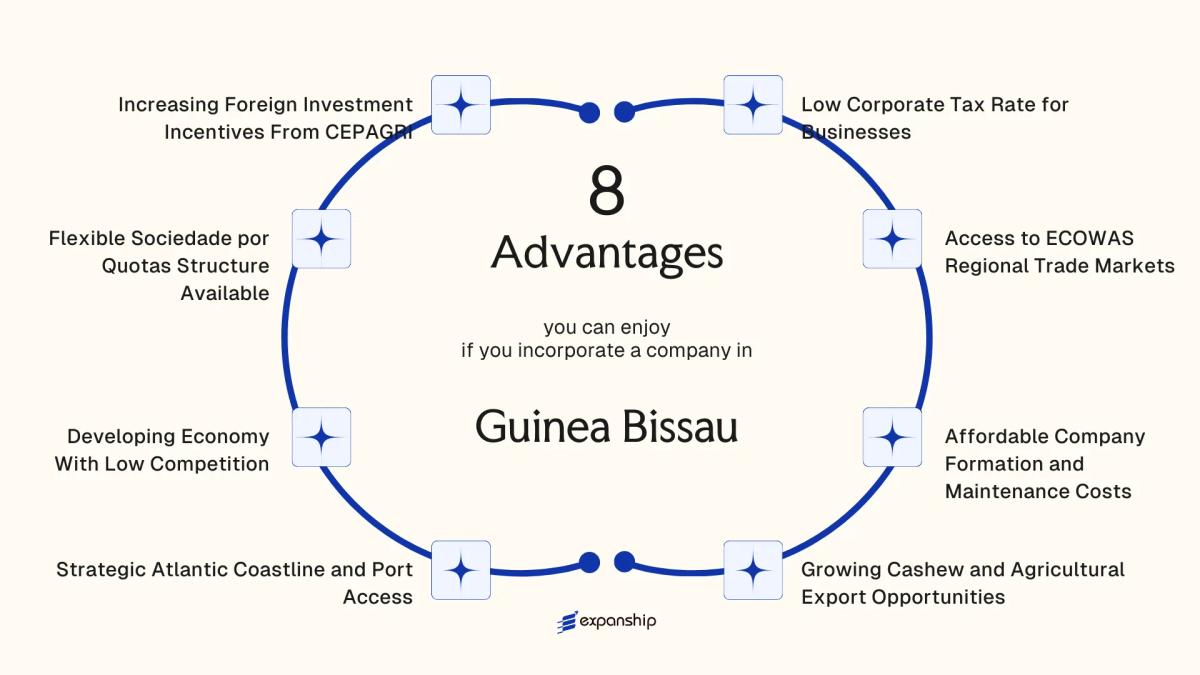
The benefits of incorporating in Guinea-Bissau span regulatory, geographic, and economic dimensions. This article examines the principal advantages your business may gain by establishing a formal presence here — from trade access and cost structures to investment incentives and sector-specific opportunities.
Low Corporate Tax Rate for Businesses
Guinea-Bissau applies a standard corporate income tax rate of 25% under its general tax code. For foreign investors assessing West African markets, this rate is meaningful when considered alongside the country's investment promotion framework.
What the Rate Means in Practice
Businesses operating under the Investment Code, administered through CEPAGRI (Centro de Promoção do Investimento e das Exportações), may qualify for reduced rates or temporary exemptions depending on the sector and declared investment volume. A reduced rate of 15% has been applied to qualifying investments in priority sectors, which can materially lower your effective tax burden during the early operational years of a new entity.
How This Compares Regionally
The standard 25% rate already sits below several ECOWAS peer jurisdictions where corporate tax rates reach 30% or higher. For a foreign-owned firm structured as a Sociedade por Quotas, profits distributed after tax are subject to withholding tax under domestic rules, so the total tax exposure depends on how your structure handles repatriation.
Qualifying for a reduced rate under the Investment Code can lower your effective corporate tax rate to 15% during the incentive period.
Access to ECOWAS Regional Trade Markets
Registered companies in Guinea-Bissau gain automatic access to the Economic Community of West African States (ECOWAS) single market, a trading bloc of 15 member states covering over 400 million consumers. For a foreign business owner, this single membership translates directly into reduced trade barriers across the region without requiring separate market entry arrangements in each country.
Under the ECOWAS Trade Liberalization Scheme (ETLS), goods produced by registered enterprises can move across member state borders free of customs duties and quantitative restrictions, provided the firm meets the scheme's rules of origin criteria. The practical effect is that your entity can manufacture or process goods locally and distribute them regionally at a structural cost advantage over non-ECOWAS competitors.
Guinea-Bissau ECOWAS trade market access benefits are particularly relevant for businesses in transit trade, given the country's Atlantic port position within the bloc. Several factors make the ETLS framework accessible to firms incorporated here:
- Approval under the ETLS does not require minimum capital thresholds that exceed standard incorporation requirements
- The rules of origin threshold is defined at the ECOWAS community level, removing country-specific unpredictability
- Firms already compliant with local investment registration through CEPAGRI are generally positioned to pursue ETLS approval
Using the CFA franc (XOF), which is shared across the UEMOA sub-bloc within ECOWAS, also eliminates currency conversion friction for intra-regional transactions across eight member states.

Company Incorporation in Guinea-Bissau
Register your company in Guinea-Bissau and access ECOWAS regional trade markets through a straightforward incorporation process managed by Expanship.
Affordable Company Formation and Maintenance Costs
Guinea-Bissau affordable company formation costs sit at the lower end of the West African spectrum, which directly reduces your capital exposure during the setup phase. Registration fees paid to the Conservatória do Registo Comercial, the body responsible for commercial registration, are modest by regional standards, meaning less of your initial budget is absorbed before the business generates any revenue.
The minimum share capital requirement for a Sociedade por Quotas, the primary private limited structure available to foreign investors, is set at a low threshold under the Commercial Code. This means you are not required to lock up substantial capital simply to satisfy a statutory deposit condition, freeing those funds for operational use instead.
| Cost Element | Details |
|---|---|
| Registration Authority | Conservatória do Registo Comercial |
| Primary Legal Entity | Sociedade por Quotas (SpQ) |
| Minimum Share Capital | Low statutory threshold under the Commercial Code |
| Annual Maintenance Obligations | General accounting and tax filings with the Direcção Geral das Contribuições e Impostos |
| Notarisation Requirement | Required for articles of association |
Annual maintenance costs also remain contained. Your ongoing obligations center on accounting compliance and periodic filings with the Direcção Geral das Contribuições e Impostos, rather than a complex multi-agency reporting structure. For a foreign-owned entity operating regionally, this administrative efficiency means lower recurring professional fees compared to jurisdictions with more layered compliance regimes.
Growing Cashew and Agricultural Export Opportunities
Guinea-Bissau cashew export business opportunities are among the most concentrated in West Africa. The country produces roughly 150,000 to 200,000 metric tons of raw cashew nuts annually, accounting for approximately 6% of global production. For a foreign business incorporating here, that volume means access to an established supply chain without building commodity relationships from scratch.
Cashews represent over 85% of the country's total export revenue. A registered entity here can position itself directly within the export chain, benefiting from proximity to farming cooperatives and port infrastructure without the intermediary costs common in more developed markets.
Agricultural export activities fall under the framework administered by CEPAGRI (Centro de Promoção do Investimento e das Exportações), which oversees foreign investor access to agribusiness sectors. Exporters operating under this framework may access incentive provisions tied to export-oriented activities defined in the Investment Code.
Keep these points in mind:
- Cashew export contracts typically follow seasonal cycles, concentrated between March and June
- Raw nut exports currently dominate; processing facilities remain limited, which creates a structural gap your business may fill
- CEPAGRI registration is required before accessing formal export incentive provisions
- Verify current phytosanitary certification requirements through INPA before shipping
Despite producing millions of cashew tons annually, Guinea-Bissau processes less than 5% domestically, meaning the most profitable stage of the value chain remains almost entirely open to foreign-owned processing firms.
Strategic Atlantic Coastline and Port Access
Guinea-Bissau Atlantic coastline business advantages stem from the country's position along the West African seaboard, where roughly 350 kilometres of coastline connect to the broader Atlantic shipping network. For companies engaged in import and export, this geography translates directly into reduced transit times and lower freight costs compared to landlocked regional economies.
Port of Bissau as a Trade Gateway
The Port of Bissau, the country's primary commercial port, handles general cargo, bulk goods, and container traffic. Because regional demand for West African port capacity is distributed across several competing terminals, your business faces less congestion than at larger West African hubs, which supports more predictable logistics scheduling. Goods destined for ECOWAS member states can move through Bissau's port infrastructure without crossing additional land borders, reducing the documentary and tariff friction that accumulates across overland routes.
Coastal Access and Maritime Trade Positioning
The Bijagós Archipelago, comprising approximately 88 islands off the Atlantic coast, forms a natural buffer that supports sheltered coastal navigation. For firms in fisheries, maritime logistics, or offshore services, the jurisdictional waters under Guinea-Bissau's maritime authority offer operational access that few comparable West African territories provide at this scale. The country's maritime zone governance falls under the Autoridade Marítima e Portuária, the body responsible for regulating port and coastal commercial activity, which means your entity interacts with a single regulatory counterpart for port-related compliance rather than fragmented agencies.
Maximise Your Coastal and Trade Advantages in Guinea-Bissau
Speak with our corporate services team about structuring your Guinea-Bissau entity to take full advantage of Atlantic port access and maritime trade positioning.
Developing Economy With Low Competition
Few formal sectors in West Africa remain as underdeveloped commercially as Guinea-Bissau, which is precisely what creates the Guinea-Bissau developing economy low competition advantage for early entrants. Most industries outside cashew agriculture have minimal organized market presence, meaning foreign firms entering sectors such as fisheries processing, telecommunications services, or logistics face few established competitors.
- Low market saturation means your pricing, brand positioning, and distribution terms are set largely without competitive pressure, a condition that rarely exists in more developed ECOWAS economies.
- Supplier and distribution relationships are still being formed across multiple sectors. A business that establishes those relationships early secures structural advantages that become difficult for later entrants to replicate.
- Consumer and institutional demand exists but is currently met by informal operators or imports. A registered formal entity can step into that gap with a compliance and quality profile that informal suppliers cannot match.
- Regulatory attention in early-stage markets tends to focus on establishing frameworks rather than enforcement density, giving compliant foreign firms time to build operational foundations before the regulatory environment matures.
- Guinea-Bissau's emerging market conditions mean human capital and physical infrastructure costs remain low relative to neighboring countries with more saturated markets, which directly reduces your initial capital outlay.
Flexible Sociedade por Quotas Structure Available
The Guinea-Bissau Sociedade por Quotas structure benefits foreign investors primarily through its accommodating ownership rules. A Lda can be formed with as few as two quota holders, and there is no requirement that any shareholder be a resident or national. This means your business can be entirely foreign-owned from the outset, without the need to bring in a local partner.
Quota transfers are governed by the company's articles of association rather than rigid statutory prescriptions, giving shareholders meaningful control over how ownership changes hands. That flexibility is particularly useful for holding structures or joint ventures where staged ownership transfers are anticipated.
The minimum capital requirement for a Sociedade por Quotas under Guinea-Bissau's commercial framework is relatively low, reducing the upfront financial commitment needed to establish a legal presence in the country.
A foreign-owned Lda incorporated with two shareholders contributing a modest initial capital could begin trading operations and opening bank accounts within the same legal structure, without restructuring for foreign ownership compliance later — unlike jurisdictions that impose mandatory local shareholding thresholds of 25% to 51%.
Increasing Foreign Investment Incentives From CEPAGRI
Guinea-Bissau CEPAGRI foreign investment incentives have expanded in scope as the government works to attract capital into underdeveloped sectors. CEPAGRI, the Centre for the Promotion of Investment and Exports (Centro de Promoção do Investimento e das Exportações), functions as the primary institutional body for coordinating foreign investor engagement and processing investment applications.
Under the national investment framework, approved foreign investors may qualify for:
- Exemptions or reductions on import duties for equipment and inputs
- Corporate profit tax holidays during an initial operational period
- Guarantees against expropriation without compensation
These incentives are not automatic. CEPAGRI evaluates applications based on the sector, projected employment generation, and capital investment thresholds, meaning eligibility depends on the nature and scale of your proposed activity.
For capital-intensive projects or those targeting priority sectors such as agriculture, fisheries, and infrastructure, the formal approval route through CEPAGRI provides a structured legal basis for the incentives your business receives. This reduces reliance on informal arrangements and gives investors a documentable framework for financial planning.
CEPAGRI incentive eligibility is tied to formal investment approval; operating without registration through this body means your entity will not qualify for tax holidays or import duty exemptions, regardless of sector.
Why Guinea-Bissau Stands Out Against Regional Competitors
Assessing Guinea-Bissau's competitive position against regional peers requires selecting jurisdictions a realistic investor would weigh in parallel. Senegal, Cabo Verde, and Ghana are the three most relevant benchmarks: Senegal shares a land border and similar OHADA legal infrastructure; Cabo Verde targets foreign investors through its own offshore and holding structures; Ghana attracts West African incorporation traffic through its relatively established financial sector. Across these comparators, Guinea-Bissau's advantages cluster around cost, entry thresholds, and ECOWAS membership rather than institutional depth.
The CEPAGRI investment framework positions the country with a lower effective cost base than any of these three markets for early-stage foreign entities. Cabo Verde's incorporation fees and annual maintenance costs run significantly higher, reflecting its more developed services economy. Senegal, while sharing OHADA's Acte Uniforme sur les Sociétés Commerciales, carries a larger regulatory overhead and more competitive domestic market conditions that can disadvantage new entrants. Your business cost exposure from formation through to annual compliance filing remains measurably lower here than across those alternatives.
| Parameter | Guinea-Bissau | Senegal | Cabo Verde | Ghana |
|---|---|---|---|---|
| OHADA Legal Framework | Yes | Yes | No | No |
| ECOWAS Full Member | Yes | Yes | No | Yes |
| Minimum Share Capital (Sarl/Quotas) | Low / flexible | Moderate | Moderate | Moderate |
| Foreign Ownership Restriction | None (general sectors) | Sector-specific | Sector-specific | Sector-specific |
| Market Competition Level | Low | High | Moderate | High |
| Investment Promotion Body | CEPAGRI | APIX | CVAI | GIPC |
Compliance Services for Companies in Guinea-Bissau
Maintain your Guinea-Bissau entity in good standing with annual filings, registered agent support, and regulatory reporting tailored to local requirements.
Conclusion
Guinea-Bissau presents a coherent case for incorporation when its component advantages are considered together. ECOWAS membership gives registered entities tariff-free access to a regional market of over 400 million people, while the Sociedade por Quotas structure keeps formation costs and administrative overhead low relative to comparable West African jurisdictions. For businesses oriented toward agricultural trade, the country's position as a primary cashew exporter creates direct commercial alignment between entity location and sector activity.
Fit matters here. A firm seeking deep capital markets or extensive bilateral tax treaty coverage will find the offering limited. For trading companies, agricultural exporters, and regional holding structures where low entry cost and market access carry more weight than financial infrastructure, the proposition holds.
The investment framework managed through CEPAGRI continues to develop, and the legal environment operating under OHADA principles provides a recognized commercial law foundation that reduces structural uncertainty for foreign incorporators. The next step for most business owners is matching their specific operational model against what the jurisdiction concretely offers, including applicable incentive eligibility and sectoral conditions, before proceeding with formal registration.
Start Your Guinea-Bissau Company With Expanship Today
Expanship supports foreign investors through each stage of entity formation in Guinea-Bissau, from drafting the pacto social required for a Sociedade por Quotas to filing with the Conservatória do Registo Comercial. The services cover the full scope of obligations discussed throughout this blog, including CEPAGRI investment registration, ECOWAS-related compliance considerations, and ongoing statutory requirements under the country's commercial code. Each engagement is structured around the actual regulatory process, not a generic template.
Expanship's service scope for your Guinea-Bissau entity includes:
- Preparation and legalization of incorporation documents, including the pacto social and founding declarations
- Registered agent and registered office provision within the jurisdiction
- Filing coordination and liaison with the Conservatória do Registo Comercial
- Post-incorporation compliance management, including annual obligations under local commercial law
- CEPAGRI registration support for foreign investment incentive eligibility
- Banking introduction assistance for corporate account setup
Your business deserves accurate, jurisdiction-specific handling rather than a one-size-fits-all approach. Expanship works directly with local authorities on your behalf, reducing the administrative burden of operating from outside the country.
To discuss your incorporation requirements, contact Expanship Guinea-Bissau directly.
Frequently Asked Questions (FAQ)
Foreign nationals can hold 100% ownership in a Sociedade por Quotas incorporated in Guinea-Bissau. The Investment Code, administered through CEPAGRI (Centro de Promoção do Investimento e das Exportações), does not impose mandatory local shareholding requirements for most sectors. Certain strategic sectors may carry additional conditions, so sector-specific review is advisable before structuring ownership.
The standard corporate income tax rate in Guinea-Bissau is 25%, applied to net taxable profit. Companies operating in qualifying sectors or under specific investment agreements with CEPAGRI may be eligible for reduced rates or temporary exemptions during an initial operating period. The applicable rate should be confirmed against the current fiscal legislation, as incentive terms can vary by sector and investment size.
Incorporation timelines can vary depending on document preparation and notarial scheduling, but registration through the Conservatória do Registo Comercial generally takes several weeks under standard procedures. Delays commonly arise from document legalisation requirements for foreign-sourced materials. Engaging a local legal representative familiar with the Conservatória's processes can reduce administrative back-and-forth.
A company registered in Guinea-Bissau, as a member state of ECOWAS, is entitled to operate within the regional trade framework governed by the ECOWAS Trade Liberalisation Scheme (ETLS). This grants access to reduced or eliminated tariffs on qualifying goods traded across member states. Eligibility for ETLS benefits requires the company and its products to meet defined rules-of-origin criteria set by the ECOWAS Secretariat.
Guinea-Bissau's commercial framework does not universally mandate a resident director for a Sociedade por Quotas, but a registered local address is required for official correspondence and filings. Operational and compliance obligations may, in practice, make local representation advisable. Requirements can also shift based on the nature of the business activity and any sector-specific licensing conditions.
Failure to meet annual filing and tax obligations can result in administrative penalties, potential suspension of business registration, and complications with banking relationships. The Direcção Geral de Impostos e Aduanas oversees tax compliance, and persistent non-compliance can trigger enforcement proceedings. Maintaining an active local accounting or legal representative is the standard method for managing ongoing obligations from abroad.
Formation and notarial costs in Guinea-Bissau are generally lower than in Senegal and Cabo Verde, where registration fees, minimum capital thresholds, and professional service rates are higher. The minimum share capital for a Sociedade por Quotas is modest relative to equivalent structures in several neighbouring states. However, the lower cost must be weighed against Guinea-Bissau's comparatively limited banking infrastructure and institutional capacity, which can affect operational efficiency.
CEPAGRI serves as the primary government body responsible for processing foreign investment applications and administering incentives under the Investment Code. Approved investment agreements formalised through CEPAGRI can carry legally binding commitments regarding tax treatment, customs duties, and operational conditions for a defined period. The enforceability of these terms depends on the agreement being properly executed and registered in accordance with the applicable procedural requirements.
Legal Disclaimer
The information provided in this article is for general informational purposes only and does not constitute legal, tax, or professional advice. While we strive to ensure the accuracy and timeliness of the content, laws and regulations are subject to change, and the application of laws can vary widely based on specific facts and circumstances.
Readers should not act upon this information without seeking professional counsel tailored to their individual situation. Expanship and its authors disclaim any liability for actions taken or not taken based on the content of this article.
For specific advice regarding your business setup, compliance requirements, or any legal matters, please consult with qualified legal and tax professionals in the relevant jurisdiction.