

Key Takeaways
- Every corporation or LLC registering to do business in Guam must appoint a registered agent who maintains a physical presence on the island, as required under Title 18 of the Guam Code Annotated.
- Beneficial ownership disclosure obligations in Guam have been progressively aligned with U.S. federal reporting standards, meaning foreign investors must account for both local and federal UBO compliance frameworks when structuring their entities.
- The Department of Revenue and Taxation serves as the primary regulatory authority overseeing entity formation in Guam, and failure to satisfy its documentary and structural requirements results in application rejection or loss of good standing for operating businesses.
- Foreign corporations seeking to conduct business in Guam face a distinct registration pathway from domestic corporations, with requirements that vary further depending on industry and ownership structure under the Guam Uniform Business Organizations Code.
Entity formation in Guam is governed by the Guam Code, specifically Title 18 of the Guam Code Annotated, which covers corporations and business organizations. The Department of Revenue and Taxation serves as the primary regulatory body overseeing company registration.
This article covers the structural and documentary requirements that apply when forming a business entity under Guam law. Failure to satisfy these requirements results in rejection of the registration application or, where a business is already operating, potential penalties and loss of good standing.
Requirements differ depending on whether you are forming a domestic corporation, a foreign corporation registering to do business locally, a limited liability company, or another recognized entity type. Your industry and ownership structure may also affect which specific rules apply.
This article is most relevant to foreign investors and internationally based business owners seeking to establish or register a legal presence under Guam's corporate framework.
Minimum Share Capital Requirements in Guam

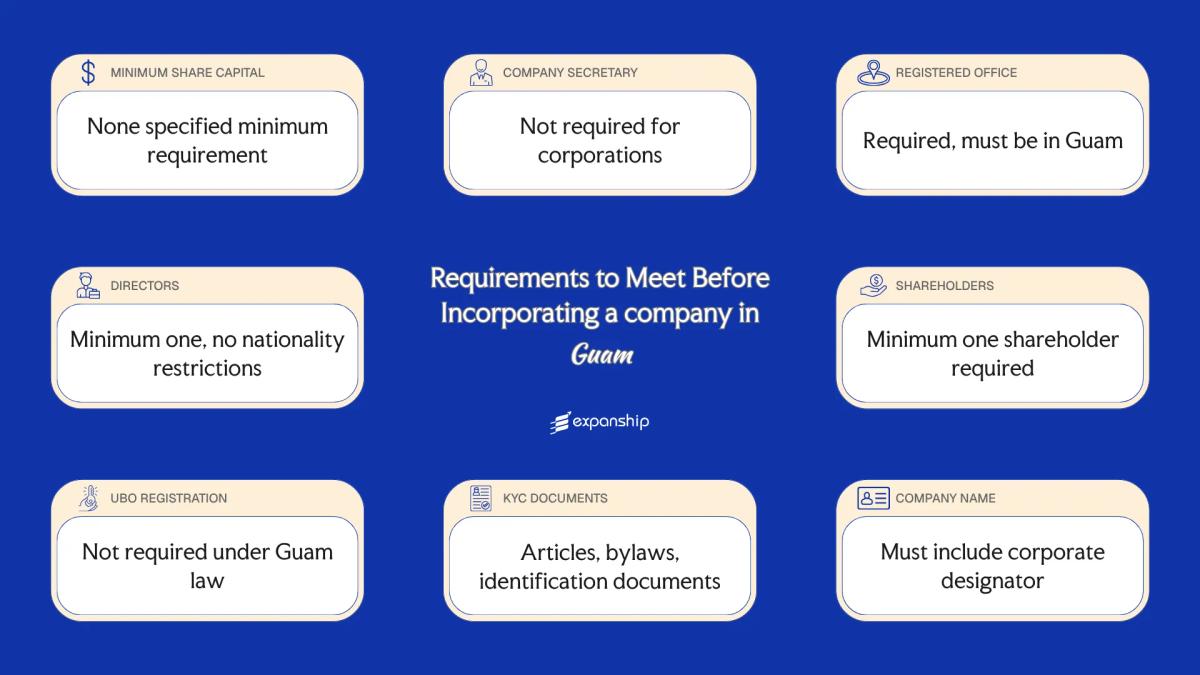
Guam minimum share capital requirements are governed under Title 18 of the Guam Code Annotated, which regulates business corporations on the island. No minimum authorized capital threshold is mandated for standard corporations formed under this statute.
Corporations in Guam may issue shares with or without par value, giving organizers flexibility in structuring the initial capital. The Department of Revenue and Taxation, through its Business License Division, is the primary authority that processes incorporation filings, though it does not verify or enforce a capital deposit at the point of formation.
| Parameter | Detail |
|---|---|
| Minimum Authorized Share Capital | No statutory requirement |
| Maximum Authorized Share Capital | No statutory requirement |
| Minimum Paid-Up Capital | No statutory requirement |
| Paid-Up Requirement at Incorporation | No statutory requirement |
| Accepted Currency | US Dollar (USD) |
| Accepted Forms of Contribution | Cash, property, services rendered, or promissory notes as permitted under Title 18 |
| Timeframe to Deposit Capital | No statutory timeframe |
Even without a mandated minimum, your corporation must define its authorized share structure in the Articles of Incorporation filed with the Department of Revenue and Taxation. Omitting this entirely will result in a defective filing.
Registered Agent Requirements in Guam
Under the Guam Uniform Business Organizations Code (Title 18 of the Guam Code Annotated), every corporation and registered business entity operating in the territory must designate a registered agent. This agent serves as the official point of contact for service of process and receives legal notices on behalf of the entity.
Statutory agent obligations include accepting service of process, forwarding legal correspondence to the entity, and maintaining availability during normal business hours at the designated address.
Qualification criteria for a registered agent in Guam:
- Must be an individual resident of Guam or a business entity authorized to conduct business in the territory
- Individual agents must maintain a physical street address in Guam; a P.O. box does not satisfy this requirement
- A domestic or foreign corporation may serve as agent provided it is in good standing with the Department of Revenue and Taxation
- The agent must be available during regular business hours to receive and forward legal documents

Incorporate a Company in Guam
Set up your business entity in Guam with accurate filings and full compliance under the Guam Uniform Business Organizations Code.
Registered Office Requirements in Guam
Registered office requirements in Guam are governed under the Guam Uniform Business Organizations Code (Title 18 of the Guam Code Annotated), which mandates that every domestic and foreign corporation maintain a designated principal office address within the territory where official correspondence and legal notices can be directed.
- A physical street address is required; P.O. boxes are not accepted as a registered office address.
- The address must be physically located within Guam.
- Virtual office addresses are generally not recognized as compliant principal office addresses under Guam law.
- You are not required to own the premises; a valid lease or occupancy arrangement is sufficient to satisfy the address requirement.
- The principal office address is recorded with the Department of Revenue and Taxation and is accessible as part of the public business registry.
- Any change to the registered office address must be reported to the Department of Revenue and Taxation through a formal amendment filing; failure to update the address can result in administrative penalties or loss of good standing.
Director Requirements in Guam

Under Guam's Corporations Act (Title 18, Guam Code Annotated), director requirements for a Guam corporation place fiduciary duties on each appointed director, including duties of care and loyalty to the entity. Directors are personally liable for actions taken in bad faith or outside the scope of their authority under the business judgment rule as applied in Guam courts.
| Parameter | Detail |
|---|---|
| Minimum Number of Directors | One director is required. |
| Maximum Number of Directors | No statutory maximum is prescribed. |
| Local/Resident Director Required | No local or resident director is required. |
| Nationality Restrictions | No nationality restrictions are imposed. |
| Minimum Age Requirement | Directors must be at least 18 years of age. |
| Corporate Directors Permitted | No statutory provision explicitly permits corporate directors; natural persons are the standard. |
| Director Must Be a Shareholder | No, a director is not required to hold shares in the corporation. |
| Publicly Listed on Registry | Director information is filed with the Department of Revenue and Taxation but is not prominently published in a searchable public registry. |
| Disqualification Conditions | Persons convicted of fraud or breaches of fiduciary duty may face disqualification under applicable Guam law. |
A single individual can simultaneously serve as the sole director, sole officer, and sole shareholder of a Guam corporation, with no requirement for any of these roles to be held by separate persons.
Shareholder Requirements in Guam

Guam corporations must have at least one shareholder, permitting a sole shareholder structure. No statutory maximum on shareholder count is imposed under the Guam Uniform Corporation Act.
Nationality and Residency Restrictions
Shareholders face no nationality or residency requirements under Guam corporate law. Foreign nationals and non-resident individuals may hold shares without restriction, and there is no foreign ownership cap applicable to privately held corporations.
Corporate Shareholders
Corporate entities are permitted to act as shareholders in a Guam corporation. No conditions specific to corporate shareholders are imposed beyond standard documentation requirements at the time of incorporation.
Shareholder Liability
Shareholder liability is generally limited to the amount paid or agreed to be paid for shares. Piercing the corporate veil remains a judicial remedy in cases of fraud or improper commingling of personal and corporate assets.
Register of Shareholders
A register of shareholders must be maintained by the corporation. This record is not filed publicly with the Department of Revenue and Taxation, though it must remain accessible to shareholders upon request.
Shareholder Structure Support for Your Guam Corporation
Get guidance on structuring shareholder arrangements that meet Guam's corporate requirements from incorporation through ongoing compliance.
UBO / Beneficial Ownership Disclosure Requirements in Guam
Beneficial ownership disclosure in Guam is governed at the federal level through the Corporate Transparency Act (CTA), enacted by the U.S. Congress in 2021, which defines a beneficial owner as any individual who exercises substantial control over a reporting company or owns at least 25% of its ownership interests.
- Determine whether your entity qualifies as a "reporting company" under the CTA, as certain exemptions apply to large operating companies, regulated entities, and inactive firms.
- Compile beneficial ownership information (BOI) for each qualifying individual, including full legal name, date of birth, residential address, and an identifying document number.
- Submit the BOI report to the Financial Crimes Enforcement Network (FinCEN) through its secure online filing system.
- File an updated report within 30 days of any change to previously reported beneficial ownership information.
| Parameter | Detail |
|---|---|
| Ownership Threshold for UBO Status | 25% ownership interest or substantial control |
| Filing Authority | FinCEN (Financial Crimes Enforcement Network) |
| Disclosure Deadline at Incorporation | 90 days for entities formed in 2024; 30 days for entities formed after January 1, 2025 |
| Publicly Accessible Register | No; BOI is held in a non-public federal database |
| Penalties for Non-Disclosure | Civil penalties up to $500 per day; criminal penalties up to $10,000 and two years imprisonment |
| Ongoing Update Obligation | Yes; updates required within 30 days of any change |
KYC / Document Requirements in Guam
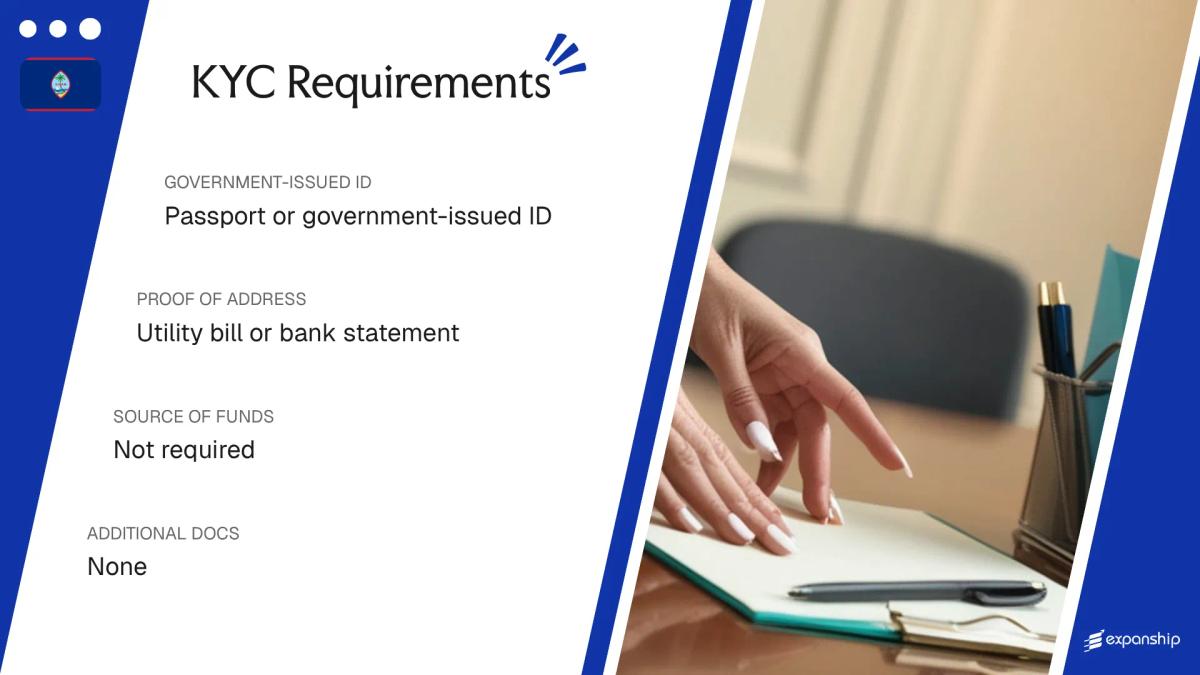
KYC document requirements in Guam are governed by the Guam Banking Law (Title 13 of the Guam Code Annotated) and federal anti-money laundering obligations enforced through the FinCEN framework. Registered agents and financial institutions must collect and verify prescribed documentation before an entity is formed.
Individual / Personal Documents
- Government-issued photo ID (passport or driver's license) for each director, shareholder, and beneficial owner
- Proof of residential address dated within three months, such as a utility bill or bank statement
- Completed and signed KYC/AML intake form as required by the registered agent
- Tax identification number or equivalent where the individual is a U.S. person
Corporate Documents
- Certificate of incorporation or equivalent formation document from the parent entity's home jurisdiction
- Articles of incorporation or constitutional documents (memorandum and articles, bylaws, or equivalent)
- Current register of directors and register of shareholders
- Proof of registered address for the corporate shareholder or director
Source of Funds Documentation
- Recent bank statements (typically covering the preceding three to six months)
- Audited financial statements where the introducing entity has an established operating history
- Written declaration of the source of capital where bank documentation is unavailable
Notarisation and Apostille Requirements
- Foreign-issued identity and corporate documents generally require notarisation by a licensed notary
- Documents originating outside the United States may require an apostille under the Hague Convention
- Official English translations are required for any document not originally in English
Incomplete or unverified beneficial ownership documentation is the most frequent cause of incorporation delays filed through Guam's Department of Revenue and Taxation.
Company Name Requirements in Guam
Company name requirements in Guam are assessed at the point of incorporation through the Department of Revenue and Taxation, which reviews proposed names for availability and compliance before registration is approved.
Names must include a legal suffix denoting the entity type, such as "Corporation," "Incorporated," or an accepted abbreviation. No specific character limit is publicly codified, but the name must be in English or include a romanized form.
Certain words are restricted or prohibited outright. Terms implying government affiliation, banking functions, or professional licensing may require supporting documentation or approval from the relevant regulatory authority before use.
Name reservation is available prior to formal incorporation. A reserved name is held for a defined period, typically around 120 days, and is applied for through the same filing office that processes incorporation documents.
Compliance Services for Companies in Guam
Stay current with Guam's ongoing filing obligations, registered agent requirements, and corporate maintenance rules through Expanship's compliance support.
Conclusion
Incorporation requirements in Guam operate under the Guam Uniform Business Organizations Code, administered through the Department of Revenue and Taxation, which sets out a defined set of structural and documentary obligations for foreign and domestic entities alike. Among the more notable requirements covered are the mandatory appointment of a registered agent physically present on the island and the UBO disclosure framework that has been progressively aligned with U.S. federal beneficial ownership reporting standards. Once these obligations are understood, a foreign investor is positioned to move from planning into the practical execution of registration and post-incorporation compliance.
Expanship's Corporate Services for Guam Expansion
Guam's incorporation framework sits under a dual layer of local GovGuam regulation and applicable federal requirements, and managing that structure from outside the territory adds real administrative weight. Expanship's Guam company formation services are designed to reduce that burden by handling the procedural side of your entity setup, from Department of Revenue and Taxation registration through to ongoing compliance obligations.
Our corporate services span the full incorporation lifecycle across the island's regulatory environment.
- We prepare and file all company registration documents with the relevant GovGuam authorities on your behalf.
- Registered agent and local office provision is arranged to satisfy Guam's statutory presence requirements.
- We liaise directly with government departments and regulatory bodies throughout the filing process.
- Post-incorporation compliance, including annual report filings and license renewals, is managed on a continuing basis.
- Banking introduction assistance is provided to help your business establish a local or regional account.
- Tax registration with the Department of Revenue and Taxation, along with liaison with other local authorities, is handled as part of your setup.
Expanship Guam is available to discuss your incorporation requirements in detail.
Frequently Asked Questions (FAQ)
Yes, Guam imposes no residency or citizenship requirement on directors, so a foreign national can serve as the sole director. The Guam Uniform Business Organizations Code sets the minimum at one director, and that individual can be based anywhere in the world.
A corporation that fails to maintain a continuously available registered agent in Guam risks administrative dissolution by the Department of Revenue and Taxation. Reinstating a dissolved entity requires filing the appropriate restoration documents and paying any outstanding fees and penalties, which extends your timeline and increases your overall cost.
Beneficial ownership reporting obligations under the federal Corporate Transparency Act apply to both corporations and LLCs formed in Guam, regardless of the number of members or shareholders. Single-member LLCs are not exempt solely on the basis of having one owner; the exemptions are based on specific criteria such as employee count, revenue thresholds, and physical presence in the United States.
Guam's Department of Revenue and Taxation allows name reservations prior to formal filing, giving your business time to prepare incorporation documents without losing the intended name to another applicant. The reservation holds the name for a defined period, after which it lapses if articles of incorporation have not been submitted.
Foreign shareholders are generally required to provide government-issued identification and proof of address as part of the incorporation process. Because Guam operates under both local and federal compliance frameworks, the documentation standards reflect U.S. anti-money laundering expectations, which means certified or notarized copies may be required depending on the filing agent's procedures.
Guam is an unincorporated U.S. territory, so entities formed there are not formed under any U.S. state statute and do not carry the same legal precedents that Delaware or Nevada courts have developed over decades. A Guam corporation operates under the Guam Uniform Business Organizations Code, which means disputes are resolved in Guam's own court system, and the entity may face different recognition considerations when conducting business on the U.S. mainland.
Legal Disclaimer
The information provided in this article is for general informational purposes only and does not constitute legal, tax, or professional advice. While we strive to ensure the accuracy and timeliness of the content, laws and regulations are subject to change, and the application of laws can vary widely based on specific facts and circumstances.
Readers should not act upon this information without seeking professional counsel tailored to their individual situation. Expanship and its authors disclaim any liability for actions taken or not taken based on the content of this article.
For specific advice regarding your business setup, compliance requirements, or any legal matters, please consult with qualified legal and tax professionals in the relevant jurisdiction.