

Key Takeaways
- Businesses incorporated in Guam face a dual-layer fiscal burden, owing obligations to both the U.S. federal government and the Guam Department of Revenue and Taxation under local statutes, which increases compliance costs relative to many alternative jurisdictions.
- Entities structured under the Guam Uniform Partnership Act and related local commercial statutes must navigate a rules-intensive regulatory environment that imposes compliance requirements across both federal and territorial legal frameworks simultaneously.
- Guam's small resident population, geographic remoteness from mainland U.S. markets, and heavy economic concentration in tourism and military activity expose incorporated businesses to structural revenue volatility that is difficult to mitigate through diversification alone.
- Operational costs — including freight, logistics, and talent acquisition — are materially elevated by Guam's mid-Pacific location, making cost-competitive scaling significantly harder for firms whose business models depend on supply chain efficiency or access to specialized labor.
Guam operates under a dual regulatory framework, subject to both federal U.S. law and local statutes administered by the Guam Department of Revenue and Taxation, placing incorporated entities within a structured and rules-intensive compliance environment. Understanding the disadvantages of incorporating in Guam requires examining several distinct categories — operational, fiscal, geographic, and structural — each of which can affect a foreign business differently depending on its sector and legal form.
Not every drawback applies equally to all entities. A federal contractor operating under Department of Defense agreements faces a different risk profile than a retail or e-commerce firm targeting regional Pacific consumers.
This article is most relevant to foreign investors and business owners considering a U.S.-territory presence, particularly those incorporating under the Guam Uniform Partnership Act or related local commercial statutes. The drawbacks of Guam business incorporation vary materially based on your entity type, capital structure, and intended operational scope.
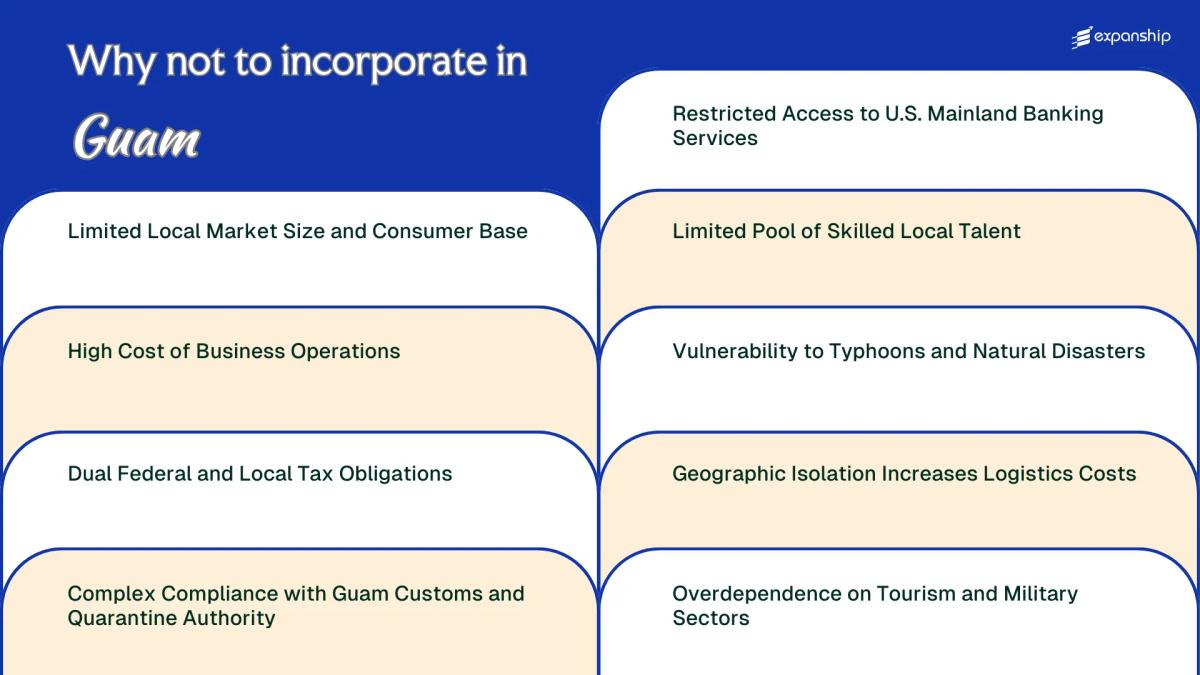
Limited Local Market Size and Consumer Base
Guam small market size limitations present one of the most immediate structural barriers for foreign businesses. With a population of approximately 160,000 residents, the addressable consumer base is too narrow to sustain most revenue models that require scale.
Population Constraints and Demand Ceilings
A business incorporated in Guam cannot realistically generate high-volume domestic sales when the entire island population sits below the size of a mid-tier U.S. city neighborhood. This forces most entities to depend on export markets or transient tourism spending, neither of which offers the predictability that local consumer demand typically provides.
Even within that limited consumer pool, purchasing patterns are segmented across military households, local Chamorro residents, and short-term visitors, reducing the effective target audience for most product or service categories.
Structural Limits on Market Expansion
Guam's market restrictions for corporations extend beyond headcount. The Guam Code Annotated and local licensing frameworks do not create additional consumer access beyond the island's physical boundaries, meaning your firm cannot organically grow into adjacent markets without separate legal structures in other jurisdictions.
Foreign businesses targeting the Asia-Pacific region sometimes use Guam as a regional foothold, but the limited consumer base Guam business challenges present means local revenue alone rarely justifies incorporation costs.
A foreign business owner relying on local consumer revenue to recover incorporation and operational costs will find that Guam's population size makes break-even timelines significantly longer than in larger U.S. territories or comparable Pacific jurisdictions.
High Cost of Business Operations
High business operating costs in Guam stem from a structural reality: nearly all goods, materials, and equipment must be imported. Under the Merchant Marine Act of 1920 (the Jones Act), cargo shipped between U.S. ports must travel on U.S.-flagged vessels, which are significantly more expensive to operate than foreign-flag alternatives. Your supply chain costs are inflated before operations even begin.
Utility expenses compound this burden. Electricity rates on the island consistently rank among the highest in any U.S. jurisdiction, driven by dependence on imported petroleum for power generation. For manufacturing, hospitality, or any energy-intensive business, this translates directly into higher fixed overhead that cannot easily be offset.
Guam business overhead challenges also surface in commercial real estate. Developable land is limited by military reservations, environmental protections, and topography, which constrains supply and sustains elevated lease rates.
Taken together, these cost pressures mean foreign-owned entities face operational friction that businesses in mainland U.S. states or competing Asia-Pacific jurisdictions do not encounter at the same scale:
- Shipping cost premiums under the Jones Act inflate the landed cost of every imported input, from raw materials to office supplies
- Electricity bills for commercial operations can reach two to three times mainland U.S. averages, increasing monthly fixed costs substantially
- Scarce commercial real estate drives lease rates higher, reducing the margin available to businesses still establishing their revenue base
- Local contractor and construction costs are elevated by the same import dependency, making physical buildout or facility upgrades more expensive than comparable projects elsewhere
Businesses with thin margins or capital-constrained launch phases absorb these disadvantages most acutely.

Company Incorporation in Guam
Set up your business entity in Guam with accurate filing support and local compliance guidance from Expanship.
Dual Federal and Local Tax Obligations
Guam federal and local tax obligations create a compounded tax exposure that few other U.S. territories impose in the same structural form. Under the Organic Act of Guam, the territory operates a mirror tax code, meaning the Guam Territorial Income Tax (GTIT) replicates the U.S. Internal Revenue Code almost verbatim, with "Guam" substituted for "United States." Your business files and pays taxes to the Guam Department of Revenue and Taxation rather than the IRS, but the rate structure and compliance requirements are functionally identical.
The duplication itself is the problem. A foreign-owned entity incorporated on the island must determine its tax residency status and filing obligations under both frameworks, which requires legal analysis that increases professional fees significantly.
| Obligation | Rate / Requirement | Implication for Foreign Entity |
|---|---|---|
| Guam Territorial Income Tax (corporate) | Up to 21% (mirrors federal corporate rate) | Full corporate-rate exposure with no territorial reduction |
| Withholding on dividends to foreign shareholders | Up to 30% (mirroring U.S. withholding rules) | Profit repatriation is costly without an applicable tax treaty |
| Annual filing with Guam DRT | Mandatory regardless of profit | Compliance cost applies even in loss years |
U.S. tax treaties generally do not extend to Guam, which eliminates the withholding rate reductions that foreign investors rely on in mainland structures. This absence directly increases the cost of distributing profits to non-U.S. shareholders. A branch or subsidiary structure provides no automatic relief.
Complex Compliance with Guam Customs and Quarantine Authority
Guam customs compliance challenges for businesses are more demanding than many foreign investors anticipate. As a U.S. territory, Guam applies U.S. Customs and Border Protection (CBP) rules for most imports, but the Guam Customs and Quarantine Authority (CQA) operates as a separate territorial agency with its own inspection mandates, quarantine protocols, and agricultural restrictions layered on top of federal requirements.
This dual-layer structure means your shipments may clear U.S. federal customs yet still face CQA holds, particularly for organic materials, food products, and equipment carrying soil or biological matter.
Any delay at the CQA level directly translates to storage costs, missed delivery windows, and contract penalties. For a small-volume operation, even a single detained shipment can disrupt supply chains that took months to establish.
Import compliance drawbacks in Guam are compounded by the island's biosecurity sensitivity. Guam quarantine regulations impose strict controls due to the ongoing ecological damage caused by invasive species, most notably the brown tree snake, making inspections more thorough than in most U.S. port jurisdictions.
- Your shipments must comply with both CBP federal entry requirements and separate CQA territorial inspection protocols.
- Agricultural or organic materials are subject to mandatory CQA quarantine holds regardless of federal clearance status.
- Non-compliance with CQA directives can result in destruction of goods at the importer's expense, not just detention.
- Re-export of rejected goods may not always be permitted, depending on the nature of the restricted item.
Guam's biosecurity inspections apply not just to commercial imports but also to personal and household goods shipped by relocating business owners, adding an unexpected compliance layer that most jurisdictions reserve for commercial cargo only.
Restricted Access to U.S. Mainland Banking Services
Guam banking access restrictions for companies are a practical and often underestimated complication for foreign-owned entities incorporated on the island. Because Guam is an unincorporated U.S. territory rather than a state, its corporate status creates friction with how mainland U.S. financial institutions assess account eligibility.
Structural Barriers Within the U.S. Banking System
Many mainland U.S. banks treat Guam-incorporated businesses similarly to foreign entities for account-opening purposes, applying enhanced due diligence requirements under federal Bank Secrecy Act compliance frameworks. This classification can disqualify your firm from basic commercial banking products that a Delaware or Wyoming entity would access without additional scrutiny.
Some banks decline Guam entities outright due to internal risk policies tied to territorial jurisdiction classifications, not because of any legal prohibition.
Operational Consequences for Corporate Finance
Limited U.S. mainland banking services in Guam translate directly into constrained access to credit facilities, merchant processing agreements, and payment infrastructure that many cross-border business models depend on. A business incorporated locally may find itself restricted to a small pool of Pacific-regional banks, which typically offer fewer products at less competitive terms than their mainland counterparts.
This constraint disproportionately affects companies with U.S.-facing revenue models, where domestic banking relationships are operationally necessary.
Addressing Corporate Banking Challenges Before You Incorporate in Guam
Understand how Guam's territorial banking status may affect your corporate account access, credit facilities, and financial infrastructure before making an incorporation decision.
Limited Pool of Skilled Local Talent
Guam skilled labor shortage problems are structural, rooted in a resident population of roughly 153,000 people and an ongoing pattern of outmigration as locally trained professionals relocate to the U.S. mainland. For a foreign corporation establishing operations on the island, this translates directly into higher recruitment costs, longer vacancy periods, and a ceiling on what can be built locally.
- The island's small working-age population means that qualified candidates in specialized fields such as finance, engineering, and technology are scarce, forcing employers into prolonged and expensive hiring cycles.
- Outmigration of college-educated residents to the mainland continuously narrows the available talent pool, leaving firms to compete intensely for a shrinking cohort of skilled workers.
- Filling senior or technical roles often requires sponsoring foreign workers under federal visa programs, adding immigration compliance costs and processing timelines that mainland U.S. incorporations do not face.
- Prevailing wage requirements under applicable federal labor standards apply to certain worker categories, limiting your ability to offset talent scarcity through competitive but below-market compensation structures.
Vulnerability to Typhoons and Natural Disasters
Guam typhoon risks for businesses are not a peripheral concern — they are a structural operational reality. The island sits within Typhoon Alley in the western Pacific, placing it in one of the most active tropical cyclone basins on Earth. Direct hits and near-miss storms cause facility damage, supply chain interruptions, and extended power outages that can halt operations for days or weeks.
Rebuilding after a major typhoon involves costs that standard commercial insurance often underestimates, particularly for imported equipment and inventory. Because virtually all materials must be shipped in, post-disaster restocking timelines are extended compared to continental locations.
Your business continuity planning must account for the Guam Homeland Security/Office of Civil Defense, which coordinates emergency responses and may restrict commercial activity during and after storm events. These restrictions are outside your control and can delay client commitments or contract fulfillment.
A foreign-owned firm storing $200,000 in imported equipment sustaining 40% damage from a typhoon faces roughly $80,000 in replacement costs, with restocking lead times of four to eight weeks given the island's supply chain dependencies — a liquidity burden that mainland U.S. counterparts in lower-risk zones rarely encounter at equivalent scale.
Geographic Isolation Increases Logistics Costs
Guam geographic isolation logistics challenges are not incidental — they are structural. Positioned roughly 6,000 miles from the U.S. West Coast and over 1,500 miles from major Asian ports, the island receives virtually all goods by sea or air freight, with no overland supply alternatives.
Nearly all commercial cargo enters through Antonio B. Won Pat International Airport or the Port of Guam. Both facilities have limited throughput capacity relative to mainland U.S. ports, which means congestion and delay during peak periods translate directly into higher holding and demurrage costs for your business.
Freight insurance premiums, extended transit times, and minimum order requirements from suppliers who factor in remote delivery all compound the base shipping cost. A business that sources from multiple suppliers across Asia or the continental United States cannot consolidate logistics efficiently under these conditions.
Supply chain risks incorporating in Guam are particularly acute for firms dependent on just-in-time inventory. A single weather event or port disruption can halt incoming stock with no viable alternative route, forcing expensive emergency air freight.
If your business model depends on frequent, high-volume, or time-sensitive goods movement, high shipping costs in Guam will materially affect your unit economics in ways that cannot be offset by local operational adjustments alone.
Overdependence on Tourism and Military Sectors
Guam tourism dependence business risks are structural, not cyclical. The island's economy relies heavily on two sectors — Japanese and Korean visitor arrivals, and U.S. military presence — leaving incorporated entities exposed to sharp revenue contractions when either pillar weakens.
COVID-19 demonstrated this fragility directly. Visitor arrivals collapsed from roughly 1.6 million annually to near zero, causing GDP to contract significantly with limited economic buffers to absorb the shock.
Military spending, while stabilizing, is controlled entirely by federal appropriations decisions made in Washington. Your business has no influence over that allocation, yet the downstream effects on local consumer spending, construction, and services can alter your revenue environment overnight.
- Sectors outside tourism and defense remain underdeveloped, limiting diversification opportunities for your firm.
- Demand forecasting becomes unreliable when two external variables dominate the entire economic base.
Economic concentration risks for Guam corporations are compounded by the island's inability to independently adjust monetary or trade policy, as it operates under U.S. federal jurisdiction.
Strategies to Overcome Incorporation Challenges
Overcoming Guam incorporation challenges requires deliberate structural planning rather than reactive adjustments after formation. The disadvantages documented in this blog, ranging from dual tax obligations to logistics constraints, respond to specific procedural and regulatory decisions made early in the setup process.
- Register your entity type through the Guam Department of Revenue and Taxation to confirm your applicable local tax structure before committing to a business model.
- Obtain a business license under the Guam Business License Act to ensure baseline compliance with local operating requirements from the outset.
- File with the Guam Customs and Quarantine Agency before importing goods to reduce clearance delays tied to quarantine enforcement.
- Establish banking relationships with federal credit unions operating on-island, which maintain FDIC-equivalent federal oversight under NCUA.
- Enroll in workforce training programs administered through the Guam Community College to address local talent gaps in skilled roles.
- Secure typhoon-rated property insurance and maintain documented business continuity plans aligned with Guam Homeland Security advisories.
These steps operate within the broader framework of federal oversight applicable to all U.S. territories. Compliance with both federal statutes and the Guam Code Annotated governs the minimum standards any foreign business must meet.
Guam's Overall Business Viability
Guam business viability risks and limitations are real, but they do not uniformly disqualify the territory as an incorporation destination. For businesses whose model aligns with the island's geographic position, U.S. regulatory framework, and tax mirror system, the structural fit can be genuine.
| Pros | Cons |
|---|---|
| Operates under U.S. federal law, providing legal familiarity for American-linked entities | Local market is small, with a population under 170,000 limiting domestic revenue potential |
| The mirror tax code aligns with federal structures, reducing dual-system complexity for experienced U.S. tax filers | Shipping costs and logistics delays are elevated due to geographic isolation in the western Pacific |
| Strategic time-zone positioning bridges U.S. and Asia-Pacific business hours | Skilled labor supply is constrained, with workforce gaps in technical and professional roles |
| Military and federal presence provides a stable economic baseline | High operational costs, including energy and imported goods, compress profit margins |
| U.S. territorial status removes foreign-country regulatory barriers for American firms | Typhoon exposure and seismic risk create recurring business continuity vulnerabilities |
Assessing whether incorporating in Guam is worth the drawbacks ultimately depends on how directly your business depends on local consumers, local talent, or low-cost logistics. A Guam corporate environment challenges assessment should weigh the territory's legal stability against its geographic and economic constraints in equal measure.
Compliance Services for Companies in Guam
Maintain your Guam-registered entity in good standing with the Department of Revenue and Taxation and meet all ongoing territorial obligations on time.
Conclusion
The cons of Guam company registration are real and structurally embedded in how the territory operates. Geographic isolation drives up shipping and logistics costs in ways that cannot be engineered away. The dual federal-local tax framework under the Guam mirror code adds compliance layers that most other U.S. territories do not impose in the same form. Talent shortages compound these pressures for firms requiring specialized skills. Understanding the full Guam incorporation disadvantages summary before committing capital is the foundation of any sound entry decision. Professional guidance specific to Guam's regulatory environment remains a practical necessity.
Expanship's Support for Your Guam Expansion
Guam business expansion support services involve more than standard incorporation paperwork. The Guam Department of Revenue and Taxation, the Guam Business License Office, and the Customs and Quarantine Authority each impose distinct filing and compliance requirements that create real administrative load for foreign-owned entities. Expanship works alongside your team to manage those obligations, reducing the operational burden that comes with maintaining a compliant presence on the island.
Our team supports businesses across the full formation and post-incorporation cycle:
- We prepare and file all company registration documents with the relevant Guam authorities.
- A registered agent and local office address are provided to satisfy statutory presence requirements.
- We liaise directly with government departments for regulatory filings and agency correspondence.
- Ongoing compliance obligations are tracked and managed after your entity is established.
- Banking introductions are facilitated to help your business open a local or regional account.
- Tax registration is handled in coordination with the Guam Department of Revenue and Taxation.
Reach out through Expanship Guam to discuss your specific requirements.
Frequently Asked Questions (FAQ)
Product importers face the direct weight of Guam Customs and Quarantine Authority (CQA) requirements, including inspection, quarantine holds, and permit obligations, while purely service-based entities have limited direct exposure. That said, any business importing physical equipment, office materials, or commercial goods must comply with CQA protocols, which can delay operations and add costs. If your company sources anything from outside Guam, including from the U.S. mainland, CQA oversight still applies.
Shipping costs to Guam are materially higher because all goods must comply with the Merchant Marine Act of 1920 (the Jones Act), which restricts inter-island shipping to U.S.-flagged vessels, and the island sits roughly 6,000 miles from the U.S. West Coast. Freight premiums, longer transit times, and limited carrier competition compound operating expenses in ways that mainland-incorporated businesses do not face. For inventory-dependent companies, this alone can erode margins significantly.
The Department of Revenue and Taxation (DRT) in Guam imposes penalties for late filing, underpayment, and failure to register, broadly mirroring IRS penalty structures given the territorial tax framework. Fines accrue on unpaid balances, and operating without a proper business license issued under Guam law can result in administrative sanctions or forced closure. Foreign-owned entities that overlook local compliance in favor of federal-only filings are particularly exposed to penalties from the DRT.
Guam's total population sits around 150,000, making the local talent pool structurally smaller than Puerto Rico's, which exceeds three million residents. Recruiting professionals in finance, technology, or specialized legal fields almost always requires bringing workers from the U.S. mainland or abroad, which introduces H-2B visa processes, relocation costs, and retention challenges unique to a remote island posting. Puerto Rico's larger urban centers offer a denser professional workforce, making Guam comparatively more constrained for skill-intensive businesses.
No, access is materially more limited. Many U.S. mainland banks are reluctant to open accounts for Guam-registered entities without a physical U.S. mainland presence, and correspondent banking relationships are less straightforward for a territory-based firm. Guam's local banking sector is dominated by a small number of institutions, and foreign-owned companies often find that financing options, credit facilities, and international wire infrastructure are narrower than what a standard U.S. mainland incorporation would provide.
Guam sits in one of the most active typhoon corridors in the Pacific, and super typhoons have caused billions of dollars in infrastructure damage on the island historically. Physical assets, supply chain continuity, and office operations can all be disrupted for weeks following a major storm, and commercial insurance premiums reflect that elevated risk profile. Business interruption losses are a real exposure, and companies without disaster recovery infrastructure specific to the island often find recovery timelines far longer than those faced by mainland-based entities.
Military spending in Guam is driven by U.S. federal defense appropriations and strategic decisions made entirely outside of Guam's control, meaning your revenue base can shift with no local recourse. If federal defense budgets contract or strategic priorities shift, companies tied to base construction, logistics, or service contracts can face abrupt revenue loss with limited ability to pivot to a comparable local market. The civilian economy is too small to absorb that slack quickly, making the risk of concentration in military-dependent sectors particularly acute for incorporated businesses on the island.
Legal Disclaimer
The information provided in this article is for general informational purposes only and does not constitute legal, tax, or professional advice. While we strive to ensure the accuracy and timeliness of the content, laws and regulations are subject to change, and the application of laws can vary widely based on specific facts and circumstances.
Readers should not act upon this information without seeking professional counsel tailored to their individual situation. Expanship and its authors disclaim any liability for actions taken or not taken based on the content of this article.
For specific advice regarding your business setup, compliance requirements, or any legal matters, please consult with qualified legal and tax professionals in the relevant jurisdiction.