

Key Takeaways
- Businesses incorporated in Guam and approved through the Guam Economic Development Authority's Qualifying Certificate program can access significant reductions in local corporate income tax, giving qualifying entities a measurable fiscal advantage unavailable in U.S. mainland states.
- Under 48 U.S.C. and Guam's Title 18 corporate statutes, foreign-owned entities benefit from the full weight of U.S. legal protections — including federal intellectual property law — without facing the general statutory foreign ownership restrictions common in many Asian jurisdictions.
- Guam's position as a U.S. territory means registered companies operate with U.S. dollar accounts and access to U.S. banking infrastructure, reducing the currency risk and correspondent banking friction that typically affects entities domiciled in sovereign Pacific island nations.
- Located within close proximity to major East and Southeast Asian economies while operating under U.S. federal jurisdiction, a Guam-registered entity can serve as a legally grounded bridge structure for businesses whose commercial activity spans both markets.
Guam is an unincorporated territory of the United States located in the western Pacific Ocean, positioned within Micronesia. Its political status means businesses registered there operate under U.S. federal jurisdiction while maintaining a distinct local regulatory environment. The benefits of incorporating in Guam draw from this dual framework, which distinguishes it from both fully sovereign Pacific nations and U.S. mainland states.
Company registration falls under the oversight of the Guam Department of Revenue and Taxation, the local agency responsible for business licensing and entity registration. Foreign businesses typically form a Limited Liability Company when establishing a local presence. The territory's tax posture is incentive-based, with qualifying entities eligible for significant local tax reductions administered through the Guam Economic Development Authority.
Foreign ownership faces no general statutory restrictions, making the territory open to full foreign direct investment across most sectors. This article examines the key advantages that the territory's legal, geographic, and fiscal structure offers to internationally operating businesses.
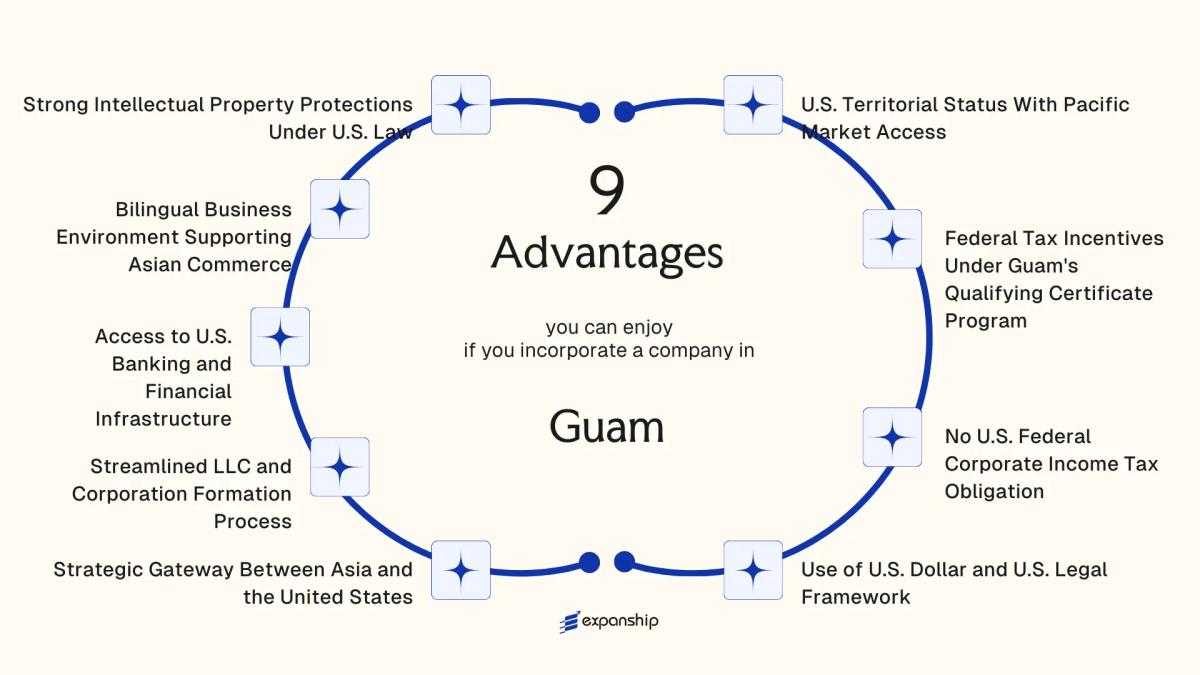
U.S. Territorial Status With Pacific Market Access
Guam's status as an unincorporated U.S. territory gives businesses registered there a positioning that few Pacific jurisdictions can replicate. A company formed under Guam law operates within U.S. legal structures while sitting geographically at the edge of the Asia-Pacific region.
What Territorial Status Actually Confers
Under the Organic Act of Guam (48 U.S.C. § 1421 et seq.), the island operates as a self-governing U.S. territory, meaning your entity benefits from U.S. constitutional protections and federal legal frameworks without being subject to all the same federal obligations as a mainland corporation. This distinction is consequential: contracts are enforceable under a recognizable legal system, which reduces counterparty risk for international partners unfamiliar with smaller offshore regimes.
Pacific Market Access as a Structural Advantage
Guam US territory Pacific market access is not merely a geographic claim. The territory holds observer status with APEC and maintains established trade relationships across Micronesia, Japan, South Korea, and the Philippines, giving your firm a credible regional foothold. Businesses incorporating in Guam for Pacific expansion gain a U.S.-backed address that resonates with Asian counterparts who require regulatory familiarity before entering commercial agreements.
A Guam-registered entity lets you present U.S. legal standing to Asian partners while operating from a Pacific time zone.
Federal Tax Incentives Under Guam's Qualifying Certificate Program
Guam's Qualifying Certificate Program tax incentives represent one of the more direct fiscal tools available to businesses operating on the island. Administered under Guam law, the program allows qualifying entities to receive abatements on business privilege taxes, real property taxes, and qualifying certificate-related fees, with the specific terms negotiated on a case-by-case basis through the Guam Economic Development Authority (GEDA).
The abatement structure means your effective tax burden can be substantially reduced from standard statutory rates for the duration of the certificate period. This is not a blanket reduction applied automatically; GEDA evaluates applications based on capital investment commitments, projected employment figures, and the nature of business activity proposed.
For foreign investors, several features of the program reduce entry friction:
- Capital investment thresholds are structured to accommodate mid-sized enterprises, not only large multinationals
- Employment requirements focus on local job creation rather than imposing complex operational mandates
- The negotiated nature of each certificate means terms can reflect your firm's actual activity profile
- Certificate durations can extend across multiple years, providing planning certainty for longer investment horizons
Once approved, your business operates under a defined, written agreement with GEDA, giving tax obligations a contractual basis rather than relying solely on discretionary administrative decisions.

Company Incorporation in Guam
Establish your business in Guam and explore eligibility for tax abatement programs administered through the Guam Economic Development Authority.
No U.S. Federal Corporate Income Tax Obligation
Corporations formed in Guam carry no U.S. federal corporate income tax obligation on income sourced within the territory. This treatment stems from Guam's status under the Internal Revenue Code's mirror tax system, codified in 48 U.S.C. § 1421i, which directs that federal income tax obligations are satisfied by paying the equivalent amount to the Guam Department of Revenue and Taxation rather than the IRS. For a foreign business owner, this means your entity is taxed locally at rates set by Guam's own tax authority, not by the federal government in Washington.
| Tax Authority | Rate Basis | Governing Framework |
|---|---|---|
| Guam Dept. of Revenue and Taxation | Mirror of U.S. IRC rates | 48 U.S.C. § 1421i |
| IRS (Federal) | No direct liability on Guam-source income | Mirror Tax Exclusion |
| Qualifying Certificate Program | Reduced local rate possible | Guam Economic Development Authority |
Under the mirror tax arrangement, tax payments flow to the local treasury rather than the federal one. This keeps revenue within the territory's fiscal system, and it means your business interacts with a single, locally accessible tax authority for its territorial income obligations. The Guam Department of Revenue and Taxation administers assessments, filings, and compliance independently from federal tax processes. Qualifying Certificate holders may also access reduced local tax rates through the Guam Economic Development Authority, creating a tiered tax position unavailable in most U.S. states.
Use of U.S. Dollar and U.S. Legal Framework
Guam US dollar and legal framework benefits are grounded in federal law, not local policy. The island operates under Title 48 of the U.S. Code as an unincorporated territory, which means your entity transacts in USD without exposure to currency conversion risk, capital controls, or exchange rate volatility that businesses face in neighboring Pacific markets.
Contract disputes are resolved under a common law system derived from U.S. federal jurisprudence. Guam's local courts apply established U.S. legal precedents, giving foreign investors a predictable litigation environment where case law is accessible, documented, and consistent with standards familiar to any U.S.-experienced counsel.
Intellectual property registered under U.S. federal law, filings with U.S. federal agencies, and compliance with U.S. regulatory bodies all apply by default. This matters because your business avoids the cost and uncertainty of operating under a foreign-language legal system with limited case history.
Keep these points in mind:
- USD is the sole legal tender; no currency hedging costs apply
- Guam Code Annotated governs local corporate law alongside applicable federal statutes
- Common law contract enforceability follows U.S. precedent
- Some federal statutes apply differently in unincorporated territories; verify applicability with qualified U.S. counsel
Despite being outside the U.S. customs zone, Guam entities still transact under full U.S. dollar monetary policy set by the Federal Reserve, with no separate territorial currency risk.
Strategic Gateway Between Asia and the United States
Guam's position as a strategic gateway between Asia and the United States is grounded in geography, not branding. Situated roughly 2,500 miles from Tokyo and Manila, and within a similar range of Seoul and Hong Kong, the island sits at an intersection that few U.S. jurisdictions can replicate. For businesses targeting both Asian and American markets simultaneously, that physical proximity translates into real operational advantages.
A U.S. Address With Pacific Reach
As a U.S. territory, your company registered here carries the legal identity of a U.S.-domiciled entity. Asian counterparts, suppliers, and institutional partners in markets like Japan, South Korea, and the Philippines often treat that designation as a marker of legal predictability, given the United States' established commercial law framework. A Guam-based firm can enter contracts, open accounts, and engage regulators across the Asia-Pacific region as a U.S.-recognized business without the overhead of maintaining a stateside headquarters.
Time Zone and Logistics Alignment
Operating within the Chamorro Standard Time zone (UTC+10), a business incorporated here can conduct same-business-day communications with financial centers across East and Southeast Asia during normal working hours. That alignment reduces the lag that affects companies coordinating across the U.S. mainland and Asian markets from a single base. Guam also serves as a U.S. Customs territory, meaning goods moving through the island enter U.S. commerce under federal trade rules, which matters for companies structuring distribution or fulfillment operations across the Pacific.
Structure Your Pacific Market Entry From Guam
Speak with Expanship's corporate services team about how a Guam entity can serve your Asia-U.S. business operations.
Streamlined LLC and Corporation Formation Process
Guam LLC and corporation formation advantages extend to the registration process itself. The entity formation framework is governed by the Guam Uniform Limited Liability Company Act (Title 18, Guam Code Annotated) for LLCs and the Guam Business Corporation Act for corporations. Both require filing with the Department of Revenue and Taxation (DRT), and neither statute imposes a residency requirement on members, directors, or officers.
- A foreign national can serve as the sole member of a Guam LLC without appointing a local resident director, reducing the structural overhead that many Asian jurisdictions require.
- The DRT accepts Articles of Organization and Articles of Incorporation without requiring notarized foreign documents for the initial filing, which shortens the timeline considerably compared to civil law jurisdictions in the Asia-Pacific region.
- Minimum capital requirements are not mandated for LLC formation, meaning your firm is not required to deposit and verify paid-in capital before the entity becomes operational.
- Annual reporting obligations are filed directly with the DRT, and the reporting cycle is predictable, allowing compliance calendars to be set well in advance.
- A registered agent with a physical address in Guam is required, but this is a standard, low-cost compliance function rather than a substantive operational constraint.
Access to U.S. Banking and Financial Infrastructure
Guam's access to U.S. banking infrastructure benefits foreign businesses in a structurally distinct way: entities incorporated there can open accounts with U.S.-chartered banks operating on the island, including branches of major institutions that operate under federal banking regulation. This means your business is subject to the same Federal Deposit Insurance Corporation (FDIC) protections and Bank Secrecy Act compliance standards as any mainland U.S. entity.
For foreign companies, this carries significant practical weight. Correspondent banking relationships between U.S. banks and international financial institutions are generally more accessible than those with offshore or purely foreign-domiciled firms. A Guam-incorporated entity is not treated as a foreign corporation by U.S. banks, which reduces the friction associated with account opening and wire transfers.
Wire transfers processed through U.S.-chartered banks on the island clear through the SWIFT network under U.S. jurisdiction, giving counterparties in Asia and the Americas a high degree of confidence in settlement reliability.
A foreign-owned LLC incorporated in Guam and holding a U.S. bank account can receive USD wire transfers from Japanese or South Korean business partners without the additional correspondent banking layers typically required for accounts held in non-U.S. jurisdictions, potentially reducing per-transaction costs and processing delays.
Bilingual Business Environment Supporting Asian Commerce
Guam's bilingual business environment advantages are most visible in day-to-day commercial operations. English is the primary language of government, law, and corporate documentation, while the Chamorro language reflects the island's indigenous Pacific identity. For Asian companies entering U.S.-regulated markets, this English-language legal environment removes a significant translation burden from contracts, filings, and regulatory correspondence.
The island's population includes substantial communities of Filipino, Korean, Japanese, and Chinese descent. This demographic reality means local professional networks, translators, and intermediaries familiar with Asian business culture are accessible. Your firm benefits from a workforce that understands both the U.S. regulatory context and the cultural norms of key Asian markets.
Geographic and cultural proximity to Japan, South Korea, the Philippines, and other Pacific economies means client-facing operations, negotiations, and partnerships can proceed without the friction typical of purely Western jurisdictions. English documentation remains fully valid under U.S. territorial law, while local cultural fluency supports relationship-building across the region.
Business communications and legal filings must be conducted in English to comply with Guam's official government and court procedures; Chamorro-language documentation does not substitute for English in formal corporate or regulatory submissions.
Strong Intellectual Property Protections Under U.S. Law
Businesses that generate value through patents, trademarks, copyrights, or trade secrets operate with considerably more legal certainty when incorporated in a jurisdiction where U.S. federal IP law applies directly. Guam intellectual property protection under U.S. law extends the full coverage of federal statutes — including the Lanham Act, the Patent Act (35 U.S.C.), and the Copyright Act (17 U.S.C.) — to entities registered on the island.
Federal IP Registration Covers Guam-Based Entities
A trademark registered with the U.S. Patent and Trademark Office (USPTO) by a Guam-incorporated company carries the same territorial scope and legal standing as one filed by a Delaware or California entity. This means your business gains access to federal injunctive relief, statutory damages, and criminal enforcement mechanisms that many offshore jurisdictions simply cannot offer through their domestic legal systems.
Enforcement Through Federal Courts
IP disputes involving your Guam-registered entity fall under U.S. federal court jurisdiction. The District Court of Guam, as an Article IV federal court, applies U.S. federal IP statutes in proceedings. Foreign businesses operating through jurisdictions without access to a federal judicial system face a meaningful gap in enforcement capability that this arrangement closes.
Practical Benefit for Technology and Brand-Driven Businesses
- Copyright protection arises automatically upon creation under U.S. law, with registration enabling statutory damages up to $150,000 per willful infringement
- USPTO-registered trademarks held by your entity qualify for U.S. Customs and Border Protection recordation, enabling border seizure of infringing imports
- Patent applications filed through a Guam entity access the same USPTO examination process as any domestic U.S. applicant
Why Guam Stands Apart From Other Pacific Jurisdictions
Guam's advantages over other Pacific jurisdictions become clearer when you place it alongside the alternatives a foreign investor would realistically evaluate. Palau, the Federated States of Micronesia, and the Marshall Islands operate under compact arrangements with the U.S., but none carries the same territorial status that grants access to U.S. federal banking infrastructure, U.S. courts, and the Uniform Commercial Code. The Compact of Free Association creates cooperation, not integration. That distinction shapes everything from banking correspondent relationships to contract enforceability.
Comparing Guam vs Pacific island jurisdictions for business also reveals a structural point that rarely surfaces in incorporation discussions: most Pacific alternatives lack a territorial tax incentive program backed by statutory authority. Guam's Qualifying Certificate program, administered by the Guam Economic Development Authority under 10 GCA Chapter 10, offers rate reductions on corporate income and gross receipts taxes that few regional peers can match through equivalent legislation. The table below captures the parameters where this distinction is most measurable.
| Parameter | Guam | Palau | Marshall Islands |
|---|---|---|---|
| U.S. Territorial Status | Yes | No (Compact State) | No (Compact State) |
| U.S. Federal Court Jurisdiction | Yes | No | No |
| Statutory Tax Incentive Program | Yes (GEDA QC Program) | Limited | Limited |
| U.S. Dollar as Official Currency | Yes | Yes | Yes |
| U.S. Banking System Access | Direct | Indirect | Indirect |
| Intellectual Property Under U.S. Law | Full coverage | Partial | Partial |
Compliance Services for Companies in Guam
Maintain good standing with Guam's regulatory requirements, from annual reporting to licensing obligations under the Department of Revenue and Taxation.
Conclusion
Guam's position as a U.S. territory in the Western Pacific creates a structural combination that few jurisdictions can replicate: domestic U.S. legal standing, federal tax incentive access through the Qualifying Certificate program, and direct commercial proximity to East and Southeast Asian markets. These features are not incidental. They reflect the specific legal architecture governing the island under 48 U.S.C. and Guam's own Title 18 corporate statutes.
The benefits of incorporating in Guam carry different weight depending on your business model. A firm seeking tax reductions through the Guam Economic Development Authority will have different priorities than one using a local entity primarily as a U.S.-anchored holding structure for Asian transactions. The territory's bilingual environment and U.S. dollar economy are consistently relevant, but the Qualifying Certificate incentives are industry-specific and require meeting defined criteria.
For businesses where the combination of Pacific geography, U.S. legal protections, and tax incentive eligibility aligns with operational needs, the case for Guam company formation is grounded in verifiable regulatory and fiscal structure rather than perception. Understanding how these factors apply to your specific entity type and industry is the step that determines whether the Guam business incorporation benefits translate into measurable outcomes for your firm.
Start Your Guam Incorporation Journey With Expanship
Expanship assists foreign investors with Guam incorporation services that span the full lifecycle of establishing and maintaining a U.S. territorial entity. From preparing formation documents compliant with the Guam Department of Revenue and Taxation's requirements to managing ongoing obligations under the Guam Business Privilege Tax regime, the firm works directly with the relevant local authorities on your behalf. The specific entity structures, tax programs, and U.S. legal frameworks discussed throughout this blog each carry distinct procedural requirements that Expanship handles at the jurisdictional level.
Expanship's service scope for company formation in the territory includes:
- Preparation and legalization of Articles of Incorporation or Articles of Organization
- Registered agent and registered office provision within the territory
- Filing liaison with the Guam Department of Revenue and Taxation and the Department of Law
- Qualifying Certificate application support under the relevant incentive program
- Post-incorporation compliance management, including annual reporting and license renewals
- Banking introduction assistance to support access to U.S. financial infrastructure
Each service addresses a specific procedural or regulatory requirement, reducing the administrative burden on foreign principals who are not physically present in the territory.
To discuss your requirements directly, contact Expanship Guam.
Frequently Asked Questions (FAQ)
The Qualifying Certificate Program is administered by the Guam Economic Development Authority (GEDA) and provides certified businesses with reductions on Guam income tax, as well as potential relief from other local taxes. Eligibility is tied to specific economic activity criteria, including investment thresholds and job creation commitments within the territory. Businesses outside qualifying industries or below the required investment levels may not be eligible for these incentives.
A company incorporated in Guam and operating solely within the territory generally pays Guam income tax in lieu of U.S. federal corporate income tax, under the mirror tax system established by the Organic Act of Guam. This means the entity files with the Guam Department of Revenue and Taxation rather than the IRS. However, companies with U.S.-source income or mainland operations may have different federal obligations.
Intellectual property protections available to a Guam-incorporated entity are grounded in U.S. federal law, including the Lanham Act for trademarks and the Copyright Act, because Guam is a U.S. territory subject to applicable federal statutes. Registration through the U.S. Patent and Trademark Office is available to Guam-based businesses on the same basis as mainland entities. This gives the firm access to federal enforcement mechanisms that are not available through most offshore or Pacific island jurisdictions.
No, Guam is a U.S. territory, and businesses incorporated there are generally not treated as foreign entities by U.S. financial institutions. A Guam company can access U.S. dollar-denominated accounts and domestic wire infrastructure without the additional due diligence burden typically applied to offshore entities. This distinction is significant for companies that need to transact with U.S.-based clients or suppliers.
Formation is processed through the Department of Revenue and Taxation's Business License Division, and standard processing times can range from a few business days to several weeks depending on the filing method and current agency workload. Expedited options may be available for an additional fee. Once the Articles of Organization or Articles of Incorporation are accepted, the entity is legally formed and can proceed with licensing and banking steps.
Both Guam and the U.S. Virgin Islands operate mirror tax systems, meaning local territorial tax replaces U.S. federal income tax for qualifying income. The key differences lie in their respective incentive programs: the Virgin Islands offers the Economic Development Commission program, while Guam operates through GEDA's Qualifying Certificate Program, each with distinct eligibility criteria, benefit levels, and industry focus. The geographic positioning of each territory also differs materially, with Guam serving as a closer hub for East and Southeast Asian commerce.
Legal Disclaimer
The information provided in this article is for general informational purposes only and does not constitute legal, tax, or professional advice. While we strive to ensure the accuracy and timeliness of the content, laws and regulations are subject to change, and the application of laws can vary widely based on specific facts and circumstances.
Readers should not act upon this information without seeking professional counsel tailored to their individual situation. Expanship and its authors disclaim any liability for actions taken or not taken based on the content of this article.
For specific advice regarding your business setup, compliance requirements, or any legal matters, please consult with qualified legal and tax professionals in the relevant jurisdiction.