
Key Takeaways
- Entities incorporating in Greenland must be registered with the Danish Business Authority (Erhvervsstyrelsen), which retains jurisdiction over commercial registration for the territory and will reject applications that fail to meet its formation requirements.
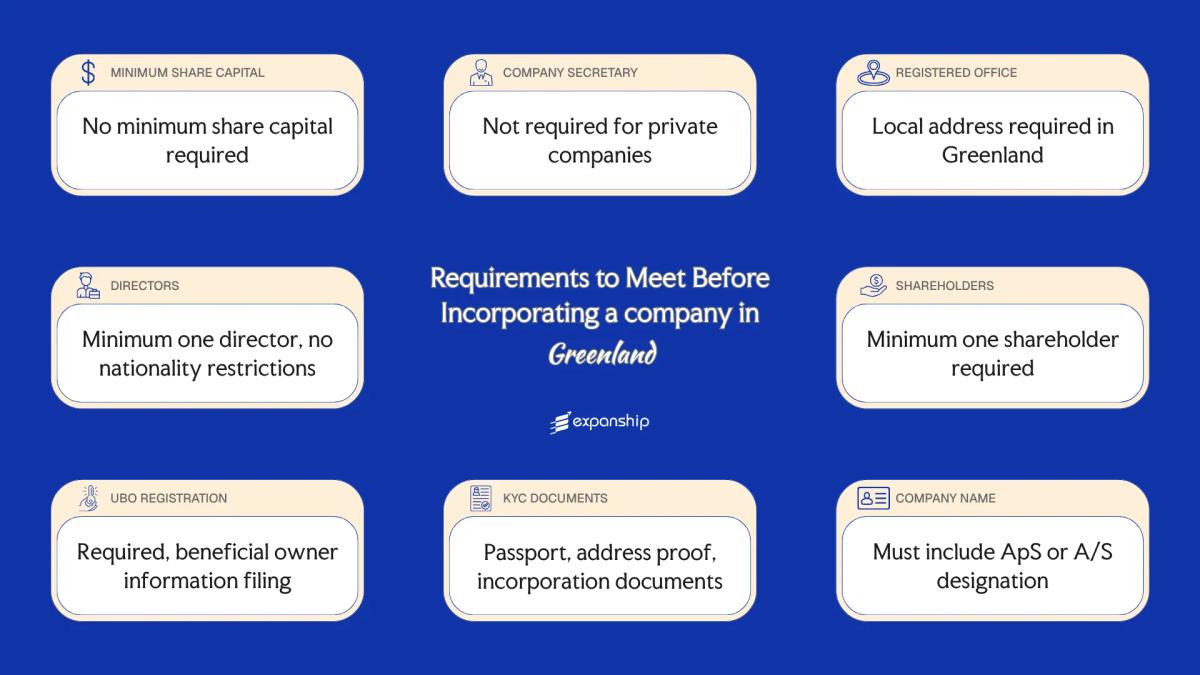
- Under Selskabsloven, companies are subject to minimum share capital thresholds that vary by entity type and must be satisfied before registration can be completed.
- Beneficial ownership disclosure is a compliance obligation, not an optional step, requiring founders and controlling parties to report UBO information as part of the registration process administered through Danish-derived corporate law.
- A registered office must be maintained within Greenland's territory, and directorship rules — including any applicable residency conditions — must be satisfied from the point of incorporation onward.
Greenland's company law framework is governed by Danish-derived legislation, with entity formation overseen by the Danish Business Authority (Erhvervsstyrelsen), which maintains jurisdiction over commercial registration for entities operating within the territory. Understanding the incorporation requirements in Greenland means engaging with a regulatory structure that applies across capital thresholds, directorship rules, registered address obligations, and ownership disclosure standards.
Failure to satisfy these requirements at the point of registration results in rejection of the application, and operating without proper registration exposes a business to legal liability under applicable commercial law. Requirements can also differ depending on the entity type selected and the specific industry your business intends to operate in.
The primary legislation governing business formation is accessible via Selskabsloven. Foreign investors, non-resident entrepreneurs, and multinational firms establishing a presence in an Arctic jurisdiction with distinct regulatory considerations will find this article most directly applicable to their situation.
Minimum Share Capital Requirements in Greenland
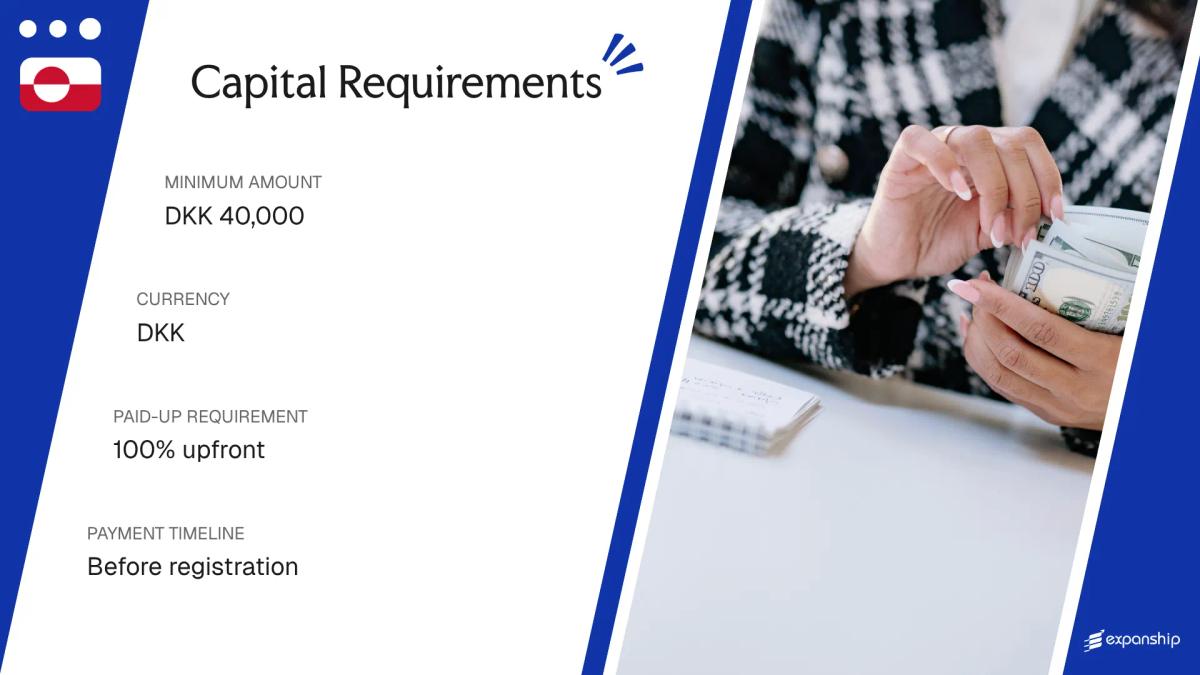
Greenland minimum share capital requirements are governed by Danish-derived corporate law, as Greenland applies rules substantially aligned with Danish legislation through its Self-Rule framework. The two primary private business structures are the Anpartsselskab (ApS) and the Aktieselskab (A/S), each carrying distinct capital thresholds enforced at registration.
Capital registration is administered through the Danish Business Authority (Erhvervsstyrelsen), which also handles Greenlandic entities due to the absence of a separate local commercial registry. Share capital is a one-time statutory requirement at incorporation, not an ongoing obligation subject to annual recalibration, though changes must be formally registered if the capital structure is later altered.
| Parameter | Detail |
|---|---|
| Minimum Authorized Share Capital | DKK 40,000 for an ApS; DKK 400,000 for an A/S |
| Maximum Authorized Share Capital | No statutory maximum |
| Minimum Paid-Up Capital | Full amount required at incorporation |
| Paid-Up Requirement at Incorporation | 100% of the minimum share capital must be paid up upon formation |
| Accepted Currency | Danish Krone (DKK) |
| Accepted Forms of Contribution | Cash or non-cash contributions (in-kind assets subject to independent valuation) |
| Timeframe to Deposit Capital | Prior to or at the time of registration with the Danish Business Authority |
Meeting the minimum threshold does not mean capital can be withdrawn immediately after incorporation. The subscribed amount must remain accessible as working capital and is not treated as a one-time deposit that can be freely repatriated post-registration.
Company Secretary Requirements in Greenland
Greenland company secretary requirements differ from many European jurisdictions in that the corporate secretary role is not a formally mandated statutory position under the Danish-derived company law framework that applies in Greenland. However, businesses incorporated as an Aktieselskab (A/S) or Anpartsselskab (ApS) are generally expected to maintain a responsible contact point capable of handling regulatory correspondence and record-keeping obligations.
The agent or equivalent contact person carries duties that include maintaining statutory registers, ensuring filings are submitted to the relevant Danish Business Authority (Erhvervsstyrelsen) processes applicable to Greenland-registered entities, and keeping corporate records current.
Qualification criteria for who may serve in this capacity:
- No statutory residency requirement is explicitly mandated for the secretary or equivalent contact role.
- The individual or entity must have legal capacity to act on behalf of a company under applicable rules.
- Corporate service providers operating legitimately within the jurisdiction may fulfil this function.
- There is no formal licensing regime specifically governing corporate secretaries in this jurisdiction.

Incorporate a Company in Greenland
Set up your Aktieselskab or Anpartsselskab in Greenland with accurate filing support and ongoing compliance assistance.
Registered Office Requirements in Greenland
Registered office requirements in Greenland are governed under Danish-derived corporate law, as the territory operates within the Danish legal framework through the Selskabsloven (Companies Act), which applies with local administrative adaptations. A non-compliant or missing registered address can result in administrative sanctions, including deregistration of the entity from the Greenlandic business registry.
- A physical address within Greenland is required; P.O. boxes do not satisfy the registered office obligation.
- Virtual office addresses are generally not accepted as a standalone registered address without a verifiable physical presence.
- The address must be locally situated within Greenland's territory; a Danish mainland address does not qualify.
- Proof of occupancy, such as a lease agreement or ownership documentation, is typically required to substantiate the address.
- The registered address is publicly listed in the Greenlandic business register and is accessible to third parties.
- Any change to the registered office address must be formally notified to the relevant registration authority; failure to update the record in a timely manner may constitute a compliance breach.
Director Requirements in Greenland
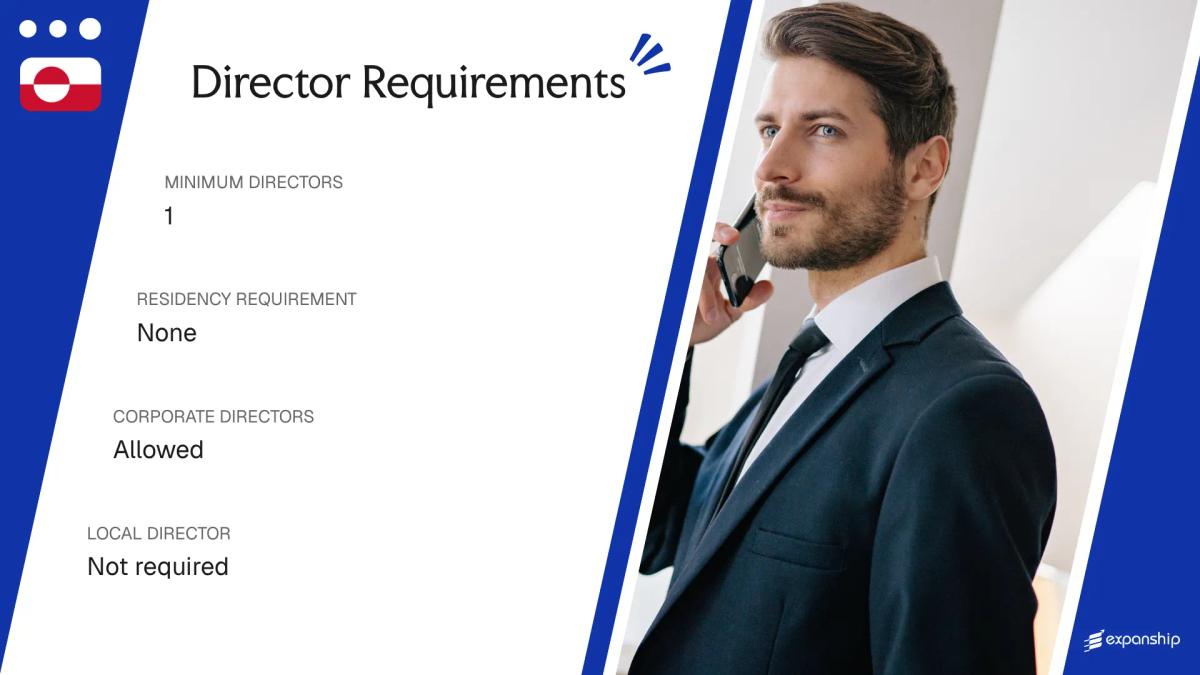
Director requirements in Greenland follow the legal framework established under Danish corporate law, as adapted for application within Greenlandic jurisdiction, placing statutory duties of loyalty, due care, and financial accountability on each appointed director. Upon appointment, a director assumes personal liability for decisions that breach the company's articles or applicable law.
| Parameter | Detail |
|---|---|
| Minimum Number of Directors | One director is required. |
| Maximum Number of Directors | No statutory maximum is prescribed. |
| Local/Resident Director Required | No residency requirement is imposed by statute. |
| Nationality Restrictions | No nationality restrictions apply. |
| Minimum Age Requirement | Directors must be at least 18 years of age. |
| Corporate Directors Permitted | Corporate directors are generally not permitted; a natural person is required. |
| Director Must Be a Shareholder | No statutory requirement for a director to hold shares. |
| Publicly Listed on Registry | Director information is recorded in the Greenlandic business registry. |
| Disqualification Conditions | Persons declared bankrupt or disqualified by court order are ineligible to serve. |
Despite Greenland's administrative ties to Denmark, Danish residency does not automatically satisfy any local directorship condition, as the two jurisdictions maintain separate registration frameworks.
Shareholder Requirements in Greenland
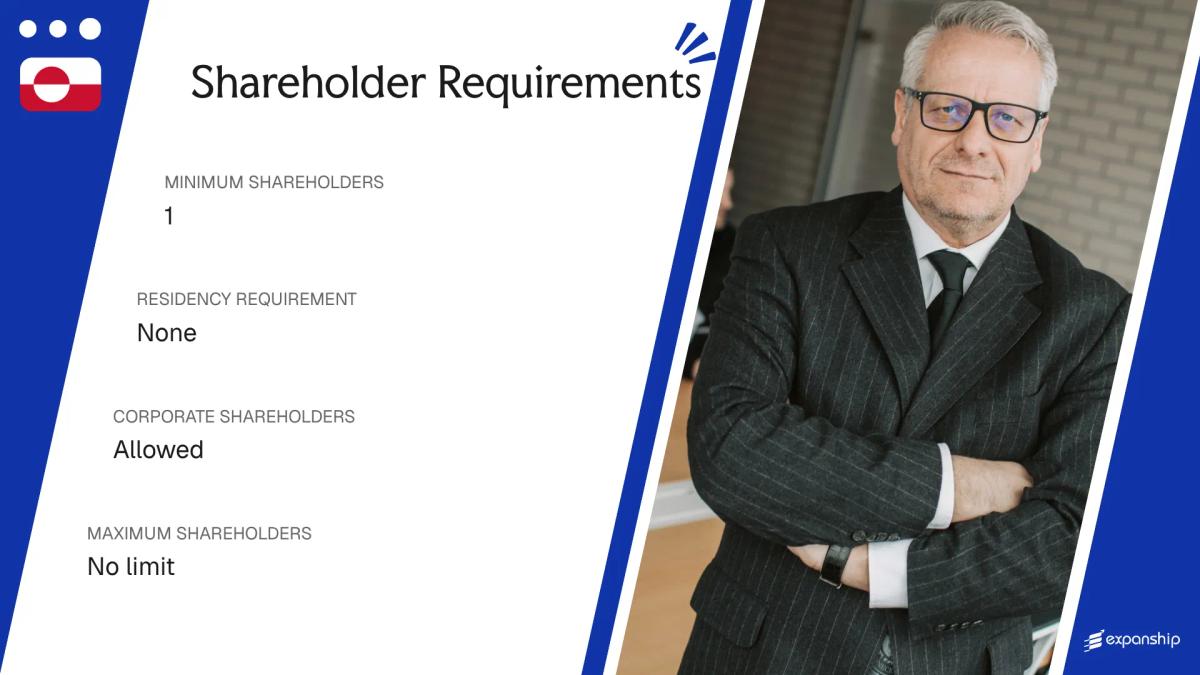
Under Greenlandic company law, an Anpartsselskab (ApS) requires a minimum of one shareholder, meaning a sole shareholder structure is permitted. No statutory maximum applies to the number of shareholders.
Nationality and Residency Restrictions
Shareholder requirements in Greenland do not impose nationality or residency conditions on shareholders. Foreign individuals and entities may hold full ownership without restrictions on the percentage of shares held.
Corporate Shareholders
Corporate entities are permitted to act as shareholders in a Greenlandic company. No specific conditions are imposed solely on the basis of the shareholder being a legal entity rather than a natural person.
Shareholder Liability
Shareholder liability is limited to the amount contributed toward the share capital. Circumstances that could extend liability beyond that contribution generally follow standard Danish-derived legal principles applicable in Greenland, such as cases involving fraud or improper conduct.
Register of Shareholders
Your business is required to maintain an internal register of shareholders. This register is not publicly accessible, but it must be kept current and made available to relevant authorities upon request.
Ownership Structure Guidance for Your Greenland Entity
Get tailored advice on structuring shareholder arrangements that meet local legal requirements for your Greenland incorporation.
UBO / Beneficial Ownership Disclosure Requirements in Greenland
Greenland beneficial ownership disclosure requirements follow Danish legislative frameworks, as the territory operates under Danish jurisdiction for corporate and financial regulation purposes. The Danish Companies Act (Selskabsloven) and the Danish Anti-Money Laundering Act establish the definition of a beneficial owner as any natural person holding more than 25% of ownership, voting rights, or effective control over an entity.
- Identify all natural persons meeting the 25% ownership or control threshold.
- Record UBO details in the entity's internal register, including full name, address, nationality, and the nature of the controlling interest.
- Submit UBO information to the Danish Business Authority (Erhvervsstyrelsen) via the Central Business Register (CVR).
- Update the register promptly when any change in beneficial ownership occurs.
| Parameter | Detail |
|---|---|
| Ownership Threshold for UBO Status | 25% of shares, voting rights, or effective control |
| Filing Authority | Danish Business Authority (Erhvervsstyrelsen) via CVR |
| Disclosure Deadline at Incorporation | Upon registration of the entity |
| Publicly Accessible Register | Yes, via the CVR public portal |
| Penalties for Non-Disclosure | Fines under the Danish Companies Act |
| Ongoing Update Obligation | Yes, upon any change in beneficial ownership |
KYC / Document Requirements in Greenland
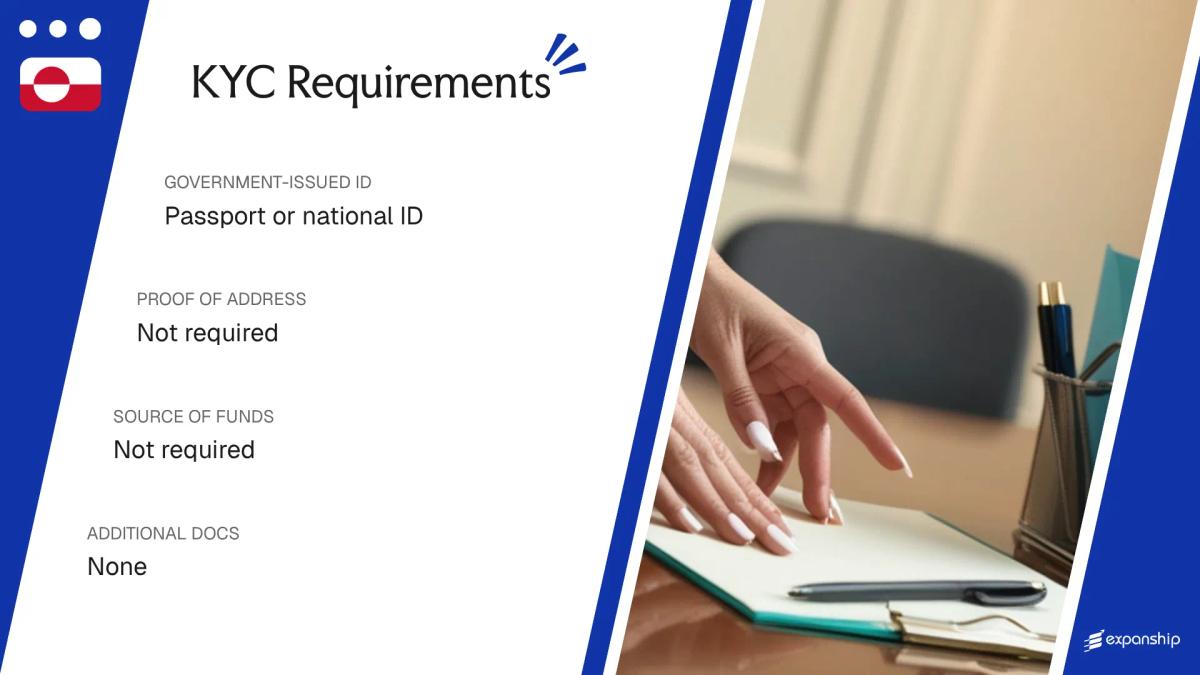
Greenland KYC document requirements are governed by the Danish AML framework, which extends to Greenland under the Act on Measures to Prevent Money Laundering and Financing of Terrorism. The Danish Financial Supervisory Authority (Finanstilsynet) oversees compliance obligations applicable to entities formed in the territory.
Individual / Personal Documents
- Valid government-issued photo ID (passport or national identity card) for each director, shareholder, and beneficial owner
- Proof of residential address dated within three months, such as a utility bill or official bank statement
- Signed declaration confirming the individual's role and capacity within the company
- Tax identification number or equivalent, where applicable under Danish tax registration rules
Corporate Documents
- Certificate of incorporation or equivalent formation document for any corporate shareholder or director
- Articles of association or constitutional document confirming the entity's legal structure
- Current register of directors issued by the relevant company registry
- Official proof of the corporate entity's registered address
Source of Funds Documentation
- Recent bank statements covering a minimum of three months prior to incorporation
- Audited financial statements, where the introducing entity has an established trading history
- Written explanation of the origin of capital, signed by an authorised representative
Notarisation and Apostille Requirements
- Foreign documents must generally be apostilled under the Hague Convention before submission
- Documents not in Danish or English require a certified translation by a sworn translator
- Notarisation by a qualified notary is required for corporate documents originating outside Denmark or Greenland
Submission of address verification documents older than three months is among the most common reasons for incorporation delays.
Company Name Requirements in Greenland
Greenland company name requirements follow a general approval process conducted through the Danish Business Authority, which holds jurisdiction over commercial registrations in Greenland. Proposed names are assessed for uniqueness against existing registrations before an entity can be incorporated.
Names must be in Danish or Greenlandic and include a legal suffix corresponding to the chosen entity type, such as "A/S" for public limited companies or "ApS" for private limited companies. Generic or purely descriptive names are typically rejected.
Certain words implying state affiliation, financial licensing, or professional regulation require prior consent from the relevant authority before they can be included in a business name. Words suggesting a connection to government bodies or regulated industries are subject to heightened scrutiny.
Name reservation is available through the Danish Business Authority prior to formal registration. Reserved names are held for a limited period, and your application must be submitted directly through the authority's registration portal.
Compliance Services for Companies in Greenland
Stay current with Greenland's regulatory obligations, from annual reporting to business authority filings, through structured compliance support.
Conclusion
Greenland company incorporation requirements follow a structured framework under Danish-derived corporate law, administered through the Danish Business Authority. Residency conditions for directors, the registered office mandate within Greenland's territory, and the disclosure obligations tied to beneficial ownership represent some of the more consequential requirements for foreign investors forming an entity here. Once these obligations are understood, the practical work shifts to preparing compliant documentation, coordinating with local registered agents, and filing correctly with the relevant authority before business operations can begin.
Expanship's Corporate Services for Greenland Expansion
Greenland's incorporation framework, with its interplay between Danish corporate law principles, Naalakkersuisut's regulatory expectations, and local registered office obligations, requires careful coordination from the outset. Expanship's Greenland company formation services are structured to manage that coordination on your behalf, reducing the administrative burden at each stage without replacing your own decision-making. Your business retains full visibility while we handle the procedural requirements.
Beyond initial registration, our service scope covers the full lifecycle of your entity's compliance obligations:
- We prepare and file all company registration documents with the relevant Greenlandic authorities.
- Our team provides registered agent and office facilities within the jurisdiction.
- We liaise directly with government bodies on your behalf for regulatory filings and official correspondence.
- Post-incorporation obligations, including annual reporting and ongoing compliance, are managed through our team.
- Banking introduction support is available to help your entity establish the accounts it needs to operate.
- We also assist with tax registration and coordination with local fiscal authorities.
To discuss your requirements, contact Expanship Greenland.
Frequently Asked Questions (FAQ)
An Anpartsselskab (ApS) requires a minimum share capital of DKK 40,000, which must be fully paid up at the time of registration. No partial payment arrangement is available for meeting this threshold. For an Aktieselskab (A/S), the minimum rises significantly to DKK 400,000.
Under the Danish Companies Act, there is no strict residency requirement for directors of an ApS, meaning foreign nationals can serve without being resident in Greenland or Denmark. However, practical considerations around signing authority, legal notifications, and local administrative obligations may make appointing a local representative advisable. The absence of a statutory residency rule does not eliminate the operational need for a local point of contact.
Failure to maintain a valid registered office address results in the company being unreachable for official correspondence from the Danish Business Authority (Erhvervsstyrelsen), which can trigger administrative dissolution proceedings. The registered address is the legal anchor for regulatory notices, legal service, and public registry records. A lapsed or invalid address is treated as a compliance failure, not a minor administrative oversight.
Greenland is not a member of the European Union and is not subject to EU directives directly, including the Anti-Money Laundering Directives that mandate beneficial ownership registers across EU member states. Denmark, while an EU member, has a specific carve-out for Greenland, so EU AML register requirements do not automatically extend to Greenlandic entities. That said, companies registered through Danish legal frameworks may still face UBO reporting obligations depending on the structure and where activities are conducted.
Foreign shareholders are generally required to provide certified identification documents, proof of residential address, and depending on the corporate structure, documentation establishing the ownership chain up to the ultimate beneficial owner. Where the shareholder is itself a corporate entity, constitutional documents such as the certificate of incorporation and articles of association will be required. The specific document standards may vary based on the registering agent or notary involved, but the underlying purpose is satisfying anti-money laundering identification standards.
Company names in Greenland must be distinctive and must not mislead the public or duplicate an already-registered name, with the Danish Business Authority responsible for reviewing and approving names at the point of registration. Names implying a regulated activity, such as banking or insurance, require corresponding authorisation before the name can be used. The suffix must also correctly reflect the legal form, so an ApS cannot use A/S in its name, and vice versa.
Legal Disclaimer
The information provided in this article is for general informational purposes only and does not constitute legal, tax, or professional advice. While we strive to ensure the accuracy and timeliness of the content, laws and regulations are subject to change, and the application of laws can vary widely based on specific facts and circumstances.
Readers should not act upon this information without seeking professional counsel tailored to their individual situation. Expanship and its authors disclaim any liability for actions taken or not taken based on the content of this article.
For specific advice regarding your business setup, compliance requirements, or any legal matters, please consult with qualified legal and tax professionals in the relevant jurisdiction.