
Key Takeaways
- Foreign businesses incorporating in Greenland must operate within a legal framework derived from the Danish Companies Act, meaning structural compliance obligations are anchored to Danish law rather than a locally autonomous corporate statute.
- Greenland's small resident population and geographic isolation create a commercially constrained local market that is unlikely to support scale for most non-extractive business models without reliance on export or remote service delivery.
- The dual-layer administrative structure of Naalakkersuisut self-government alongside Danish regulatory oversight introduces procedural complexity that can materially extend company registration and ongoing compliance timelines.
- Sparse local banking infrastructure and limited access to international financial services from within the territory place an additional operational burden on foreign entities that require routine cross-border payment, lending, or treasury functions.
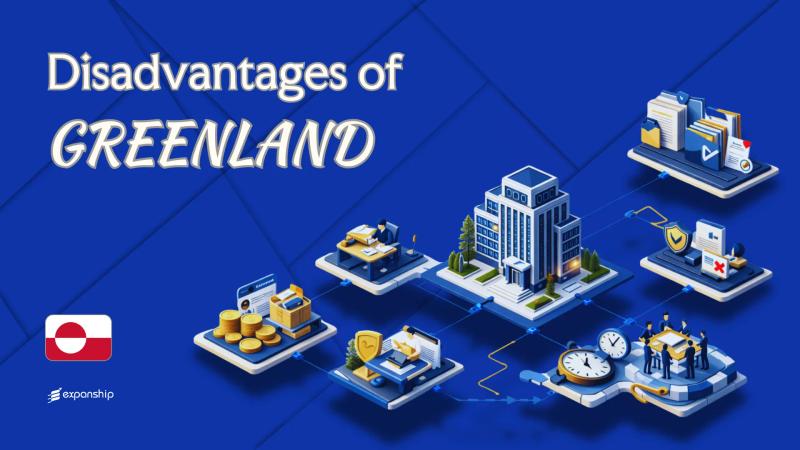
Incorporating a business in Greenland sits within an evolving regulatory framework, shaped significantly by the relationship between Greenlandic self-government and the Kingdom of Denmark. The disadvantages of incorporating in Greenland span operational, financial, structural, and administrative categories — each carrying different weight depending on your industry and intended business model.
Not every drawback will apply equally to your firm. A resource extraction company faces a different set of constraints than a digital services entity, and the severity of each obstacle shifts accordingly.
This article is most relevant to foreign investors and international business owners considering a formal commercial presence in Greenland, particularly those unfamiliar with the self-rule governance structure under Naalakkersuisut. Business formation in the territory is governed within a legal framework that draws directly from Danish company law, including the Danish Companies Act.
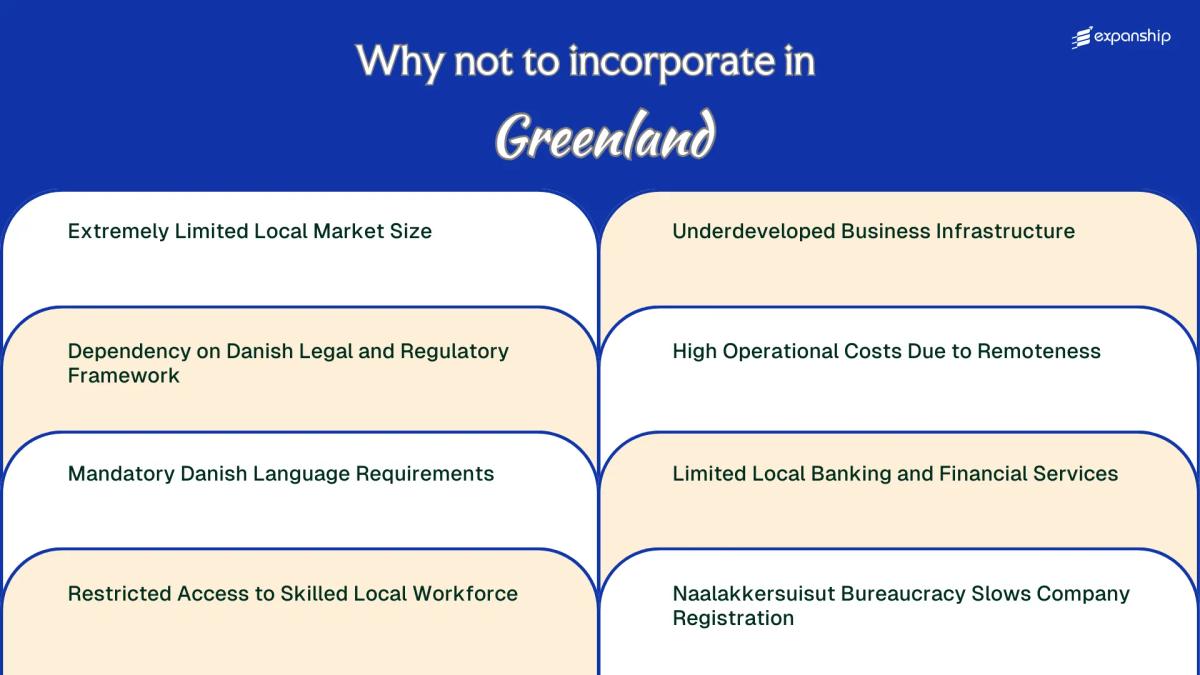
Extremely Limited Local Market Size
Greenland small market size limitations present one of the most structurally fixed barriers for any foreign entity entering this territory. With a population of approximately 56,000 people spread across a landmass larger than Mexico, the restricted consumer base defines the ceiling for almost every domestic revenue model.
A Population Too Small to Sustain Most Business Models
Consumer demand at this scale cannot support standard volume-dependent business models in retail, manufacturing, or services. Your firm would need to generate the majority of its revenue from external markets from the outset, since the local economy cannot absorb typical startup growth trajectories.
Most economic activity concentrates in Nuuk, which holds roughly 20,000 residents. Outside the capital, settlements are small, geographically isolated, and commercially underdeveloped, meaning your distribution costs rise sharply relative to the revenue each location can generate.
Structural Limits on B2C and B2B Opportunity
Greenland limited domestic market drawbacks extend into the B2B sector as well. The number of registered businesses is correspondingly small, constraining the addressable market for professional services, technology, or supply-chain-dependent operations.
Even public sector contracts, a common fallback in small economies, are subject to Naalakkersuisut procurement rules that may prioritize local or Danish-affiliated suppliers.
Your business cannot realistically use Greenland as a primary revenue market; any incorporation strategy that depends on local sales volume will fail to reach financial sustainability.
Dependency on Danish Legal and Regulatory Framework
Greenland's dependency on Danish legal framework means your business does not operate under a fully autonomous corporate law system. The Danish Companies Act (Selskabsloven) and related Danish legislation apply directly, administered at arm's length from Copenhagen, which adds a layer of jurisdictional complexity that does not exist in most other incorporation destinations.
Foreign business owners face a structurally fragmented regulatory environment. Local Naalakkersuisut authority covers certain sectors, but Danish law governs company formation, financial reporting, and corporate governance. Resolving which layer applies to a given compliance obligation requires legal counsel familiar with both systems.
This dual-layer structure creates specific operational burdens:
- Disputes may fall under Danish court jurisdiction, requiring legal representation in Denmark rather than locally, which increases litigation costs significantly.
- Changes to Danish corporate legislation automatically affect your entity without any local legislative process or prior notice from Greenlandic authorities.
- Compliance timelines set under Danish law do not account for the logistical delays common to operating from a remote territory.
- Regulatory interpretations sometimes require escalation to Danish authorities, extending resolution periods and creating administrative bottlenecks.
Companies with no existing Danish legal infrastructure are disproportionately affected. Building that capacity adds cost and management overhead that firms incorporating in fully self-governing jurisdictions do not encounter.

Company Incorporation in Greenland
Understand the regulatory requirements and legal framework before establishing your business presence in Greenland.
Mandatory Danish Language Requirements
Danish language requirements in Greenland create a concrete, ongoing compliance burden for foreign business owners that extends well beyond initial registration.
All formal corporate documentation, filings with the Danish Business Authority (Erhvervsstyrelsen), and regulatory correspondence must be submitted in Danish. Greenland operates under Danish jurisdiction for company law purposes, which means the legal framework itself, including the Danish Companies Act (Selskabsloven), functions exclusively in Danish. If your legal and financial team does not include Danish-fluent professionals, every document your entity produces requires certified translation before it carries legal validity.
| Requirement | Language Mandated | Implication for Foreign Firms |
|---|---|---|
| Articles of Association | Danish | Full certified translation required for non-Danish founders |
| Filings with Erhvervsstyrelsen | Danish | Non-Danish submissions rejected or returned |
| Shareholder resolutions | Danish | External legal translation needed for each resolution |
| Annual financial statements | Danish | Audit and accounting firms must operate in Danish |
| Employment contracts | Danish (standard) | Non-Danish drafts carry legal ambiguity in disputes |
Certified translation services for legal and corporate documents carry significant per-word or per-page costs, and for a business producing ongoing compliance materials, those costs accumulate quickly. The language barriers incorporating in Greenland presents are not a one-time obstacle at setup; they recur with every board resolution, financial filing, and regulatory update.
Greenlandic (Kalaallisut) holds co-official status alongside Danish in some administrative contexts, but this does not reduce the Danish language compliance challenges foreign businesses face. Corporate law, tax filings, and commercial registry requirements remain anchored entirely to Danish-language standards.
Restricted Access to Skilled Local Workforce
Greenland skilled workforce shortage risks are among the most structurally embedded constraints any foreign business will face after incorporation. The island's total population sits at approximately 56,000, with the majority concentrated in Nuuk and a handful of coastal towns.
That geographic dispersal directly limits the pool of workers available for specialized roles. Sectors requiring technical, financial, or engineering expertise face particular strain, as local training infrastructure remains thin relative to industry demand.
Formal education beyond secondary level typically requires students to relocate to Denmark. That relocation pattern means many qualified Greenlanders do not return, creating a persistent outflow of skilled graduates that your firm cannot easily offset through local recruitment.
Under Greenlandic labor market conditions, recruiting internationally involves navigating residence and work permit procedures administered through Danish immigration authorities. That process adds lead time and administrative cost before a single hire can begin work.
- Work permits for non-EU, non-Danish nationals are processed under Danish immigration rules, not local Greenlandic authority
- Reliance on expat hires increases payroll costs due to relocation allowances and housing in a high-cost environment
- Local vocational and higher education outputs are insufficient to fill roles in finance, engineering, or IT
- Talent sourced from Denmark may require contracts structured around periodic rotation, adding HR complexity
Greenland has no university of its own; the University of Greenland (Ilisimatusarfik) offers limited degree programs, meaning most advanced professional qualifications must be obtained abroad.
Underdeveloped Business Infrastructure
Greenland's underdeveloped business infrastructure drawbacks extend beyond inconvenience; they translate directly into structural constraints that affect daily operations, supply chains, and long-term viability for any foreign-registered entity.
Physical Infrastructure Gaps
Outside Nuuk, paved road networks are largely absent, and there is no road connection between towns at all. Your business cannot rely on overland freight between settlements, which means that distributing goods or equipment across the island depends entirely on air or sea, both of which are subject to severe seasonal and weather-related disruptions.
Greenland logistics limitations for businesses are compounded by the fact that the country has no railway system and limited port capacity outside a handful of coastal locations.
Operational Consequences for Foreign Entities
Poor infrastructure risks for a Greenland company include unpredictable delivery timelines that make inventory planning and contract fulfillment genuinely unreliable. Firms operating in sectors that require time-sensitive logistics, such as construction or retail supply, face disproportionate exposure to delays that cannot be contractually insured away.
Digital infrastructure outside Nuuk also remains limited, with connectivity gaps that restrict remote operations.
Operating Through Greenland's Infrastructure Constraints
Speak with our team about the structural limitations that affect company operations in Greenland and how to structure your entity accordingly.
High Operational Costs Due to Remoteness
High operational costs Greenland remoteness creates are among the most structurally embedded disadvantages any foreign business will face when establishing a presence there. Geographic isolation from European and North American supply chains drives up nearly every input cost before operations even begin.
- Shipping goods to Greenland depends heavily on Royal Arctic Line, the dominant carrier serving the territory, which operates on infrequent schedules that extend lead times and increase per-unit logistics costs compared to continental European markets.
- Fuel prices run significantly above Danish mainland rates because all petroleum products must be imported, directly inflating energy costs for any facility-dependent business.
- Construction and facility maintenance costs are elevated by the need to import most building materials, labor, and equipment across remote geographic isolation business risks that are impossible to hedge through local sourcing.
- The absence of road connections between most settlements means inter-settlement transport relies on air or sea, multiplying distribution costs for any firm serving multiple Greenlandic locations.
Limited Local Banking and Financial Services
Accessing reliable banking is one of the more concrete banking access challenges incorporating in Greenland presents to foreign businesses. The territory has no independent central bank; monetary policy falls under Danmarks Nationalbank, and the financial sector is served by a small number of Danish-affiliated institutions, primarily Grønlandsbanken (Bank of Greenland), which holds a dominant market position with limited competition.
For a foreign-owned entity, this concentration means fewer choices, less competitive fee structures, and slower service timelines than you would encounter in most European jurisdictions. Opening a corporate account typically requires in-person verification and extensive documentation, and the process is not designed with non-resident directors in mind.
Greenland financial services restrictions for companies also extend to trade finance, credit facilities, and foreign currency products. These instruments are either unavailable locally or must be arranged through Danish parent institutions, adding intermediary layers and cost.
A foreign-owned ApS incorporated in Greenland requiring a EUR 50,000 trade credit facility would likely need to engage a Danish bank's mainland division, incurring cross-institutional processing fees, extended approval timelines of potentially 6-10 weeks, and currency conversion costs that a business banking in Copenhagen would not face.
Naalakkersuisut Bureaucracy Slows Company Registration
Naalakkersuisut bureaucracy company registration delays are a documented friction point for foreign investors attempting to establish a legal presence in Greenland. The Naalakkersuisut, the island's self-governance authority, operates with a relatively small administrative apparatus, and processing capacity does not scale efficiently against the complexity of inbound foreign business applications.
Company registration must align with both Danish commercial law frameworks and Greenlandic self-governance regulations, creating a dual-layer compliance requirement. For a foreign business owner, this means your application may move between two administrative systems before receiving clearance, extending timelines unpredictably.
Greenland's public administration is concentrated in Nuuk, with limited regional processing capacity elsewhere. Delays are compounded when documents require translation, Danish notarization, or inter-agency coordination between Nuuk and Copenhagen.
There is no publicly available standard service level agreement governing registration timelines, which makes incorporation planning difficult for businesses operating against contractual or investment deadlines. Unlike jurisdictions with online single-window registration systems, the process here relies heavily on manual review.
- No fully digital company registration portal exists for foreign applicants
- Inter-jurisdictional coordination with Danish authorities adds procedural steps
- Limited staffing at the Naalakkersuisut business registry creates processing bottlenecks
Because Greenland lacks a standalone company law independent of Danish legislation, your registration process is subject to review under both the Danish Companies Act and Naalakkersuisut administrative procedures, and failure to satisfy either layer will stall or void your application.
Strategies to Overcome These Obstacles
Overcoming Greenland incorporation obstacles requires structural preparation before the company is registered, not after problems surface. The jurisdiction's dependency on Danish legal frameworks and its remote geography create conditions that reward advance planning over reactive adjustment.
- Retain a Danish-qualified legal counsel familiar with the Selskabsloven (Danish Companies Act) to handle corporate documentation from the outset.
- Pre-translate all founding documents, articles of association, and regulatory filings into Danish before engaging Erhvervsstyrelsen.
- Establish a correspondent banking relationship with a Danish parent bank prior to incorporation, given the absence of local financial institutions.
- Identify remote-hire or secondment arrangements to fill skilled roles not available locally before operational launch.
- Budget for air freight and satellite-dependent infrastructure costs as fixed overheads, not contingency items.
Mitigating risks of Greenland company formation is constrained by the Naalakkersuisut's administrative processes, which operate on timelines outside your control. These steps reduce friction at the preparatory stage but do not eliminate the structural limitations inherent to this jurisdiction.
Greenland's Overall Business Viability
Conducting a thorough Greenland business viability risks assessment reveals a destination that is not without merit. The territory holds genuine strategic value for extractive industries and Arctic-focused operations, yet the structural constraints documented throughout this blog are real and not easily offset by incorporation alone.
| Pros | Cons |
|---|---|
| Access to significant natural resource sectors under Greenlandic law | Local market of roughly 56,000 people offers minimal domestic consumer demand |
| Corporate tax rates governed under a defined Greenlandic tax code | Dependency on Danish legal frameworks adds a layer of regulatory complexity |
| Potential proximity to Arctic trade and shipping routes | Remote geography drives consistently high operational and logistics costs |
| Self-governing status gives Naalakkersuisut direct authority over resource licensing | Banking and financial services infrastructure remains underdeveloped by regional standards |
| Workforce availability is severely constrained by population size and skill concentration |
For the right business profile, incorporating here is a credible option. For many others, the combination of infrastructure gaps, language requirements, and administrative friction through Naalakkersuisut will outweigh the jurisdictional benefits.
Compliance Services for Companies in Greenland
Maintain your Greenlandic entity in good standing with local regulatory requirements, including annual filings and ongoing obligations under Greenlandic and Danish legal frameworks.
Conclusion
Greenland company formation drawbacks summary reflects a jurisdiction with genuine commercial potential but substantial structural barriers. Operating through Selvstyret's regulatory environment under Danish legal frameworks, while managing the language requirements tied to Danish-language filings, creates an administrative burden that many foreign investors underestimate. The geographic remoteness that drives high logistics costs compounds the underdeveloped financial services sector, limiting practical access to credit and banking facilities. Specialist guidance aligned with local registration procedures and Naalakkersuisut requirements can determine whether an incorporation effort succeeds or stalls.
Expanship's Support for Your Greenland Expansion
Expanship Greenland company formation support is structured around the specific friction points this jurisdiction presents, from satisfying Naalakkersuisut's registration requirements to managing ongoing compliance under Danish corporate law as applied in Greenland. Your business still carries the operational weight of those challenges, but Expanship reduces the time and administrative burden of working through them correctly.
Beyond initial registration, Expanship supports your entity across its full corporate lifecycle in Greenland.
- Preparing and filing company registration documents with the relevant Greenlandic authorities.
- Providing a registered agent and local office address for your entity.
- Handling government filings and liaising directly with regulatory bodies on your behalf.
- Managing post-incorporation compliance obligations as they arise.
- Introducing your business to banking contacts where local financial services are accessible.
- Registering your firm for tax purposes and coordinating with local authorities on related requirements.
Reach out through Expanship Greenland to discuss what your incorporation process would involve.
Frequently Asked Questions (FAQ)
All primary commercial entities registered in Greenland operate under legal frameworks that derive from Danish company law, including the Danish Companies Act (Selskabsloven), regardless of entity type. The Greenlandic Self-Government does not maintain a fully independent corporate legal code, so Danish statutory principles govern formation, director liability, and capital requirements across the board. This means your legal counsel must be competent in Danish law, not just local Greenlandic administrative procedure.
Greenland's operational costs are materially higher than both Iceland and Denmark, driven primarily by the near-total dependence on air and sea freight for goods, equipment, and personnel movement. Import logistics to towns outside Nuuk are particularly costly, as Greenland has no connected road network between settlements. Businesses in sectors requiring physical infrastructure or regular supply chains should expect cost structures that significantly exceed comparable Nordic jurisdictions.
Local banking options in Greenland are extremely limited, with Grønlandsbanken being the dominant retail institution. If your company does not qualify for or cannot access local banking, you will be unable to hold a Greenlandic corporate account, which complicates payroll, tax remittances to the Greenlandic Tax Authority (Skattestyrelsen in Greenland), and client invoicing. Danish mainland banks may provide alternatives in some cases, but remote onboarding for foreign-owned entities is not guaranteed.
The shortage is acute. Greenland's total population is approximately 56,000, and the pool of professionally qualified workers in finance, law, engineering, or technology is very small relative to what most incorporated businesses require. Importing skilled labor involves navigating immigration procedures under the Self-Government framework, and housing shortages in Nuuk add a practical constraint on top of the regulatory one.
Delays in processing by Naalakkersuisut do not automatically invalidate a pending application, but they do extend the period during which your business cannot legally operate, enter contracts, or open a corporate bank account. For time-sensitive projects, particularly those tied to natural resource concessions or public tenders, these delays carry real commercial cost. There is no publicly documented standard processing timeline that guarantees registration within a fixed window.
Compared to Iceland, which has modern telecommunications, road networks, and a diversified financial sector, Greenland's infrastructure deficit is considerably more pronounced. Even relative to Canada's northern territories, which receive federal infrastructure investment, Greenland's isolated settlement pattern and limited public investment in commercial facilities create a more constrained operating environment. The gap is not narrowing quickly, given the scale of capital required and the size of Greenland's domestic revenue base.
The local consumer market in Greenland cannot support most B2C business models at scale, given a population of roughly 56,000 spread across geographically disconnected settlements. If your revenue model depends on local demand rather than export, natural resources, or government contracts, the market simply may not generate sufficient volume to cover the high fixed costs of operating in the jurisdiction. Exiting or dissolving a Greenlandic entity also involves compliance procedures under Danish-derived company law, which adds time and cost to any wind-down scenario.
Legal Disclaimer
The information provided in this article is for general informational purposes only and does not constitute legal, tax, or professional advice. While we strive to ensure the accuracy and timeliness of the content, laws and regulations are subject to change, and the application of laws can vary widely based on specific facts and circumstances.
Readers should not act upon this information without seeking professional counsel tailored to their individual situation. Expanship and its authors disclaim any liability for actions taken or not taken based on the content of this article.
For specific advice regarding your business setup, compliance requirements, or any legal matters, please consult with qualified legal and tax professionals in the relevant jurisdiction.