
Key Takeaways
- Businesses incorporating in Greenland operate within Denmark's network of double taxation agreements, reducing the risk of double taxation across multiple jurisdictions where Danish bilateral treaties apply.
- Companies registered through the Danish Business Authority as an Anpartsselskab (ApS) benefit from a legal framework grounded in Danish corporate law principles, providing contractual and structural predictability uncommon in comparably emerging markets.
- The Naalakkersuisut's administrative authority over local business regulation gives incorporated entities a degree of regulatory flexibility not available in fully centralised jurisdictions, allowing for more direct engagement with the governing body responsible for sector-specific approvals.
- Greenland's position along emerging Arctic shipping corridors offers logistics and extractive-industry businesses first-mover advantages in a region where commercial infrastructure remains underdeveloped relative to its long-term strategic value.
Greenland is an autonomous territory within the Kingdom of Denmark, positioned between the North Atlantic and Arctic Ocean. Despite its constitutional ties to Denmark, it exercises significant self-governance through the Naalakkersuisut (the Government of Greenland), which administers local business regulation. Company registration is overseen by the Danish Business Authority, and businesses incorporating here typically do so through an Anpartsselskab (ApS).
The benefits of incorporating in Greenland draw interest from firms across extractive industries, logistics, and environmental sectors. The territory operates within a treaty-based tax framework, connected to Denmark's network of double taxation agreements, though local fiscal rules administered by Greenlandic authorities also apply. Foreign ownership of locally registered entities is generally permitted, and the territory has signalled openness to foreign direct investment, particularly in sectors tied to natural resources and infrastructure.
This article examines the key advantages your business can gain by establishing a formal presence here, drawing on the territory's regulatory structure, geographic position, and investment conditions.
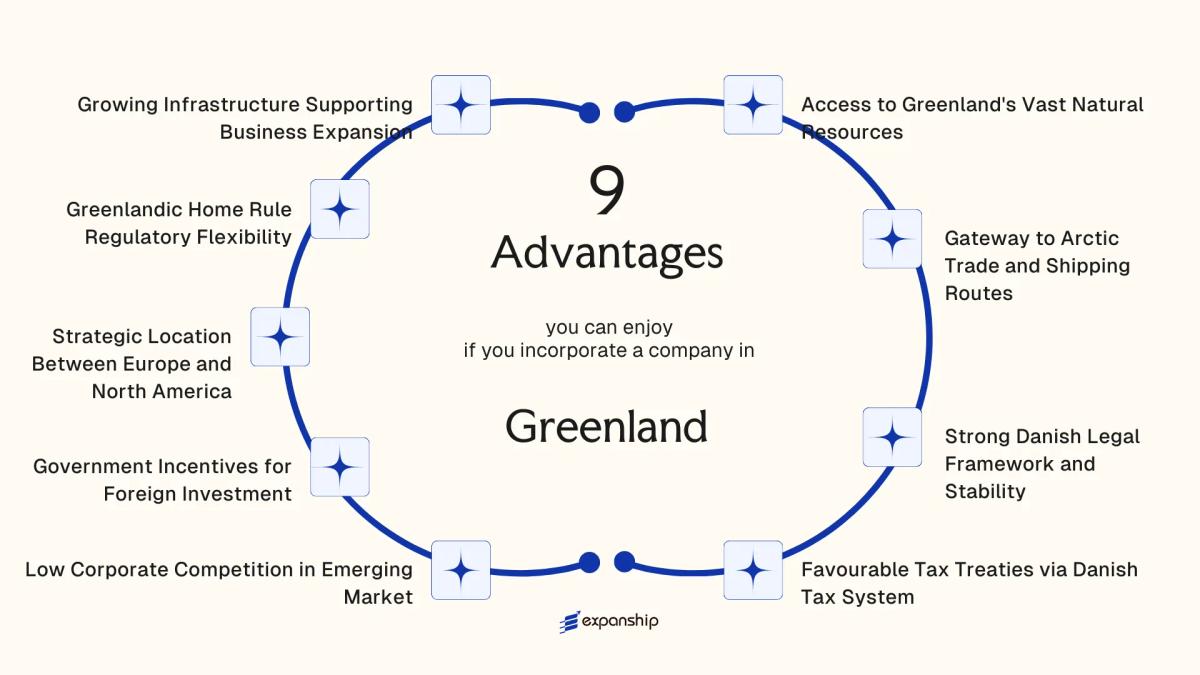
Access to Greenland's Vast Natural Resources
Greenland natural resources business opportunities span an extraordinary range of sectors, from rare earth elements to offshore hydrocarbons. Incorporating a local entity positions your business to hold licences directly rather than operating through intermediary structures.
Mineral and Rare Earth Licensing
The Mineral Licence and Safety Authority (MLSA), operating under the Greenlandic government's Ministry of Mineral Resources, administers all exploration and extraction licences. Holding a registered company in the territory is a prerequisite for obtaining these licences, meaning incorporation is a structural gateway to participation, not merely a convenience.
Greenland's subsoil contains significant deposits of rare earth elements, uranium, iron ore, and zinc. For businesses seeking exposure to critical minerals that are subject to supply constraints in other regions, direct access through a locally incorporated firm removes a layer of commercial and contractual complexity.
Offshore Hydrocarbon Access
The Bureau of Minerals and Petroleum (BMP), now consolidated under the MLSA, oversees oil and gas exploration licences in offshore blocks. Foreign investors pursuing Greenland mining and oil investment advantages must hold a compliant local entity to participate in licensing rounds issued by the Naalakkersuisut, Greenland's self-government.
Licence eligibility criteria include technical capacity and financial qualification thresholds set per licensing round.
A registered Greenlandic entity is a legal requirement for direct resource licence eligibility, not an optional structure.
Gateway to Arctic Trade and Shipping Routes
Positioned along the shortest navigable path between the Atlantic and Pacific oceans, Greenland Arctic trade route advantages for business are rooted in physical geography rather than policy incentives. The Northern Sea Route and the Northwest Passage both pass through or near Greenlandic waters, reducing transit distances between European and East Asian ports by thousands of nautical miles compared to traditional southern routes through the Panama or Suez canals.
For a logistics or shipping company, registering an entity here places your firm structurally closer to the emerging Arctic freight corridor. As polar ice coverage continues to recede seasonally, commercial transit windows through these routes are expanding, and businesses with an established Arctic presence are positioned to contract with carriers before freight volumes increase.
Arctic shipping route business benefits in Greenland extend to specific sectors:
- Port proximity to Nuuk and Sisimiut means vessels operating regionally do not require distant refuelling or maintenance stops
- Greenlandic entities can more readily enter Arctic-specific service contracts under local commercial law
- Operating from within the region supports compliance with Arctic Council environmental protocols that apply to commercial operators
- Local registration strengthens your standing when bidding on infrastructure or logistics tenders tied to Arctic development projects

Incorporate a Company in Greenland
Register your business entity in Greenland and position your firm within the emerging Arctic trade corridor.
Strong Danish Legal Framework and Stability
Incorporating in Greenland means your business operates under Danish legal framework benefits that carry real structural weight. Greenland is an autonomous territory within the Kingdom of Denmark, which means Danish private law, including the Danish Companies Act (Selskabsloven), governs corporate formation and operation. Foreign investors gain access to a legal system with centuries of codified commercial law, independent courts, and predictable enforcement mechanisms.
| Legal Feature | Governing Instrument | Practical Relevance |
|---|---|---|
| Corporate formation | Danish Companies Act (Selskabsloven) | Standardised registration and governance rules |
| Contract enforcement | Danish civil law principles | Predictable dispute resolution process |
| Insolvency proceedings | Danish Bankruptcy Act | Creditor protections aligned with EU norms |
| Court jurisdiction | Danish courts with Greenlandic application | Access to experienced, independent judiciary |
Selskabsloven sets clear requirements for share capital, board structure, and annual reporting, which gives your business a defined compliance path rather than an ambiguous regulatory environment. That predictability reduces legal risk when entering contracts with international partners, since counterparties recognise Danish law as a credible governing framework.
Property rights and contractual obligations are protected under established legal precedent, not discretionary administrative decisions. For foreign-owned entities, this means disputes are resolved through rule-based processes rather than political influence. Greenland business stability under this system is not incidental; it is a structural outcome of remaining within Danish legal jurisdiction despite holding self-governance status.
Favourable Tax Treaties via Danish Tax System
Greenland tax treaty benefits via Denmark arise from a distinct constitutional arrangement: under the Danish Tax Authority, Greenland operates its own tax system through Naalakkersuisut, the self-government authority, yet retains access to elements of the broader Danish-administered international tax framework. Denmark maintains one of the more extensive double tax treaty networks in the world, covering over 70 jurisdictions. For certain cross-border structures, particularly those involving Danish parent companies or Danish-registered holding entities, this network reduces withholding taxes on dividends, interest, and royalties routed through the arrangement.
The corporate tax rate in Greenland is set at 26.5% under Greenlandic tax legislation, which is already below Denmark's standard 22% corporate rate and sits competitively against Nordic peers. Foreign investors using a Danish holding structure to channel income from Greenlandic operations may access treaty-reduced withholding rates rather than domestic rates, which directly affects after-tax returns on profit repatriation.
Keep these points in mind:
- Greenlandic entities are taxed under separate rules from Danish companies; treaty access depends on how the corporate structure is arranged
- Dividends paid from a Danish holding company to treaty-country residents may benefit from reduced withholding rates under applicable bilateral agreements
- Treaty eligibility requires genuine economic substance; passive holding structures without operational activity may not qualify
Greenland has its own standalone tax code entirely separate from Danish law, meaning two companies operating side-by-side in Copenhagen and Nuuk can face materially different tax obligations despite sharing the same kingdom.
Low Corporate Competition in Emerging Market
Low business competition Greenland emerging market conditions present a structural opening that simply does not exist in saturated economies. With a population of approximately 56,000 and a concentrated economic base historically anchored in fishing and public administration, most formal sectors remain thinly occupied by private enterprises, particularly foreign-owned ones.
Scarcity of Established Players
Registered business activity in Greenland is administered through the Greenlandic Business Register (Erhvervsregisteret), and the number of active private entities across most commercial sectors remains comparatively low. For a foreign firm entering mining services, logistics, or professional consulting, the absence of entrenched incumbents means your entity does not need to displace existing competition to gain market share. That absence of displacement is a direct cost advantage.
First mover positioning in an economy undergoing structural expansion carries compounding returns. Sectors tied to the extractive industry licensing process under the Greenland Self-Government's Bureau of Minerals and Petroleum, or tourism development supported by Visit Greenland, are still in formative stages, meaning early entrants can establish supplier relationships, brand recognition, and operational footprints before regulatory and commercial frameworks solidify around competitors.
Untapped Demand Across Sectors
Untapped market benefits of incorporating in this jurisdiction extend beyond resource extraction. Retail, digital services, and professional sectors serve a concentrated population with limited domestic supply, meaning import-dependent demand structurally favours incoming businesses. Market entry here does not require competing against established networks; it requires filling documented gaps.
Identify Your Competitive Window in Greenland
Speak with our corporate advisors about which sectors offer the most open market entry and how to structure your Greenland entity accordingly.
Government Incentives for Foreign Investment
Greenland government incentives for foreign investment are relatively limited in breadth but targeted in focus, reflecting the territory's development priorities under Naalakkersuisut, the self-governance authority that administers domestic economic policy.
- Naalakkersuisut maintains a Bureau of Minerals and Petroleum (BMP) that grants exploration and exploitation licences to foreign entities under the Mineral Resources Act. Licence holders gain exclusive rights within defined geographic areas, a structural protection not commonly available in open-tender markets.
- Foreign firms operating in approved extractive sectors may qualify for cost recovery provisions embedded within licence agreements, allowing capital expenditure to offset taxable income before profit-sharing obligations apply.
- Under the Act on Greenland Self-Government, the territory can negotiate sector-specific arrangements with foreign investors outside the standard Danish regulatory framework, giving your entity access to a degree of bespoke structuring not available in most EU-adjacent markets.
- Large-scale project investors may engage directly with Naalakkersuisut for negotiated fiscal terms, particularly in mining and energy, where standard tax schedules can be adjusted through development agreements.
- The Greenland Business Register (Erhvervsstyrelsen Grønland) processes company registrations without imposing sector-specific foreign ownership restrictions in most industries, removing a barrier that comparable frontier markets frequently impose.
Strategic Location Between Europe and North America
Greenland's geographic position is a concrete structural advantage. Sitting between the European and North American continental shelves, it sits within reasonable proximity to both Brussels and New York — a placement that few jurisdictions can claim. For a business with transatlantic operations, this geography reduces the friction of straddling two major economic zones.
Time zones reinforce this. The island operates across UTC-2 to UTC-4, meaning your firm can maintain working-hour overlap with both Western Europe and the Eastern seaboard of the United States within a single business day. That dual accessibility has tangible value for companies coordinating across both regions.
The Greenland strategic location Europe North America business case extends beyond connectivity. As Arctic sea routes become more commercially viable, the territory's position along northern transatlantic corridors places it within emerging logistics networks that bypass traditional Southern shipping lanes. Companies incorporated here can position themselves structurally close to those corridors.
A hypothetical scenario: A transatlantic trading firm incorporated in Greenland, coordinating shipments between Hamburg and Halifax, could reduce coordination lag by operating from a single entity in UTC-3 — maintaining a 4-hour overlap with Central European business hours and a 6-hour overlap with Eastern North America simultaneously.
Greenlandic Home Rule Regulatory Flexibility
Greenland Home Rule regulatory flexibility for businesses stems from the territory's autonomous status under the 2009 Act on Greenland Self-Government. Naalakkersuisut, the territory's government, holds legislative authority over a defined set of domestic affairs, which creates a regulatory environment that can be adapted more quickly than those operating under full EU member state frameworks.
This separation from Danish domestic regulation in certain sectors means your business may face a lighter or differently structured compliance burden depending on the industry. Foreign firms operating in sectors under Naalakkersuisut's jurisdiction are subject to locally enacted rules rather than Copenhagen-directed legislation, giving the territory genuine capacity to tailor conditions for incoming entities.
The practical benefit is responsiveness. A smaller legislative body governing a population under 60,000 can modify sector-specific rules faster than larger jurisdictions, reducing the regulatory lag that often affects business planning cycles.
- Naalakkersuisut controls licensing and operational rules in several resource and commercial sectors
- Locally governed areas can have distinct registration and reporting requirements separate from Danish national standards
- This dual-layer structure allows businesses to engage directly with a single, accessible authority for approvals
The scope of Naalakkersuisut's regulatory authority is sector-specific; areas not devolved remain subject to Danish national law, so confirming which regulatory layer governs your intended activity is essential before structuring your entity.
Growing Infrastructure Supporting Business Expansion
Greenland infrastructure development business expansion benefits are increasingly tangible, driven by government-backed capital programmes tied to the country's ambitions in mining, energy, and international transit.
Airport Modernisation and Connectivity
Three major airport construction projects are underway or recently completed, including expanded facilities at Nuuk and Ilulissat. These upgrades are funded partly through Kalaallit Airports, a government-owned entity established specifically to manage the programme. For a foreign company, direct international air links reduce the logistical burden of operating in a territory that previously required transit through Copenhagen for most business travel.
Port Development and Cargo Capacity
Nuuk's port has undergone capacity expansion to accommodate larger commercial and industrial vessels. Improved quay infrastructure means your firm can move equipment and materials with greater predictability, which matters especially if your operations connect to offshore extraction or Arctic research contracts.
Telecommunications and Digital Infrastructure
The submarine fibre-optic cable system connecting Greenland to Iceland and Canada, operated under arrangements involving Tele Greenland, has improved bandwidth availability in major settlements. Reliable connectivity is a functional prerequisite for any company managing remote operations or maintaining real-time communication with international headquarters.
Energy Infrastructure Investment
Hydropower supplies the majority of electricity in populated areas, with the national utility Nukissiorfiit managing the grid. Expansion projects are progressively reducing dependence on diesel generation in secondary settlements, which lowers operational energy costs over time for businesses with physical installations outside the capital.
Why Greenland Stands Apart from Competing Jurisdictions
Comparing Greenland against other Arctic or North Atlantic jurisdictions reveals a specific set of structural factors that matter to foreign investors evaluating where to place a holding, resource, or logistics entity. The most realistic competitors are Iceland, Norway, and Canada's northern territories. Each targets a similar investor profile — those seeking Arctic access, resource rights, or transatlantic positioning — yet each presents different legal architectures, tax exposures, and regulatory entry points.
What the comparison shows is not simply a cost differential. The Danish legal underpinning gives entities incorporated under Greenlandic law a degree of treaty access and legal enforceability that purely autonomous Arctic territories cannot match. At the same time, Naalakkersuisut, Greenland's self-government authority, retains jurisdiction over resource licensing and certain business regulations, creating a layered framework that Norway's fully centralised system and Canada's fragmented territorial structure do not replicate.
| Parameter | Greenland | Iceland | Norway | Canada (Territories) |
|---|---|---|---|---|
| Legal framework basis | Danish civil law with autonomous overlay | Independent civil law | Norwegian civil law (EU EEA-aligned) | Common law (federal + territorial split) |
| Corporate tax rate | 26.5% | 20% | 22% | 15% federal + territorial add-on |
| Tax treaty access | Via Danish treaty network | Independent network (approx. 40 treaties) | Extensive independent network | Extensive independent network |
| Resource licensing authority | Naalakkersuisut (autonomous) | Orkustofnun (national) | Petroleum Safety Authority Norway | Federal-territorial shared jurisdiction |
| Foreign ownership restrictions | Generally open | Sector-specific restrictions apply | Sector-specific restrictions apply | Sector-specific restrictions apply |
| Arctic trade route access | Direct (Northwest Passage proximity) | Indirect (North Atlantic) | Northern Sea Route indirect access | Direct (Northwest Passage) |
| Competition density | Low | Moderate | High | Moderate to high |
Compliance Services for Companies in Greenland
Maintain your Greenlandic entity in good standing with ongoing compliance support, including annual filings, reporting obligations, and regulatory monitoring under both Danish and Naalakkersuisut frameworks.
Conclusion
The benefits of incorporating in Greenland are grounded in structural realities: access to resource-rich territories governed under Danish legal principles, positioning along emerging Arctic trade corridors, and operation within a tax treaty network tied to Denmark's bilateral agreements. These are not incidental advantages but features of how the jurisdiction is constituted.
Greenland company formation advantages are most pronounced for businesses in extractive industries, logistics, and Arctic-oriented research and development, where the combination of Naalakkersuisut's regulatory authority and Danish-backed legal stability provides a defined operating environment. Your business benefits from a jurisdiction where the legal architecture is established, not provisional.
Whether this jurisdiction suits your specific structure depends on your industry, your investor base, and your long-term operational footprint in the region. A firm oriented toward Arctic shipping, mineral extraction, or North Atlantic logistics will find more applicable alignment here than one with no geographic or sectoral connection to the region. The next step is assessing how your corporate structure maps to the requirements under Greenlandic and Danish law before proceeding with registration.
Start Your Greenland Company with Expanship Today
To start a Greenland company with Expanship, you work with a team that has direct experience across the full scope of what this blog has covered: from the Selvstyrets regulatory framework and the Erhvervsstyrelsen filing requirements, to entity structures available under Danish-administered commercial law. Expanship handles each stage of formation and ongoing compliance for your ApS or A/S, coordinating directly with the relevant Danish Business Authority processes that apply to Greenlandic registrations.
Across the full lifecycle of your entity, Expanship provides:
- Document preparation, notarisation, and apostille legalisation
- Registered agent and registered office address provision
- Government filing and Erhvervsstyrelsen liaison on your behalf
- Post-incorporation compliance management, including annual reporting obligations
- Banking introduction assistance with institutions familiar with Arctic-region entities
- Ongoing corporate secretarial support to maintain good standing
Expanship Greenland services are structured around the specific legal and administrative requirements that apply to foreign-owned businesses operating under the jurisdiction's dual regulatory environment, not a generic offshore formation template.
Reach out to Expanship Greenland to discuss your incorporation requirements.
Frequently Asked Questions (FAQ)
Naalakkersuisut, the Greenlandic Self-Government authority, holds legislative competence over several sectors including mineral resources, fishing, and land use. Foreign-owned businesses operating in resource-adjacent industries must comply with both Self-Government regulations and any applicable Danish framework where Greenland has not assumed full legislative control. The division of authority means your compliance obligations can involve two regulatory layers depending on the sector your firm operates in.
Companies incorporated in Greenland are subject to a corporate income tax rate of 25%, administered under Greenlandic tax rules rather than Danish domestic tax law, since Greenland operates a separate tax jurisdiction. This distinction is material because Greenland is not part of the EU and does not automatically benefit from all Danish tax treaty arrangements. Your entity's treaty access depends on the specific bilateral agreements in force and whether Greenland is explicitly included in their scope.
Greenland maintains its own tax treaty network, separate from Denmark's, because it operates as a distinct tax jurisdiction outside the EU. The territory has concluded a limited number of double taxation agreements independently, and Danish treaties do not automatically extend to Greenlandic-incorporated entities. Before structuring cross-border operations through a Greenlandic entity, you should verify which specific treaties the territory has in force with your home jurisdiction.
The principal entity forms available follow the Danish corporate framework, including the Anpartsselskab (ApS), which is a private limited liability company, and the Aktieselskab (A/S), a public limited company. The ApS is the more common choice for foreign investors due to its lower minimum capital requirement and simplified governance structure. Both forms are governed under the Danish Companies Act as adopted and applied within the territory.
The primary regulatory risk lies in the Greenland Self-Government's authority over licensing under the Mineral Resources Act, which governs exploration and extraction activities. Licences can be subject to conditions tied to local content, labour requirements, or environmental compliance, and non-compliance can result in suspension or revocation. The relatively thin body of established case law in the territory also means that legal precedents from comparable situations may be limited, requiring careful legal due diligence before committing capital.
Greenland's incorporated company base is small, which means competition is limited but so is the existing commercial ecosystem, including professional services, suppliers, and local financing options. Businesses in sectors such as tourism, fisheries processing, or digital services can operate through a locally incorporated entity and benefit from the stable Danish legal framework without direct involvement in resource extraction. That said, market size constraints mean firms should assess whether local incorporation serves a genuine operational or jurisdictional purpose rather than treating the territory as a simple offshore structure.
Legal Disclaimer
The information provided in this article is for general informational purposes only and does not constitute legal, tax, or professional advice. While we strive to ensure the accuracy and timeliness of the content, laws and regulations are subject to change, and the application of laws can vary widely based on specific facts and circumstances.
Readers should not act upon this information without seeking professional counsel tailored to their individual situation. Expanship and its authors disclaim any liability for actions taken or not taken based on the content of this article.
For specific advice regarding your business setup, compliance requirements, or any legal matters, please consult with qualified legal and tax professionals in the relevant jurisdiction.