

Key Takeaways
- All companies incorporated in France must be registered through the Guichet unique portal operated by INPI, which replaced the former network of Centres de Formalités des Entreprises in 2023.
- Under the Code de commerce, société anonyme (SA) formations are subject to a minimum share capital requirement of €37,000, while the société par actions simplifiée (SAS) imposes no statutory minimum, making entity type selection a materially consequential compliance decision.
- Foreign investors establishing a French entity must register beneficial ownership information with the Registre des bénéficiaires effectifs before the company can be considered fully operational and legally compliant.
- Structural requirements — including director eligibility, shareholder composition, and registered office location in France — vary depending on the chosen legal form and whether the founding shareholders are residents or non-residents.
Incorporation requirements in France are governed by the Code de commerce, with entity registration handled through the Guichet unique, the single digital portal operated by the Institut national de la propriété industrielle (INPI) since 2023.
This article covers the structural, documentary, and compliance requirements applicable to companies being formed under French law.
Failure to meet these requirements results in the rejection of your registration application or, where obligations arise post-formation, potential legal sanctions and the inability to operate as a legally recognised entity.
Requirements can differ depending on the legal form chosen, the sector of activity, and whether the shareholders are residents or foreign nationals. You can consult the applicable legislation directly in the Code de commerce.
This article is most relevant to foreign entrepreneurs and international holding structures seeking to establish a legal presence in the French market.
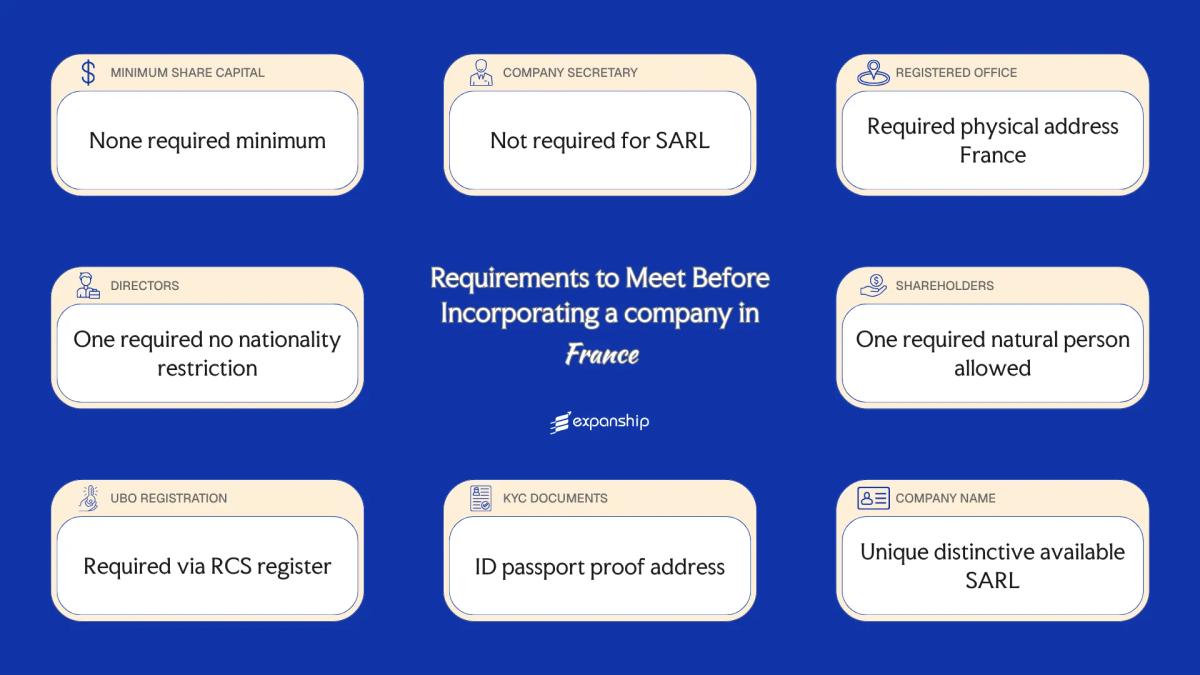
Minimum Share Capital Requirements in France
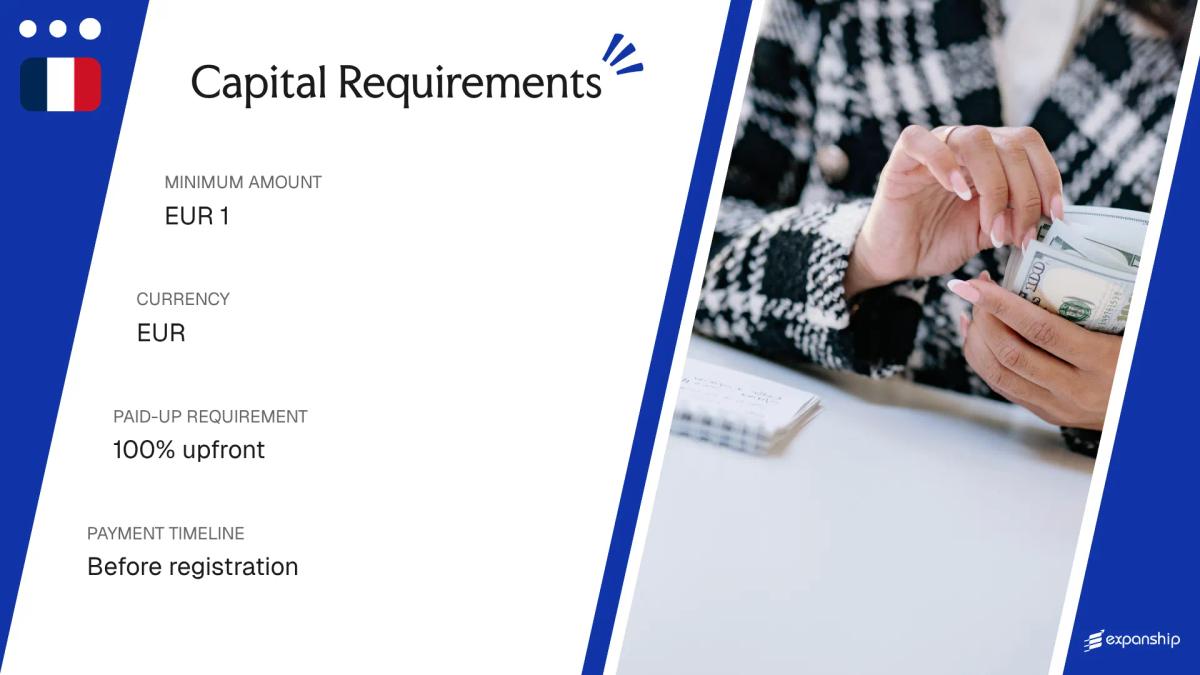
France minimum share capital requirements vary depending on the legal form chosen. A société par actions simplifiée (SAS) can be formed with as little as €1 in share capital, while a société à responsabilité limitée (SARL) carries no statutory minimum under current French commercial law, though both structures require a defined capital social to be registered with the Greffe du Tribunal de Commerce.
French company law operates on a par value system. Capital contributions are verified at the point of incorporation through a blocked account (compte bloqué) at a French bank or notary, and funds must be deposited before the entity receives its KBIS extract from the Registre du Commerce et des Sociétés (RCS).
| Parameter | Detail |
|---|---|
| Minimum Authorized Share Capital | €1 for SAS and SARL; €37,000 for SA |
| Maximum Authorized Share Capital | No statutory requirement |
| Minimum Paid-Up Capital | €1 for SAS and SARL; €37,000 for SA |
| Paid-Up Requirement at Incorporation | At least 50% of cash contributions must be deposited at incorporation for SARL; at least 50% for SAS; full amount for SA |
| Accepted Currency | Euro (EUR) |
| Accepted Forms of Contribution | Cash (apports en numéraire) and in-kind assets (apports en nature); industry contributions permitted in certain structures |
| Timeframe to Deposit Capital | Funds must be deposited before filing with the RCS; released upon receipt of the KBIS |
Capital deposited in the blocked account must remain frozen until the KBIS is issued. If incorporation does not proceed, the funds are returned to the subscribers, but the clock on that deposit begins at the filing date, not the date funds were transferred.
Company Secretary Requirements in France
French corporate law does not impose a mandatory company secretary requirement for standard business entities. Under the framework governing the société à responsabilité limitée (SARL) and the société par actions simplifiée (SAS), the company secretary requirements France establishes are effectively optional, with governance functions distributed among directors and statutory officers instead.
Where a secretary is voluntarily appointed, the role typically covers preparing board minutes, maintaining the registre des mouvements de titres, and ensuring filings with the Greffe du Tribunal de Commerce remain current.
Qualification criteria for those serving in a voluntary secretary capacity include:
- No statutory minimum age is prescribed beyond general legal capacity under French civil law.
- The role may be filled by an individual or, in certain entity forms, a legal person.
- No professional license or specific qualification is required by the Code de commerce.
- Non-residents and foreign nationals are not excluded from serving in this capacity.
- Serving directors may concurrently hold the secretary function in most entity structures.

Incorporate a Company in France
Set up your French entity with full compliance support, from document preparation to Greffe registration.
Registered Office Requirements in France
Every company registered in France must declare a siège social, which serves as the official address of the entity and determines its legal domicile for correspondence with public authorities, courts, and the Greffe du Tribunal de Commerce.
- A physical address in France is required; a P.O. box alone does not satisfy the siège social requirements France imposes.
- Virtual office addresses are permitted under French law, provided the service includes a genuine right of occupancy and the address can receive official mail.
- The address must be located within French territory; foreign addresses do not qualify.
- Proof of occupancy is required at incorporation, such as a lease agreement, property title, or a domiciliation contract with a certified domiciliation company.
- The registered address is publicly listed in the Registre du Commerce et des Sociétés (RCS) and is accessible via the Infogreffe portal.
- Any change to the registered office address requires a formal amendment filed with the relevant Greffe, accompanied by updated corporate resolutions and a new proof of occupancy.
- Failure to maintain a valid, compliant address can result in administrative irregularities, potential deregistration proceedings, and difficulty enforcing contracts or receiving valid legal service of process.
Director Requirements in France
Upon appointment, directors in a French company assume statutory duties under the Code de commerce, including obligations of loyalty, diligence, and acting within the scope of their delegated authority. Liability can be personal where a director commits a fault separable from their corporate functions, as established under French civil and commercial law.
| Parameter | Detail |
|---|---|
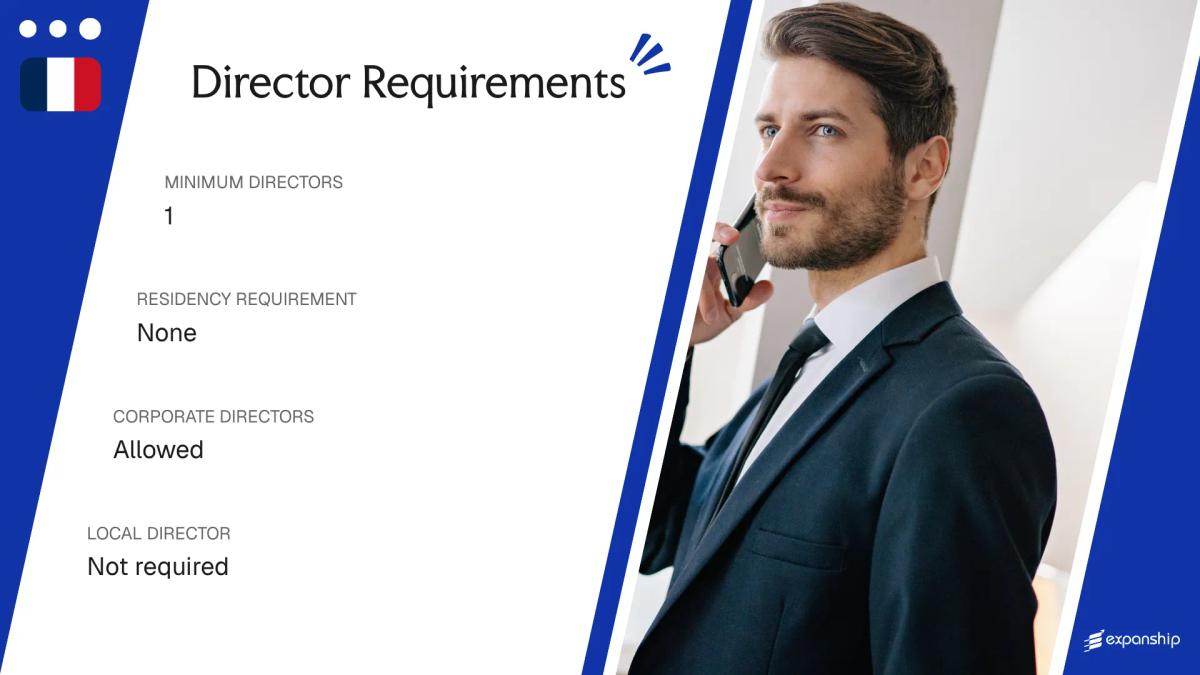
| Minimum Number of Directors | A SARL requires at least one gérant; an SAS requires at least one président; an SA requires a board of at least three directors. |
| Maximum Number of Directors | An SA board may not exceed 18 members under Article L225-17 of the Code de commerce. |
| Local/Resident Director Required | No statutory requirement for a resident or locally domiciled director. |
| Nationality Restrictions | No nationality restrictions apply; non-EU nationals may serve as directors. |
| Minimum Age Requirement | Directors must be at least 18 years of age. |
| Corporate Directors Permitted | Corporate directors are permitted in an SAS but are generally not permitted to serve as gérant in a SARL. |
| Director Must Be a Shareholder | No statutory requirement for directors to hold shares in the company. |
| Publicly Listed on Registry | Directors are listed on the Registre du Commerce et des Sociétés (RCS), which is publicly accessible. |
| Disqualification Conditions | A director may be disqualified following a criminal conviction, bankruptcy proceedings, or a court order under the Code de commerce. |
France imposes no upper age limit on directors for most company types, but an SA is required by law to ensure that no more than one-third of its board members exceed the age of 70, unless the company's articles provide otherwise.
Shareholder Requirements in France
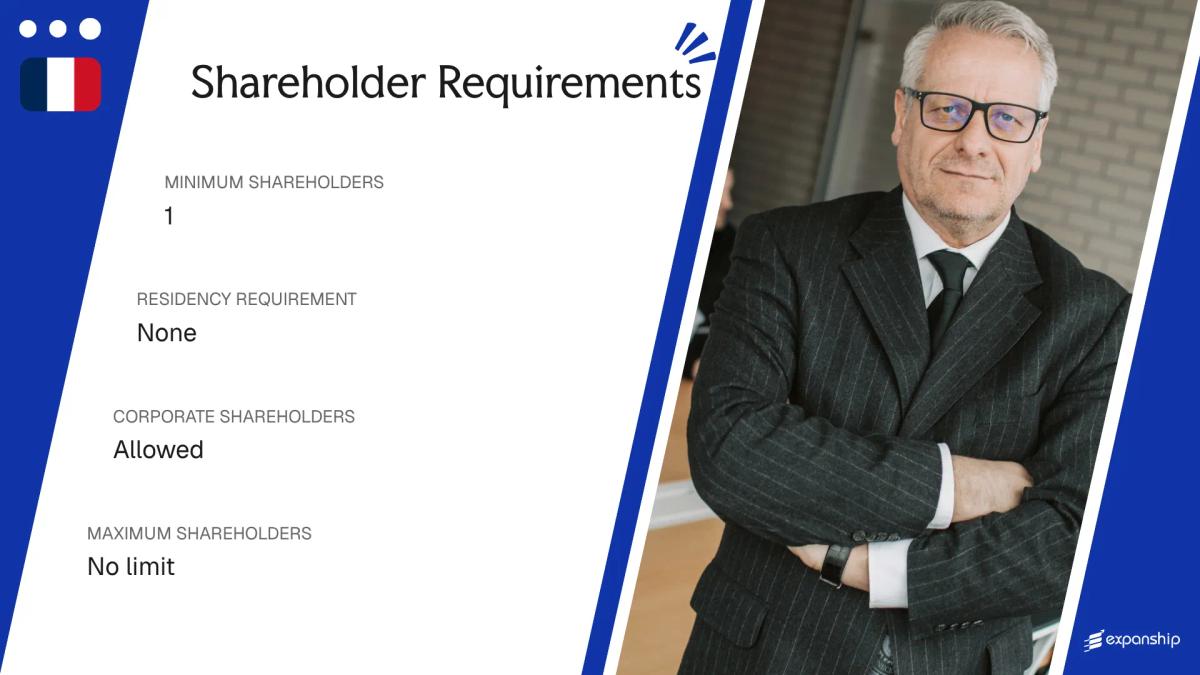
France's most common incorporation vehicle, the Société par Actions Simplifiée (SAS), requires a minimum of one shareholder with no statutory maximum. A single-shareholder SAS, known as a SASU, is a fully recognized structure under French commercial law.
Nationality and Residency Restrictions
Shareholder requirements in France impose no nationality or residency conditions on shareholders of an SAS or SASU. Foreign individuals and entities may hold 100% of the share capital without restriction.
Corporate Shareholders
Legal entities are permitted to act as shareholders in an SAS. No special authorization is required, though the corporate shareholder must provide valid constitutional documents during the incorporation process.
Shareholder Liability
Liability is limited to each associé's capital contribution. French law does not extend personal liability to shareholders beyond their subscribed amount under ordinary circumstances.
Register of Shareholders
An SAS must maintain an internal shareholder register (registre des mouvements de titres). This register is not publicly accessible, but must be updated each time a share transfer occurs.
Shareholder Structure Guidance for Your French Incorporation
Understand how shareholder rules apply to your specific entity type in France before you incorporate.
UBO / Beneficial Ownership Registration Requirements in France
Under the French Commercial Code and in transposition of the EU's Fourth and Fifth Anti-Money Laundering Directives, a beneficial owner (bénéficiaire effectif) is any natural person holding, directly or indirectly, more than 25% of the capital or voting rights of a legal entity, or exercising control by other means.
- Identify all natural persons meeting the ownership or control threshold before filing incorporation documents.
- Submit the UBO declaration to the Greffe du Tribunal de Commerce (commercial court registry) at the time of company registration.
- File the declaration through the Guichet Unique operated by the Institut National de la Propriété Industrielle (INPI).
- Update the declaration within 30 days of any change to the beneficial ownership structure.
| Parameter | Detail |
|---|---|
| Ownership Threshold for UBO Status | More than 25% of capital or voting rights |
| Filing Authority | Greffe du Tribunal de Commerce via the INPI Guichet Unique |
| Disclosure Deadline at Incorporation | At the time of company registration |
| Publicly Accessible Register | Yes, the registre des bénéficiaires effectifs is accessible to authorities and parties with a legitimate interest |
| Penalties for Non-Disclosure | Up to €7,500 in fines for natural persons; up to €37,500 for legal entities, plus potential imprisonment |
| Ongoing Update Obligation | Within 30 days of any change |
KYC / Document Requirements in France
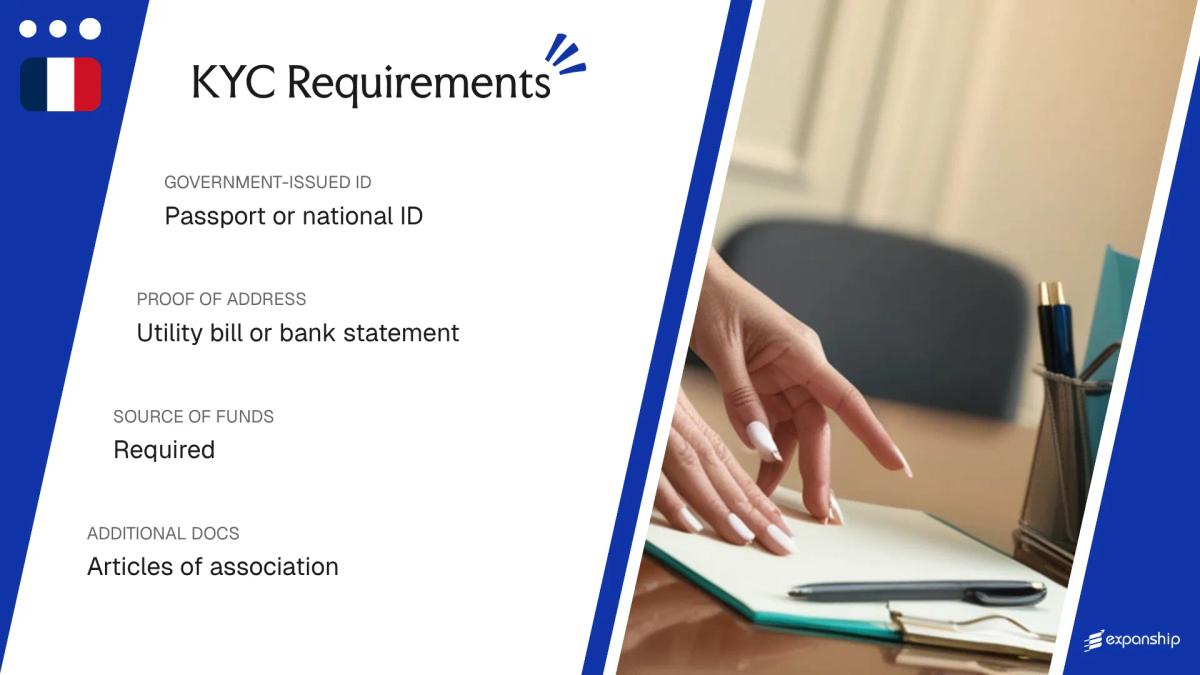
KYC document requirements for a France company registration are governed by the French Monetary and Financial Code (Code monétaire et financier), specifically its AML/CFT provisions transposing the EU's Anti-Money Laundering Directives, enforced domestically by Tracfin.
Individual / Personal Documents
- Valid government-issued photo ID (passport or national identity card) for each director, shareholder, and beneficial owner
- Proof of residential address dated within three months, such as a utility bill or bank statement
- Specimen signature may be required by the formation agent or notaire
- Tax identification number where the individual holds one in their country of residence
Corporate Documents
- Certificate of incorporation or equivalent constitutional document for any corporate shareholder or director
- Articles of association or statutes, translated into French by a certified translator
- Current register of directors and shareholders of the corporate entity
- Proof of the corporate entity's registered office address
Source of Funds Documentation
- Recent bank statements (typically covering the last three months) evidencing the origin of capital
- Audited financial statements where the subscribing entity is an established business
- A written declaration of the source of funds may be required if capital origin is not self-evident
Notarisation and Apostille Requirements
- Foreign public documents must bear an apostille under the 1961 Hague Convention if issued outside the EU
- Certified French translations are required for all documents not originally in French
- Notarisation by a local notaire may be required for certain deed-based incorporation steps
Unresolved discrepancies between the declared beneficial owner and the documents submitted to the Registre du commerce et des sociétés are the most common cause of registration delays in France.
Company Name Requirements in France
Your chosen dénomination sociale undergoes a uniqueness check at the point of registration to confirm it is not already in use by an existing entity. The assessment considers both identical and confusingly similar names.
Structurally, the name must include a legal suffix corresponding to the entity type, such as SAS, SARL, or SA. No statutory minimum or maximum character length applies, but the name must be in Latin script.
Certain words are restricted from use without prior authorisation. Terms implying state affiliation, regulated professions such as banking or insurance, or protected designations require approval from the relevant supervisory authority before registration proceeds.
Name reservation is available through the Institut National de la Propriété Industrielle (INPI) as a trademark, which provides broader protection than corporate registration alone. A reserved name can be protected for ten years, subject to renewal.
Compliance Services for Companies in France
Ongoing compliance obligations in France include annual filings, statutory reporting, and beneficial ownership updates. Expanship manages these requirements on your behalf.
Conclusion
Meeting the incorporation requirements in France involves engaging with a defined set of legal obligations under the Code de commerce and regulatory oversight from bodies such as the Greffe du tribunal de commerce. Registered capital thresholds vary by entity type, with the SAS offering notable flexibility compared to the SA. UBO registration with the Registre des bénéficiaires effectifs adds a compliance layer that foreign investors must address before the entity is fully operational. Once these requirements are understood, the practical next step is structuring the formation process to meet each condition in the correct sequence.
Expanship's Corporate Formation Services in France
Registering a company in France involves meeting requirements set across multiple regulatory bodies, from the Guichet Unique at the INPI to beneficial ownership filings with the RBE. Expanship's France company formation services are structured around these specific obligations, reducing the administrative load that comes with navigating parallel registration, notarial, and compliance processes. Our role is to manage the procedural detail so your business can focus on its French operations.
Beyond initial registration, our scope covers the full formation lifecycle:
- We prepare and file all incorporation documents with the relevant French authorities on your behalf.
- Our team provides a registered agent and compliant registered office address in France.
- We handle government filings and liaise directly with bodies such as the INPI and tax authorities.
- Post-incorporation obligations, including annual filings and statutory updates, are managed as your entity evolves.
- We facilitate introductions to banking partners familiar with foreign-owned French entities.
- Tax registration with the Direction Générale des Finances Publiques and local authority liaison are included in our formation process.
To discuss your requirements, contact Expanship France.
Frequently Asked Questions (FAQ)
The requirement varies by entity type. A société à responsabilité limitée (SARL) and a société par actions simplifiée (SAS) can both be incorporated with a minimum share capital of €1, while a société anonyme (SA) requires at least €37,000, of which half must be paid up at registration. Choosing the wrong structure for your capitalisation level can create compliance issues with the Greffe, so the distinction matters from the outset.
A non-French resident can serve as sole director of a French SAS or SARL without holding a French residency permit, as France does not impose a local director requirement for these structures. However, if that director intends to physically manage operations from French soil, a titre de séjour mention "commerçant" may be required under French immigration law. Serving as a director purely in a governance capacity from abroad does not trigger this obligation.
Failure to file beneficial ownership information with the Registre des bénéficiaires effectifs, maintained at the Greffe du Tribunal de commerce, can result in criminal sanctions under Article L. 561-46 of the French Monetary and Financial Code, including fines of up to €7,500 for natural persons and €37,500 for legal entities. Directors can also face personal liability in enforcement proceedings. The initial filing must be submitted within 15 days of registration, and updates must be filed within 30 days of any change.
Both EU and non-EU shareholders must provide certified identity documents and proof of address, but non-EU individuals may face additional scrutiny under France's anti-money laundering framework transposed from the EU's Fifth Anti-Money Laundering Directive. Corporate shareholders from outside the EU are typically required to supply apostilled or legalised constitutional documents, along with a certificate of good standing from their home jurisdiction. The notaire or domiciliation agent handling the incorporation process will specify the exact certification standard required based on the country of origin.
French company names must not duplicate or closely resemble an existing registered name or protected trademark, and certain terms such as "national," "France," or professional designations like "notaire" are restricted without authorisation. The Greffe du Tribunal de commerce reviews name availability at the point of registration through the SIRENE system administered by INSEE. Unlike some jurisdictions, France does not operate a formal pre-clearance process, so a name conflict can result in rejection at the filing stage rather than being caught in advance.
A single-shareholder SARL, structured as an EURL (entreprise unipersonnelle à responsabilité limitée), must file substantially the same documents as a standard SARL, including the statuts, a declaration of non-conviction from the gérant, proof of capital deposit, and publication of a legal notice in a journal d'annonces légales. The main procedural difference is that the statuts are signed unilaterally rather than by multiple parties. All filings are submitted through the guichet unique on the Formalités des entreprises portal, which has been mandatory since January 2023.
Legal Disclaimer
The information provided in this article is for general informational purposes only and does not constitute legal, tax, or professional advice. While we strive to ensure the accuracy and timeliness of the content, laws and regulations are subject to change, and the application of laws can vary widely based on specific facts and circumstances.
Readers should not act upon this information without seeking professional counsel tailored to their individual situation. Expanship and its authors disclaim any liability for actions taken or not taken based on the content of this article.
For specific advice regarding your business setup, compliance requirements, or any legal matters, please consult with qualified legal and tax professionals in the relevant jurisdiction.