

Key Takeaways
- France's standard corporate tax rate, combined with mandatory social contributions levied on top of payroll, creates a combined fiscal burden that consistently exceeds the EU average and compounds operating costs for foreign-owned entities.
- Under the Code de commerce, incorporation procedures for SAS and SARL structures involve multi-stage registration across both the INPI and the Greffe du Tribunal de commerce, adding procedural layers that extend timelines beyond what most non-EU founders anticipate.
- Ongoing compliance obligations under the Direction Générale des Finances Publiques (DGFiP) for VAT reporting require French-language filings on defined periodic schedules, creating an administrative overhead that cannot be delegated without engaging qualified local counsel or a registered fiscal representative.
- French labour law imposes protections that significantly restrict an employer's ability to modify contracts or initiate terminations, making workforce adjustments materially more complex and costly than in most comparable EU jurisdictions.
France operates under one of the more heavily regulated corporate environments in the European Union, with compliance obligations spread across multiple public bodies and codified frameworks. For any foreign investor assessing the disadvantages of incorporating in France, that regulatory density is the starting point — not a peripheral concern.
This article covers the core categories of disadvantage that arise from France's tax structure, administrative requirements, employment law, and legal formalities under the Code de commerce.
The drawbacks of setting up a company in France do not apply uniformly. A small SAS with a single foreign shareholder faces a different compliance burden than a mid-size SARL with local employees or an SA targeting institutional investors.
This article is most relevant to non-EU founders, foreign holding structures, and international businesses entering the French market for the first time without an established local presence.
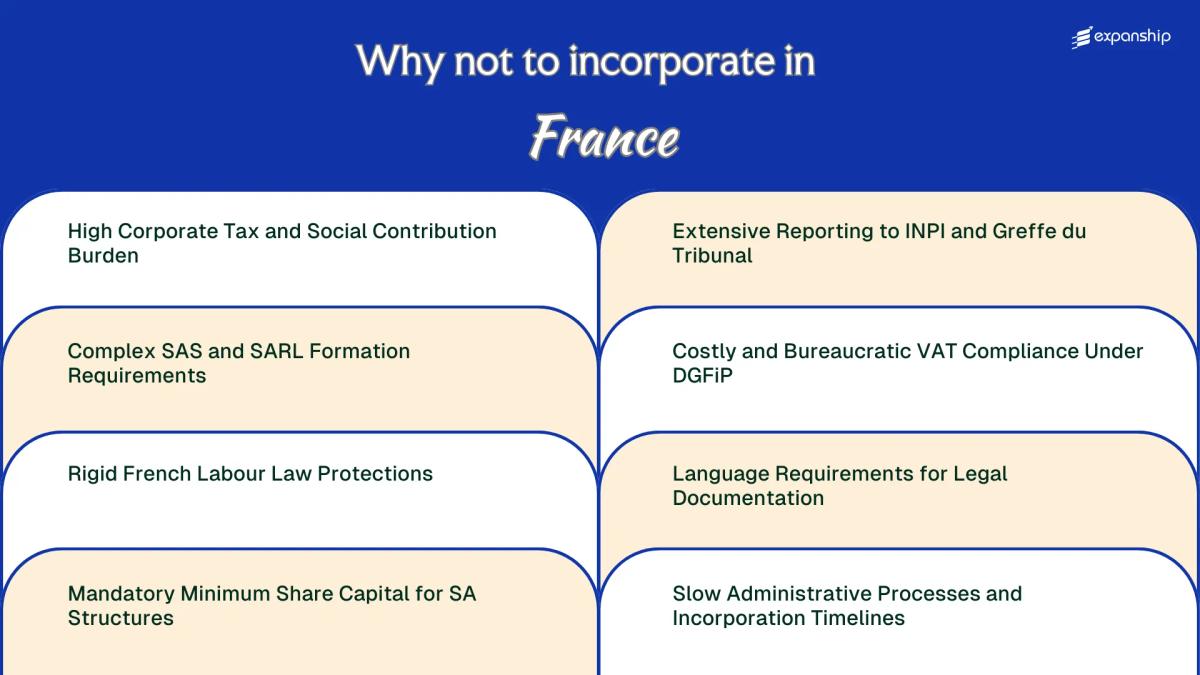
High Corporate Tax and Social Contribution Burden
The France corporate tax burden drawbacks are significant enough to affect your entity's cost structure from the first year of operation. Both the headline tax rate and the layered social contribution system add costs that many foreign investors underestimate before incorporation.
The Impôt sur les Sociétés and Its Rate Structure
The standard rate of impôt sur les sociétés (IS) sits at 25%, applied to net taxable profits. A reduced rate of 15% applies only to small qualifying entities on profits up to €42,500, meaning most foreign-owned subsidiaries face the full rate immediately.
Above this, a social solidarity contribution (contribution sociale de solidarité) of 3.3% applies to firms with IS liability exceeding €763,000, compounding the effective rate further.
Cotisations Sociales and Their Employer Impact
Employer-side cotisations sociales can reach 40 to 45% of gross salary, depending on classification and sector, making payroll one of the heaviest cost lines a foreign firm will carry. This is substantially above the EU average employer social contribution rate.
Even a lean team of salaried employees triggers significant recurring obligations to URSSAF, the body that collects these contributions on behalf of social funds.
Foreign businesses structuring French payroll without accounting for employer cotisations sociales regularly face budget overruns that materially alter projected break-even timelines.
Complex SAS and SARL Formation Requirements
SAS and SARL formation requirements in France impose procedural burdens that catch many foreign founders off guard. Both structures require drafting statuts (articles of association) in French, notarised or not depending on the structure, which must meet specific legal standards under the French Commercial Code before any registration proceeds.
For a SARL, the gérant must be formally appointed through the statuts or a separate act. An SAS requires at least one president, but its governance rules must be exhaustively detailed in the statuts since the law grants significant freedom that courts interpret strictly if disputes arise.
Practical friction builds quickly:
- Errors in the statuts require formal corrective amendments, creating legal fees that accumulate before the business has even opened
- Foreign shareholders must provide apostilled identity documents, adding weeks if issued outside the EU
- Capital deposit must be made in a French bank or Caisse des dépôts, which can delay registration when non-resident founders lack an existing French banking relationship
- SARL share transfers to third parties require shareholder approval under Article L223-14, restricting exit flexibility from the outset
Incorporating through the Guichet Unique via the INPI portal became mandatory in 2023, but technical issues with the platform have caused documented processing delays. Foreign directors without a prior French tax identification number face additional administrative steps before registration completes.

Company Incorporation in France
Incorporate your SAS or SARL in France with full statutory compliance, French banking coordination, and INPI registration support.
Rigid French Labour Law Protections
French labour law restrictions for employers represent one of the most structurally demanding aspects of operating a business in this jurisdiction. The Code du Travail, France's consolidated labour code, governs virtually every dimension of the employment relationship, from hiring conditions to termination procedures, leaving employers with limited flexibility to adjust workforce size in response to operational changes.
Dismissing an employee for economic reasons requires you to follow a defined procedure under Articles L.1237 and L.1233 of the Code du Travail. That process includes written justification, mandatory notice periods, a preliminary interview, and in larger firms, consultation with employee representative bodies. Failing to meet any procedural step exposes your business to claims before the Conseil de Prud'hommes, the dedicated French labour tribunal.
| Restriction | Threshold / Requirement | Implication for Employer |
|---|---|---|
| Economic dismissal procedure | Mandatory for any redundancy | Multi-step process; no summary termination |
| Collective redundancy consultation | Required for 10+ dismissals in 30 days | Mandatory works council involvement delays execution |
| Reinstatement risk | Possible when dismissal ruled unfair | Court may order reinstatement, not just compensation |
| Severance entitlement | Minimum 1/4 month salary per year of service | Accrues regardless of firm size or financial position |
Rigid employment protections in France mean that restructuring decisions which might take weeks in other EU jurisdictions can take months here. The obligation to negotiate a Plan de Sauvegarde de l'Emploi for larger-scale redundancies adds further procedural weight that smaller foreign entities rarely anticipate when entering the market.
Mandatory Minimum Share Capital for SA Structures
France SA minimum share capital requirements create a significant entry barrier that many foreign investors underestimate before committing to this structure. Under French commercial law, a Société Anonyme requires a minimum share capital of €37,000, of which at least half must be paid up at the time of incorporation.
That threshold is not symbolic. It represents real capital that must be deposited with a French bank or notary before the entity can be registered, tying up funds before the business generates any revenue.
The SAS and SARL structures carry no statutory minimum, which makes the SA's requirement stand out sharply within the same legal system. For early-stage operations or market-entry vehicles, this capital lock-in is a structural cost with no operational return.
Governed under Articles L225-1 et seq. of the Code de commerce, the SA also requires a minimum of seven shareholders, compounding the organisational complexity alongside the capital obligation.
- Minimum €37,000 share capital required before registration can proceed
- At least 50% of the capital must be deposited at incorporation
- Remaining capital must be paid up within five years of registration
- Seven shareholders are required at formation, not one or two
- Capital must be held in a blocked account until the Greffe issues the Kbis extract
Despite its high setup requirements, the SA remains the only French corporate structure eligible to list shares on a regulated stock exchange, which means some foreign groups incorporate one solely to satisfy capital markets requirements, not for operational use.
Extensive Reporting to INPI and Greffe du Tribunal
The INPI Greffe du Tribunal reporting burden France imposes on registered companies is substantial and recurring. Once incorporated, your entity must maintain current records across two distinct systems: the Institut National de la Propriété Industrielle and the Greffe du Tribunal de Commerce.
Scope of Mandatory Filings
Every structural change to your company — including amendments to bylaws, changes in registered address, officer appointments, and capital modifications — requires formal registration with the Greffe. Annual financial accounts must also be deposited, with the Greffe publishing them in the official registry, meaning non-compliance is publicly visible and can trigger regulatory scrutiny.
Cost and Complexity for Foreign Operators
Each filing carries administrative fees, and many submissions require certified translations or notarised documents if originating outside France. Foreign-owned entities without a local legal representative face particular difficulty, since the Greffe accepts filings in French only and procedures vary by tribunal jurisdiction, adding coordination costs that domestic firms rarely encounter.
Smaller foreign firms below certain employee or revenue thresholds may qualify for simplified disclosure, but the underlying filing obligations to both registries remain in place regardless.
Overcoming Corporate Compliance Challenges in France
Get structured guidance on managing your filing obligations with the INPI and Greffe du Tribunal as a foreign business operating in France.
Costly and Bureaucratic VAT Compliance Under DGFiP
France VAT compliance challenges DGFiP affect foreign businesses disproportionately, given the Direction Générale des Finances Publiques operates one of the more demanding TVA filing regimes in the EU.
- Businesses with taxable turnover above certain thresholds must file TVA returns monthly rather than quarterly, creating a high-frequency administrative obligation that requires either dedicated in-house accounting or ongoing external professional fees.
- The DGFiP requires VAT returns to be submitted through its online portal in French, meaning foreign-owned entities without French-speaking finance staff must bear translation and advisory costs on a recurring basis.
- Under the régime réel normal, your firm must reconcile detailed input and output tax figures each filing period, a granular requirement that increases accountancy costs relative to simplified regimes available in other EU member states.
- Late or incorrect TVA filings attract penalties and interest charges under the Livre des procédures fiscales, creating direct financial exposure for businesses still learning the system.
- Foreign entities not established in France but required to register for TVA must appoint a fiscal representative, adding a structural cost layer with no equivalent obligation in several comparable EU jurisdictions.
Language Requirements for Legal Documentation
French language requirements for legal documents are mandated by the Loi Toubon (Law No. 94-665 of 4 August 1994), which requires that all official corporate documents be drafted in French. For a foreign founder, this means your statuts, shareholder agreements, board resolutions, and filings with the Greffe du Tribunal de Commerce must all be in French, regardless of your company's internal operating language.
Relying on bilingual legal counsel or certified translators adds a direct cost layer that founders incorporating in common-law English-speaking jurisdictions do not face. Any document submitted in another language will be rejected outright.
The practical burden goes beyond translation fees. Misaligned terminology between your original-language instructions and the final French statuts can introduce legal ambiguities that only surface during disputes or due diligence.
A non-French-speaking founder who drafts statuts en français through a bilingual notaire or avocat for an SAS can expect professional translation and legal review fees ranging from €1,500 to €3,000, on top of standard formation costs, depending on the complexity of the shareholders' agreement.
Slow Administrative Processes and Incorporation Timelines
Slow incorporation timelines in France create a real operational cost for foreign businesses that need to trade, open bank accounts, or hire staff within a defined window. Even after the introduction of the guichet unique numérique through the Institut National de la Propriété Industrielle (INPI) in 2023, registration delays have persisted due to backlogs and document verification procedures.
A newly formed SAS or SARL must obtain a SIREN number from INSEE before any commercial activity begins. Until that number is issued, your entity cannot enter into binding contracts or register for VAT with the Direction Générale des Finances Publiques (DGFiP).
Processing times across the greffe du tribunal de commerce vary by jurisdiction and document complexity, with some registrations taking two to four weeks. For foreign directors submitting authenticated documents from outside the EU, apostille requirements and translation obligations extend timelines further.
This lag directly affects liquidity planning, as lease agreements, supplier contracts, and payroll setup cannot proceed until the Kbis extract is issued.
If your founding documents include foreign-language instruments, each must be accompanied by a certified translation prepared by a sworn translator (traducteur assermenté) recognised by a French court of appeal, and failure to meet this requirement will halt registration entirely regardless of how complete your other filings are.
Navigating These Disadvantages Successfully
Overcoming France incorporation challenges requires structural preparation before entity registration, not after problems arise.
- Select your entity type based on capital and governance requirements, distinguishing between SAS flexibility and the €37,000 minimum share capital obligation of the SA.
- Register your company through the Guichet unique portal operated by INPI, which centralises filings previously split across multiple bodies.
- Appoint a French-qualified accountant to manage DGFiP VAT obligations and ensure periodic declarations meet mandatory submission schedules.
- Prepare all constitutional documents, including the statuts, in French before submission to the Greffe du Tribunal de Commerce.
- Establish payroll and social contribution processes through URSSAF prior to hiring, given the non-negotiable nature of French labour protections.
These steps reduce procedural delays but do not eliminate the underlying compliance burden that French corporate law imposes on foreign-owned entities. The regulatory framework administered by bodies including INPI, DGFiP, and URSSAF operates with limited flexibility.
France Still a Viable Business Destination
France viable business destination despite drawbacks — that tension is real, and the disadvantages covered in this blog are genuine structural features of the French regulatory system, not anomalies. For the right business profile, however, the country's market size, EU membership, skilled workforce, and treaty network continue to make it a credible place to incorporate.
| Pros | Cons |
|---|---|
| Access to the EU single market and France's extensive double tax treaty network | Corporate tax rate combined with social contributions creates one of the heavier fiscal burdens in the EU |
| SAS offers significant structural flexibility for shareholders and governance arrangements | Formation of an SAS or SARL involves multi-step procedures across several administrative bodies |
| No minimum share capital requirement for SAS and SARL structures | SA structures require a minimum share capital of €37,000, restricting this form for early-stage ventures |
| France holds strong credibility with international banks and institutional counterparties | Labour protections under the Code du Travail significantly limit workforce restructuring options |
| A large domestic consumer and B2B market of over 67 million people | INPI registration, Greffe filings, and DGFiP VAT compliance generate sustained administrative overhead |
| EU-wide VAT rules allow structured cross-border trade once compliance is established | All legal documentation must be in French, adding translation costs for foreign-language operators |
Slow processing timelines at the Greffe du Tribunal de Commerce and the administrative demands of the Direction Générale des Finances Publiques add friction that foreign operators should factor into their setup budget and timeline from the outset.
Compliance Services for Companies in France
Stay aligned with French regulatory requirements, from INPI filings and Greffe reporting to DGFiP obligations and ongoing corporate maintenance.
Conclusion
The cons of France company registration summary are substantial enough to require deliberate planning before committing to a structure. Social charge obligations tied to SAS and SARL formations, the administrative load imposed by INPI filings and the Greffe du Tribunal, and the constraints of the Code du Travail each carry real operational weight. Compliance costs do not diminish after incorporation; they accumulate. Knowing where the friction points sit before you register determines how well your structure holds up over time.
Expanship Supports Your France Expansion
Incorporating in France carries real administrative weight, from mandatory INPI filings and Greffe du Tribunal registrations to DGFiP-managed VAT obligations and strict URSSAF social contribution requirements. Expanship's France business expansion support services are designed to reduce the operational burden these frameworks place on foreign-owned entities, particularly during the formation and early compliance phases.
Beyond incorporation, the firm supports your business across the full setup lifecycle.
- Expanship prepares and files all company registration documents with the relevant French authorities on your behalf.
- A registered agent and local office address are provided to satisfy French domiciliation requirements.
- Your team handles government filings and liaises directly with bodies including the INPI and Greffe.
- Post-incorporation compliance management keeps your entity in good standing with ongoing obligations.
- Banking introduction assistance connects your business with suitable French financial institutions.
- Tax registration and liaison with the DGFiP and local authorities is managed from the outset.
Reach out to Expanship France to discuss your incorporation requirements.
Frequently Asked Questions (FAQ)
Both the SAS and SARL impose the same statutory formation requirements regardless of whether the shareholders are French residents or foreign nationals, but non-resident founders face additional friction. Notarised and apostilled identity documents, certified translations, and in some cases foreign shareholder declarations are required before the Greffe du Tribunal de Commerce will process the registration. This means the timeline for foreign-owned entities is typically longer than for domestic formations.
Failure to file annual accounts with the INPI or the Greffe du Tribunal de Commerce can result in the company being struck from the Registre du Commerce et des Sociétés, effectively suspending its legal standing. Directors may also face personal liability for non-compliance under the French Commercial Code. Repeated failures can trigger formal judicial intervention, including court-ordered dissolution in serious cases.
The direct cost varies, but foreign-owned companies without a permanent establishment in France are generally required to appoint a fiscal representative, which alone can cost several thousand euros per year before accounting for filing fees. DGFiP requires periodic VAT returns, and errors or late filings attract penalties of 10% of the tax due, rising to 40% for deliberate non-compliance. For small businesses with thin margins, this compliance overhead can materially affect the viability of the French operation.
French language requirements for corporate and legal documentation are a hard legal obligation under the Loi Toubon of 1994, not an advisory standard. Contracts, articles of association, and official correspondence with French administrative bodies must be drafted in French, and documents submitted in another language can be rejected outright. Bilingual versions are permissible in some commercial contexts, but the French text governs in any dispute before French courts or regulators.
Contractor arrangements do not reliably insulate a business from French labour law obligations. French courts and the URSSAF apply a requalification doctrine under the Labour Code, meaning that a contractor relationship can be reclassified as an employment contract if the working conditions suggest economic dependence or subordination. If requalification occurs, the company becomes liable for all unpaid employer social contributions retroactively, plus applicable penalties.
For a Société Anonyme, the minimum share capital is 37,000 euros, which must be deposited before registration is finalised. An SAS and SARL have no statutory minimum share capital under current French law, making the SA requirement a genuine differentiator for capital-light businesses. The SA structure is typically required for companies seeking a stock exchange listing or certain regulated activities, so the obligation is not always avoidable depending on the business model.
Late VAT filings with the Direction Générale des Finances Publiques attract an automatic 10% surcharge on unpaid tax, increasing to 40% where non-compliance is deemed deliberate. Interest accrues at 0.20% per month on outstanding amounts. Persistent non-compliance can prompt a tax audit, during which DGFiP holds broad investigative powers to reassess several prior fiscal years simultaneously.
Legal Disclaimer
The information provided in this article is for general informational purposes only and does not constitute legal, tax, or professional advice. While we strive to ensure the accuracy and timeliness of the content, laws and regulations are subject to change, and the application of laws can vary widely based on specific facts and circumstances.
Readers should not act upon this information without seeking professional counsel tailored to their individual situation. Expanship and its authors disclaim any liability for actions taken or not taken based on the content of this article.
For specific advice regarding your business setup, compliance requirements, or any legal matters, please consult with qualified legal and tax professionals in the relevant jurisdiction.