

Key Takeaways
- France's standard corporate tax rate of 25% applies within a territorial framework supported by treaties across 120+ jurisdictions, giving cross-border businesses a structurally predictable basis for managing international tax exposure.
- Under the Crédit Impôt Recherche scheme, qualifying R&D expenditure can generate a tax offset of up to 30%, making France one of the more fiscally advantageous locations in Europe for technology and innovation-driven entities.
- Articles L. 227-1 et seq. of the Code de commerce govern the SAS structure, which allows foreign investors to define governance arrangements and share capital terms contractually rather than relying on statutory defaults — a meaningful advantage for investors requiring flexibility at the point of entry.
- Bpifrance's grant and funding instruments, combined with registration through the Registre du Commerce et des Sociétés via the Greffe du Tribunal, give incorporated entities access to state-backed capital support within a clearly administered legal environment.
France is a sovereign nation at the heart of Western Europe and a founding member of the European Union, giving incorporated entities direct access to one of the world's largest economic blocs. Company registration is administered by the Greffe du Tribunal through the Registre du Commerce et des Sociétés, which serves as the central commercial registry for all business entities. Foreign investors most commonly establish a Société par Actions Simplifiée when entering the French market. The tax posture is territorial-based with a standard corporate rate and an extensive treaty network that shapes how cross-border income is treated.
France maintains no general restrictions on foreign ownership of companies, and foreign direct investment is actively permitted across most sectors, subject to standard national security screening under the décret Montebourg framework for strategic industries. Your business can be wholly foreign-owned without requiring a local shareholder or resident director in most structures.
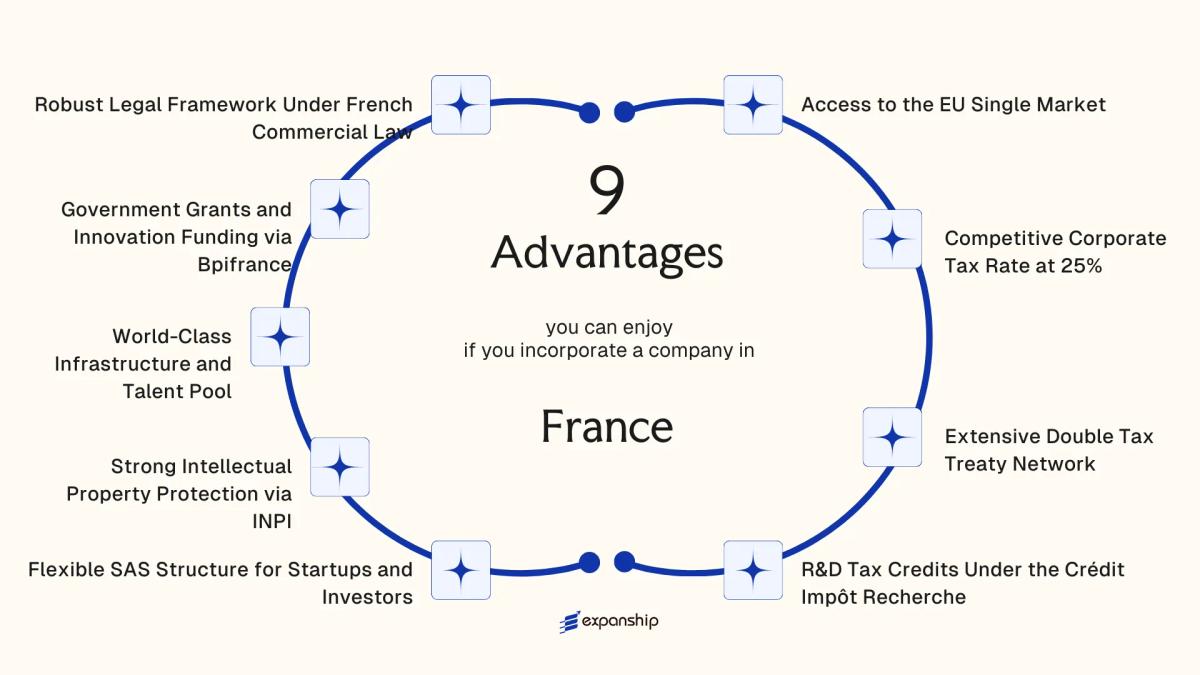
This article examines the key advantages of setting up a company here, drawing on the specific legal, fiscal, and institutional features that distinguish the French incorporation environment.
Access to the EU Single Market
Incorporating in France grants your business direct access to the EU single market — a trading bloc of over 440 million consumers governed by common regulatory standards under the Treaty on the Functioning of the European Union (TFEU). This access is a structural advantage, not a preference.
Unrestricted Movement of Goods and Services
A French-registered entity operates under the EU's four freedoms: free movement of goods, services, capital, and persons. Your firm can sell products across all 27 member states without customs duties or border controls at internal EU frontiers, which materially reduces distribution costs compared to operating from outside the bloc.
Eurozone Membership and Currency Stability
France is a eurozone member, meaning your business transacts in euros across 20 countries without currency conversion costs or exchange rate exposure at the point of sale. For investors structuring European operations, this eliminates a layer of financial risk that entities incorporated in non-euro EU states — such as Poland or Czechia — still carry.
A French entity gives you EU market entry without the additional compliance layer of a separate EU subsidiary.
Competitive Corporate Tax Rate at 25%
France's standard corporate income tax rate — known as the impôt sur les sociétés (IS) — sits at 25% for most companies, regardless of sector or legal structure. This rate applies to net taxable profits and has been at this level since the 2022 fiscal year, following a phased reduction that began in 2018. For foreign investors assessing European incorporation destinations, the France 25% corporate tax rate advantage is that it matches the EU average rather than exceeding it, placing French-registered entities on par with competitors in comparable Western European markets.
For smaller businesses, a reduced IS rate of 15% applies to the first €42,500 of taxable profit, provided the company meets specific eligibility conditions under Article 219 of the French General Tax Code (Code général des impôts). Your firm must be at least 75% held by natural persons and have fully paid-up share capital to qualify.
Why this structure works in your favour:
- The threshold-based reduced rate means early-stage entities pay significantly less tax during the period when cash flow matters most
- The standard 25% rate applies uniformly without industry-specific surcharges that exist in some other EU jurisdictions
- Share capital requirements for the reduced rate are straightforward for most foreign-owned SAS or SARL structures

Incorporate Your Company in France
Set up a French legal entity with full compliance support across SAS, SARL, and other structures recognised under French commercial law.
Extensive Double Tax Treaty Network
France's double tax treaty network benefits foreign-incorporated businesses in a direct, measurable way. With over 120 bilateral tax treaties in force, French-resident entities can reduce or eliminate withholding taxes on dividends, interest, and royalties paid to or received from counterparties in treaty partner countries. These agreements follow the OECD Model Tax Convention and are individually negotiated, meaning treaty rates vary by partner country and income type.
| Treaty Partner | Standard Rate | Reduced Treaty Rate |
|---|---|---|
| United States | 30% | 5% / 15% |
| Germany | 26.375% | 5% / 15% |
| United Kingdom | 0% / 20% | 5% / 15% |
| Singapore | 17% | 5% / 10% |
| United Arab Emirates | 0% | 0% |
For a foreign investor routing income through a French entity, these reduced rates translate into lower total tax drag across international structures. A holding company incorporated in France can receive dividends from subsidiaries in treaty jurisdictions at rates significantly below statutory levels, preserving more capital within the group.
Treaty benefits typically require the entity to meet substance and tax residency conditions under French domestic law, particularly Articles 4 B and 209 of the Code Général des Impôts. Shell arrangements without genuine local presence generally do not qualify. Your business must demonstrate actual management and control within the territory to claim residency-based protections under these agreements.
R&D Tax Credits Under the Crédit Impôt Recherche
The Crédit Impôt Recherche benefits for businesses are among the most generous R&D incentive mechanisms available within the EU. Under the scheme, companies can claim a tax credit equal to 30% of eligible R&D expenditure up to €100 million, and 5% on amounts above that threshold. For foreign-owned entities operating through a French subsidiary, this credit directly offsets corporate income tax liability — and if the credit exceeds the tax due, the surplus is refundable.
Eligible expenses are defined under Article 244 quater B of the Code général des impôts and include staff costs for researchers, depreciation of dedicated equipment, subcontracting to approved public research bodies, and intellectual property acquisition costs. This breadth means the credit can apply across sectors from biotech to software, provided the activities meet the definition of research or experimental development under OECD Frascati standards.
For startups and newly established entities, the refund is available immediately in the first year rather than being carried forward, which materially improves early-stage cash flow.
Keep these points in mind:
- Activities must qualify under the Frascati definition; commercial development phases do not qualify
- Claims are filed with the Direction générale des finances publiques via the annual tax return
- Subcontracting to private firms is capped and subject to specific conditions under Article 244 quater B
- Foreign parent companies cannot claim directly; the French entity must be the claimant
The official CIR guidance published by the tax authority provides the current eligibility criteria and filing procedures.
Young Innovative Companies (Jeunes Entreprises Innovantes) that also qualify for CIR can receive a full exemption from employer social contributions on researcher salaries, effectively stacking two separate fiscal reliefs simultaneously.
Flexible SAS Structure for Startups and Investors
The Société par Actions Simplifiée (SAS) is the dominant incorporation vehicle for startups and venture-backed companies in France, and the France SAS structure benefits for startups become evident the moment you examine what the Civil and Commercial Code permits in its articles governing this entity type. Unlike the SARL, the SAS imposes no statutory ceiling on share capital and allows a single individual (auto-entrepreneur excluded) to act as sole shareholder under the SASU variant. That combination gives founders immediate structural room to scale without reforming the entity.
Shareholder Agreements and Custom Governance
French law grants SAS shareholders near-complete freedom to define governance through the company's statuts (articles of association). Decision thresholds, veto rights, and board composition are all negotiable, which means investor protections like anti-dilution clauses and preferred liquidation rights can be embedded directly into founding documents. For foreign founders accustomed to common law shareholder agreements, this civil-law equivalent offers comparable contractual certainty.
Equity Flexibility for Investment Rounds
The SAS can issue multiple share classes, including ordinary shares, preference shares, and non-voting shares, making it structurally compatible with successive funding rounds without converting to a different entity type. SAS company advantages for investors in France are particularly tangible here: incoming investors can receive preferential rights while founders retain voting control. Registration of any capital increase is handled through the Greffe du Tribunal de Commerce, and the process does not require a notarial deed for most standard amendments, reducing both cost and procedural friction for your business.
Structure Your French SAS the Right Way
Get expert guidance on configuring your SAS for investor readiness, multi-class share issuance, and compliant governance under French commercial law.
Strong Intellectual Property Protection via INPI
France's Institut National de la Propriété Industrielle (INPI) administers trademark, patent, and design registrations under a well-established legal framework, giving your business enforceable IP rights from the date of filing. The France INPI intellectual property protection benefits are particularly significant for foreign companies because INPI registration creates a priority date that can be extended internationally under the Madrid Protocol or the Patent Cooperation Treaty within 12 months.
- A trademark registered with INPI is valid for 10 years and renewable indefinitely, giving your brand long-term legal certainty in one of Europe's largest consumer markets.
- France is a signatory to the Paris Convention, meaning your INPI filing date can establish priority for corresponding applications in over 170 member countries, a direct advantage for businesses building a multi-market IP portfolio.
- French IP rights for foreign companies are treated on equal footing with domestic applicants under the principle of national treatment, removing barriers that exist in some other jurisdictions.
- Patent protection granted through INPI, or via the European Patent Office designating France, provides up to 20 years of exclusivity, which connects directly to the Crédit Impôt Recherche regime for tax-efficient IP commercialisation.
- INPI's online filing system accepts applications in French, and professional representation is not legally required for foreign applicants, reducing administrative costs.
World-Class Infrastructure and Talent Pool
France talent pool advantages for businesses are partly structural. The country produces over 300,000 engineering and technology graduates annually through institutions such as École Polytechnique and CentraleSupélec, meaning your business can recruit from a deep pipeline of technically trained professionals without relying solely on international hiring.
Geographically, Paris ranks among Europe's top three cities for tech talent density, according to the CBRE European Tech Cities report. For foreign firms establishing European operations, this concentration reduces the time and cost of building functional teams from day one.
The transport and digital infrastructure supports distributed operations as well. France's high-speed rail network (TGV) connects major business centers including Lyon, Bordeaux, and Lille to Paris within two hours, and fiber broadband coverage continues to expand under the Plan France Très Haut Débit.
According to CBRE's 2023 European Tech Talent Report, Paris holds the third-largest concentration of tech workers in Europe, behind London and Amsterdam, with over 700,000 tech professionals in the greater metropolitan area.
French labor law, governed by the Code du Travail, sets defined frameworks for employment contracts, working hours, and collective agreements, giving foreign employers a predictable structure when scaling a local workforce.
Government Grants and Innovation Funding via Bpifrance
Bpifrance grants benefits for foreign companies extend beyond symbolic support. Bpifrance, the French public investment bank, administers a range of non-dilutive grants, subsidized loans, and co-investment mechanisms specifically available to companies incorporated on French soil, regardless of the parent entity's nationality.
Incorporated entities can access programs such as:
- Aide à l'Innovation, which funds early-stage R&D projects through direct grants
- Prêt d'Amorçage, a zero-interest seed loan for startups under five years old
- French Tech financing programs tied to the La French Tech initiative, offering both capital and visibility
For a foreign-founded business, incorporation in France converts eligibility from zero to active. A German-headquartered group, for example, can establish a French SAS and qualify for Bpifrance co-financing that would otherwise be inaccessible from abroad.
Funding decisions are based on the applicant entity's French legal existence and innovation activity, not the nationality of its shareholders. This structural neutrality is what makes Bpifrance financing benefits for startups and established foreign firms practically equivalent.
Bpifrance eligibility is tied to the incorporated entity's registered activity and innovation criteria in France; holding structures or dormant entities without active French operations will generally not qualify.
Robust Legal Framework Under French Commercial Law
French commercial law advantages for investors stem partly from the codified legal certainty that the Code de Commerce provides. This statute governs commercial entities, trading obligations, and business conduct in a unified, accessible framework. Foreign directors and shareholders benefit directly: the rules applying to your company are publicly codified, consistently interpreted by specialist commercial courts, and not subject to arbitrary administrative discretion.
Specialist Commercial Courts
France operates a network of Tribunaux de Commerce, commercial courts staffed by elected judges who are themselves experienced business practitioners. These courts handle disputes between traders, insolvency proceedings, and commercial contract conflicts. Cases are heard by judges with direct industry experience, which generally produces commercially grounded judgments rather than purely procedural ones.
Predictable Enforcement of Contracts
Under the Code Civil, as reformed by Ordinance No. 2016-131, French contract law was modernised to clarify rules on formation, interpretation, and performance. The reform codified pre-existing case law and introduced clearer provisions on hardship and good faith obligations. For a foreign business owner, this means the legal treatment of your commercial agreements follows written, predictable rules rather than purely judge-made doctrine.
Shareholder Protections Under Corporate Law
The Loi de Sauvegarde and related insolvency statutes provide structured procedures for business recovery before liquidation becomes unavoidable. Minority shareholder protections are codified within the Code de Commerce itself, covering:
- Rights to information and annual account access
- Protections against abusive majority decisions
- Procedural recourse through statutory audit mechanisms
These protections apply regardless of whether shareholders are French residents, making the framework accessible to internationally structured ownership.
How France Stacks Up Against Other European Incorporation Destinations
Comparing France against other European incorporation destinations reveals a profile that differs meaningfully from the jurisdictions most foreign investors consider alongside it. Germany, the Netherlands, and Ireland are the most realistic alternatives for businesses evaluating a Western European base, given overlapping investor profiles and similar access to EU institutions. The comparison is most instructive not on headline tax rates alone, but across the combination of structural, regulatory, and fiscal factors that affect operating costs and long-term compliance obligations.
Where the Netherlands offers a participation exemption and Ireland competes on a 12.5% corporate tax rate, the French framework counters with the Crédit Impôt Recherche, a treaty network exceeding 125 bilateral agreements, and the SAS structure's contractual freedom under the Code de commerce. For R&D-intensive businesses or those with complex shareholder arrangements, these factors shift the calculus considerably. Germany's GmbH requires a minimum share capital of €25,000; the SAS carries no statutory minimum, reducing the upfront capital commitment for early-stage entities.
| Parameter | France | Germany | Netherlands | Ireland |
|---|---|---|---|---|
| Standard Corporate Tax Rate | 25% | ~30% (federal + trade tax) | 25.8% | 12.5% |
| Minimum Share Capital (Main Entity) | None (SAS) | €25,000 (GmbH) | €0.01 (BV) | €1 (LTD) |
| R&D Tax Incentive | CIR (up to 30% of eligible spend) | Yes, since 2020 | Innovation Box regime | R&D tax credit (25%) |
| Double Tax Treaties | 125+ | 90+ | 100+ | 74+ |
| IP Regime | Yes (INPI, reduced rate on IP income) | Yes | Innovation Box (9%) | Knowledge Development Box (10%) |
| EU VAT Registration | Required at threshold | Required at threshold | Required at threshold | Required at threshold |
| Bilateral Investment Treaties | Extensive | Extensive | Extensive | Limited |
Compliance Services for Companies in France
Stay aligned with French regulatory obligations, from annual filing requirements under the Code de commerce to ongoing corporate maintenance with the Greffe du tribunal de commerce.
Conclusion
France offers a structurally sound case for foreign incorporation, grounded in concrete legal and fiscal provisions rather than general EU membership benefits. The benefits of incorporating in France are most clearly visible in the combination of a 25% corporate tax rate, the Crédit Impôt Recherche scheme that can offset up to 30% of qualifying R&D expenditure, and access to Bpifrance's funding instruments — each underpinned by enforceable statutory frameworks rather than discretionary policy.
The SAS structure, governed by Articles L. 227-1 et seq. of the Code de commerce, gives foreign investors meaningful contractual freedom over governance and share capital arrangements. That statutory flexibility, paired with France's treaty network spanning over 120 jurisdictions, produces a predictable operating environment that directly reduces tax exposure and structural risk for cross-border businesses.
France company formation advantages apply differently depending on your industry, ownership structure, and long-term exit strategy. A technology firm focused on R&D will derive different value from the same legal framework than a holding company or a distribution entity. The foundation is consistent across business types; how much it benefits your specific structure depends on how your operations align with the provisions covered. Getting that alignment right from the point of incorporation determines how much of the available framework your entity can actually access.
Let Expanship Handle Your French Company Formation
Incorporating through Expanship gives foreign business owners direct support across the specific advantages this blog has outlined, from structuring an SAS to accessing the Crédit Impôt Recherche or registering intellectual property through the INPI. Each step in the French incorporation process involves interaction with the Guichet des Formalités des Entreprises, the centralized online portal that replaced the former Centre de Formalités des Entreprises network, and navigating that system without local expertise adds avoidable delays. Expanship manages that liaison on your behalf.
The firm's service scope covers the full formation and post-incorporation cycle:
- Document preparation, notarization, and apostille legalization where required
- Registered agent and registered office provision in France
- Filing and correspondence with the Guichet des Formalités des Entreprises and the Registre du Commerce et des Sociétés
- Ongoing compliance management, including annual account filing obligations
- Director and shareholder registry maintenance under French commercial law requirements
- Banking introduction assistance to support account opening with French or international banks
These services apply whether your entity is an SAS, SARL, or another recognized French legal form, and they continue well beyond the date of incorporation.
To discuss your formation requirements, contact Expanship France.
Frequently Asked Questions (FAQ)
The standard corporate income tax rate in France is 25%, applicable to most companies regardless of size. A reduced rate of 15% applies to SMEs on the first €42,500 of taxable profit, provided the company's share capital is fully paid up and at least 75% is held by individuals. This tiered structure is set under Article 219 of the French General Tax Code (Code général des impôts).
The Crédit Impôt Recherche (CIR) allows companies conducting qualifying R&D activities in France to claim a tax credit equal to 30% of eligible R&D expenditure up to €100 million, and 5% above that threshold. A newly incorporated entity with no prior tax liability can receive the credit as a direct cash refund rather than carrying it forward, which improves early-stage cash flow. Eligible costs include researcher salaries, subcontracting to approved public or private research organizations, and certain depreciation charges on R&D equipment.
France has over 120 bilateral tax treaties in force that can reduce or eliminate withholding tax on dividends paid to foreign parent entities. The applicable rate depends on the specific treaty and the ownership percentage held by the foreign shareholder. Under the EU Parent-Subsidiary Directive, dividends paid to an EU parent holding at least 10% of a French subsidiary may be fully exempt from French withholding tax, subject to anti-abuse conditions.
No statutory requirement mandates that the president of an SAS be a French resident or a French national. The SAS president can be a foreign individual or a foreign legal entity, and no minimum local shareholding applies. That said, practical considerations such as corporate bank account opening, signing authority, and VAT registration may benefit from having a local representative or a registered legal address provider.
INPI, the Institut national de la propriété industrielle, administers trademark, patent, and design registrations at the national level. A French trademark registration provides protection for 10 years, renewable indefinitely, while patents are granted for a maximum of 20 years from the filing date. Companies incorporated in France also have direct access to EU-wide protections through the European Union Intellectual Property Office (EUIPO) and the European Patent Office (EPO), without requiring separate local filings for each member state.
Bpifrance, the public investment bank, offers a range of financing instruments including innovation grants, repayable advances, subsidized loans, and equity participation for early-stage and growth-phase companies. Eligibility criteria vary by program; some schemes target specific sectors such as deep tech, green transition, or life sciences, while others are open to any innovative SME meeting defined criteria. Applications are submitted directly to Bpifrance, and certain regional programs are co-financed with local authorities, which can increase the total funding available to your entity.
Each jurisdiction has a distinct regime. Ireland offers a 6.25% Knowledge Development Box rate on qualifying IP income, while the Netherlands provides an Innovation Box taxing qualifying profits at 9%. France does not have a dedicated IP box rate at the same level, but the combination of the CIR, full deductibility of R&D expenses, and the 25% standard rate can produce a competitive effective tax burden for companies with significant R&D activity. The most advantageous structure depends on the proportion of income derived from IP exploitation versus active trading, as well as treaty access requirements specific to your investor base.
Legal Disclaimer
The information provided in this article is for general informational purposes only and does not constitute legal, tax, or professional advice. While we strive to ensure the accuracy and timeliness of the content, laws and regulations are subject to change, and the application of laws can vary widely based on specific facts and circumstances.
Readers should not act upon this information without seeking professional counsel tailored to their individual situation. Expanship and its authors disclaim any liability for actions taken or not taken based on the content of this article.
For specific advice regarding your business setup, compliance requirements, or any legal matters, please consult with qualified legal and tax professionals in the relevant jurisdiction.