
Key Takeaways
- Entities incorporating in Micronesia must comply with the Business Corporation Act of the Federated States of Micronesia, with registration administered at the state level rather than through a single national registry.
- Bearer shares are prohibited under FSM law, and companies are required to disclose beneficial ownership information, making transparency of corporate structure a mandatory compliance obligation for foreign investors.
- Every registered entity in Micronesia must maintain a locally present registered agent within FSM, a requirement with direct operational implications for foreign companies that cannot fulfill this role themselves.
- Compliance obligations in Micronesia are subject to variation based on entity type, the specific FSM state in which the company is registered, and the nature of the business activity being conducted.
Incorporation requirements in Micronesia are governed primarily by the Business Corporation Act of the Federated States of Micronesia, with entity registration administered at the state level through each FSM state's government rather than a single national registry.
This article covers the structural, documentary, and compliance requirements applicable to foreign and domestic entities seeking to register a business under FSM law.
Failure to satisfy these requirements results in rejection of the registration application or, for entities already operating, potential legal liability and loss of standing to conduct business.
Requirements can differ based on entity type, the state in which registration is filed, and the nature of the business activity being conducted. Foreign investors should account for these variables when assessing their specific obligations.
This article is most relevant to foreign entrepreneurs and international companies evaluating formal entry into the FSM market through a locally registered entity.
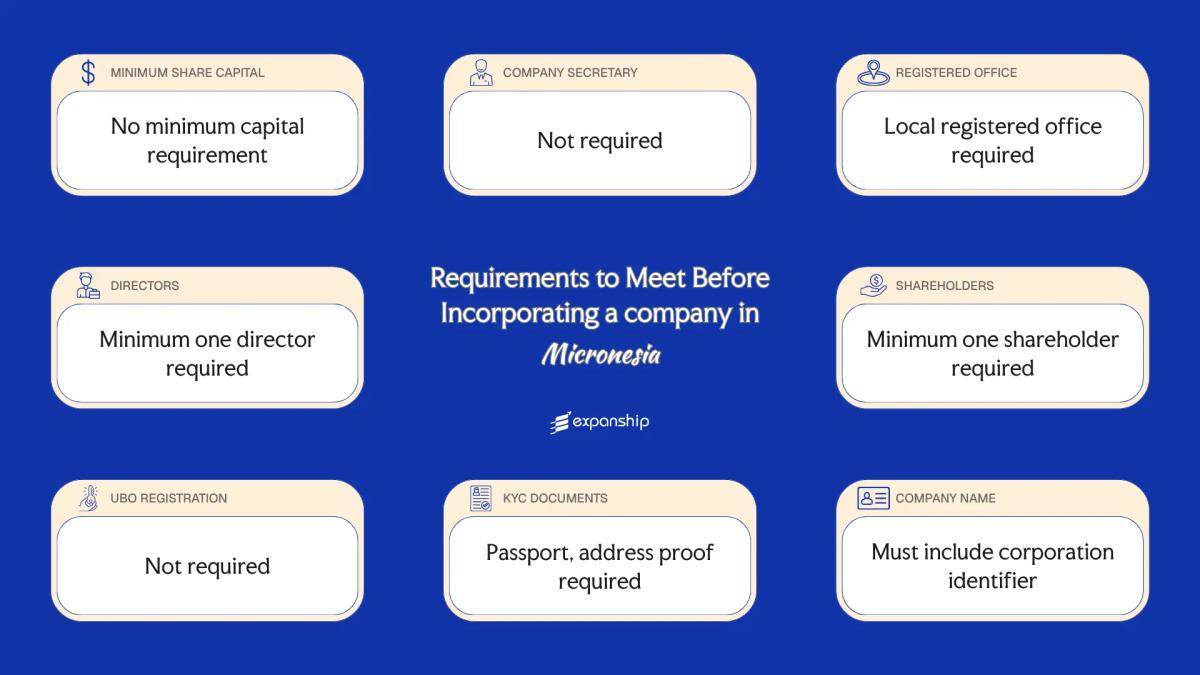
Minimum Share Capital Requirements in Micronesia
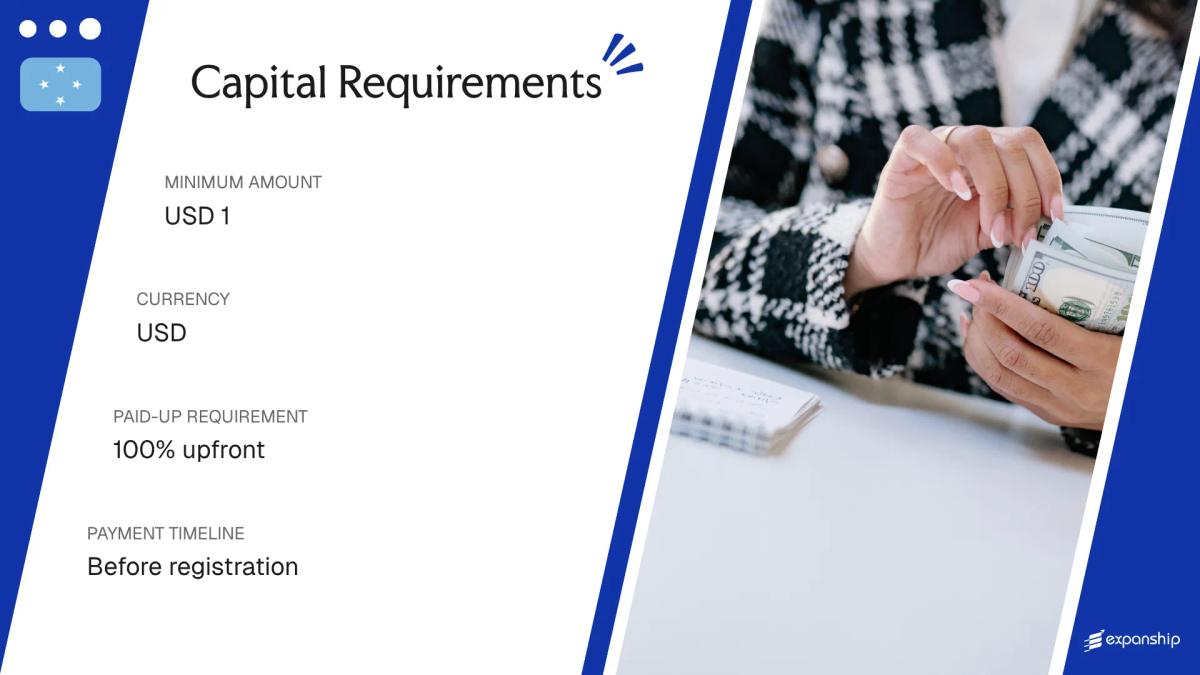
Under the Associations Law of the Federated States of Micronesia, there is no prescribed minimum share capital for business corporations. The Division of Revenue and Taxation, which oversees corporate registrations at the national level, does not require proof of capital deposit as a condition of incorporation.
FSM share capital obligations are structured around what the articles of incorporation specify rather than a statutory floor. Your company's authorized capital is defined in its formation documents, and shares may be issued with or without par value depending on how the charter is drafted.
| Parameter | Detail |
|---|---|
| Minimum Authorized Share Capital | No statutory requirement |
| Maximum Authorized Share Capital | No statutory requirement |
| Minimum Paid-Up Capital | No statutory requirement |
| Paid-Up Requirement at Incorporation | No statutory requirement |
| Accepted Currency | United States Dollar (USD) |
| Accepted Forms of Contribution | Cash and non-cash contributions permissible |
| Timeframe to Deposit Capital | No statutory timeframe |
Even without a statutory minimum, your articles of incorporation must still define an authorized share structure. Leaving capital provisions vague can create complications when issuing shares or admitting new shareholders post-incorporation.
Registered Agent Requirements in Micronesia
Under the Associations Law of the Federated States of Micronesia, every foreign and domestic corporation registered in the country must maintain a registered agent. This requirement applies continuously, not just at the point of incorporation — your entity must have an agent on record at all times to remain in good standing with the FSM Department of Justice.
The registered agent acts as the official point of contact for service of process and government correspondence. Keeping that channel open ensures any legal notices or regulatory communications directed at your firm are received and handled without interruption.
Qualification criteria for a registered agent in FSM include:
- The agent must be a resident individual or a business entity authorized to operate within the FSM.
- Corporate agents must be incorporated or registered under FSM law to conduct business in the jurisdiction.
- Individual agents must maintain a physical presence within the FSM, not merely a postal address.
- No specific professional licensing is mandated, but the agent must be legally competent to receive service of process.

Incorporate a Company in Micronesia (FSM)
Set up your legal entity in the Federated States of Micronesia with full compliance support, including registered agent appointment and ongoing maintenance.
Registered Office Requirements in Micronesia
Registered office requirements in Micronesia apply to all entities incorporated under the FSM Business Corporations Act, which mandates that each company maintain a designated office address within the Federated States of Micronesia at all times. Failure to maintain a compliant address can result in administrative penalties, loss of good standing, or involuntary dissolution by the FSM Department of Justice.
- A physical address within the FSM is required; P.O. boxes do not satisfy the registered office obligation.
- Virtual office arrangements are generally not recognized as compliant substitutes for a physical premises.
- The address must be located within the jurisdiction; foreign addresses are not permitted.
- Proof of occupancy, such as a lease agreement or title document, may be required to substantiate the address on file.
- The registered office address is recorded in the public company registry maintained by the FSM government and is accessible to third parties.
- Any change to the registered office address must be formally reported to the relevant FSM state-level authority through an amendment filing.
- Non-compliance with FSM registered address obligations can affect your company's ability to receive legal correspondence and official government notices.
Director Requirements in Micronesia
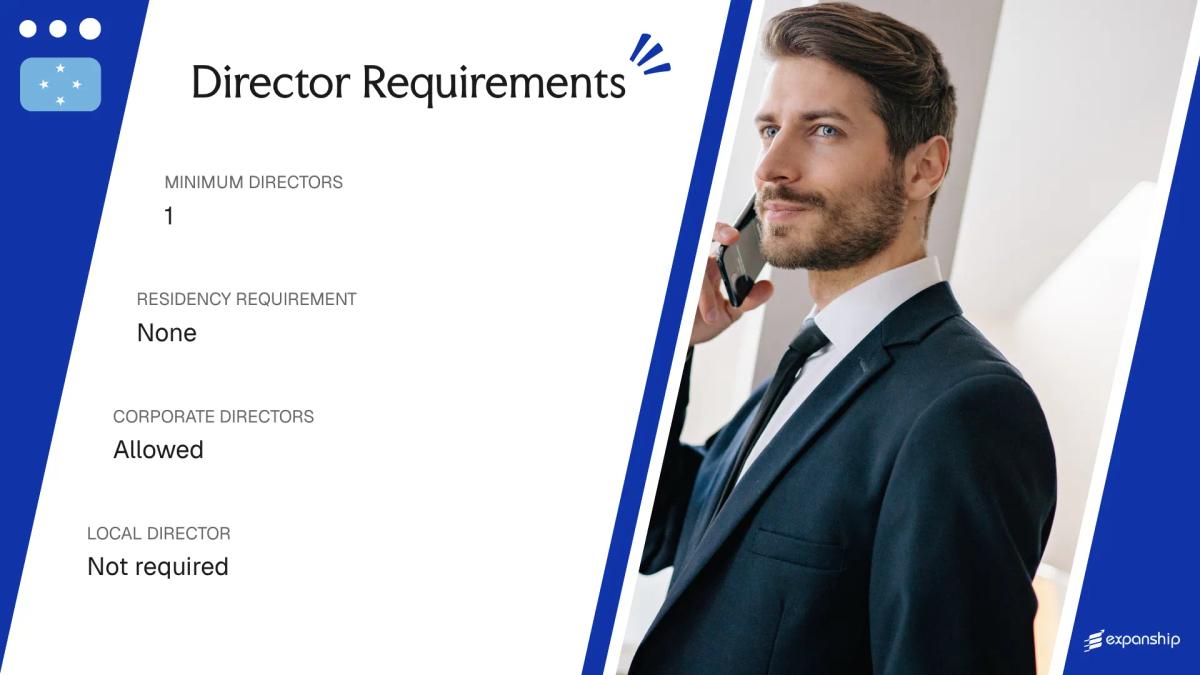
Under the Federated States of Micronesia Business Corporations Act, director requirements Micronesia company structures must satisfy are relatively minimal, though directors assume full fiduciary duties upon appointment. Those duties include acting in good faith, exercising reasonable care, and avoiding conflicts of interest that could harm the corporation.
| Parameter | Detail |
|---|---|
| Minimum Number of Directors | One director is required. |
| Maximum Number of Directors | No statutory maximum is prescribed. |
| Local/Resident Director Required | No residency requirement exists under FSM corporate law. |
| Nationality Restrictions | No nationality restrictions are imposed. |
| Minimum Age Requirement | Directors must be of legal adult age (18 years). |
| Corporate Directors Permitted | No statutory prohibition exists, though natural persons are standard in practice. |
| Director Must Be a Shareholder | No statutory requirement for a director to hold shares. |
| Publicly Listed on Registry | Director details are recorded with the FSM Division of Revenue and Taxation but are not broadly published in a public registry. |
| Disqualification Conditions | Persons adjudged bankrupt or convicted of fraud-related offences may be disqualified from directorship. |
Despite FSM having no residency requirement for directors, the FSM Division of Revenue and Taxation requires a locally present registered agent, meaning foreign-resident directors must still rely on an in-country representative for all official correspondence.
Shareholder Requirements in Micronesia
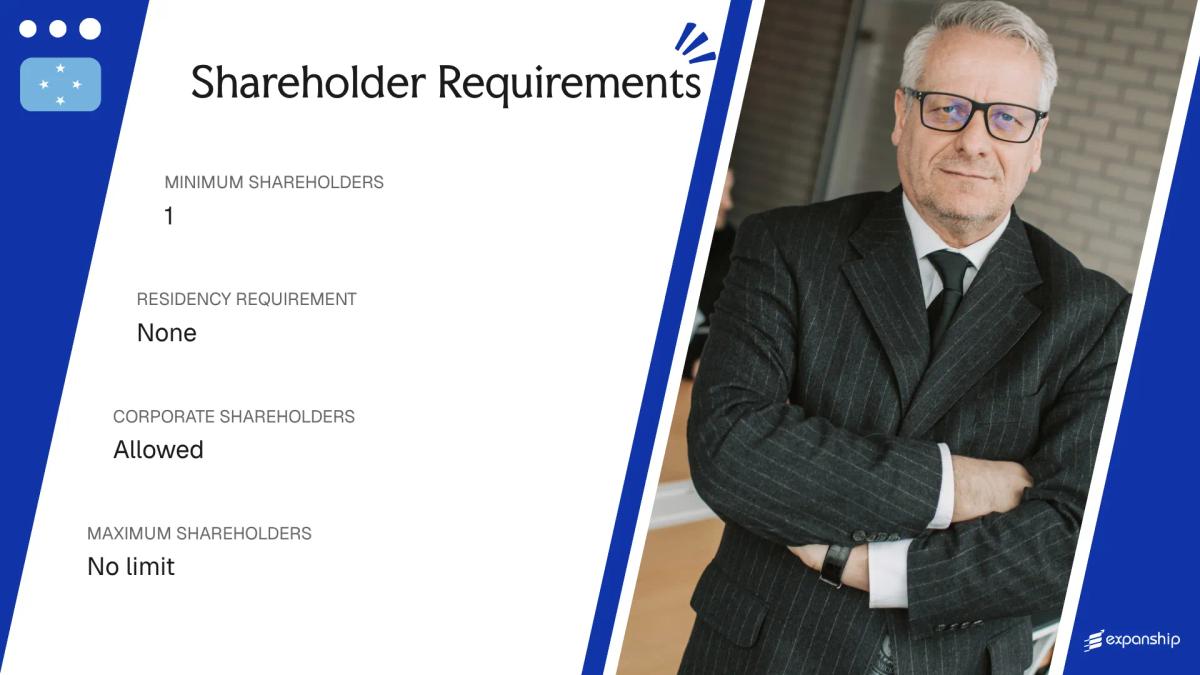
Under the Federated States of Micronesia's corporate framework, a company may be formed with a single shareholder, making sole-owner structures permissible. Meeting the shareholder requirements Micronesia FM mandates starts with confirming no statutory maximum on shareholder count exists under general FSM business corporation rules.
Nationality and Residency Restrictions
Foreign nationals may hold shares in an FSM-registered entity, though certain business activities require majority local ownership under FSM law. Your ownership structure should be reviewed against any sector-specific restrictions that apply to the intended commercial activity.
Corporate Shareholders
Corporate entities are permitted to act as shareholders in an FSM business corporation. No general prohibition exists against foreign-incorporated companies holding shares, provided the underlying business activity does not trigger local ownership thresholds.
Shareholder Liability
Shareholder liability is generally limited to the amount unpaid on each member's shares. Circumstances such as fraud or improper conduct may expose shareholders to extended liability under applicable FSM statutes.
Register of Shareholders
A register of shareholders must be maintained at the company's registered office. FSM company law generally requires this record to reflect current ownership, though public accessibility provisions follow the general principles applicable to corporate records held domestically.
Structuring Your Shareholder Setup for FSM Incorporation
Get guidance on meeting ownership and shareholder obligations when registering a business entity in the Federated States of Micronesia.
UBO / Beneficial Ownership Disclosure Requirements in Micronesia
Micronesia (FSM) does not currently maintain a statutory UBO or beneficial ownership disclosure framework applicable to privately held companies. No federal legislation within the FSM Code establishes a mandatory beneficial ownership register or prescribes filing obligations with a designated authority.
KYC / Document Requirements in Micronesia
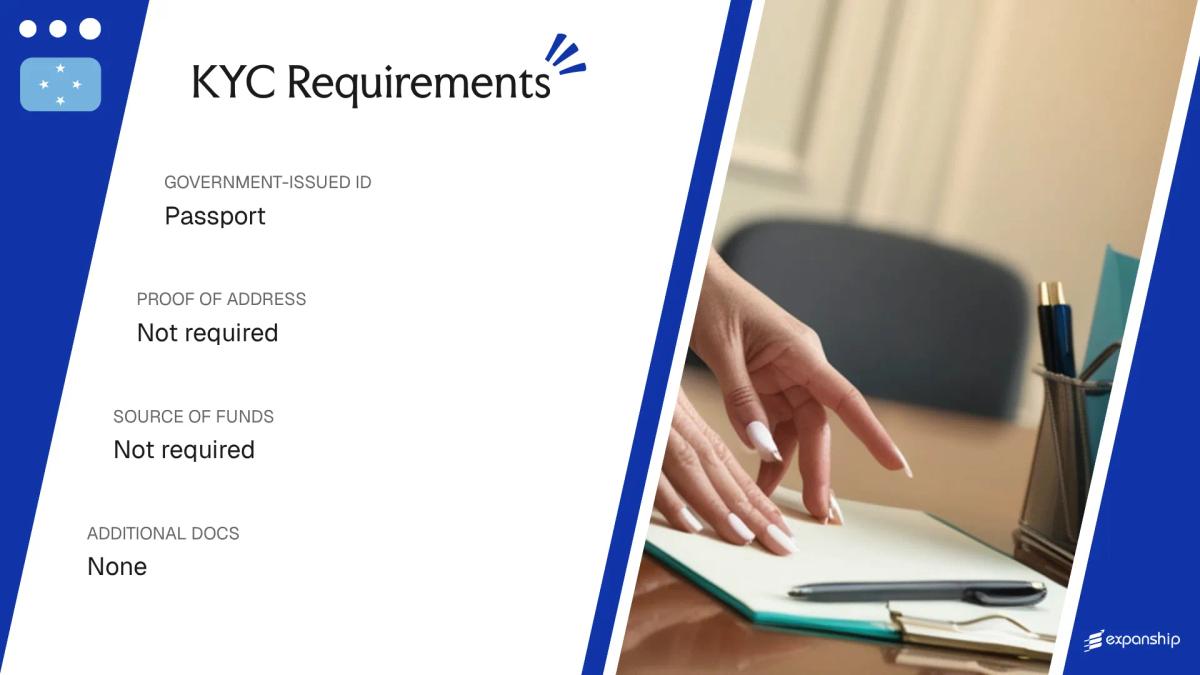
KYC requirements for Micronesia company formation are governed by the FSM's anti-money laundering framework, administered by the FSM FIU, which sets due diligence standards that apply at the point of incorporation.
Individual / Personal Documents
- Valid government-issued passport or national identity document
- Proof of residential address dated within three months, such as a utility bill or bank statement
- Completed KYC/AML declaration form as required by the registered agent
- Recent passport-sized photograph may be requested depending on the agent's internal compliance procedures
Corporate Documents
- Certificate of incorporation or equivalent constitutional document from the home jurisdiction
- Memorandum and articles of association or equivalent governing instrument
- Register of directors and register of shareholders from the parent entity
- Proof of the corporate entity's registered office address
Source of Funds Documentation
- Bank statements covering a minimum of three to six months prior to incorporation
- Audited financial statements where the introducing entity is an established business
- A written declaration or letter explaining the origin of capital if bank records are insufficient
Notarisation and Apostille Requirements
- Foreign documents are generally required to be notarised in the country of origin
- FSM is not a signatory to the Hague Apostille Convention, so certified authentication through consular or embassy channels may apply instead
- Official translations into English are required for any document not originally issued in English
Incomplete or unverified source of funds documentation is among the most common reasons for incorporation delays under FSM compliance review.
Company Name Requirements in Micronesia
Proposed company name requirements in Micronesia FM are reviewed by the relevant state-level registry at the time of incorporation, as corporate registration is administered on a state-by-state basis across the FSM. Each submitted name is assessed for uniqueness against existing registrations before approval is granted.
Names must include a legal suffix that identifies the entity type, such as "Corporation," "Incorporated," or an accepted abbreviation. No specific character or word-length limits are publicly codified, but names must be clearly distinguishable from those already on record.
Certain words implying government affiliation, banking functions, or regulated financial activity are either prohibited outright or require prior authorization from the relevant supervisory authority before use in a business name.
Name reservation is generally available through the applicable state registry. Reservation periods and procedural steps vary by state, so your firm should confirm the specific timeframe and fee with the registry in the state where incorporation is planned.
Compliance Services for Companies in Micronesia
Maintain good standing with FSM state-level registry requirements, including name compliance, periodic filings, and regulatory obligations.
Conclusion
Incorporation requirements in Micronesia are governed primarily by the FSM Business Corporation Act, with additional oversight from the Department of Finance and Administration at the national level and corresponding state-level authorities. Among the requirements covered, the prohibition on bearer shares and the mandatory disclosure of beneficial ownership carry particular weight for foreign investors structuring cross-border entities. The registered agent requirement, which mandates a locally present agent within FSM, also has direct operational implications. Once these obligations are understood, the practical next step is engaging qualified local counsel and a registered agent to begin the formal filing process.
Expanship's Corporate Services for Micronesia Expansion
Micronesia FM corporate services from Expanship are designed to help your business manage the specific requirements that come with incorporating under the FSM Business Corporations Act, from appointing a locally qualified registered agent to maintaining statutory compliance across the relevant state jurisdiction. These obligations place a real administrative load on foreign founders, and Expanship's role is to carry the operational weight of that process on your behalf.
Beyond initial registration, Expanship supports your business across the full incorporation lifecycle.
- Preparing incorporation documents and filing your company with the relevant FSM state authority
- Providing a registered agent and registered office address in the applicable jurisdiction
- Liaising with government offices and regulatory bodies on your behalf
- Managing post-incorporation compliance obligations as they arise
- Introducing your entity to suitable banking options in the region
- Handling tax registration and coordination with local authorities
To discuss your requirements directly, contact Expanship Micronesia.
Frequently Asked Questions (FAQ)
Foreign nationals can serve as directors in the FSM, but you must hold a valid foreign investment permit issued by the FSM Foreign Investment Board before conducting business operations. The permit is tied to the entity, not the individual director, so the business itself must be properly authorised. Director appointments are recorded with the relevant state-level registry, as corporate registration in the FSM operates at the state level rather than nationally.
Operating without a valid foreign investment permit under the FSM Foreign Investment Act exposes your business to administrative sanctions, including cease-and-desist orders and potential fines. The FSM Foreign Investment Board has authority to revoke permits or deny renewal where compliance obligations have not been met. Continued non-compliance can result in forced closure of operations within the jurisdiction.
Beneficial ownership disclosure obligations apply to foreign-owned entities operating under an FSM foreign investment permit, regardless of the specific legal structure used. The FSM has strengthened its anti-money laundering framework in response to international standards, meaning UBO information must be submitted to the relevant regulatory authority during the permit application process. Failure to provide accurate beneficial ownership information can result in permit refusal or cancellation.
A physical registered office within the relevant FSM state is required; a virtual address alone does not satisfy this requirement. The registered office must be a genuine address where official correspondence and legal notices can be received and where the entity can be contacted by the state registry. This address must be maintained for the duration of the company's registration.
Because corporate registration is administered at the state level in the FSM, operating across Chuuk, Pohnpei, Yap, and Kosrae may require separate registrations or compliance filings with each state's relevant registry. Each state has its own administrative procedures, which means your documentation and fee obligations can differ depending on where your business activity is concentrated. You should confirm requirements with the specific state registry rather than assuming uniform national rules apply.
Legal Disclaimer
The information provided in this article is for general informational purposes only and does not constitute legal, tax, or professional advice. While we strive to ensure the accuracy and timeliness of the content, laws and regulations are subject to change, and the application of laws can vary widely based on specific facts and circumstances.
Readers should not act upon this information without seeking professional counsel tailored to their individual situation. Expanship and its authors disclaim any liability for actions taken or not taken based on the content of this article.
For specific advice regarding your business setup, compliance requirements, or any legal matters, please consult with qualified legal and tax professionals in the relevant jurisdiction.