
Key Takeaways
- Businesses incorporated under Micronesia's Business Corporations Act must also navigate state-level requirements that vary across Chuuk, Pohnpei, Kosrae, and Yap, creating a layered compliance burden with no single unified process.
- Foreign investors face statutory restrictions on ownership in key sectors, limiting the share of control available to non-citizens in industries central to the FSM's economy.
- The FSM maintains an extremely narrow double taxation treaty network, leaving most cross-border transactions without bilateral tax relief and exposing internationally oriented businesses to unmitigated withholding and income tax exposure in counterparty jurisdictions.
- The combination of underdeveloped correspondent banking relationships and limited local financial infrastructure means routine treasury functions — including international transfers and credit facilities — carry operational friction that would not exist in more commercially developed jurisdictions.
Incorporating a business in Micronesia sits within an evolving regulatory framework, one that reflects the Federation's position as a developing Pacific Island nation with limited institutional capacity and an economy shaped largely by external dependency. The Business Corporations Act governs company formation at the national level, though state-level requirements can add a further layer of complexity depending on where operations are based.
The disadvantages of incorporating in Micronesia span structural, financial, and operational dimensions. How severely these affect your business depends on the nature of the entity, the industry it operates in, and whether its activities are domestically focused or internationally oriented.
This article is most relevant to foreign investors and internationally oriented firms considering the FSM as a base for Pacific operations, trade, or professional services.
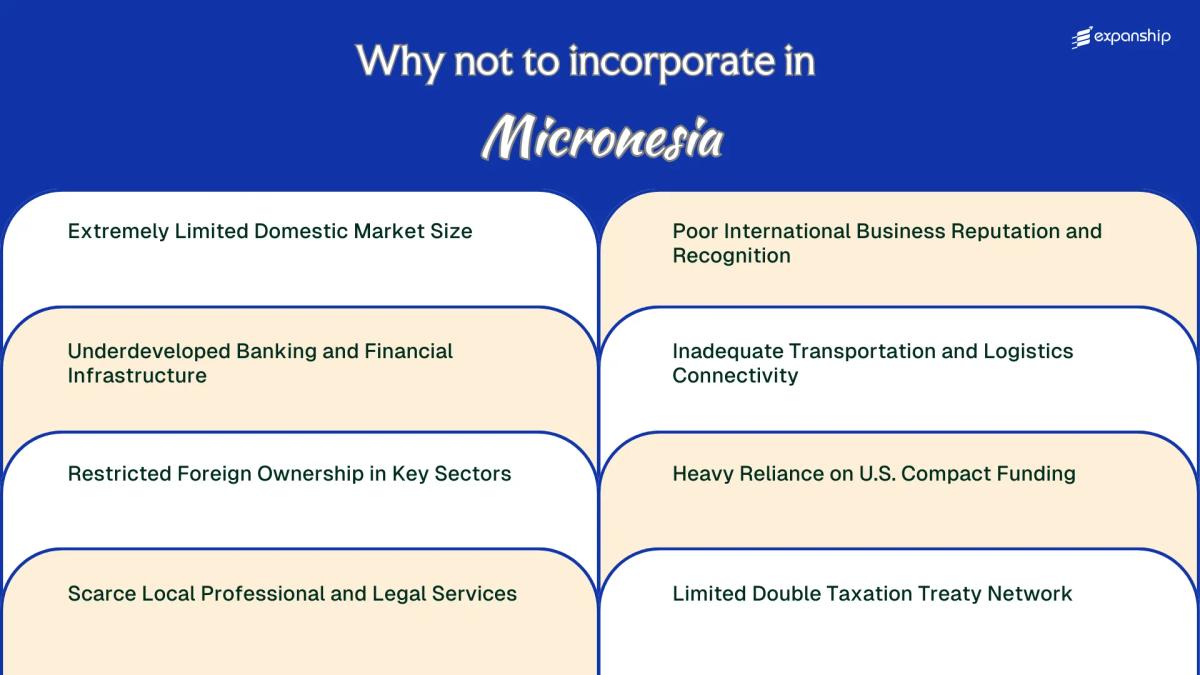
Extremely Limited Domestic Market Size
Micronesia small market size business limitations are among the most immediate structural constraints any foreign entity will encounter after incorporation. The Federated States of Micronesia has a total population of approximately 115,000 people spread across four states and more than 600 islands.
A Consumer Base Too Small to Sustain Most Business Models
Domestic demand across the FSM cannot support volume-dependent business models in retail, manufacturing, or consumer services. Your revenue ceiling is effectively set by the purchasing power of a dispersed, low-income population, where GDP per capita hovers around USD 3,500, making unit economics unfavorable for most incorporated entities.
The limited consumer base in Micronesia incorporation contexts forces most foreign firms to orient operations entirely toward export or regional trade, which introduces separate logistical and regulatory costs not reflected in the initial business plan.
Structural Economic Constraints on Market Growth
Private sector development under the FSM's economic framework remains constrained by high import dependency and minimal industrial output. Any firm relying on domestic sales to reach breakeven will find the local absorption capacity structurally insufficient.
A foreign business incorporated in the FSM that targets domestic revenue will almost certainly fail to reach financial viability, as the total addressable market cannot support standard commercial returns across most sectors.
Underdeveloped Banking and Financial Infrastructure
Micronesia banking infrastructure problems begin with a fundamental structural reality: the country operates only a small number of commercial banks, with the FSM Development Bank and a limited presence of U.S.-affiliated institutions forming the backbone of the formal financial system.
For a foreign-incorporated entity, this concentration means fewer options for corporate accounts, trade finance, or credit facilities.
Correspondent banking relationships with international institutions are thin. Your business may find it difficult to execute routine cross-border transactions, particularly with counterparties outside the U.S. dollar zone, because local banks carry minimal correspondent networks.
The practical friction this creates includes:
- Opening a corporate account can require in-person procedures that delay your operational timeline by weeks
- Limited trade finance products force you to seek external financing arrangements, adding transaction costs
- Absence of digital banking infrastructure comparable to regional peers means slower settlement cycles for international payments
Regulatory oversight falls under the FSM Banking Board, but its supervisory capacity reflects the small scale of the domestic system. Businesses requiring treasury management, multi-currency accounts, or structured financial products will find local institutions cannot fulfill those needs.

Company Incorporation in Micronesia (FM)
Understand the full regulatory and banking requirements before registering your company in the Federated States of Micronesia.
Restricted Foreign Ownership in Key Sectors
Foreign ownership restrictions in Micronesia apply across several economically significant sectors, creating structural barriers that limit how much control a foreign entity can hold over its operations.
Under the Foreign Investment Act and related statutes administered by the Department of Resources and Development, certain sectors are either fully closed to foreign ownership or subject to majority local ownership requirements. These include fishing, retail trade below specific thresholds, and land-related activities — sectors that, in a small island economy, represent a meaningful share of commercial activity.
| Sector | Foreign Ownership Restriction | Practical Impact |
|---|---|---|
| Land ownership | Prohibited for non-citizens | Foreign firms cannot hold real property directly |
| Retail trade (small-scale) | Reserved for Micronesian citizens | Foreign firms excluded from local consumer market entry |
| Fishing and marine resources | Subject to licensing and local partnership requirements | Limits operational control and profit repatriation |
| Agriculture (certain activities) | Preference for citizen-owned enterprises | Access conditional on local equity participation |
Because land cannot be held by foreign nationals or foreign-owned firms, your business must rely on lease arrangements, which introduces dependency on local counterparties and constrained tenure security.
Sectors requiring local majority ownership force foreign investors to cede controlling interest, reducing decision-making authority over hiring, contracts, and strategic direction. This is not a minor procedural condition — it structurally limits the independence of foreign-owned operations. Exceptions may exist for export-oriented enterprises or specific concession agreements, but these require case-by-case negotiation rather than a standard legal pathway.
Scarce Local Professional and Legal Services
Micronesia legal services scarcity challenges are not incidental — they reflect a structural gap in the country's professional economy. The Federated States of Micronesia has a small licensed attorney pool, and practitioners with direct experience in corporate formation, cross-border transactions, or foreign investment compliance are particularly scarce.
Corporate work in FSM is governed under the Business Corporations Act, yet few local firms regularly handle its application to foreign-owned entities. Your business may face extended timelines simply because qualified legal counsel is unavailable or already committed.
Accounting professionals with international reporting familiarity are similarly limited. Engaging professionals remotely from outside FSM is possible, but it creates coordination gaps and raises costs substantially.
- Retaining local registered agent services is a statutory requirement under FSM corporate law, not optional.
- Legal filings with the Department of Justice require compliance documentation that must meet FSM-specific standards, not general international templates.
- Foreign businesses bear sole responsibility for ensuring filings meet local statutory deadlines without reliable professional infrastructure to support them.
- No centralized professional referral system exists to verify practitioner credentials or availability.
The FSM bar association has fewer licensed attorneys than many mid-sized law firms in Singapore or Hong Kong, making it one of the smallest legal professional bodies in any incorporated jurisdiction worldwide.
Poor International Business Reputation and Recognition
Micronesia's poor international business reputation stems from limited global visibility rather than documented misconduct, but the practical effect on your company is the same: low international credibility risks for any Micronesia-registered entity remain a persistent commercial obstacle.
Perception Among Foreign Banks and Counterparties
Businesses incorporated under the Federated States of Micronesia's domestic legal framework are rarely recognized by foreign financial institutions or corporate counterparties. This low global business recognition means that due diligence requests, correspondent banking approvals, and counterparty onboarding processes take significantly longer, if they succeed at all.
Structural Absence from Global Frameworks
The FSM is not a member of the OECD, holds no meaningful standing in major international trade or investment treaty networks, and lacks a substantive profile in global compliance databases used by multinational firms. For your business, this translates to heightened scrutiny during Know Your Customer (KYC) reviews, where incorporation in a jurisdiction with minimal international regulatory engagement is itself treated as a risk indicator. That classification applies regardless of your company's actual activity or structure.
Addressing Business Credibility Challenges in Micronesia
Understand the structural and reputational barriers of operating through an FSM-registered entity and how to assess whether this jurisdiction fits your corporate objectives.
Inadequate Transportation and Logistics Connectivity
Micronesia transportation connectivity limitations present a concrete operational problem: the country consists of over 600 islands spread across 2.7 million square kilometers of the Pacific, and inter-island freight movement depends almost entirely on infrequent shipping services and limited air cargo capacity.
- Your business will depend on the Caroline Maru and similarly infrequent field trip vessels for inter-island cargo, creating supply chain gaps that can extend to weeks between deliveries.
- Pohnpei International Airport handles limited cargo volume, and the absence of dedicated freight carriers means your shipments compete with passenger luggage for space.
- No domestic rail or road network connects the main island groups, so logistics costs per unit shipped significantly exceed those typical in mainland or well-connected island jurisdictions.
- Poor transport infrastructure in Micronesia forces companies to hold larger safety stock, directly increasing working capital requirements.
- Even businesses incorporated on Pohnpei face delays moving goods to Chuuk, Yap, or Kosrae, as inter-state shipping schedules are not commercially oriented.
Heavy Reliance on U.S. Compact Funding
Micronesia reliance on US Compact funding risks is not an abstract concern — it is a structural vulnerability embedded in the national budget. Under the Compact of Free Association (COFA) with the United States, the Federated States of Micronesia receives direct grants that have historically funded over 30% of government revenues, covering public services, infrastructure, and civil administration.
This dependency creates direct exposure for any business operating in the jurisdiction. When Compact funding allocations shift or face renegotiation, government procurement contracts, infrastructure projects, and public-sector wages are all affected, compressing the already narrow commercial activity that foreign firms depend on.
The 2003 Amended Compact extended funding through 2023, with transition provisions extending into the mid-2020s. Your business cannot assume that current funding levels will persist, and no domestic tax base exists at sufficient scale to replace that revenue if U.S. appropriations decline.
A hypothetical scenario: If a foreign firm secures a government-linked service contract valued at $200,000 annually, and Compact disbursements are reduced by 20% in a given fiscal year, the contracting agency may face budget shortfalls that delay or cancel payment — with no alternative public financing mechanism to absorb the gap.
Limited Double Taxation Treaty Network
The Micronesia limited tax treaty network is, in practical terms, almost nonexistent. The Federated States of Micronesia has not concluded any comprehensive bilateral double taxation agreements with major trading economies, leaving your business exposed to taxation in both FSM and the jurisdiction where your counterparties, investors, or parent entities are resident.
Without treaty protection, dividend payments, royalties, interest, and service fees paid across borders can face full withholding tax in the source country with no offsetting credit mechanism. This creates a genuine cost burden that erodes the economics of cross-border structures routed through an FSM entity.
The absence of tax agreements also affects how foreign tax authorities treat FSM-incorporated firms. Many jurisdictions apply heightened scrutiny or default withholding rates to payments made to entities in non-treaty countries, compounding double taxation risks for Micronesia FM companies.
- No tax sparing provisions exist for investors from capital-exporting countries.
- Transfer pricing disputes lack the mutual agreement procedure (MAP) framework that treaties normally provide.
- Foreign income earned by FSM entities receives no reduced withholding treatment in most OECD member states.
If your business structure depends on cross-border income flows, the absence of any double taxation treaty means you cannot claim treaty-based relief in counterparty jurisdictions regardless of your FSM entity's legal standing.
Overcoming Incorporation Challenges in Micronesia
Overcoming Micronesia incorporation challenges begins not with optimism but with structural realism. The disadvantages discussed in this blog are systemic, and addressing them requires deliberate planning before entity formation, not after.
- Register your business through the FSM government and confirm sector-specific foreign ownership restrictions under the FSM Foreign Investment Act before committing to a legal structure.
- Establish a correspondent banking relationship with a U.S.-based institution prior to incorporation, given the limited local financial infrastructure.
- Retain a registered agent based in Pohnpei or your chosen state, as local legal representation is a statutory requirement for foreign entities.
- Account for the absence of a broad double taxation treaty network in your cross-border tax structuring from the outset.
- Build logistics costs into your operational model, reflecting the documented constraints in inter-island and international freight connectivity.
Each of these steps operates within a federal-state jurisdictional split, where FSM national law and individual state-level regulations both apply. Your compliance obligations do not resolve at the national level alone.
Micronesia's Overall Business Viability
The Federated States of Micronesia presents a legally structured incorporation environment under its existing business laws, and foreign entities can establish operations there through defined channels. That said, the Micronesia business viability risks documented throughout this blog collectively point to a jurisdiction better suited to specific, limited-scope use cases than broad commercial ambitions.
| Pro | Con |
|---|---|
| U.S. Compact of Free Association provides political and economic stability | Heavy reliance on Compact funding creates structural fiscal vulnerability |
| Operates within a U.S.-aligned legal and regulatory framework | Domestic market of roughly 115,000 people limits commercial scale |
| No foreign exchange controls restrict capital movement | Banking infrastructure is underdeveloped, limiting financial service access |
| English is an official language, reducing administrative friction | Double taxation treaty network is effectively absent, raising cross-border tax exposure |
| Geographic spread across island states offers some locational variety | Transportation and logistics connectivity is poor, complicating supply chains |
| Foreign nationals may hold ownership stakes in many sectors | Restricted foreign ownership applies in land, fishing, and certain licensed industries |
Asking whether incorporating in Micronesia FM is worth it depends entirely on what your business actually requires from a jurisdiction. Professional and legal service capacity remains thin, and international recognition of Micronesian entities is limited among foreign banks and counterparties.
Compliance Services for Companies in Micronesia (FM)
Maintain your Micronesian entity in good standing with ongoing compliance support, including annual reporting, registered agent obligations, and regulatory filings under applicable FSM law.
Conclusion
Micronesia company incorporation drawbacks summary points to a jurisdiction with structural constraints that go beyond typical emerging market challenges. Limited banking access, the absence of a meaningful tax treaty network, and tight foreign ownership restrictions in core sectors collectively reduce its suitability for most international corporate strategies. These are not temporary gaps but embedded features of how the economy and legal framework currently operate. For businesses requiring reliable financial infrastructure or cross-border tax efficiency, those gaps carry real operational consequences. Specialist guidance grounded in local regulatory knowledge remains the most reliable way to assess whether an entity structure here is workable for your specific objectives.
Expanship's Support for Your Micronesia Expansion
Incorporating a business in Micronesia involves specific compliance obligations under the Business Corporations Act and registration with the Department of Revenue and Taxation across individual FSM states. Expanship Micronesia business incorporation support is structured around the practical friction points this blog outlines, from working within state-level regulatory requirements to addressing banking access limitations that affect newly formed entities.
Beyond formation, Expanship supports your business across the full post-registration period.
- Your company registration documents are prepared and filed in accordance with FSM state requirements.
- A registered agent and local office address are provided to satisfy statutory presence obligations.
- Liaison with relevant government departments handles regulatory filings on your behalf.
- Post-incorporation compliance is managed to keep your entity in good standing.
- Banking introduction assistance is provided to help your firm establish a functional account.
- Tax registration and coordination with the Department of Revenue and Taxation are handled directly.
Reach out through Expanship Micronesia to discuss your incorporation requirements.
Frequently Asked Questions (FAQ)
Restrictions are concentrated in sectors designated as reserved for Federated States of Micronesia citizens, including certain land-based activities and businesses tied to natural resources. Foreign investors operating outside those restricted categories can hold majority or full ownership, but identifying which activities fall under the restrictions requires careful review of state-level legislation, since each of the four FSM states — Chuuk, Pohnpei, Yap, and Kosrae — maintains its own business regulations alongside federal rules.
Compact of Free Association funding from the United States constitutes a substantial portion of the FSM government's fiscal revenue, which means public services, infrastructure, and regulatory capacity are all tied to an external funding arrangement subject to periodic renegotiation. A reduction or restructuring of Compact terms directly affects government operational budgets, potentially slowing regulatory processing times and public investment in infrastructure your business depends on. This creates a macroeconomic dependency risk that is structurally different from jurisdictions with diversified revenue bases.
The FSM banking sector is among the more constrained in the Pacific region. Only a small number of commercial banks operate across the islands, international correspondent banking relationships are limited, and accessing trade finance or multi-currency accounts is considerably more difficult than in jurisdictions such as Palau or the Marshall Islands, which have comparatively more developed financial service access. For businesses requiring frequent cross-border transactions, this is a material operational constraint, not a minor inconvenience.
Your firm will need to engage foreign counsel or advisors, typically based in Guam, Hawaii, or the continental United States, which increases both cost and turnaround time for routine legal and compliance work. The FSM has a small domestic legal profession, and specialists in corporate, tax, or international commercial law are scarce on the ground. Relying on remote advisors also creates practical difficulties when government interactions or in-person filings are required at the state or national level.
Yes, directly. Foreign banks and financial institutions unfamiliar with FSM corporate structures often apply heightened due diligence or decline to open accounts for entities incorporated there, treating the jurisdiction with the same caution applied to low-profile or opaque offshore locations. This reputational friction is separate from any formal blacklist designation and stems from Micronesia's limited presence in international business practice, making it harder to establish the credibility your business needs with overseas counterparties.
Micronesia's main islands are served by a limited number of international flight routes, and inter-island cargo shipping operates on irregular schedules with high freight costs. For any business that imports goods, exports products, or requires reliable movement of personnel, these logistical constraints translate into longer lead times and unpredictable supply chains. Unlike transport bottlenecks in larger developing economies that are being actively addressed through infrastructure investment, Micronesia's geographic dispersion across the western Pacific makes fundamental improvement structurally difficult to achieve.
The FSM population is approximately 115,000 people spread across multiple island groups, which places an absolute ceiling on domestic revenue potential for consumer-facing businesses. Low population density across widely separated islands also means distribution costs per customer are disproportionately high relative to the revenue each customer generates. A business model dependent on local market volume is unlikely to reach the scale needed to cover setup and operational costs without exporting services or goods beyond the FSM's borders.
Legal Disclaimer
The information provided in this article is for general informational purposes only and does not constitute legal, tax, or professional advice. While we strive to ensure the accuracy and timeliness of the content, laws and regulations are subject to change, and the application of laws can vary widely based on specific facts and circumstances.
Readers should not act upon this information without seeking professional counsel tailored to their individual situation. Expanship and its authors disclaim any liability for actions taken or not taken based on the content of this article.
For specific advice regarding your business setup, compliance requirements, or any legal matters, please consult with qualified legal and tax professionals in the relevant jurisdiction.