
Key Takeaways
- Micronesia's territorial tax posture means foreign-sourced corporate earnings are not subject to domestic income tax, directly eliminating one of the most significant recurring cost burdens for internationally operating entities.
- Under the Compact of Free Association with the United States, a Micronesian-registered company gains preferential access to U.S. federal programs and processes unavailable to entities incorporated in conventional offshore jurisdictions.
- Corporate registrations in Micronesia fall under the oversight of the Department of Justice through its corporate registry division, providing a defined regulatory structure grounded in U.S.-derived legal principles rather than bespoke offshore frameworks.
- Operating in U.S. dollars removes currency conversion exposure entirely, allowing foreign-owned entities to maintain accounts and conduct transactions without exchange rate risk across their full financial cycle.
The Federated States of Micronesia is an independent sovereign nation in the western Pacific Ocean, comprising four states — Yap, Chuuk, Pohnpei, and Kosrae — and operating under a Compact of Free Association with the United States. Company registration falls under the authority of the Department of Justice, specifically through its corporate registry division. Foreign businesses incorporating there most commonly do so through a limited liability company.
From a tax standpoint, the jurisdiction maintains a territorial tax posture, meaning income sourced outside the country is generally not subject to domestic corporate tax. Foreign ownership is broadly permitted across most sectors, and the regulatory framework does not impose significant restrictions on foreign direct investment at the entity formation level.
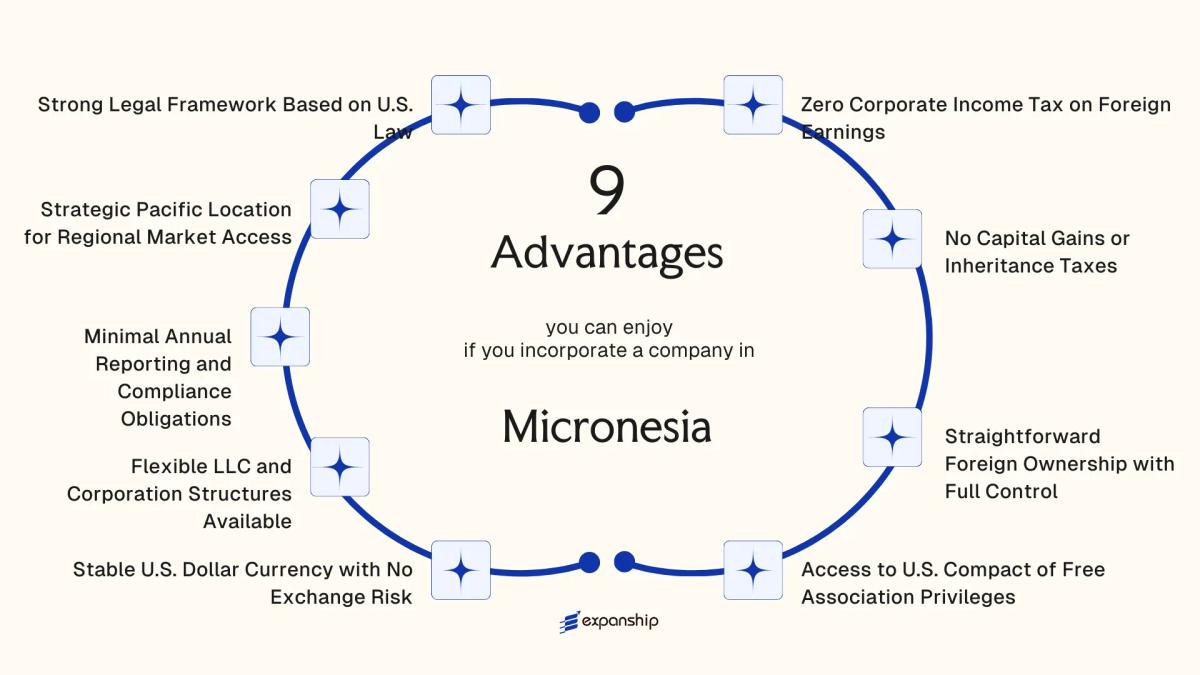
This article covers the key advantages that make Micronesia company formation a practical consideration for internationally operating businesses. The benefits of incorporating in Micronesia span tax treatment, legal structure, currency stability, and regional access — each addressed in its own section.
Zero Corporate Income Tax on Foreign Earnings
Under the Federated States of Micronesia's tax code, foreign-sourced income earned by a locally registered company is not subject to national corporate income tax. For business owners structuring international operations, Micronesia zero corporate tax on foreign earnings represents a direct reduction in tax liability with no reliance on treaty networks or complex exemption filings.
How the Exemption Is Structured
The FSM national tax system imposes corporate income tax primarily on income derived from within the jurisdiction. Revenue generated from clients, contracts, or assets located outside FSM falls outside this domestic tax base, meaning your business retains the full margin on international activity.
What This Means in Practice
This treatment is not a concessionary rate or a time-limited incentive — it reflects the standard application of FSM's income sourcing rules under the national tax framework. A firm billing clients in Asia, Europe, or the Americas from an FSM-registered entity owes no national corporate tax on those earnings, provided the income source remains external.
Foreign earnings routed through your FSM entity are not subject to national corporate income tax under the FSM's source-based tax rules.
No Capital Gains or Inheritance Taxes
Neither capital gains nor inheritance taxes apply to companies registered in the Federated States of Micronesia. For investors disposing of appreciated assets, no capital gains tax Micronesia business obligation arises at the national level, meaning the full proceeds from a sale of shares, real property held through a corporate structure, or other business assets remain with the entity rather than being reduced by a government levy.
This matters practically when you are structuring exits, reinvesting proceeds, or transferring ownership stakes across generations of family-held firms. In jurisdictions that impose capital gains taxes, rates frequently range from 20% to 30% on corporate disposals. The absence of such a charge here preserves capital for redeployment without requiring complex restructuring to defer or minimise a tax event.
On the inheritance side, no national-level estate or succession tax applies to corporate assets held through an FSM-registered entity. This makes generational transfer of business interests straightforward from a tax cost perspective.
The practical advantages of this position include:
- Asset disposals do not trigger a separate tax calculation at the point of sale
- Corporate restructuring for ownership succession carries no inheritance tax exposure at the national level
- Reinvestment of sale proceeds can occur immediately without setting aside funds for a capital gains liability
- The Micronesia inheritance tax exemption for companies removes one layer of cross-border estate planning complexity
Eligibility for these benefits applies to entities properly constituted under FSM national or state-level corporate law.

Company Incorporation in the Federated States of Micronesia
Register your company in FSM and benefit from a tax structure that includes no capital gains or inheritance taxes at the national level.
Straightforward Foreign Ownership with Full Control
Under the FSM Foreign Investment Act, foreign nationals may own 100 percent of a registered business entity without any mandatory local partnership or shareholder requirement. This is the structural foundation of Micronesia full foreign ownership benefits, and it has direct consequences for how you govern and profit from your company.
Full ownership means full voting authority. You retain exclusive rights over board decisions, profit distributions, and capital allocation without negotiating those decisions through a local co-owner. In many Asia-Pacific jurisdictions, foreign equity caps compel investors to dilute control at the ownership level, which affects operational independence from the outset.
| Parameter | FSM Position |
|---|---|
| Maximum foreign equity allowed | 100% |
| Local shareholder requirement | None |
| Local director requirement | Not mandated by statute |
| Governing legislation | FSM Foreign Investment Act |
| Registration authority | FSM Department of Justice |
Registration is handled through the FSM Department of Justice, and the Foreign Investment Permit process applies to businesses operating in sectors open to foreign participation. Certain activities, including some retail and subsistence-level trades, are reserved for FSM citizens, so confirming your intended business activity against the permitted categories before incorporation is essential.
For investors structuring holding companies or regional operating entities, FSM 100 percent foreign ownership company structures allow profit repatriation and internal group decisions to flow without third-party interference at the ownership level, which simplifies both governance and cross-border treasury management.
Access to U.S. Compact of Free Association Privileges
The Micronesia Compact of Free Association business advantages stem from a treaty-level agreement with the United States, formally established under the Compact of Free Association Act of 1985 and renewed through the Amended Compact in 2003. This arrangement grants the Federated States of Micronesia a set of formal privileges that no standard bilateral trade agreement replicates.
Under the Compact, FSM nationals can live and work in the United States without a visa, and U.S. federal programs extend into the jurisdiction. For a foreign investor, this creates a practical operating environment where staffing across the U.S. and FSM involves fewer immigration barriers than comparable Pacific structures.
COFA trade benefits for foreign investors also include preferential access to U.S. markets for qualifying goods, which can reduce export friction for businesses using FSM as a production or transit base. The treaty framework also supports U.S. federal grant eligibility for certain infrastructure and development projects.
Keep in mind:
- COFA privileges apply to FSM-registered entities operating within treaty-defined parameters
- U.S. visa-free movement applies to FSM nationals, not foreign shareholders by default
- Export preference rules require goods to meet origin criteria to qualify for U.S. preferential treatment
- The Amended Compact runs through 2023, with ongoing renegotiation affecting long-term certainty
FSM is one of only three sovereign nations worldwide that holds Compact of Free Association status with the United States, placing it in a category entirely separate from standard U.S. territories or trading partners.
Stable U.S. Dollar Currency with No Exchange Risk
The Micronesia US dollar currency stability benefit is not incidental — the USD has been the official currency of the Federated States of Micronesia since independence, embedded in the nation's monetary framework through the Compact of Free Association with the United States. For a foreign business owner, this means all transactions, contracts, and financial statements operate in the world's primary reserve currency from day one.
Eliminating Currency Conversion Costs and Volatility
Businesses operating across multiple jurisdictions typically absorb hedging costs, conversion fees, and accounting adjustments tied to fluctuating local currencies. Your firm in FSM carries none of that burden. Revenue, expenses, and distributions are all denominated in USD, so there is no functional currency mismatch to manage, no forward contracts to purchase, and no revaluation losses to report at year-end.
Practical Implications for Cross-Border Financial Management
Invoicing international clients in USD from an FSM entity requires no currency conversion on either end for U.S.-based counterparties, and simplifies settlement for clients in dollarized or USD-pegged economies across the Pacific. Banking relationships, loan facilities, and intercompany transfers also avoid the spread losses and regulatory approval delays that arise when moving funds between currencies. For businesses structured to hold or deploy dollar-denominated assets, the absence of a domestic central bank or independent monetary authority means there is no risk of government-imposed currency controls or devaluation events affecting your capital.
Plan Your Entry into Micronesia's Dollar-Based Business Environment
Speak with an Expanship specialist about structuring your FSM entity to make full use of the jurisdiction's USD framework and zero exchange risk environment.
Flexible LLC and Corporation Structures Available
The FSM Business Corporation Act and the Limited Liability Company Act together give foreign investors two structurally distinct options, each with features that reduce administrative friction and protect ownership interests. Understanding the Micronesia LLC and corporation structure advantages begins with recognizing how these entity types are designed relative to what comparable offshore jurisdictions typically impose.
- An LLC formed under FSM law is not required to have a board of directors or hold annual shareholder meetings. For a sole foreign owner managing operations remotely, this removes a layer of formal governance that serves no functional purpose in a single-member structure.
- Corporations under the FSM Business Corporation Act permit nominee arrangements and flexible share structures, including shares with no par value. This gives your company the ability to structure equity distribution without being locked into rigid minimum capital requirements.
- Neither entity type imposes residency requirements on directors or members. A foreign national can hold full controlling authority from outside FSM without appointing a local director, which keeps decision-making consolidated.
- Liability separation between the entity and its owners is statutorily recognized under FSM corporate law, meaning your personal assets remain insulated from company obligations by default rather than through additional legal instruments.
Minimal Annual Reporting and Compliance Obligations
Micronesia minimal annual compliance obligations are among the lightest of any Pacific incorporation jurisdiction, and that has direct consequences for your operating costs and administrative burden. Foreign-owned entities registered under the FSM Business Corporations Act are not subject to the kind of recurring disclosure, audit, or financial statement filing requirements typical of OECD-member jurisdictions.
Annual compliance for most foreign business structures generally involves maintaining a registered agent within the FSM and filing a basic annual report with the relevant state-level Division of Commerce, confirming the company's continued existence and registered office details. No audited financial statements are required at the national level for standard private companies. This means you are not paying for annual statutory audits simply to remain in good standing.
For businesses structured primarily to hold assets or conduct operations outside FSM territory, the absence of mandatory financial disclosure requirements reduces ongoing professional fees considerably.
A company incorporated in a comparable Pacific jurisdiction requiring annual audited accounts might typically incur audit and filing costs of USD 3,000 to USD 8,000 per year. Under the FSM framework, a foreign business with no local operations can maintain compliance for a fraction of that cost, primarily covering registered agent fees and the basic annual report filing.
Strategic Pacific Location for Regional Market Access
The FSM sits at the geographic center of the Pacific Ocean, positioning any business registered there within practical reach of three major economic zones: East Asia, Southeast Asia, and the U.S. West Coast. For firms that move goods, services, or capital across the Pacific, this Micronesia Pacific location market access advantage is geographic, not theoretical.
The FSM's Exclusive Economic Zone (EEZ) spans approximately 2.6 million square kilometers of ocean. This is directly relevant for businesses operating in maritime industries, fisheries licensing, and transoceanic logistics.
Under the Compact of Free Association, FSM-registered entities have direct connectivity to U.S. federal programs and infrastructure support, which includes access to U.S. postal services and certain federal agencies. This creates operational links to American markets that most Pacific island jurisdictions cannot replicate.
- Proximity to Japan, the Philippines, and Guam supports regional distribution arrangements
- Pohnpei and Chuuk serve as intermediate transit points for Pacific shipping routes
- The FSM's membership in the Pacific Islands Forum facilitates trade dialogue with 17 Pacific nations
Market access benefits are geographic and treaty-based; your specific industry or cargo type may still be subject to applicable FSM import, export, or licensing regulations under national or state law.
Strong Legal Framework Based on U.S. Law
The Federated States of Micronesia's legal system is directly derived from U.S. common law, giving your business a predictable, well-documented legal environment. This Micronesia US-based legal framework delivers business benefits that are uncommon across Pacific island jurisdictions, where legal infrastructure is often thin or inconsistently applied.
Constitutional Foundation and Judicial Structure
The FSM Constitution, adopted in 1979, was modeled closely on the U.S. federal constitutional structure. Courts within the FSM operate under principles of common law, meaning judicial precedent, contract enforceability, and property rights follow established doctrines familiar to U.S.-trained legal counsel and widely understood by international advisors.
Contract and Commercial Law Certainty
For foreign business owners, the practical value of a U.S.-derived system is that contract disputes are adjudicated under recognized legal principles. Commercial agreements, shareholder arrangements, and liability structures are interpreted through a common law lens, reducing interpretive ambiguity compared to civil law or hybrid systems found elsewhere in the Pacific.
Governance Under the FSM Commercial Code
Business entities formed in FSM are governed under the FSM Code, which incorporates statutory provisions aligned with U.S. corporate law traditions. This means your company's internal governance documents, fiduciary duties, and director obligations follow frameworks with direct conceptual parallels to U.S. state-level corporate statutes.
Key structural protections available under FSM company law include:
- Separate legal personality for incorporated entities
- Limited liability protection for shareholders and members
- Enforceable articles of incorporation and operating agreements
- Defined fiduciary standards for directors and officers
Why Micronesia Stands Out Among Pacific Jurisdictions
Compared to other Pacific Island jurisdictions, the FSM draws a distinct profile for foreign businesses because its advantages are structural rather than promotional. Jurisdictions like Vanuatu, Palau, and the Marshall Islands each serve segments of the offshore Pacific market, but the combination of U.S. dollar denomination, a legal system derived from U.S. federal and state law, and treaty-based access to U.S. federal programs under the Compact of Free Association creates a configuration that few Pacific peers replicate simultaneously.
Vanuatu attracts formations largely through its absence of direct taxes and relatively low setup costs, but it operates under a mixed French-British legal tradition that introduces different interpretive frameworks for dispute resolution. Palau shares Compact status with FSM, yet its smaller economy limits the depth of available professional services. The Marshall Islands is known for its ship and entity registries, which target a narrower segment of international business. Your decision of which Pacific jurisdiction to use for company formation ultimately depends on which structural features align with your operational and legal requirements.
| Parameter | Micronesia (FSM) | Vanuatu | Marshall Islands |
|---|---|---|---|
| Legal System Basis | U.S. common law | Dual French-British | U.S. common law |
| Currency | U.S. Dollar (no exchange risk) | Vanuatu Vatu | U.S. Dollar |
| Compact of Free Association | Yes | No | Yes |
| Corporate Income Tax on Foreign Earnings | None | None | None |
| Corporate Dispute Resolution Framework | U.S.-derived court system | Mixed jurisdiction courts | U.S.-derived court system |
Compliance Services for Companies in Micronesia (FSM)
Stay current with FSM's annual reporting obligations and registration requirements through Expanship's jurisdiction-specific compliance support.
Conclusion
Micronesia FM presents a coherent case for foreign incorporation built on a combination of structural and legal factors that few Pacific jurisdictions can replicate at the same intersection. The absence of tax on foreign-sourced earnings, underpinned by the Federated States of Micronesia's domestic tax code, removes one of the most significant cost burdens a foreign-owned entity typically carries. Paired with the Compact of Free Association, which grants preferential access to U.S. federal programs and processes, the framework addresses both operational cost and market reach simultaneously.
Not every business structure benefits equally. Your specific industry, the source of your revenue, and where your clients are based all determine how effectively a Micronesian entity serves your structure. A firm with significant U.S.-oriented activity will extract more value from the Compact privileges than one focused exclusively on Southeast Asian markets.
For those whose circumstances align with what this jurisdiction offers, the combination of U.S.-based legal foundations, dollar-denominated accounts with no currency conversion exposure, and minimal annual compliance obligations creates a stable, low-friction environment for running an international business. The path forward from formation is one that requires proper structuring from the outset to ensure your entity operates within the intended parameters of local law and international tax obligations.
Start Your Micronesia Company Formation with Expanship Today
Micronesia company formation with Expanship covers the full process of establishing and maintaining a legal entity under the jurisdiction of the Federated States of Micronesia, from initial registration with the Department of Commerce to ongoing compliance under the FSM Business Corporations Act. The benefits outlined in this blog, including the absence of corporate income tax on foreign-sourced earnings, U.S. dollar denomination, Compact of Free Association privileges, and U.S.-based legal principles, form the foundation of Expanship's advisory approach for clients structuring operations through this jurisdiction.
Expanship's services for FSM incorporations include:
- Preparation and legalization of all formation documents, including Articles of Incorporation or Organization
- Registered agent and registered office provision within the FSM as required by local statute
- Direct liaison with the FSM Department of Commerce for government filing and registration
- Post-incorporation compliance management, including annual reporting obligations
- Banking introduction assistance to facilitate account opening with institutions operating in or connected to the FSM
To discuss your FSM incorporation requirements, contact Expanship Micronesia directly.
Frequently Asked Questions (FAQ)
Foreign nationals can hold 100% ownership of a company incorporated in the FSM, with no mandatory local partnership requirement at the entity level. However, certain business activities, particularly those involving land use or specific licensed sectors, may carry separate restrictions under FSM law. Outside those regulated categories, foreign investors retain full equity control and directorial authority over their incorporated entity.
The exemption on foreign-sourced income applies based on the nature of the income and where it is earned, not through a discretionary application process. A company must still comply with registration requirements under FSM national law and any applicable state-level rules, but no special tax holiday application is required to access the foreign income exemption. Accurate record-keeping to distinguish foreign-sourced from domestically-sourced revenue remains the company's responsibility.
The Compact of Free Association governs the political and economic relationship between the FSM and the United States, and it provides FSM entities with access to certain U.S. federal programs, grant funding channels, and preferential treatment in specific procurement contexts. For a business, this translates into a degree of institutional connectivity with the U.S. not available in most Pacific island jurisdictions. The Compact also underpins the FSM's use of the U.S. dollar as its official currency, removing exchange rate exposure for transactions denominated in USD.
Incorporation timelines in the FSM vary depending on whether the entity is registered at the national level or within a specific state, as the FSM operates under a federal structure with four semi-autonomous states. National-level registration through the FSM national government generally proceeds within a few weeks under standard processing, though state-level requirements can add time depending on the jurisdiction chosen. Preparing accurate documentation in advance reduces the risk of delays from resubmission requests.
Annual compliance obligations in the FSM are generally less extensive than in OECD jurisdictions, with no mandatory statutory audit requirement imposed on most private foreign-owned entities under standard incorporation conditions. Companies are typically required to maintain good standing through annual registration renewal rather than submitting audited accounts to a public registry. Specific licensing categories or entities receiving public funding may face additional reporting obligations beyond standard corporate maintenance.
FSM commercial law is substantially derived from U.S. legal principles, and the national court system, including the FSM Supreme Court, applies this framework to commercial disputes. This provides foreign investors with a recognizable legal environment, particularly for contract enforcement and corporate governance matters. While the FSM does not operate within the U.S. federal court system, the alignment with U.S.-based legal doctrine gives the framework a level of predictability that diverges from civil law or customary law systems found elsewhere in the Pacific.
The FSM is not listed on major international blacklists such as the EU's list of non-cooperative jurisdictions for tax purposes, which distinguishes it from jurisdictions commonly labeled as tax havens. Its tax treatment of foreign income reflects its economic development status under the Compact framework rather than a secretive offshore structure. Businesses with operations in OECD member states should still assess their home-country controlled foreign corporation rules, as those rules govern how foreign entity income is treated domestically regardless of FSM tax policy.
Legal Disclaimer
The information provided in this article is for general informational purposes only and does not constitute legal, tax, or professional advice. While we strive to ensure the accuracy and timeliness of the content, laws and regulations are subject to change, and the application of laws can vary widely based on specific facts and circumstances.
Readers should not act upon this information without seeking professional counsel tailored to their individual situation. Expanship and its authors disclaim any liability for actions taken or not taken based on the content of this article.
For specific advice regarding your business setup, compliance requirements, or any legal matters, please consult with qualified legal and tax professionals in the relevant jurisdiction.