

Key Takeaways
- Under the Limited Liability Companies Act (Osakeyhtiölaki 624/2006), all incorporation applications must be submitted to the Finnish Patent and Registration Office (PRH), and a valid Business ID cannot be obtained until the registration is formally approved.
- Private limited companies (Oy) must deposit their share capital in full before the PRH will complete the registration process, making capital availability a prerequisite rather than a post-incorporation obligation.
- Foreign investors are subject to director residency conditions under Finnish corporate law, which affect how the board must be composed before a compliant registration can be submitted.
- All Finnish companies are required to disclose their ultimate beneficial owners to the PRH's beneficial ownership register, a disclosure obligation that applies regardless of the investor's country of origin.
Finland's company formation process is governed by the Limited Liability Companies Act (Osakeyhtiölaki 624/2006), with registrations processed through the Finnish Trade Register administered by the Finnish Patent and Registration Office (PRH). Meeting the incorporation requirements in Finland is a legal prerequisite for obtaining a valid Business ID and commencing operations.
This article covers the structural, documentary, and administrative requirements that apply to entity formation, as set out under Finnish corporate law.
Failure to satisfy these conditions results in rejection of the registration application by the PRH, leaving the business without legal standing to operate.
Exact obligations vary depending on the entity type selected, whether that is a private limited company (Oy) or a public limited company (Oyj), and may differ further based on the industry or the investor's country of origin.
Foreign investors and business owners incorporating through a Finnish entity for the first time will find this article most directly applicable to their situation.
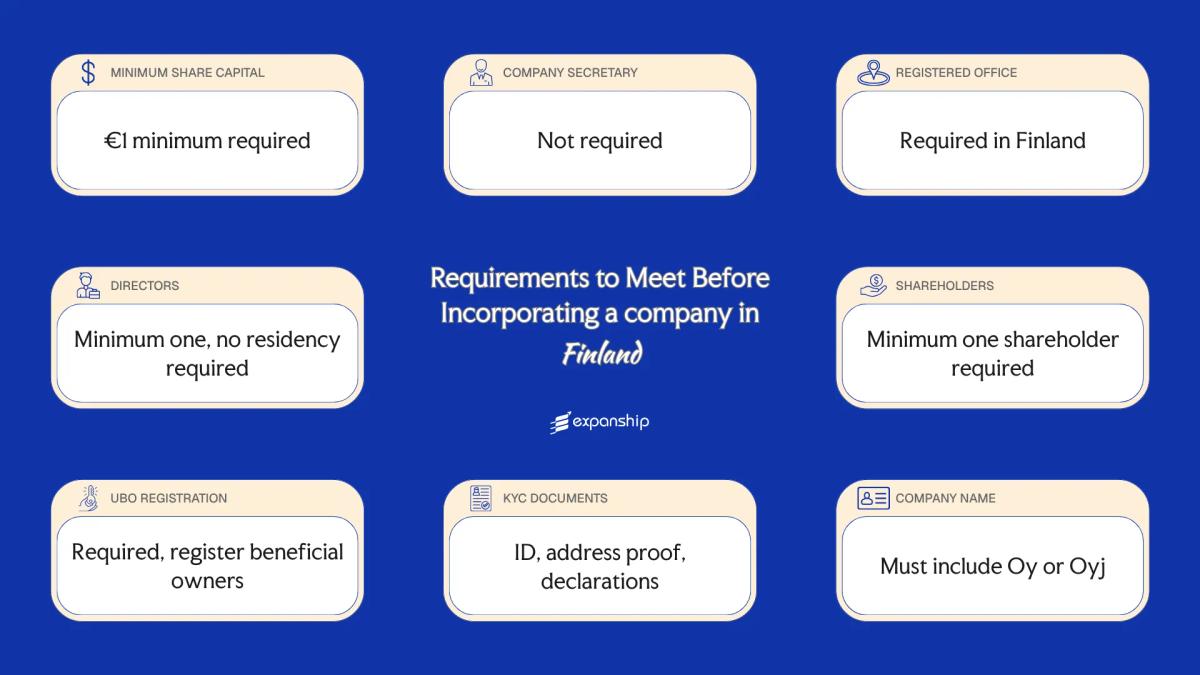
Minimum Share Capital Requirements in Finland
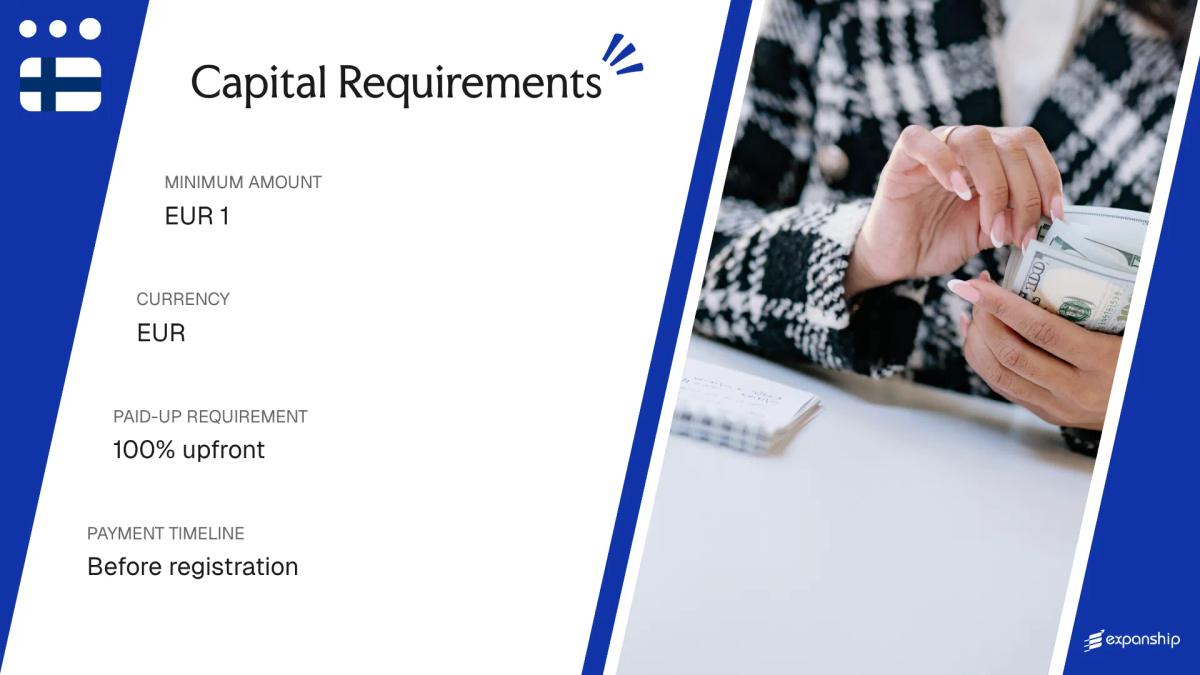
Under the Companies Act (osakeyhtiölaki 624/2006), Finland minimum share capital requirements differ by entity type. A private limited company (osakeyhtiö, or Oy) currently has no statutory minimum share capital, following legislative amendments that removed the previous EUR 2,500 threshold.
Registration is handled through the Finnish Patent and Registration Office (PRH), which processes incorporation filings and verifies that the company's Articles of Association correctly document the share structure. Share capital, once registered, forms part of the firm's permanent equity structure and carries ongoing statutory implications under Finnish accounting law.
| Parameter | Detail |
|---|---|
| Minimum Authorized Share Capital | No statutory minimum for a private limited company (Oy) |
| Maximum Authorized Share Capital | No statutory maximum |
| Minimum Paid-Up Capital | No statutory minimum |
| Paid-Up Requirement at Incorporation | No mandatory paid-up amount required at registration |
| Accepted Currency | Euro (EUR) |
| Accepted Forms of Contribution | Cash or non-cash assets (in-kind contributions subject to valuation rules under the Companies Act) |
| Timeframe to Deposit Capital | No statutory deposit deadline imposed by the PRH |
Even with zero minimum capital, your company's Articles of Association must define the share structure. An undocumented or inconsistent capital arrangement can cause the PRH to reject the incorporation filing.
Company Secretary Requirements in Finland
Finnish law does not impose a statutory requirement for a dedicated company secretary role in a private limited company (osakeyhtiö, or Oy). The Companies Act (Osakeyhtiölaki 624/2006) places governance obligations on the board of directors and, where appointed, a managing director rather than a separate secretary function.
That said, your business may voluntarily appoint a person or entity to handle corporate compliance tasks. Where such a role exists, duties typically include maintaining the shareholder register, preparing board meeting records, and ensuring filings to the Finnish Patent and Registration Office (PRH) remain current.
Qualification criteria for anyone serving in a voluntary corporate secretary capacity:
- No statutory licensing requirement exists for this role under Finnish company law.
- Natural persons must have legal capacity; those under guardianship or declared bankrupt are generally disqualified.
- Corporate entities registered in Finland may perform secretarial functions, subject to their own articles of association.
- No mandatory residency requirement applies to individuals undertaking this role.
- The PRH does not maintain a register of approved company secretaries.

Incorporate a Company in Finland
Set up your Finnish osakeyhtiö with end-to-end support covering registration, compliance structuring, and PRH filings.
Registered Office Requirements in Finland
Registered office requirements in Finland apply from the moment of incorporation, and your company's address must be maintained in good standing throughout its operational life. A non-compliant or outdated address can result in missed regulatory correspondence from the Finnish Patent and Registration Office (PRH) and may expose the entity to administrative sanctions under the Companies Act (Osakeyhtiölaki 624/2006).
- A physical street address is required; a P.O. box alone does not satisfy the requirement.
- The address must be located in Finland; foreign addresses are not accepted for domestic legal entities.
- Virtual office addresses are generally permitted provided they correspond to a real, identifiable location within the country.
- Proof of entitlement to use the address, such as a lease agreement or property ownership document, is required at registration.
- The registered address is publicly listed in the Trade Register (kaupparekisteri) maintained by the PRH and is accessible to third parties.
- Any change to the registered address must be formally notified to the PRH through a change notification filing; the update takes effect upon registration.
Director Requirements in Finland

Director requirements in Finland are governed by the Limited Liability Companies Act (Osakeyhtiölaki, 624/2006), under which directors assume statutory duties of care and loyalty toward the company upon appointment. Liability for breach of these duties is personal, meaning directors can be held financially accountable for decisions that cause damage to the firm, its shareholders, or creditors.
| Parameter | Detail |
|---|---|
| Minimum Number of Directors | One director is required; if the board has fewer than three members, at least one deputy member must be appointed. |
| Maximum Number of Directors | No statutory maximum is prescribed under Finnish law. |
| Local/Resident Director Required | At least one board member or the managing director must be a resident of the European Economic Area, unless the Finnish Patent and Registration Office (PRH) grants an exemption. |
| Nationality Restrictions | No nationality-based restrictions apply beyond the EEA residency requirement. |
| Minimum Age Requirement | Directors must be at least 18 years of age and must not be under guardianship. |
| Corporate Directors Permitted | Corporate entities are not permitted to serve as directors under Finnish company law. |
| Director Must Be a Shareholder | No statutory requirement exists for directors to hold shares in the company. |
| Publicly Listed on Registry | Directors are recorded in the Trade Register maintained by the PRH and are publicly visible. |
| Disqualification Conditions | A person who is bankrupt, has been barred from business activity (liiketoimintakielto), or lacks legal capacity is disqualified from serving as a director. |
Despite Finland's EEA residency rule for directors, the PRH can grant an exemption that allows a company to be managed entirely by non-EEA residents, making full foreign-resident boards legally possible with prior approval.
Shareholder Requirements in Finland
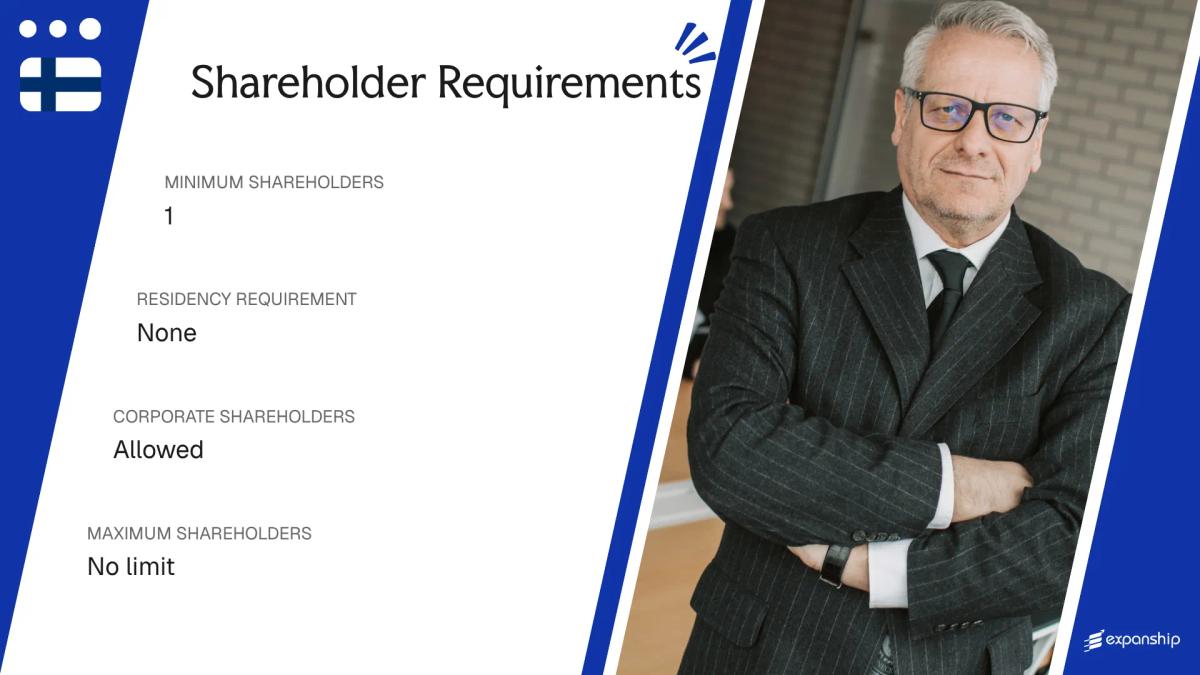
A Finnish private limited company (osakeyhtiö, or Oy) requires a minimum of one shareholder. No statutory maximum applies, meaning the shareholder requirements in Finland accommodate both sole-owner structures and multi-party ownership arrangements.
Nationality and Residency Restrictions
Shareholders of a Finnish Oy face no nationality or residency requirements under the Companies Act (osakeyhtiölaki 624/2006). Foreign individuals and entities may hold 100% of the shares without restriction.
Corporate Shareholders
Corporate entities are permitted to act as shareholders in a Finnish private company. No conditions specific to corporate ownership are imposed beyond standard identification and beneficial ownership disclosure obligations.
Shareholder Liability
Shareholder liability is limited to the amount contributed for the subscribed shares. Finnish company law does not generally permit creditors to pursue shareholders for company debts, though liability may extend in cases of improper conduct documented under the Companies Act.
Register of Shareholders
An Oy must maintain an internal register of shareholders. This register is not publicly accessible through the Finnish Trade Register (kaupparekisteri), though certain ownership data becomes visible through beneficial ownership filings with the register.
Shareholder Structuring Support for Your Finnish Company
Get guidance on meeting ownership and registration requirements when setting up a private limited company in Finland.
UBO / Beneficial Ownership Registration Requirements in Finland
Finland beneficial ownership registration requirements are governed by the Act on the Register of Beneficial Owners (572/2019), which transposed the EU's Fourth and Fifth Anti-Money Laundering Directives into national law. A beneficial owner (tosiasialliset edunsaajat) is any natural person who holds more than 25% of the shares or voting rights, or otherwise exercises control over a legal entity.
- Identify all natural persons meeting the 25% ownership or control threshold.
- Collect the required particulars for each UBO, including full name, date of birth, nationality, and the nature of ownership or control.
- Submit a UBO notification to the Finnish Trade Register (Patentti- ja rekisterihallitus, PRH) via the YTJ online portal.
- File within one month of incorporation or of any change to beneficial ownership.
- Update the register whenever ownership or control structure changes.
| Parameter | Detail |
|---|---|
| Ownership Threshold for UBO Status | More than 25% of shares, voting rights, or equivalent control |
| Filing Authority | Finnish Trade Register (Patentti- ja rekisterihallitus, PRH) |
| Disclosure Deadline at Incorporation | Within one month of registration |
| Publicly Accessible Register | Yes, the PRH beneficial ownership register is publicly accessible |
| Penalties for Non-Disclosure | Administrative penalties apply under the Act on the Register of Beneficial Owners (572/2019) |
| Ongoing Update Obligation | Yes, updates required within one month of any change |
KYC / Document Requirements in Finland
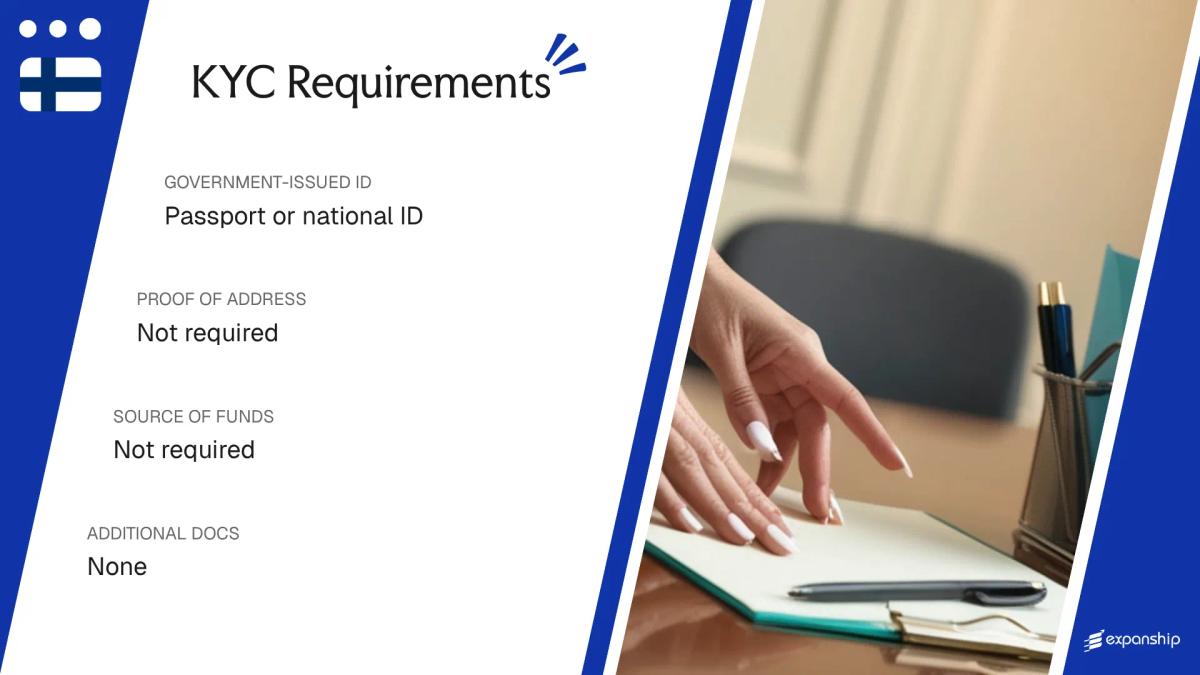
KYC document requirements for a Finland company are governed by the Act on Preventing Money Laundering and Terrorist Financing (AML Act 444/2017), administered by the Financial Intelligence Unit (FIU) within the National Police Board.
Individual / Personal Documents
- Valid government-issued photo ID (passport or national identity card) for each director, shareholder, and beneficial owner
- Proof of residential address dated within three months, such as a utility bill or official bank statement
- Personal identification number (henkilötunnus) where the individual holds one as a Finnish resident
- Completed and signed KYC declaration confirming the individual's role and capacity
Corporate Documents
- Certificate of incorporation or equivalent formation document for the corporate shareholder or director
- Articles of association or constitutional document in its current, in-force version
- Official register of directors confirming current appointments
- Proof of registered office address for the corporate entity
Source of Funds Documentation
- Recent bank statements covering a minimum of three months prior to incorporation
- Audited financial statements where the corporate subscriber has an audited reporting history
- Written declaration of source of funds for capital contributions made by individual shareholders
Notarisation and Apostille Requirements
- Foreign documents must generally be apostilled under the Hague Convention of 1961 before submission
- Documents not in Finnish or Swedish require a certified translation by a sworn translator
- Notarisation by a local notary in the country of origin may be required for corporate constitutional documents from non-EU jurisdictions
The most common cause of incorporation delay is the submission of source of funds declarations without supporting bank statements or audited accounts to substantiate the declared capital origin.
Company Name Requirements in Finland
Finland company name requirements are assessed by the Finnish Patent and Registration Office (PRH) at the point of registration. A proposed name must be distinctive enough to differentiate the entity from other registered businesses, and names that are considered too generic or descriptive will be rejected.
Registered private limited companies must append the suffix "Oy" (osakeyhtiö) to their name. The name must be expressed in Finnish, Swedish, or both, and a parallel name in another language may also be registered.
Certain words are prohibited outright or require prior authorisation from a relevant authority before the PRH will accept them. Terms referencing financial institutions, governmental bodies, or official functions typically fall into this category.
Name reservation is available through the PRH before formal incorporation. A reserved name is held for a defined period, after which it lapses if no registration application is submitted.
Compliance Services for Companies in Finland
Maintain your Finnish entity's good standing with ongoing compliance support, from annual filings to PRH obligations.
Conclusion
Incorporation requirements in Finland are governed by the Companies Act (Osakeyhtiölaki), with the Finnish Patent and Registration Office (PRH) overseeing the registration process. Among the requirements covered, the mandatory UBO disclosure to the PRH's beneficial ownership register and the residency conditions applicable to directors carry particular weight for foreign investors. Share capital, while relatively modest for a private limited company (Oy), must be deposited before registration completes. Once these obligations are understood, the practical next step is structuring your entity to meet each condition before submission.
Expanship's Corporate Services for Finland Expansion
Expanship's Finland company incorporation services are structured around the specific compliance obligations that Finnish law imposes, from PRH registration and the Finnish Trade Register filings to beneficial ownership reporting under the Act on Money Laundering. Our role is to reduce the operational burden these requirements place on your team, not to suggest they can be avoided.
Beyond registration, Expanship supports your entry into the Finnish market across several practical areas:
- We prepare and file your incorporation documents directly with the Finnish Trade Register through the PRH.
- Our team provides a registered office address and acts as your local registered agent in Finland.
- We manage all government filings and liaise with relevant Finnish regulatory authorities on your behalf.
- Post-incorporation compliance obligations, including annual filings, are tracked and managed for your entity.
- We facilitate introductions to Finnish banking institutions suited to your business structure.
- Tax registration with the Finnish Tax Administration (Vero) and related local authority liaison are handled as part of your setup.
To discuss your requirements, contact Expanship Finland.
Frequently Asked Questions (FAQ)
Under Finnish law, any individual who directly or indirectly holds more than 25% of the shares or voting rights in a company qualifies as a beneficial owner and must be registered with the Finnish Trade Register, maintained by the Finnish Patent and Registration Office (PRH). This obligation stems from Finland's implementation of the EU Anti-Money Laundering Directives. If no individual meets this threshold, the company's senior management must be recorded in place of a UBO.
Foreign nationals can serve as directors of a Finnish private limited company, but at least one member of the board must hold a permanent residence within the European Economic Area unless the PRH grants a specific exemption. This requirement is set out under the Finnish Companies Act (624/2006). Failure to meet this condition without securing an exemption can delay or block registration.
Failure to register or update beneficial ownership information with the Finnish Patent and Registration Office can result in administrative sanctions, including financial penalties imposed through court order. The obligation to maintain accurate UBO records is ongoing, not a one-time registration requirement at incorporation. Persistent non-compliance can also trigger scrutiny from Finnish financial intelligence authorities under the country's anti-money laundering framework.
The PRH's registration process requires identity verification and supporting corporate documents, but Finnish banks and licensed service providers conduct their own independent KYC checks under the Act on Preventing Money Laundering and Terrorist Financing (444/2017). Satisfying the PRH's requirements does not automatically satisfy a bank's due diligence obligations. In practice, opening a Finnish corporate bank account often requires additional documentation beyond what incorporation itself demands.
The PRH will reject a company name that is identical or confusingly similar to an existing registered name in the Finnish Trade Register. The assessment considers phonetic and visual similarity, not just exact matches, so minor spelling variations do not guarantee approval. You can conduct a preliminary name search through the PRH's online services before submitting a registration application to reduce the risk of rejection.
Legal Disclaimer
The information provided in this article is for general informational purposes only and does not constitute legal, tax, or professional advice. While we strive to ensure the accuracy and timeliness of the content, laws and regulations are subject to change, and the application of laws can vary widely based on specific facts and circumstances.
Readers should not act upon this information without seeking professional counsel tailored to their individual situation. Expanship and its authors disclaim any liability for actions taken or not taken based on the content of this article.
For specific advice regarding your business setup, compliance requirements, or any legal matters, please consult with qualified legal and tax professionals in the relevant jurisdiction.