
Key Takeaways
- Finland's 20% corporate tax rate applies alongside capital gains levied at the same rate, creating a compounded tax burden that reduces retained earnings and investor return efficiency compared to several competing EU incorporation jurisdictions.
- Under the Companies Act (624/2006), ongoing compliance obligations for an osakeyhtiö extend well beyond formation, requiring continuous adherence to Finnish Trade Register filings, board resolutions, and financial disclosures that impose sustained administrative costs on foreign-managed entities.
- Employer social security contributions in Finland add a substantial percentage on top of base salaries, making the true cost of Finnish employment materially higher than headline wage figures suggest for workforce planning purposes.
- Non-EU founders face structural disadvantages in accessing local and Nordic investor networks, as Finnish venture and private equity capital tends to favor entities with established local governance and Finnish-language regulatory documentation already in place.
Finland operates under a heavily regulated corporate and legal framework, and understanding the disadvantages of incorporating in Finland is the starting point for any foreign investor conducting a realistic feasibility assessment. The Companies Act governs the formation and operation of limited liability companies, and compliance obligations under it extend well beyond the incorporation stage.
The disadvantages covered in this article span taxation, administrative burden, labor obligations, and capital access — each carrying different weight depending on your business structure and industry. A technology startup will face a different set of friction points than a manufacturing firm or a financial services entity.
This article is most relevant to non-EU founders and foreign investors considering a Finnish osakeyhtiö (OY) as their primary operating entity in Northern Europe.
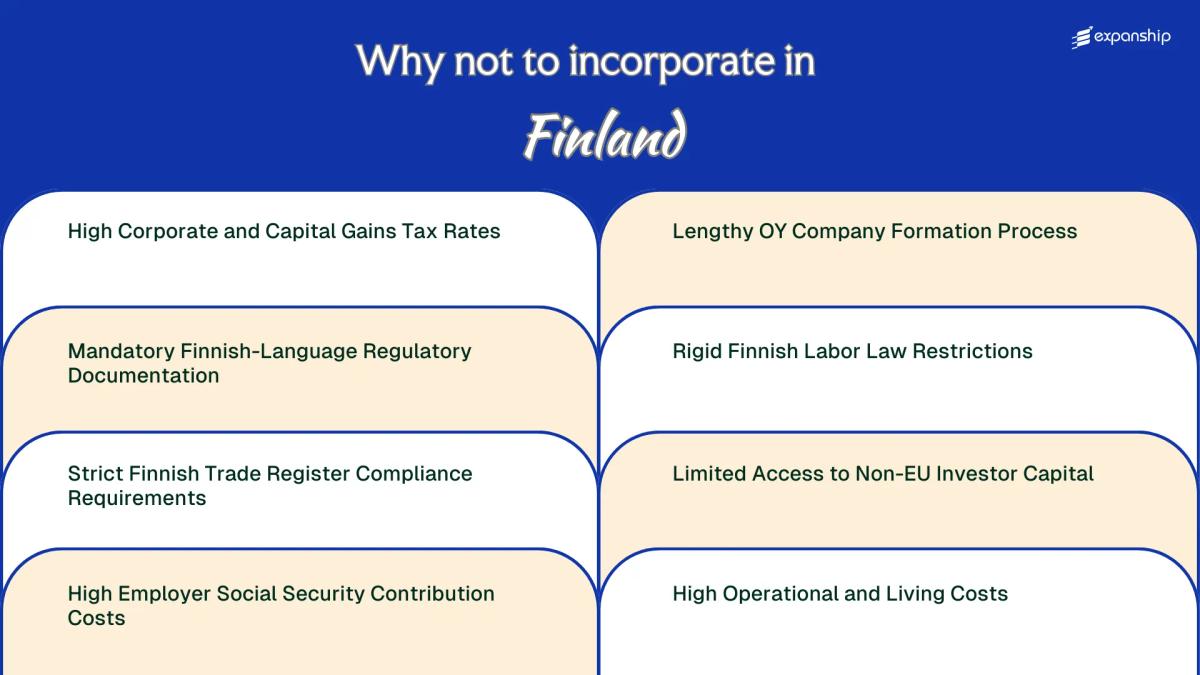
High Corporate and Capital Gains Tax Rates
Finland corporate tax rate drawbacks affect foreign-owned companies from the first year of operation. The rate itself is only part of the picture — the interaction between corporate tax, dividend taxation, and capital gains rules creates a compounding burden that is easy to underestimate at incorporation stage.
Corporate Tax Rate in Context
Finland applies a flat corporate income tax rate of 20% on company profits. While that figure sits close to the EU average, your retained earnings are then subject to further taxation when distributed, as dividends from a private OY are taxed under a split model that can push the combined effective rate on distributed profits considerably higher than the headline figure suggests.
Capital Gains Tax and Dividend Distribution Costs
Capital gains realized by a Finnish-resident company are treated as ordinary business income and taxed at the same 20% rate. For foreign individual shareholders, dividends from an OY are subject to Finnish withholding tax, generally at 20% under domestic law, though applicable tax treaties may reduce this rate.
The practical consequence is that a non-resident investor extracting profits faces double taxation unless a favorable treaty applies, and treaty qualification requires meeting specific residency and beneficial ownership conditions that not all foreign structures satisfy.
A foreign shareholder who does not qualify under an applicable double tax treaty with Finland will face withholding tax on dividends on top of the corporate-level tax already paid, materially reducing after-tax returns compared to jurisdictions with participation exemption regimes.
Mandatory Finnish-Language Regulatory Documentation
Finland's Finnish language documentation requirements apply across the full lifecycle of a corporate entity. All official filings submitted to the Finnish Patent and Registration Office (PRH), which administers the Trade Register, must be in Finnish or Swedish. For a foreign business owner operating in English, this creates a structural translation dependency that adds both cost and delay to routine compliance work.
The obligation is not limited to formation documents. Ongoing statutory filings, including annual financial statements, board meeting minutes, and amendments to company rules, must meet the same language standard.
For foreign-owned firms, this means:
- Retaining a certified translator or local legal counsel for every regulatory submission, which increases baseline compliance costs.
- Risking rejected filings if translations contain technical inaccuracies, since the PRH applies strict formal review standards.
- Facing extended processing times when translation errors require corrected resubmissions.
- Managing bilingual internal record-keeping if the business also has Swedish-language obligations under Finland's language legislation.
Finnish law does not recognize English as an accepted filing language, with no general exemption available for foreign-incorporated entities or international holding structures.

Company Incorporation in Finland
Understand the full compliance requirements before establishing your entity in Finland.
Strict Finnish Trade Register Compliance Requirements
Finnish Trade Register compliance challenges extend well beyond simple paperwork. The kaupparekisteri, administered by the Patent and Registration Office (PRH), imposes ongoing filing obligations that demand consistent attention and, for foreign directors unfamiliar with Finnish administrative systems, recurring professional fees.
Every osakeyhtiö (OY) must file a notification to the PRH whenever core company details change, including board composition, registered address, or articles of association. Each such notification carries a processing fee, and errors or omissions trigger formal rejection rather than correction requests, restarting the process entirely.
| Filing Trigger | PRH Notification Required | Processing Fee (approx.) |
|---|---|---|
| Board member change | Yes, mandatory | €85 per notification |
| Amendment to articles of association | Yes, mandatory | €380 |
| Change of registered address | Yes, mandatory | €85 |
| Annual financial statement filing | Yes, within 8 months of financial year-end | Late filing penalty applies |
| Share capital increase | Yes, mandatory | €380 |
Annual account submissions must reach the PRH within eight months of the financial year-end. Missing this window results in penalty fees and, in persistent cases, the PRH can initiate dissolution proceedings.
PRH Finland registration requirements problems compound for firms operating across multiple legal entities, since each subsidiary carries its own independent filing calendar. There is no consolidated group-level filing mechanism for kaupparekisteri purposes, meaning administrative load scales linearly with corporate structure.
High Employer Social Security Contribution Costs
Finland employer social security costs burden ranks among the most direct financial pressures on any foreign-owned business hiring locally. Employers are legally required to contribute to multiple statutory schemes, each governed by separate legislation and administered by different bodies.
The TyEL pension contribution (Employees' Pensions Act) represents the largest single component. For 2024, the employer's TyEL rate sits at approximately 17.39% of gross wages, applied to every employee's salary without an earnings cap removing the ceiling effect that limits exposure in some other systems.
Beyond TyEL, employers must pay health insurance contributions, unemployment insurance premiums, and accident and occupational disease insurance. These combined Finnish payroll contribution obligations can push the total employer burden to roughly 20-25% above gross salary, depending on workforce age and industry classification.
For a foreign firm scaling headcount rapidly, this creates a compounding cost that directly reduces the capital available for operations. Part-time or short-term contracts do not fully exempt employers from these statutory obligations.
- TyEL contributions are mandatory from the first employee, with no minimum headcount threshold
- Unemployment insurance premiums are payable to the Unemployment Insurance Fund (TVR), not a single consolidated authority
- Accident insurance must be arranged separately through a private insurer authorised under Finnish law
- Contribution rates are recalculated periodically; the TyEL rates published by the Finnish Centre for Pensions apply each calendar year
- Employee age affects the TyEL rate, with differentiated rates applying to workers over 53
Finland's employer social security contributions apply even to foreign nationals temporarily seconded to a Finnish entity, provided they fall outside an applicable social security agreement or EU coordination rule.
Lengthy OY Company Formation Process
Finland OY company formation delays stem from a registration process that is more procedurally demanding than many comparable EU jurisdictions.
Structural Requirements That Extend Timelines
Incorporating an osakeyhtiö (OY) requires filing with the Finnish Trade Register, maintained by the Finnish Patent and Registration Office (PRH). The process involves submitting a memorandum of association, articles of association, and a formation notice, with processing times that can extend beyond several weeks depending on the filing method and completeness of documentation. For a foreign founder unfamiliar with Finnish procedural norms, missing or incorrectly formatted documents trigger rejection cycles that compound delays.
Practical Consequences for Foreign Founders
The PRH does offer an electronic incorporation path through its YTJ portal, but foreign nationals without a Finnish personal identity code often face barriers accessing the system, effectively pushing them toward paper-based filings with longer processing queues. Your business cannot legally operate, open a Finnish corporate bank account, or register for VAT until the PRH issues a Business Identity Code (Y-tunnus), meaning every week of delay directly defers trading activity.
Resolving Finland OY Formation Delays
Get structured guidance on navigating the PRH registration process, documentation requirements, and Y-tunnus issuance as a foreign founder.
Rigid Finnish Labor Law Restrictions
Finnish labor law restrictions for businesses create some of the most binding employment obligations in the EU, with employer flexibility significantly constrained by statute and sector-level agreements.
- The työsopimuslaki (Employment Contracts Act 55/2001) sets minimum standards that cannot be waived by contract, meaning your employment terms must meet or exceed statutory floors regardless of what you negotiate.
- Finland's system of generally applicable collective agreements (yleissitovat työehtosopimukset) binds all employers in a covered sector, even firms that are not members of the relevant employer association.
- Termination requires legally justified grounds under the Act, and procedural errors in dismissal processes expose your business to reinstatement orders or compensation liability.
- Mandatory co-determination obligations under the Act on Co-operation within Undertakings (334/2007) require consultation with employees before operational changes, adding procedural lead time to restructuring decisions.
- Working time rules under the Working Hours Act (872/2019) cap overtime and impose strict record-keeping requirements that demand dedicated HR compliance resources.
Limited Access to Non-EU Investor Capital
Finland non-EU investor capital limitations present a structural challenge that many foreign founders underestimate before incorporation. The country's investment ecosystem is deeply integrated with EU funding mechanisms, Nordic institutional networks, and domestic public financing bodies such as Business Finland and the Finnish Industry Investment Ltd (Tesi), most of which restrict eligibility to EU-registered entities or require a local operational presence.
Non-EU investors face additional friction under the Act on the Screening of Foreign Investments in Finland (Laki ulkomaisten investointien seulonnasta, 2023), which grants the Ministry of Economic Affairs and Employment authority to review and potentially block acquisitions by non-EU/EEA parties in sectors deemed critical. This screening obligation applies at relatively low ownership thresholds, which narrows the pool of viable non-EU capital partners for your business.
Venture funding compounds this issue. Finnish VC activity is concentrated among Nordic funds that typically co-invest under EU state aid frameworks, structurally excluding non-EU limited partners from participation in many rounds.
A non-EU founder seeking a €500,000 seed round may find that the majority of eligible Finnish institutional investors require EU-domiciled co-investors as a condition of deployment, effectively halving the accessible capital pool before the first meeting.
High Operational and Living Costs
High operational costs in Finland business environments are driven by a combination of above-average wage expectations, expensive real estate, and utility costs that consistently rank among the highest in Northern Europe. For a foreign-owned entity without an established local network, these baseline expenses can erode margins before revenue stabilizes.
Office space in Helsinki, where most foreign firms choose to establish their registered presence, carries commercial rents that reflect one of the priciest property markets in the Nordic region. Salary benchmarks are set against a high cost-of-living baseline, meaning your compensation packages must reflect local living standards to attract qualified staff.
Expatriate costs compound this further. Relocating a director or key employee to manage the Finnish operation involves housing, schooling, and daily living expenses that are materially higher than the EU average.
- Electricity and heating costs are elevated due to climate demands, directly affecting industrial and warehouse-based operations.
- Mandatory occupational health services under the Occupational Health Care Act create a recurring overhead that employers cannot opt out of.
- Business insurance premiums and statutory pension contributions (TyEL) add layers of fixed cost with limited flexibility.
Even a dormant or minimally active Finnish company remains liable for statutory occupational health care obligations and TyEL pension contributions once it registers employees, regardless of the firm's revenue or profitability.
Overcoming These Incorporation Challenges
Overcoming these incorporation challenges in Finland requires structural preparation rather than reactive adjustment. The barriers are systemic, and addressing them begins before the company registration process starts.
- Register your Osakeyhtiö (OY) through the PRH portal to reduce formation timelines compared to paper-based filing.
- Engage a certified Finnish-language translator or legal professional to prepare Trade Register and regulatory documentation in compliant Finnish.
- Model your payroll costs against the statutory employer social security contribution rates set by the Finnish Centre for Pensions (ETK) before finalising hiring plans.
- Structure shareholder agreements to account for Finland's capital gains tax treatment under the Income Tax Act (tuloverolaki).
- Review compliance obligations under the Employment Contracts Act (työsopimuslaki) prior to drafting any employment terms.
Each of these steps corresponds directly to a structural requirement embedded in Finnish corporate or employment law. Addressing them early reduces the likelihood of registration delays or post-incorporation penalties from the PRH or tax authorities.
Finland's Business Case Despite the Drawbacks
Finland's business drawbacks vs advantages present a mixed but coherent picture for foreign investors: the structural costs and compliance obligations are real, but they exist within a system that is transparent, stable, and predictable. For businesses that require credibility in Northern European markets or access to EU frameworks, the Finnish osakeyhtiö remains a credible vehicle despite the friction involved.
| Advantage | Disadvantage |
|---|---|
| Finland's 20% corporate tax rate is fixed and applies uniformly, offering predictability in tax planning. | Combined with capital gains tax, the overall tax burden on distributed profits can reach levels that reduce net returns for foreign shareholders. |
| The Finnish Trade Register (PRH) operates a transparent, publicly accessible registry with defined legal processes. | Compliance with PRH requirements is strict, and registration timelines for an OY can extend the setup period considerably. |
| Finland's membership in the EU and Eurozone provides access to a single market of over 440 million consumers. | Non-EU investors face structural barriers when seeking local capital, limiting financing options outside self-funding or EU-based sources. |
| Finnish labor law offers a structured, legally certain employment framework with clear employer obligations. | Employer social security contributions and rigid termination procedures increase both payroll costs and operational inflexibility. |
| Regulatory documentation follows consistent legal standards under Finnish law. | Mandatory use of Finnish in certain regulatory filings creates administrative complexity for non-Finnish-speaking operators. |
High operational costs, including office space, salaries benchmarked to Finnish wage norms, and employer contribution obligations, reflect the cost structure of a developed Nordic economy rather than anomalies that can be avoided through entity structuring.
Compliance Services for Companies in Finland
Keep your Finnish osakeyhtiö (OY) aligned with PRH requirements, annual reporting obligations, and Finnish regulatory standards.
Conclusion
A Finland company incorporation disadvantages summary points to a jurisdiction with genuine structural friction. Employer social security contributions, calculated under the Employees Pensions Act (TyEL) and related schemes, add substantial payroll overhead that compounds as your workforce grows. The mandatory use of Finnish in regulatory documentation and filings with the Finnish Patent and Registration Office creates an ongoing administrative burden for foreign founders. Compliance with Trade Register deadlines adds further cost and management time. Incorporating here requires a clear-eyed assessment of these obligations before committing resources.
Expanship's Finland Expansion Services
Expanship Finland company formation services are structured around the specific compliance demands that make incorporating in Finland operationally demanding for foreign businesses. From Trade Register filings at the Finnish Patent and Registration Office to employer contribution obligations and Finnish-language documentation requirements, the administrative load is considerable. Expanship's role is to reduce that burden on your team, not to sidestep the obligations themselves.
Beyond formation, the firm supports your business across a broader compliance lifecycle in Finland.
- Your entity is registered and all incorporation documents are prepared to PRH standards.
- A registered agent and local office address are provided to meet Finnish legal requirements.
- Government filings and regulatory body correspondence are handled on your behalf.
- Post-incorporation compliance obligations are managed on an ongoing basis.
- Banking introduction assistance is available to help your business establish local financial access.
- Tax registration and liaison with the Finnish Tax Administration (Vero) are coordinated for you.
To discuss your Finland expansion, contact Expanship Finland.
Frequently Asked Questions (FAQ)
Yes, the 20% corporate income tax rate applies to the osakeyhtiö (OY) and other Finnish corporate entities. There are no reduced rates for small businesses or startups, which makes the flat rate notably less competitive compared to jurisdictions that offer tiered or preferential regimes for early-stage companies.
Failure to file mandatory annual returns or notify the PRH of structural changes can result in the company being struck from the register. Reinstatement requires a formal application and payment of outstanding fees, and during the deregistered period your firm loses legal standing to contract or operate.
Finland's total employer social security contribution burden sits among the higher tiers in the EU, with pension (TyEL), unemployment, and health insurance contributions collectively adding a substantial percentage on top of gross salary. Countries such as Estonia and Ireland impose materially lower employer-side payroll costs, making Finland less competitive for labour-intensive businesses.
The standard capital gains tax rate of 30% (rising to 34% above EUR 30,000) applies to gains on share disposals, and there is no participation exemption for individual shareholders equivalent to what some EU jurisdictions offer. Tax treaty relief may be available depending on the investor's country of residence, but the treaty must be reviewed on a case-by-case basis for dividend and gain articles.
The minimum share capital for a private limited company in Finland was abolished in 2019, so there is no longer a EUR 2,500 minimum requirement. However, the articles of association must still specify the share structure, and errors in that documentation will cause the PRH to reject the registration application outright.
In practice, yes. While Estonia's e-Residency system allows digital OÜ incorporation within hours, the Finnish OY process typically takes several business days to a few weeks when notarisation requirements, PRH processing, and bank account opening are factored in together. The absence of a fully digital end-to-end formation pathway is a recognised structural gap.
Yes, the Employment Contracts Act (Työsopimuslaki 55/2001) applies to all employers operating in Finland regardless of ownership structure or the nationality of the founding shareholders. Foreign-owned entities have no exemptions from collective agreement obligations, termination restrictions, or statutory notice periods, which can significantly limit workforce flexibility compared to more permissive jurisdictions.
Legal Disclaimer
The information provided in this article is for general informational purposes only and does not constitute legal, tax, or professional advice. While we strive to ensure the accuracy and timeliness of the content, laws and regulations are subject to change, and the application of laws can vary widely based on specific facts and circumstances.
Readers should not act upon this information without seeking professional counsel tailored to their individual situation. Expanship and its authors disclaim any liability for actions taken or not taken based on the content of this article.
For specific advice regarding your business setup, compliance requirements, or any legal matters, please consult with qualified legal and tax professionals in the relevant jurisdiction.