

Key Takeaways
- Finland's 20% corporate tax rate, combined with its territorial-leaning system and bilateral tax treaty network, gives foreign-owned OY structures a measurable advantage when managing cross-border tax exposure across EU and non-EU operations.
- The Finnish Companies Act provides the legal foundation for the OY structure, which limits shareholder liability to contributed capital and allows that protection to transfer predictably as ownership changes hands.
- Registration through the Patent and Registration Office (PRH) and the Finnish Trade Register activates full EU single market access, meaning a compliant Finnish OY can operate across member states without replicating its legal structure in each jurisdiction.
- Technology and IP-focused businesses benefit specifically from Finnish law's alignment with EU-level intellectual property frameworks, making Finland a structurally sound location for holding and commercialising intangible assets across international markets.
Situated in Northern Europe, Finland is an independent EU member state bordering Sweden, Norway, and Russia, with Helsinki serving as its capital and primary business hub. Company registration is administered by the Finnish Patent and Registration Office (PRH), which maintains the Trade Register through which all commercial entities must be registered. Foreign businesses establishing a local presence most commonly do so through an osakeyhtiö, or OY.
Finland operates a territorial-leaning corporate tax system supported by an extensive network of bilateral tax treaties. The country places no general restrictions on foreign ownership of Finnish companies, and foreign direct investment across most sectors proceeds without prior government approval. Certain regulated industries — such as defence and media — are subject to specific oversight, but the general framework treats domestic and foreign investors on comparable terms.
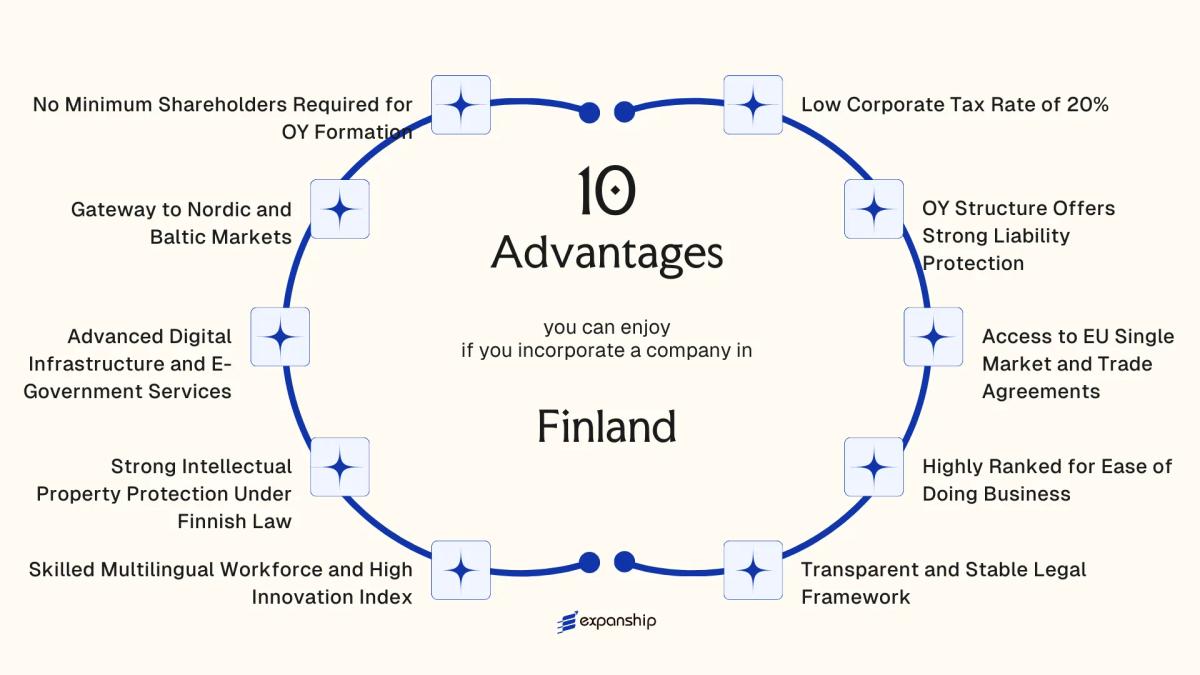
This article covers the principal advantages of Finnish company formation for international businesses considering this jurisdiction.
Low Corporate Tax Rate of 20%
Finland's corporate tax rate sits at 20%, a fixed flat rate that applies to the worldwide income of resident companies, including the Finnish private limited company, known as the Osakeyhtiö or OY. For foreign investors, the Finland 20% corporate tax rate advantage becomes most visible when measured against the EU average, which hovers around 21-22%, placing Finnish entities at or below that benchmark with full EU membership intact.
What the Rate Covers and Why It Matters
Resident OY entities are taxed on global income under the Business Income Tax Act (Laki elinkeinotulon verottamisesta, EVL). Your Finnish firm benefits from a predictable, single-tier rate rather than a tiered or variable structure, which simplifies tax forecasting across accounting periods.
Dividend Distributions and the Shareholder-Level Benefit
Finland applies a partial exemption on dividend income received by corporate shareholders from other Finnish entities, reducing effective tax burdens within group structures. This makes the OY a tax-efficient holding vehicle for foreign investors managing multi-entity operations across borders.
A flat 20% rate with no surtax tiers means your effective corporate tax liability is predictable from the first euro of taxable income.
OY Structure Offers Strong Liability Protection
Under Finnish corporate law, the Osakeyhtiö — commonly referred to as the OY — establishes a clear legal boundary between the company and its owners. Finland OY structure liability protection is codified in the Companies Act (Osakeyhtiölaki, 624/2006), which explicitly limits shareholder liability to the amount of their subscribed capital. Personal assets remain outside the reach of business creditors.
This separation has direct consequences for foreign investors. If the business incurs debt or faces legal claims, your personal financial exposure does not extend beyond what you contributed to the share capital.
The Osakeyhtiö limited liability benefits become particularly relevant when operating across borders, where contractual risks and local regulatory exposure can be difficult to predict in advance.
Several structural features of the OY reinforce this protection:
- Shareholder obligations are confined to capital contributions, not ongoing business losses
- Directors' personal liability arises only in cases of deliberate misconduct or breach of fiduciary duty under the Companies Act
- The legal personality of the firm is fully separate from that of its owners from the moment of registration
Registration is handled through the Finnish Patent and Registration Office (PRH), and the entity gains its separate legal status upon entry into the Trade Register.

Company Incorporation in Finland
Register your Finnish OY with full legal compliance and ongoing corporate support through Expanship.
Access to EU Single Market and Trade Agreements
Membership in the European Union means your Finnish-registered company operates under EU law as a domestic business across all 27 member states. That translates directly to passporting rights: goods, services, capital, and personnel can move without customs duties or border controls within the bloc, eliminating barriers that non-EU entities routinely face when trying to sell into European markets.
The Treaty on the Functioning of the European Union (TFEU) is the legal backbone of these freedoms. For a foreign investor, registering an Osakeyhtiö (OY) in Finland means the entity is covered by these treaty provisions from day one, not as a foreign applicant seeking access, but as a participant with the same standing as any locally incorporated German or French firm.
| Framework | Scope | Practical Benefit |
|---|---|---|
| EU Single Market (TFEU) | All 27 EU member states | Tariff-free goods and services movement |
| EU-Japan Economic Partnership Agreement | Japan | Reduced tariffs and market access commitments |
| EU-Canada CETA | Canada | Preferential terms on goods, services, investment |
| EU-South Korea FTA | South Korea | Lowered duties across major export categories |
Beyond the single market, your entity gains access to over 40 trade agreements the EU maintains with third countries. These are negotiated at the EU level by the European Commission, meaning a small Finnish firm holds the same preferential trade terms as a large German conglomerate operating under the same agreements.
Finland's position also places EU-incorporated businesses within scope of EU digital single market regulations, including mutual recognition of electronic signatures under eIDAS, which supports cross-border contracting without additional authentication layers.
Highly Ranked for Ease of Doing Business
Finland's ease of doing business advantages are well-documented in international assessments. The World Bank's Doing Business reports consistently placed the country among the top-performing economies in Europe, with particular recognition for contract enforcement, investor protection, and registration procedures.
Starting a private limited company, the osakeyhtiö (OY), involves registering through the Finnish Patent and Registration Office (PRH). The process can be completed digitally via the Business Information System, and registration is typically confirmed within a few business days. For a foreign investor, this translates to a short window between deciding to enter the market and having a legally operational entity.
Regulatory predictability also contributes here. Finland operates under a clear statutory framework, which means the rules governing your business are consistently applied and not subject to administrative discretion. That consistency reduces the legal uncertainty that can increase operating costs in less stable environments.
Keep the following in mind to make the most of this environment:
- Use the YTJ portal to register and manage business details online
- Confirm your business activity code (TOL code) accurately at registration; it affects licensing obligations
- Non-EU directors may need additional documentation at the PRH stage
- Verify that your selected company name clears the PRH's distinctiveness requirement before filing
Finland's company registration system allows foreign nationals to complete the entire OY formation process without being physically present in the country.
Transparent and Stable Legal Framework
Finland's stable legal framework for businesses is grounded in a codified system that has remained structurally consistent for decades. Foreign-owned entities operate under the same statutory protections as domestic firms, with no special restrictions tied to ownership origin.
Predictability Built Into the Legal Structure
The Finnish legal system operates under the Companies Act (Osakeyhtiölaki 624/2006), which governs the formation, management, and dissolution of limited liability companies. Statutory clarity of this kind means your obligations, rights, and recourse options are defined in advance, reducing exposure to interpretive uncertainty.
Finland consistently ranks among the highest in the EU on rule of law indices published by the World Justice Project. Judicial decisions are publicly accessible, courts operate independently, and contract enforcement follows established procedural timelines.
Regulatory Transparency as an Operational Advantage
The Finnish transparent regulatory environment is administered through clearly designated authorities. The Finnish Patent and Registration Office (PRH) handles company registration and public filings, while the Finnish Tax Administration (Vero) oversees fiscal compliance through published guidelines that are accessible in English.
Regulatory changes in the country are subject to legislative process and public consultation, meaning your business is not exposed to abrupt policy shifts. For foreign investors, this predictability directly affects how confidently you can enter multi-year contracts, hire staff, and commit capital.
Understand Your Legal Standing as a Foreign Business in Finland
Speak with an Expanship advisor about how Finnish corporate law applies to your specific structure and ownership setup.
Skilled Multilingual Workforce and High Innovation Index
Finland's skilled multilingual workforce advantages are well-documented in measurable terms. The country consistently ranks among the top performers in the European Innovation Scoreboard, classified as an "Innovation Leader" by the European Commission. English proficiency across the working-age population is high, and a significant share of university graduates enter the labor market with technical or engineering qualifications from institutions such as Aalto University and the University of Helsinki.
- Finnish residents regularly rank among Europe's highest in English proficiency, reducing communication barriers for foreign management teams operating remotely or from headquarters abroad.
- Finland's position as an EU Innovation Leader means your business can access a talent pool trained in R&D-intensive industries, including ICT, life sciences, and clean technology, sectors where the country has sustained output over decades.
- The Finnish education system produces a high concentration of STEM graduates relative to population size, which directly reduces recruitment cycles for technical roles.
- Research collaboration between universities and private firms is structured through programs administered by Business Finland, the state agency responsible for innovation funding, giving incorporated entities a formal pathway to co-funded R&D projects.
- Multilingual capability extends beyond English, with Swedish holding official language status, which is a practical asset for firms operating across Scandinavian markets.
Strong Intellectual Property Protection Under Finnish Law
Finland intellectual property protection advantages stem from a legal framework that aligns with both EU-level directives and domestic statutes, giving foreign-owned businesses enforceable rights from the moment of registration.
IP rights in Finland are governed by several specific laws: the Act on Copyright (404/1961), the Trademarks Act (544/2019), and the Patents Act (550/1967). Each statute is administered through the Finnish Patent and Registration Office (PRH), which handles trademark, patent, and design registrations. For your business, this means IP assets can be registered and legally protected through a single national authority operating under clear statutory mandates.
As an EU member state, Finland also gives your company direct access to EU-wide IP instruments, including EU trademark registration through the EUIPO and the European Patent Convention system. A patent secured through these channels carries protection across member states without requiring separate national filings.
Finland consistently ranks among the top countries in the Global Innovation Index, reflecting an institutional environment where IP rights are actively enforced through the court system rather than merely codified on paper.
Finland ranked 6th globally in the Global Innovation Index 2023 (WIPO), indicating a high-trust environment for IP-intensive business models.
Advanced Digital Infrastructure and E-Government Services
Finland's digital infrastructure advantages for businesses are grounded in deliberate public investment and legislative backing. The Act on Electronic Services and Communication in the Public Sector established a legal framework requiring government agencies to provide digital service access, meaning your company interacts with Finnish authorities through structured, documented digital channels rather than paper-based processes.
Company registration, tax filings, and annual reporting are handled through the Business Information System (YTJ), a joint platform operated by the Finnish Patent and Registration Office (PRH) and the Finnish Tax Administration. This centralization means your entity can fulfill multiple compliance obligations through a single portal without engaging separate agencies.
Finnish e-government services extend to electronic signatures with legally binding status under the Act on Strong Electronic Identification and Electronic Signatures. Foreign directors and shareholders can execute documents remotely, reducing the operational dependency on physical presence in the country.
- VAT registration is completed online through MyTax, the Tax Administration's self-service portal
- Annual financial statements are submitted digitally to the PRH via XBRL-format reporting
- Trade register notifications are processed electronically with confirmed response timelines
Remote document execution is legally recognized, but certain notarial acts and authenticated translations may still require physical or apostilled documentation depending on the originating country.
Gateway to Nordic and Baltic Markets
Finland's geographic position makes it a practical base for businesses targeting the broader Nordic-Baltic region. As a Finland gateway to Nordic Baltic markets, a company registered here sits at the intersection of eight Nordic and Baltic economies with a combined GDP exceeding €1.5 trillion, all within relatively short logistics and trade corridors.
Proximity to Key Regional Economies
Helsinki is approximately 80 kilometres from Tallinn by sea, and direct ferry connections operate multiple times daily. This places your entity within hours of Estonia's digital-first business environment and, by extension, the wider Baltic states. Stockholm, Oslo, and Copenhagen are all accessible within a single business day by air or sea freight.
Regional Trade Without Additional Barriers
As an EU member state, Finland operates within the same regulatory and customs framework as the other EU members in the region, including Sweden and Estonia. Goods, services, and capital can move across these borders without the friction that non-EU incorporation would introduce. For a foreign-owned company, this means one incorporated entity can serve multiple Northern European markets without requiring separate registrations in each country.
Nordic Business Network Access
Finnish membership in the Nordic Council of Ministers facilitates cooperation frameworks across Denmark, Iceland, Norway, and Sweden. While Norway and Iceland sit outside the EU, the European Economic Area agreement extends comparable single-market access across those jurisdictions. Your business gains a foothold in a region consistently ranked among the world's highest for trade openness and institutional transparency.
No Minimum Shareholders Required for OY Formation
Under Finnish corporate law, an Osakeyhtiö can be formed with a single shareholder. The Finland OY no minimum shareholder requirement applies to both natural persons and legal entities, meaning a foreign company can establish a wholly owned subsidiary without bringing in local partners or co-founders.
This matters structurally. In jurisdictions that mandate two or more shareholders, solo founders must either dilute ownership or arrange nominee arrangements to satisfy formation rules. The Finnish Osakeyhtiölaki (Companies Act 624/2006) removes that friction entirely, allowing full ownership concentration from day one.
For foreign investors operating holding structures or testing a new market, the single-shareholder model preserves clean group architecture. There is no requirement to restructure ownership once the entity is formed, which reduces administrative overhead across the corporate group.
The benefits this creates for a solo founder or parent company include:
- No mandatory co-founder or local partner required at formation
- Full voting control retained by a single shareholder from incorporation
- Simplified shareholder agreements, since there are no other parties to the equity
- Parent companies can hold 100% of shares directly without structural workarounds
- Ownership changes do not require minimum shareholder thresholds to be maintained post-formation
The Finnish Patents and Registration Office (PRH) handles OY registrations and does not impose residency or nationality conditions on shareholders. A foreign individual or corporate entity qualifies on equal footing with domestic applicants, which makes the Finnish solo founder company structure accessible without requiring local presence at the equity level.
Why Finland Stands Out Among EU Incorporation Destinations
Businesses evaluating EU incorporation typically compare jurisdictions with similar investor profiles: low-tax environments, stable legal systems, and access to regional markets. The Netherlands, Estonia, and Sweden are the most frequent alternatives a foreign investor would realistically weigh against a Finnish entity. Each targets internationally oriented businesses, yet they differ in meaningful ways on corporate tax, regulatory transparency, and digital infrastructure.
Where this comparison becomes instructive is in the combination of factors rather than any single metric. Estonia's e-Residency programme attracts attention, but its 20% tax applies only on distributed profits, creating a structural difference from Finland's flat 20% rate on all corporate income under the Business Income Tax Act. Sweden's headline corporate rate stands at 20.6%, marginally above Finland's. The Netherlands applies a two-tier rate of 19% up to €200,000 and 25.8% above that threshold, which affects larger profit volumes directly.
| Parameter | Finland | Estonia | Sweden | Netherlands |
|---|---|---|---|---|
| Corporate Tax Rate | 20% (flat) | 20% on distributed profits only | 20.6% | 19% / 25.8% (tiered) |
| Primary Business Entity | OY (Osakeyhtiö) | OÜ | AB | BV |
| Minimum Share Capital (Private Entity) | €2,500 (OY) | €0.01 | SEK 25,000 | €0.01 |
| EU Single Market Access | Yes | Yes | Yes | Yes |
| OECD Tax Treaty Network | Extensive | Extensive | Extensive | Extensive |
| PRH Digital Registration | Yes | Yes | Yes | Partial |
| Mandatory Audit Threshold | Applies above statutory thresholds | Applies above statutory thresholds | Applies above statutory thresholds | Applies above statutory thresholds |
Compliance Services for Companies in Finland
Maintain your Finnish company's statutory obligations, including annual filings, bookkeeping requirements, and PRH reporting, with structured compliance support.
Conclusion
Finland's combination of a 20% corporate tax rate, a transferable OY liability structure, and direct access to the EU single market forms a coherent case for foreign business owners evaluating European incorporation. These aren't isolated features; they reinforce each other. Tax efficiency, legal predictability under the Finnish Companies Act, and market reach compound into a structure that reduces operational exposure for an international entity.
That said, the strength of this case varies by context. A technology firm prioritising IP ownership will find Finnish law particularly well-suited to its needs. A trading company focused on Nordic distribution chains benefits differently than a holding structure optimising for EU treaty access. Your industry, ownership model, and long-term objectives all shape how much weight each factor carries.
Formal registration with the Finnish Trade Register, administered by the Patent and Registration Office (PRH), marks the point at which these advantages become legally operative for your business. Understanding exactly how to reach that point, and how to maintain compliance once you do, is where the formation process begins.
Start Your Finnish Company Formation With Expanship Today
Expanship assists foreign founders and businesses with Finnish company formation, handling the procedural and compliance requirements that apply from the point of registration through to ongoing statutory obligations. The services cover the full incorporation lifecycle for an Osakeyhtiö (OY), including interaction with the Finnish Patent and Registration Office (PRH), which maintains the Trade Register and serves as the primary authority for business registration in Finland.
Expanship's support across the incorporation and post-incorporation process includes:
- Preparation and legalization of incorporation documents, including the Articles of Association and shareholder resolutions
- Registered agent and registered office provision to satisfy Finnish address requirements
- Filing and liaison with the PRH for Trade Register entry and related notifications
- Post-incorporation compliance management covering annual reporting and statutory filings
- Coordination with the Finnish Tax Administration (Vero) for VAT and employer registration where applicable
- Banking introduction assistance to support the opening of a Finnish corporate account
For questions about incorporating in Finland or to begin the process, contact Expanship Finland.
Frequently Asked Questions (FAQ)
Registration through the Finnish Trade Register typically takes between one and three weeks when submitted via the YTJ business information portal. Expedited processing may be available for an additional fee. The timeline can extend if supporting documents require translation or if the registration authority requests clarifications.
Finland applies a flat corporate income tax rate of 20% on the taxable profits of an osakeyhtiö. This rate has been in effect since 2014 and applies uniformly regardless of profit size, with no tiered structure. Withholding tax on dividends paid to foreign shareholders may apply, subject to applicable tax treaties.
Since the 2019 amendment to the Finnish Companies Act (Osakeyhtiölaki, 624/2006), the minimum share capital requirement for a private limited company was reduced to zero euros. Prior to this change, a minimum of EUR 2,500 was required. The OY must still maintain share capital and a shareholders' register, but the initial capital threshold no longer presents a barrier to formation.
Finland's extensive double tax treaty network, covering over 70 countries, directly affects withholding tax rates on dividends distributed to foreign shareholders. Under domestic law, the standard withholding rate on dividends paid to non-residents is 20%, but applicable treaties frequently reduce this. The Finnish Tax Administration (Verohallinto) administers treaty relief claims, and investors must apply for reduced rates through the prescribed procedure.
Finnish law does not require a Finnish citizen on the board, but at least one board member must be a resident of the European Economic Area (EEA) unless the National Board of Patents and Registration of Finland (PRH) grants an exemption. This requirement applies to the board of directors and the managing director if one is appointed. Non-EEA investors who cannot fulfill this condition must formally apply for an exemption from PRH.
IP rights registered in Finland are governed domestically by statutes including the Patents Act (550/1967) and the Trademarks Act (544/2019), and are reinforced by Finland's obligations under EU IP regulations. Finnish courts have jurisdiction to enforce these rights, and the Finnish Patent and Registration Office (PRH) administers national filings. EU-wide protections, such as EU trademarks and European patents validated in Finland, operate in parallel with domestic registrations.
Foreign applicants can use the YTJ portal and the Business Information System to initiate registration, though full digital access to some services requires Finnish authentication credentials, such as a Finnish bank ID or identity card. Non-residents without these credentials may need to submit paper-based applications or engage a local representative to complete the process. The degree of digital access depends on whether the applicant holds a Finnish personal identity code issued by DVV.
Legal Disclaimer
The information provided in this article is for general informational purposes only and does not constitute legal, tax, or professional advice. While we strive to ensure the accuracy and timeliness of the content, laws and regulations are subject to change, and the application of laws can vary widely based on specific facts and circumstances.
Readers should not act upon this information without seeking professional counsel tailored to their individual situation. Expanship and its authors disclaim any liability for actions taken or not taken based on the content of this article.
For specific advice regarding your business setup, compliance requirements, or any legal matters, please consult with qualified legal and tax professionals in the relevant jurisdiction.