

Key Takeaways
- Under Ethiopia's Commercial Code of 2021, companies must satisfy entity-specific minimum share capital thresholds before registration can proceed, with the applicable amount varying based on both company type and whether the investor is domestic or foreign.
- Foreign-involved entities are required to register through the Ethiopian Investment Commission in addition to the Ministry of Trade and Regional Integration, meaning compliance obligations run across two distinct regulatory bodies.
- Every company incorporated in Ethiopia must maintain a physical registered office address within the country as a mandatory condition of registration, not an administrative formality that can be deferred.
- The Commercial Registration and Business Licensing Proclamation sets the overarching legal framework that governs structural, documentary, and operational requirements throughout the incorporation process in Ethiopia.
Entity formation in Ethiopia is governed by the Commercial Code of 2021, which replaced the 1960 code and introduced updated rules on company structures, governance, and registration procedures. The Ministry of Trade and Regional Integration, together with the Ethiopian Investment Commission for foreign-involved entities, oversees the registration and licensing process.
Meeting the incorporation requirements in Ethiopia is not optional. Failure to satisfy the prescribed conditions results in rejection of the registration application or an inability to obtain the necessary business license to operate legally.
This article addresses the structural, documentary, and compliance requirements applicable to company registration in Ethiopia across several defined categories. Specific thresholds and obligations can differ based on entity type, the sector in which the business operates, and whether the applicant is a domestic or foreign investor.
Foreign nationals and internationally-based business owners evaluating Ethiopia business incorporation rules will find this article most directly applicable to their planning process.
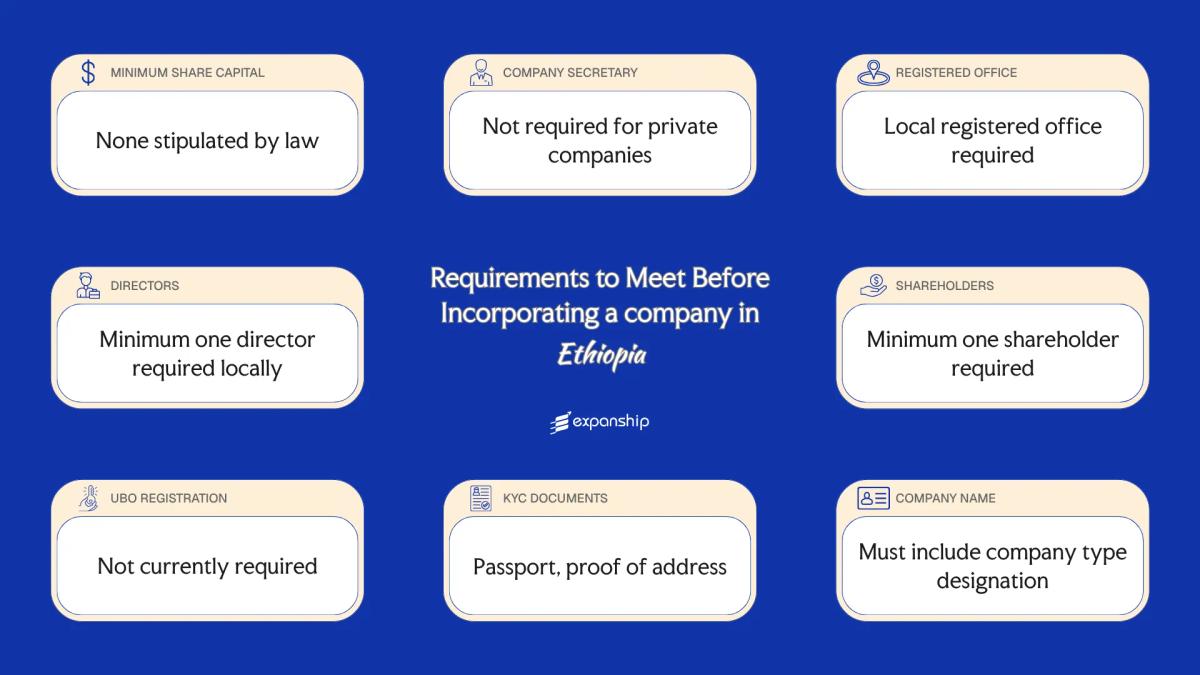
Minimum Share Capital Requirements in Ethiopia
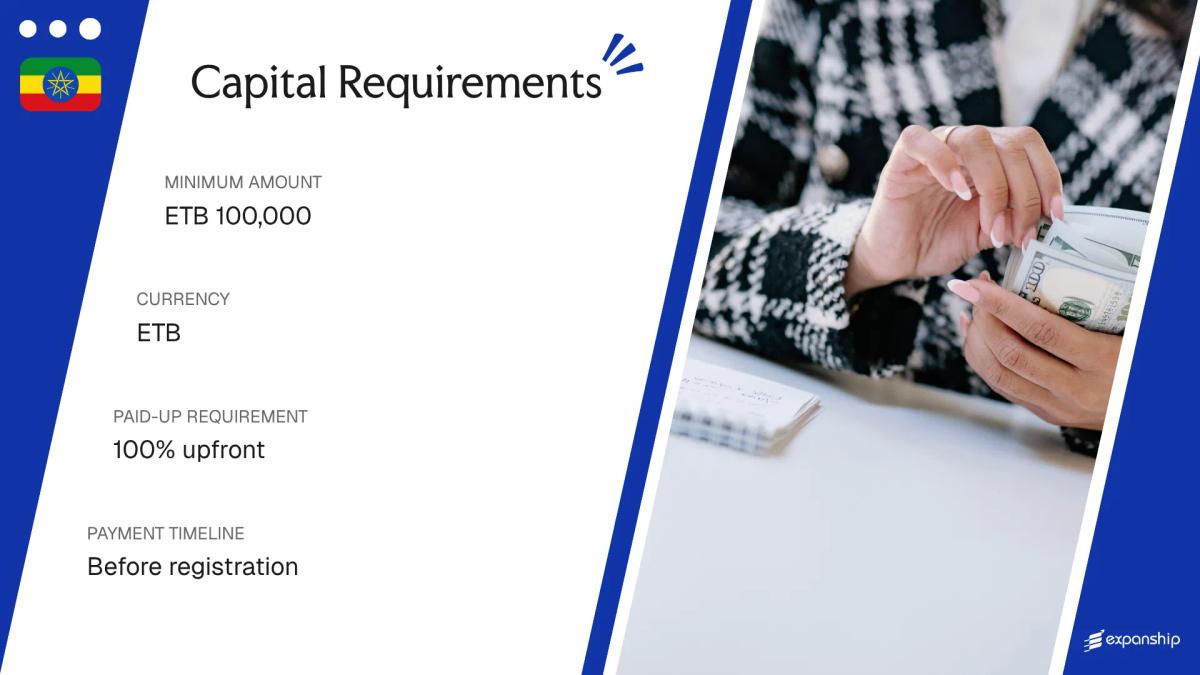
Under the Commercial Code of Ethiopia (Proclamation No. 1243/2021), minimum share capital requirements in Ethiopia vary by entity type and are enforced at the point of registration through the Ethiopian Investment Commission or the relevant regional trade bureau. Share capital is structured on a par value basis, meaning each share carries a nominal value stated in the company's memorandum of association.
Capital verification is conducted before a certificate of incorporation is issued, making the deposit an incorporation condition rather than a post-registration obligation. Your business must demonstrate that the required paid-up capital has been deposited with a licensed commercial bank in Ethiopia prior to completing registration.
| Parameter | Detail |
|---|---|
| Minimum Authorized Share Capital | ETB 15,000 for a Private Limited Company (PLC) under the 2021 Commercial Code |
| Maximum Authorized Share Capital | No statutory maximum |
| Minimum Paid-Up Capital | ETB 15,000 for a PLC at incorporation |
| Paid-Up Requirement at Incorporation | Full minimum capital must be deposited before registration is completed |
| Accepted Currency | Ethiopian Birr (ETB); foreign currency accepted for foreign investors through a licensed bank |
| Accepted Forms of Contribution | Cash; in-kind contributions permitted if valued by an independent auditor |
| Timeframe to Deposit Capital | Prior to submission of incorporation documents |
The bank deposit slip confirming paid-up capital must accompany your incorporation filing. Registration will not proceed without it, regardless of how far along other documentation may be.
Company Secretary Requirements in Ethiopia
Under the Commercial Code of Ethiopia (Proclamation No. 1243/2021), there is no mandatory company secretary requirement in the same form as common law jurisdictions. Private limited companies and share companies operating under the Commercial Registration and Business Licensing Proclamation are not statutorily obligated to appoint a dedicated corporate secretary.
That said, certain administrative and compliance functions typically assigned to a secretary role must still be fulfilled. These include maintaining statutory registers, ensuring timely filing with the relevant regional or federal trade bureau, and keeping minutes of shareholder and board meetings.
Qualification criteria for individuals fulfilling a secretary or equivalent administrative compliance role:
- No statutory licensing requirement exists specifically for corporate secretaries under current Ethiopian commercial law.
- The role may be filled by an Ethiopian resident or a foreign national legally authorized to work in the country.
- A legal or accounting professional may serve in this capacity, though no specific credential is mandated.
- Corporate entities providing registered or administrative services may also fulfill these functions where permitted.

Company Incorporation in Ethiopia
Set up your business entity in Ethiopia with full compliance support across federal and regional registration requirements.
Registered Office Requirements in Ethiopia
Registered office requirements in Ethiopia are governed under the Commercial Registration and Business Licensing Proclamation No. 980/2016, which mandates that every registered company maintain a physical address within the country at which official correspondence and regulatory notices can be served. Non-compliance with this obligation can result in administrative penalties or suspension of the firm's commercial registration by the Ethiopian Business Registration and Licensing Agency (EBRLA).
- A physical address is required; virtual offices are not recognised as compliant registered addresses under Ethiopian commercial law.
- The address must be located within Ethiopia and correspond to the jurisdiction in which the entity is registered.
- Documentary evidence of occupation, such as a lease agreement or title deed, is generally required to substantiate the address at registration.
- The registered address is recorded in the commercial register and is publicly accessible.
- Any change to your business's registered address must be formally reported to the EBRLA, and the updated information must be reflected in the commercial register.
- Failure to maintain a valid, current address on record may trigger regulatory review or result in the business licence being invalidated.
Director Requirements in Ethiopia
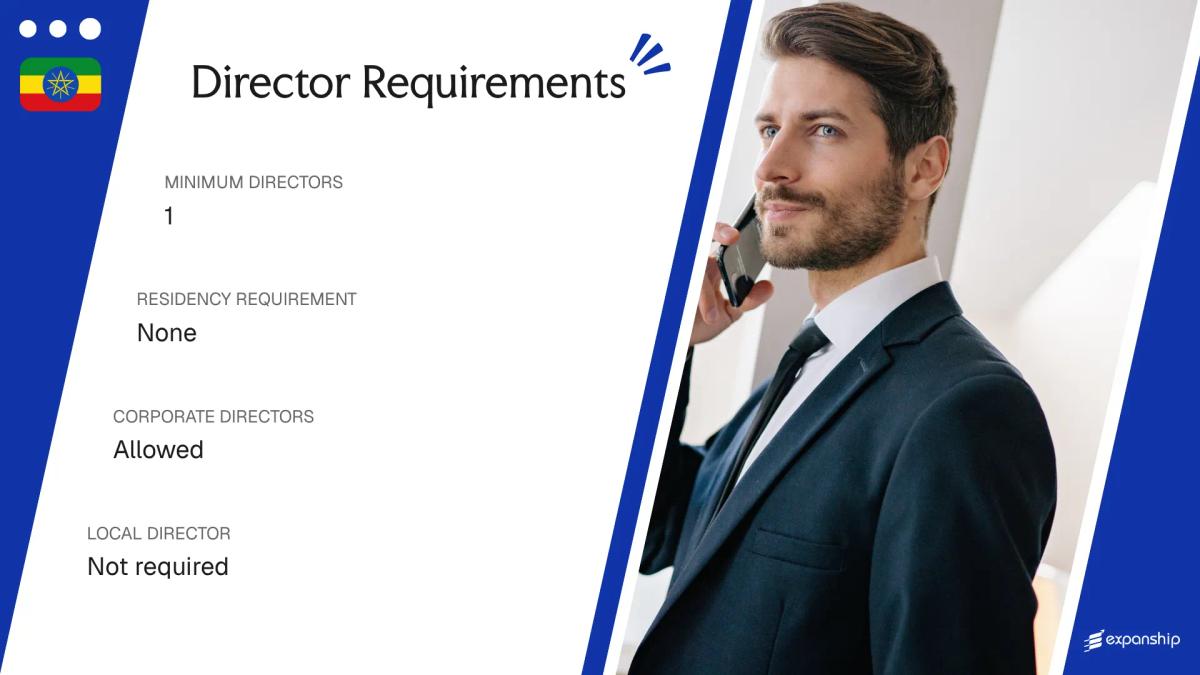
Under the Commercial Code of Ethiopia (Proclamation No. 1243/2021), director requirements Ethiopia company structures must satisfy are defined at the entity level, with directors assuming statutory duties of care, loyalty, and financial accountability upon appointment.
| Parameter | Detail |
|---|---|
| Minimum Number of Directors | A private limited company (PLC) requires at least one director; a share company requires a board of at least three directors. |
| Maximum Number of Directors | No statutory maximum is prescribed for PLCs; share companies are subject to the articles of association. |
| Local/Resident Director Required | No statutory requirement for a resident or locally domiciled director. |
| Nationality Restrictions | No nationality restrictions are imposed on directors under the Commercial Code. |
| Minimum Age Requirement | Directors must have attained the age of majority, which is 18 years under Ethiopian civil law. |
| Corporate Directors Permitted | No statutory provision explicitly permits corporate entities to serve as directors; natural persons are the standard requirement. |
| Director Must Be a Shareholder | No statutory requirement for directors to hold shares in the company. |
| Publicly Listed on Registry | Director information is filed with the relevant regional trade bureau but is not universally accessible through a centralised public registry. |
| Disqualification Conditions | Persons convicted of fraud, bankruptcy-related offences, or serious financial crimes may be disqualified from directorship under the Commercial Code. |
Ethiopia's 2021 Commercial Code removed the previous requirement for share companies to appoint an odd number of board members, a rule that had historically influenced quorum and voting mechanics.
Shareholder Requirements in Ethiopia
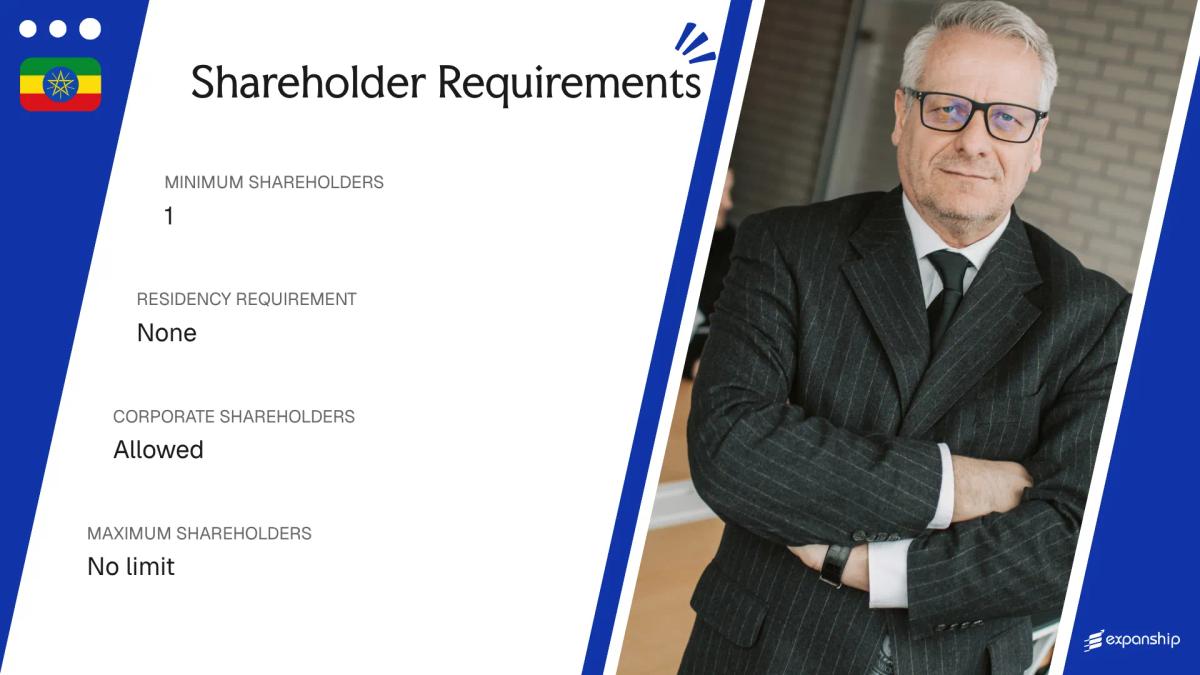
Under the Commercial Code of Ethiopia (Proclamation No. 1243/2021), a Private Limited Company (PLC) requires a minimum of two shareholders and permits a maximum of fifty. A single-shareholder structure is not recognized for a PLC under this framework.
Nationality and Residency Restrictions
Foreign nationals may hold shares in an Ethiopian PLC, though sectors subject to the Investment Proclamation may impose foreign ownership restrictions or reserve certain activities for domestic investors. Your business should verify sector-specific eligibility through the Ethiopian Investment Commission before structuring ownership.
Corporate Shareholders
Corporate entities are permitted to act as shareholders in an Ethiopian PLC. No general prohibition exists, though the entity must meet standard KYC and registration requirements during incorporation.
Shareholder Liability
Shareholder liability in a PLC is limited to each member's capital contribution. Ethiopian corporate law does not generally extend liability beyond the subscribed share amount under ordinary circumstances.
Register of Shareholders
A register of shareholders must be maintained at the company's registered office. Filing obligations and public accessibility are governed by the Commercial Registration and Business Licensing framework administered by the Ministry of Trade and Regional Integration.
Shareholder Structure Guidance for Incorporating in Ethiopia
Get tailored advice on meeting shareholder eligibility and compliance requirements when setting up a company in Ethiopia.
UBO / Beneficial Ownership Disclosure Requirements in Ethiopia
Beneficial ownership disclosure Ethiopia falls under the Commercial Registration and Business Licensing Proclamation No. 980/2016 and subsequent directives issued by the Ethiopian Investment Commission and the Ministry of Trade and Industry, which require companies to identify and register individuals exercising ultimate control or ownership.
- Identify all individuals who directly or indirectly hold 20% or more of shares or voting rights in the entity.
- Submit beneficial ownership particulars to the relevant registration authority at the time of business registration.
- Notify the registering authority of any changes to beneficial ownership within the prescribed timeframe following the change.
- Maintain internal records of beneficial ownership information, available for inspection upon regulatory request.
| Parameter | Detail |
|---|---|
| Ownership Threshold for UBO Status | 20% or more of shares or voting rights |
| Filing Authority | Ministry of Trade and Industry / Ethiopian Investment Commission |
| Disclosure Deadline at Incorporation | At the time of commercial registration |
| Publicly Accessible Register | No publicly accessible register confirmed by statute |
| Penalties for Non-Disclosure | Sanctions under Proclamation No. 980/2016; specific penalty amounts not separately codified |
| Ongoing Update Obligation | Yes; changes must be reported to the registering authority |
KYC / Document Requirements in Ethiopia
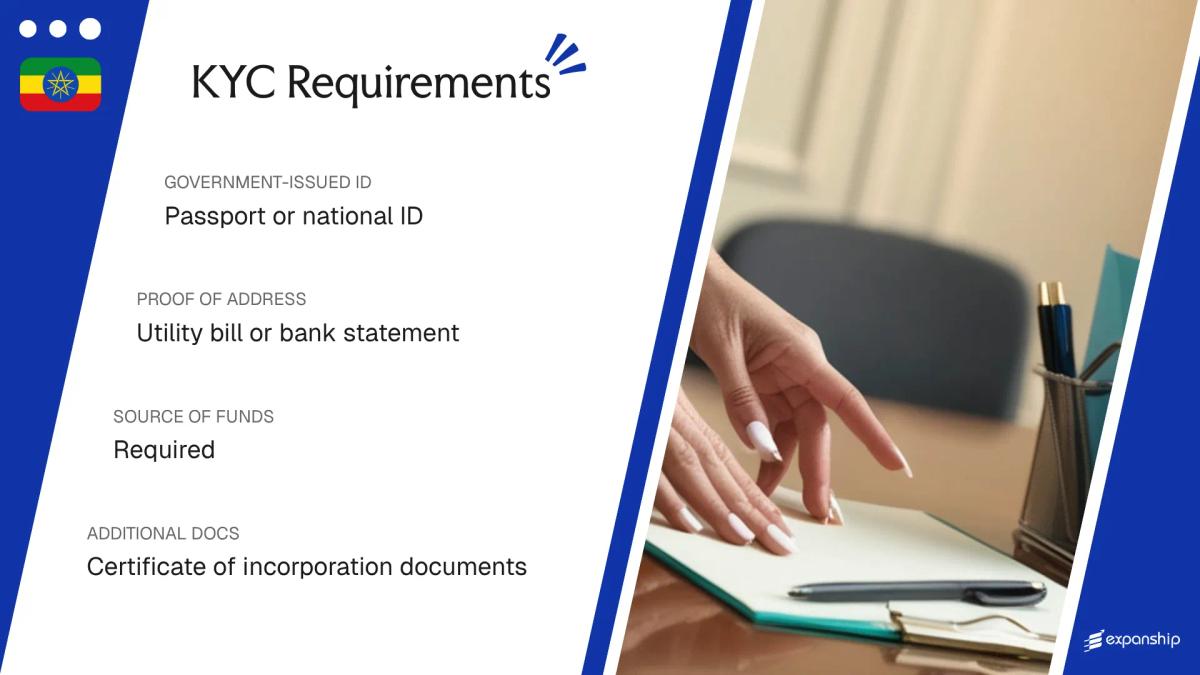
KYC document requirements Ethiopia are governed primarily by the Financial Intelligence Centre Establishment Council of Ministers Regulation No. 271/2012, which places anti-money laundering due diligence obligations on institutions involved in financial transactions, including those facilitating company formation. The Financial Intelligence Centre oversees compliance at the national level.
Individual / Personal Documents
- Valid passport or national identity card for each individual director, shareholder, or beneficial owner
- Recent proof of residential address dated within three months, such as a utility bill or bank statement
- Passport-sized photograph may be required depending on the registering authority's internal procedures
- Tax Identification Number (TIN) where the individual already holds one in their country of residence
Corporate Documents
- Certificate of incorporation issued by the home jurisdiction's company registry
- Memorandum and articles of association or equivalent constitutional documents
- Register of directors and register of shareholders from the incorporating jurisdiction
- Proof of the corporate entity's registered office address
Source of Funds Documentation
- Recent bank statements covering a minimum of three to six months
- Audited financial statements where the corporate shareholder is an established operating entity
- Written declaration of the source of capital if bank documentation is insufficient
Notarisation and Apostille Requirements
- Foreign documents submitted to the Ethiopian Investment Commission generally require notarisation by a competent authority in the country of origin
- Documents issued outside Ethiopia must be apostilled if the originating country is a Hague Convention signatory
- Official Amharic translation is required for any document not already in Amharic or English
Submission of foreign corporate documents without certified Amharic or English translation is among the most common causes of registration delays at the Ethiopian Investment Commission.
Company Name Requirements in Ethiopia
Proposed company name requirements Ethiopia must be submitted to the Ethiopian Investment Commission or the relevant regional trade bureau for approval before registration proceeds. Names are assessed against existing registrations to avoid duplication.
Your chosen name must be written in either Amharic or English, and must include a legal suffix reflecting the entity type, such as "PLC" for a private limited company. No specific character limit is publicly codified, but names must be distinct and non-deceptive.
Certain words are prohibited or require prior authorisation. Terms implying government affiliation, banking, insurance, or national symbols generally fall into restricted categories that demand regulatory clearance before use.
Name reservation is available through the registration authority prior to formal incorporation. Reservations are typically granted for a limited period, after which the name lapses if incorporation is not completed.
Company Compliance Services in Ethiopia
Manage your ongoing statutory obligations in Ethiopia, from annual filings to regulatory reporting.
Conclusion
Meeting the incorporation requirements in Ethiopia means working within a framework governed primarily by the Commercial Registration and Business Licensing Proclamation and overseen by the Ethiopian Investment Commission for foreign-involved entities. Minimum share capital thresholds vary by entity type and investor nationality, carrying direct implications for how a business is structured from day one. Registered office requirements are also strictly enforced, with a physical address inside the country mandatory for registration. Once these obligations are understood, the practical next step is assembling compliant documentation and engaging with the relevant federal or regional authorities to begin the formal registration process.
Expanship's Corporate Formation Services in Ethiopia
Expanship's corporate formation services in Ethiopia are structured around the specific requirements that govern how foreign and domestic entities establish themselves under the Commercial Registration and Business Licensing Proclamation. From coordinating notarized incorporation documents to liaising with the Ethiopian Investment Commission where applicable, Expanship helps reduce the administrative weight of meeting Ethiopia's registration framework.
Our service scope covers each stage of the process:
- Preparing and filing company registration documents with the relevant authorities
- Providing registered agent and office address services in Ethiopia
- Handling government filings and liaising directly with regulatory bodies on your behalf
- Managing post-incorporation compliance obligations as your business operates
- Facilitating introductions to local banking institutions
- Coordinating tax registration and engagement with local authorities
To discuss how your business can be structured for the Ethiopian market, contact Expanship Ethiopia.
Frequently Asked Questions (FAQ)
Ethiopian law does not explicitly require that at least one director be a resident of Ethiopia, but all directors must be registered with the Ethiopian Trade and Industry Bureau and their details submitted during incorporation. Foreign nationals serving as directors will need to provide notarized and apostilled identification documents, and in some cases a valid residence or work permit may be required depending on their operational role within the entity.
Failure to comply with beneficial ownership disclosure obligations under Ethiopia's anti-money laundering framework can result in administrative penalties, fines, and in serious cases, suspension of the company's operating license. The Financial Intelligence Centre (FIC) oversees AML compliance, and non-disclosure or misrepresentation of UBO information is treated as a regulatory violation. The severity of the penalty generally scales with whether the omission was deemed negligent or deliberate.
A virtual office address is not sufficient to meet Ethiopia's registered office requirement. The commercial registration process requires a physical, verifiable address within Ethiopia where official correspondence and regulatory notices can be served, and this address must be documented with a valid lease agreement submitted to the relevant Trade Bureau. Using an address that cannot be verified or does not have a corresponding tenancy arrangement will result in rejection of the registration application.
Foreign ownership restrictions in Ethiopia depend on the sector in which your business operates. Certain industries, including retail trade and import-export of some goods, are reserved exclusively for Ethiopian nationals under the Investment Proclamation. In sectors open to foreign investment, a foreign national or entity can hold shares in an Ethiopian PLC, but the investment must be registered with the Ethiopian Investment Commission and meet any applicable minimum capital thresholds for foreign-owned entities.
Foreign shareholders face a more extensive documentation process than Ethiopian nationals. In addition to standard identification, foreign individuals must typically provide notarized copies of their passport, proof of address from their country of residence, and in some cases a certificate of good standing or equivalent from their home jurisdiction, all of which must be authenticated for use in Ethiopia. Domestic shareholders generally need only a national ID or kebele identification certificate along with their tax identification number.
The Ethiopian Investment Commission (EIC) is specifically relevant to foreign investors and businesses seeking to operate under an investment permit, rather than to all entities incorporating in Ethiopia. Domestic businesses typically register through the Trade Bureau at the federal or regional level without EIC involvement. Foreign-owned or partially foreign-owned companies, however, must obtain EIC approval before or alongside commercial registration, and the EIC determines eligible sectors, minimum capital requirements, and any conditions attached to the investment permit.
Legal Disclaimer
The information provided in this article is for general informational purposes only and does not constitute legal, tax, or professional advice. While we strive to ensure the accuracy and timeliness of the content, laws and regulations are subject to change, and the application of laws can vary widely based on specific facts and circumstances.
Readers should not act upon this information without seeking professional counsel tailored to their individual situation. Expanship and its authors disclaim any liability for actions taken or not taken based on the content of this article.
For specific advice regarding your business setup, compliance requirements, or any legal matters, please consult with qualified legal and tax professionals in the relevant jurisdiction.