
Key Takeaways
- Under Ethiopia's Investment Proclamation, foreign investors are entirely excluded from a range of sectors reserved for domestic investors, meaning certain business models cannot be legally structured as wholly foreign-owned entities regardless of capital commitment.
- Foreign currency retention and profit repatriation are subject to National Bank of Ethiopia controls that restrict how and when foreign-currency earnings can be transferred out of the country, adding a structural financial constraint that affects return-on-investment calculations.
- Obtaining the full set of business licenses and approvals in Ethiopia typically requires engagement with multiple agencies — including the Ethiopian Investment Commission and sector-specific ministries — extending the pre-operational timeline beyond what most investors budget for.
- Intellectual property rights registered in Ethiopia face limited practical enforcement capacity, leaving foreign businesses with brand assets, patents, or proprietary technology exposed to infringement without reliable judicial or administrative remedy.
Ethiopia's regulatory environment for foreign investors sits within an evolving but heavily controlled framework, where sector-specific restrictions, foreign exchange rules, and multi-agency approval processes create a distinct compliance burden. The disadvantages of incorporating in Ethiopia span structural, financial, and operational categories, each examined separately in this article.
Not every firm will encounter the same friction points. The challenges you face depend significantly on your industry, the ownership structure you choose, and whether your business falls under sectors reserved for domestic investors under the Investment Proclamation.
This article is most relevant to foreign nationals and internationally incorporated entities seeking to establish a subsidiary, joint venture, or wholly foreign-owned company in Ethiopia, particularly those entering regulated or capital-intensive sectors.
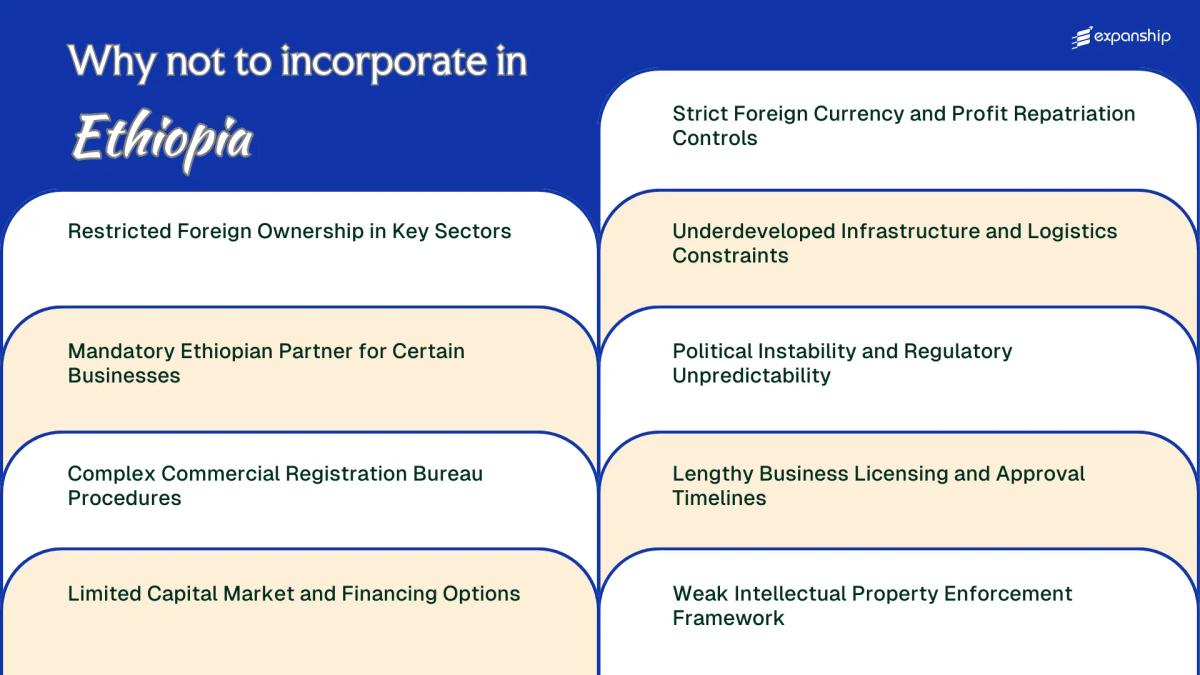
Restricted Foreign Ownership in Key Sectors
Foreign ownership restrictions in Ethiopia are not incidental policy choices; they reflect a deliberate legal architecture that systematically excludes or limits foreign participation across a defined range of economic activities.
Sectors Closed or Reserved Under the Investment Proclamation
Under Proclamation No. 1180/2020 and its accompanying investment regulations, specific sectors are entirely closed to foreign investors, while others are reserved exclusively for Ethiopian nationals or joint ventures. Banking, insurance, microfinance, and domestic air transport fall within the reserved categories, meaning your firm cannot hold any equity stake in these industries regardless of capital or structure. This directly eliminates entire verticals from your market entry options, forcing business models to be redesigned around legal boundaries rather than commercial logic.
How Sector Lists Create Structural Risk
The restricted sectors list is subject to revision by the Ethiopian Investment Commission without a fixed review cycle, which means a business model that is permissible today may become non-compliant following a regulatory update. Retail trade and import-export activities have historically been among the most tightly controlled segments for foreign entities, adding friction to distribution-heavy operations.
If your intended business activity falls within a sector reserved for Ethiopian nationals under Proclamation No. 1180/2020, no amount of capital commitment or structural engineering will secure you a legal operating license in that space.
Mandatory Ethiopian Partner for Certain Businesses
The mandatory Ethiopian partner business requirement applies across a defined range of sectors under the Investment Proclamation No. 1180/2020 and its accompanying regulations. Foreign investors operating in these sectors cannot hold 100% equity. That structural ceiling forces you into a joint venture arrangement before you generate a single birr in revenue.
Under the proclamation, activities such as import trade, export of raw coffee and live animals, and several domestic retail and wholesale categories are either fully reserved for Ethiopian nationals or require joint ownership. Your ability to control day-to-day decisions, profit distribution, and exit terms is legally constrained by the presence of a local partner whose interests may not align with yours.
The practical friction this creates includes:
- Finding a vetted local partner adds pre-incorporation costs and delays, since due diligence on a partner's financial standing and legal history falls entirely on you
- Shared ownership compresses your dividend entitlement, meaning your effective return on investment is reduced before operational costs are factored in
- Dispute resolution with a local co-investor is governed by Ethiopian courts, where enforcement timelines are unpredictable for foreign parties
- Exiting the partnership requires the local partner's cooperation or a court process, locking your capital in longer than initially planned
The Ethiopia joint venture requirements are administered through the Ethiopian Investment Commission, which reviews proposed structures for compliance before registration proceeds.

Company Incorporation in Ethiopia
Set up your business entity in Ethiopia with structured guidance on ownership requirements, registration procedures, and Investment Commission filings.
Complex Commercial Registration Bureau Procedures
Ethiopia Commercial Registration Bureau problems begin before your business opens its first account. The Commercial Registration and Business Licensing Proclamation No. 980/2016 governs the registration process, and in practice, compliance requires multiple sequential approvals from separate government bodies, each with its own documentation standards and processing timelines.
The Ethiopian Investment Commission handles foreign investor pre-approval, while the Ministry of Trade and Regional Integration oversees commercial registration. Because these agencies do not operate on a unified submission platform, your firm must satisfy each body independently, and a delay at one stage does not pause requirements at another.
| Requirement | Burden Imposed |
|---|---|
| Minimum capital verification | Must be deposited and certified before registration proceeds |
| Notarized memorandum of association | Requires local notarization; foreign documents need apostille and translation |
| Trade name reservation | Separate step with no guaranteed hold period |
| Tax Identification Number (TIN) issuance | Processed by a distinct authority after commercial registration is complete |
| Investment permit renewal | Annual requirement, with lapses triggering operational restrictions |
Document rejections are common when foreign-issued certificates do not meet local formatting standards, and resubmissions restart processing queues rather than resuming from the point of rejection. That structural reset can extend your company formation timeline by weeks.
Even after registration, obtaining a business license requires a further sector-specific approval that the complex company registration process in Ethiopia does not automatically trigger.
Limited Capital Market and Financing Options
Ethiopia limited capital market risks are a direct structural constraint for any foreign business seeking external funding after incorporation. The country does not have a functioning stock exchange with broad market access; the Ethiopian Securities Exchange only launched in 2024 and remains in an early operational phase, meaning equity financing through public markets is not a viable short-term option for most firms.
Commercial bank lending is the primary financing channel, yet foreign-owned entities face tighter scrutiny and collateral requirements than domestic counterparts. Credit markets are shallow relative to the size of the economy, which forces many foreign firms to rely on parent-company funding or retained earnings.
The National Bank of Ethiopia restricts foreign currency-denominated lending by domestic banks to local entities, which directly limits your firm's ability to borrow in a currency that matches your operational exposures. This mismatch creates foreign exchange risk that compounds the underlying financing gap.
- Equity capital markets are not operationally mature enough to support capital raises for most incoming businesses
- Domestic bank loans require substantial local collateral, which foreign entities typically cannot provide at incorporation
- Foreign currency loans from Ethiopian banks are restricted under National Bank directives
- Development Finance Institutions remain a narrow channel, accessible only to specific qualifying sectors
Ethiopia's securities exchange became one of Africa's newest formal exchanges only in 2024, meaning foreign businesses incorporated even five years ago had zero domestic equity market infrastructure available to them.
Strict Foreign Currency and Profit Repatriation Controls
Ethiopia foreign currency repatriation restrictions present one of the most binding structural barriers for foreign investors. The National Bank of Ethiopia (NBE) controls all foreign exchange transactions, and approvals for transferring profits abroad are neither automatic nor fast.
The Regulatory Mechanics That Create the Problem
Under Directive No. FXD/75/2023 and related NBE foreign exchange directives, foreign investors must channel all foreign currency transactions through licensed commercial banks, which are themselves constrained by the central bank's allocation system. Because foreign currency supply is persistently rationed, your firm may wait months before receiving approval to convert birr earnings into hard currency, effectively trapping working capital inside the country.
Practical Consequences for Foreign-Owned Businesses
Profit repatriation controls mean that even when your investment is profitable, access to those profits outside the country is not guaranteed on any predictable schedule. The birr is not freely convertible, and the structural gap between the official exchange rate and parallel market rates historically created additional valuation losses for firms calculating returns in their home currency. Businesses in export-generating sectors may access preferential foreign currency retention accounts, but this exception does not apply broadly across all investment categories.
Managing Foreign Currency and Repatriation Challenges in Ethiopia
Get structured guidance on how foreign exchange controls and profit repatriation restrictions apply to your specific business structure in Ethiopia.
Underdeveloped Infrastructure and Logistics Constraints
Ethiopia infrastructure challenges business presents a compounding problem: physical and logistical gaps translate directly into higher operating costs and longer delivery timelines for foreign firms.
- Road connectivity outside Addis Ababa remains limited, forcing companies to absorb elevated freight costs and unpredictable transit times that erode margins on time-sensitive goods.
- Dependence on the Port of Djibouti for nearly all seaborne trade exposes your supply chain to congestion delays and third-country port fees that landlocked competitors in other regions do not face.
- Frequent power outages impose unplanned capital expenditure on backup generation, a cost burden that disproportionately affects manufacturing and technology-dependent operations.
- Unreliable fixed-line and broadband infrastructure in secondary cities limits where your entity can practically operate without accepting degraded communications capacity.
- Cold chain and specialized logistics networks remain underdeveloped, restricting foreign firms in pharmaceuticals, perishables, or precision manufacturing from scaling distribution without building proprietary infrastructure.
Political Instability and Regulatory Unpredictability
Ethiopia political instability business risks are not abstract concerns — they have direct consequences for foreign entities operating under unpredictable policy conditions. The Tigray conflict, which intensified from 2020 onward, disrupted supply chains, restricted movement in northern regions, and created significant operational uncertainty for businesses already established in the country.
Regulatory changes in Ethiopia can occur without structured transition periods, leaving foreign investors with limited time to adjust compliance postures. The Ethiopian Investment Commission (EIC) has revised permitted activity lists and sector restrictions multiple times in recent years, meaning the conditions under which your company was originally licensed may shift materially after incorporation.
Policy announcements do not always translate into consistent enforcement across federal and regional authorities. This disconnect between federal directives and regional implementation creates legal ambiguity that raises your compliance costs and exposure.
- The Somali, Oromia, and Amhara regional states have each experienced governance disruptions that interrupted business operations locally.
- Foreign investors have reported inconsistent interpretation of the same investment regulations by different government offices.
According to the World Bank's Worldwide Governance Indicators, Ethiopia scores in the bottom quartile globally on political stability and absence of violence/terrorism (World Bank, 2022 data), placing it among the higher-risk environments for new foreign direct investment.
Lengthy Business Licensing and Approval Timelines
Ethiopia business licensing delays are a documented operational risk, not an occasional inconvenience. Multiple government bodies are involved in the approval chain, and each authority processes applications on its own schedule without a legally binding deadline in most cases.
Obtaining an investment permit through the Ethiopian Investment Commission (EIC) is typically the first step, but it does not authorize trading. Sector-specific operating licenses from ministries such as the Ministry of Trade and Regional Integration add separate approval layers, each requiring its own documentation set.
For regulated sectors, including telecoms, banking, and energy, licensing involves additional sign-off from sector regulators. Delays at any single agency stall the entire process, meaning your firm cannot generate revenue until every approval is in hand.
Pre-approval requirements compound the problem. These can include:
- Authenticated and apostilled foreign documents
- Notarized capital deposit evidence from a local bank
- Sector-specific feasibility studies or technical assessments
- Ministry clearance letters specific to the business activity
Collectively, these requirements can push the total setup timeline well beyond what most foreign operators initially budget for, affecting lease commitments, staffing plans, and projected launch dates.
Firms operating in sectors reserved for joint ventures or subject to investment screening under the Investment Proclamation No. 1180/2020 face additional EIC review stages that are not reflected in standard commercial registration timelines.
Weak Intellectual Property Enforcement Framework
Ethiopia intellectual property enforcement limitations present a concrete operational risk for foreign businesses, particularly those with proprietary products, brands, or technology. The Ethiopian Intellectual Property Office (EIPO) administers trademark and patent registration, but registration alone does not guarantee protection in practice.
Enforcement relies heavily on court proceedings, and the judiciary's limited capacity in IP-specific litigation means disputes can remain unresolved for extended periods. Your registered trademark can be infringed without a reliable mechanism for swift injunctive relief.
Counterfeiting and unauthorized use of registered marks remain documented concerns in the market. For a firm that depends on brand integrity or licensed technology, this creates direct revenue exposure that cannot be offset through registration alone.
There is no specialized IP tribunal, so cases are processed through general commercial courts with inconsistent rulings on IP matters. The absence of dedicated IP judicial infrastructure makes enforcement outcomes difficult to predict.
Strategies to Overcome These Incorporation Challenges
Overcoming Ethiopia incorporation challenges requires structural preparation before any registration steps are taken. The country's regulatory architecture leaves limited room for reactive adjustments once incorporation is underway.
- Review the Investment Proclamation No. 1180/2020 and its reserved sector schedules to confirm your business activity's foreign ownership eligibility prior to structuring your entity.
- Where a joint venture is required, formalize the partnership agreement under Ethiopian Commercial Code provisions before submitting documents to the Commercial Registration Bureau.
- Open a blocked capital account with the National Bank of Ethiopia early in the process to address foreign currency deposit requirements tied to minimum capital thresholds.
- Register intellectual property rights with the Ethiopian Intellectual Property Institute at the earliest stage of market entry, not after commercial operations begin.
- Obtain an investment permit through the Ethiopian Investment Commission before pursuing sector-specific operating licenses to avoid sequencing delays.
These steps address structural requirements embedded in Ethiopian federal law. Compliance gaps at any stage can trigger mandatory re-registration, additional licensing rounds, or permit cancellations under existing proclamations.
Ethiopia's Overall Investment Potential
Ethiopia's overall investment potential remains credible despite the documented disadvantages. The country offers a large domestic population, preferential trade access under frameworks such as AGOA, and an active federal investment promotion agency in the Ethiopian Investment Commission. These structural factors do not cancel the barriers covered in this blog, but they do establish a legitimate case for selective engagement.
| Pros | Cons |
|---|---|
| Large domestic market of over 120 million people supports demand-driven business models | Foreign ownership is excluded from several sectors under the Investment Proclamation |
| Preferential export access under AGOA reduces tariff costs for qualifying goods | Joint venture requirements in restricted activities dilute foreign control |
| The Ethiopian Investment Commission provides a single-window registration point | Commercial Registration Bureau procedures involve multiple steps and unclear timelines |
| Low-cost manufacturing labor relative to comparable frontier markets | Strict National Bank of Ethiopia controls limit profit repatriation in hard currency |
| Government-designated industrial parks offer pre-built infrastructure for exporters | Logistics bottlenecks and port dependency on Djibouti increase supply chain costs |
| Active government interest in attracting FDI across priority sectors | Regulatory changes can occur without adequate notice, creating compliance uncertainty |
Intellectual property protection remains structurally weak, with enforcement gaps that expose proprietary assets. Combined with financing constraints and underdeveloped capital markets, the operating environment requires careful pre-entry assessment.
Corporate Compliance Services in Ethiopia
Maintaining good standing in Ethiopia involves ongoing obligations across tax filings, license renewals, and regulatory reporting. This service covers the compliance requirements your entity must meet under Ethiopian law.
Conclusion
The Ethiopia company incorporation drawbacks summary is straightforward: the country offers genuine market potential, but the structural and regulatory constraints are real and material. Sector-specific foreign ownership restrictions under the Investment Proclamation, combined with tight foreign currency controls administered by the National Bank of Ethiopia, represent the most immediate friction points for foreign investors. Lengthy approval timelines across the Commercial Registration Bureau add further delay to what is already a procedurally demanding process. Informed entry, supported by qualified local legal and compliance expertise, remains the most reliable basis for managing these conditions.
Expanship's Ethiopia Expansion Services
Incorporating in Ethiopia means contending with sector-specific foreign ownership restrictions, Commercial Registration Bureau procedures, and foreign currency controls that together create a demanding compliance environment. Expanship's Ethiopia expansion services are structured around the practical realities of operating under the Ethiopian Investment Commission's requirements and the National Bank of Ethiopia's profit repatriation framework. Our role is to reduce the operational burden these obligations place on your business, not to sidestep them.
Expanship offers corporate services Ethiopia business setup support across the full incorporation and post-formation cycle.
- We prepare and file all company registration documentation with the relevant Ethiopian authorities.
- Our team provides registered agent and local office provision to satisfy residency requirements.
- We handle direct liaison with government bodies and regulatory agencies on your behalf.
- Post-incorporation compliance management keeps your entity in good standing on an ongoing basis.
- We facilitate banking introductions to support your operational setup.
- Tax registration and local authority liaison are handled as part of your broader formation process.
Reach out to Expanship Ethiopia to discuss your expansion requirements.
Frequently Asked Questions (FAQ)
The requirement applies to specific sectors rather than all foreign entities. Under the Investment Proclamation No. 1180/2020 and its accompanying schedules, joint venture structures with Ethiopian partners are required in designated areas, while fully foreign-owned entities are permitted in others, such as manufacturing for export. The distinction depends on your specific activity code, so misclassifying your business at registration with the Ethiopian Investment Commission has direct legal consequences.
The conflict in the Tigray region and recurring inter-ethnic tensions have led to declared states of emergency, which historically have triggered regulatory freezes, movement restrictions, and supply chain disruptions. Foreign firms operating in affected regions have faced asset exposure without reliable recourse through Ethiopian courts. The regulatory unpredictability that follows political crises also means licensing conditions or tax treatment that applied at incorporation may not hold through your operating period.
The direct cost is not a fixed fee but a delay and conversion loss. The National Bank of Ethiopia controls foreign currency allocations, and businesses routinely wait months to access hard currency for profit repatriation or import payments. That delay forces firms to hold Ethiopian birr, which has depreciated significantly, meaning the real value of retained profits erodes before repatriation is approved.
Enforcement through the Ethiopian Intellectual Property Office or the courts is slow and outcomes are inconsistent. Ethiopia's IP framework exists on paper under the Ethiopian Intellectual Property Office's mandate, but the practical capacity to investigate, prosecute, and award meaningful remedies for trademark or patent infringement remains limited. Foreign brand owners have found that even registered IP provides limited deterrence against local infringers.
Registration in Ethiopia involves more procedural layers than Kenya or Rwanda, both of which have consolidated digital registration systems. In Ethiopia, your firm must move through the Commercial Registration Bureau, sector-specific licensing bodies, and the Ethiopian Investment Commission if foreign capital is involved, and these agencies do not operate from a unified platform. Each step has its own documentary requirements and processing timelines, which compounds the overall registration period.
Penalties include fines, suspension of foreign currency access, and in serious cases, criminal referral under the National Bank of Ethiopia's foreign exchange directives. Businesses that fail to report foreign currency transactions accurately or that attempt to transfer funds outside approved channels risk having their bank accounts flagged and their import or export permits revoked. The National Bank of Ethiopia has broad administrative authority to impose these measures without requiring a court order first.
Legal Disclaimer
The information provided in this article is for general informational purposes only and does not constitute legal, tax, or professional advice. While we strive to ensure the accuracy and timeliness of the content, laws and regulations are subject to change, and the application of laws can vary widely based on specific facts and circumstances.
Readers should not act upon this information without seeking professional counsel tailored to their individual situation. Expanship and its authors disclaim any liability for actions taken or not taken based on the content of this article.
For specific advice regarding your business setup, compliance requirements, or any legal matters, please consult with qualified legal and tax professionals in the relevant jurisdiction.