
Key Takeaways
- Export-oriented manufacturers operating within Ethiopia's Special Economic Zones can simultaneously reduce corporate tax obligations, eliminate import duties, and access preferential tariff treatment under AGOA and EBA, compounding cost advantages that are unavailable when these incentives are applied in isolation.
- Under Investment Proclamation amendments that have progressively widened eligible sectors, foreign investors can hold 100% ownership in a substantial range of industries, removing the joint-venture requirement that constrains entry in many comparable African markets.
- The Industrial Parks Proclamation No. 984/2016 provides a codified legal basis for duty-free privileges within designated industrial parks, giving businesses in manufacturing and agribusiness a structurally enforceable cost advantage rather than a discretionary concession.
- Ethiopia's average manufacturing wage ranks among the lowest on the continent, meaning that for labor-intensive sectors such as garment production, the workforce cost base reinforces the savings already available through trade agreements and tax incentives.
Incorporated as a sovereign federal republic in the Horn of Africa, Ethiopia operates under a constitutional framework that grants the federal government authority over investment and commercial regulation. Company registration is administered by the Ethiopian Investment Commission, the primary body responsible for issuing investment permits and overseeing foreign business entry. Foreign investors typically establish a Private Limited Company as their preferred legal vehicle when entering the market.
Ethiopia's tax posture is broadly territorial, with rates governed under the Income Tax Proclamation No. 979/2016. The federal government has maintained a policy of openness toward foreign direct investment across a wide range of sectors, and this posture is reflected in successive amendments to the Investment Proclamation that have progressively expanded eligible activities for foreign-owned entities.
This article examines the key advantages of registering a business in Ethiopia, drawing on the country's investment laws, trade agreements, and regulatory incentives that are relevant to foreign companies considering incorporation here.
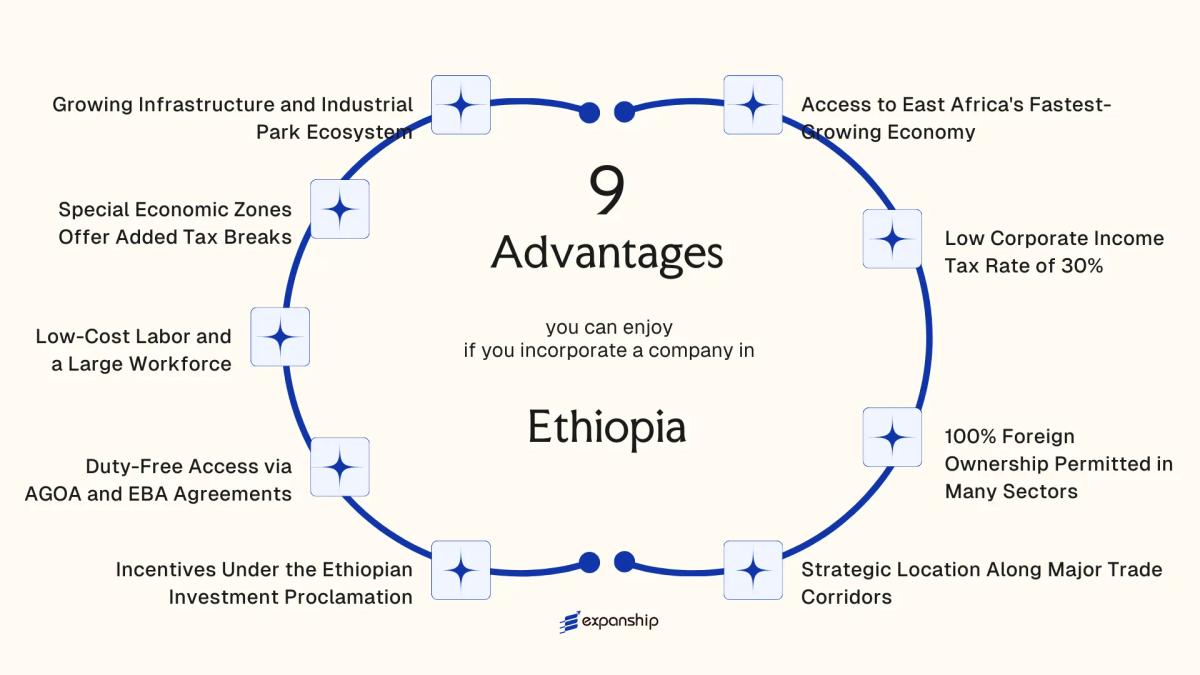
Access to East Africa's Fastest-Growing Economy
Ethiopia registers as one of Africa's fastest-growing economies by GDP, averaging growth rates that consistently outpaced regional peers over the past decade. For a foreign business owner, that trajectory translates into concrete market opportunity across consumer goods, manufacturing, agriculture, and services.
A Large and Underserved Domestic Market
With a population exceeding 120 million, the domestic consumer base is the second-largest on the continent. Purchasing power remains concentrated in urban centers like Addis Ababa, but urbanization is expanding that base year on year, creating early-mover advantages in sectors where formal retail and services are still thin.
Positioning Within a High-Growth Region
East Africa business investment opportunities extend well beyond any single border, and a company registered in Ethiopia sits at the center of a regional bloc. As a member of the Common Market for Eastern and Southern Africa (COMESA), your entity gains preferential trade access to a market of over 600 million people across member states, which reduces the marginal cost of regional expansion once your Ethiopian operations are established.
A company incorporated here can serve both a large domestic market and preferential regional export destinations from a single legal entity.
Low Corporate Income Tax Rate of 30%
Ethiopia's standard corporate income tax rate sits at 30%, applied to the taxable profits of resident companies and permanent establishments of foreign firms operating in the country. This rate is governed under the Income Tax Proclamation No. 979/2016 and its accompanying regulations, which form the primary legislative basis for business taxation.
At 30%, the rate is broadly competitive within the Sub-Saharan African context. For foreign investors accustomed to jurisdictions where headline rates exceed 35%, this figure represents a measurable reduction in recurring tax liability on declared profits.
The practical advantage extends beyond the headline number. Several factors make the overall tax position more favorable than the rate alone suggests:
- Taxable income can be reduced through allowable deductions, including depreciation on fixed assets, which lowers the effective rate below the statutory 30%
- Tax holiday periods available under the Investment Proclamation No. 1180/2020 can defer liability entirely during qualifying periods
- Loss carry-forward provisions allow businesses to offset early-stage losses against future profits, reducing tax exposure in growth phases
- The Ethiopian Investment Commission oversees the incentive framework, providing a defined regulatory channel for accessing relief
Foreign companies structured as branch offices or incorporated local subsidiaries both fall within the scope of this tax regime, so the applicable rate and available deductions depend on how your business is registered in-country.

Company Incorporation in Ethiopia
Set up a compliant legal entity in Ethiopia with support from Expanship's corporate services team.
100% Foreign Ownership Permitted in Many Sectors
Under the Ethiopian Investment Proclamation No. 1180/2020, foreign nationals are permitted to hold 100% equity in a wide range of business sectors without requiring a local partner. This is the central regulatory fact underpinning the 100 percent foreign ownership Ethiopia benefits that international investors frequently cite. Full ownership means your profits, governance decisions, and exit options remain under your direct control, without dilution through mandatory joint-venture arrangements.
The Proclamation reserves certain sectors exclusively for Ethiopian nationals or the government, including retail trade, import-export of certain goods, and specific professional services. Outside these reserved categories, wholly foreign-owned companies operate under the same legal framework as domestic entities, regulated by the Ethiopian Investment Commission (EIC).
| Sector | Foreign Ownership Permitted | Notes |
|---|---|---|
| Manufacturing | 100% | Open to foreign investors |
| Agriculture (large-scale) | 100% | Subject to land lease terms |
| ICT and Technology | 100% | Increasingly open post-2020 reforms |
| Retail Trade | Restricted | Reserved for Ethiopian nationals |
| Import of goods for domestic sale | Restricted | Reserved for Ethiopian nationals |
Sectors such as manufacturing, agriculture, and information technology are fully accessible to foreign-owned firms. For a business structuring regional operations from Ethiopia, retaining full ownership eliminates the legal complexity and cost of negotiating, drafting, and maintaining a joint-venture agreement with a local counterpart. Operational decisions move faster, and profit repatriation is not subject to partner approval requirements under a shareholder agreement you did not author.
Strategic Location Along Major Trade Corridors
Ethiopia's geographic position within the Horn of Africa places your business at a natural crossroads between East Africa, the Middle East, and global shipping lanes. For companies targeting regional distribution, this translates into reduced transit costs and shorter supply chains compared to establishing a base in landlocked southern or central African markets.
Addis Ababa functions as the headquarters city for the African Union and the United Nations Economic Commission for Africa. That institutional concentration creates consistent demand for goods and services and keeps the city integrated into continental policy and procurement networks.
Goods moving through the Djibouti corridor — Ethiopia's primary port access route — connect your operations to the Port of Djibouti, which handles the vast majority of the country's import and export volume. For manufacturers operating inside an industrial park, this corridor forms the primary export pathway to markets across East Africa and beyond.
Keep these factors in mind when assessing location as an operational advantage:
- Port access runs through Djibouti under a bilateral transit agreement
- Addis Ababa Bole International Airport serves as a major cargo hub via Ethiopian Airlines
- Proximity to COMESA member markets expands your addressable trade zone
- Road and rail infrastructure quality varies by corridor; verify route conditions relevant to your supply chain
Ethiopia is the only landlocked country in the world with a flag carrier airline — Ethiopian Airlines — that ranks among the largest cargo operators on the African continent.
Incentives Under the Ethiopian Investment Proclamation
Ethiopia's Investment Proclamation No. 1180/2020 establishes a formal incentive framework administered by the Ethiopian Investment Commission (EIC) and overseen by the Ethiopian Investment Board. For foreign businesses, these incentives reduce the effective cost of entry and operation in ways that statutory tax rates alone do not capture.
Income Tax Exemptions Tied to Sector and Location
The Proclamation grants income tax holidays ranging from two to seven years, depending on the investment sector and geographic location of the business. Firms operating in manufacturing, agro-processing, or export-oriented industries in less-developed regions qualify for longer exemption periods than those in Addis Ababa. This structure means a foreign-owned factory in a regional industrial zone can defer tax liability for years while recouping startup capital.
Carried-forward losses are also protected. If your business sustains a loss during the tax holiday period, that loss can be carried forward for an additional half the duration of the exemption period, reducing taxable income once the holiday expires.
Customs Duty Exemptions and Capital Repatriation Rights
Under the Ethiopia investment incentives proclamation framework, qualifying investors are entitled to import capital goods and construction materials free of customs duty. This directly lowers the upfront cost of establishing manufacturing or processing operations. The exemption applies to machinery, equipment, and inputs used in production rather than general business expenses.
Separately, the Proclamation guarantees the right to remit profits, dividends, and principal loan repayments in foreign currency. For a foreign investor managing cross-border cash flows, this convertibility guarantee reduces exposure to currency controls that would otherwise complicate financial planning.
Maximize Your Investment Incentives in Ethiopia
Understand which EIC-administered exemptions, tax holidays, and duty waivers apply to your specific sector and structure before you incorporate.
Duty-Free Access via AGOA and EBA Agreements
Manufacturers registered in Ethiopia gain duty-free access to two of the world's largest consumer markets through AGOA and EBA, making export-oriented incorporation here a structurally different proposition than in most peer economies.
- Under the African Growth and Opportunity Act, eligible Ethiopian exporters can ship over 6,500 product categories into the United States without tariffs. For manufacturers producing garments, textiles, or processed goods, this eliminates a cost layer that competitors in non-AGOA countries must absorb on every shipment.
- The Everything But Arms initiative, granted by the European Union under its Generalised Scheme of Preferences, extends duty-free and quota-free access to EU markets for virtually all exports except arms and ammunition. Your business can reach over 450 million EU consumers without facing the standard customs duties that apply to most developing-country exporters.
- Both programs are contingent on rules-of-origin requirements and continued eligibility under their respective frameworks. AGOA eligibility is reviewed annually by the U.S. government, so maintaining qualifying status depends on the political and regulatory environment remaining compliant with program criteria.
- For foreign investors establishing export-oriented firms, the combined reach of these two agreements across North America and Europe creates a tariff advantage that directly affects landed costs, pricing competitiveness, and margin structure in those markets.
Low-Cost Labor and a Large Workforce
Ethiopia low-cost labor advantages for businesses are grounded in structural demographics, not temporary conditions. The country has a population exceeding 120 million, with a median age below 20, producing a continuous supply of working-age labor. For manufacturing-oriented investors, this translates directly into lower per-unit production costs compared to regional peers.
Average monthly wages in Ethiopian industrial parks have been reported in the range of $26 to $60 USD, among the lowest in sub-Saharan Africa. For apparel, textile, or light assembly operations, this wage base significantly reduces the cost of goods compared to sourcing from South or Southeast Asia.
Under the Ethiopian Investment Proclamation No. 1180/2020 and its associated regulations, foreign firms operating in designated sectors can recruit workers under standard employment terms governed by the Labour Proclamation No. 1156/2019. Your business retains flexibility in structuring workforce arrangements within these legal parameters.
A garment manufacturer employing 500 workers at an average monthly wage of $50 USD would incur approximately $300,000 annually in direct labor costs. A comparable facility in Bangladesh, where average wages exceed $95 USD per month, would cost over $570,000 for the same headcount, a difference exceeding $270,000 per year.
Special Economic Zones Offer Added Tax Breaks
Ethiopia special economic zones tax benefits extend well beyond the standard corporate tax regime. Companies operating inside designated industrial parks are governed by the Industrial Parks Proclamation No. 886/2015, which grants qualifying investors income tax exemptions of up to 15 years depending on the type of activity and export performance.
Hawassa Industrial Park is the most documented example. Tenants there benefit from a zero-rate income tax period, duty-free importation of capital goods and raw materials, and access to a bonded warehouse regime that eliminates customs delays on inputs.
Key advantages for firms operating inside a designated industrial park include:
- Income tax holidays ranging from 2 to 15 years based on sector and export volume
- Exemption from customs duties on machinery, equipment, and production inputs
- Value-added tax relief on imported inputs used for export-oriented manufacturing
The Ethiopian Investment Commission administers eligibility for these incentives. To qualify, your business must meet minimum investment thresholds and operate within a licensed industrial park boundary — activities outside these zones follow the standard investment incentive framework under Proclamation No. 1180/2020.
Industrial park tax holidays are tied to export performance benchmarks; firms selling primarily to the domestic market may qualify for reduced exemption periods or none at all.
Growing Infrastructure and Industrial Park Ecosystem
Ethiopia's industrial park program gives foreign manufacturers direct access to plug-and-play production environments. The Ethiopian Industrial Parks Development Corporation (IPDC) oversees a network of government-developed parks that provide dedicated power supply, water treatment, waste management, and customs clearance facilities on-site. For a foreign firm entering a new market, this removes the burden of sourcing and financing basic industrial utilities independently.
Purpose-Built Zones for Export-Oriented Production
Parks such as Hawassa Industrial Park and Bole Lemi Industrial Park were developed specifically for export-focused sectors, particularly apparel and textile manufacturing. These facilities connect directly to international logistics chains, which shortens the time between production and shipment. Your business does not need to build supply chain infrastructure from the ground up.
Infrastructure Benefits Tied to Ethiopia Industrial Park Infrastructure Benefits
Tenants operating within IPDC-managed parks benefit from one-stop-shop services that consolidate customs, tax administration, and permits under one roof. This administrative consolidation reduces the time your firm spends on regulatory compliance and coordination across multiple government agencies. The arrangement is structured to support high-volume, time-sensitive manufacturing operations.
Key operational features available within designated industrial parks include:
- Dedicated single-phase and three-phase power connections
- Effluent and solid waste treatment systems managed at the park level
- On-site Ethiopian Customs Commission processing
- Direct road and rail connectivity in select parks
These physical and administrative features reduce setup timelines and lower the capital expenditure required to begin operations at scale.
Why Ethiopia Stands Out Among African Investment Destinations
Compared to other Sub-Saharan African markets, the combination of preferential trade access, a large domestic consumer base, and sector-specific investment incentives makes the country a structurally distinct option for foreign investors evaluating East and Horn of Africa entry points. The jurisdictions most commonly considered alongside it — Kenya, Rwanda, and Djibouti — each offer competitive incorporation environments, but differ meaningfully on tax treatment, market size, and trade corridor access.
Kenya attracts investors with a more developed financial services sector and a 30% corporate tax rate comparable to Ethiopia's, but lacks the same volume of industrial park infrastructure or duty-free export concessions under both AGOA and EBA simultaneously. Rwanda offers a lower corporate tax rate of 30% with reduced rates in priority sectors and a well-regarded ease-of-doing-business record, though its domestic market is substantially smaller. Djibouti functions primarily as a logistics and port hub rather than a manufacturing or services base. For businesses prioritising export-oriented manufacturing with low labour costs and preferential access to both US and EU markets, the structural advantages differ across all four.
| Parameter | Ethiopia | Kenya | Rwanda | Djibouti |
|---|---|---|---|---|
| Corporate Tax Rate | 30% | 30% | 30% (15% in priority sectors) | 25% |
| AGOA Eligibility | Yes | Yes | Yes | Yes |
| EBA (EU Duty-Free) | Yes | No (EPA negotiations) | Yes (EPA) | Yes |
| Industrial Parks / SEZs | Yes (government-developed) | Limited | Limited | Yes (port-focused) |
| Minimum Capital for Foreign Entity | Sector-dependent | No statutory minimum | No statutory minimum | Sector-dependent |
| Population / Domestic Market | 120M+ | ~56M | ~14M | ~1M |
| Foreign Ownership (General) | Up to 100% in permitted sectors | Up to 100% | Up to 100% | Up to 100% |
Compliance Services for Companies in Ethiopia
Stay current with Ethiopian regulatory requirements, including annual filings, tax obligations, and investment permit renewals under the Ethiopian Investment Commission framework.
Conclusion
Ethiopia's combination of export access under AGOA and EBA, duty-free industrial park privileges under the Industrial Parks Proclamation No. 984/2016, and a cost base anchored by one of Africa's lowest average manufacturing wages creates a specific economic logic that is difficult to replicate in the region. These are not incidental features — they are codified structural advantages tied to enforceable legal instruments.
The benefits of incorporating in Ethiopia are most pronounced for firms in export-oriented manufacturing, agribusiness, and logistics. Your entity's ability to access preferential trade arrangements while operating within a Special Economic Zone effectively compounds the savings across production costs, import duties, and corporate tax obligations simultaneously.
That said, the value of these advantages depends on your sector, ownership structure, and intended markets. A firm targeting domestic retail faces a different regulatory calculus than one producing garments for the U.S. market under AGOA. The fit between your business model and Ethiopia's investment framework determines how much of this advantage you can actually access. Engaging with the Ethiopian Investment Commission early in the formation process gives your business the clearest picture of what applies to your specific structure and sector.
Start Your Ethiopian Company Formation With Expanship
Ethiopia company formation with Expanship covers the full registration cycle under the Ethiopian Investment Commission and the Ministry of Trade and Regional Integration, from selecting the appropriate legal vehicle, whether a Private Limited Company or a Branch Office, through to obtaining your business license and tax identification number from the Ethiopian Revenues and Customs Authority. The compliance obligations discussed throughout this blog, including sector-specific foreign ownership thresholds, Investment Proclamation incentives, and Special Economic Zone requirements, each generate distinct documentation and filing demands that vary depending on your chosen structure.
Expanship's service scope for Ethiopia incorporations includes:
- Preparation and notarization of incorporation documents, including Memorandum and Articles of Association
- Registered office address and local registered agent provision
- Filing and liaison with the Ethiopian Investment Commission and the Commercial Registration and Licensing Directorate
- Post-incorporation compliance management, including annual renewal obligations and reporting requirements
- Corporate bank account introduction support with locally licensed financial institutions
Reach out to Expanship Ethiopia to discuss how these services apply to your specific structure and sector.
Frequently Asked Questions (FAQ)
The standard corporate income tax rate is 30%, applied to net taxable profits as established under the Income Tax Proclamation No. 979/2016. This rate applies uniformly to both domestic and foreign-owned companies; there is no separate rate for foreign entities. Certain income tax exemptions and reduced rates may apply depending on your investment sector and whether your business operates within a designated Special Economic Zone or industrial park.
Under Proclamation No. 1180/2020 and its accompanying regulations, qualifying investors may receive income tax exemptions for a defined period, the length of which varies based on the investment sector and geographic location within the country. Businesses established in less-developed regions or in priority export-oriented sectors generally receive longer exemption periods. The Ethiopian Investment Commission administers these incentives, and eligibility must be confirmed at the point of investment registration.
Yes, a foreign-owned company incorporated and operating in Ethiopia can export eligible goods to the United States duty-free under the African Growth and Opportunity Act, provided the products meet the rules of origin and other AGOA eligibility requirements. Ethiopia's AGOA status has been subject to political and diplomatic considerations, so verifying current eligibility status before making sourcing or manufacturing decisions is advisable. The U.S. Trade Representative's office and the Ethiopian Ministry of Trade and Regional Integration are the relevant authorities for confirming active eligibility.
Ethiopian law does not universally require a local national as a director for foreign-invested companies, though specific licensing requirements in certain regulated sectors may impose local representation conditions. The company must maintain a registered address in the country, and a local contact is often required for correspondence with the Ethiopian Investment Commission and the Commercial Registration and Business Licensing Directorate. Practical compliance with tax filing, employment obligations, and regulatory reporting typically benefits from having a locally based representative.
If the government reclassifies a previously open sector as restricted or reserved, existing investments generally retain a degree of protection under the investment protections outlined in the Ethiopian Investment Proclamation, including guarantees against expropriation without compensation. However, new activities within the reclassified area may no longer be permitted, and expansion or amendment of your business license could be refused. Legal counsel familiar with the investment framework and any applicable bilateral investment treaties between Ethiopia and your home country would be relevant in assessing your exposure.
Companies established within a designated Special Economic Zone, such as the Hawassa Industrial Park, are subject to a distinct incentive regime that can include extended income tax exemptions and relief from customs duties on imported inputs. The specific terms vary by zone and by the nature of the business activity, and are governed by agreements with the zone authority in addition to the general investment regulations. Your tax obligations outside the SEZ framework, including obligations to the Ethiopian Revenue and Customs Authority, may differ substantially from those that apply within the zone.
Legal Disclaimer
The information provided in this article is for general informational purposes only and does not constitute legal, tax, or professional advice. While we strive to ensure the accuracy and timeliness of the content, laws and regulations are subject to change, and the application of laws can vary widely based on specific facts and circumstances.
Readers should not act upon this information without seeking professional counsel tailored to their individual situation. Expanship and its authors disclaim any liability for actions taken or not taken based on the content of this article.
For specific advice regarding your business setup, compliance requirements, or any legal matters, please consult with qualified legal and tax professionals in the relevant jurisdiction.