

Key Takeaways
- Entities must register with the Mercantile Registry, administered through the Chambers of Commerce and Production, as the foundational step toward legal recognition under Dominican commercial law.
- Law No. 479-08 on Commercial Companies, as amended by Law No. 31-11, governs the structural and documentary obligations that any newly formed entity must satisfy before operating in the Dominican Republic.
- Beneficial ownership information must be disclosed in compliance with Law 155-17, which operates as a separate compliance layer independent of the core incorporation process under the Commercial Companies framework.
- Director appointments are not subject to residency requirements, but the configuration of directors and shareholders must conform to the entity type selected under Law No. 479-08.
Company formation in the Dominican Republic is governed primarily by Law No. 479-08 on Commercial Companies and Individual Limited Liability Enterprises, as amended by Law No. 31-11. The Mercantile Registry (Registro Mercantil), administered through the Chambers of Commerce and Production, serves as the principal body overseeing entity registration.
This article addresses the formal incorporation requirements Dominican Republic law imposes on businesses seeking legal standing, spanning structural, documentary, and compliance-related obligations.
Failure to satisfy these obligations results in rejection of the registration application or, where an entity operates without proper registration, exposure to legal penalties under Dominican commercial law.
Requirements can differ based on the chosen entity type, the industry sector, and whether the investor is a foreign national or a locally domiciled party. Consulting the Commercial Companies Law directly is advisable before proceeding.
This article is most relevant to foreign investors and international business owners assessing company registration requirements Dominican Republic authorities enforce prior to granting legal recognition to a new entity.
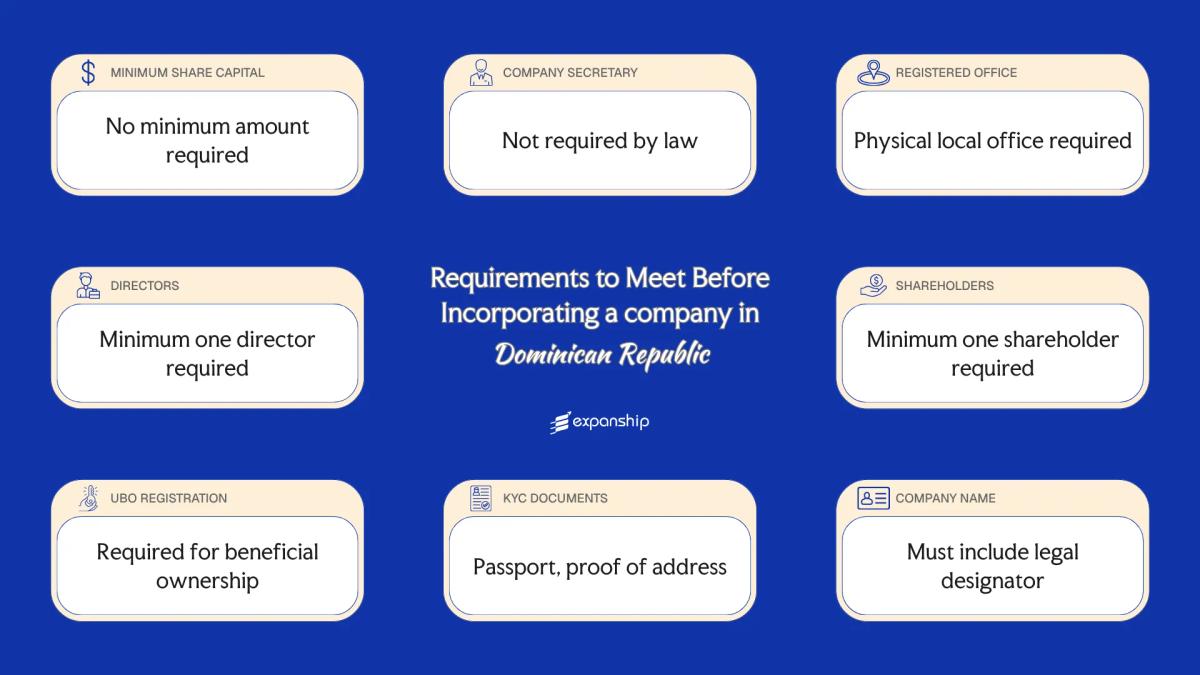
Minimum Share Capital Requirements in the Dominican Republic
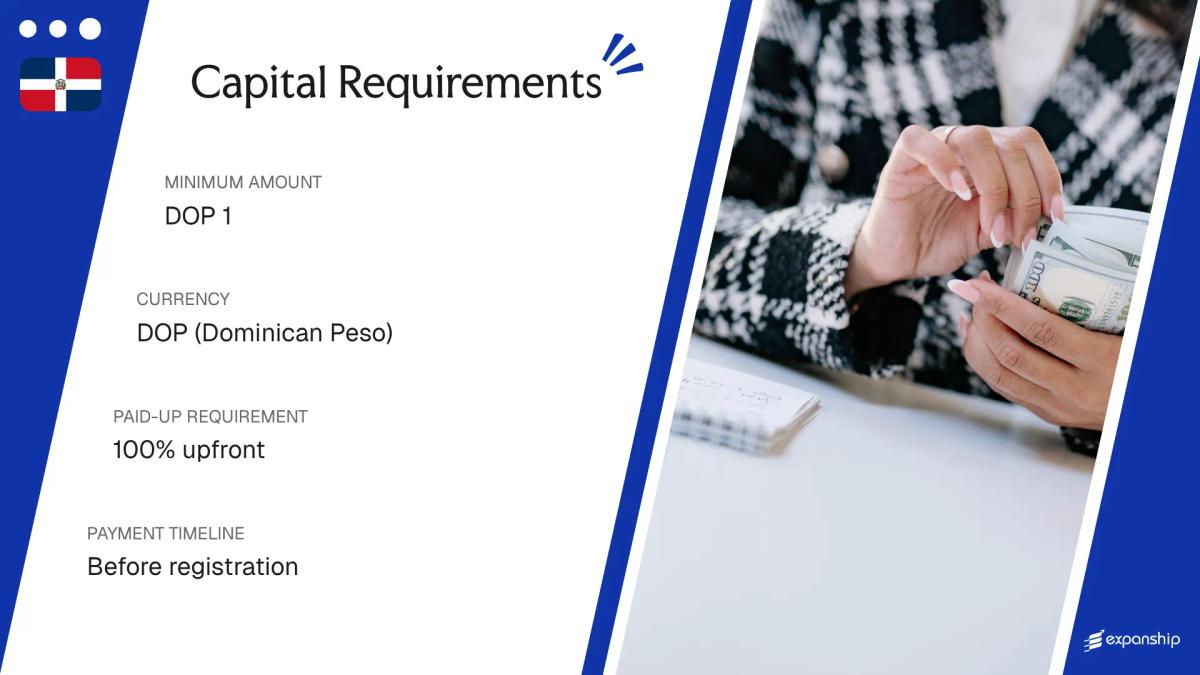
Under Law No. 479-08 on Commercial Companies and Individual Limited Liability Enterprises, the minimum share capital requirements in the Dominican Republic vary by entity type. Both the Sociedad Anónima (SA) and the Sociedad de Responsabilidad Limitada (SRL) operate on a par value share system, where each share carries a nominal value established in the company's statutes.
Capital requirements are verified at the point of incorporation by the Registro Mercantil, which operates under the Cámara de Comercio y Producción. Deposit of paid-up capital into a local bank account is required before registration, and the bank certificate confirming that deposit forms part of the incorporation filing.
| Parameter | Detail |
|---|---|
| Minimum Authorized Share Capital | No universal statutory minimum for SRLs; SAs require a minimum of DOP 30,000,000 |
| Maximum Authorized Share Capital | No statutory maximum |
| Minimum Paid-Up Capital | 50% of subscribed capital must be paid up at incorporation |
| Paid-Up Requirement at Incorporation | Yes; confirmed by bank certificate submitted to the Registro Mercantil |
| Accepted Currency | Dominican Peso (DOP); foreign currency permitted if converted |
| Accepted Forms of Contribution | Cash and in-kind contributions; in-kind contributions require independent valuation |
| Timeframe to Deposit Capital | Prior to filing incorporation documents with the Registro Mercantil |
The bank certificate confirming paid-up capital must be obtained before submitting incorporation documents. Registration will not proceed without it, regardless of whether all other filings are complete.
Company Secretary Requirements in the Dominican Republic
Under Dominican corporate law, the company secretary requirements Dominican Republic businesses must observe differ depending on the entity type. For a Sociedad de Responsabilidad Limitada (SRL), there is no statutory obligation to appoint a separate company secretary.
For Sociedades Anónimas (S.A.), a board secretary is typically required to maintain corporate records, certify board resolutions, and ensure that minutes of shareholder and board meetings are properly documented. This role is governed by the Ley General de las Sociedades Comerciales y Empresas Individuales de Responsabilidad Limitada (Law 479-08, as amended by Law 31-11), which sets out internal governance obligations for S.A. entities.
Qualification criteria for those eligible to serve in this capacity:
- No statutory nationality or residency requirement applies to the secretary of an S.A.
- The role may be held by a natural person or, in some cases, a legal entity depending on the company's bylaws.
- A sitting director of the same entity may serve as secretary, unless the bylaws prohibit dual roles.
- No professional licensing requirement is mandated by Law 479-08 for this position.

Incorporate a Company in the Dominican Republic
Set up your legal entity in the Dominican Republic with guidance on structure, documentation, and regulatory requirements.
Registered Office Requirements in the Dominican Republic
Registered office requirements in the Dominican Republic are governed by the Ley General de las Sociedades Comerciales y Empresas Individuales de Responsabilidad Limitada (Law No. 479-08, as amended by Law No. 31-11), which obliges every commercial entity to maintain a declared legal domicile within the country. Failure to maintain a valid registered address can expose the company to administrative sanctions and may affect its legal standing before the Cámara de Comercio y Producción.
- A physical address within the Dominican Republic is required; correspondence addresses alone do not satisfy the legal domicile requirement.
- Virtual offices are not formally recognised under Law No. 479-08 as a compliant registered address for commercial entities.
- The address must be located within Dominican territory; foreign addresses cannot serve as the legal domicile.
- Supporting documentation, such as a lease agreement or proof of ownership, is generally required to substantiate the declared address.
- The registered address is recorded in the Registro Mercantil and is publicly accessible through the Cámara de Comercio y Producción.
- Any change to the legal domicile must be formally notified and updated in the Registro Mercantil to remain compliant with registration obligations.
Director Requirements in the Dominican Republic
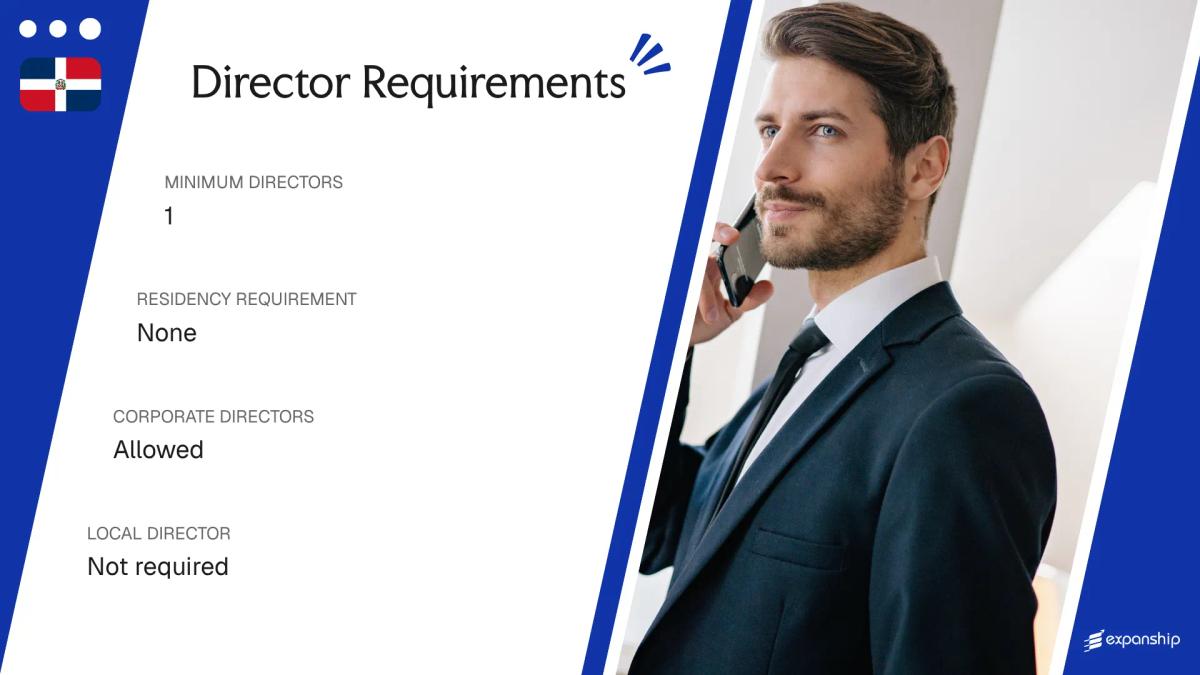
Under Ley 479-08 (the Commercial Companies Law), director requirements in the Dominican Republic place statutory duties on appointed individuals from the moment they take office, including obligations of loyalty, diligence, and accountability to shareholders. Directors bear personal liability for resolutions they approve that contravene the company's bylaws or applicable law.
| Parameter | Detail |
|---|---|
| Minimum Number of Directors | A Sociedad Anónima (SA) requires a minimum of three directors; a Sociedad de Responsabilidad Limitada (SRL) is managed by one or more managers rather than a formal board. |
| Maximum Number of Directors | No statutory maximum is defined under Ley 479-08; the bylaws typically govern the upper limit. |
| Local/Resident Director Required | No statutory requirement for a locally resident director exists under Dominican corporate law. |
| Nationality Restrictions | No nationality restrictions are imposed on directors under Ley 479-08. |
| Minimum Age Requirement | Directors must be of legal age, which is 18 years under Dominican civil law. |
| Corporate Directors Permitted | Ley 479-08 does not explicitly authorize corporate entities to serve as directors; natural persons are the standard requirement in practice. |
| Director Must Be a Shareholder | No statutory requirement exists for directors to hold shares in the company. |
| Publicly Listed on Registry | Directors of an SA are recorded in the Registro Mercantil held by the Cámara de Comercio y Producción, making appointments a matter of public record. |
| Disqualification Conditions | Individuals declared bankrupt, convicted of fraud, or subject to a judicial prohibition may be disqualified from serving as directors under Dominican law. |
Unlike many civil law jurisdictions, the Dominican Republic does not require any director to be a resident or national, meaning a company's entire board can consist of foreign nationals residing abroad while remaining fully compliant under Ley 479-08.
Shareholder Requirements in the Dominican Republic
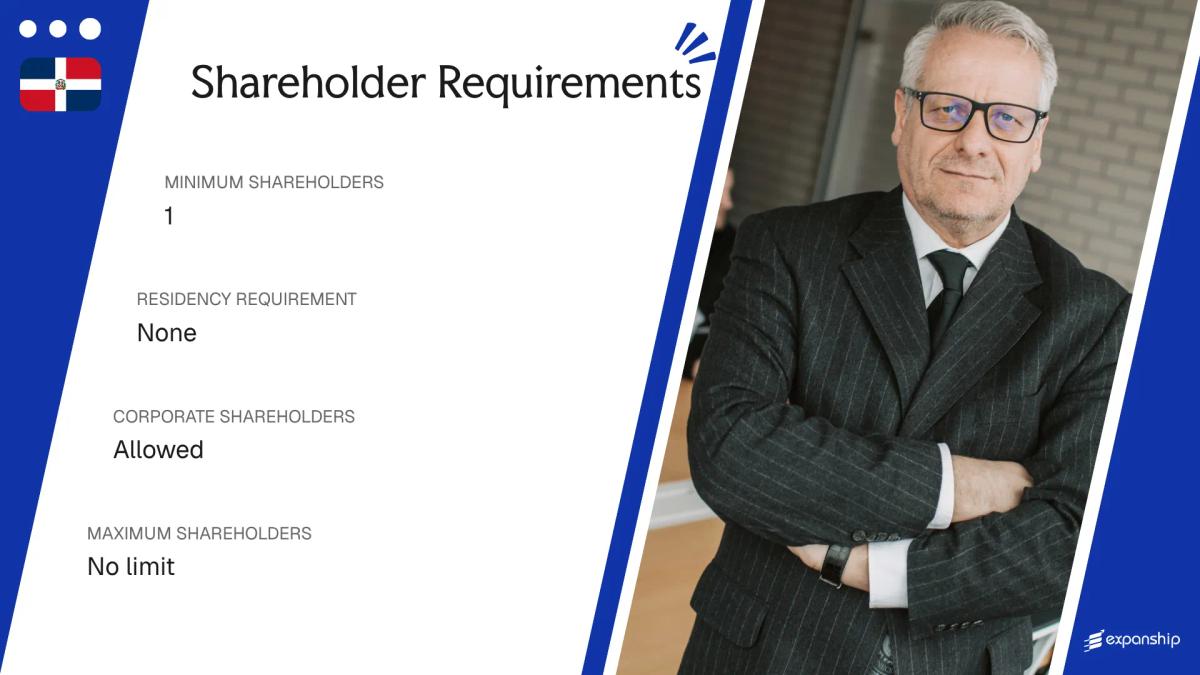
Under Dominican corporate law, a Sociedad de Responsabilidad Limitada (SRL) requires a minimum of two shareholders and permits a maximum of fifty. A sole shareholder structure is not available under this entity type.
Nationality and Residency Restrictions
Shareholders in a Dominican Republic SRL face no nationality or residency requirements. Foreign nationals and non-residents may hold shares without restriction, and there is no statutory cap on foreign ownership percentage.
Corporate Shareholders
Legal entities may act as shareholders in an SRL. No special conditions are imposed solely on the basis of a shareholder being a corporate body rather than a natural person.
Shareholder Liability
Liability is limited to each shareholder's capital contribution. Under the General Commercial Companies Law, personal assets remain protected unless a court pierces the corporate veil due to fraud or abuse of the legal structure.
Register of Shareholders
Your firm must maintain an internal register of shareholders. This register is not publicly accessible, though updates reflecting changes in ownership should be documented to satisfy the Mercantile Registry's requirements.
Shareholder Structuring Support for Your Dominican Company
Get guidance on meeting shareholder requirements when setting up a legal entity in the Dominican Republic.
UBO / Beneficial Ownership Disclosure Requirements in the Dominican Republic
Under Law No. 155-17 on Money Laundering and Terrorist Financing, beneficial ownership disclosure is a statutory requirement in the Dominican Republic, with a beneficial owner defined as any natural person who directly or indirectly holds 20% or more of the capital or voting rights of a legal entity.
- Identify all natural persons meeting the 20% ownership threshold or who exercise effective control over the entity.
- Compile the required beneficial owner information, including full legal name, nationality, identification document details, and nature of the ownership or control interest.
- Submit this information to the Financial Analysis Unit (Unidad de Análisis Financiero, UAF) in accordance with the reporting obligations established under Law No. 155-17.
- Maintain internal records reflecting any changes to beneficial ownership and update disclosures accordingly.
| Parameter | Detail |
|---|---|
| Ownership Threshold for UBO Status | 20% of capital or voting rights |
| Filing Authority | Unidad de Análisis Financiero (UAF) |
| Disclosure Deadline at Incorporation | No statutory deadline explicitly prescribed; required upon registration and commencement of operations |
| Publicly Accessible Register | No public register; information held by the UAF |
| Penalties for Non-Disclosure | Administrative and criminal sanctions under Law No. 155-17, including fines and potential suspension |
| Ongoing Update Obligation | Yes; entities must update records upon any change in beneficial ownership |
KYC / Document Requirements in the Dominican Republic
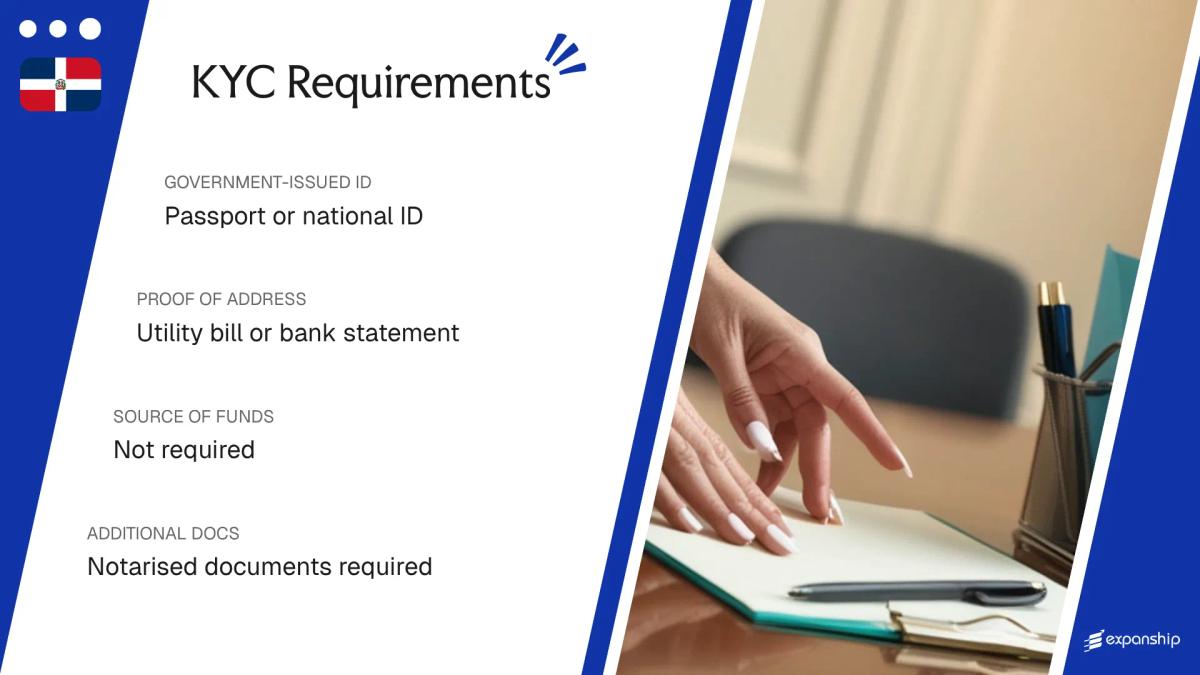
KYC requirements for Dominican Republic company formation are governed by Law No. 155-17 on Money Laundering and Financing of Terrorism, administered by the UAF. All incorporations processed through the Registro Mercantil trigger due diligence obligations for the notary and service provider handling the process.
Individual / Personal Documents
- Valid government-issued passport or national identity document for each individual director, shareholder, or beneficial owner
- Proof of residential address dated within three months, such as a utility bill or bank statement
- Completed KYC declaration form confirming personal details and role in the entity
- Recent professional or bank reference letter may be requested by the handling notary
Corporate Documents
- Certificate of incorporation or equivalent constitutional document from the parent entity's home jurisdiction
- Articles of association or bylaws of the corporate shareholder or director
- Register of directors and register of shareholders from the corporate entity
- Proof of the corporate entity's registered office address
Source of Funds Documentation
- Bank statements covering a minimum of three to six months showing the origin of capital
- Audited financial statements or accountant's letter where bank statements are insufficient
- Signed declaration explaining the commercial or investment basis for capital introduction
Notarisation and Apostille Requirements
- Foreign documents must generally be apostilled under the Hague Convention if issued in a signatory country
- Documents not in Spanish require a certified translation by a sworn translator recognised in the Dominican Republic
- Notarisation by a local notary may be required for documents executed abroad before submission to the Registro Mercantil
Unsigned or untranslated foreign-language documents are the most frequent cause of registration delays at the Registro Mercantil.
Company Name Requirements in the Dominican Republic
Company name requirements in the Dominican Republic are assessed by the Mercantile Registry (Registro Mercantil) at the point of incorporation. Names must be distinguishable from those already registered and cannot duplicate or closely resemble an existing entity.
Structurally, the company name must reflect the chosen legal form through an appropriate suffix, such as "S.R.L." for a Sociedad de Responsabilidad Limitada or "S.A." for a Sociedad Anónima. Names are generally required to be in Spanish.
Certain words are restricted or prohibited outright. Terms implying government affiliation, regulated financial activity, or official authority require prior approval from the relevant supervisory body before the Mercantile Registry will accept the name.
Name reservation is available through the Mercantile Registry prior to formal incorporation. The reservation secures the proposed name for a defined period, during which no other entity may register under the same designation.
Compliance Services for Companies in the Dominican Republic
Maintain your company's good standing with ongoing compliance support tailored to Dominican Republic regulatory requirements.
Conclusion
The incorporation requirements Dominican Republic imposes are defined primarily under Law 479-08 on Commercial Companies, along with subsequent amendments and regulations administered by the Mercantile Registry. Registered capital thresholds, director configurations, and beneficial ownership disclosure under Law 155-17 each carry distinct procedural weight within this framework.
Residency-neutral director rules offer structural flexibility, while UBO reporting obligations introduce a parallel compliance layer that operates independently of the incorporation process itself.
Once these requirements are understood, the practical next step involves assembling the correct documentation, engaging a local agent, and coordinating with the relevant Dominican authorities to move from registration to operational status.
Expanship's Corporate Services for the Dominican Republic
Expanship's Dominican Republic corporate services are built around the specific requirements set by the General Companies Law and the oversight functions of the Registro Mercantil. From structuring your SRL or SA correctly to meeting the country's UBO disclosure obligations, Expanship reduces the administrative burden that comes with incorporating in a civil-law jurisdiction where notarised documentation and Spanish-language filings are standard.
Our service scope covers the full incorporation and maintenance cycle:
- We prepare your company registration documents and coordinate notarisation in line with Dominican procedural requirements.
- A registered agent and local office address are provided to satisfy Dominican domicile requirements.
- We manage all filings with the Registro Mercantil and liaise with relevant government bodies on your behalf.
- Post-incorporation compliance, including annual obligations, is maintained on an ongoing basis.
- Banking introduction assistance is available to support your account opening process.
- We handle tax registration and coordinate with the DGII and other local authorities as required.
To discuss your requirements, contact Expanship Dominican Republic.
Frequently Asked Questions (FAQ)
The requirements diverge significantly between the two entity types. A Sociedad Anónima requires a minimum share capital of DOP 30,000,000, while an SRL carries no statutory minimum capital requirement under Law 479-08. The choice of entity type can therefore have a direct financial impact on your formation costs.
Maintaining a valid registered office in the Dominican Republic is an ongoing legal obligation, not a one-time formation requirement. If the address lapses or becomes unregisterable, your entity may lose its standing for official correspondence with the Registro Mercantil and other regulatory bodies, which can affect compliance filings and legal notifications.
Law 155-17 on Money Laundering and Terrorism Financing requires disclosure of any natural person who ultimately owns or controls 20% or more of a company. The obligation applies regardless of whether ownership is direct or exercised through intermediate entities, and the information must be maintained and available to Dominican authorities upon request.
Foreign-issued identity and corporate documents generally require apostille certification or consular legalization before they are accepted by Dominican authorities and service providers. The specific requirement depends on whether the issuing country is a signatory to the Hague Apostille Convention, which determines whether a full legalization chain is needed.
The Registro Mercantil rejects names that are identical or confusingly similar to existing registered entities, but restrictions extend further than duplication. Names implying government affiliation, regulated professional activities, or financial institutions without the corresponding authorizations are also refused, and the entity type suffix must accurately reflect the legal structure being registered.
Legal Disclaimer
The information provided in this article is for general informational purposes only and does not constitute legal, tax, or professional advice. While we strive to ensure the accuracy and timeliness of the content, laws and regulations are subject to change, and the application of laws can vary widely based on specific facts and circumstances.
Readers should not act upon this information without seeking professional counsel tailored to their individual situation. Expanship and its authors disclaim any liability for actions taken or not taken based on the content of this article.
For specific advice regarding your business setup, compliance requirements, or any legal matters, please consult with qualified legal and tax professionals in the relevant jurisdiction.