
Key Takeaways
- Under Act No. 90/2012 Coll. (the Business Corporations Act), a společnost s ručením omezeným can be formed with a minimum share capital of CZK 1, though each shareholder must fulfill their contribution obligation before registration is completed.
- All Czech entities are required to register beneficial owners in the Evidence of Beneficial Owners, a statutory obligation that applies regardless of the company's size or the residency status of its shareholders.
- Registration of a new company must be submitted to the Obchodní rejstřík (Commercial Register), administered by the regional courts, and incomplete or non-compliant applications are subject to rejection under Czech procedural rules.
- Foreign nationals serving as directors or shareholders must satisfy specific KYC and documentary requirements as part of the Commercial Register application, including certified identity documents and, where applicable, apostilled supporting records.
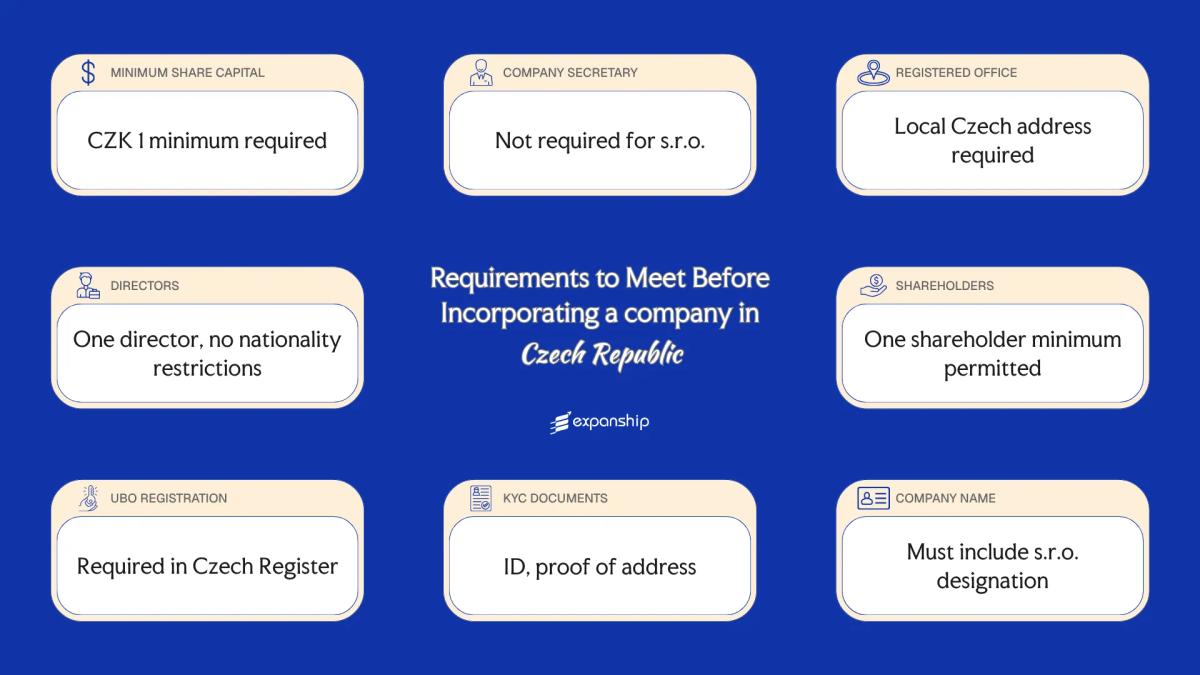
Entity formation in Czechia is governed by the Zákon o obchodních korporacích (Act No. 90/2012 Coll., the Business Corporations Act), with registrations processed through the Obchodní rejstřík (Commercial Register) administered by the regional courts. Meeting the incorporation requirements in Czechia is a statutory obligation, not a discretionary process.
This article addresses the structural, documentary, and compliance requirements applicable to company formation, as codified under Czech law.
Failure to satisfy these requirements results in rejection of the registration application by the competent court, and operating without valid registration exposes the entity to legal liability under Czech law.
Requirements differ depending on the legal form selected, the nature of the business activity, and the applicant's residency status. Certain regulated industries carry additional conditions set by sector-specific authorities.
Foreign investors and non-resident business owners considering a Czech entity will find this article most directly applicable to their situation.
Minimum Share Capital Requirements in Czechia
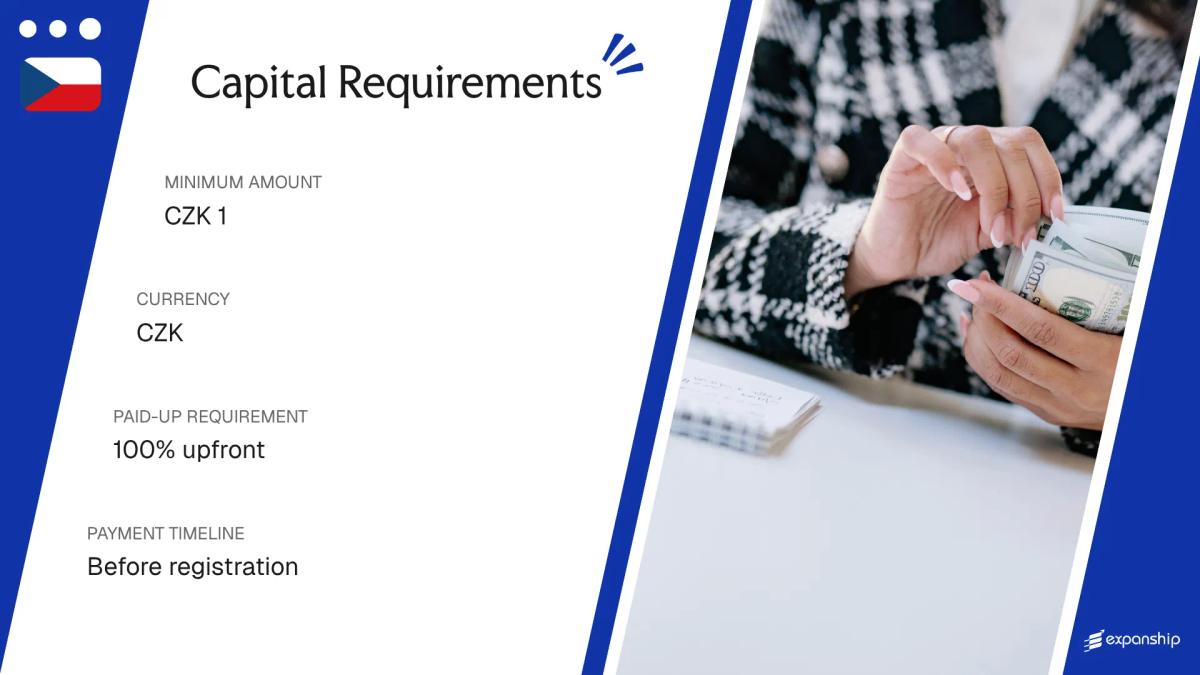
Minimum share capital requirements in Czechia differ by legal form and are governed by the Zákon o obchodních korporacích (Act No. 90/2012 Coll., the Business Corporations Act). For a společnost s ručením omezeným (s.r.o.), the statutory minimum is CZK 1 per business share, making the aggregate základní kapitál requirement effectively symbolic in most cases.
Capital contributions are verified by the Trade Licensing Office and the Commercial Register (Obchodní rejstřík) during the incorporation process. Once registered, share capital functions as a one-time structural requirement rather than an ongoing obligation, though any subsequent changes must be formally registered.
| Parameter | Detail |
|---|---|
| Minimum Authorized Share Capital | CZK 1 for s.r.o. (per business share); CZK 2,000,000 for a.s. (joint-stock company) |
| Maximum Authorized Share Capital | No statutory maximum |
| Minimum Paid-Up Capital | CZK 1 for s.r.o.; CZK 2,000,000 for a.s. |
| Paid-Up Requirement at Incorporation | At least 30% of each cash contribution must be paid before registration; non-monetary contributions must be fully paid before registration |
| Accepted Currency | Czech Koruna (CZK) |
| Accepted Forms of Contribution | Cash deposits and non-monetary contributions (movable assets, real property, receivables) |
| Timeframe to Deposit Capital | Prior to filing for registration with the Obchodní rejstřík |
A CZK 1 minimum does not eliminate the need for a formally documented capital structure. Each s.r.o. must still define the value of business shares in its articles of association, and those figures are recorded in the Commercial Register.
Company Secretary Requirements in Czechia
Czech company law does not impose a company secretary requirement as a distinct mandatory corporate office. Under the Act on Business Corporations (zákon o obchodních korporacích), a společnost s ručením omezeným (s.r.o.) operates through its statutory manager or managers, who collectively handle the compliance and administrative functions typically assigned to a secretary in common-law systems.
That said, Czech corporate secretary obligations in practice fall on the statutory body. The managing director is responsible for maintaining corporate records, ensuring filings with the Commercial Register (Obchodní rejstřík) are current, and keeping minutes of general meetings.
Qualification criteria for serving in this administrative capacity:
- Natural persons must be at least 18 years of age and have full legal capacity.
- No prior convictions for economic crimes that would bar the individual under Czech law.
- Both Czech residents and foreign nationals may serve without a residency condition.
- Legal entities may not serve as managing directors under Czech corporate law.
- No state-issued licence or professional certification is required for the role.

Incorporate Your Company in Czechia
Set up your Czech s.r.o. or other legal entity with full support on statutory requirements, Commercial Register filings, and ongoing compliance obligations.
Registered Office Requirements in Czechia
Registered office requirements in Czechia are governed by the Zákon o obchodních korporacích (Act No. 90/2012 Coll.) and the Civil Code (Act No. 89/2012 Coll.), which together define the sídlo společnosti as the legal seat that must be recorded in the veřejný rejstřík (public commercial register). Failure to maintain a valid, registered address can result in the court initiating dissolution proceedings against the entity under Section 105 of the Civil Code.
- A physical address in the Czech Republic is required; a P.O. box does not qualify as a legal seat.
- Virtual office addresses are permitted, provided the operator has consented in writing to the company's use of the address.
- The address must be located within Czech territory; foreign addresses are not accepted.
- Proof of a right to use the premises, such as a lease agreement or property ownership document, must be submitted to the commercial register.
- The registered address is publicly visible in the obchodní rejstřík and accessible to any third party.
- Any change to the legal seat must be formally registered with the příslušný rejstříkový soud (competent registry court) to take legal effect.
Director Requirements in Czechia
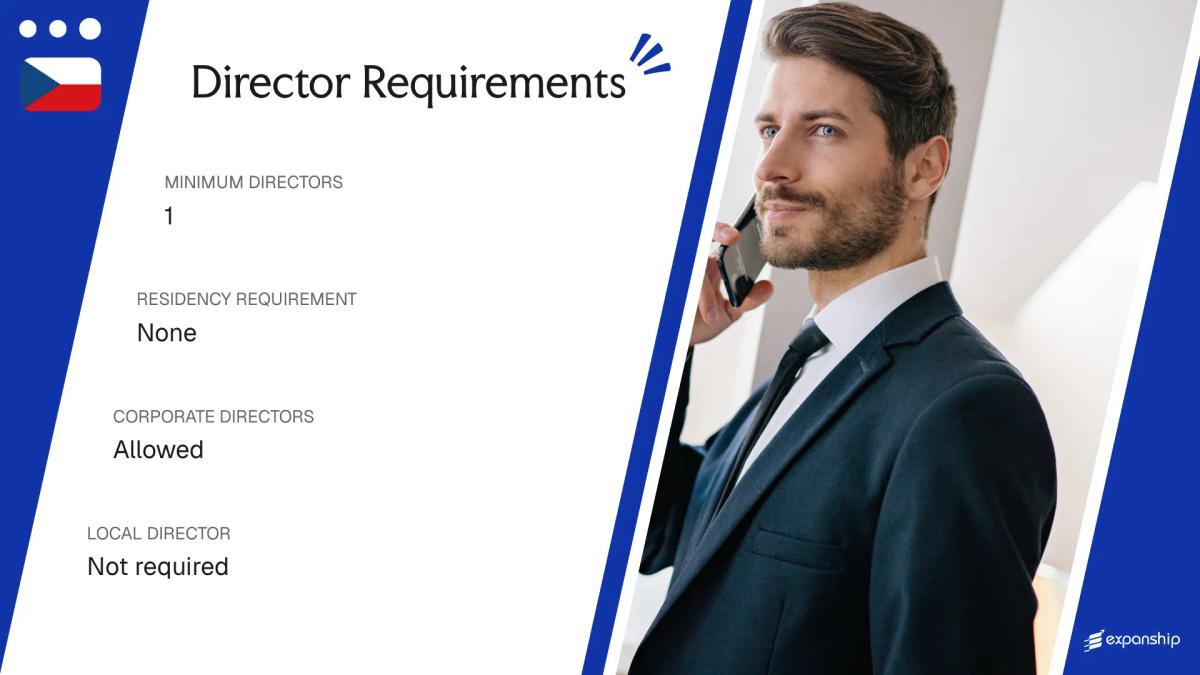
Under the Zákon o obchodních korporacích (Act No. 90/2012 Coll., the Business Corporations Act), director requirements in Czech Republic centre on the jednatel, the statutory managing director of a společnost s ručením omezeným (s.r.o.). Upon appointment, a jednatel assumes personal liability for damages caused by breach of the duty of care (péče řádného hospodáře), which requires acting with the diligence and knowledge of a reasonably competent person in a comparable position.
| Parameter | Detail |
|---|---|
| Minimum Number of Directors | One jednatel is required. |
| Maximum Number of Directors | No statutory maximum; the articles of association may define the number. |
| Local/Resident Director Required | No residency or local presence requirement exists under Czech law. |
| Nationality Restrictions | No nationality restrictions apply; foreign nationals may serve without limitation. |
| Minimum Age Requirement | The jednatel must be at least 18 years of age. |
| Corporate Directors Permitted | Legal entities may serve as directors, though a natural person must be designated to act on their behalf. |
| Director Must Be a Shareholder | No statutory requirement for the director to hold a share in the company. |
| Publicly Listed on Registry | The jednatel's name and details are recorded in the Obchodní rejstřík (Commercial Register), which is publicly accessible. |
| Disqualification Conditions | A person with a prior criminal conviction for a related economic offence, or who has been disqualified by a court, may not serve as jednatel. |
A Czech jednatel can be held personally liable for company debts if they fail to file for insolvency in time — even when the financial distress was not caused by their own conduct.
Shareholder Requirements in Czechia
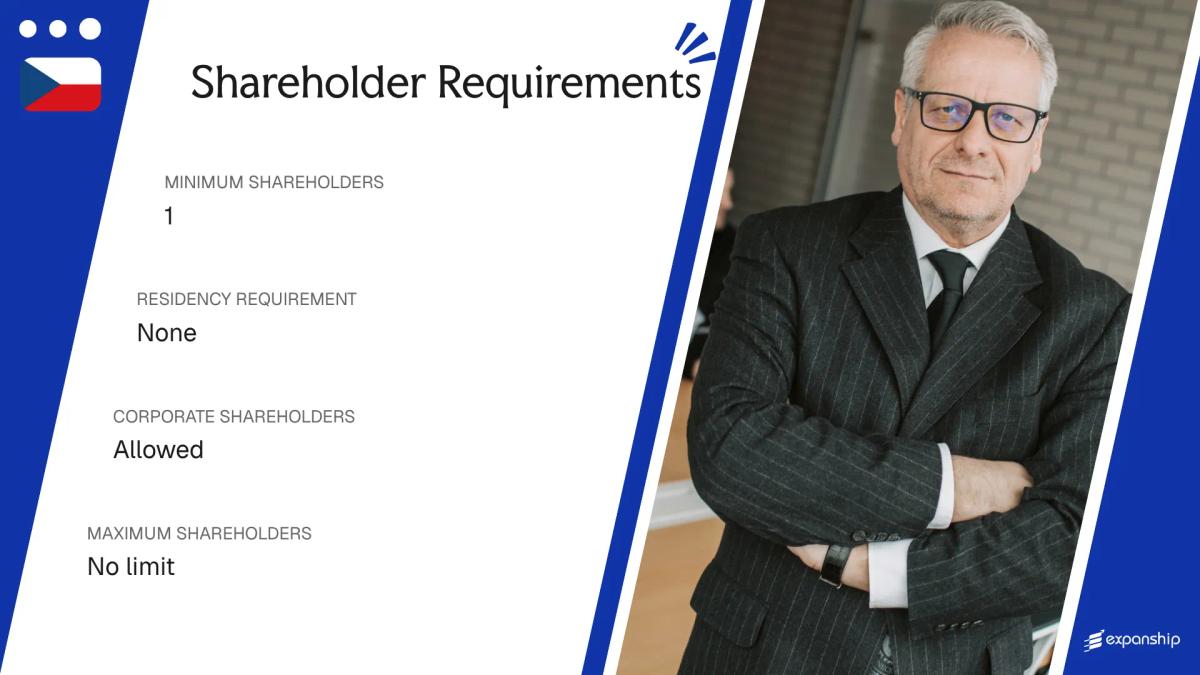
A Czech s.r.o. (společnost s ručením omezeným) can be formed by a single natural person, making a sole shareholder structure fully permissible. No statutory maximum applies to the number of shareholders.
Nationality and Residency Restrictions
Meeting the shareholder requirements Czech Republic law sets is straightforward for foreign nationals, as no residency or citizenship conditions restrict ownership. Foreign individuals and entities may hold 100% of the share capital without limitation.
Corporate Shareholders
Corporate entities are permitted to act as shareholders in a Czech s.r.o. under the Zákon o obchodních korporacích (Act No. 90/2012 Coll.). A single corporate shareholder may hold the entire business, subject to standard UBO disclosure obligations.
Shareholder Liability
Shareholder liability is limited to any outstanding portion of their agreed capital contribution. Once contributions are fully paid, personal assets remain outside the reach of company creditors.
Register of Shareholders
Each s.r.o. must maintain an internal list of společníci (shareholders). This record is not publicly accessible, though ownership data is disclosed through the Veřejný rejstřík (Public Register) via the rejstříkový soud (Registry Court).
Shareholder Structure Setup for Your Czech Entity
Get guidance on structuring ownership for your Czech s.r.o. in line with local corporate law requirements.
UBO / Beneficial Ownership Registration Requirements in Czechia
Beneficial ownership registration in Czechia is governed by Act No. 37/2021 Coll. on the Register of Beneficial Owners, which defines a beneficial owner as any natural person holding more than 25% of voting rights or economic benefits in an entity, either directly or through a chain of control.
- Identify all natural persons who meet the 25% ownership or control threshold under Act No. 37/2021 Coll.
- Prepare the required identification data for each beneficial owner, including name, date of birth, country of residence, and the nature of their interest.
- Submit the registration to the Register of Beneficial Owners (Evidence skutečných majitelů), administered by the relevant regional court.
- Complete registration within 15 days of incorporation or of any change in beneficial ownership.
| Parameter | Detail |
|---|---|
| Ownership Threshold for UBO Status | More than 25% of voting rights or economic benefit |
| Filing Authority | Regional court administering the Register of Beneficial Owners (Evidence skutečných majitelů) |
| Disclosure Deadline at Incorporation | Within 15 days of incorporation |
| Publicly Accessible Register | Partially; limited data is publicly accessible, full data accessible to authorities |
| Penalties for Non-Disclosure | Entity may be restricted from distributing profits; fines may apply under Act No. 37/2021 Coll. |
| Ongoing Update Obligation | Yes; changes must be filed within 15 days of occurrence |
KYC / Document Requirements in Czechia
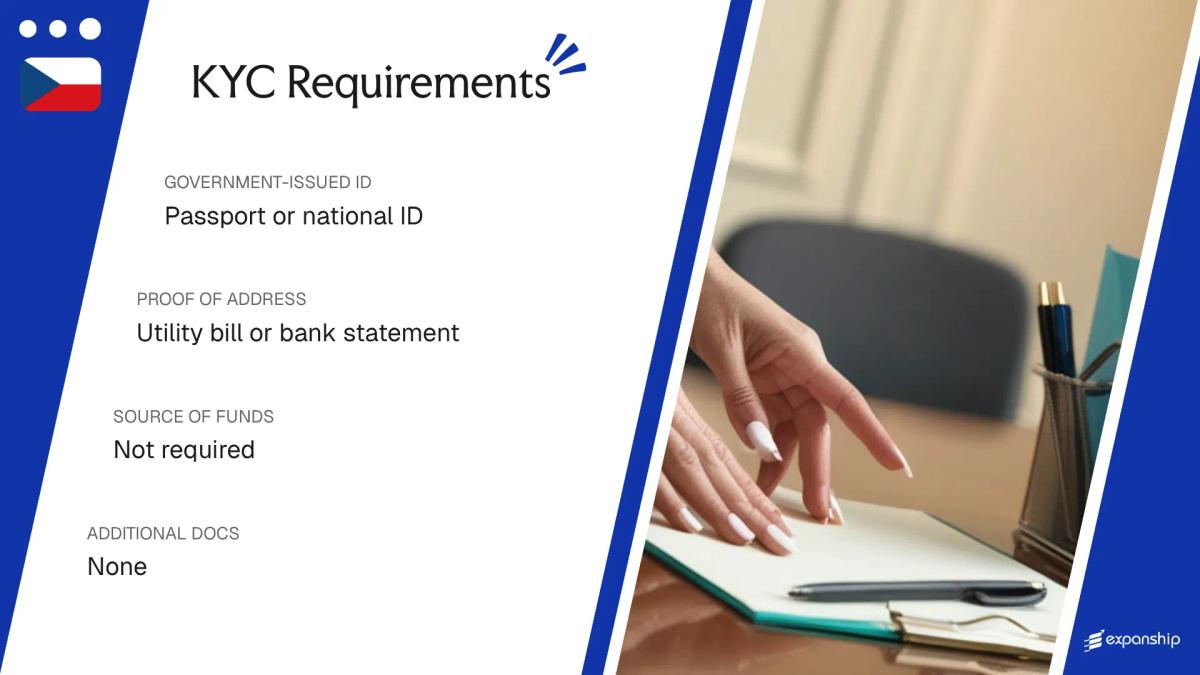
KYC document requirements in Czechia are governed primarily by Act No. 253/2008 Coll. on Certain Measures against Money Laundering and Terrorist Financing, administered by the Financial Analytical Office (FAÚ). Obliged entities involved in incorporation, including notaries and legal service providers, must conduct customer due diligence before establishing a business relationship.
Individual / Personal Documents
- Valid government-issued photo ID (passport or national identity card) for each director, shareholder, and beneficial owner
- Proof of residential address dated within 90 days, such as a utility bill or bank statement
- Personal identification number (rodné číslo) where the individual holds Czech nationality or residency
- Signed declaration confirming the individual's role and capacity within the entity
Corporate Documents
- Certificate of incorporation or equivalent constitutional document from the corporate shareholder's home jurisdiction
- Extract from the relevant commercial register, dated within three months
- Register of directors confirming current officeholders
- Proof of the corporate entity's registered address
Source of Funds Documentation
- Recent bank statements covering a minimum of three months prior to incorporation
- Audited financial statements where the corporate subscriber operates an active business
- Written declaration explaining the origin of capital contributed to the share capital
Notarisation and Apostille Requirements
- Foreign-issued documents generally require apostille under the 1961 Hague Convention if originating from a signatory state
- Documents in languages other than Czech must be accompanied by a certified Czech translation
- Notarised copies may be accepted in place of originals at the discretion of the receiving notary
The most common cause of incorporation delay is submitting foreign corporate documents without a certified Czech translation or a valid apostille.
Company Name Requirements in Czechia
Your firm's proposed company name requirements Czechia must satisfy before registration is assessed on the basis of distinctiveness and accuracy. The name must not be deceptive or misleading about the nature or scope of the business, and it must differ sufficiently from existing registered names to avoid confusion in the market.
Structurally, the firm's name must be in Czech or use Latin script characters. For a společnost s ručením omezeným, the legal suffix "s.r.o." or its full form must appear in the registered name. No statutory minimum word count applies, but the name must be usable as a unique identifier.
Certain words are restricted by law. Terms implying a state connection, such as "česká" or "národní," require official authorisation before use. Words associated with regulated industries, financial institutions, or professional bodies are similarly subject to prior approval from the relevant supervisory authority.
Name reservation is available through the Czech public register system prior to formal incorporation. A reserved name is held for a defined period, giving your business time to complete the registration process without risk of the name being claimed by another party in the interim.
Compliance Services for Companies in Czechia
Ongoing compliance support for Czech entities, including statutory filings, registered office maintenance, and regulatory monitoring.
Conclusion
Incorporation requirements in Czechia are governed by the Business Corporations Act (Act No. 90/2012 Coll.) and administered through the Commercial Register. Among the requirements covered, the CZK 1 share capital minimum for a společnost s ručením omezeným and the mandatory UBO registration with the Evidence of Beneficial Owners stand out as particularly consequential for foreign investors. Once these obligations are understood, your business is positioned to move from planning into the formal registration process with the Commercial Register.
Expanship's Corporate Services for Your Czechia Expansion
Expanship's corporate services for your Czechia expansion cover the specific obligations you've encountered throughout this guide, from satisfying the Commercial Register requirements to maintaining ongoing compliance with Czech regulatory bodies. Setting up a Czech entity involves coordinated steps across notarial processes, the Trade Licensing Office, and the Financial Administration, and our role is to manage that coordination on your behalf. Your operational burden is reduced, though the statutory obligations themselves remain yours to meet.
Expanship supports your Czech Republic company formation across the full incorporation lifecycle:
- We prepare and file all registration documents required for submission to the Commercial Register.
- A registered office address and agent services are provided to satisfy Czech domiciliation requirements.
- We liaise directly with government authorities and regulatory bodies on your behalf.
- Post-incorporation compliance management keeps your entity in good standing with Czech authorities.
- Banking introduction assistance is available to support your account opening process.
- We handle tax registration and coordinate with the Czech Financial Administration and local authorities.
Reach out to Expanship Czechia to discuss your incorporation requirements.
Frequently Asked Questions (FAQ)
The law permits a minimum contribution of CZK 1 per shareholder, but the amount you register as share capital has direct implications for creditor confidence and certain licensing requirements. Regulatory bodies or commercial partners may require evidence of adequate capitalisation before entering contracts, and some regulated activities carry their own minimum capital thresholds that override the statutory minimum.
Under Act No. 37/2021 Coll. on the Register of Beneficial Owners, your company is legally obligated to keep UBO records current and update the Evidence of Beneficial Owners whenever a change in ownership or control occurs. Failure to maintain accurate records can result in sanctions including the suspension of profit distributions to the unregistered beneficial owner, and the entity itself may face fines imposed by the relevant court.
A foreign national can serve as director of a Czech s.r.o. without residency restrictions, but the KYC documentation requirements expand accordingly. You will typically need to provide a notarised and apostilled copy of your passport, proof of foreign address, and a criminal record extract from your country of citizenship or long-term residence, all translated into Czech by a sworn translator.
A virtual or administrative address is legally acceptable as a registered office for a Czech s.r.o., provided the company holds documented consent from the property owner. The address must be valid and capable of receiving official correspondence from the Commercial Register and other public authorities, and it must be entered into the Commercial Register at the time of incorporation.
A company name registered in the Czech Commercial Register does not need to include Czech words, but it must comply with the distinctiveness and non-deception requirements under the Civil Code (Act No. 89/2012 Coll.) and the Business Corporations Act. The legal form designation, such as "s.r.o." or its full equivalent, must always appear as part of the registered name regardless of the language used for the rest of the title.
Courts overseeing the Evidence of Beneficial Owners can impose a fine of up to CZK 500,000 on a company that fails to register its beneficial ownership data within the prescribed period. Beyond the financial penalty, an unregistered beneficial owner loses the right to exercise voting rights and receive profit distributions until the registration is completed and compliant with Act No. 37/2021 Coll.
Yes, the UBO registration requirement looks through corporate layers to identify the natural persons who ultimately own or control your Czech entity, regardless of how many intermediary structures exist. Under Act No. 37/2021 Coll., if no individual holds a qualifying ownership threshold, the senior managing officials of the Czech entity must be registered as beneficial owners by default, and the entire chain of ownership must be documented.
Legal Disclaimer
The information provided in this article is for general informational purposes only and does not constitute legal, tax, or professional advice. While we strive to ensure the accuracy and timeliness of the content, laws and regulations are subject to change, and the application of laws can vary widely based on specific facts and circumstances.
Readers should not act upon this information without seeking professional counsel tailored to their individual situation. Expanship and its authors disclaim any liability for actions taken or not taken based on the content of this article.
For specific advice regarding your business setup, compliance requirements, or any legal matters, please consult with qualified legal and tax professionals in the relevant jurisdiction.