
Key Takeaways
- Foreign founders operating an s.r.o. must navigate registration requirements under the Zákon o obchodních korporacích (Act No. 90/2012 Sb.), adding a layer of Czech-specific legal compliance that goes beyond standard EU incorporation norms.
- All official corporate documents, filings, and trade license applications must be submitted in Czech, creating a procedural burden for non-Czech-speaking foreign operators without local legal representation.
- Employers registered in Czechia face substantial social security contribution obligations that increase the effective cost of hiring beyond the nominal gross salary, a recurring overhead that disproportionately affects smaller foreign-owned entities.
- Before commencing most business activities, companies must obtain the relevant trade authorization through the Živnostenský úřad, a mandatory licensing step that adds time and administrative complexity to the pre-operational phase.
Czechia operates under a structured, EU-aligned regulatory framework governed primarily by the Zákon o obchodních korporacích (Czech law), which sets defined compliance obligations for all registered entities. The regulatory environment is neither lightly supervised nor exceptionally burdensome by European standards, but it carries specific procedural and statutory requirements that create friction for foreign operators.
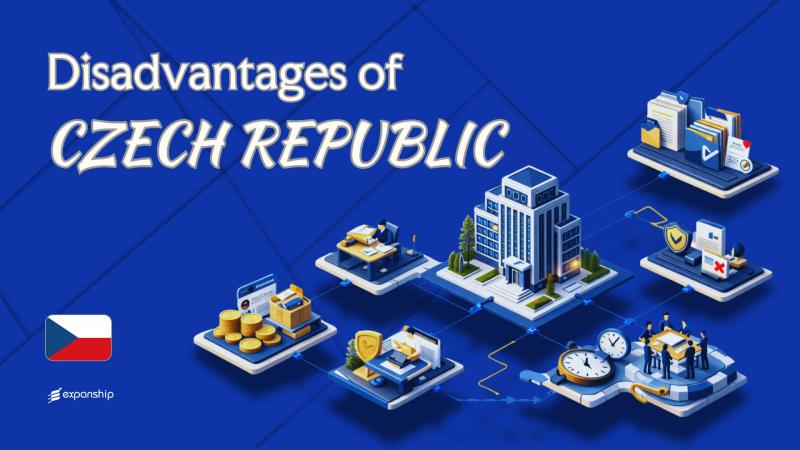
The disadvantages of incorporating in Czechia span administrative, financial, linguistic, and labor-related categories. Not all of these will affect every business equally — the drawbacks of Czech company formation tend to be more pronounced for small foreign-owned firms than for large multinationals with dedicated legal and compliance resources.
This article is most relevant to non-EU founders, foreign sole shareholders, and international SMEs considering the cons of registering a business in Czech Republic without an established local presence or legal team.
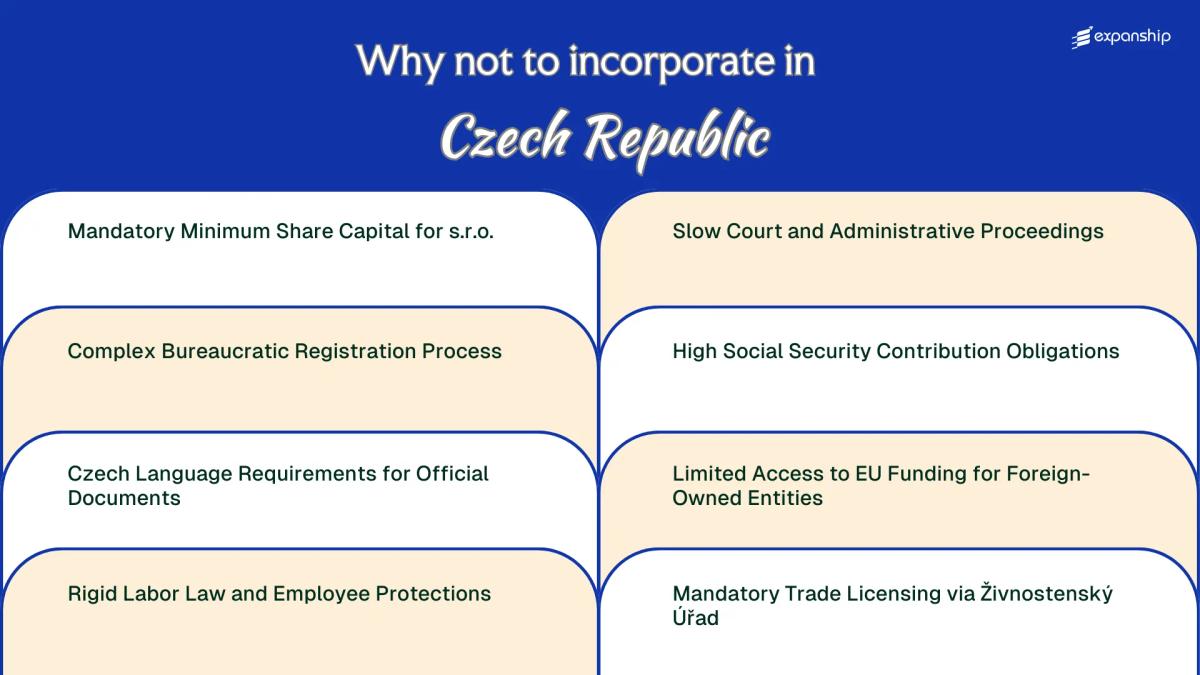
Mandatory Minimum Share Capital for s.r.o.
Czech s.r.o. share capital requirements changed significantly in 2014, dropping the minimum contribution to just CZK 1 per shareholder under the amended Zákon o obchodních korporacích (Act No. 90/2012 Coll.). On paper, this appears permissive, but the practical consequences for foreign-owned entities are less straightforward.
Undercapitalization Risk and Creditor Perception
A CZK 1 minimum share capital carries almost no creditor protection, which means Czech banks, suppliers, and institutional counterparties routinely demand additional security before extending credit or entering contracts. Your firm may be legally compliant yet commercially disadvantaged from the moment it begins operating.
Banking and Contractual Barriers for Foreign Entities
Czech banks assess minimum capital restrictions when opening a business account, and a nominally capitalized s.r.o. owned by foreign nationals faces heightened scrutiny under AML due diligence requirements. The gap between the statutory floor and what the market actually requires forces many foreign founders to inject capital well above the legal threshold, increasing the real cost of s.r.o. incorporation capital without any corresponding regulatory obligation.
Foreign-owned s.r.o. entities with minimal share capital frequently encounter account opening refusals or prolonged verification periods at Czech banking institutions, delaying operational readiness by weeks or months.
Complex Bureaucratic Registration Process
Czech company registration bureaucracy problems begin before you file a single document. Establishing a společnost s ručením omezeným (s.r.o.) requires coordinating across multiple state bodies, and the sequence is strictly ordered, meaning a delay at one stage blocks progress at the next.
The process typically involves the following friction points for a foreign business owner:
- Notarized articles of association must be prepared by a Czech notary, creating a mandatory local dependency that adds both cost and scheduling delays for founders based abroad.
- A trade license from the Živnostenský úřad must be secured before court registration, so any rejection or correction request extends your timeline before the entity is even legally formed.
- Registration through the Czech court-administered Commercial Register (Obchodní rejstřík) introduces a judicial bottleneck, with statutory processing windows that can stretch several weeks.
- Foreign founders must obtain a Czech identification number and often a local address, requiring additional administrative steps with no equivalent in many EU member states.
The complex business registration process in Czech Republic does not offer a single-window submission system. Each authority operates independently, and your application cannot advance in parallel across bodies.

Company Incorporation in Czech Republic
Set up your Czech s.r.o. with full administrative support across the Živnostenský úřad, notarial process, and Commercial Register registration.
Czech Language Requirements for Official Documents
Czech language requirements for business documents apply broadly under Czech law, and for foreign-owned companies, this creates a persistent operational cost that begins at registration and does not diminish over time.
All founding documents, including the memorandum of association (společenská smlouva), must be executed in Czech. Notarial deeds required for s.r.o. formation carry this requirement by default, meaning foreign-language drafts have no legal standing until formally translated.
| Document Type | Czech Language Requirement | Cost Implication for Foreign Firms |
|---|---|---|
| Memorandum of Association | Mandatory in Czech | Sworn translation required for each foreign-language source version |
| Notarial Deeds | Must be executed in Czech | Notary fees apply separately from translation costs |
| Court and Registry Filings | Czech only accepted by Obchodní rejstřík | Re-submission required if non-compliant |
| Annual Financial Statements | Czech language required for statutory filing | External accountant or translator typically needed |
| Employment Contracts | Czech version legally prevails in disputes | Bilingual contracts do not remove Czech-language obligation |
Official document language restrictions extend into ongoing compliance. Annual accounts filed with the Obchodní rejstřík must meet Czech language standards, and any discrepancy between a Czech and foreign-language version of a contract typically leaves the Czech text controlling under local legal practice.
For foreign directors or shareholders who do not speak Czech, every formal interaction with public authorities requires a certified interpreter or sworn translator (soudní tlumočník). This adds recurring cost to routine administrative tasks that would carry no equivalent expense in jurisdictions that accept English-language filings.
Rigid Labor Law and Employee Protections
Czech labor law restrictions for employers are embedded directly in the zákoník práce (Labour Code, Act No. 262/2006 Coll.), which sets binding floors on termination procedures, notice periods, and severance entitlements that leave little room for contractual deviation.
Dismissals require one of the exhaustively listed grounds under Section 52 of the Labour Code. If your stated reason falls outside this closed list, the termination is legally invalid regardless of the underlying circumstances.
Notice periods run for a minimum of two months, and severance pay kicks in at one to three monthly salaries depending on length of service. For a foreign firm attempting to restructure or exit a market quickly, these obligations translate directly into locked-in payroll costs.
Fixed-term contracts cannot be renewed more than twice and cannot exceed three years in total under the Labour Code. That structural ceiling forces employers into open-ended contracts earlier than they may find commercially viable.
- Minimum two-month statutory notice period applies regardless of what the employment contract states
- Dismissal grounds are restricted to those enumerated in Section 52; no contractual expansion is permitted
- Fixed-term contracts are capped at three years total with a maximum of two renewals
- Severance obligations under Section 67 are triggered automatically based on tenure, not negotiated on exit
- Collective redundancy rules under Act No. 435/2004 Coll. impose mandatory notification to the Labour Office
Even a probationary period dismissal in Czechia, typically considered low-risk, cannot occur during the first three days of an employee's sickness absence.
Slow Court and Administrative Proceedings
Slow court and administrative proceedings represent a tangible operational risk for foreign businesses, with slow court proceedings in the Czech Republic consistently cited as a structural limitation by international investors.
Institutional Backlog and Timeline Reality
Czech civil courts, operating under the jurisdiction of the Ministry of Justice, carry persistent case backlogs that can extend commercial dispute resolution to several years. For a foreign business waiting on contract enforcement or debt recovery, that timeline directly affects cash flow and operational certainty.
Administrative proceedings before bodies such as the trade licensing office (Živnostenský úřad) or the Commercial Register court (Krajský soud) can also exceed statutory response windows during high-volume periods. Delays in registration updates or license approvals translate into deferred operational start dates and missed market entry windows.
Consequences for Foreign Business Operations
Czech administrative process delays affect companies at multiple stages, from initial incorporation through ongoing compliance filings. A dispute that might resolve within months in jurisdictions with dedicated commercial courts can remain unresolved long enough to destabilize a smaller foreign entity entirely.
The Czech Republic does have arbitration mechanisms available under Act No. 216/1994 Coll., which some commercial parties use to bypass state court timelines, though this option depends on contractual agreement between parties before a dispute arises.
Legal and Administrative Navigation Support in Czechia
Get structured guidance on managing court timelines, administrative filings, and compliance processes when establishing or operating a business entity in the Czech Republic.
High Social Security Contribution Obligations
Czech social security contribution obligations create one of the higher payroll cost burdens in the Central European region, with combined employer and employee rates that significantly inflate the total cost of each hire.
- Employers are required to contribute 24.8% of gross wages toward social insurance under Czech law, covering pension, sickness, and unemployment schemes administered by the Czech Social Security Administration (ČSSZ).
- The employee-side contribution adds a further 7.1% of gross wages, meaning the total statutory deduction from a single salary can reach nearly 32% before income tax is applied.
- For foreign-owned firms accustomed to lower payroll tax burden structures elsewhere in the EU, this rate compresses hiring budgets and raises the break-even cost per employee.
- Contributions are calculated on gross wages with no startup-phase exemption for newly registered entities, so the obligation applies from the first payroll cycle.
- The high social insurance drawback is compounded for Czech employer structures that rely on multiple locally contracted staff rather than self-employed contractors.
Limited Access to EU Funding for Foreign-Owned Entities
EU funding restrictions on foreign-owned Czech companies stem from eligibility rules embedded in both EU structural fund regulations and national program conditions. Many grant schemes administered through the Czech operational programs under the 2021–2027 programming period attach ownership and control criteria that systematically disadvantage non-EU-headquartered entities.
Under programs managed by the Czech Ministry of Industry and Trade and CzechInvest, grant eligibility often requires that the applying entity demonstrate genuine economic ties or that ultimate ownership remains within the EU. A company incorporated as a Czech s.r.o. but ultimately controlled by a non-EU parent can find itself disqualified or assessed at a lower priority tier.
Even where foreign-owned firms technically qualify, scoring frameworks for competitive grant calls frequently award points for local economic embeddedness. This means your application competes at a structural disadvantage against domestically anchored businesses, regardless of the investment size or job creation potential of your project.
Hypothetical scenario: A non-EU-owned Czech s.r.o. applies for a CZK 4,000,000 digitalization grant under Operační Program Technologie a aplikace pro konkurenceschopnost (OP TAK). The ownership criterion reduces its scoring benchmark by 15 points relative to a domestically owned competitor, placing it below the funding threshold without any change to the underlying project merit.
Mandatory Trade Licensing via Živnostenský Úřad
Operating most business activities in Czechia requires obtaining a živnostenský list (trade license) through the Živnostenský Úřad (Trade Licensing Office). This is not a formality — it is a legal prerequisite. Conducting regulated activities without the appropriate license exposes a company to administrative penalties and potential suspension of operations.
Trade activities under the Živnostenský zákon (Trade Licensing Act, Act No. 455/1991 Coll.) are divided into free, craft, and regulated categories. Craft and regulated trades require documented professional qualifications, and for foreign nationals, these credentials must often be recognized through a separate Czech or EU equivalency process. This adds both time and cost before your business can legally operate.
Foreign directors or responsible representatives who lack recognized Czech or EU qualifications must appoint a locally qualified "responsible person" (odpovědný zástupce) to satisfy the licensing conditions. This creates a structural dependency on a third party that has no parallel in many other EU member states.
- Živnostenský Úřad trade license restrictions apply per activity type, meaning a single entity conducting multiple regulated trades must obtain and maintain separate licenses for each, multiplying the compliance burden accordingly.
If your appointed odpovědný zástupce resigns or becomes unavailable, your trade license may be suspended until a qualified replacement is formally registered with the Živnostenský Úřad.
Overcoming Czech Incorporation Challenges
Overcoming Czech incorporation challenges requires structural preparation rather than reactive problem-solving. Foreign founders who map compliance obligations before entity formation face fewer procedural delays.
- Register your s.r.o. with a minimum share capital of CZK 1 per shareholder, confirming deposit requirements with your appointed bank before filing with the Commercial Register.
- Obtain the appropriate trade licence from the Živnostenský úřad prior to commencing operations, identifying whether your activity falls under free, regulated, or licensed categories.
- Prepare all founding documents in Czech, using a certified translator and notarised apostille where cross-border authentication is required.
- Account for employer-side social security contributions of approximately 33.8% of gross salary when modelling total workforce costs.
- Engage a Czech-domiciled data box (datová schránka) for mandatory electronic communication with public authorities.
- Verify eligibility criteria for any EU structural fund programmes administered through Czech national authorities before committing to funding assumptions.
Czech administrative law distributes regulatory authority across multiple bodies, including trade licensing offices, the Commercial Register court, and the Czech Social Security Administration. Meeting each body's distinct requirements forms the baseline of compliant incorporation.
Czechia's Value as a Business Destination
Acknowledged the disadvantages this blog has covered, the Czech Republic business destination case still holds up under scrutiny for foreign investors who enter with accurate expectations. EU membership, a central European location, and a developed industrial base are structural facts, not incidental benefits. Weighing cons of incorporating in Czechia against those foundations produces a more grounded picture than either the drawbacks or the advantages alone can offer.
| Consideration | Drawback |
|---|---|
| EU market access and stable legal framework | Mandatory s.r.o. share capital of CZK 1 (though practical banking requirements raise the effective threshold) |
| Corporate income tax rate of 21%, consistent with regional norms | High social security contributions apply to both employer and employee, adding payroll cost |
| Skilled, educated workforce in manufacturing and tech sectors | Rigid Labor Code protections limit contract flexibility and complicate terminations |
| Prague's established position as a Central European financial hub | Court and administrative proceedings frequently extend timelines beyond projected schedules |
| Access to EU single market for goods and services | Foreign-owned entities face eligibility restrictions on certain EU structural and cohesion funds |
Czech Republic foreign investment limitations and benefits sit side by side rather than canceling each other out.
Compliance Services for Companies in Czechia
Maintaining a legally compliant entity in Czechia involves ongoing obligations under the Business Corporations Act, trade licensing rules, and Czech tax and labor law. This service covers the regulatory requirements your Czech entity must meet after incorporation.
Conclusion
The risks of incorporating in Czech Republic are real and documented. As a Central European EU member state with an established commercial framework, the country offers genuine market access, yet the structural friction involved in doing business here is not incidental. Social security contribution rates that burden both employer and employee payrolls, combined with a registration process that threads through the Commercial Register, notarial requirements, and the Živnostenský úřad, create compounding administrative obligations. Language requirements for official documentation add a further layer for foreign directors. Specialist guidance specific to Czech corporate and regulatory conditions will determine how efficiently your entity moves from registration to operation.
Expanship's Czech Republic Expansion Services
From the Živnostenský úřad trade licensing requirements to the high social security contribution rates and Czech-language document obligations, incorporating in Czechia brings a specific set of administrative and compliance demands that can slow your market entry. Expanship's Czech Republic company expansion services are structured to reduce the operational weight of these requirements on your team, handling the local process work while you focus on business operations.
Beyond initial registration, Expanship supports your firm across the full incorporation and post-incorporation cycle:
- Preparing and filing company registration documents with the Czech Commercial Register
- Providing a registered agent and local office address for your entity
- Liaising directly with government bodies, including the Živnostenský úřad and tax authorities
- Managing ongoing compliance obligations after your business is established
- Facilitating introductions to Czech banking institutions to support account opening
- Handling tax registration and coordination with the Finanční správa
To discuss how Expanship can support your Czech expansion, contact Expanship Czechia.
Frequently Asked Questions (FAQ)
The Commercial Register (Obchodní rejstřík) will reject submissions that do not meet Czech language requirements, which delays registration and restarts procedural timelines. Under Czech law, all founding documents, notarially certified deeds, and regulatory filings must be in Czech or accompanied by a certified translation. Using uncertified translations does not satisfy the requirement, and the error cannot simply be corrected by resubmission without repeating notarization steps.
The trade licensing obligation through the Živnostenský Úřad applies to virtually all business activities conducted in Czechia, regardless of the owner's nationality. Free trades, craft trades, and regulated trades each carry different qualification and documentation thresholds, and foreign nationals may face additional requirements to demonstrate equivalent professional qualifications from their home country. There is no blanket exemption for EU citizens or foreign-owned entities.
Employer-side contributions to the Czech social insurance system currently total approximately 33.8% of gross salary — 24.8% for social security and 9% for health insurance. This is on top of the employee's own contributions of around 11%, making total payroll costs substantially higher than the gross salary figure alone. For businesses planning to hire locally, this overhead significantly affects budget projections.
Czech civil and commercial court proceedings are widely regarded as among the slower in Central Europe, with first-instance commercial disputes often taking one to three years to resolve. The European Commission's EU Justice Scoreboard has repeatedly ranked Czechia below the EU average for the time required to resolve litigious civil and commercial cases. For foreign businesses dependent on contract enforcement or dispute resolution, this is a material operational risk.
Terminating an employee without following the procedures set out in the Czech Labour Code (Act No. 262/2006 Coll.) can result in the termination being declared invalid by a court, obligating the employer to continue paying the employee's salary for the duration of the dispute. Courts can also order reinstatement, which is particularly costly if the proceedings extend over months. There is no cap on the salary compensation owed during an invalidated termination period.
Access to EU Structural and Investment Funds administered through Czech operational programmes is often restricted by ownership and control criteria set at the programme level, not solely by the entity's Czech registration. Several programmes under the Czech national framework explicitly limit eligibility to entities without majority foreign ownership or require that decision-making and economic activity remain substantially in Czechia. A Czech registration alone does not guarantee equal access to these funding streams.
Legal Disclaimer
The information provided in this article is for general informational purposes only and does not constitute legal, tax, or professional advice. While we strive to ensure the accuracy and timeliness of the content, laws and regulations are subject to change, and the application of laws can vary widely based on specific facts and circumstances.
Readers should not act upon this information without seeking professional counsel tailored to their individual situation. Expanship and its authors disclaim any liability for actions taken or not taken based on the content of this article.
For specific advice regarding your business setup, compliance requirements, or any legal matters, please consult with qualified legal and tax professionals in the relevant jurisdiction.